
⚡ Executive Summary: The 2026 PMI Deduction Restoration
- OBBBA Section 70108 permanently restores the mortgage insurance deduction starting January 1, 2026.
- The deduction phases out rapidly for taxpayers with an Adjusted Gross Income (AGI) between $100,000 and $110,000.
- You must itemize on Schedule A to claim this benefit; standard deduction filers do not qualify.
- Eligible policies include conventional PMI, FHA MIP, VA funding fees, and USDA guarantee fees for contracts issued after 2006.
Table of Contents
- Section 70108 of OBBBA – Is Private Mortgage Insurance Deductible in 2026?
- Which Mortgage Insurance Premiums Qualify? (PMI, FHA MIP, VA, USDA)
- The AGI Phase-Out Trap ($100,000–$110,000 Limit)
- How to Claim PMI on Taxes: Form 1098 Box 5 & Schedule A
- Mortgage Interest Deduction Rules & The $750,000 Debt Cap
- Upfront vs. Monthly Premiums: How the Math Changes
- State vs. Federal Tax Treatment of PMI
- Frequently Asked Questions About the Mortgage Insurance Deduction
Section 70108 of OBBBA – Is Private Mortgage Insurance Deductible in 2026?
Homeowners have spent the last few years asking a simple question: is private mortgage insurance deductible? For a long time, the answer was a frustrating no. Congress let the tax break expire at the end of 2021, leaving buyers who purchased property between 2022 and 2025 with zero federal tax benefit for the extra monthly fee tacked onto their loans.
But the rules have officially changed. Under Section 70108 of the Omnibus Budget Reconciliation Act (OBBBA), the answer to whether is private mortgage insurance deductible is finally yes again, starting January 1, 2026. This legislation permanently restores the write-off, meaning you no longer have to wait for last-minute congressional extenders to know if you can claim your premiums.
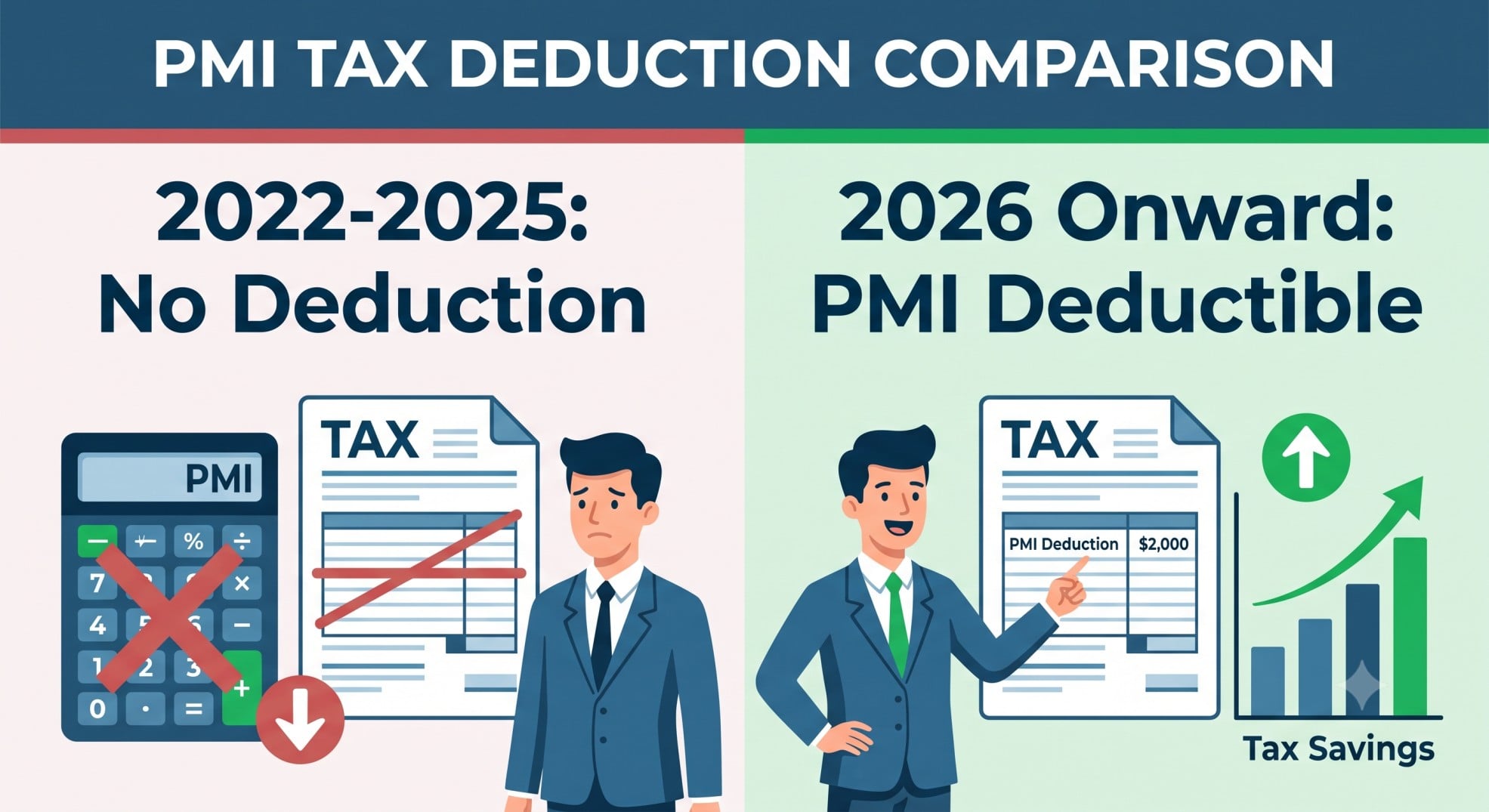
People often wonder, is mortgage insurance premium tax deductible for all homeowners? The short answer is that it depends heavily on your income and how you file your return. You must itemize your deductions to take advantage of this rule. Taking the standard deduction means you leave this specific benefit on the table. If you put less than 20% down and you pay PMI, this is a brand-new line item to add to your itemized deductions starting with your 2026 return.
Taxpayers looking for a PMI tax deduction for 2026 will find that the IRS treats these payments as qualified residence interest. This means the premiums are grouped together with your standard mortgage interest, subject to similar caps and restrictions. So, is PMI tax deductible in 2026? Yes, but you have to navigate the specific eligibility requirements first.
Which Mortgage Insurance Premiums Qualify? (PMI, FHA MIP, VA, USDA)
Not all home loans use the exact same terminology for their insurance requirements. You might pay conventional PMI, or you might pay a government-backed fee. So, are mortgage insurance premiums deductible across the board? Yes, provided the contract was issued after 2006 and the loan is for your primary residence or a qualified second home.
Let’s look at the specific types of policies that generate a qualified mortgage insurance premium. The IRS recognizes four main categories of coverage.
| Loan Type | Insurance Name | Deductible in 2026? |
|---|---|---|
| Conventional | Private Mortgage Insurance (PMI) | Yes |
| FHA | Mortgage Insurance Premium (MIP) | Yes |
| VA | VA Funding Fee | Yes |
| USDA | USDA Guarantee Fee | Yes |
Conventional loans require standard Private Mortgage Insurance (PMI) when you put down less than 20%. This is the most common type of policy, and it is fully eligible. If you have an FHA loan, you pay a Mortgage Insurance Premium. Is MIP tax deductible? Absolutely. The IRS treats FHA MIP exactly the same as conventional PMI for tax purposes.
Veterans using a VA loan do not pay monthly mortgage insurance, but they do pay an upfront VA Funding Fee. This fee is considered a qualified mortgage insurance premium and can be deducted. Similarly, rural buyers using a USDA loan pay a USDA Guarantee Fee, which also qualifies under the reinstated rules.
Every single one of these programs counts as a valid write-off. If you are wondering if your specific policy qualifies, ask yourself: is pmi mortgage insurance tax deductible if it protects the lender? The answer is yes, as long as it meets the income and loan origination date requirements. Understanding the difference between these loan types can help you plan your tax strategy.
The AGI Phase-Out Trap ($100,000–$110,000 Limit)
This is where the math gets aggressive. The private mortgage insurance deduction is not a blanket write-off for high earners. The IRS enforces a strict phase-out based on your Adjusted Gross Income (AGI), which catches many taxpayers off guard.
If your AGI is $100,000 or less, you get the full deduction. Once your income crosses that line, the benefit disappears rapidly. The deduction drops by 10% for every $1,000 you earn over the limit. By the time your AGI hits $110,000, the deduction is gone entirely.

Married couples filing separately face an even tighter window. Their threshold starts at $50,000, and the deduction phases out completely at $55,000. They lose 10% of the deduction for every $500 over the limit. If you are asking, can I deduct PMI on my taxes with a six-figure salary? You have to run the numbers carefully.
Hypothetical Scenario: The Single Filer Phase-Out
David is a single taxpayer who bought a house in Texas. His AGI for the year is $104,000. He paid $2,000 in conventional PMI.
- Step 1: Calculate the excess income. $104,000 – $100,000 = $4,000.
- Step 2: Determine the reduction percentage. The rule dictates a 10% drop for every $1,000 over the limit. $4,000 / $1,000 = 4. Multiply 4 by 10% to get a 40% reduction.
- Step 3: Apply the reduction to the premium. 40% of $2,000 is $800.
- Step 4: Calculate the final deduction. $2,000 – $800 = $1,200.
David can legally claim $1,200 on his tax return.
Many taxpayers assume they make too much money to qualify. However, if your AGI sits at $108,000, you still get to deduct 20% of your premiums. It is always worth calculating the exact phase-out before abandoning the write-off. Knowing exactly how is private mortgage insurance deductible at various income levels prevents you from leaving money behind.
Hypothetical Scenario: Married Filing Separately
Sarah and John are married but file separate returns. Sarah claims the house. Her AGI is $53,000, and she paid $1,500 in PMI.
- Step 1: Calculate the excess income. $53,000 – $50,000 = $3,000.
- Step 2: Determine the reduction percentage. For MFS, the drop is 10% for every $500 over the limit. $3,000 / $500 = 6. Multiply 6 by 10% to get a 60% reduction.
- Step 3: Apply the reduction. 60% of $1,500 is $900.
- Step 4: Calculate the final deduction. $1,500 – $900 = $600.
Sarah can deduct $600 on her separate return.
How to Claim PMI on Taxes: Form 1098 Box 5 & Schedule A
Filing the paperwork correctly is the only way to get your money back. You might be asking, what is mortgage insurance premiums on Form 1098? Your loan servicer will send you IRS Form 1098 early in the year. Look directly at Box 5. This box contains the exact dollar amount you paid in premiums for the year.
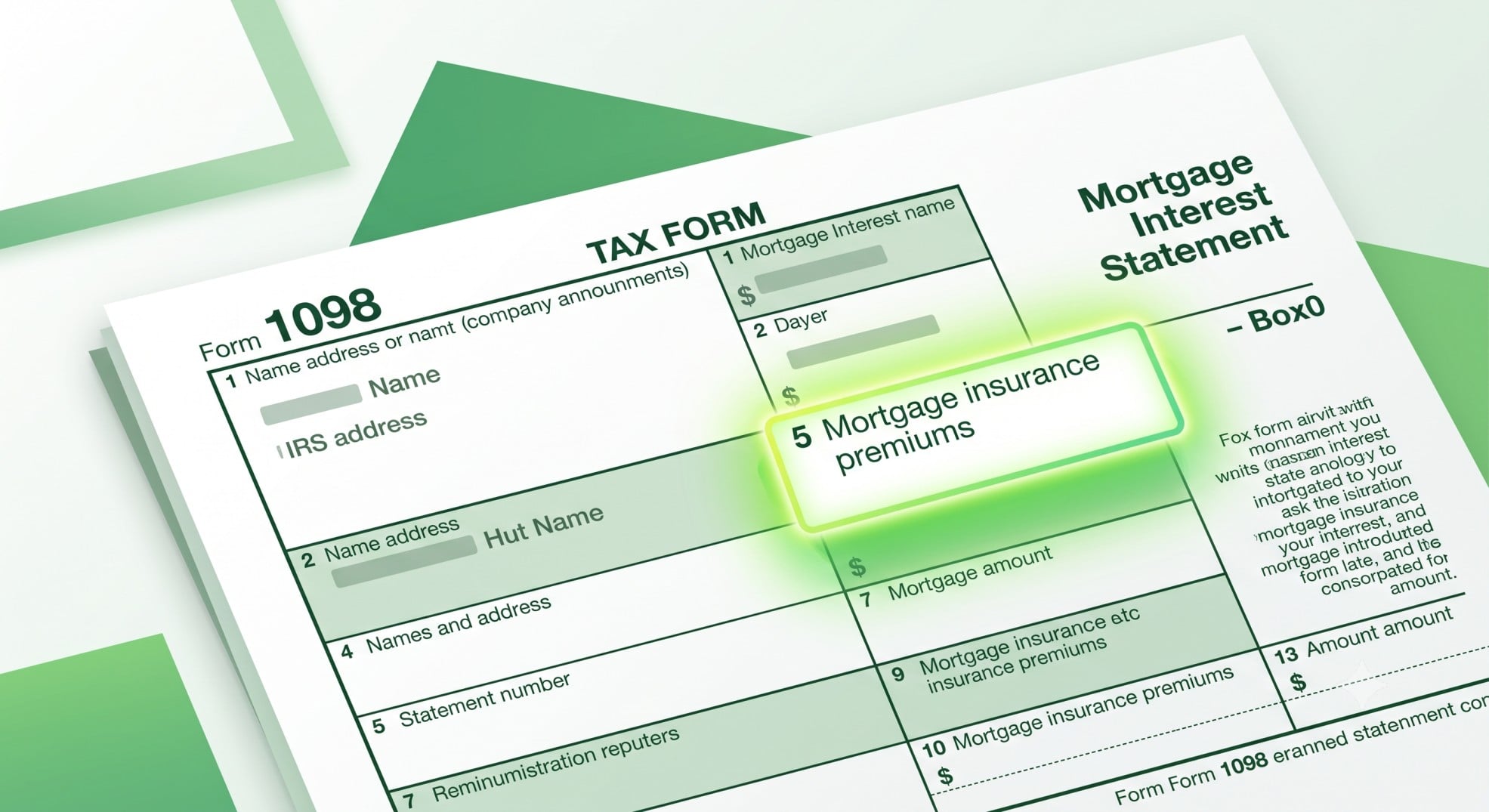
Are mortgage insurance premiums deductible on Schedule A? Yes. You cannot claim this deduction if you take the standard deduction. You must itemize. You will transfer the amount from Box 5 directly to Schedule A, line 8d (or the designated line for the 2026 tax year), right alongside your mortgage interest.
Can I deduct mortgage insurance premium payments if my lender didn’t send a form? Usually, lenders are required to send Form 1098 if your interest and PMI exceed $600 for the year. If you paid less than that, you can still claim the deduction by pulling the exact figures from your year-end mortgage statement.
Taxpayers often wonder, can you deduct mortgage insurance premiums if you prepay them? The IRS is very strict about prepaid premiums. You can only deduct the portion of the premium that applies to the current tax year. If you prepaid your 2027 premiums in December 2026, you must allocate those costs to the correct year. You cannot front-load the deduction to artificially inflate your itemized expenses.
Historically, the average value of this write-off is roughly $2,364 per qualifying homeowner. That makes the mortgage insurance tax deductible status a highly valuable tool for middle-class families trying to lower their tax liability. Learning how to optimize your Schedule A is critical for maximizing your refund.
Mortgage Interest Deduction Rules & The $750,000 Debt Cap
The restored deduction does not exist in a vacuum. It is tied directly to the rules governing mortgage interest. Under current law, you can only deduct interest and insurance premiums on the first $750,000 of acquisition indebtedness ($375,000 if married filing separately).
Older loans get better treatment. If you took out your mortgage before December 16, 2017, you keep a grandfathered limit of $1,000,000 ($500,000 if married filing separately). If your loan exceeds these caps, you must prorate your deduction. You cannot claim 100% of your PMI if your loan balance is over the legal limit.
Is pmi insurance tax deductible if my loan is $900,000? Yes, but only partially. You have to calculate the ratio of the deductible debt limit to your actual loan balance. This prorated approach ensures that high-net-worth individuals do not get an unlimited mortgage insurance tax write off for luxury properties.
Hypothetical Scenario: Prorating the $750,000 Cap
Marcus and Elena bought a home in 2026 with an $850,000 mortgage. They put down 10% and pay $3,000 annually in PMI. Their AGI is $90,000, so they face no income phase-out.
- Step 1: Identify the debt limit. The cap is $750,000.
- Step 2: Calculate the deductible ratio. $750,000 / $850,000 = 0.8823 (88.23%).
- Step 3: Apply the ratio to the PMI paid. $3,000 * 88.23% = $2,647.
Marcus and Elena can deduct $2,647 of their PMI on Schedule A.
This cap applies to the combined balance of your main home and one qualified second home. It is not a per-loan limit. You must aggregate your acquisition debt to determine if you cross the $750,000 threshold before asking is private mortgage insurance deductible for your specific situation.
Upfront vs. Monthly Premiums: How the Math Changes
Most homeowners pay their premiums monthly, rolled into their standard mortgage payment. Some buyers choose to pay their insurance upfront at closing to lower their monthly overhead. How does the IRS handle these lump-sum payments?
If you pay conventional PMI or FHA MIP upfront, you generally cannot deduct the entire lump sum in the year you bought the house. The IRS requires you to allocate the upfront payment over the shorter of two periods: 84 months (7 years) or the actual life of the loan. You divide the lump sum by 84 and deduct that specific fraction each year.
Hypothetical Scenario: Upfront VA Funding Fee
There is one major exception to the 84-month allocation rule: the VA Funding Fee and the USDA Guarantee Fee. The IRS allows you to deduct these specific government fees in full in the year they are paid, provided you meet the income requirements.
James, a veteran, buys a home in 2026. He rolls a $5,000 VA Funding Fee into his loan. His AGI is $85,000. Because it is a VA loan, James can deduct the entire $5,000 on his 2026 tax return, rather than spreading it out over 7 years.
Understanding the difference between monthly and upfront payments is essential. If you are asking are mortgage insurance premiums deductible when paid at closing, you must identify the exact type of loan you have before claiming the write-off.
State vs. Federal Tax Treatment of PMI
Federal tax law dictates your IRS return, but your state department of revenue sets its own rules. Is pmi tax deductible at the state level? It depends entirely on your zip code and how your state handles federal tax conformity.
Some states automatically adopt federal tax changes. In these rolling conformity states, the reinstatement of OBBBA Section 70108 means your state itemized deductions will automatically include your PMI. Other states use static conformity, meaning they only adopt the federal tax code as it existed on a specific past date. If your state has not updated its conformity date to include the 2026 changes, you might get the federal deduction but lose the state deduction.
A few states do not allow itemized deductions at all, or they completely decouple from the federal mortgage interest rules. You need to check your specific state’s tax instructions for 2026 to confirm if the local government recognizes the restored benefit. Reviewing state-specific tax brackets can provide more context on your local filing requirements.
Frequently Asked Questions About the Mortgage Insurance Deduction
Is private mortgage insurance deductible?
Yes. Starting January 1, 2026, OBBBA Section 70108 permanently restores the deduction for private mortgage insurance. You can claim it as qualified residence interest on Schedule A, provided your Adjusted Gross Income falls within the allowable limits.
Is mortgage insurance premium tax deductible if I take the standard deduction?
No. You must itemize your deductions on Schedule A to claim this benefit. If your total itemized deductions (including mortgage interest, state taxes, and charitable gifts) do not exceed the standard deduction for your filing status, you will not benefit from this write-off.
Is pmi tax deductible for a rental property?
Yes, but under entirely different rules. For a rental property, PMI is deducted as a standard business expense on Schedule E, not as qualified residence interest on Schedule A. The $100,000 AGI phase-out does not apply to rental property business expenses.
Are mortgage insurance premiums deductible if I refinance my home?
Yes, but only the premiums paid on the remaining balance of your original acquisition debt. If you do a cash-out refinance and use the extra money to pay off credit cards, the PMI associated with that extra non-acquisition debt is not deductible.
Is mip tax deductible for FHA loans?
Yes. The IRS treats the Mortgage Insurance Premium (MIP) required for FHA loans exactly the same as conventional PMI. You can deduct your monthly MIP payments subject to the standard AGI phase-outs and debt caps.
Can I deduct PMI on my taxes if my AGI is $115,000?
No. The deduction completely phases out once your Adjusted Gross Income reaches $110,000 ($55,000 if married filing separately). If your AGI is $115,000, your allowable deduction is reduced to zero.
Is mortgage premium insurance tax deductible for a second home?
Yes. The IRS allows you to deduct qualified residence interest, including PMI, on your primary residence and one qualified second home. However, the combined mortgage balances of both homes cannot exceed the $750,000 acquisition debt limit.
Are mortgage insurance premiums tax deductible for a loan from 2005?
No. The tax code specifically states that the mortgage insurance contract must have been issued after December 31, 2006. If you have an older loan that has never been refinanced, those premiums do not qualify.
Is pmi mortgage insurance tax deductible if I pay it as a lump sum at closing?
Yes, but you generally cannot deduct the entire amount in the first year. For conventional PMI and FHA MIP, you must allocate the upfront payment over 84 months or the life of the loan, whichever is shorter. VA and USDA upfront fees are the exception and can be deducted in full in the year paid.
Can you write off mortgage insurance on a home equity line of credit (HELOC)?
Only if the HELOC funds were used to buy, build, or substantially improve the home securing the loan. If you used the HELOC to buy a car or pay for college, the interest and any associated insurance premiums are not deductible.
Disclaimer: This content provides general information for educational purposes only. Tax laws are complex and change often. It is not professional tax, legal, or financial advice. Always consult a qualified tax professional for personalized guidance regarding your specific situation. Ourtaxpartner.com is not responsible for any actions taken based on the information provided herein.
