
⚡ Executive Summary: Schedule A Changes for 2026
- The 2026 tax year introduces a massive shift as the Tax Cuts and Jobs Act (TCJA) provisions expire, lowering the standard deduction and making Schedule A highly relevant again.
- The $10,000 cap on state and local taxes (SALT) sunsets, allowing homeowners in high-tax states to deduct their full property and state income taxes.
- The mortgage interest deduction limit reverts from $750,000 back to $1 million for acquisition indebtedness.
- Strategic “bunching” of medical expenses and charitable contributions is the most effective method to clear the standard deduction hurdle.
Table of Contents
- The 2026 Landscape: Standard Deduction vs Itemized Deductions
- The Big Four: How to Optimize Schedule A Categories
- The “Bunching” Strategy: A Masterclass in Tax Timing
- Common Mistakes: What Will Disqualify Your Deductions
- Your CPA Prep Checklist: Documents You Need
- Frequently Asked Questions About Schedule A
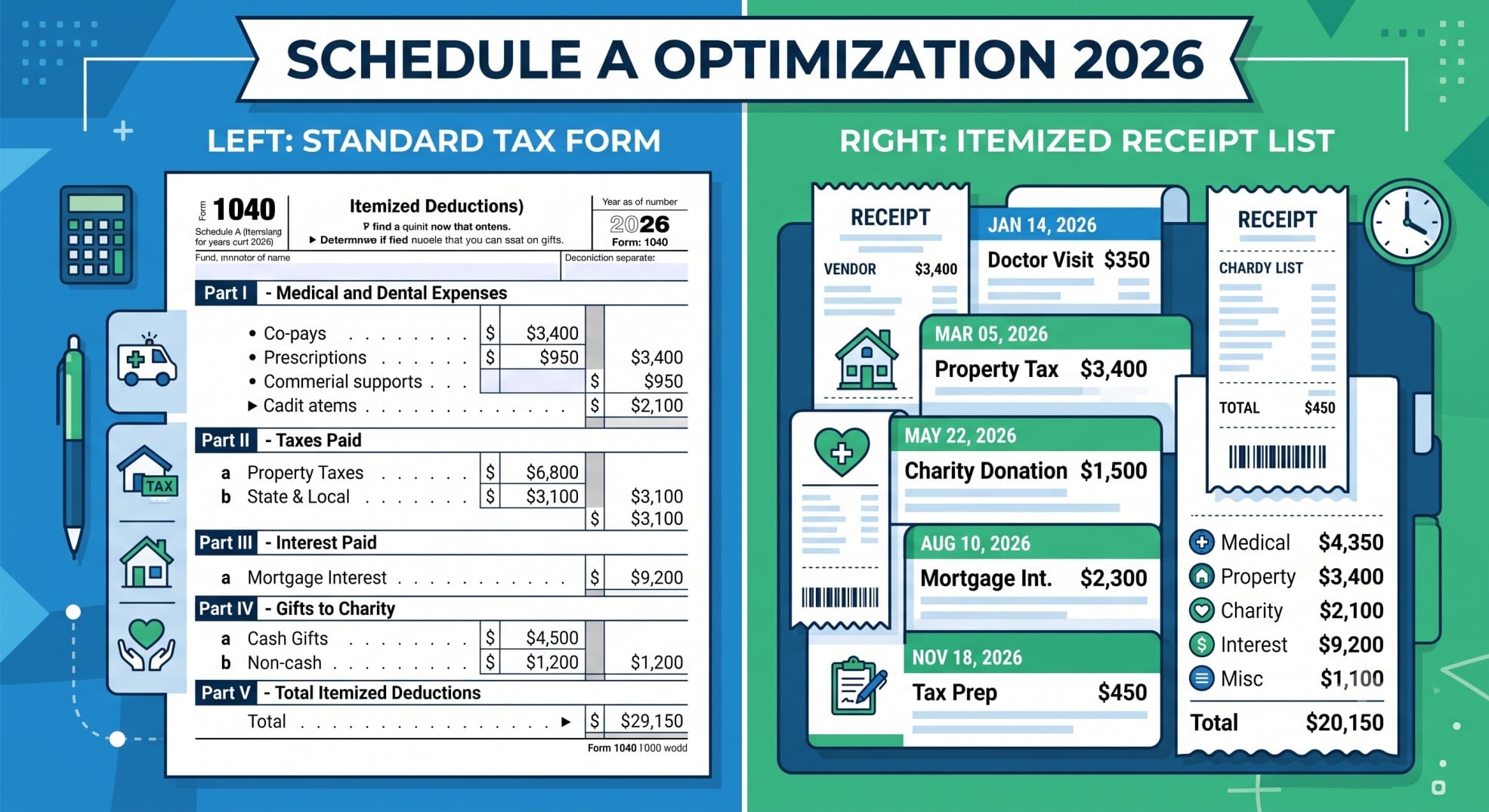
The 2026 Landscape: Standard Deduction vs Itemized Deductions
The math behind filing your taxes has fundamentally changed for 2026. For the past eight years, the vast majority of Americans simply took the standard deduction because it was artificially doubled by the Tax Cuts and Jobs Act (TCJA). Those provisions expired at the end of 2025. The standard deduction has now dropped back to historical norms, adjusted for inflation.
This legislative shift forces a massive recalculation for homeowners and high earners. The debate of standard deduction vs itemized deductions is no longer a quick afterthought. It requires active planning. If your total deductible expenses exceed the new, lower standard deduction threshold for your filing status, you must file Schedule A to claim the difference. Failing to do so means paying the IRS more than you legally owe.
Learning exactly how to optimize schedule a is the most direct way to protect your wealth this year. You cannot wait until April to figure this out. The expenses that qualify for itemization must be incurred before December 31st. By understanding the mechanics of the “Big Four” deduction categories, you can strategically time your payments to maximize itemized deductions and slash your taxable income.
The Big Four: How to Optimize Schedule A Categories
Schedule A is not a free-for-all. The IRS strictly limits what you can write off. To effectively maximize itemized deductions, you must focus your energy on the four primary categories that generate the largest write-offs. Small miscellaneous expenses rarely move the needle. Mortgages, taxes, healthcare, and philanthropy do.
1. Mortgage Interest and PMI
For most taxpayers, mortgage interest is the heavy lifter on Schedule A. With the sunset of the TCJA, the limit on deductible mortgage debt has reverted. You can now deduct the interest paid on up to $1 million of acquisition indebtedness (debt used to buy, build, or substantially improve your home), up from the previous $750,000 limit.
This category also includes Private Mortgage Insurance (PMI) and points paid at closing. If you purchased a home this year and paid points to buy down your interest rate, those points are generally fully deductible in the year you paid them, provided they meet specific IRS criteria.
Hypothetical Scenario: The $1 Million Mortgage Rule
Mark and Lisa bought a primary residence in early 2026, taking out a $950,000 mortgage at a 6.5% interest rate. During their first year, they paid roughly $61,000 in mortgage interest.
Under the old 2025 rules, their deduction would have been capped based on a $750,000 loan limit, forcing them to prorate and lose a portion of their write-off. Because the 2026 rules allow interest deductions on up to $1 million of debt, Mark and Lisa can deduct the entire $61,000 on Schedule A. In their 32% tax bracket, this single deduction saves them $19,520 in federal income taxes.
2. State and Local Taxes (SALT)
The most controversial tax cap of the last decade is gone. From 2018 through 2025, taxpayers were strictly limited to deducting a maximum of $10,000 for combined state and local taxes. This punished residents of high-tax states like California, New York, and New Jersey.
For 2026, the SALT cap has expired. You can now deduct the full amount of your state income taxes (or state sales taxes) plus your local property taxes. When you calculate how to optimize schedule a, this category alone will likely push millions of homeowners over the standard deduction threshold.
Hypothetical Scenario: The Uncapped SALT Benefit
David lives in New Jersey. He pays $18,000 a year in local property taxes and has $12,000 withheld from his paychecks for state income taxes. His total state and local taxes are $30,000.
Last year, David lost $20,000 of this deduction to the $10,000 SALT cap. In 2026, he deducts the full $30,000 on Schedule A. This uncapped deduction completely changes his standard deduction vs itemized deductions calculation, making itemizing the obvious choice.
3. Charitable Contributions
Philanthropy offers the most flexible way to control your tax liability. You can deduct cash donations, non-cash property (like clothing or vehicles), and appreciated assets given to qualified 501(c)(3) organizations.
Donating appreciated stock is one of the most powerful tax maneuvers available. If you hold a stock for more than one year and it goes up in value, selling it triggers capital gains tax. If you donate those shares directly to a charity, you pay zero capital gains tax, and you get to deduct the full fair market value of the stock on Schedule A. This double-benefit is a cornerstone strategy for high-net-worth individuals looking to maximize itemized deductions.
Keep in mind that charitable contributions are subject to Adjusted Gross Income (AGI) limits. Generally, you can deduct cash contributions up to 60% of your AGI, and non-cash assets up to 30% of your AGI. Excess contributions carry forward to future tax years.
4. Medical and Dental Expenses
The IRS provides a safety net for taxpayers who suffer catastrophic health events, but the math is rigid. You can only deduct unreimbursed medical and dental expenses that exceed 7.5% of your Adjusted Gross Income.
This hurdle is steep. If your AGI is $100,000, your first $7,500 in medical expenses yields zero tax benefit. You only deduct the amount above that threshold. Eligible expenses include health insurance premiums (if paid with after-tax dollars), prescription drugs, copays, dental work, vision care, and travel expenses related to medical care.
Hypothetical Scenario: Clearing the Medical Hurdle
Rachel has an AGI of $80,000. Her 7.5% hurdle is $6,000. This year, she required out-of-pocket dental surgery and paid for expensive physical therapy, totaling $11,000 in unreimbursed medical costs.
Rachel cannot deduct the full $11,000. She subtracts her $6,000 hurdle from her total expenses. She gets to add the remaining $5,000 to her Schedule A. To properly figure out how to optimize schedule a, Rachel scheduled her physical therapy in November rather than January of the following year, ensuring all costs fell into the same tax year to clear the hurdle.
The “Bunching” Strategy: A Masterclass in Tax Timing
If your total deductible expenses sit just below the standard deduction threshold, you are in a tax dead zone. You get no benefit from your mortgage interest, your state taxes, or your charitable giving. The solution is a technique called “bunching.”
Bunching requires you to group multiple years’ worth of deductible expenses into a single calendar year. By doing this, you force your itemized deductions to spike massively in Year 1, allowing you to itemize. In Year 2 and Year 3, you intentionally keep your deductible expenses low and take the standard deduction.
This strategy is most commonly executed with charitable contributions and a Donor-Advised Fund (DAF). A DAF acts like a personal charitable savings account. You contribute a large lump sum into the fund and take the massive tax deduction immediately in that calendar year. Then, you advise the fund to grant the money out to your favorite charities slowly over the next several years.
You can also bunch medical expenses. If you need elective surgery, braces for your children, and new prescription glasses, do not spread them out over two years. Schedule and pay for all of them in the same calendar year to blast past the 7.5% AGI hurdle. This level of intentional timing is exactly how to optimize schedule a.
Common Mistakes: What Will Disqualify Your Deductions
The IRS scrutinizes Schedule A heavily. A single mistake can trigger an audit and the disallowance of your write-offs. When planning how to maximize itemized deductions, avoid these critical errors.
Deducting Non-Qualifying Home Equity Debt
You cannot deduct the interest on a Home Equity Line of Credit (HELOC) if you used the money to buy a car, pay off credit cards, or fund a vacation. The debt must be used exclusively to buy, build, or substantially improve the home securing the loan. If you use a HELOC to renovate your kitchen, the interest is deductible. If you use it to pay off student loans, it is not.
Donating to Unverified Organizations
GoFundMe campaigns for individuals, political campaigns, and foreign organizations do not qualify for charitable deductions. You can only deduct contributions made to qualified 501(c)(3) tax-exempt organizations. Always use the IRS Tax Exempt Organization Search (TEOS) tool to verify a charity’s status before making a large year-end gift.
Forgetting the Quid Pro Quo Rule
If you buy a $500 ticket to a charity gala, and the dinner provided is worth $150, you cannot deduct $500. You can only deduct the $350 difference. The charity is required to provide you with a written acknowledgment detailing the fair market value of the goods or services you received.
Guessing Non-Cash Donation Values
Dropping off bags of clothes at Goodwill yields a deduction, but you cannot simply guess they are worth $500. You must use fair market value (what a willing buyer would pay for the used items in their current condition). If you claim more than $500 in total non-cash contributions, you must file Form 8283. If you claim a single item worth more than $5,000, you must obtain a qualified written appraisal.
Your CPA Prep Checklist: Documents You Need
To successfully evaluate standard deduction vs itemized deductions, your tax professional needs hard evidence. Do not hand your CPA a shoebox of mixed receipts. Organize the following documents before your tax appointment.
| Deduction Category | Required Documents & Forms |
|---|---|
| Mortgage & Real Estate | Form 1098 from all lenders, Final Closing Disclosure (if purchased/refinanced this year), property tax bills. |
| State & Local Taxes | W-2s showing state withholding, estimated state tax payment receipts, vehicle registration (for state ad valorem taxes). |
| Charitable Giving | Written acknowledgment letters for gifts over $250, Form 1098-C (for vehicle donations), qualified appraisals for property over $5,000. |
| Medical Expenses | Itemized receipts from providers, mileage logs for medical travel, health insurance premium statements (post-tax only). |
Having these documents ready allows your CPA to quickly run the math and determine exactly how to optimize schedule a for your specific financial profile.
Frequently Asked Questions About Schedule A
What is the main difference between standard deduction vs itemized deductions?
The standard deduction is a flat, no-questions-asked dollar amount that reduces your taxable income based on your filing status. Itemized deductions require you to list out specific, IRS-approved expenses (like mortgage interest and state taxes) on Schedule A. You choose whichever option results in the larger tax write-off.
Can I switch between standard and itemized deductions each year?
Yes. You are not locked into one method. Taxpayers frequently alternate between the two depending on their expenses for that specific calendar year. This flexibility is what makes the bunching strategy so effective.
How do I know if I have enough expenses to itemize?
You must track your state and local taxes, mortgage interest, charitable contributions, and qualifying medical expenses. If the combined total of these four categories is higher than the standard deduction for your filing status, you should itemize.
Are out-of-pocket therapy costs deductible on Schedule A?
Yes, mental health therapy provided by a licensed psychologist or psychiatrist qualifies as a medical expense. However, it is still subject to the 7.5% AGI hurdle. You can only deduct the total medical costs that exceed that percentage of your income.
Can I deduct the time I volunteer for a charity?
No. The IRS strictly prohibits deducting the value of your time or services, regardless of your normal hourly billing rate. However, you can deduct out-of-pocket expenses directly related to volunteering, including the standard mileage rate for driving to and from the charity.
Is my home office deduction claimed on Schedule A?
No. If you are a W-2 employee, you cannot deduct home office expenses at all under current federal law. If you are self-employed or an independent contractor, you claim the home office deduction on Schedule C, not Schedule A.
What happens to my state and local taxes if I am subject to the AMT?
The Alternative Minimum Tax (AMT) operates under a parallel set of rules. If you trigger the AMT, state and local taxes are generally disallowed as a deduction. Your CPA will calculate your taxes under both the regular system and the AMT system, and you must pay whichever tax bill is higher.
Can I deduct closing costs when I buy a house?
Most closing costs are not deductible. Appraisal fees, title insurance, and recording fees cannot be written off on Schedule A. You can only deduct mortgage interest, property taxes paid at closing, and qualifying mortgage points.
How do Donor-Advised Funds help maximize itemized deductions?
A DAF allows you to make a massive charitable contribution in a single year, securing a massive tax deduction when you need it most. You can then distribute the funds to various charities over several years, separating the tax benefit from the actual charitable payout.
Does the expiration of the TCJA mean I will pay more taxes?
It depends entirely on your specific situation. While the standard deduction is lower and tax brackets may shift, the removal of the $10,000 SALT cap and the expansion of the mortgage interest limit will actually lower the tax burden for many homeowners who know how to optimize schedule a properly.
Disclaimer: This content provides general information for educational purposes only. Tax laws are complex and change often. It is not professional tax, legal, or financial advice. Always consult a qualified tax professional for personalized guidance regarding your specific situation. Ourtaxpartner.com is not responsible for any actions taken based on the information provided herein.
