
⚡ Executive Summary: Mortgage Tax Benefits for 2026
- The 2026 tax year brings major changes to homeownership deductions, making the difference between mortgage loan types more critical than ever for your tax strategy.
- The mortgage insurance premium tax deduction has been permanently restored, allowing taxpayers who itemize to write off conventional PMI, FHA MIP, and USDA guarantee fees.
- The VA funding fee is explicitly tax-deductible in 2026, offering a massive first-year write-off for eligible Veterans who finance or pay the fee in cash.
- With the expiration of the Tax Cuts and Jobs Act (TCJA) standard deduction limits, millions of homeowners will return to itemizing their taxes, unlocking first time home buyer tax deductions that were previously out of reach.
Table of Contents
- Why the Difference Between Mortgage Loan Types Matters
- Conventional Loans: PMI and Tax Deductibility
- FHA Loans: Upfront vs. Annual MIP Mechanics
- VA Loans: Zero Down and the VA Funding Fee
- USDA Loans: Rural Requirements and Guarantee Fees
- Summary Matrix: Comparing Loan Types
- Step-by-Step: Claiming Your Tax Benefits
- Frequently Asked Questions About Mortgage Loan Types
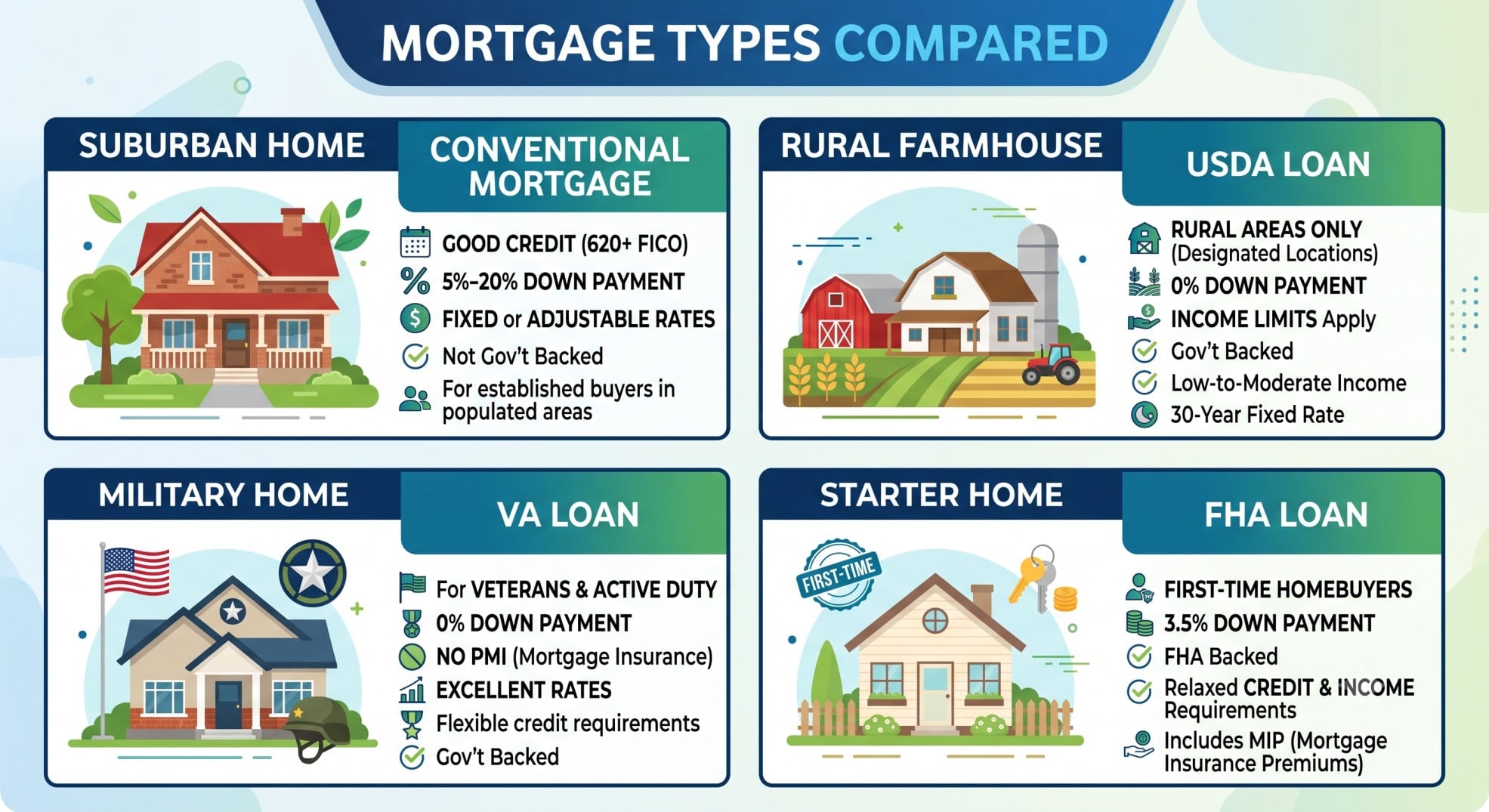
Why the Difference Between Mortgage Loan Types Matters
Most buyers choose a mortgage based entirely on the required down payment and the monthly interest rate. But the structure of your loan dictates exactly what you can write off on your federal tax return. Understanding the difference between mortgage loan types allows you to project your true cost of homeownership after the IRS takes its cut.
The 2026 tax year completely rewrites the math for homeowners. The Tax Cuts and Jobs Act (TCJA) provisions have sunset. The standard deduction has dropped back to historical norms (adjusted for inflation), and the state and local tax (SALT) cap has disappeared. The mortgage interest deduction limit has also reverted from $750,000 back to $1 million.
Because the standard deduction is lower, millions of middle-class taxpayers will benefit from itemizing their deductions on Schedule A for the first time in nearly a decade. This shift makes the mortgage insurance premium tax deduction highly valuable. Whether you pay private mortgage insurance (PMI) on a conventional loan, a funding fee on a VA loan, or mortgage insurance premiums (MIP) on an FHA loan, those costs can now directly reduce your taxable income.
Conventional Loans: PMI and Tax Deductibility
Conventional loans are not backed by any government agency. They are originated by private lenders and sold to government-sponsored enterprises like Fannie Mae or Freddie Mac. Because the government does not insure the lender against default, you must pay for Private Mortgage Insurance (PMI) if you put down less than 20%.
PMI protects the lender, not you. But the IRS offers a silver lining. Under the restored 2026 tax rules, your monthly PMI payments qualify for the mortgage insurance premium tax deduction. You can write off the exact amount you paid in PMI throughout the year, provided your Adjusted Gross Income (AGI) falls below the IRS phase-out limits.
The defining feature of a conventional loan is that PMI is temporary. Once you reach 20% equity in your home—either by paying down the principal or through home price appreciation—you can request your lender to cancel the PMI. By law, the lender must automatically terminate PMI when your equity reaches 22%.
Hypothetical Scenario: The Conventional PMI Write-Off
Sarah buys a $400,000 home with a 5% down payment ($20,000). Her loan amount is $380,000. Her lender charges her $150 per month in PMI, totaling $1,800 for the year.
Sarah’s AGI is $85,000, well below the phase-out threshold. Because the 2026 standard deduction is lower, she chooses to itemize. She deducts her $1,800 in PMI alongside her mortgage interest and property taxes. In her 22% marginal tax bracket, that $1,800 deduction saves her $396 in actual federal income tax.
When analyzing the difference between mortgage loan types, conventional loans offer the cleanest exit strategy for mortgage insurance. You get the tax deduction while you pay it, and you have a clear path to drop the expense entirely without refinancing.
FHA Loans: Upfront vs. Annual MIP Mechanics
Federal Housing Administration (FHA) loans are designed to help buyers with lower credit scores or limited cash. You can secure an FHA loan with a credit score as low as 580 and a down payment of just 3.5%.
The tradeoff for this flexibility is expensive, permanent mortgage insurance. FHA loans require two distinct types of Mortgage Insurance Premiums (MIP): an Upfront MIP and an Annual MIP. The Upfront MIP is currently 1.75% of the base loan amount. You can pay this in cash at closing, but almost all buyers roll it into the total loan balance. The Annual MIP is divided by 12 and added to your monthly mortgage payment.
When evaluating FHA vs conventional loan tax benefits, the treatment of that upfront premium is a major factor. If you finance the 1.75% Upfront MIP into your loan, the IRS does not let you deduct the entire lump sum in year one. Instead, IRS rules generally require you to allocate that financed premium over the shorter of the loan term or 84 months (7 years). You deduct a portion of it each year alongside your monthly Annual MIP payments.
Hypothetical Scenario: FHA MIP Allocation
Marcus buys a $300,000 home with an FHA loan. He puts down 3.5% ($10,500), leaving a base loan of $289,500. The FHA charges a 1.75% Upfront MIP, which equals $5,066. Marcus rolls this into his loan.
At tax time, Marcus wants to maximize his first time home buyer tax deductions. He cannot deduct the full $5,066 upfront. Under the 84-month rule, he divides $5,066 by 84 months, which equals about $60.31 per month. For his first full year (12 months), he deducts $723.72 for the upfront portion, plus the total of his monthly Annual MIP payments. This combined amount qualifies for the mortgage insurance premium tax deduction.
Unlike conventional PMI, FHA monthly MIP cannot be canceled simply by reaching 20% equity. If you put down less than 10% on an FHA loan, the monthly MIP remains for the entire life of the loan. The only way to remove it is to refinance into a conventional loan later.
VA Loans: Zero Down and the VA Funding Fee
Veterans Affairs (VA) loans offer arguably the most powerful financing terms on the market. Available to eligible active-duty service members, Veterans, and qualifying surviving spouses, VA loans require zero down payment and charge absolutely no monthly mortgage insurance.
Instead of monthly PMI, the VA charges a one-time VA Funding Fee. This fee ranges from 1.25% to 3.3% of the loan amount, depending on your down payment and whether it is your first time using the VA loan benefit. Veterans receiving VA disability compensation are completely exempt from paying this fee.
So, is the VA funding fee tax deductible? Yes. Under the 2026 tax rules, the VA funding fee is explicitly categorized as qualified mortgage insurance. This means it qualifies for the mortgage insurance premium tax deduction.
The tax mechanics here are incredibly favorable. Unlike the FHA upfront premium, which must be amortized over 84 months if financed, the IRS generally allows eligible Veterans to deduct the entire VA funding fee in the year the loan closes, even if the fee was rolled into the loan balance. This creates a massive first-year tax write-off.
Hypothetical Scenario: The VA Funding Fee Write-Off
David, a first-time homebuyer and Veteran, purchases a $500,000 home with zero down. His VA funding fee is 2.15%, which equals $10,750. He finances this fee into his loan.
When David files his 2026 taxes, he itemizes his deductions. Because the VA funding fee tax deductible rules allow it, he writes off the entire $10,750 on Schedule A as mortgage insurance, alongside his standard mortgage interest. In a 24% tax bracket, this single deduction reduces his federal tax liability by $2,580 in his first year of homeownership.
This massive upfront deduction highlights the core difference between mortgage loan types. A conventional borrower gets small, steady deductions over time, while a VA borrower gets a heavy, front-loaded tax benefit.
USDA Loans: Rural Requirements and Guarantee Fees
United States Department of Agriculture (USDA) loans are designed to encourage homeownership in rural and suburban areas. Like VA loans, they offer 100% financing (zero down payment). However, they come with strict geographical limits and household income caps. You cannot use a USDA loan to buy a home in a major metropolitan city.
USDA loans do not charge traditional PMI. Instead, they charge an Upfront Guarantee Fee (usually 1% of the loan amount) and an Annual Guarantee Fee (usually 0.35% of the loan balance, divided into monthly payments). Both fees function exactly like FHA mortgage insurance.
From a tax perspective, USDA guarantee fees are treated as mortgage insurance. The monthly fee qualifies for the mortgage insurance premium tax deduction. If you finance the 1% upfront fee into the loan, it is subject to the same 84-month allocation rule as the FHA upfront premium. You cannot deduct the entire financed amount in year one.
Summary Matrix: Comparing Loan Types
To clearly illustrate the difference between mortgage loan types, we have mapped out the core mechanics and tax treatments for 2026. Use this matrix to compare upfront costs and long-term tax benefits.
| Loan Type | Minimum Down Payment | Insurance Type | Can Insurance Be Canceled? | Tax Deductibility (2026 Rules) |
|---|---|---|---|---|
| Conventional | 3% to 5% | Monthly PMI | Yes, at 20% equity. | Monthly PMI is fully deductible on Schedule A (subject to AGI limits). |
| FHA | 3.5% | Upfront MIP + Annual MIP | No (unless 10%+ down). | Monthly MIP is deductible. Financed Upfront MIP must be allocated over 84 months. |
| VA | 0% | Upfront Funding Fee (No monthly) | N/A (Paid once). | The entire fee is deductible in the year of purchase, even if financed. |
| USDA | 0% | Upfront Fee + Annual Fee | No. Lasts life of loan. | Monthly fee is deductible. Financed Upfront fee allocated over 84 months. |
Step-by-Step: Claiming Your Tax Benefits
Many taxpayers leave money on the table because they do not know how to properly claim first time home buyer tax deductions. The IRS does not automatically apply these benefits to your return. You must actively choose to itemize.
Follow these steps to ensure you capture every allowable deduction for your specific loan type:
Step 1: Gather Form 1098 from Your Lender
By January 31st, your mortgage servicer will mail you Form 1098 (Mortgage Interest Statement). This document is your golden ticket. Box 1 shows the mortgage interest you paid. Box 5 shows the mortgage insurance premiums you paid. If you paid a VA funding fee, it should be included in Box 5, but always verify the amount against your original Closing Disclosure (CD).
Step 2: Calculate Your Total Itemized Deductions
Add up your mortgage interest, your mortgage insurance premiums, your state and local taxes (property taxes and state income taxes), and any charitable contributions. Compare this total to the 2026 standard deduction for your filing status. If your itemized total is higher, you will itemize.
Step 3: Check the AGI Phase-Out Limits
The mortgage insurance premium tax deduction is not unlimited. Historically, the IRS begins phasing out this deduction if your Adjusted Gross Income exceeds $100,000 ($50,000 if married filing separately). The deduction is reduced by 10% for every $1,000 you earn over the limit, disappearing entirely at $109,000. Verify your AGI on Form 1040 before claiming the full amount.
Step 4: File Schedule A
Input your mortgage interest and mortgage insurance premiums into the “Interest You Paid” section of Schedule A. If you are using tax software, simply enter the numbers from your Form 1098, and the software will automatically apply the correct phase-out math based on your income.
Frequently Asked Questions About Mortgage Loan Types
What is the main difference between mortgage loan types for tax purposes?
The primary difference lies in how mortgage insurance is structured and deducted. Conventional loans offer straightforward monthly PMI deductions. VA loans offer a massive one-time deduction for the funding fee. FHA and USDA loans require complex 84-month allocations if you finance their upfront premiums.
Are FHA vs conventional loan tax benefits better for high-income earners?
Conventional loans generally favor high-income earners because they allow you to drop PMI once you reach 20% equity. FHA loans force you to pay MIP for the life of the loan (if you put down less than 10%), which becomes a dead expense once your income exceeds the IRS phase-out limit for the mortgage insurance premium tax deduction.
Is the VA funding fee tax deductible if I pay it in cash at closing?
Yes. Whether you pay the VA funding fee in cash at the closing table or roll it into your total loan balance, it is fully deductible in the tax year the loan closes, provided you itemize your deductions and meet the income requirements.
Do I have to itemize to claim first time home buyer tax deductions?
Yes. You cannot take the standard deduction and deduct mortgage interest or mortgage insurance premiums at the same time. You must file Schedule A and itemize to claim these specific homeownership tax benefits.
How long does the 84-month allocation rule last for FHA loans?
If you finance the 1.75% FHA Upfront MIP into your loan, you must divide that amount by 84 months (7 years). You can deduct the corresponding monthly portion each year on your taxes for those first seven years. After 84 months, that specific deduction ends, though your annual MIP remains deductible.
Can I deduct mortgage insurance on a second home?
Yes, the IRS generally allows you to deduct mortgage insurance premiums paid on a qualified primary residence or a second home. However, the loan must be used to buy, build, or substantially improve the property. Investment properties and rentals fall under different tax rules (Schedule E).
What happens to my tax deduction if I refinance my FHA loan?
If you refinance an FHA loan into a conventional loan, you will stop paying FHA MIP and start paying conventional PMI (unless you have 20% equity). Any remaining unamortized portion of your original FHA Upfront MIP may be fully deductible in the year you refinance, depending on how the new loan is structured.
Why did the mortgage insurance deduction disappear and come back?
The deduction originally expired but was permanently reinstated by Congress starting in the 2026 tax year. This legislative change ensures that middle-class homeowners can consistently rely on this deduction when planning their household budgets.
Does the USDA guarantee fee count as mortgage insurance?
Yes. The IRS treats both the upfront USDA guarantee fee and the annual USDA fee as qualified mortgage insurance premiums. They follow the exact same tax deductibility rules as FHA mortgage insurance.
Where do I find how much PMI I paid this year?
Your mortgage servicer will send you Form 1098 early in the year. Look at Box 5. This box reports the exact amount of mortgage insurance premiums you paid during the calendar year, which is the number you will use on your tax return.
Disclaimer: This content provides general information for educational purposes only. Tax laws are complex and change often. It is not professional tax, legal, or financial advice. Always consult a qualified tax professional for personalized guidance regarding your specific situation. Ourtaxpartner.com is not responsible for any actions taken based on the information provided herein.
