
⚡ Executive Summary: State Taxes in 2026
- The expiration of federal TCJA provisions in 2026 directly impacts your state taxes, depending entirely on your state’s conformity laws.
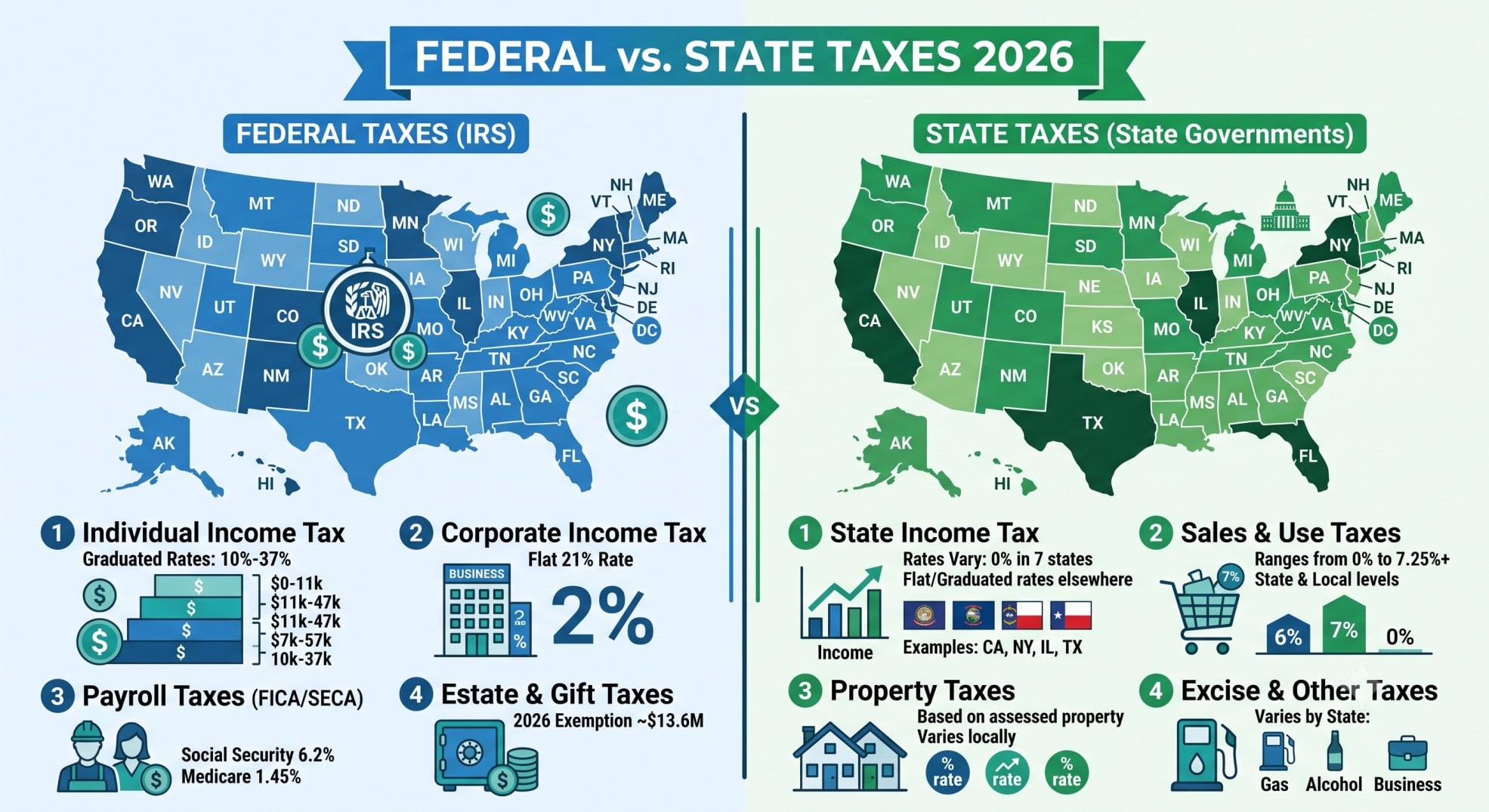
- States are divided into three categories: no income tax states, flat tax states, and progressive tax bracket states.
- Rolling conformity states automatically adopt the new, lower federal standard deduction for 2026, while static conformity states may require manual legislative updates.
- Homeowners in decoupled states must calculate their mortgage interest and property tax deductions twice—once for the IRS and once for their state revenue department.
Table of Contents
Why Your State Return Looks Different
Filing your federal tax return is only half the battle. Once you finish calculating what you owe the IRS, you have to run the numbers all over again for your state. Many taxpayers assume their state return is just a carbon copy of their federal return, but with a lower tax rate. That assumption leads to massive filing errors.
Your state has its own constitution, its own revenue needs, and its own tax code. While the IRS dictates federal rules, your state legislature decides how to tax your income locally. This means the deductions you claim on your federal return might be completely disallowed on your state return. Conversely, your state might offer generous tax credits—like renter’s credits or local education deductions—that the IRS does not recognize at all.
For the 2026 tax year, understanding state income tax brackets for 2026 is critical. The federal tax landscape has shifted dramatically due to the sunset of the Tax Cuts and Jobs Act (TCJA). Because federal rules have changed, state tax liabilities are shifting in tandem. If you work remotely, own property, or recently moved across state lines, you need to know exactly how your local government calculates its cut.
The 3 Types of State Tax Systems
Every state approaches revenue differently. When you look at the state income tax brackets for 2026, you will find that jurisdictions generally fall into one of three distinct categories. Knowing which system your state uses is the first step in projecting your total tax liability.
1. No Income Tax States
If you live in one of the nine no income tax states, you do not file a state income tax return. Your paycheck is only subject to federal income tax and FICA (Social Security and Medicare). These states fund their governments through alternative methods, such as higher sales taxes, massive property taxes, or corporate taxes on natural resources.
The recognized no income tax states are Alaska, Florida, Nevada, New Hampshire, South Dakota, Tennessee, Texas, Washington, and Wyoming. Washington does levy a capital gains tax on high earners, and New Hampshire previously taxed interest and dividends, but for traditional W-2 wage earners, these states take zero percent of your salary.
Hypothetical Scenario: Moving for Tax Relief
Marcus earns $150,000 a year working remotely. He currently lives in California, where his income is subject to high state taxes. He decides to relocate to Texas, one of the premier no income tax states.
By moving, Marcus completely eliminates his state income tax bill, instantly increasing his take-home pay by thousands of dollars. However, when he buys a house in Texas, he discovers his property tax rate is more than double what he paid in California. The state still gets its revenue; it just collects it from his real estate rather than his paycheck.
2. Flat Tax States
A growing trend across the country is the shift toward flat tax systems. In flat tax states, every taxpayer pays the exact same percentage of their taxable income to the state, regardless of how much money they make. Whether you earn $40,000 or $4,000,000, the rate remains identical.
States like Colorado, Illinois, Pennsylvania, and Utah have utilized flat taxes for years. Recently, states like Arizona, Georgia, and North Carolina have transitioned into flat tax states to attract businesses and high-net-worth residents. Flat tax states simplify the filing process immensely, as there are no complex brackets to navigate.
Hypothetical Scenario: The Flat Tax Calculation
Elena lives in Colorado, which operates as one of the flat tax states with a rate of 4.40%. Her taxable income for 2026 is $85,000.
Elena does not have to worry about marginal brackets. She simply multiplies her $85,000 taxable income by 4.40%. Her state tax liability is exactly $3,740. This straightforward math makes tax planning incredibly predictable for residents.
3. Progressive Tax Bracket States
The majority of the country, along with the federal government, uses a progressive tax system. In progressive tax bracket states, your income is divided into chunks, and each chunk is taxed at a progressively higher rate. The more you earn, the higher the tax rate applied to your last dollar of income.
California, New York, New Jersey, and Hawaii are prime examples of progressive tax bracket states. These states often have low rates for entry-level earners but impose heavy top marginal rates on high earners. When you analyze the state income tax brackets for 2026 in these jurisdictions, you must calculate your liability step-by-step through each tier.
Understanding State Tax Conformity
Knowing your tax rate is only part of the equation. You also need to know how your state defines “taxable income.” This brings us to the concept of state tax conformity. Conformity dictates how closely your state’s tax code aligns with the federal Internal Revenue Code (IRC).
When the federal government changes a rule—like altering the standard deduction or changing what medical expenses are deductible—states have to decide whether to adopt that change or ignore it. There are three ways states handle state tax conformity.
Rolling Conformity
States with rolling conformity automatically adopt changes to the federal tax code as soon as Congress passes them. If the IRS lowers the standard deduction for 2026, a rolling conformity state automatically lowers its state-level standard deduction to match. This makes filing easy, as your state Adjusted Gross Income (AGI) will usually match your federal AGI perfectly.
Static Conformity
States with static conformity (also called fixed-date conformity) tie their tax code to the federal IRC as it existed on a specific date in the past. For example, a state might conform to the federal tax code as it was written on January 1, 2022. If the IRS makes a change in 2026, the state ignores it until the state legislature actively passes a new bill to update their conformity date. This creates temporary differences between your federal and state returns.
Decoupled States
Decoupled states pick and choose. They might use your federal AGI as a starting point, but they explicitly reject specific federal rules. For instance, a state might conform to federal rules for business expenses but completely decouple from federal rules regarding bonus depreciation or standard deductions. If you live in a decoupled state, you will spend a lot of time adding and subtracting items on your state return to adjust your federal numbers to local rules.
Hypothetical Scenario: The Conformity Clash
David lives in a static conformity state that is tied to the 2017 federal tax code (pre-TCJA). In 2026, the federal standard deduction drops significantly.
On his federal return, David is forced to itemize because his expenses now exceed the lower 2026 federal standard deduction. But on his state return, the state tax conformity rules dictate that the state still uses the old, higher standard deduction logic from 2017. David itemizes on his federal return but takes the standard deduction on his state return. His CPA has to run two entirely separate tax strategies.
How Conformity Affects Homeowners
State tax conformity heavily impacts homeowners, particularly regarding the State and Local Tax (SALT) deduction and mortgage interest rules. Because the 2026 tax year brings the sunset of several TCJA provisions, homeowners must pay close attention to how their state reacts.
Consider the SALT cap. From 2018 to 2025, the federal government capped the SALT deduction at $10,000. In 2026, that cap expires, allowing taxpayers to deduct their full property and state income taxes on their federal Schedule A. But how does your state handle this?
If you live in a state that requires you to add back your state income taxes to your state return (because a state generally won’t let you deduct the tax you pay to them from the tax you owe them), the federal uncapping of SALT won’t lower your state tax bill. You will get a massive federal benefit, but your state taxable income will remain higher.
Mortgage interest is another prime example. The federal limit for deducting mortgage interest has reverted to $1 million of acquisition debt in 2026. However, some decoupled progressive tax bracket states never adopted the TCJA’s temporary $750,000 limit in the first place. Homeowners in those states have been deducting interest on $1 million for state purposes all along. Now, in 2026, the federal and state rules will finally align again for those specific taxpayers.
State-by-State Directory: 2026 Overview
Because state legislatures finalize their inflation adjustments late in the year, you must check your specific state’s Department of Revenue for the exact, to-the-dollar state income tax brackets for 2026. However, the structural categories remain locked. Use this directory overview to determine how your state will process your 2026 income.
| Tax System Category | Notable States in this Category | 2026 Filing Impact |
|---|---|---|
| No Income Tax States | Texas, Florida, Nevada, Washington, Wyoming, South Dakota, Alaska, Tennessee, New Hampshire. | No state income tax return required for W-2 wages. High reliance on property or sales tax. |
| Flat Tax States | Colorado, Illinois, Pennsylvania, Utah, North Carolina, Arizona, Georgia, Indiana, Michigan. | Income is taxed at a single, flat percentage. Easy calculation, minimal bracket planning required. |
| Progressive Tax States | California, New York, New Jersey, Hawaii, Oregon, Minnesota, Maryland, Virginia. | Income is taxed in ascending tiers. High earners face steep top marginal rates. Requires careful bracket management. |
If you live in one of the progressive tax bracket states, you must actively manage your Adjusted Gross Income. Contributing to a traditional 401(k) or Health Savings Account (HSA) not only lowers your federal tax bill but can also drop you into a lower state tax bracket, yielding a double tax benefit.
Frequently Asked Questions About State Taxes
What are the state income tax brackets for 2026?
The exact brackets vary wildly by jurisdiction. Some states have zero brackets, flat tax states have one bracket, and progressive states can have up to ten brackets. You must check your specific state’s Department of Revenue website for the finalized 2026 inflation-adjusted tables.
Do no income tax states tax capital gains?
Generally, no. States like Texas and Florida do not tax capital gains. However, Washington state is a notable exception; while it does not tax W-2 wages, it does levy a specific tax on high-dollar capital gains. Always verify local rules if you plan to sell significant assets.
What does state tax conformity mean for my standard deduction?
If your state has rolling conformity, your state standard deduction will automatically adjust to mirror the federal standard deduction. If your state is decoupled, your state legislature sets its own standard deduction, which may be significantly higher or lower than the federal amount.
Are flat tax states better for low-income earners?
Not necessarily. Progressive tax systems often tax the first $10,000 to $20,000 of income at 0% or 1%. In a flat tax state, every dollar is taxed at the flat rate (e.g., 4%), which can sometimes result in a higher tax burden for entry-level earners compared to a progressive system.
Do I have to file a state return if I work remotely?
Yes, if you live in a state that levies an income tax. Furthermore, if your company is based in a different state, you may have to file a non-resident return in your employer’s state and a resident return in your home state, depending on reciprocal agreements and “convenience of the employer” rules.
Why did my state disallow my federal bonus depreciation?
Many states decouple from federal bonus depreciation rules because it costs the state too much immediate revenue. If your state is decoupled, you must add back the federal bonus depreciation on your state return and depreciate the asset slowly over several years according to state schedules.
How do progressive tax bracket states calculate my tax?
They use marginal tax rates. If the top bracket is 8% for income over $100,000, you do not pay 8% on your entire salary. You only pay 8% on the specific dollars you earn above the $100,000 threshold. The income below that threshold is taxed at lower rates.
Can I itemize on my state return if I take the federal standard deduction?
It depends on your state’s conformity rules. Some states require you to use the same method (standard or itemized) that you used on your federal return. Other states allow you to itemize for state purposes even if you took the standard deduction federally.
Do local city taxes apply on top of state taxes?
Yes, in certain jurisdictions. Cities like New York City, Philadelphia, and local municipalities in Ohio levy their own local income taxes on top of the state income tax. You must account for federal, state, and local taxes when calculating your total burden.
Will the 2026 TCJA sunset increase my state taxes?
It depends entirely on your state’s conformity. If your state automatically conforms to federal definitions of taxable income, the expiration of certain federal deductions could broaden your state tax base, inadvertently increasing your state tax liability unless the local legislature intervenes.
Disclaimer: This content provides general information for educational purposes only. Tax laws are complex and change often. It is not professional tax, legal, or financial advice. Always consult a qualified tax professional for personalized guidance regarding your specific situation. Ourtaxpartner.com is not responsible for any actions taken based on the information provided herein.
