
Executive Summary
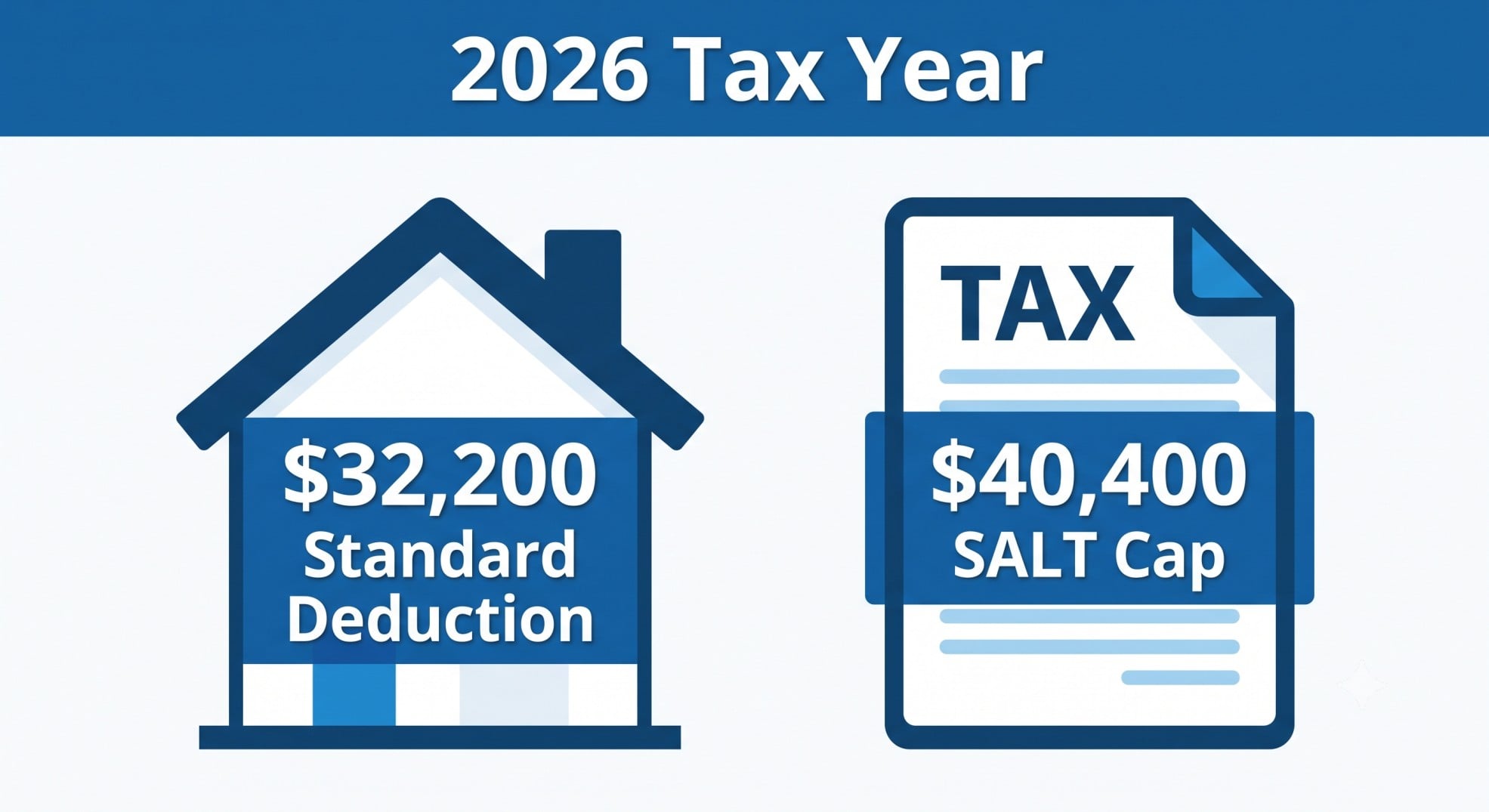
- The 2026 Standard Deduction: Increased to $32,200 for married couples filing jointly and $16,100 for single filers, setting a higher threshold for itemizing deductions.
- The Expanded SALT Cap: The State and Local Tax deduction cap has increased to $40,400 for 2026, allowing homeowners in high-tax states to deduct significantly more in property taxes.
- Mortgage Interest Limits: Homeowners can deduct interest on up to $750,000 of qualified mortgage debt, a limit made permanent by recent legislation.
- Capital Gains Exclusion: Sellers can still exclude up to $250,000 (single) or $500,000 (married) in profit from the sale of a primary residence under Section 121.
The 2026 tax year brings substantial legislative updates that directly impact property owners. With the passage of the One Big Beautiful Bill Act (OBBBA), the rules governing homeowners tax write offs have shifted, specifically regarding state and local tax limits and standard deduction thresholds. Understanding these exact mechanics dictates whether you claim the standard deduction or itemize your expenses.
Property ownership remains one of the most heavily subsidized investments in the US tax code. However, claiming a tax break for homeowners requires strict adherence to IRS documentation rules and an understanding of how your specific expenses stack against federal baselines. Taxpayers frequently ask, “what can i deduct from my taxes this year?” The answer depends entirely on your filing status, your mortgage balance, and your local property tax burden.
This guide breaks down the exact tax benefits of owning a home in 2026. We cover the math behind mortgage interest, the expanded property tax rules, and the capital gains exclusions that protect your home equity.
How Does the Standard Deduction Compare to Itemizing for Homeowners?
To claim specific homeowner deductions, your total itemized expenses must exceed the standard deduction for your filing status. If they do not, you take the standard deduction, and your specific home-related expenses provide no additional tax benefit.
For the 2026 tax year, the IRS has set the standard deductions at the following levels:
| Filing Status | 2026 Standard Deduction |
|---|---|
| Single / Married Filing Separately | $16,100 |
| Head of Household | $24,150 |
| Married Filing Jointly | $32,200 |
Taxpayers age 65 or older receive an additional standard deduction of $2,050 (single) or $1,650 (per qualifying spouse for joint filers). Furthermore, 2026 introduces a new $6,000 deduction for seniors, which phases out for those with a Modified Adjusted Gross Income (MAGI) over $75,000.
To utilize homeowners tax write offs, you must file Schedule A (Form 1040). You add your mortgage interest, property taxes, state income taxes, and charitable contributions. If that total surpasses $32,200 (for a married couple), you itemize. If it equals $30,000, you take the $32,200 standard deduction instead.
Hypothetical Scenario: The Itemization Threshold
Consider a married couple filing jointly in 2026. They paid $18,000 in mortgage interest, $12,000 in property taxes, and $6,000 in state income taxes. Their total State and Local Taxes (SALT) equal $18,000. Their total itemized deductions equal $36,000 ($18,000 mortgage interest + $18,000 SALT).
Because $36,000 exceeds the $32,200 standard deduction, they will choose to itemize. In this scenario, their homeowner deductions directly reduce their taxable income by an additional $3,800 beyond what the standard deduction provides.
The Mortgage Interest Deduction: 2026 Limits
The mortgage interest deduction allows taxpayers to write off the interest paid on a loan used to buy, build, or substantially improve a primary or secondary residence. This is often the largest single tax break for homeowners.

Recent legislation permanently extended the $750,000 limitation on acquisition indebtedness. If you took out your mortgage after December 15, 2017, you can only deduct the interest paid on the first $750,000 of the loan ($375,000 if married filing separately). Mortgages established before that date are grandfathered into the old $1,000,000 limit.
Additionally, for the 2026 tax year, mortgage insurance premiums (PMI) are once again considered deductible as mortgage interest, providing further relief for buyers who put down less than 20% on their home purchase.
Calculating Proportional Interest
If your mortgage exceeds the $750,000 threshold, the IRS requires a proportional calculation. You cannot simply deduct all the interest you paid. You must divide the deduction limit by your total mortgage balance, then multiply that percentage by the total interest paid during the year.
Step-by-Step Calculation Example:
A taxpayer finalized a $1,000,000 mortgage in January 2026. During the year, they paid $65,000 in pure interest.
1. Divide the IRS limit by the loan balance: $750,000 / $1,000,000 = 0.75 (75%).
2. Multiply the total interest by that percentage: $65,000 x 0.75 = $48,750.
The taxpayer can claim $48,750 as their deductible mortgage interest on Schedule A.
State and Local Tax (SALT) Deductions for Property Taxes
Property taxes are fully deductible, but they are subject to the State and Local Tax (SALT) cap. The SALT deduction includes property taxes, state income taxes, and local sales taxes. For years, this cap was strictly held at $10,000, which severely limited the tax benefits of owning a home in states with high property values and high income taxes.
For the 2026 tax year, the SALT cap has been significantly expanded to $40,400 ($20,200 for married filing separately). This legislative change restores massive homeowners tax write offs for millions of taxpayers.
There is a phase-down provision for high earners. The $40,400 cap begins to phase down for taxpayers with a Modified Adjusted Gross Income (MAGI) exceeding $505,000 in 2026. Taxpayers who are fully phased down will see their SALT cap revert to the baseline $10,000.
How to Claim Property Taxes
Your mortgage servicer will send you Form 1098 at the beginning of the year. Box 1 shows your deductible mortgage interest, while Box 10 often shows the property taxes paid out of your escrow account. You report these figures directly on Schedule A. Ensure you only deduct property taxes actually paid to the municipality during the calendar year, not the amount simply held in escrow.
Capital Gains Exclusion: Selling Your Primary Residence
When you sell a property for a profit, the IRS generally taxes that profit as a capital gain. However, Section 121 of the Internal Revenue Code provides a massive tax break for homeowners selling their primary residence.

If you meet the eligibility criteria, you can exclude up to $250,000 of capital gains from your taxable income if you file as a single taxpayer. Married couples filing jointly can exclude up to $500,000. This exclusion permanently shields that profit from federal taxation.
The Ownership and Use Tests
To qualify for the full Section 121 exclusion, you must pass two specific tests during the five-year period ending on the date of the sale:
- The Ownership Test: You must have owned the home for at least 24 months (two years) out of the last five years.
- The Use Test: You must have lived in the home as your primary residence for at least 24 months out of the last five years. The 24 months do not need to be consecutive.
You can only claim this exclusion once every two years. If you sell a home and use the exclusion, you must wait a full 24 months before applying it to another property sale.
Hypothetical Scenario: The $500,000 Exclusion
A married couple bought a home in 2015 for $400,000. They lived in it continuously as their primary residence. In 2026, they sell the home for $850,000. Their realized capital gain is $450,000.
Because they meet both the ownership and use tests, and their $450,000 profit is below the $500,000 threshold for joint filers, they owe zero federal capital gains tax on the sale. The entire profit is excluded from their taxable income.
What Can I Deduct From My Taxes When Buying or Improving a Home?
Taxpayers frequently ask, “what can i deduct from my taxes in the year I actually purchase the property?” The IRS allows specific write-offs related to the acquisition and improvement of the asset.
Mortgage Points (Discount Points): When you close on a mortgage, you might pay “points” to lower your interest rate. One point equals 1% of the loan amount. The IRS considers these points to be prepaid mortgage interest. If you meet certain requirements—such as the points being a standard business practice in your area and computed as a percentage of the loan—you can deduct the full cost of the points in the year you bought the home. For a deeper breakdown of settlement expenses, review our guide on deducting closing costs on your taxes.
Energy Efficient Home Improvements: The tax code incentivizes green upgrades. If you install solar panels, solar water heaters, or geothermal heat pumps, you may qualify for the Residential Clean Energy Credit, which allows you to claim a percentage of the installation cost as a direct dollar-for-dollar tax credit (not just a deduction). Standard energy-efficient upgrades like exterior doors, windows, and insulation also qualify for specific annual credits under the Energy Efficient Home Improvement Credit.
Medical Home Improvements: If you install ramps, widen doorways, or lower cabinets to accommodate a medical condition or disability for yourself, your spouse, or a dependent, these costs are fully deductible as medical expenses. They are not subject to the usual rule that improvements only add to the home’s cost basis. For standard renovations, you must track the expenses to lower your future capital gains tax. Learn exactly how to track these in our guide to deducting home improvements and repairs.
What Is Not Considered an Advantage to Owning a Home?
What is not considered an advantage to owning a home from a tax perspective? Many routine expenses associated with property ownership provide absolutely no federal tax relief. Taxpayers often mistakenly attempt to write off the following non-deductible items:
- Homeowners Association (HOA) Fees: Monthly or annual dues paid to an HOA or condo board are strictly personal expenses and cannot be deducted on a primary residence.
- Principal Mortgage Payments: You can deduct the interest portion of your mortgage payment, but the portion that goes toward paying down the principal loan balance is never deductible.
- Standard Homeowners Insurance: Premiums paid for fire, hazard, or comprehensive property insurance are not deductible for a primary residence. For exceptions related to home offices or rental properties, see our complete breakdown of the tax rules for homeowners insurance.
- Depreciation: You cannot claim depreciation on your primary residence to lower your taxable income. Depreciation is strictly reserved for investment properties and business assets.
- Title Insurance and Appraisal Fees: These closing costs are not deductible. They are added to the cost basis of the home, which helps reduce capital gains tax when you eventually sell, but they provide no immediate tax deduction in the year of purchase.
Frequently Asked Questions About Homeowner Deductions
What are the tax benefits of homeownership?
The primary tax benefits of owning a home include the ability to deduct mortgage interest on up to $750,000 of debt, the ability to deduct up to $40,400 in state and local property taxes (for 2026), and the Section 121 capital gains exclusion, which shields up to $500,000 of profit when you sell the property.
What is not considered an advantage to owning a home?
What is not considered an advantage to owning a home includes the inability to deduct routine maintenance, HOA fees, standard homeowners insurance premiums, and the principal portion of your monthly mortgage payment. These are classified as non-deductible personal expenses.
How does the standard deduction compare to itemizing for homeowners?
How does the standard deduction compare to itemizing for homeowners? You only receive a tax benefit from your home expenses if your total itemized deductions (mortgage interest, property taxes, charitable gifts) exceed the standard deduction. For 2026, a married couple must have more than $32,200 in itemized expenses to make itemizing mathematically beneficial.
Can I deduct the cost of a new roof?
No, you cannot deduct the cost of a new roof in the year you install it on a primary residence. A new roof is considered a capital improvement. You add the cost of the roof to your home’s cost basis, which reduces your taxable capital gain when you eventually sell the property.
Are mortgage insurance premiums (PMI) deductible in 2026?
Yes. Under the recent legislative updates for 2026, mortgage insurance premiums paid on contracts issued after 2006 are treated as deductible mortgage interest. This deduction is subject to phase-outs based on your adjusted gross income.
What happens if I work from home? Can I deduct part of my mortgage?
If you are a W-2 employee working from home, you cannot claim the home office deduction. The home office deduction is strictly reserved for self-employed individuals and independent contractors who use a specific area of their home exclusively and regularly for business.
Do I have to pay taxes if I sell my house and buy another one?
The requirement to reinvest proceeds into a new home to avoid taxes was eliminated in 1997. Today, you simply use the Section 121 exclusion. If your profit is under $250,000 (single) or $500,000 (married) and you meet the two-year ownership and use tests, you owe no federal taxes on the gain, regardless of what you do with the money.
Can I deduct property taxes paid on a second home?
Yes, property taxes paid on a second home or vacation property are deductible. However, they are combined with the property taxes on your primary residence and your state income taxes, and the combined total is strictly subject to the $40,400 SALT cap for 2026.
Disclaimer: The tax information provided in this article is for general educational purposes only and does not constitute legal or tax advice. Tax laws, including standard deductions, brackets, and phase-out limits, are subject to frequent changes by the IRS and Congress. Every taxpayer’s financial situation is unique. We strongly recommend consulting with a licensed Certified Public Accountant (CPA) or Enrolled Agent (EA) to verify how current tax laws apply to your specific circumstances before filing your return.
