
Executive Summary
- The Escrow Mechanism: Your lender collects a portion of your annual tax liability every month and pays the county on your behalf when the bill is due.
- The IRS Golden Rule: You cannot deduct the monthly payments you make into your escrow account. You can only deduct the exact amount the lender actually disbursed to the taxing authority during the calendar year.
- 2026 SALT Cap Changes: For the 2026 tax year, the State and Local Tax (SALT) deduction cap is $40,400 for married couples filing jointly and single filers. This allows homeowners to deduct significantly more of their property taxes paid through escrow than in previous years.
- Form 1098: Your lender will report the exact amount of property taxes paid from your escrow account in Box 10 of your year-end Form 1098.
Homeowners reviewing their annual financial statements frequently ask one specific question: does escrow pay property tax obligations automatically? The short answer is yes, provided your loan is structured with an active escrow account. Understanding the exact mechanics of this process is necessary to claim your allowable deductions for property taxes on your federal tax return.
The tax code dictates strict rules regarding when and how you can claim these expenses. The IRS does not care how much money you deposited into your escrow account over the last twelve months. The IRS only cares about the exact date and the exact dollar amount your mortgage servicer transferred to your local county tax assessor.
With the 2026 tax year bringing significant changes to the State and Local Tax (SALT) deduction limits—specifically raising the cap to $40,400 for single filers and married couples filing jointly—tracking your escrow disbursements is more financially impactful than ever. This guide breaks down exactly how your mortgage company handles your tax bills, how to identify your deductible amounts, and how to report them accurately on Schedule A.
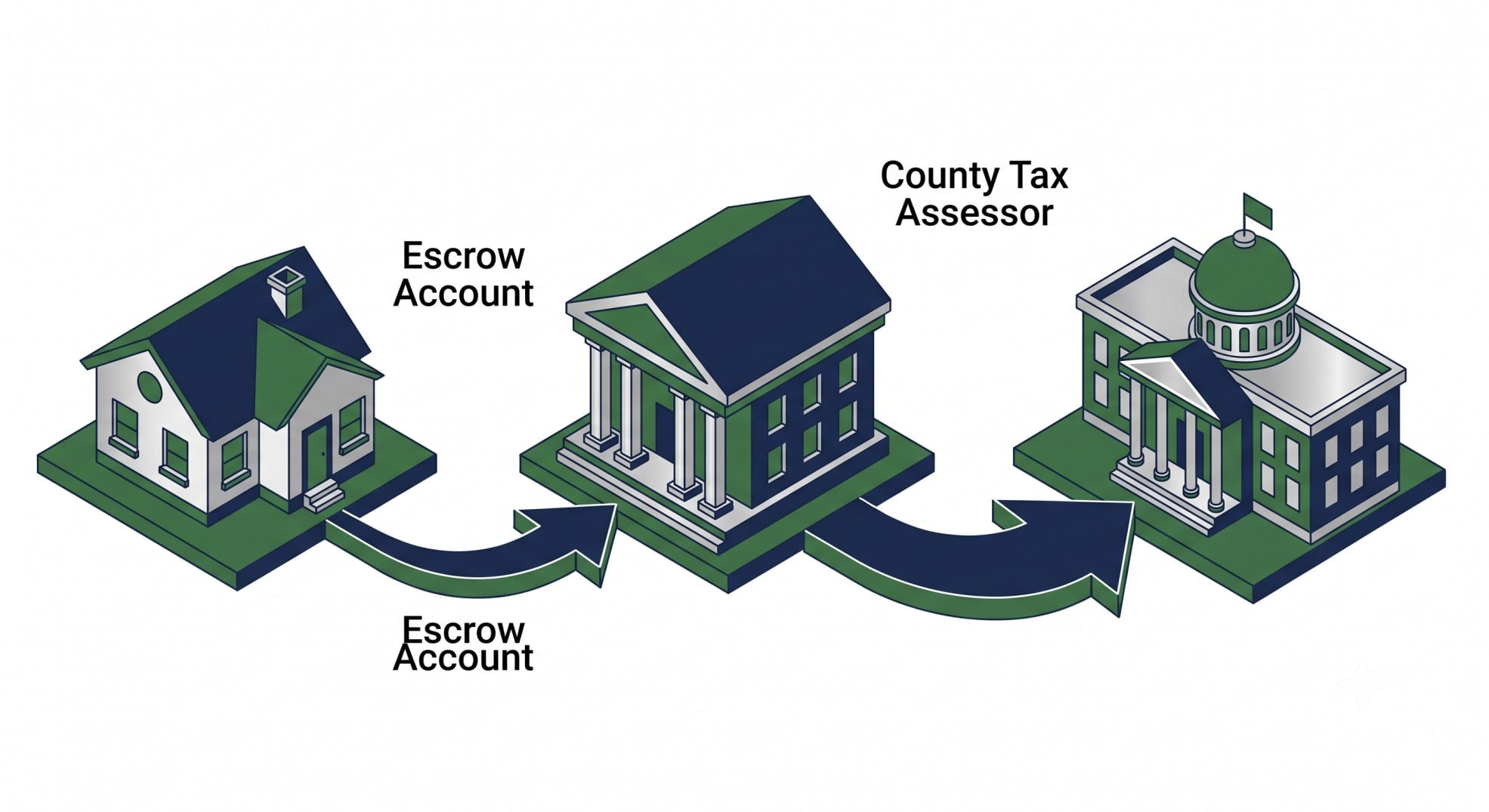
Table of Contents
- How the System Works: Does Escrow Pay Property Tax?
- The Mechanics of Property Taxes Paid With Mortgage
- The Golden IRS Rule: When Can You Claim the Deduction?
- Handling Prepaid Real Estate Taxes at Closing
- Locating Your 1098 Form Property Taxes Paid From Escrow
- Real-World Scenarios & Calculations
- Frequently Asked Questions About Escrow and Property Taxes
How the System Works: Does Escrow Pay Property Tax?
To understand the tax implications, you must first understand the financial plumbing of your mortgage. So, does escrow pay property tax? Yes. An escrow account is essentially a forced savings account managed by your mortgage servicer. Its primary purpose is to protect the lender’s investment. If a homeowner fails to pay their property taxes, the local government can place a tax lien on the house, which supersedes the bank’s mortgage lien. To prevent this, lenders require an escrow account for most borrowers.
When your county tax assessor calculates your annual property tax bill, they send a copy directly to your mortgage servicer. The servicer divides that annual bill by twelve. They add this one-twelfth amount to your monthly principal and interest payment. You write one check to the bank every month, and the bank deposits the tax portion into your escrow account.
When the county tax deadline approaches—whether it is billed annually, semi-annually, or quarterly—the mortgage servicer withdraws the required funds from your escrow account and wires the payment directly to the county tax collector. The homeowner never touches the money, but the homeowner receives the legal credit for paying the tax.
The Mechanics of Property Taxes Paid With Mortgage
Many first-time buyers ask, are property taxes included in mortgage payments inherently? Technically, a mortgage payment consists only of principal and interest. However, in everyday practice, most homeowners pay a consolidated bill known as PITI: Principal, Interest, Taxes, and Insurance.
Because property taxes paid with mortgage statements are bundled together, it creates a common point of confusion during tax season. Taxpayers often look at their total monthly payment, multiply it by twelve, and assume that entire sum is deductible. This is mathematically incorrect. You must separate the principal (never deductible), the interest (deductible under specific rules), the homeowners insurance (never deductible for a primary residence), and the property taxes (deductible under the SALT cap).
Does my mortgage company pay my property taxes exactly as billed? Yes, but the amount they collect from you will fluctuate. Property tax assessments change annually based on local real estate values and municipal budgets. Because of this, your lender performs an Annual Escrow Analysis. If your property taxes increase, your escrow account will experience a shortage. The lender will then increase your monthly PITI payment for the following year to cover the higher tax bill and replenish the required minimum balance in the escrow account.
The Golden IRS Rule: When Can You Claim the Deduction?
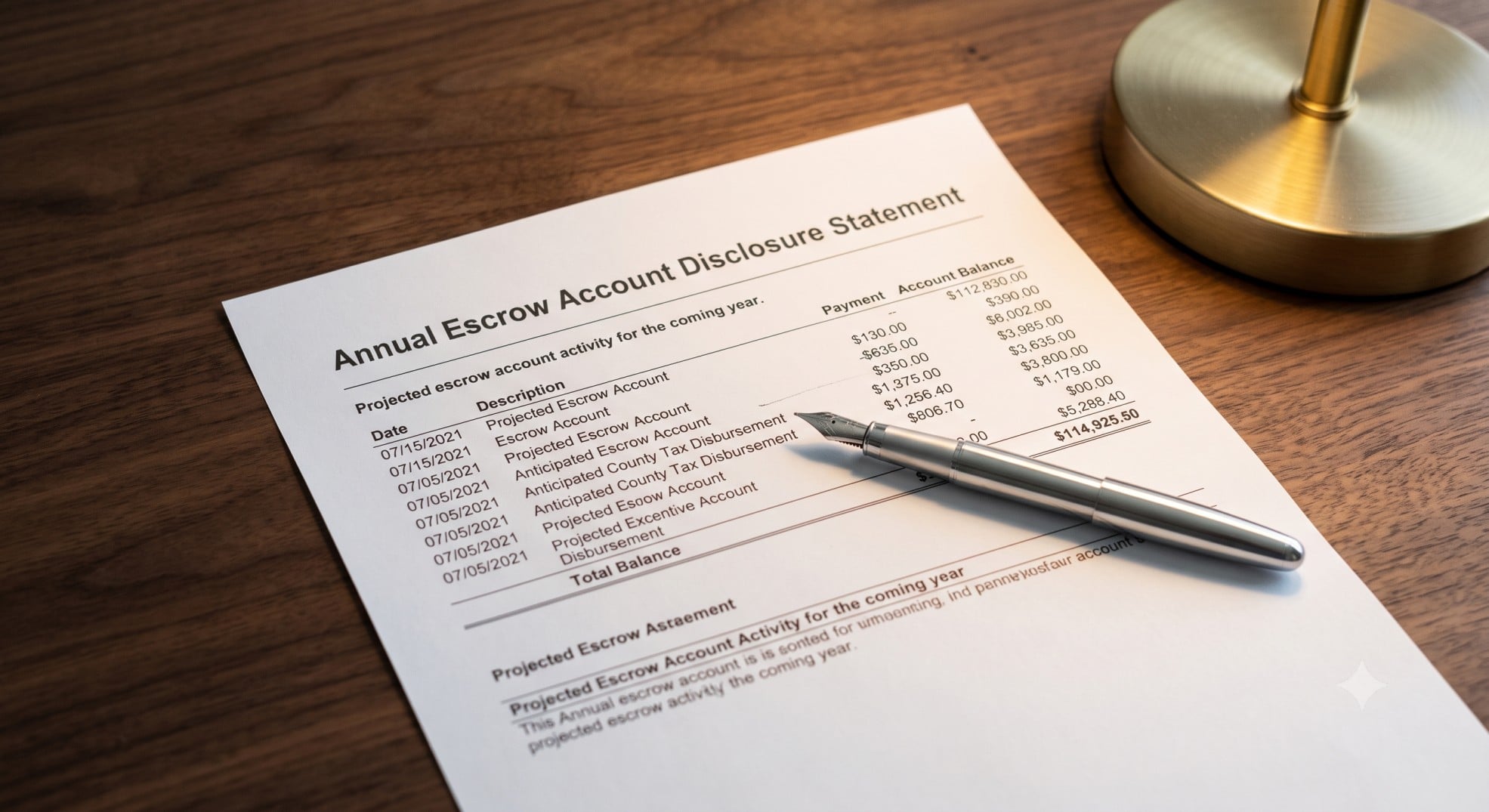
The IRS enforces a strict timeline for claiming deductions. You can only deduct property taxes in the calendar year that the third party (your escrow agent) actually paid the taxing authority. You cannot deduct the funds simply because you deposited them into the escrow account.
For example, if you pay $500 a month into your escrow account for property taxes from January through December, you have deposited $6,000. However, if your county only bills taxes once a year in October, and the bank wired $5,800 to the county on October 15th, your allowable deduction is exactly $5,800. The remaining $200 sitting in the escrow account as a cushion cannot be deducted until the bank uses it to pay a future tax bill.
Taxpayers frequently ask how to deduct property taxes paid through escrow when the timing crosses calendar years. If your county tax bill is due on January 15, 2027, but your mortgage servicer proactively wires the payment to the county on December 28, 2026, you claim that deduction on your 2026 tax return. The date the funds leave the escrow account and are accepted by the county dictates the tax year of the deduction.
Handling Prepaid Real Estate Taxes at Closing
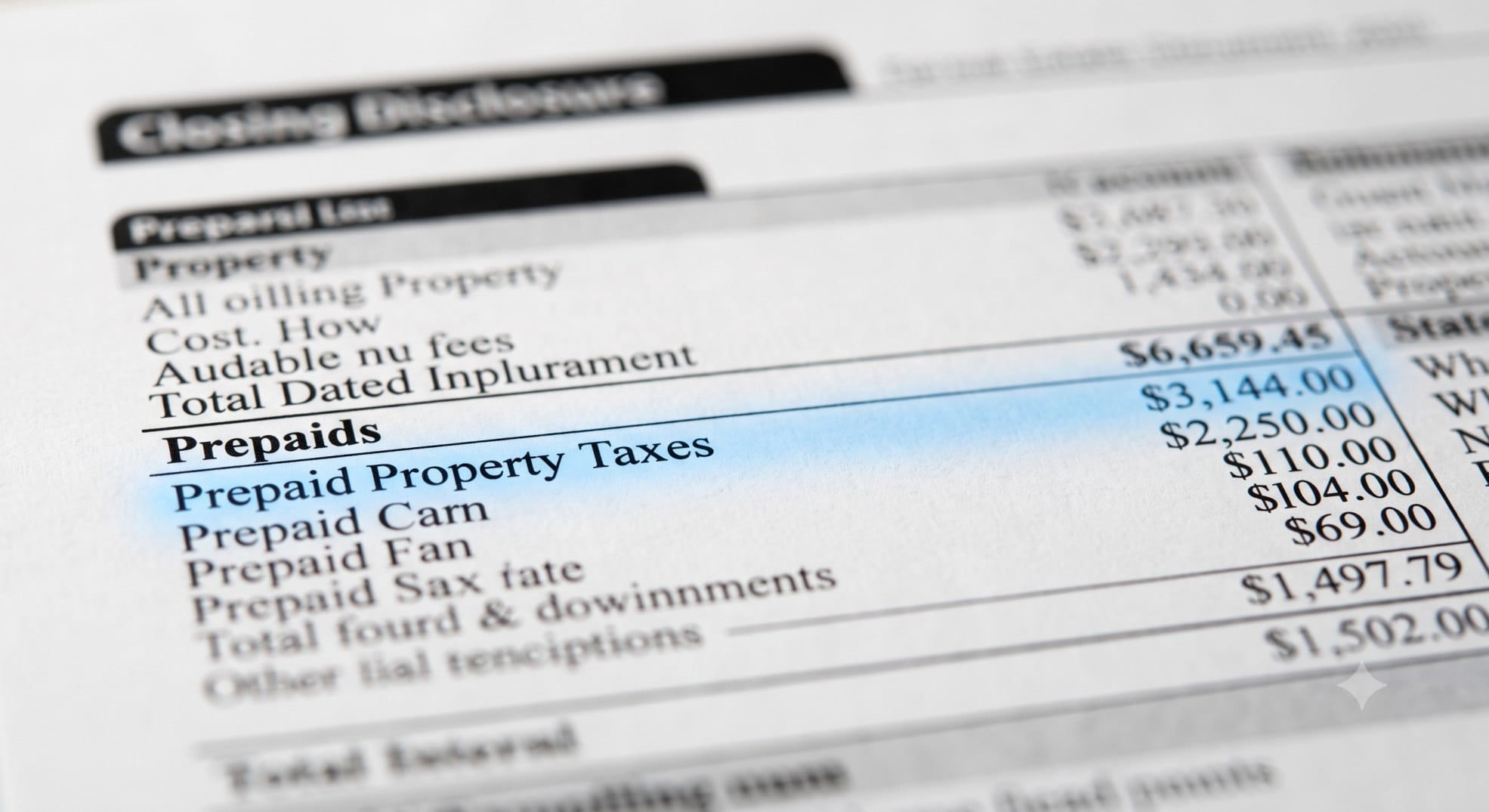
The rules shift slightly during the year you purchase or refinance a home. When you sit at the closing table, you will likely encounter prepaid real estate taxes. Lenders require you to “seed” your new escrow account with several months’ worth of tax payments upfront to ensure they have enough cash on hand when the first county bill arrives.
Are property taxes paid in advance or arrears? This depends entirely on your local municipality. Some states, like Texas, bill property taxes in arrears (you pay 2026 taxes at the end of 2026). Other states, like California, bill in advance or in split fiscal year installments. Your title company will prorate the taxes between you and the seller based on exactly how many days you each owned the home during the billing cycle.
You can deduct prepaid real estate taxes in the year you close on the house, provided the taxes were actually assessed for that specific year and the funds were disbursed to the county. If the money you paid at closing simply sits in your newly formed escrow account as a reserve buffer, it is not yet deductible. You must review your Closing Disclosure (HUD-1) statement. Look for the section detailing “Taxes and Other Government Fees.” You can deduct the prorated amount of taxes you reimbursed to the seller, as well as any direct payments made to the county at the time of closing.
Locating Your 1098 Form Property Taxes Paid From Escrow
You do not need to guess or manually calculate your escrow disbursements. By January 31st of each year, your mortgage servicer is legally required to send you IRS Form 1098 (Mortgage Interest Statement). This document provides the exact figures you need for your tax return.
To find your 1098 form property taxes paid from escrow, look directly at Box 10. This box is specifically labeled “Real estate taxes.” The dollar amount printed in Box 10 represents the total sum your lender transferred from your escrow account to the local tax authority during the previous calendar year.
If Box 10 is blank, it means the lender did not make any tax disbursements during that calendar year. This occasionally happens with newly constructed homes where the county has not yet assessed the finished property, or if the billing cycle simply did not fall within the January 1 to December 31 window. If you believe Box 10 is blank in error, you must contact your loan servicer immediately to request a corrected Form 1098.
Real-World Scenarios & Calculations
To fully grasp how these rules apply, we must look at the math. These hypothetical scenarios demonstrate how property taxes paid with mortgage accounts interact with the 2026 SALT cap and standard deductions.
Scenario 1: The Standard Escrow Disbursement
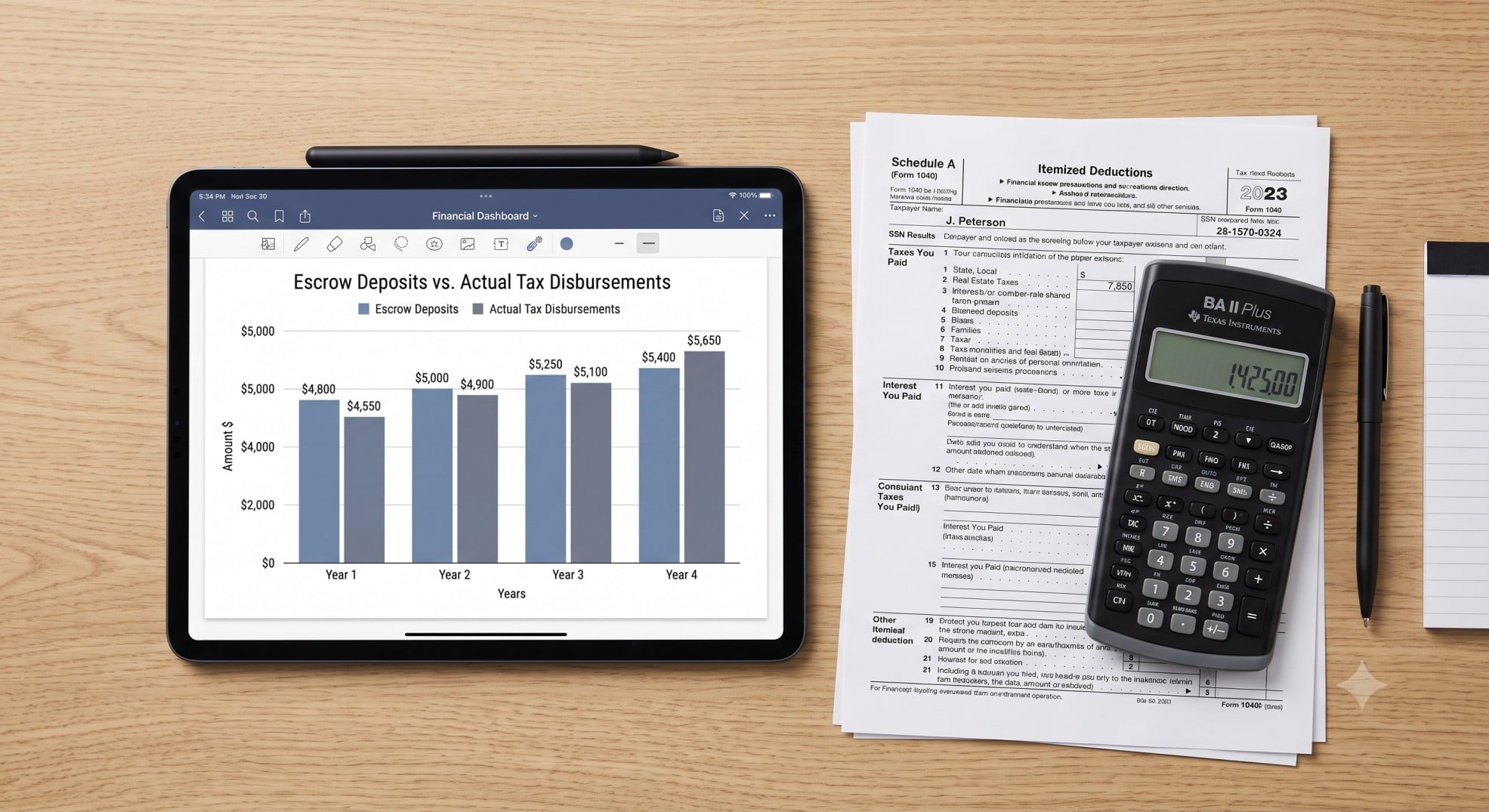
Michael is a single filer in Michigan. His mortgage payment includes $400 a month for property taxes, meaning he deposits $4,800 into his escrow account throughout 2026. In September, his county issues a tax bill for $4,500. His bank wires $4,500 from the escrow account to the county. Michael also pays $3,000 in state income taxes.
- Total Escrow Deposits: $4,800
- Actual Escrow Disbursement (Box 10): $4,500
- Total SALT (State Income + Property Tax): $7,500
- 2026 Single Standard Deduction: $16,100
The Logic: Michael asks, does escrow pay property tax? Yes, it paid $4,500. He cannot deduct the $4,800 he deposited. He can only claim the $4,500 disbursed. However, his total itemized deductions (including the $7,500 SALT) do not exceed his standard deduction of $16,100. Michael will take the standard deduction and will not directly itemize his property taxes.
Scenario 2: The Escrow Shortage and the 2026 SALT Cap
David and Sarah are married filing jointly in New York. Their property taxes spiked in 2026. Their bank had been collecting $1,500 a month ($18,000 total). The county tax bill arrived in October for $22,000. The bank paid the $18,000 from escrow, leaving a $4,000 shortage. The bank paid the shortage to avoid a lien, and then billed David and Sarah for the $4,000 difference, which they paid via personal check in December. They also paid $25,000 in state income taxes.
- Escrow Disbursement (Box 10): $22,000
- State Income Taxes: $25,000
- Total SALT Paid: $47,000
- 2026 MFJ SALT Cap: $40,400
- 2026 MFJ Standard Deduction: $32,200
The Logic: The bank disbursed the full $22,000 to the county in 2026. David and Sarah’s total state and local taxes equal $47,000. Because the 2026 SALT cap for married couples filing jointly is $40,400, they are capped at that amount. Since $40,400 is greater than their $32,200 standard deduction, they will itemize on Schedule A and claim the maximum $40,400 SALT deduction.
Scenario 3: The Mid-Year Purchase and Prepaid Taxes
Elena bought a house in Florida on August 1, 2026. At closing, she paid $3,000 in prepaid real estate taxes to fund her new escrow account. The seller had already paid the 2026 annual tax bill of $6,000 back in March. At closing, Elena had to reimburse the seller for the 5 months (August through December) she would own the home. $6,000 / 12 = $500 per month. $500 x 5 months = $2,500.
- Prepaid Escrow Funding: $3,000
- Prorated Taxes Reimbursed to Seller: $2,500
The Logic: Elena cannot deduct the $3,000 she used to fund her escrow account, because the bank has not yet sent that money to the county (the next bill isn’t due until 2027). She can, however, deduct the $2,500 she reimbursed to the seller at closing, because those taxes were assessed for 2026 and were paid to the county. She will find this $2,500 figure on her Closing Disclosure, not on a Form 1098.
Frequently Asked Questions About Escrow and Property Taxes
Taxpayers frequently encounter specific edge cases when dealing with mortgage servicers. This section addresses the most common technical questions regarding escrow accounts and tax deductions.
Can I deduct property taxes if they are paid through escrow?
Yes. You can deduct property taxes paid through an escrow account, provided you itemize your deductions on Schedule A. The IRS treats the payment exactly the same as if you had written a personal check to the county tax assessor. The only restriction is that you can only deduct the amount the escrow agent actually transferred to the county during the tax year.
Are property taxes included in mortgage payments if I don’t have an escrow account?
No. If you opted out of an escrow account (which usually requires a down payment of 20% or more), your monthly mortgage payment to the bank will only cover principal and interest. You are entirely responsible for saving for and paying your property tax bills directly to the county when they are due.
What happens if my bank forgets to pay my property taxes from escrow?
If your mortgage servicer fails to disburse the funds from your escrow account before the county deadline, you cannot claim the tax deduction for that year. Furthermore, the county will likely assess late fees and penalties. By law, if the servicer made the error, they are financially responsible for paying all resulting late fees and penalties, not the homeowner. In this scenario, does escrow pay property tax late? Yes, but you deduct it in the year they actually make the late payment.
Does my mortgage company pay my property taxes if my loan is sold?
Yes. It is very common for mortgages to be sold between servicers. When this happens, your escrow account balance is transferred directly to the new servicer. The new servicer assumes the legal responsibility of paying your upcoming property tax bills. You will likely receive two Form 1098s at the end of the year—one from each servicer. You must check Box 10 on both forms to calculate your total deduction.
Can I deduct the escrow cushion my lender requires me to keep?
No. Federal law allows lenders to require a two-month cushion in your escrow account to protect against unexpected tax increases. Because this money remains in the account and has not been paid to the taxing authority, it is not tax-deductible. It remains your money and will be refunded to you when you pay off the loan or sell the house.
How do I know if my property taxes are paid in advance or arrears?
You must check your local county tax assessor’s website. States operate on different fiscal calendars. For example, Illinois bills property taxes in arrears, meaning the bill you receive in 2026 is actually paying for the 2025 tax year. California bills in advance, splitting the fiscal year into two installments. Your local assessor’s office will explicitly state their billing cycle.
What if the amount in Box 10 of my 1098 doesn’t match my county tax bill?
If Box 10 on your Form 1098 does not match your county tax bill, you must investigate. The lender may have paid a supplemental tax bill, or they may have missed a payment. You can only deduct the amount actually paid. If you discover the lender underpaid, and you write a personal check to the county to cover the difference, you can deduct both the Box 10 amount and the amount of your personal check.
Are supplemental property taxes paid through escrow?
Usually, no. When you buy a house, the county often reassesses the property value, resulting in a one-time “supplemental” tax bill. Most mortgage servicers do not pay supplemental bills from your escrow account because they did not collect funds for it. You are generally responsible for paying supplemental bills directly out of pocket. You can deduct these direct payments in the year you make them.
Can I deduct special assessments paid through my escrow account?
Generally, no. If your county includes a special assessment on your tax bill for a local improvement (like a new sidewalk or sewer line), and your escrow account pays the total bill, you must subtract the assessment amount from your deduction. Special assessments that increase the value of your property are not deductible as real estate taxes; they are added to the cost basis of your home.
If I refinance, what happens to the property taxes in my old escrow account?
When you refinance, your old loan is closed. The old lender cannot transfer your escrow balance to the new lender. Instead, the old lender will mail you a check for the remaining escrow balance within 30 days. Simultaneously, your new lender will require you to bring cash to closing to fund a brand new escrow account. You only deduct the taxes actually disbursed to the county during the year, regardless of this account shuffling.
