
Executive Summary
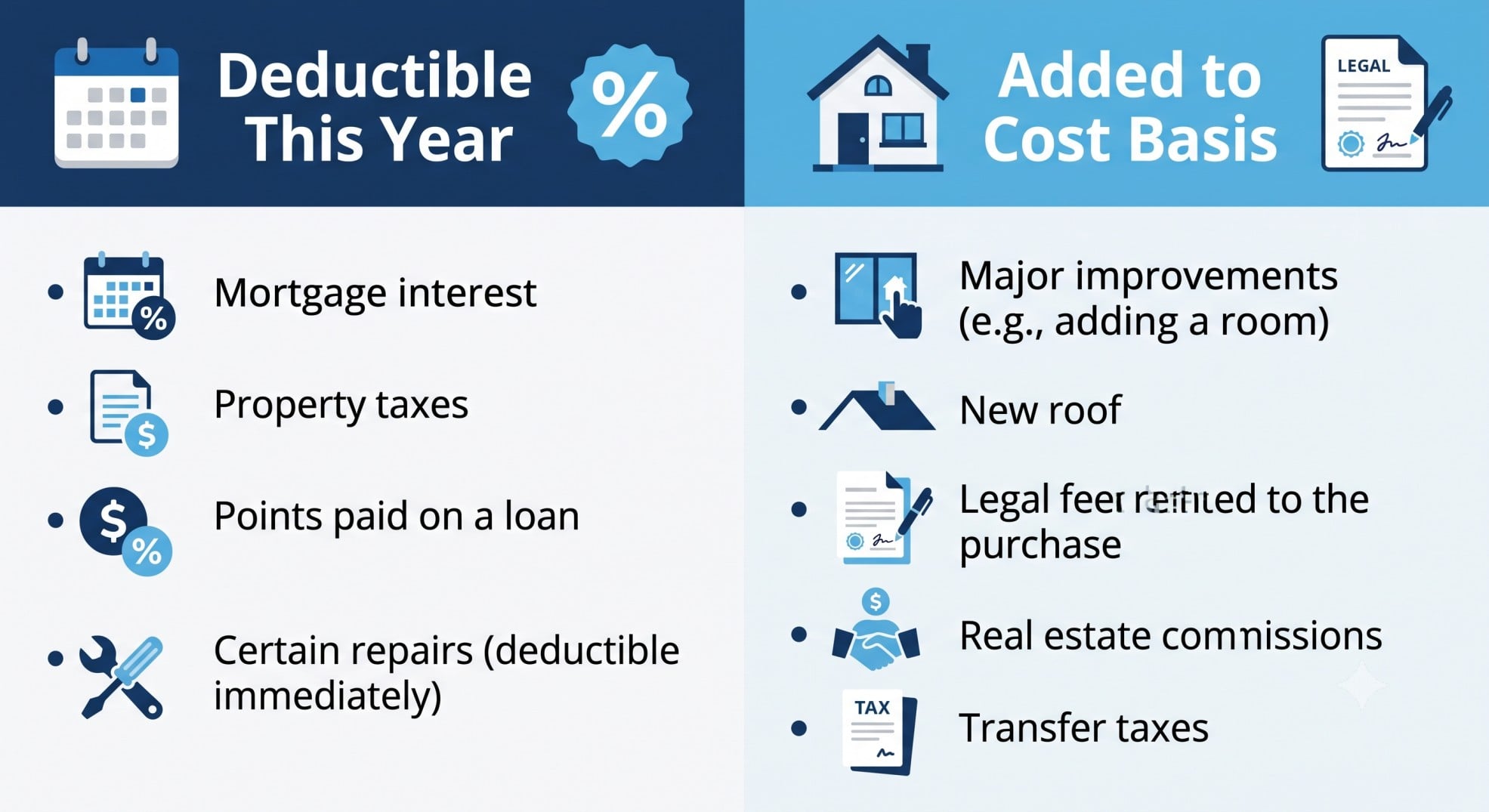
- Immediate Deductions: Mortgage points, prepaid interest, and prorated property taxes are generally deductible in the year you purchase the home.
- Cost Basis Additions: Title insurance, recording fees, transfer taxes, and legal fees are not immediately deductible but reduce your future capital gains tax by increasing your home’s cost basis.
- Refinancing Rules: Points paid on a refinance must typically be amortized over the life of the loan, rather than deducted all at once.
- Real Estate Commissions: Agent commissions are paid by the seller and reduce the realized gain on the sale; they are not an itemized deduction for the buyer.
Purchasing a home involves a mountain of paperwork and thousands of dollars in settlement fees. After leaving the closing table, buyers immediately want to know how to recoup some of those expenses on their tax return. The most common question CPAs hear in the spring is, are closing costs deductible?
The IRS treats real estate transactions with strict categorization. You cannot simply take the bottom-line number from your Closing Disclosure and write it off on Schedule A. Instead, the tax code divides settlement fees into three distinct buckets: expenses you can deduct immediately, expenses that add to your property’s cost basis, and personal expenses that offer no tax benefit whatsoever. Understanding these categories is a foundational part of maximizing your homeowners tax write offs.
To successfully claim tax deductible closing costs in 2026, your total itemized deductions must exceed the standard deduction. If you take the standard deduction, your immediate closing cost write-offs provide no extra financial benefit, though your cost basis additions remain highly valuable for the future.
This guide breaks down exactly what settlement costs are tax deductible, how to handle refinancing fees, and the step-by-step math required to report these figures accurately to the IRS.
Are Closing Costs Deductible When Buying a House?
Yes, but only specific line items. When asking, are closing costs deductible when buying a house, you must look at the nature of the fee. The IRS allows you to deduct fees directly related to the cost of borrowing money or paying local taxes. Fees related to acquiring the physical property or securing the title are not immediately deductible.
If you attempt to deduct your entire settlement bill, the IRS will flag your return. You must isolate the qualifying expenses found on your Closing Disclosure (CD) or HUD-1 settlement statement.
Tax Deductible Closing Costs in the Year of Purchase
The following expenses can be deducted in the tax year you close on the home, provided you itemize your deductions on Schedule A.
1. Mortgage Points (Discount Points)
Mortgage points are fees paid directly to the lender at closing in exchange for a reduced interest rate. One point equals 1% of your total loan amount. The IRS considers these points to be prepaid mortgage interest. Because they are interest, they are fully deductible in the year you buy the home, provided they meet specific IRS tests.
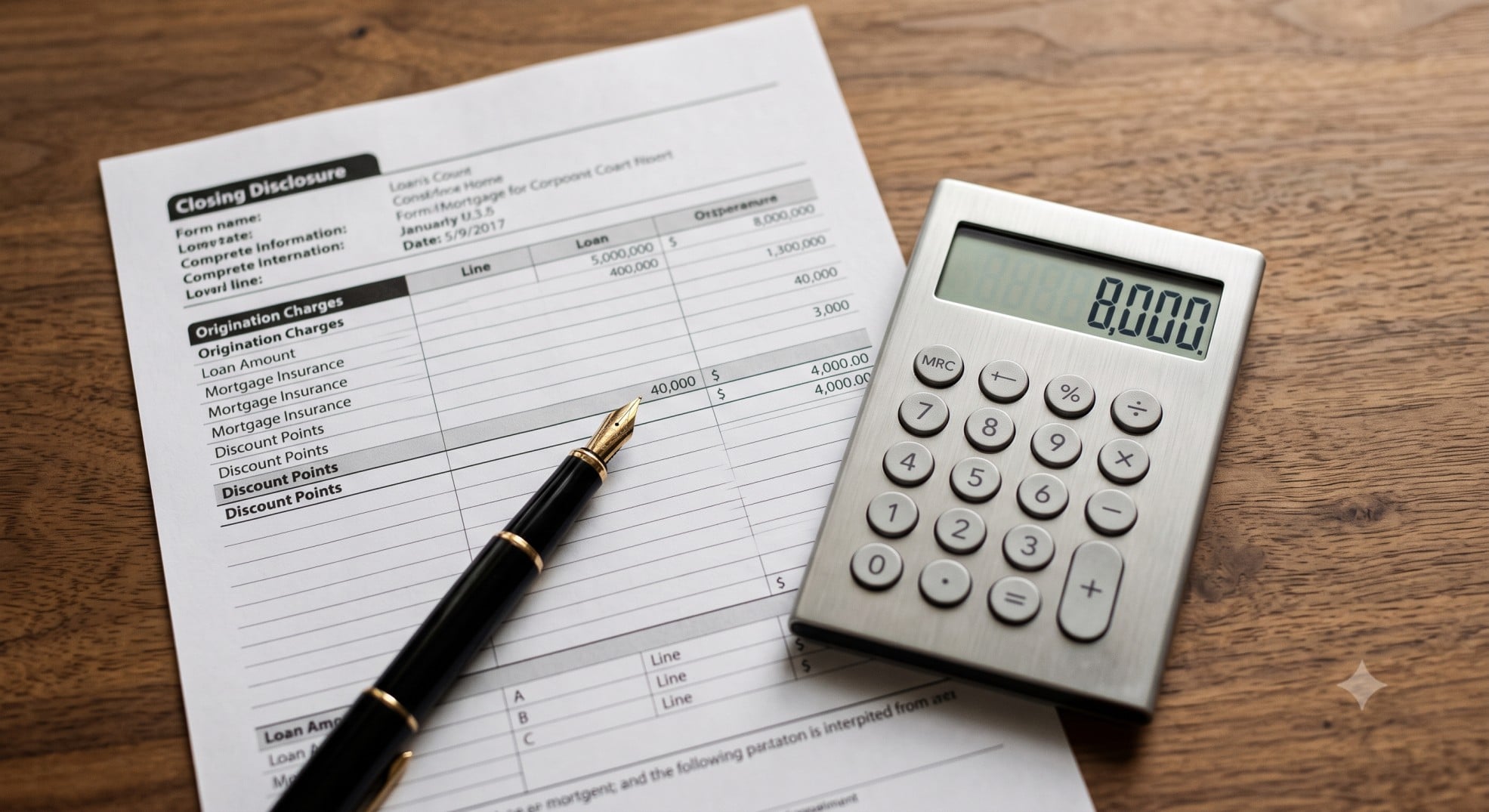
To deduct points immediately, the loan must be secured by your primary residence, paying points must be an established business practice in your area, and the points must be computed as a percentage of the loan amount. They cannot be a substitute for appraisal fees, inspection fees, or attorney fees.
Hypothetical Scenario: Calculating the Points Deduction
A buyer takes out a $600,000 mortgage to purchase a primary residence in 2026. To lower their interest rate, they purchase 1.5 discount points at closing.
Calculation: $600,000 x 0.015 (1.5%) = $9,000.
The buyer paid $9,000 in points. Assuming they itemize, they can add this $9,000 directly to their mortgage interest deduction on Schedule A for the 2026 tax year.
2. Prorated Property Taxes
When you close on a house, you usually reimburse the seller for property taxes they prepaid for the remainder of the year, or you pay a prorated amount directly to the municipality. This prorated amount is fully deductible as a State and Local Tax (SALT).
For the 2026 tax year, the SALT deduction cap limits how much you can write off. Your prorated property taxes at closing count toward this limit, alongside your state income taxes and standard annual property tax bills.
3. Prepaid Mortgage Interest
Your first official mortgage payment is usually due a full month after closing. Interest accrues daily in the interim. At closing, you pay “per diem” (daily) interest from the day you close until the end of that month. This prepaid interest is fully deductible in the year of purchase.
What Settlement Costs Are Tax Deductible by Adding to Your Cost Basis?
Many buyers are disappointed to learn that title fees and transfer taxes are not immediate write-offs. These fees still provide a massive tax benefit. Instead of deducting them today, you add them to your home’s “cost basis.”
Your cost basis is the original purchase price of the home plus qualifying settlement fees and future capital improvements. When you eventually sell the home, your capital gain is calculated by subtracting your cost basis from the sale price. A higher cost basis means a lower taxable profit.
The following settlement costs are added to your basis:
- Title search and title insurance fees
- Transfer taxes and recording fees paid to the county
- Legal and attorney fees related to the property transfer
- Survey fees
- Owner’s title insurance policy premiums
- Any back taxes or utility bills owed by the seller that you agreed to pay

Hypothetical Scenario: The Power of Cost Basis
A single taxpayer buys a home for $400,000. At closing, they pay $8,000 in title insurance, transfer taxes, and recording fees. Their official cost basis is now $408,000.
Seven years later, they sell the home for $670,000. To find their profit, they subtract their basis from the sale price: $670,000 – $408,000 = $262,000 in capital gains.
The IRS allows single filers to exclude up to $250,000 in capital gains on a primary residence. Because their gain is $262,000, they owe capital gains tax on the remaining $12,000. If they had not tracked their $8,000 in settlement fees, their calculated gain would have been $270,000, and they would have owed taxes on $20,000. Tracking those fees saved them hundreds of dollars in federal taxes upon the sale.
Can You Deduct Closing Costs on a Refinance?
Homeowners frequently ask, can you deduct closing costs on a refinance? The rules for refinancing are significantly stricter than the rules for an initial purchase.
When you refinance, you are not buying a home; you are simply replacing one loan with another. Because of this, you cannot deduct mortgage points in full in the year you pay them. The IRS requires you to amortize (spread out) the deduction over the life of the new loan.
Amortizing Refinance Points
If you pay $3,600 in points to refinance into a 30-year (360-month) mortgage, you must divide the cost by the number of months. $3,600 / 360 = $10 per month. You can deduct $120 per year for the next 30 years.
The Home Improvement Exception
There is one major exception. If you do a cash-out refinance and use a portion of the funds to “buy, build, or substantially improve” your primary residence, you can deduct the points associated with that portion of the loan immediately.
Step-by-Step Mixed-Use Refinance Calculation:
You refinance your home with a new $300,000 mortgage and pay $6,000 in points.
You use $200,000 to pay off the old mortgage and take $100,000 in cash to build a new master suite.
Because one-third ($100,000 / $300,000) of the loan was used for home improvements, you can deduct one-third of the points immediately.
Immediate deduction: $6,000 x 33.3% = $2,000.
The remaining $4,000 in points must be amortized over the life of the loan.
Are Real Estate Commission Fees Tax Deductible?
Buyers and sellers both wonder, Are real estate commission fees tax deductible? The answer depends entirely on which side of the transaction you are on, but they are never an itemized deduction on Schedule A.
For the Seller: The seller traditionally pays the real estate agent commissions (usually 5% to 6% of the sale price). This fee is deducted from the final sale proceeds. It directly reduces the seller’s realized capital gain. If you sell a house for $500,000 and pay $30,000 in commissions, your “amount realized” for tax purposes is $470,000. It is a highly valuable tax benefit, but it is factored into the capital gains calculation, not deducted against your ordinary income.
For the Buyer: In rare cases where a buyer pays their agent’s commission directly out of pocket, that fee is added to the home’s cost basis. It will help reduce capital gains tax when the buyer eventually sells the property, but it provides no immediate tax relief in the year of purchase.
Step-by-Step Guide: How to Deduct Closing Costs on Taxes
If you want to deduct closing costs on taxes, you must follow a precise documentation process. Missing a step can result in an IRS audit or leaving thousands of dollars on the table.
- Locate Your Closing Disclosure (CD): This five-page document outlines every fee paid at settlement. Look specifically at Page 2, under “Origination Charges” and “Other Costs.”
- Identify Deductible Items: Highlight the line items for Discount Points, Prepaid Interest, and Prorated Property Taxes. Ignore appraisal fees, home inspection fees, and title fees for this step.
- Review Form 1098: Your mortgage servicer will mail you Form 1098 early in the year following your purchase. Box 1 shows your mortgage interest (including prepaid interest), Box 6 shows points paid on the purchase, and Box 10 often shows property taxes paid.
- Compare to the Standard Deduction: Add your tax deductible closing costs to your other itemized deductions (state income taxes, charitable gifts). If this total exceeds the standard deduction for your filing status, you should itemize. If it does not, take the standard deduction.
- File Schedule A: If itemizing, report your points and interest on Line 8a of Schedule A (Form 1040). Report your prorated property taxes on Line 5b.
- Update Your Cost Basis Ledger: Take the non-deductible fees (title insurance, transfer taxes) and record them in a permanent file. You will need these numbers years or decades from now when you sell the property.
Frequently Asked Questions
Are closing costs deductible?
Are closing costs deductible? Yes, but only specific types. You can immediately deduct fees related to borrowing money (mortgage points, prepaid interest) and local taxes (prorated property taxes). Fees related to the physical property transfer (title insurance, appraisals) are not immediately deductible.
What closing fees are tax deductible?
What closing fees are tax deductible in the year you buy the home? The IRS specifically allows deductions for discount points, origination fees calculated as a percentage of the loan, prepaid per diem interest, and prorated state and local property taxes paid at the closing table.
What settlement costs are tax deductible by adding to the basis?
What settlement costs are tax deductible by increasing your cost basis? You can add title search fees, owner’s title insurance premiums, transfer taxes, recording fees, legal fees, and survey fees to your home’s original purchase price. This reduces your taxable capital gains when you sell.
Are real estate commission fees tax deductible?
Are real estate commission fees tax deductible? They are not an itemized deduction on Schedule A. Instead, for the seller, commissions reduce the total realized sale price of the home, which directly lowers the capital gains tax owed on the transaction.
Are points on a mortgage tax deductible?
Are points on a mortgage tax deductible? Yes. The IRS considers discount points to be prepaid mortgage interest. If you buy a primary residence and meet standard IRS criteria, you can deduct the full cost of the points in the year you close on the loan.
Are closing costs deductible when buying a house with cash?
If you buy a house with cash, you do not have a mortgage. You have no mortgage points, no prepaid interest, and no origination fees to deduct. The only closing cost you can deduct immediately is your prorated property taxes. All other settlement fees (title, legal, transfer taxes) must be added to your cost basis.
Can you deduct closing costs on a refinance?
Can you deduct closing costs on a refinance? Generally, no. You cannot deduct refinance points all at once. You must amortize them over the life of the new loan, deducting a small fraction each year. The only exception is if you use part of the refinance cash to substantially improve your home.
How do I deduct closing costs on taxes if I use standard deduction?
If you take the standard deduction, you cannot deduct closing costs on taxes for the current year. Immediate write-offs like points and interest require you to itemize on Schedule A. You still add title fees and transfer taxes to your cost basis, which benefits you regardless of whether you itemize.
Are appraisal and home inspection fees deductible?
No. Appraisal fees, home inspection fees, pest inspections, and credit report fees are considered personal expenses by the IRS. They are not deductible in the year of purchase, nor can they be added to the home’s cost basis. They provide zero tax benefit.
Is title insurance a tax deductible closing cost?
Title insurance is not an immediate tax deductible closing cost. You cannot write it off on Schedule A in the year you buy the house. You add the cost of the owner’s title insurance policy to the cost basis of the home, which lowers your capital gains tax liability when you eventually sell.
Disclaimer: The tax information provided in this article is for general educational purposes only and does not constitute legal or tax advice. Tax laws, including standard deductions, brackets, and phase-out limits, are subject to frequent changes by the IRS and Congress. Every taxpayer’s financial situation is unique. We strongly recommend consulting with a licensed Certified Public Accountant (CPA) or Enrolled Agent (EA) to verify how current tax laws apply to your specific circumstances before filing your return.
