
⚡ Executive Summary: Tax Deduction Fundamentals
- A tax deduction is a specific dollar amount that lowers your taxable income before the IRS applies its tax brackets.
- The flat baseline amount for a single filer in 2026 is $16,100, while married couples filing jointly receive $32,200.
- You claim this write-off directly on Line 12 of your Form 1040, requiring no receipts or expense tracking.
- The One Big Beautiful Bill Act (OBBBA) made these higher thresholds permanent, preventing a major tax hike for the 2026 filing season.
Every year, millions of Americans file their taxes without fully understanding the math happening behind the scenes. You might see a specific number subtracted from your total earnings, but you may still wonder exactly how the system works. Answering the question of what does a standard tax deduction mean forms the foundation of basic financial literacy. This guide breaks down the exact mechanics of the federal tax code for beginners. We will show you how this flat rate shields your hard-earned money from the IRS.
Understanding the Basics: What Does a Standard Tax Deduction Mean?
To grasp the federal tax system, you first need to know what is a standard deduction used for in everyday accounting. The government does not tax every single dollar you earn. They allow you to keep a specific portion of your income completely tax-free to cover basic living expenses.
When someone asks what does a standard tax deduction mean, the answer is straightforward. It is a guaranteed, flat-dollar reduction to your Adjusted Gross Income (AGI). You get to subtract this fixed amount from your total earnings before the IRS applies any marginal tax brackets. Think of it as a protective shield around a portion of your paycheck.

You do not need to save receipts or prove your expenses to claim this benefit. The IRS grants this flat rate to almost everyone. Understanding what is standard deduction math helps you realize why tax preparation is often much simpler than people assume.
The Mechanics: How Are Standard Deductions Calculated?
The IRS does not pull these numbers out of thin air. If you want to know how are standard deductions calculated, you have to look at federal legislation and inflation metrics. Congress sets the baseline amounts through tax laws.
Once Congress establishes the base figure, the IRS uses the Chained Consumer Price Index (C-CPI) to adjust the numbers annually. This ensures your tax-free threshold keeps pace with the rising cost of groceries, housing, and gas. Having the standard deduction explained in this way shows that the government actively prevents inflation from secretly pushing you into a higher tax bracket.
Your specific filing status dictates your exact baseline amount. A single person receives a different flat rate than a married couple or a single parent. We will look at exactly the math for your specific family dynamic in the next section.
The 2026 Baseline: What is Tax Deduction for 2026?
Tax rules changed significantly this year. The passage of the One Big Beautiful Bill Act (OBBBA) in 2025 made the higher tax brackets permanent, preventing a scheduled expiration that would have slashed your write-offs in half.
People preparing their returns are currently asking, what is tax deduction for 2026? The IRS set the baseline amount at $16,100 for single filers and married individuals filing separately. Married couples filing jointly receive a substantial $32,200 reduction. Head of household filers get $24,150.
This personal deduction 2026 amount represents a slight increase from the previous year due to the inflation adjustments mentioned earlier. You can review our complete breakdown of the 2026 standard deduction updates to see how these new permanent laws affect senior citizens and dependents.
Knowing the exact figures allows you to project your tax liability accurately before the April deadline arrives.
Locating the Write-Off: Where is Standard Deduction on 1040?
Finding this exact figure on your paperwork is incredibly easy. Taxpayers often ask where is standard deduction on 1040 when reviewing their final documents. You will find it right on the first page of the main federal tax form.
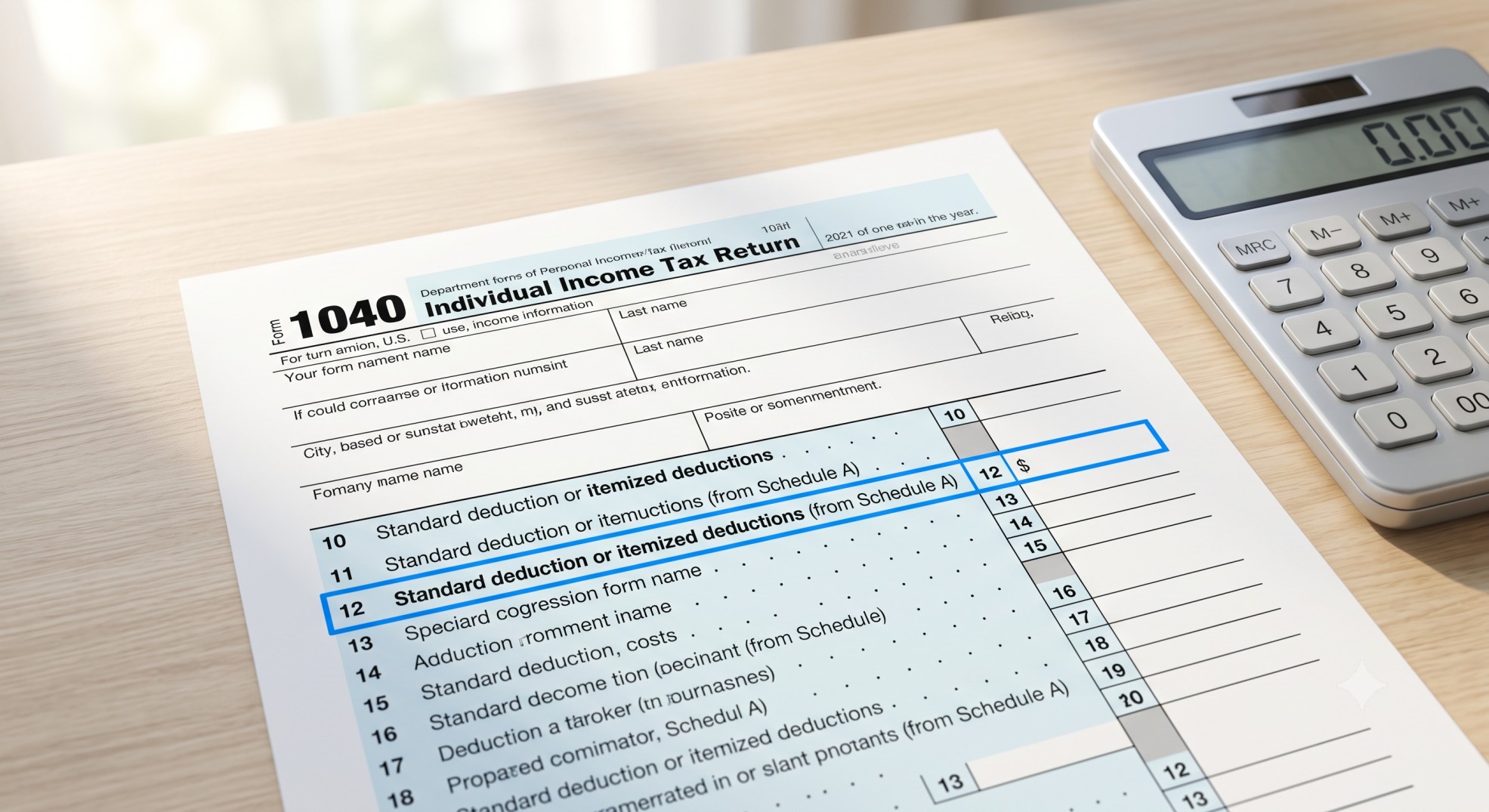
Look at Line 12 on your Form 1040. This specific line is dedicated entirely to your flat baseline write-off or your itemized expenses. If you use digital tax software, the program automatically populates Line 12 based on your age and filing status.
Seeing the number printed on Line 12 visually answers what does a standard tax deduction mean. You literally see your total income on Line 11 drop significantly by the time you reach Line 15, which represents your final taxable income.
The Math: Does the Standard Deduction Reduce Your Taxable Income?
New filers frequently ask, does the standard deduction reduce your taxable income directly, or does it just increase a refund? It directly reduces your taxable income. It is not a tax credit, which reduces your final tax bill dollar-for-dollar. Instead, it shrinks the pool of money the IRS is allowed to tax.
The standard deduction formula is simple: Adjusted Gross Income (AGI) minus your flat baseline amount equals your Taxable Income. If your AGI is $60,000 and your flat rate is $16,100, your taxable income becomes $43,900.
This math shows exactly what is standard deduction power in action. By dropping your taxable income down to $43,900, you keep more of your money in the lower 10% and 12% tax brackets, completely avoiding the higher 22% bracket.
The Flat Rate vs. Itemizing: Making the Right Choice
You have a choice to make every spring. You can take the basic standard deduction, or you can itemize your expenses on Schedule A. You are legally prohibited from claiming both.
Itemizing requires you to add up specific out-of-pocket expenses, such as mortgage interest, state and local taxes (SALT), and charitable donations. If the total of these specific expenses is larger than your flat baseline amount, you should itemize. If it is smaller, you take the flat rate.
Deciding between the standard vs itemized deductions comes down to basic arithmetic. For roughly 90% of Americans, the flat rate yields a larger tax break and requires zero receipt tracking. This simplicity is the core of what does a standard tax deduction mean for the average household.
Real-World Scenarios: Applying the Personal Deduction 2026
Looking at practical examples makes these concepts much easier to digest. Let’s walk through four distinct hypothetical scenarios to see how are standard deductions calculated in the real world.
Scenario 1: The Young Professional
Emma is 24, single, and earns $55,000 a year working as a graphic designer in Texas. She rents an apartment, pays no state income tax, and has no major medical expenses. She donated $300 to a local animal shelter.
Because she does not own a home, she has no mortgage interest to deduct. Her only itemized expense is the $300 charitable gift. Her personal deduction 2026 is $16,100. She subtracts this from her $55,000 AGI. Her taxable income drops to $38,900. Emma completely avoids the hassle of itemizing and keeps her tax preparation incredibly simple, while still getting a large tax break.
Scenario 2: The Married Homeowners
David and Sarah are married filing jointly in Ohio. They earn a combined AGI of $110,000. They paid $12,000 in mortgage interest, $8,000 in property taxes, and $3,000 in state income taxes.
Their total itemized expenses equal $23,000. Because this number is significantly lower than the $32,200 joint flat rate, they will take the flat baseline. This scenario perfectly illustrates what does a standard tax deduction mean for middle-class homeowners. The guaranteed amount often beats actual out-of-pocket expenses, meaning you do not always need to itemize just because you bought a house.
Scenario 3: The Single Parent
Marcus is divorced and has primary custody of his 10-year-old son. He pays all the rent, groceries, and utilities for their home. He earns $75,000 a year as a warehouse manager.
Because he is unmarried and supports a qualifying dependent, Marcus qualifies for the Head of Household status. His baseline write-off is $24,150. Subtracting this from his $75,000 AGI leaves him with a taxable income of $50,850. This elevated status provides him with $8,050 more in tax-free income compared to filing as a single individual.
Scenario 4: The Qualifying Senior
Linda is 68, single, and living on a $45,000 pension. The IRS provides extra write-offs for older adults to help offset the costs of aging on a fixed income.
She gets the $16,100 baseline, plus a $2,050 age add-on, plus a $6,000 senior bonus created by the OBBBA. Her total write-off is $24,150. Her taxable income drops to just $20,850. This shows exactly how are standard deductions calculated when age-based bonuses apply, wiping out federal taxes on more than half of her retirement income.
Common Mistakes to Avoid When Filing
Even though the flat rate is designed for simplicity, taxpayers still make errors that trigger IRS letters or delay their refunds. Avoiding these common pitfalls ensures your return processes smoothly.
First, never guess your filing status. Claiming Head of Household when you only qualify for Single is a major red flag for the IRS. You must meet strict dependency and household maintenance tests to claim the higher $24,150 amount.
Second, do not forget the age and blindness checkboxes. If you turn 65 on December 31, you qualify for the extra add-on for the entire tax year. Failing to check the box on Form 1040 means you leave thousands of dollars in tax-free income on the table.
Third, remember that spouses filing separately must match their deduction methods. If you are married filing separately and your spouse chooses to itemize their heavy medical bills, you are legally forced to itemize as well. You cannot claim the flat $16,100 rate if your partner uses Schedule A.
Step-by-Step: Claiming Your Write-Off
You do not need to fill out complex supplementary schedules to claim this benefit. The IRS integrated the process directly into the main filing workflow.

Step 1: Determine Your Filing Status
Your family situation on December 31 dictates your status for the entire 12-month period. If you get married on New Year’s Eve, the IRS considers you married for the whole year. You must know if you are single, married, or a head of household to find out what is tax deduction for 2026 in your specific case.
Step 2: Calculate Your Adjusted Gross Income (AGI)
Before you can apply your write-off, you need your starting number. Tally all your income sources, including W-2 wages, 1099 freelance gig money, and investment dividends. Subtract any above-the-line adjustments like student loan interest or traditional IRA contributions to find your AGI on Line 11.
Step 3: Check Age and Blindness Boxes
Look at the top of Form 1040, right below your address. Check the specific boxes if you or your spouse were born before January 2, 1962, or are legally blind. This ensures you get the extra add-ons applied to your baseline amount.
Step 4: Enter the Amount on Line 12
Write your final flat rate on Line 12 of Form 1040. This action finalizes what does a standard tax deduction mean for your return, locking in your tax-free threshold. If you use digital software, the program handles this automatically.
Step 5: Claim Above-the-Line Charity
Starting in 2026, non-itemizers can deduct up to $1,000 in cash charitable contributions ($2,000 for joint filers) on Schedule 1. Make sure you claim this extra benefit even if you take the flat rate.
Step 6: Calculate Your Final Taxable Income
Subtract Line 12 from Line 11. The result on Line 15 is your taxable income. This is the actual number the IRS uses to calculate your tax bill against the federal brackets.
Frequently Asked Questions
What does a standard tax deduction mean for a beginner?It means you get to subtract a fixed dollar amount from your total income before calculating your taxes. This guaranteed write-off ensures that a portion of your earnings remains completely tax-free to cover basic living expenses.
What is standard deduction going to be next year?The baseline amounts adjust annually for inflation. For the 2026 tax year, the amounts are $16,100 for single filers, $32,200 for married couples filing jointly, and $24,150 for head of household filers.
How are standard deductions calculated by the IRS?Congress sets the base legislative amounts, and the IRS adjusts those figures every year using the Chained Consumer Price Index (C-CPI). This inflation adjustment prevents taxpayers from facing higher tax burdens simply because the cost of living increased.
Can I claim the personal deduction 2026 and still itemize?No. You must choose one or the other. You cannot claim the flat baseline amount and also deduct your individual mortgage interest or property taxes on Schedule A.
What is tax deduction for 2026 if I am over 65?Seniors receive the baseline amount plus an age add-on of $2,050 (single) or $1,650 (married). The new OBBBA legislation also provides a $6,000 bonus deduction for taxpayers 65 and older, subject to income phase-outs.
Do I need to keep receipts to claim this?No. The flat baseline requires absolutely no proof, receipts, or expense tracking. You simply enter the correct amount for your filing status directly on your tax return.
Does this deduction reduce my self-employment taxes?No. This specific write-off only reduces your federal income tax liability. It does not lower the Medicare and Social Security taxes you owe on your net business income.
Can dependents claim their own flat rate?Yes, but the amount is limited. A dependent’s write-off cannot exceed the greater of $1,350 or their earned income plus $450 (capped at the regular $16,100 single limit).
What happens if my deduction is larger than my income?If your flat rate exceeds your Adjusted Gross Income, your taxable income becomes zero. You will not owe any federal income tax for that calendar year.
Did the tax cuts expire in 2026?No. The One Big Beautiful Bill Act (OBBBA) passed in 2025 made the higher TCJA baseline amounts permanent. The scheduled expiration was canceled, keeping your tax-free thresholds high.
