
⚡ Executive Summary: 2026 Tax-Loss Harvesting
- Tax-loss harvesting allows investors to sell assets at a loss to offset capital gains realized from winning investments.
- If your losses exceed your gains, you can use the net capital loss deduction to offset up to $3,000 of ordinary income per year.
- The wash sale rule strictly prohibits claiming a loss if you purchase a “substantially identical” asset within 30 days before or after the sale.
- The tax-loss harvesting deadline is December 31 of the tax year; trades must settle by this date to count for the current year.
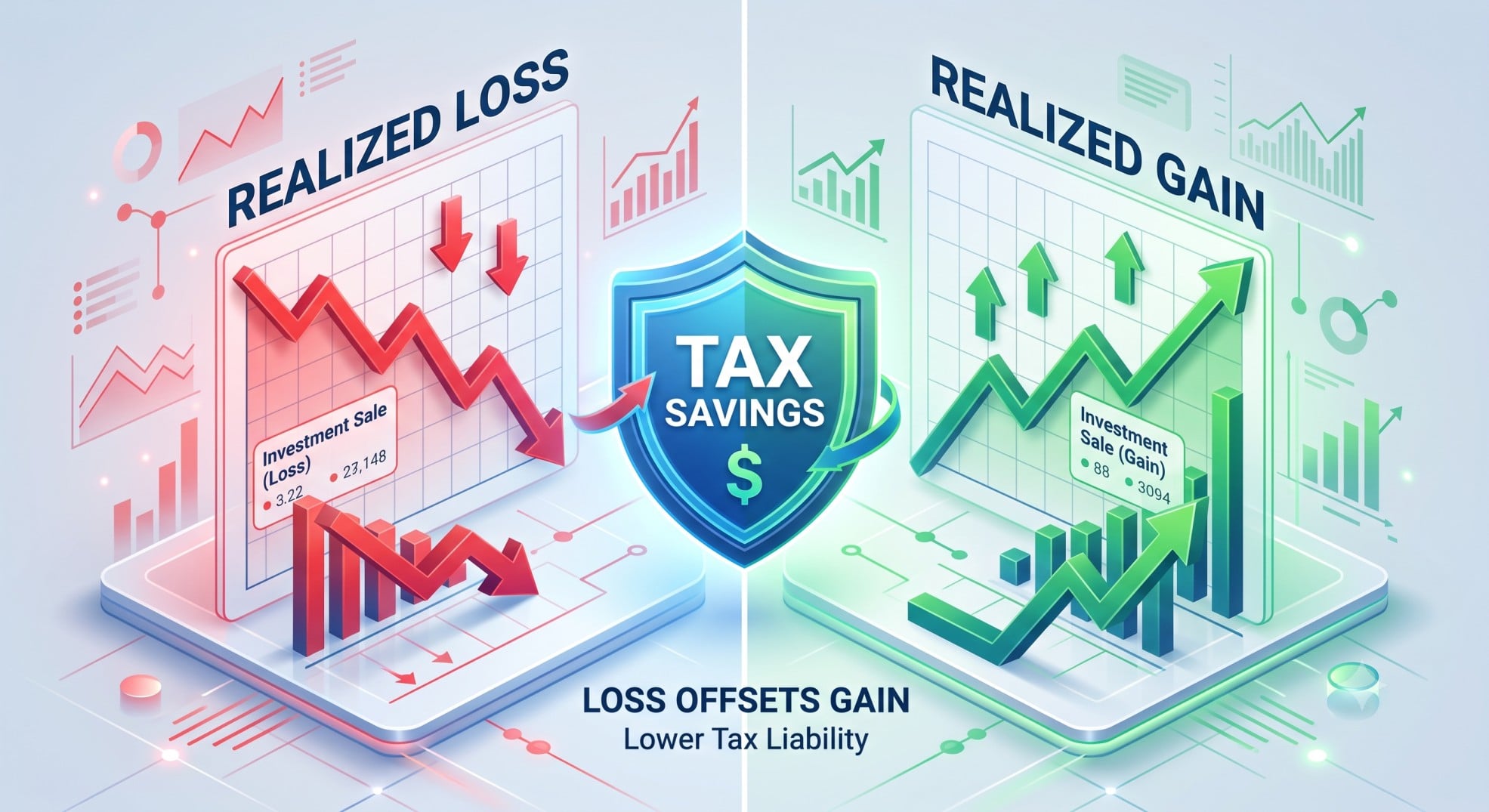
Table of Contents
- What Is Tax-Loss Harvesting?
- How Tax-Loss Harvesting Works: Step-by-Step
- The Benefits of Tax-Loss Harvesting
- Tax-Loss Harvesting Rules: The Matching Process
- The Tax-Loss Harvesting Limit and Carryovers
- Navigating the Wash Sale Rule
- Making Cost Basis Count
- The Tax-Loss Harvesting Deadline
- Frequently Asked Questions
Nobody likes watching their investments lose value. But in the US tax system, a portfolio loss is a highly valuable financial asset. If you understand the mechanics of tax-loss harvesting, you can transform market downturns into guaranteed tax savings.
This strategy is the cornerstone of tax-efficient investing. Instead of passively holding onto losing stocks or mutual funds, proactive investors intentionally sell them. They use those losses to offset capital gains from other investments, effectively neutralizing their tax liability. If done correctly, tax-loss selling can even shield a portion of your regular salary from the IRS.
We will break down exactly how tax-loss harvesting works, the strict IRS matching rules you must follow, and how to avoid the common traps that trigger audits.
What Is Tax-Loss Harvesting?
Tax-loss harvesting is the practice of selling a taxable investment—like a stock, bond, or ETF—that has dropped below its original purchase price. By realizing this loss, you generate a tax deduction. You then use this deduction to offset capital gains you realized from selling profitable investments during the same tax year.
This strategy only applies to taxable brokerage accounts. You cannot harvest losses inside tax-advantaged retirement accounts like a 401(k) or an IRA, because the IRS does not tax the individual transactions inside those accounts anyway.
How Tax-Loss Harvesting Works: Step-by-Step
Understanding how tax-loss harvesting works requires looking at your portfolio holistically. You are not just selling a loser; you are pairing it with a winner. Here is the standard process for executing tax-loss selling.
- Identify the Loss: Review your taxable brokerage account for assets currently trading below your cost basis. Making cost basis count is critical here—you need to know exactly what you paid for specific shares.
- Sell the Asset: Execute the trade to realize the loss. Until you sell, the loss is only “on paper” and the IRS does not care about it.
- Offset Capital Gains: Apply the realized loss against any realized capital gains for the year. The IRS requires you to match short-term losses with short-term gains first, which we will explain in detail below.
- Reinvest the Cash (Carefully): You don’t want your money sitting in cash. You reinvest the proceeds into a similar—but not “substantially identical”—asset to maintain your target asset allocation without violating the wash sale rule.
When people ask how tax-loss harvesting works, they often forget that fourth step. The goal is to capture the tax benefit while keeping your money in the market so it can recover when the sector rebounds.
The Benefits of Tax-Loss Harvesting
The primary benefits of tax-loss harvesting revolve around keeping more of your money compounding in the market rather than handing it over to the Treasury. It is a fundamental pillar of tax-efficient investing.
First, it provides immediate capital gains tax reduction. If you sell a highly appreciated stock to fund a home purchase or rebalance your portfolio, you will owe taxes on that profit. Harvesting losses wipes out that tax bill dollar-for-dollar.
Second, it acts as an interest-free loan from the government. By deferring taxes today, you have more capital invested tomorrow. Over a 20-year investing horizon, the compounding effect of that retained capital is massive. The benefits of tax-loss harvesting compound exponentially the longer you keep the money invested.
Finally, it allows you to upgrade your portfolio. Tax-loss selling forces you to weed out underperforming assets and replace them with better-positioned funds, all while generating a tax deduction.
Tax-Loss Harvesting Rules: The Matching Process
You cannot simply lump all your gains and losses together. The IRS enforces strict tax-loss harvesting rules regarding how you match different types of investments. The system is categorized by how long you held the asset before selling it.
- Short-term: Assets held for one year or less.
- Long-term: Assets held for more than one year.
This distinction matters because short-term capital gains are taxed at your ordinary income tax rates (up to 37%), while long-term capital gains benefit from preferential rates (0%, 15%, or 20%). Therefore, short-term capital losses are mathematically more valuable because they offset higher-taxed income.
The IRS Stacking Order
Under the tax-loss harvesting rules, you must follow a specific order of operations:
- Short-term capital losses must first offset short-term capital gains.
- Long-term capital losses must first offset long-term capital gains.
- If you have a net loss in one category and a net gain in the other, you can cross them over.
Example 1: The Basic Crossover
Let’s say you are an active trader. In 2026, you realize $10,000 in short-term capital losses. You also realize $4,000 in short-term capital gains and $5,000 in long-term capital gains.
First, you apply the short-term losses against the short-term gains. ($10,000 loss – $4,000 gain = $6,000 remaining short-term loss).
Next, you cross over. You apply that remaining $6,000 short-term loss against your $5,000 long-term gain. This wipes out your long-term capital gains tax entirely.
You are left with a final net loss of $1,000 for the year.
Read more about the differences between short-term and long-term capital gains rates.The Tax-Loss Harvesting Limit and Carryovers
What happens if your losses completely wipe out your gains, and you still have losses left over? This is where the net capital loss deduction comes into play.
The IRS allows you to use excess capital losses to offset your ordinary income (like your W-2 salary or interest income). However, there is a strict tax-loss harvesting limit.
For 2026, the maximum net capital loss deduction you can take against ordinary income is $3,000 per year. If you are married filing separately, the limit is $1,500.
The Carryover Rule
If your net losses exceed the $3,000 tax-loss harvesting limit, you do not lose them. The IRS allows you to carry the remaining losses forward into future tax years indefinitely. You can use them to offset capital gains in 2027, 2028, and beyond, or continue taking the $3,000 net capital loss deduction against ordinary income each year until the balance is exhausted.
Example 2: Hitting the Limit and Carrying Forward
Sarah sells a tech stock and realizes a $25,000 long-term capital loss. She has no capital gains for the year.
Because she has no gains to offset, she applies the loss directly to her ordinary income. She takes the maximum $3,000 net capital loss deduction, which lowers her taxable salary from $90,000 to $87,000.
She still has $22,000 in losses remaining. She carries this $22,000 forward to the next tax year. If she realizes a $10,000 gain next year, she will use her carryover to wipe it out, leaving her with $12,000 to carry forward again.
Navigating the Wash Sale Rule
The biggest trap in tax-efficient investing is the wash sale rule. The IRS created this rule to stop investors from selling a stock for a tax deduction and immediately buying it right back.
The wash sale rule states that if you sell a security at a loss and purchase a “substantially identical” security within 30 days before or 30 days after the sale, the loss is disallowed for current tax purposes.
This creates a 61-day window (the day of the sale, plus 30 days before, plus 30 days after). If you violate this rule, you cannot claim the loss. Instead, the disallowed loss is added to the cost basis of the new shares you purchased. You will eventually get the tax benefit when you sell the new shares, but your current-year capital gains tax reduction is ruined.

What Does “Substantially Identical” Mean?
The IRS is intentionally vague here, but general guidelines apply. Selling shares of Microsoft and buying shares of Apple is perfectly fine. Selling an S&P 500 index fund from Vanguard and buying an S&P 500 index fund from Fidelity is highly risky and generally considered substantially identical.
To navigate the wash sale rule during tax-loss selling, investors usually swap out a specific stock for an ETF that tracks the broader sector. For example, selling ExxonMobil at a loss and buying an Energy Sector ETF keeps your money exposed to the industry without violating the rule.
Example 3: A Wash Sale Violation
On November 10, Mark sells 100 shares of Tesla at a $4,000 loss. On November 25, Tesla announces a new product, and Mark panics. He buys 100 shares of Tesla back.
Because he repurchased the stock within 30 days, he triggered the wash sale rule. He cannot use that $4,000 loss to offset capital gains this year. The $4,000 loss is added to the cost basis of his new Tesla shares.
The IRA Trap
The wash sale rule applies across all your accounts, including your spouse’s accounts. If you sell a stock at a loss in your taxable brokerage account, and your spouse buys the exact same stock in their IRA two weeks later, you trigger a wash sale. Even worse, because the new shares are in a tax-advantaged IRA, the loss is permanently disallowed. You can never claim it.
Making Cost Basis Count
When you buy shares of the same stock or fund at different times and different prices, you create multiple “tax lots.” When it comes time to sell, making cost basis count is the difference between a massive tax bill and a massive tax deduction.
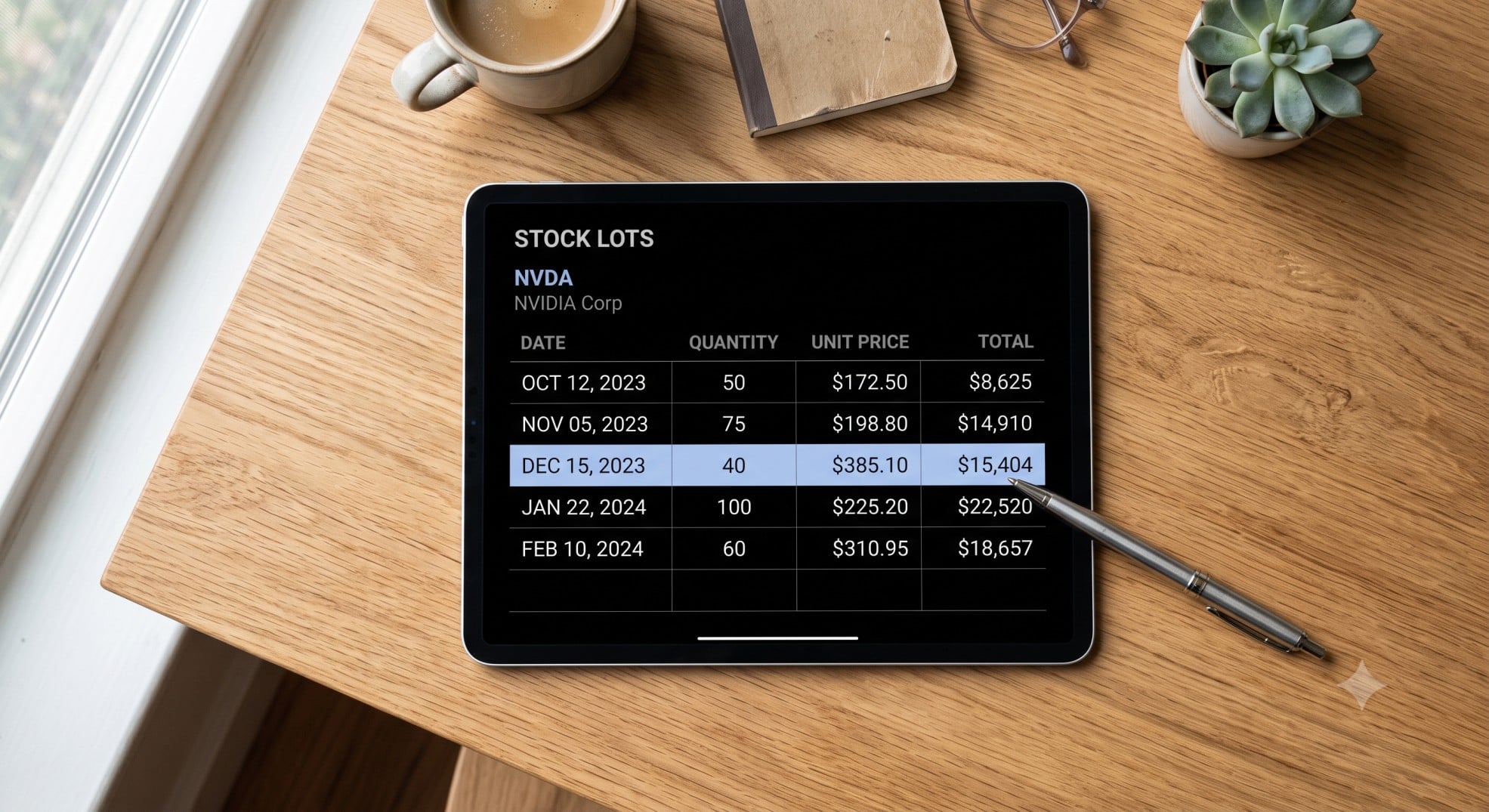
By default, most brokerages use the First-In, First-Out (FIFO) method. This means when you hit “sell,” the brokerage assumes you are selling the oldest shares you own. Because the stock market generally trends upward over time, your oldest shares usually have the lowest cost basis and the highest embedded gains.
For true tax-efficient investing, you must change your brokerage settings to Specific Identification (Specific ID). This allows you to manually select exactly which tax lots you want to sell.
Example 4: The Power of Specific ID
Over the last three years, you bought shares of an index fund:
- Lot A: 100 shares at $50/share
- Lot B: 100 shares at $100/share
- Lot C: 100 shares at $150/share
The current price is $120/share. You need to raise $12,000 in cash, so you sell 100 shares.
If you use the default FIFO method, the broker sells Lot A. You realize a long-term capital gain of $7,000 ($120 – $50 = $70 profit x 100 shares). You will owe long-term capital gains tax on this amount.
If you use Specific ID, you can tell the broker to sell Lot C. You realize a short-term capital loss of $3,000 ($120 – $150 = -$30 loss x 100 shares). By making cost basis count, you avoided a tax bill and generated a deduction you can use to offset capital gains elsewhere.
Explore more advanced strategies for managing your cost basis.The Tax-Loss Harvesting Deadline
The tax-loss harvesting deadline is strict. To claim a loss for the current tax year, the trade must be executed by December 31. Because the stock market is closed on weekends and certain holidays, the actual final trading day of the year may be December 29 or 30.
Do not wait until the last week of December to review your portfolio. The most effective investors harvest losses year-round. If the market dips in August, they harvest the loss immediately and reinvest. If you wait until the tax-loss harvesting deadline, the market may have already recovered, and the opportunity to capture the loss will be gone.
Frequently Asked Questions
What is tax-loss harvesting and how does it work?
Tax-loss harvesting is the strategy of selling taxable investments at a loss to generate a tax deduction. You use this deduction to offset capital gains realized from selling profitable investments, thereby lowering your overall tax liability for the year.
What is the tax-loss harvesting limit for 2026?
If your total capital losses exceed your total capital gains, the tax-loss harvesting limit allows you to deduct up to $3,000 of those excess losses against your ordinary income (like your salary). Married couples filing separately are limited to $1,500.
How does the wash sale rule affect tax-loss selling?
The wash sale rule disallows your tax deduction if you buy a substantially identical asset within 30 days before or after selling an asset at a loss. To avoid this during tax-loss selling, investors usually replace the sold asset with a similar, but not identical, ETF.
Can short-term capital losses offset long-term gains?
Yes, but only after following the strict tax-loss harvesting rules. Short-term capital losses must first offset short-term gains. If you still have short-term losses left over, they can then cross over to offset long-term capital gains.
What happens if my losses exceed the net capital loss deduction limit?
If your net losses exceed the $3,000 net capital loss deduction limit, the IRS allows you to carry the remaining balance forward to future tax years indefinitely. You can use these carryovers to offset capital gains in subsequent years.
What are the main benefits of tax-loss harvesting?
The primary benefits of tax-loss harvesting include immediate capital gains tax reduction, the ability to offset up to $3,000 of ordinary income, and keeping more of your capital invested and compounding rather than paying it to the IRS.
How do I avoid long-term capital gains tax?
You can avoid or reduce long-term capital gains tax by holding assets until you fall into the 0% tax bracket, or by proactively using tax-loss harvesting to generate enough capital losses to completely offset your realized gains for the year.
Why is making cost basis count important?
Making cost basis count is vital because it dictates your taxable profit or loss. By using the Specific Identification method instead of FIFO, you can choose to sell the specific shares you bought at the highest price, maximizing your loss and minimizing your tax bill.
When is the tax-loss harvesting deadline?
The tax-loss harvesting deadline is December 31 of the tax year. However, it is highly recommended to harvest losses throughout the year during market dips, rather than waiting until the final trading days of December.
Is tax-loss harvesting considered tax-efficient investing?
Yes, it is a core component of tax-efficient investing. It allows you to actively manage your tax liabilities, rebalance your portfolio without tax penalties, and improve your after-tax returns over the long term.
Disclaimer: This content provides general information for educational purposes only. Tax laws are complex and change often. It is not professional tax, legal, or financial advice. Always consult a qualified tax professional for personalized guidance regarding your specific situation. Ourtaxpartner.com is not responsible for any actions taken based on the information provided herein.
