
How to Choose Tax Filing Status: 2026 Guide
⚡ Executive Summary: Choosing Your Filing Status
- Your marital status on December 31, 2026, dictates your legal filing options for the entire tax year.
- The standard deduction for 2026 rises to $32,200 for joint filers, $16,100 for singles, and $24,150 for heads of household.
- Filing as Head of Household offers significant tax advantages over filing Single, provided you meet the strict dependency and household support tests.
- You can amend a past return to correct your status, but you generally cannot switch from joint to separate after the tax deadline has passed.
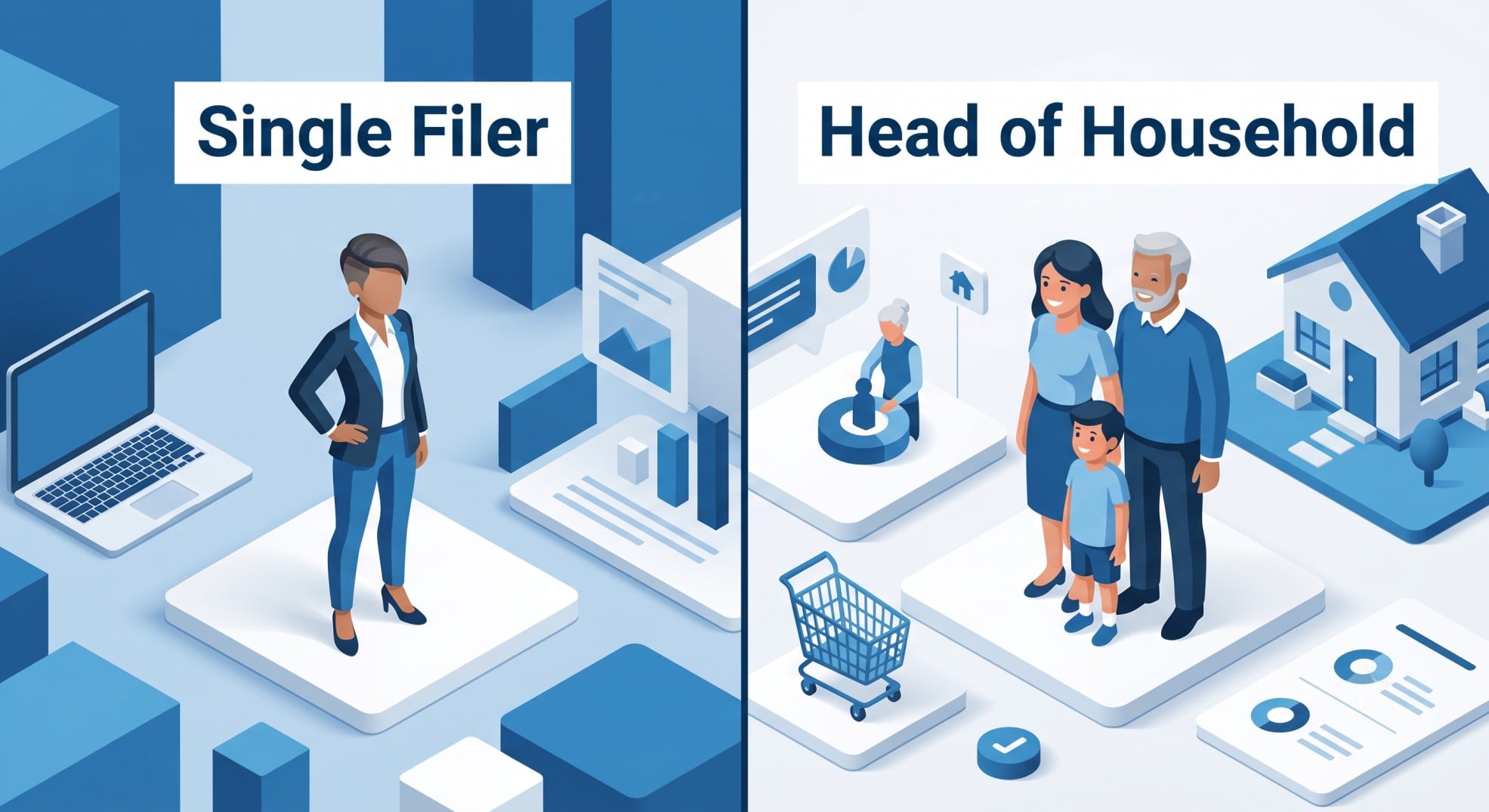
Table of Contents
- What Is a Tax Filing Status?
- IRS Tax Filing Statuses Guide
- Married Filing Jointly vs Separately: Which Is Better?
- Head of Household Rules for 2026
- Standard Deduction by Filing Status (2026)
- How to Change Your Tax Filing Status
- What Happens If I Choose the Wrong Filing Status?
- Frequently Asked Questions About Filing Status
Your tax return begins with a single, foundational decision. Knowing how to choose tax filing status correctly determines your standard deduction, your tax brackets, and your eligibility for high-value credits. Pick the right one, and you keep more of your money. Pick the wrong one, and you could overpay the IRS by thousands of dollars or trigger an audit.
The IRS recognizes five distinct filing statuses. Your eligibility for each is based entirely on your marital and family situation as of December 31 of the tax year. If you get married on New Year’s Eve, the IRS considers you married for the entire year.
We will break down the exact mechanics of each option so you know exactly how to choose tax filing status for your specific financial situation.
What Is a Tax Filing Status?
A filing status is a category that defines how the IRS treats your income. It acts as the mathematical framework for your entire tax return. The US tax code is progressive, meaning income is taxed in chunks. Your filing status dictates how wide those chunks are.
It also controls the threshold for phase-outs. High earners lose access to certain deductions and credits once their income crosses a specific line. That line shifts dramatically depending on whether you file as a single individual or a married couple.
IRS Tax Filing Statuses Guide
This IRS tax filing statuses guide covers the five legal categories available to US taxpayers. You must meet the strict legal definition for a category to claim it.
1. Single
You must file as Single if you are unmarried, divorced, or legally separated under state law on the last day of the year. You cannot file as Single if you are legally married, even if you and your spouse live in different states or keep your finances completely separate.
2. Married Filing Jointly (MFJ)
If you are legally married, you can choose to file a joint return. This status combines both spouses’ incomes, deductions, and credits onto one tax return. The IRS heavily incentivizes this status by offering the widest tax brackets and the highest income thresholds for tax credits.
However, filing jointly creates “joint and several liability.” This means both spouses are equally responsible for the entire tax bill, including any penalties or interest, even if only one spouse earned all the income or made an error on the return.
3. Married Filing Separately (MFS)
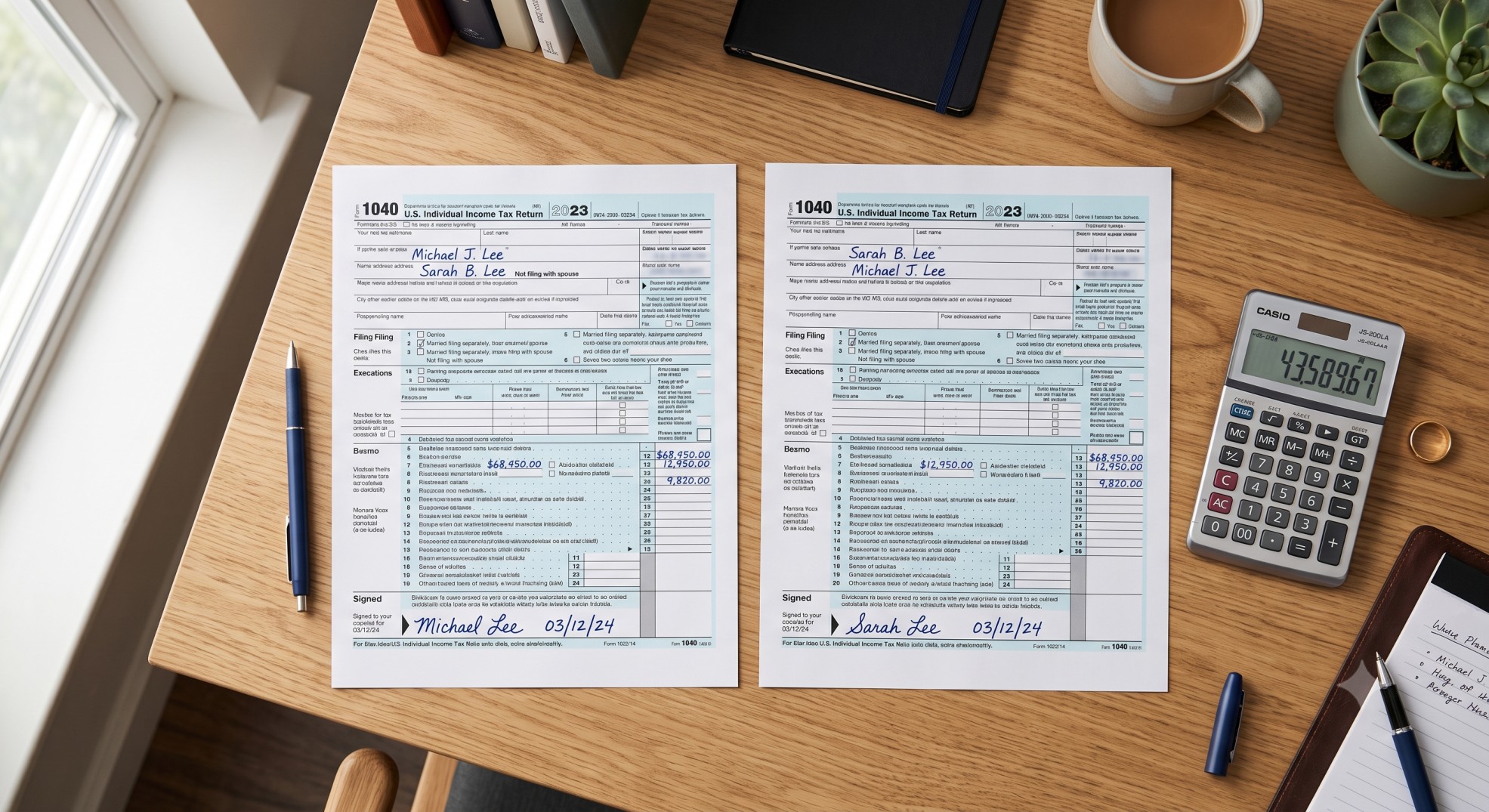
Married couples can opt to file two separate returns. Each spouse reports their own income, deductions, and credits. The IRS penalizes this status by cutting the standard deduction in half and disqualifying MFS filers from claiming several major tax breaks, including the Earned Income Tax Credit (EITC) and the Student Loan Interest Deduction.
4. Head of Household (HOH)
This status is designed for unmarried individuals who provide a home for a qualifying dependent. It offers a much larger standard deduction and more favorable tax brackets than the Single status. The rules are strict, requiring you to pay more than half the cost of keeping up the home for the year.
5. Qualifying Surviving Spouse (QSS)
If your spouse passes away, you can file as Married Filing Jointly for the year of their death. For the following two tax years, you may file as a Qualifying Surviving Spouse if you have a dependent child. This status allows you to continue using the highly favorable joint tax brackets and standard deduction while you transition financially.
Read more about tax planning after the loss of a spouse.Married Filing Jointly vs Separately: Which Is Better?
For the vast majority of couples, filing jointly results in a lower overall tax bill. But when evaluating married filing jointly vs separately, you must look at your specific debts, medical expenses, and liability risks.
Filing separately is rarely about saving on federal income tax. It is almost always a strategic move to protect assets or optimize income-driven repayment plans.
When to Choose Married Filing Separately
You should run the math on filing separately if you fall into one of these three scenarios:
- Income-Driven Repayment (IDR) for Student Loans: If one spouse has massive federal student loan debt and the other does not, filing jointly inflates the household income. This causes the IDR monthly payment to skyrocket. Filing separately bases the IDR payment solely on the borrower’s individual income.
- High Medical Expenses: You can only deduct medical expenses that exceed 7.5% of your Adjusted Gross Income (AGI). If you file jointly, your combined AGI makes that 7.5% hurdle very high. Filing separately lowers the AGI for the spouse with the medical bills, making it easier to claim the deduction.
- Liability Concerns: If you suspect your spouse is hiding income, claiming fraudulent deductions, or failing to pay their taxes, filing separately protects you from IRS audits and collections related to their actions.
Example 1: The Student Loan Strategy
David earns $90,000. His wife, Lisa, earns $50,000. Lisa has $80,000 in federal student loans.
If they file Married Filing Jointly, their combined AGI is $140,000. Lisa’s student loan servicer calculates her monthly IDR payment based on that joint income, resulting in a $900 monthly payment.
If they look at married filing jointly vs separately and choose to file separately, Lisa’s AGI is only $50,000. Her IDR payment drops to $150 a month.
Filing separately means they lose the Student Loan Interest Deduction and pay about $1,200 more in federal income tax for the year. However, saving $750 a month on loan payments ($9,000 a year) far outweighs the $1,200 tax penalty. For David and Lisa, filing separately is the correct financial choice.
Head of Household Rules for 2026
Taxpayers often try to claim Head of Household because the tax breaks are incredibly lucrative. Consequently, the IRS audits this status frequently. You must strictly adhere to the head of household rules for 2026 to claim it legally.
To qualify, you must meet three tests:
- You must be unmarried: You must be legally single, divorced, or “considered unmarried” on the last day of the year.
- You must pay more than half the cost of keeping up a home: This includes rent, mortgage interest, property taxes, utilities, repairs, and groceries eaten in the home. It does not include clothing, education, or vacations.
- You must have a qualifying person: A qualifying child or relative must live with you for more than half the year. (Exception: A dependent parent does not have to live with you, provided you pay more than half the cost of maintaining their separate home or nursing facility).
The “Considered Unmarried” Exception
Can you file as Head of Household if you are still legally married? Yes, but only under very specific conditions. The IRS considers you unmarried if you file a separate return, you pay more than half the cost of keeping up your home, your spouse did not live in your home for the last six months of the year, and your home was the main home of your dependent child.
Example 2: The Single Parent Advantage
Marcus is divorced and shares custody of his son, Leo. Because Leo sleeps at Marcus’s house 185 nights a year, Marcus is the custodial parent for tax purposes. Marcus earns $70,000 a year and pays all the rent and utilities for his apartment.
If Marcus files as Single, his standard deduction is $16,100. His taxable income becomes $53,900.
Because Marcus understands the head of household rules for 2026, he files as HOH. His standard deduction jumps to $24,150. His taxable income drops to $45,850. Because the HOH tax brackets are wider, Marcus saves over $1,500 in federal taxes simply by choosing the correct status.
Learn more about claiming dependents and the Child Tax Credit.Standard Deduction by Filing Status (2026)
Your standard deduction by filing status dictates how much of your income is entirely shielded from federal income tax. Most taxpayers take the standard deduction rather than itemizing their expenses.
The IRS adjusts these figures annually for inflation. Here are the official standard deductions for the 2026 tax year:
| Filing Status | 2026 Standard Deduction |
|---|---|
| Single | $16,100 |
| Married Filing Jointly | $32,200 |
| Married Filing Separately | $16,100 |
| Head of Household | $24,150 |
| Qualifying Surviving Spouse | $32,200 |
Taxpayers who are age 65 or older, or who are blind, receive an additional standard deduction. For 2026, the additional amount is $1,650 for married taxpayers and $2,050 for unmarried taxpayers. These amounts stack. A single filer who is 66 and blind would add $4,100 to their base $16,100 deduction.
How to Change Your Tax Filing Status
If you realize you made a mistake on a past return, you are not stuck with it forever. Learning How to Change Your Tax Filing Status can result in a significant refund if you missed out on a more favorable category.
To change your status, you must file an amended return using IRS Form 1040-X. You generally have three years from the date you filed your original return, or two years from the date you paid the tax, whichever is later.

The One Major Restriction
You can easily amend a return to change from Single to Head of Household, or from Married Filing Separately to Married Filing Jointly.
However, the IRS strictly prohibits couples from changing their status from Married Filing Jointly to Married Filing Separately after the original tax deadline (usually April 15) has passed. Once you file a joint return and the deadline expires, you are permanently locked into joint liability for that specific tax year.
Example 3: Amending for a Refund
Elena filed her 2024 tax return as Married Filing Separately because she and her husband were living apart and experiencing marital issues. In 2026, they reconcile and combine their finances again.
Elena researches How to Change Your Tax Filing Status and realizes they can amend their past return. They file Form 1040-X to change their 2024 status to Married Filing Jointly. Because the joint status offers wider tax brackets and restores credits they were previously disqualified from, the IRS issues them a $2,400 refund.
What Happens If I Choose the Wrong Filing Status?
Choosing the wrong status is a common error, but the IRS does not take it lightly. The IRS matching system automatically cross-references your tax return with your W-2s, past returns, and Social Security records.
If you file as Single but the IRS knows you are legally married, they will likely reject your return electronically before it even processes. If the return does go through, the IRS will eventually catch the discrepancy and issue a CP2000 notice.
If you claimed Head of Household without a qualifying dependent, the IRS will recalculate your taxes using the Single status. This will lower your standard deduction, push your income into higher tax brackets, and strip away dependent-related credits. You will receive a bill for the difference, plus interest and failure-to-pay penalties dating back to the original tax deadline.
Never guess your status. If you are unsure how to choose tax filing status, run the math for multiple scenarios or consult a tax professional before submitting your return.
Frequently Asked Questions About Filing Status
What is my tax filing status?
Your tax filing status is a legal category determined by your marital situation on December 31 of the tax year. It dictates your standard deduction, tax brackets, and eligibility for credits. The five statuses are Single, Married Filing Jointly, Married Filing Separately, Head of Household, and Qualifying Surviving Spouse.
Can I file as head of household if I am married?
Generally, no. However, you can if you meet the “considered unmarried” exception. You must file separately, pay more than half the cost of keeping up your home, and your spouse must not have lived in the home for the last six months of the year.
How do I know how to choose tax filing status?
You choose your status based on your legal marital status on the last day of the year. If you are unmarried, you choose between Single or Head of Household. If you are married, you choose between filing jointly or separately based on which yields the best financial outcome.
Is it better to use married filing jointly vs separately?
For most couples, married filing jointly is better because it offers wider tax brackets and access to more tax credits. Filing separately is usually only better if one spouse has significant student loan debt on an income-driven repayment plan, or massive medical expenses.
What are the head of household rules for 2026?
To file as Head of Household in 2026, you must be unmarried (or considered unmarried), pay more than 50% of the costs of maintaining a home for the year, and have a qualifying dependent who lived with you for more than half the year.
How does the standard deduction by filing status work?
The IRS assigns a specific dollar amount of tax-free income based on your status. For 2026, the standard deduction by filing status is $16,100 for Single/Married Filing Separately, $32,200 for Married Filing Jointly, and $24,150 for Head of Household.
How to Change Your Tax Filing Status after filing?
You can change your status by filing an amended return using IRS Form 1040-X. You generally have three years from the original filing deadline to make this change. Note that you cannot switch from joint to separate after the tax deadline passes.
Can I file as Single if I am married?
No. If you are legally married on December 31, you cannot file as Single under any circumstances. You must choose either Married Filing Jointly or Married Filing Separately. Filing as Single while married is considered tax fraud.
What is a Qualifying Surviving Spouse?
This status allows a widow or widower to retain the benefits of the Married Filing Jointly tax brackets and standard deduction for two years following the year their spouse died, provided they remain unmarried and have a dependent child.
Does my filing status affect my tax bracket?
Yes. Your filing status determines the income thresholds for each marginal tax bracket. For example, the 22% tax bracket starts at a much lower income level for a Single filer compared to a Married Filing Jointly filer.
Disclaimer: This content provides general information for educational purposes only. Tax laws are complex and change often. It is not professional tax, legal, or financial advice. Always consult a qualified tax professional for personalized guidance regarding your specific situation. Ourtaxpartner.com is not responsible for any actions taken based on the information provided herein.
