
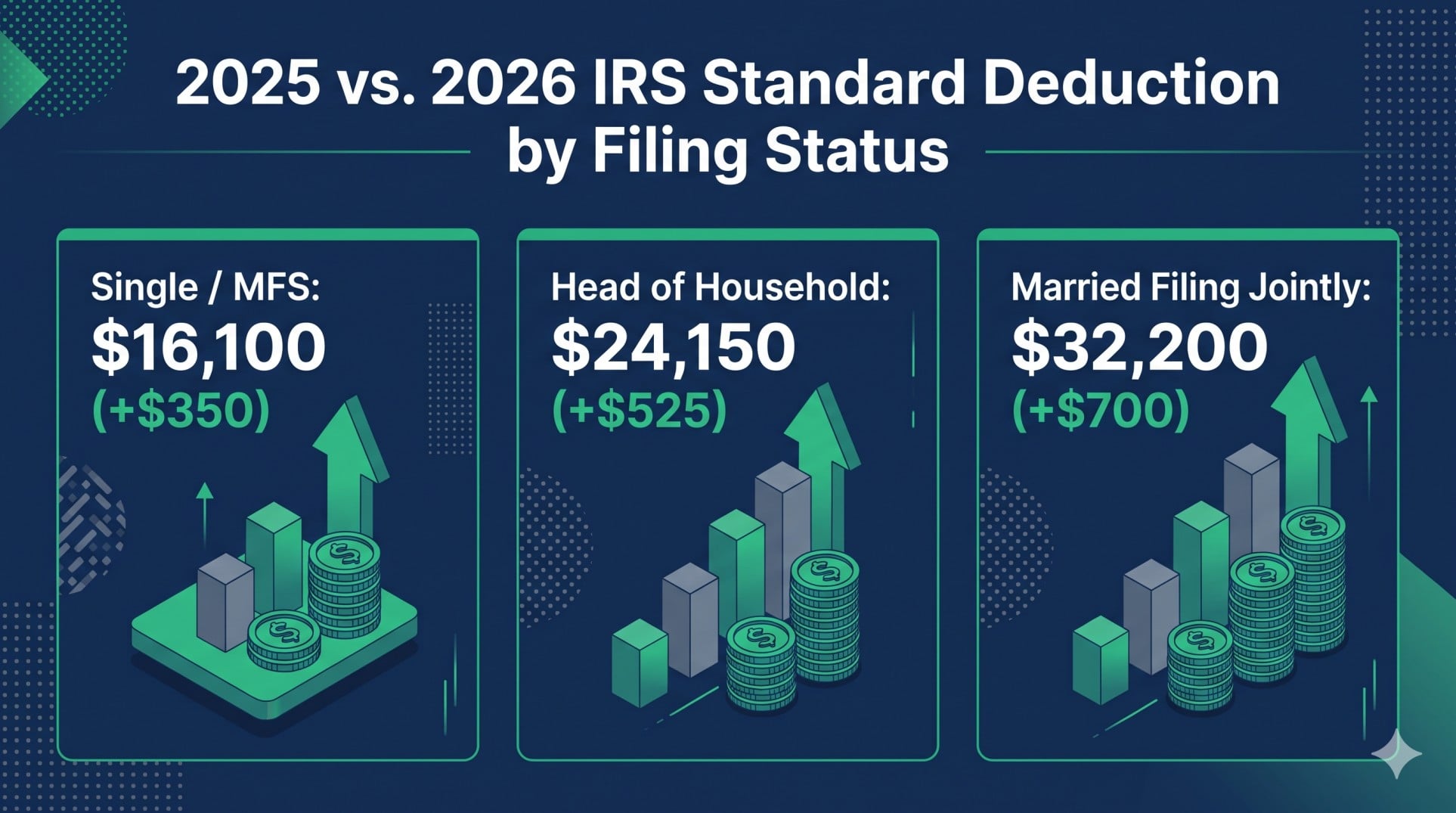
Claiming the standard deduction 2026 allowance is the fastest way for most American households to shelter five figures of income from federal tax without tracking personal receipts. Under IRS Revenue Procedure 2025-32 and the permanent extensions enacted in the One Big Beautiful Bill Act (OBBBA, P.L. 119-21), the baseline deduction for Tax Year 2026 (returns filed in 2027) climbs to $16,100 for single filers and married individuals filing separately, $24,150 for heads of household, and $32,200 for married couples filing jointly and qualifying surviving spouses.
Yet the 2026 standard deduction is no longer a standalone number on your return. Starting in 2026, non-itemizers can stack their base deduction with up to $1,000 (single) or $2,000 (married filing jointly) in cash charitable donations, traditional age-65 and blindness add-ons, and temporary Schedule 1-A write-offs—including the $6,000 per-person senior bonus deduction, qualified tips, overtime pay, and auto loan interest.
⚡ Executive Summary: Key 2026 Tax Rules at a Glance
- 2026 Base Standard Deduction (Filed by April 15, 2027): Per IRS Revenue Procedure 2025-32, the 2026 basic standard deduction is $16,100 for Single and Married Filing Separately, $24,150 for Head of Household, and $32,200 for Married Filing Jointly and Qualifying Surviving Spouse.
- Senior Age 65+ & Blindness Stack: Taxpayers age 65 or older (born on or before January 1, 1962) or legally blind add $2,050 (Single/HOH) or $1,650 per qualifying spouse (Married/QSS) on Line 12, plus up to $6,000 per person age 65+ on Schedule 1-A (totaling up to $24,150 Single or $47,500 Married Filing Jointly).
- 2026 Dependent & Non-Itemizer Charity Rules: A dependent’s 2026 standard deduction is capped at the greater of $1,350 or their earned income plus $450. Standard deduction filers in 2026 can also deduct up to $1,000 (Single) or $2,000 (MFJ) in cash gifts to public charities.
- Exact IRS Forms Required: The standard deduction is claimed on Form 1040 or Form 1040-SR, Line 12, while OBBBA bonus deductions for seniors, tips, overtime, and car loan interest are calculated on Schedule 1-A and carried to Line 13b.
Table of Contents
- ⚡ Executive Summary: Key 2026 Tax Rules at a Glance
- What Is the Standard Deduction for 2026 and How Does It Work?
- Standard Deduction 2026 Amounts for 2025 and 2026
- Additional Standard Deduction for Seniors (65+) and Blind Taxpayers
- The $6,000 Senior Deduction (2025–2028) and MAGI Phase-Out Rules
- Standard Deduction vs. Itemized Deductions: How to Decide in 2026
- When the Standard Deduction Usually Wins vs. When Itemizing Saves More
- Standard Deduction Rules for Dependents in 2026
- Why Business Deductions and Schedule 1-A Write-Offs Are Separate
- How the Standard Deduction Has Changed Over Time (1944–2026)
- 4 Real-World Hypothetical Scenarios With Step-by-Step 2026 Math
- How to Claim the Standard Deduction 2026 on Form 1040 (Step-by-Step)
- Federal vs. State Standard Deduction Conformity Rules
- Frequently Asked Questions About the 2026 Standard Deduction
- Final Filing Checklist for Your 2026 Tax Return
What Is the Standard Deduction for 2026 and How Does It Work?
The standard deduction is a fixed, statutory dollar amount under Internal Revenue Code (IRC) Section 63(c) that reduces your Adjusted Gross Income (AGI) before federal income tax brackets are applied. It acts as a no-questions-asked tax-free floor based on your filing status, age, and vision status.
When taxpayers ask what is the standard deduction for 2026, the simplest way to picture it is as an automatic 0% tax bracket at the bottom of your return. Instead of saving property tax bills, medical receipts, and mortgage interest statements to itemize on Schedule A (Form 1040), you subtract one flat figure on Line 12 of Form 1040 or Form 1040-SR. According to IRS Statistics of Income data cited by the Congressional Research Service (CRS Report RL34498), roughly 90% to 91% of all U.S. taxpayers choose the standard deduction because it exceeds their itemizable personal expenses.
Understanding how the deduction interacts with your tax brackets prevents a common mathematical misconception. A deduction does not reduce your final tax bill dollar-for-dollar like a tax credit does; instead, it reduces your taxable income, saving you money at your highest marginal tax rate. For example, when the 2026 standard deduction married filing jointly reaches $32,200, a couple in the 22% federal marginal bracket saves $7,084 in actual federal tax ($32,200 × 22%), whereas a couple in the 12% bracket saves $3,864 ($32,200 × 12%).
Crucially, the standard deduction is a “below-the-line” subtraction taken after you calculate your Adjusted Gross Income on Form 1040, Line 11. That means you first take all eligible “above-the-line” adjustments on Schedule 1 (such as Health Savings Account contributions, traditional IRA deductions, educator expenses, and student loan interest) to lower your AGI, and then subtract your standard deduction on Line 12. To see how your remaining taxable income flows through the seven federal rate tiers, review our 2026 federal income tax brackets and marginal rates guide.
Standard Deduction 2026 Amounts for 2025 and 2026
Per IRS Revenue Procedure 2025-32, the IRS standard deduction 2026 basic amounts are $16,100 for Single and Married Filing Separately (up $350 from 2025), $24,150 for Head of Household (up $525), and $32,200 for Married Filing Jointly and Qualifying Surviving Spouse (up $700).
In July 2025, Section 70102 of the One Big Beautiful Bill Act permanently locked in the higher standard deduction framework originally created by the 2017 Tax Cuts and Jobs Act (TCJA) and added an immediate statutory boost for 2025 ($750 for single filers and $1,500 for joint filers), indexed annually for Chained CPI-U inflation thereafter. Whether you need the standard deduction 2026 married filing jointly limit or the single standard deduction 2026 figure, compare the exact 2025 and 2026 amounts side by side below:
| Filing Status (Under Age 65 & Not Blind) | Tax Year 2025 Standard Deduction (Filed in 2026) | Tax Year 2026 Standard Deduction (Filed in 2027) | Year-Over-Year Dollar Increase | Statutory & IRS Authority |
|---|---|---|---|---|
| Single | $15,750 | $16,100 | +$350 (+2.22%) | IRC §63(c)(2)(C); Rev. Proc. 2025-32, §4.14 |
| Married Filing Jointly (MFJ) | $31,500 | $32,200 | +$700 (+2.22%) | IRC §63(c)(2)(A)(i); Rev. Proc. 2025-32, §4.14 |
| Qualifying Surviving Spouse (QSS) | $31,500 | $32,200 | +$700 (+2.22%) | IRC §63(c)(2)(A)(ii); Rev. Proc. 2025-32, §4.14 |
| Head of Household (HOH) | $23,625 | $24,150 | +$525 (+2.22%) | IRC §63(c)(2)(B); Rev. Proc. 2025-32, §4.14 |
| Married Filing Separately (MFS)* | $15,750 | $16,100 | +$350 (+2.22%) | IRC §63(c)(2)(C); IRC §63(c)(6)(A) |
*Important Rule for Married Filing Separately: Under IRC Section 63(c)(6)(A), if one spouse itemizes deductions on Schedule A on a separate return, the other spouse is legally barred from claiming the $16,100 standard deduction and must also itemize (their standard deduction becomes $0).
Notice how the 2026 standard deduction married joint allowance of $32,200 is exactly double the $16,100 single amount, eliminating any “marriage penalty” in the basic standard deduction. Meanwhile, taxpayers wondering what is standard deduction for 2026 when filing as a Qualifying Surviving Spouse (formerly Qualifying Widow or Widower) receive the full $32,200 joint deduction for up to two tax years following the year of their spouse’s death, provided they have not remarried and maintain a home for a dependent child.
Additional Standard Deduction for Seniors (65+) and Blind Taxpayers
Under IRC Section 63(f) and Revenue Procedure 2025-32, taxpayers who are age 65 or older or legally blind at the end of 2026 receive an additional standard deduction of $2,050 for Single or Head of Household filers and $1,650 per qualifying spouse for Married or Qualifying Surviving Spouse filers.
This long-standing provision stacks directly on top of the federal standard deduction 2026 base on Form 1040 or Form 1040-SR, Line 12. Both the age-65 add-on and the blindness add-on rose by $50 per qualifying condition in 2026 compared to 2025 ($2,050 vs. $2,000 for unmarried filers; $1,650 vs. $1,600 for married filers). Better yet, the IRC Section 63(f) additional standard deduction has zero income limit or phase-out—a retired CEO with $2 million in income still receives the full $2,050 or $1,650 add-on if taking the standard deduction.
Key Qualification Rules for the Age 65+ and Blindness Add-On
- The January 1, 1962 Birthday Rule: Under IRS Publication 501, you are considered to reach age 65 on the day before your 65th birthday. Thus, if you were born on January 1, 1962 (turning 65 on January 1, 2027), the IRS treats you as age 65 on December 31, 2026, qualifying you for the full 2026 senior add-on!
- Legal Blindness Definition (IRC Section 63(f)(4)): If you are not totally blind, you qualify if an eye physician or registered optometrist certifies that as of December 31, 2026, your central visual acuity does not exceed 20/200 in your better eye with corrective lenses, or your visual field is 20 degrees or less.
- Doubling Up for Both Conditions: Because age 65+ and blindness are separate checkboxes on page 1 of Form 1040/1040-SR, a single taxpayer who is both age 65+ and legally blind adds $4,100 ($2,050 × 2) to the $16,100 base for a Line 12 standard deduction of $20,200. A married couple where both spouses are 65+ and both are blind adds $6,600 ($1,650 × 4) to the $32,200 base for a Line 12 total of $38,800.
The $6,000 Senior Deduction (2025–2028) and MAGI Phase-Out Rules
In addition to the regular standard deduction, Section 70103 of the One Big Beautiful Bill Act (IRC Section 151(d)(5)(C)) provides a temporary $6,000 deduction per qualifying individual age 65 or older ($12,000 for married couples where both spouses are 65+) for tax years 2025 through 2028, subject to a 6% MAGI phase-out.
Unlike the $2,050 / $1,650 additional standard deduction on Line 12, this $6,000 bonus deduction is a personal exemption-style deduction claimed on Schedule 1-A (Form 1040) and carried to Form 1040, Line 13b. Consequently, qualifying seniors can claim the $6,000 deduction whether they take the standard deduction OR itemize deductions on Schedule A! For a complete deep dive into retirement-specific scenarios, see our 2026 standard deduction for seniors over 65 guide.
Phase-Out Rules and Eligibility Restrictions for the $6,000 Senior Bonus
- 6% MAGI Phase-Out Thresholds: The $6,000 deduction begins phasing out once Modified Adjusted Gross Income (MAGI—which is Line 11 AGI plus any foreign/territory income exclusions under IRC Sections 911, 931, or 933) exceeds $75,000 for Single, Head of Household, or Qualifying Surviving Spouse filers, or $150,000 for Married Filing Jointly filers.
- Exact Phase-Out Math: Each qualifying person’s $6,000 deduction is reduced by 6 cents for every $1 ($60 per $1,000) of MAGI above the threshold. It is completely eliminated at $175,000 MAGI for single/HOH filers and $250,000 MAGI for joint filers (note that on a joint return where both spouses are 65+, both $6,000 deductions phase out simultaneously at 6% each—a combined 12% reduction rate across the $100,000 phase-out range from $150,000 to $250,000).
- Married Filing Separately Disqualification & SSN Rule: Married taxpayers must file a joint return to claim the $6,000 deduction (Married Filing Separately receives $0), and each qualifying individual must have a valid work-eligible Social Security Number.
| 2026 Senior Filing Status & Age / Blindness Profile | 2026 Base Standard Deduction | 2026 Age 65+ / Blind Add-On (Line 12) | Total Line 12 Standard Deduction | Max Schedule 1-A Senior Bonus (Line 13b)* | Maximum 2026 Combined Deduction Shield* |
|---|---|---|---|---|---|
| Single (Age 65+, Not Blind) | $16,100 | +$2,050 | $18,150 | +$6,000 | $24,150 |
| Single (Age 65+ AND Blind) | $16,100 | +$4,100 | $20,200 | +$6,000 | $26,200 |
| Head of Household (Age 65+, Not Blind) | $24,150 | +$2,050 | $26,200 | +$6,000 | $32,200 |
| Married Filing Jointly (One Spouse 65+, Neither Blind) | $32,200 | +$1,650 | $33,850 | +$6,000 | $39,850 |
| Married Filing Jointly (Both Spouses 65+, Neither Blind) | $32,200 | +$3,300 | $35,500 | +$12,000 | $47,500 |
| Married Filing Jointly (Both 65+ AND Both Blind) | $32,200 | +$6,600 | $38,800 | +$12,000 | $50,800 |
*Full $6,000 / $12,000 Schedule 1-A bonus applies when 2026 MAGI is $75,000 or less (Single/HOH) or $150,000 or less (Married Filing Jointly).
Standard Deduction vs. Itemized Deductions: How to Decide in 2026
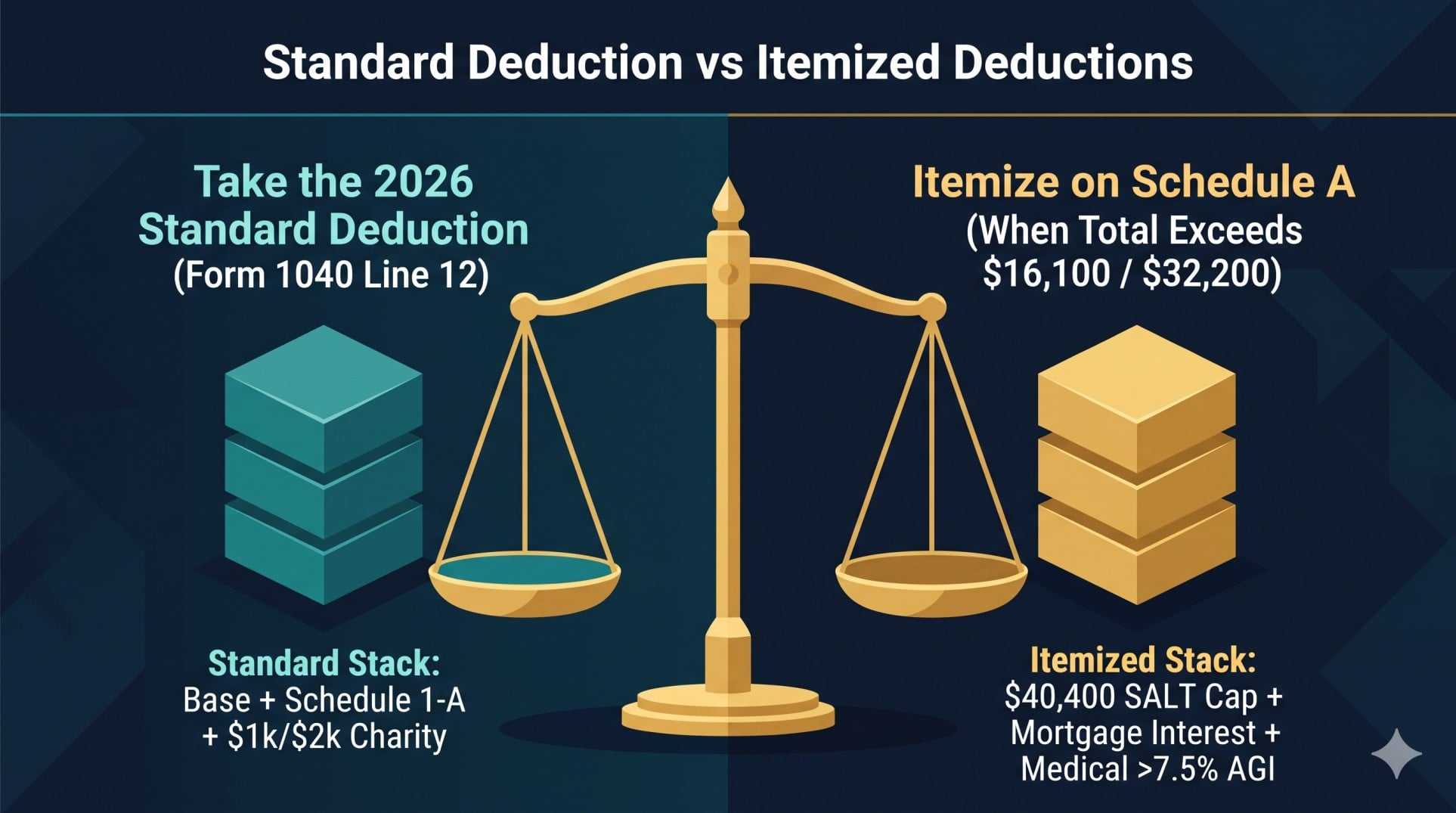
You must choose between taking the Line 12 standard deduction or itemizing deductions on Schedule A (Form 1040)—you cannot claim both on Line 12. You should only itemize in 2026 if your allowable Schedule A expenses exceed your filing status’s standard deduction (including any age-65 or blindness add-ons).
While the basic rule (“pick whichever is larger”) sounds simple, the One Big Beautiful Bill Act overhauled both sides of the equation for the 2026 tax year. On the Schedule A side, Congress raised the State and Local Tax (SALT) deduction cap from the old $10,000 limit to $40,400 for 2026 ($20,200 for Married Filing Separately), while simultaneously adding two brand-new restrictions on itemized deductions that took effect on January 1, 2026: a 0.5% of AGI floor on itemized charitable contributions and a 35% maximum tax benefit cap on itemized deductions for taxpayers in the top 37% bracket.
Meanwhile, on the standard deduction side, Congress restored an above-Schedule-A charitable deduction for non-itemizers starting in 2026: you can now take the full standard deduction AND deduct up to $1,000 (Single) or $2,000 (Married Filing Jointly) in cash donations made to qualified public charities! Look at how every major category compares for 2026:
| Tax Provision / Expense Category | Taking the 2026 Standard Deduction | Itemizing on 2026 Schedule A (Form 1040) |
|---|---|---|
| Base Line 12 Deduction Amount | Fixed at $16,100 (Single/MFS), $24,150 (HOH), or $32,200 (MFJ/QSS), plus age-65/blind add-ons. | Sum of your actual qualified Schedule A expenses (no upper dollar limit, but only beats standard if total is higher). |
| State and Local Taxes (SALT — IRC §164) | Not separately deductible (built into your flat standard deduction). | Deductible up to $40,400 in 2026 ($20,200 MFS); phases down by 30% of MAGI over $505,000 ($252,500 MFS) to a $10,000 floor. |
| Home Mortgage Interest (IRC §163(h)) | Not separately deductible on personal residence. | Deductible on up to $750,000 ($375,000 MFS) of qualified acquisition debt ($1M if incurred before Dec. 16, 2017); permanent under OBBBA. |
| Charitable Contributions (IRC §170) | New for 2026: Deduct up to $1,000 (Single) or $2,000 (MFJ) in cash gifts to public charities without itemizing! | Deductible up to 60% of AGI for cash gifts, minus a new 0.5% of AGI floor starting in 2026 (only the amount above 0.5% of AGI counts). |
| Medical & Dental Expenses (IRC §213) | Not separately deductible (though HSA funds can still be used tax-free). | Deductible only to the extent unreimbursed expenses exceed 7.5% of your AGI. |
| Casualty & Theft Losses (IRC §165(h)) | Only Qualified Disaster Losses (Form 4684) can be added to the standard deduction in specific federal disasters. | Deductible for federally declared disasters (and state-declared disasters per OBBBA updates) above $100 per event and 10% of AGI. |
| Schedule 1-A Deductions ($6k Senior, Tips, Overtime, Auto Interest) | 100% Allowed on Line 13b (stacks on top of your Line 12 standard deduction). | 100% Allowed on Line 13b (stacks on top of your Line 12 Schedule A itemized total). |
| Top 37% Bracket Benefit Limitation (New for 2026) | No reduction; reduces taxable income at full marginal rate. | For taxpayers in the 37% bracket, the tax benefit of itemized deductions is capped at 35 cents per dollar (2/37ths reduction). |
When the Standard Deduction Usually Wins vs. When Itemizing Saves More
The standard tax deduction 2026 allowance usually wins for renters, homeowners with low mortgage balances or modest state taxes, and retirees whose age-based standard deduction reaches $18,150 to $35,500. Itemizing typically saves more when high state income taxes, property taxes up to $40,400, and mortgage interest exceed those thresholds.
When the Standard Deduction Usually Wins in 2026
For roughly 9 out of 10 filers, the 2026 standard deduction beats Schedule A hands down. You will almost certainly come out ahead taking the standard deduction if you fit any of these profiles:
- Renters and Paid-Off Homeowners: Without a mortgage interest deduction on Form 1098, reaching $16,100 (Single) or $32,200 (Married Filing Jointly) requires extraordinary medical bills or state taxes.
- Residents of Zero-Income-Tax States: If you live in Florida, Texas, Nevada, Washington, Tennessee, Wyoming, South Dakota, Alaska, or New Hampshire, your SALT deduction is limited to property taxes and general sales taxes—rarely enough on its own to cross the $32,200 joint threshold.
- Homeowners With Pre-2022 Low-Rate Mortgages: If you locked in a 2.75% or 3.25% mortgage on a $350,000 loan, your annual mortgage interest is roughly $9,000 to $10,500, leaving a wide gap below the joint standard deduction.
- Retirees Over Age 65: Because the Line 12 standard deduction jumps to $18,150 (Single 65+) and $35,500 (Married Filing Jointly, both 65+), seniors have an even higher hurdle to clear before Schedule A makes sense—and remember, you get the $6,000 / $12,000 Schedule 1-A senior deduction on Line 13b even when taking the standard deduction!
When Itemizing Typically Saves More in 2026 (The $40,400 SALT Factor)
Prior to the One Big Beautiful Bill Act, the strict $10,000 SALT cap locked millions of upper-middle-class homeowners out of Schedule A. In 2026, itemizing deductions to beat the 2026 federal standard deduction frequently pays off in three situations:
- 1. High-Tax-State Homeowners Earning Under $505,000 MAGI: Because the 2026 SALT cap sits at $40,400 for both single and joint filers (before phasing down for MAGI above $505,000), a single homeowner in California, New York, New Jersey, Connecticut, or Massachusetts paying $18,000 in state income tax and $9,000 in property tax has $27,000 in SALT alone—beating the $16,100 single standard deduction by $10,900 before even counting mortgage interest! Similarly, a married couple with $34,000 in combined state income and property taxes plus $18,000 in mortgage interest reaches $52,000 on Schedule A, beating the $32,200 joint standard deduction by $19,800.
- 2. Major Unreimbursed Medical Events: If a surgery, long-term care stay, or fertility procedure pushes your out-of-pocket medical expenses far above 7.5% of your AGI, combining that excess with state taxes and mortgage interest can easily top Line 12.
- 3. “Charitable Bunching” With a Donor-Advised Fund (DAF): Suppose a married couple normally has $24,000 in SALT and mortgage interest and donates $6,000 per year to charity ($30,000 total—losing to the $32,200 standard deduction every year). If they “bunch” three years of charitable giving ($18,000) into a single tax year using a Donor-Advised Fund in 2026, their 2026 Schedule A total jumps to roughly $42,000 (minus the 0.5% AGI charitable floor), letting them itemize in 2026 and take the $32,200+ standard deduction in 2027 and 2028! Moreover, donating appreciated stock held over one year avoids capital gains tax while sidestepping the new 2026 cash-only restriction on non-itemizer donations.
Standard Deduction Rules for Dependents in 2026
Under IRC Section 63(c)(5) and IRS Revenue Procedure 2025-32, if another taxpayer can claim you as a dependent on their 2026 return, your basic standard deduction is limited to the greater of $1,350 or your earned income plus $450, up to the regular $16,100 single standard deduction.
This rule applies whenever you can be claimed as a dependent on someone else’s return (such as a high school or college student claimed by parents, or an elderly parent claimed as a qualifying relative by an adult child), even if that person chooses not to claim you. Under the IRS standard deduction 2026 rules for dependents, the distinction between “earned income” (W-2 wages, salaries, tips, and net self-employment income) and “unearned income” (interest, dividends, capital gains, and trust distributions) is critical:
- Example A (Dependent With Only Unearned Investment Income): A 19-year-old college student has $0 in wages and $3,200 in taxable interest and stock dividends in 2026. Because their earned income is $0, their 2026 standard deduction is capped at the flat minimum floor of $1,350, leaving $1,850 of taxable unearned income (and note that under the 2026 “Kiddie Tax” rules on Form 8615, a dependent child’s unearned income exceeding $2,700—twice the $1,350 dependent deduction—is taxed at the parents’ marginal tax rate).
- Example B (Dependent With a Summer W-2 Job): A 17-year-old high school student earns $6,000 at a summer lifeguard job and has $300 in savings account interest. Their 2026 dependent standard deduction is $6,000 + $450 = $6,450 (since $6,450 is greater than $1,350 and less than $16,100). Because their $6,450 standard deduction exceeds their $6,300 total gross income, their 2026 taxable income is $0!
- Example C (Dependent Earning Over $15,650): A 21-year-old full-time college student earns $18,000 from a paid internship. Adding $450 equals $18,450, which is capped at the regular 2026 single standard deduction of $16,100.
- Elderly or Blind Dependents: If a dependent is age 65 or older or legally blind, they still add the full $2,050 (unmarried) or $1,650 (married) additional standard deduction on top of their limited dependent base!
Why Business Deductions and Schedule 1-A Write-Offs Are Separate
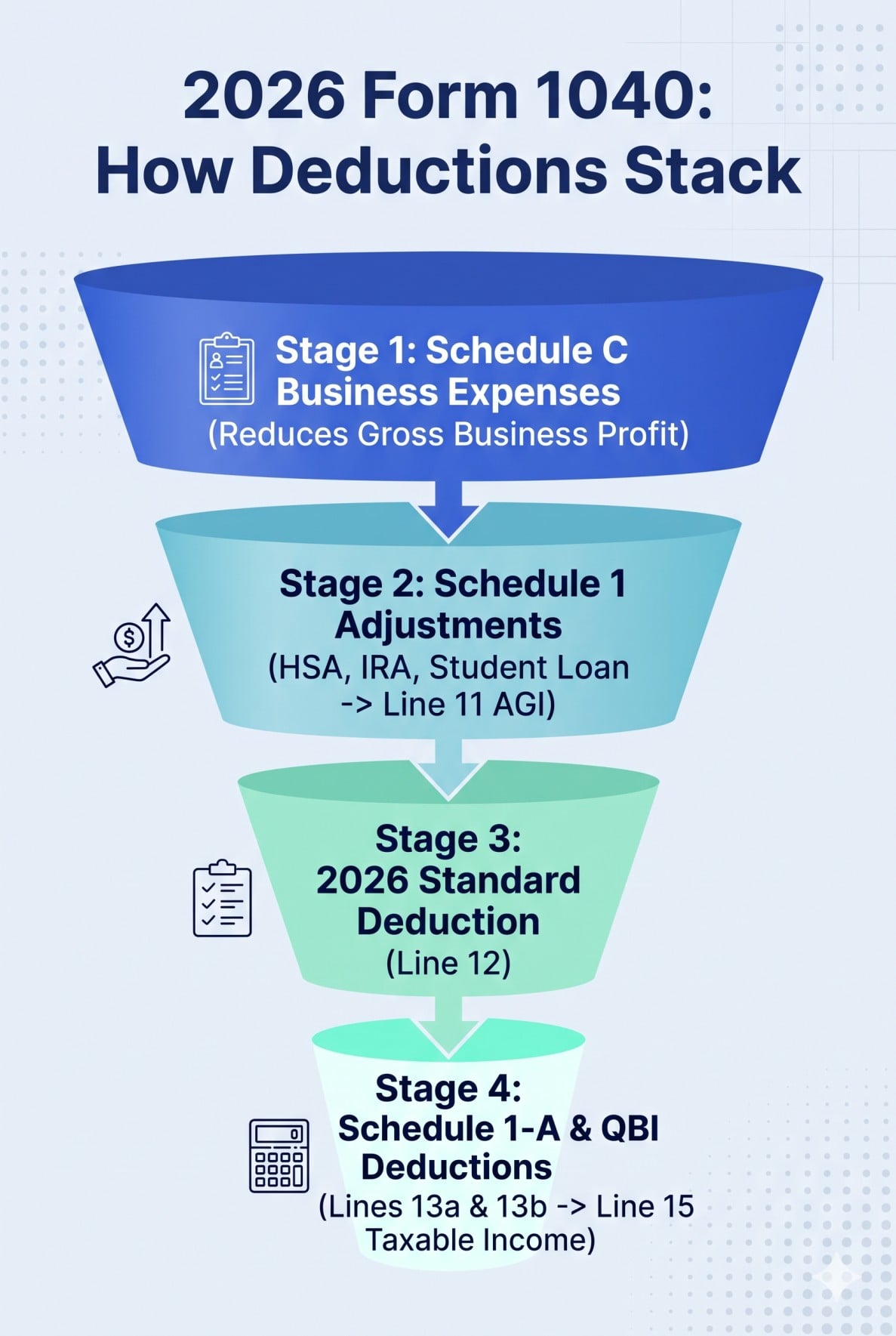
Taking the standard deduction on Form 1040, Line 12 only replaces personal itemized deductions on Schedule A. It never prevents you from deducting 100% of your business expenses on Schedule C, above-the-line adjustments on Schedule 1, the 20% QBI deduction on Line 13a, or OBBBA bonus deductions on Schedule 1-A (Line 13b).
One of the most expensive myths among new freelancers, gig workers, and small business owners is believing they need more than $16,100 (or $32,200 married) in business expenses before writing off their laptop, mileage, or home office. In reality, claiming the federal standard deduction 2026 on Line 12 does not block Schedule C write-offs because business deductions and the personal standard deduction operate on completely separate schedules of your tax return!
Look at how the four deduction buckets stack together on a 2026 tax return without conflicting with each other:
- Bucket 1: Trade or Business Expenses (Schedule C, Schedule E, or Schedule F). If you are a 1099 independent contractor, freelancer, sole proprietor, or landlord, you deduct 100% of your ordinary and necessary business expenses—including the 2026 standard mileage rate, software, advertising, equipment depreciation (including permanent 100% bonus depreciation and Section 179 expensing up to $2,560,000 in 2026), and business home office expenses—directly against your gross business revenue. That lowers both your income tax AND your 15.3% self-employment tax before your profit ever reaches Form 1040! Learn more in our complete list of self-employed Schedule C tax deductions.
- Bucket 2: “Above-the-Line” Adjustments to Income (Schedule 1, Part II -> Form 1040, Line 10). Regardless of whether you take the standard deduction, you subtract above-the-line adjustments from Gross Income to arrive at your Adjusted Gross Income (Line 11). These include the deductible half of self-employment tax, self-employed health insurance premiums, SEP-IRA / Solo 401(k) / Traditional IRA contributions, Health Savings Account (HSA) deductions, educator expenses, and up to $2,500 in student loan interest.
- Bucket 3: The 2026 Standard Deduction (Form 1040, Line 12) + Non-Itemizer Charity. Here—and only here—you choose between the flat 2026 standard deduction ($16,100 Single / $24,150 HOH / $32,200 MFJ, plus age-65/blind add-ons and up to $1,000/$2,000 in cash charitable gifts) OR personal itemized deductions on Schedule A.
- Bucket 4: Line 13a (20% QBI Deduction) & Line 13b (Schedule 1-A OBBBA Deductions). After Line 12, small business owners subtract their permanent 20% Qualified Business Income (QBI) deduction under IRC Section 199A on Line 13a (calculated on Form 8995), while eligible workers and seniors subtract their Schedule 1-A deductions on Line 13b (up to $6,000/$12,000 senior deduction, up to $25,000 in qualified tips, up to $12,500/$25,000 in qualified overtime premium pay, and up to $10,000 in qualified U.S.-assembled passenger vehicle loan interest).
How the Standard Deduction Has Changed Over Time (1944–2026)
Created by the Individual Income Tax Act of 1944 to simplify wartime returns, the standard deduction has undergone three modern structural shifts: annual inflation indexing beginning in 1989, the near-doubling under the 2017 Tax Cuts and Jobs Act, and the permanent extension and statutory boost under the 2025 One Big Beautiful Bill Act.
As documented in Congressional Research Service Report RL34498, before 2018 a taxpayer’s tax-free income floor consisted of a modest standard deduction paired with a separate Personal Exemption ($4,050 per person and dependent in 2017). When Congress passed the TCJA (P.L. 115-97), it suspended personal exemptions (setting them to $0 starting in 2018) and nearly doubled the standard deduction—raising the single deduction from $6,350 (2017) to $12,000 (2018) and the married joint deduction from $12,700 (2017) to $24,000 (2018).
Originally, those higher TCJA amounts were scheduled to expire after December 31, 2025, which would have cut the 2026 standard deduction roughly in half. Instead, in July 2025, Congress enacted the One Big Beautiful Bill Act (P.L. 119-21), which permanently set the personal exemption to $0 (while creating the temporary $6,000 Schedule 1-A senior deduction for 2025–2028) and permanently locked in the expanded 2026 standard deductions with an extra baseline bump. Track the 10-year progression from 2017 through 2026 below:
| Tax Year | Single & Married Filing Separately | Head of Household (HOH) | Married Filing Jointly & Surviving Spouse | Personal Exemption Amount | Key Legislative Milestone |
|---|---|---|---|---|---|
| 2017 | $6,350 | $9,350 | $12,700 | $4,050 per person | Final year of pre-TCJA law |
| 2018 | $12,000 | $18,000 | $24,000 | $0 | First year of TCJA (P.L. 115-97) doubling + Chained CPI |
| 2020 | $12,400 | $18,650 | $24,800 | $0 | Pandemic-era inflation adjustment |
| 2022 | $12,950 | $19,400 | $25,900 | $0 | 91% of all filers take the standard deduction |
| 2024 | $14,600 | $21,900 | $29,200 | $0 | High-inflation Chained CPI-U adjustment |
| 2025 | $15,750 | $23,625 | $31,500 | $0 (+$6,000 Senior Bonus) | OBBBA (P.L. 119-21) permanent extension + $750/$1,500 boost |
| 2026 | $16,100 | $24,150 | $32,200 | $0 (+$6,000 Senior Bonus) | Rev. Proc. 2025-32 inflation increase (+$1,000/$2,000 charity rule) |
4 Real-World Hypothetical Scenarios With Step-by-Step 2026 Math
To see how the 2026 standard deduction, the 2026 tax brackets (10%, 12%, 22%, 24%, 32%, 35%, and 37%), Schedule C business write-offs, and Schedule A itemizing rules work together in practice, examine these four step-by-step calculations.
Scenario 1: The Single W-2 Professional + 1099 Side Hustle & Non-Itemizer Charity
Taxpayer Profile: Chloe, age 31 (not blind), is a single marketing manager in Texas. In 2026, she earns $85,000 in W-2 wages, generates $18,000 in gross 1099 freelance graphic design revenue with $5,000 in Schedule C software and equipment expenses (net Schedule C profit of $13,000), contributes $4,000 to her Health Savings Account (HSA), and donates $1,000 in cash to her local 501(c)(3) animal shelter.
- Step 1 (Schedule C & Schedule 1 Adjustments): Chloe deducts her $5,000 of business expenses on Schedule C regardless of taking the standard deduction. On Schedule SE, her self-employment tax on $13,000 is $1,837, giving her a $919 above-the-line deduction (50% of SE tax) on Schedule 1, plus her $4,000 HSA deduction. Her 2026 Adjusted Gross Income (Line 11) is $85,000 + $13,000 − $919 − $4,000 = $93,081.
- Step 2 (2026 Single Standard Deduction + Charity + QBI):
- Chloe claims the 2026 single standard deduction of $16,100 on Line 12.
- Under the new 2026 OBBBA non-itemizer charitable rule, she also deducts her $1,000 cash donation to the public charity without itemizing!
- On Line 13a (Form 8995), she claims her 20% Qualified Business Income (QBI) deduction on her net self-employment income ($13,000 − $919 SE tax deduction = $12,081 × 20% = $2,416).
- Step 3 (2026 Taxable Income & Tax Calculation):
- $93,081 AGI minus $19,516 total post-AGI deductions ($16,100 + $1,000 + $2,416) = $73,565 Taxable Income on Line 15.
- Using the 2026 Single tax brackets (10% up to $12,400 = $1,240; 12% from $12,400 to $50,400 = $4,560; 22% on the remaining $23,165 above $50,400 = $5,096.30), her regular federal income tax is $10,896.30.
- Value of Her $16,100 Standard Deduction Alone: Saved her $3,542 in 2026 federal income tax ($16,100 × 22% marginal bracket).
Scenario 2: Married Couple (Both Age 67) Combining All 3 Senior Deduction Layers
Taxpayer Profile: Walter and Grace (both age 67, neither blind) file Married Filing Jointly in 2026. Between Walter’s pension, IRA Required Minimum Distributions, and the taxable portion of their Social Security benefits, their 2026 Adjusted Gross Income (and MAGI) on Line 11 is $142,000. They have paid off their home and have only $6,500 in property taxes and medical expenses.
- Step 1 (Line 12 Standard Deduction + Age 65 Add-Ons): They start with the $32,200 Married Filing Jointly base standard deduction and add $3,300 ($1,650 × 2 because both spouses were born before January 2, 1962), giving them $35,500 on Form 1040-SR, Line 12.
- Step 2 (Line 13b Schedule 1-A Senior Bonus Deduction): Because their $142,000 joint MAGI is below the $150,000 phase-out threshold for joint filers, both Walter and Grace qualify for the full $6,000 per-person OBBBA senior deduction on Schedule 1-A—adding another $12,000 on Line 13b!
- Step 3 (2026 Taxable Income & Bracket Drop):
- Combined 2026 Deductions (Line 14): $35,500 + $12,000 = $47,500.
- 2026 Taxable Income (Line 15): $142,000 AGI minus $47,500 = $94,500.
- Because the 12% Married Filing Jointly bracket in 2026 extends all the way up to $100,800 (with the 22% bracket starting at $100,801), their $47,500 deduction stack knocks them completely out of the 22% bracket! Their 2026 federal income tax is just $10,844 (10% on first $24,800 + 12% on remaining $69,700), saving them $9,820 compared to having no deductions.
Scenario 3: High-Tax Homeowner Couple — Standard Deduction vs. $40,400 SALT Itemizing
Taxpayer Profile: Marcus and Elena (both age 42) live in New Jersey and file Married Filing Jointly in 2026 with a combined W-2 AGI (and MAGI) of $340,000. In 2026, they pay $23,000 in New Jersey state income tax, $16,500 in local property taxes (total state and local taxes of $39,500), $21,000 in home mortgage interest on a $550,000 loan, and donate $5,000 in cash to charity.
- Option A (Taking the 2026 Standard Deduction): They would receive $32,200 on Line 12 plus the $2,000 non-itemizer cash charitable deduction = $34,200 in total deductions.
- Option B (Itemizing on 2026 Schedule A):
- SALT Deduction: Because their $340,000 MAGI is below the $505,000 phase-out threshold and their $39,500 in state and property taxes is under the $40,400 2026 SALT cap, they deduct the full $39,500!
- Mortgage Interest: Full $21,000 is deductible.
- Charitable Contribution (Applying the New 2026 0.5% AGI Floor): Under the new 2026 OBBBA rule for itemizers, the first 0.5% of their $340,000 AGI ($340,000 × 0.005 = $1,700) is not deductible on Schedule A. Thus, their $5,000 donation yields an allowable Schedule A charitable deduction of $3,300 ($5,000 − $1,700).
- Total 2026 Schedule A Itemized Deductions: $39,500 + $21,000 + $3,300 = $63,800.
- The Winner: Itemizing on Schedule A gives Marcus and Elena $63,800 vs. $34,200 with the standard deduction—an extra $29,600 in write-offs! In their 24% federal marginal bracket ($211,401 to $403,550 in 2026), choosing to itemize saves them an extra $7,104 in hard cash.
Scenario 4: Dependent College Student + Parent Claiming Head of Household
Taxpayer Profile: Nadia, age 45, is an unmarried mother in Ohio who pays more than half the cost of keeping up a home for her 20-year-old son, Lucas, a full-time university sophomore. In 2026, Nadia earns $92,000 as a nurse (including $6,000 of qualified FLSA overtime premium pay eligible for Schedule 1-A). Lucas earns $9,200 from a campus job and $600 in taxable bond interest.
- Nadia’s Return (Head of Household + Schedule 1-A Overtime + ODC): Nadia files as Head of Household and claims the 2026 HOH standard deduction of $24,150 on Line 12. On Schedule 1-A (flowing to Line 13b), she also deducts her $6,000 in qualified overtime premium pay (since her $92,000 MAGI is below the $150,000 overtime phase-out floor). Her total deductions are $30,150, lowering her taxable income to $61,850 (keeping her inside the 12% HOH bracket, which runs up to $67,450 in 2026!), plus she claims the $500 Credit for Other Dependents for Lucas.
- Lucas’s Dependent Return: Because Nadia claims Lucas as a dependent on her return, Lucas must use the 2026 dependent standard deduction formula on his own Form 1040: the greater of $1,350 or his earned income ($9,200) plus $450 = $9,650. Subtracting his $9,650 dependent standard deduction from his $9,800 gross income ($9,200 wages + $600 interest) leaves Lucas with just $150 of taxable income—and a total federal tax bill of $15 (at 10%), getting almost all of his paycheck withholding refunded!
How to Claim the Standard Deduction 2026 on Form 1040 (Step-by-Step)
You claim your 2026 standard deduction directly on Line 12 of Form 1040 or Form 1040-SR when filing your return in early 2027. No extra schedule is required for the basic or age-65/blindness standard deduction, though OBBBA bonus deductions require attaching Schedule 1-A.
Follow this five-step filing sequence to ensure zero math or processing errors before the April 15, 2027 deadline (or October 15, 2027 if you file a Form 4868 extension):
- Step 1: Confirm You Are Eligible to Take the Standard Deduction (IRC Section 63(c)(6)). Verify that you do not fall into one of the four groups barred from claiming the standard deduction:
- A married individual filing as Married Filing Separately whose spouse itemizes deductions on Schedule A (unless you lived apart for the last 6 months of 2026 with a qualifying child and qualify as “considered unmarried” for Head of Household status under IRC Section 7703(b)!).
- An individual who was a nonresident alien or a dual-status alien during any part of 2026 (with two key exceptions: a nonresident alien married to a U.S. citizen or resident alien who makes a joint return election under IRC Section 6013(g) or (h), and qualifying students or business apprentices from India under Article 21(2) of the U.S.–India Income Tax Treaty per IRS Publication 519).
- An individual filing a short-year return (less than 12 months) due to a change in their annual accounting period under IRC Section 443(a)(1).
- An estate, trust, common trust fund, or partnership.
- Step 2: Check All Applicable Boxes in the “Standard Deduction” Section on Page 1 of Form 1040 / 1040-SR. If someone can claim you or your spouse as a dependent, check the dependent box. If you or your spouse were born before January 2, 1962, or were legally blind on December 31, 2026, check each corresponding box.
- Step 3: Compare Your Total Against Schedule A and Enter the Winner on Line 12. Total your potential Schedule A itemized deductions (SALT up to $40,400, mortgage interest, medical above 7.5% of AGI, and charity above 0.5% of AGI). If your standard deduction is higher, enter your exact 2026 standard deduction on Form 1040, Line 12 (and report any qualifying non-itemizer cash charitable contributions up to $1,000 Single / $2,000 MFJ according to the 2026 Form 1040 instructions).
- Step 4: Complete Schedule 1-A for 2026 Bonus Deductions and Transfer to Line 13b. If you qualify for the $6,000 / $12,000 enhanced senior deduction, the qualified tips deduction (up to $25,000), the qualified overtime deduction (up to $12,500/$25,000), or the U.S.-assembled passenger car loan interest deduction (up to $10,000), complete Schedule 1-A (Form 1040) and enter the resulting total on Form 1040, Line 13b. For a full walkthrough of those worker write-offs, read our guide to the 2026 no tax on overtime and tips deductions.
- Step 5: Add Lines 12, 13a, and 13b on Line 14 to Compute Line 15 Taxable Income. Sum your Line 12 deduction, any Line 13a QBI deduction, and your Line 13b Schedule 1-A total on Line 14, then subtract Line 14 from your Line 11 AGI to determine your 2026 Taxable Income on Line 15.
Did You Pick the Wrong Method After Filing? YouHave 3 Years to Switch! Under IRC Section 63(e)(3), if you file your 2026 return taking the standard deduction and later discover forgotten property tax or medical receipts (or vice versa), you can change your election from the standard deduction to itemizing (or from itemizing to the standard deduction) by filing an amended return on Form 1040-X within the 3-year statute of limitations.
If you and your spouse filed Married Filing Separately, both spouses must consent and file consistent amended returns to switch methods.
Federal vs. State Standard Deduction Conformity Rules
Your state income tax return does not automatically follow your federal standard deduction choice. While some states conform to the federal standard deduction 2026 amounts, others set much lower state standard deductions, offer no standard deduction at all, or let you itemize on your state return even when taking the federal standard deduction.
Before discarding your 2026 mortgage interest, property tax, or medical receipts just because your expenses are under the $16,100 or $32,200 federal threshold, check which of the four state categories applies to you:
- Category 1: States That Allow You to Itemize on the State Return While Taking the Federal Standard Deduction. Several major states—including California, New York, New Jersey, Arizona, Arkansas, Delaware, Hawaii, Idaho, Iowa, Kentucky, Minnesota, Mississippi, Montana, North Carolina, and Oregon—allow (or compute) state itemized deductions independently of your federal election! For example, in California, the state standard deduction is roughly a third of the federal amount (~$5,700 single / ~$11,400 joint). A California couple with $22,000 in mortgage interest, property taxes, and charity should take the $32,200 standard deduction on their federal Form 1040 AND itemize $22,000 on their California Form 540!
- Category 2: States That Lock You Into Your Federal Election (“Same-Method Mandate”). States such as Maryland, Virginia, Georgia, Kansas, Missouri, and Utah require you to use the same method on your state return that you chose on your federal Form 1040: if you take the federal standard deduction, you cannot itemize on your state return. In rare borderline cases where your federal itemized deductions are $31,800 (just $400 below the $32,200 federal standard deduction), electing to itemize on your federal return (under IRC Section 63(e)) can unlock tens of thousands of dollars in state itemized deductions that save far more state tax than the $400 lost federally!
- Category 3: Flat/Gross-Income States With Zero Standard Deduction (e.g., Illinois, Indiana, Michigan, Massachusetts, Ohio, Pennsylvania). Several states use personal exemptions rather than a standard deduction, meaning your federal Line 12 choice has no effect on your state calculation.
- Category 4: The 9 Zero-Income-Tax States. Residents of Alaska, Florida, Nevada, New Hampshire, South Dakota, Tennessee, Texas, Washington, and Wyoming have no state wage income tax return to file.
Frequently Asked Questions About the 2026 Standard Deduction
1. What is the standard deduction for 2026 across all filing statuses?
For Tax Year 2026 (returns filed in 2027), the official basic standard deduction is $16,100 for Single and Married Filing Separately filers, $24,150 for Head of Household filers, and $32,200 for Married Filing Jointly and Qualifying Surviving Spouse filers, per IRS Revenue Procedure 2025-32. Taxpayers who are age 65 or older or legally blind receive an extra $2,050 (Single/HOH) or $1,650 per qualifying spouse (Married/QSS) on top of those amounts.
2. Did the standard deduction get cut in half in 2026 when the TCJA expired?
No, the standard deduction did not drop in 2026. Although the 2017 Tax Cuts and Jobs Act was originally scheduled to sunset at the end of 2025, Congress passed the One Big Beautiful Bill Act (P.L. 119-21) in July 2025, which permanently extended the doubled standard deduction structure, added an extra statutory increase, and continued annual inflation indexing for 2026 and beyond.
3. How much is the 2026 standard deduction for seniors over 65?
A single senior age 65 or older (born on or before January 1, 1962) gets a Line 12 standard deduction of $18,150 ($16,100 base + $2,050 age add-on), while a married couple filing jointly gets $33,850 if one spouse is 65+ or $35,500 if both spouses are 65+. In addition, qualifying seniors with MAGI at or below $75,000 (single) or $150,000 (joint) can claim the $6,000 per-person OBBBA senior bonus deduction on Schedule 1-A (Line 13b), bringing their total 2026 tax shield up to $24,150 (single) or $47,500 (married both 65+).
4. Can I deduct charitable donations in 2026 if I take the standard deduction?
Yes! Starting in Tax Year 2026 under the One Big Beautiful Bill Act amendments to IRC Section 170, taxpayers who claim the standard deduction can also deduct up to $1,000 (Single) or $2,000 (Married Filing Jointly) for direct cash contributions made to qualified 501(c)(3) public charities. Contributions of clothing or household goods and transfers to donor-advised funds do not qualify for this non-itemizer deduction.
5. Can I claim my Schedule C business expenses and still take the 2026 standard deduction?
Yes, 100% of your legitimate trade or business expenses on Schedule C (or rental expenses on Schedule E) are deducted separately from the personal standard deduction. You subtract business expenses from your gross business income on Schedule C first to determine your net business profit, and then you still claim your full $16,100, $24,150, or $32,200 personal standard deduction on Form 1040, Line 12.
6. What happens if I file Married Filing Separately and my spouse itemizes deductions?
Under IRC Section 63(c)(6)(A), if you and your spouse file separate returns (Married Filing Separately) and one spouse itemizes deductions on Schedule A, the other spouse is strictly prohibited from taking the $16,100 standard deduction—their standard deduction becomes $0, forcing them to itemize as well. The only exception is if you lived apart for the last six months of 2026 with a qualifying dependent child and qualify as “considered unmarried” for Head of Household status ($24,150 standard deduction) under IRC Section 7703(b).
7. Can I claim the new 2026 overtime, tip, or car loan interest deductions if I take the standard deduction?
Yes, all four temporary deductions on Schedule 1-A—qualified tips (up to $25,000), qualified overtime premium pay (up to $12,500 Single / $25,000 MFJ), qualified U.S.-assembled passenger vehicle loan interest (up to $10,000), and the $6,000 senior deduction—are claimed on Form 1040, Line 13b. They stack directly on top of your Line 12 standard deduction without requiring you to itemize on Schedule A.
8. What is the 2026 standard deduction for a child or college student claimed as a dependent?
For 2026, a dependent’s basic standard deduction cannot exceed the greater of (1) $1,350, or (2) the dependent’s earned income plus $450, capped at the regular $16,100 single standard deduction. That means a teen or college student who earns up to $15,650 in W-2 wages (and has $450 or less in investment interest) will owe $0 in federal income tax for 2026.
9. Can Nonresident Aliens on F-1, J-1, or H-1B visas claim the 2026 standard deduction?
Generally no: if you are classified as a Nonresident Alien for tax purposes (filing Form 1040-NR because you have not passed the Green Card Test or the 183-day Substantial Presence Test), IRC Section 63(c)(6)(B) bars you from claiming the standard deduction. The two major exceptions are students and business apprentices from India (who may claim the $16,100 standard deduction under Article 21(2) of the U.S.–India Tax Treaty) and nonresident spouses who elect to be treated as U.S. residents on a joint return with a U.S. citizen or resident spouse under IRC Section 6013(g).
Final Filing Checklist for Your 2026 Tax Return
Making the most of your 2026 return comes down to stacking every deduction layer Congress placed outside Schedule A. Whether you are calculating your standard deduction 2026 married jointly allowance of $32,200, claiming the $24,150 Head of Household floor, or taking the $16,100 single amount, always remember to add your $1,000 / $2,000 non-itemizer cash charitable contributions, your $2,050 / $1,650 age-65 or blindness add-ons, and any eligible Schedule 1-A deductions on Line 13b.
At the same time, don’t assume that applying the IRS standard deduction 2026 chart automatically beats itemizing if you bought a home at current interest rates or pay high state and local taxes. With the 2026 SALT deduction cap sitting at $40,400 for households earning under $505,000 MAGI—and states like California and New York allowing state itemizing even when you take the federal standard deduction—running a two-minute side-by-side comparison against Schedule A before April 15, 2027, guarantees you never leave money with the IRS.
Disclaimer: This content provides general information for educational purposes only and reflects federal tax laws applicable to Tax Year 2026 (returns filed in 2027). Tax laws are complex and subject to change. This article does not constitute professional tax, legal, or accounting advice. Always consult a certified public accountant (CPA), enrolled agent (EA), or qualified tax attorney regarding your specific financial situation. Ourtaxpartner.com is not responsible for any actions taken based on the information provided herein.

2 thoughts on “Standard Deduction 2026: Official IRS Amounts, Senior Rules & Filing Guide”