
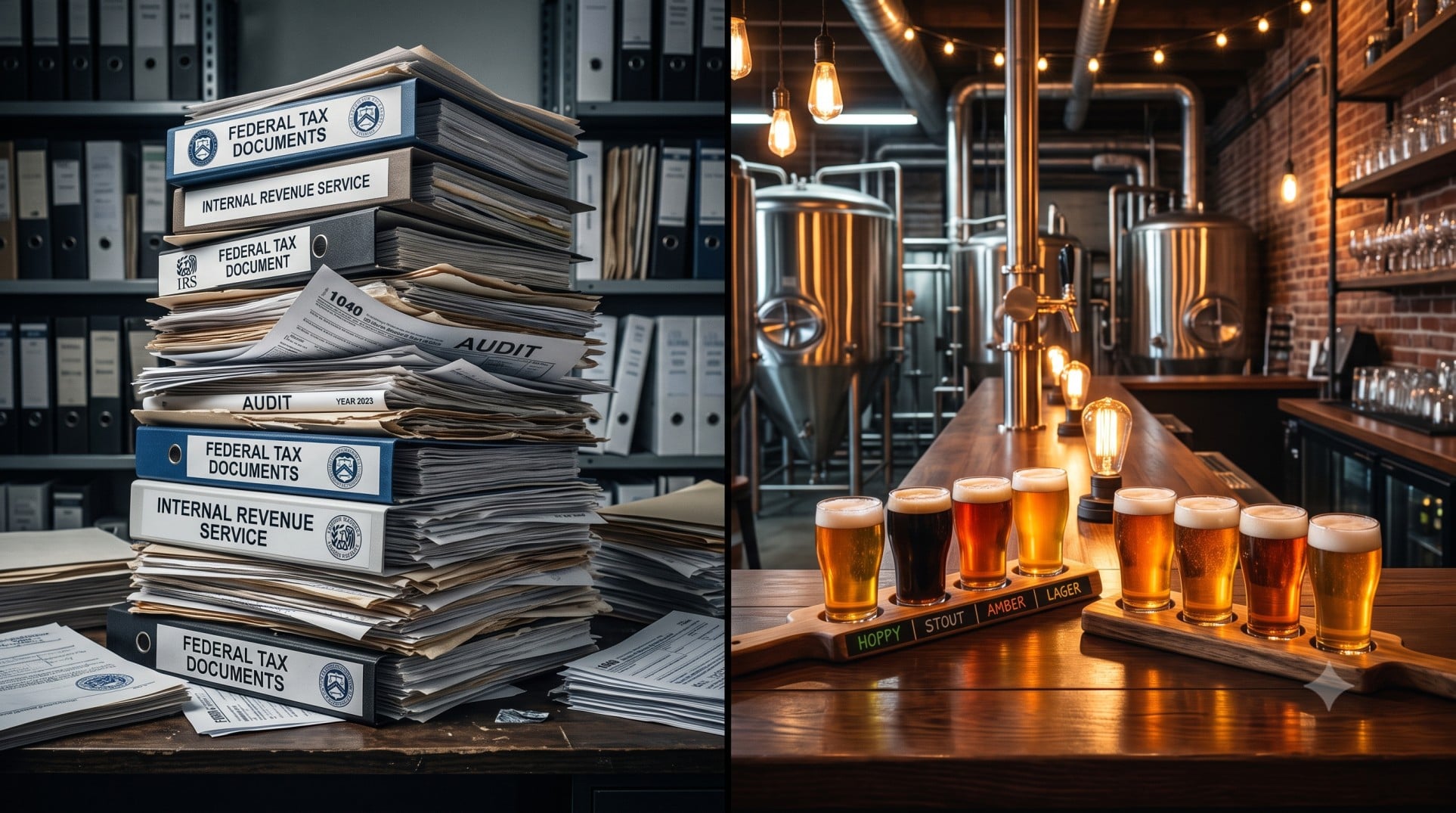
Entering the beverage industry is entirely different from opening a standard retail or manufacturing business. Selling alcohol in the US means operating within a legal framework designed nearly a century ago following the repeal of Prohibition. You are not just selling a product; you are dealing in a highly controlled, federally taxed substance. One missing permit can result in federal agents seizing your inventory, padlocking your doors, and issuing crippling financial penalties.
Many entrepreneurs assume that getting a local business license and a health department permit is enough to start pouring pints or mixing cocktails. That assumption is legally fatal. The alcohol industry operates on a strict dual-jurisdiction system. You must satisfy the federal government to produce or wholesale the alcohol, and you must satisfy the state government to distribute or sell it to the end consumer.
We are going to break down the exact mechanics of this regulatory gauntlet. You will learn the specific rules enforced by the federal Alcohol and Tobacco Tax and Trade Bureau. We will also expose the realities of the three-tier system and explain how to survive the highly restrictive, wildly expensive local retail markets across the country.
⚡ Executive Summary: Alcohol Compliance Essentials
- Federal vs. State: The federal government (TTB) regulates production, taxation, and labeling. State governments regulate distribution, retail sales, and operating hours.
- The Three-Tier System: Most states legally mandate a strict separation between Producers (breweries/distilleries), Distributors (wholesalers), and Retailers (bars/liquor stores).
- Quota Licenses: Many states cap the number of retail liquor licenses based on population. You cannot simply apply for a new one; you must buy an existing license on the open market, often for hundreds of thousands of dollars.
Table of Contents
- The Federal Hurdle: Alcohol and Tobacco Tax and Trade Bureau Rules
- The State Level: Navigating the TTB and State Liquor Control Boards
- The Retail Battleground: State-by-State Quota Systems for Retail Liquor Licenses
- Step-by-Step Guide to Selling Alcohol in the US
- Frequently Asked Questions About Selling Alcohol in the US
The Federal Hurdle: Alcohol and Tobacco Tax and Trade Bureau Rules
Before you mash your first grain or ferment a single grape, you must answer to the federal government. The Alcohol and Tobacco Tax and Trade Bureau (TTB) is a division of the US Department of the Treasury. Their primary mission is not public safety; it is tax collection. They want to ensure every drop of alcohol produced in the United States is accurately measured, categorized, and taxed before it ever reaches a consumer.
You cannot legally possess commercial distillation or brewing equipment without TTB approval. The application process is notoriously rigorous, often taking three to six months for approval. The agency will scrutinize your business structure, your source of funding, and the exact physical layout of your facility. They require strict physical barriers—often floor-to-ceiling walls—separating bonded (untaxed) alcohol storage areas from public spaces.
The TTB also controls what goes on your bottles. Before you can sell a packaged product across state lines, you must secure a Certificate of Label Approval (COLA). The agency reviews your label for mandatory information like alcohol by volume (ABV), government health warnings, and accurate class/type designations. If your label claims your product is a “Straight Bourbon Whiskey,” the TTB will verify that your production methods legally meet that exact definition.
Understanding the Requirements for Breweries and Distilleries
The specific requirements for breweries and distilleries differ significantly due to the alcohol concentration of their products. Distilled spirits carry a much higher excise tax rate than beer, meaning the TTB watches distilleries much closer than they watch breweries.
- Brewer’s Notice: Breweries must file a Brewer’s Notice with the TTB. This qualifies the facility to produce beer and dictates how the brewery measures its output (usually in barrels) for tax purposes.
- Distilled Spirits Plant (DSP) Registration: Distilleries face the strictest federal oversight. You must register as a DSP. The TTB requires highly detailed diagrams of your still, your security systems, and your locking mechanisms for all tanks holding high-proof spirits.
- Basic Permit: Wineries and wholesale distributors must obtain a Federal Basic Permit under the Federal Alcohol Administration (FAA) Act. This ensures fair trade practices and prevents monopolies.
Failing to adhere to these requirements for breweries and distilleries will stop your business before it starts. If you order a custom copper still from a manufacturer, they will often require proof of your pending DSP application before they will even ship the equipment to your facility.
The State Level: Navigating the TTB and State Liquor Control Boards
Once the federal government approves your production facility, you hit the state-level wall. Successfully navigating the TTB and state liquor control boards requires understanding that these two entities do not share a unified rulebook. The TTB gives you the right to make the alcohol, but the state gives you the right to sell it.
Every state has its own Alcoholic Beverage Control (ABC) board. Following the repeal of Prohibition in 1933 via the 21st Amendment, the federal government handed the power to regulate alcohol sales back to individual states. This created a fractured, chaotic system where the rules in California are entirely different from the rules in Utah or Pennsylvania.
You must determine if you are operating in a “Control State” or a “License State.” In a Control State (like Pennsylvania, Virginia, or Utah), the state government holds a monopoly on the wholesale or retail sale of certain categories of alcohol. The state literally owns the liquor stores. In a License State (like New York or California), the state issues licenses to private businesses to sell the alcohol.
The Ironclad Three-Tier System
The most critical concept in state alcohol law is the three-tier system. This legal structure was designed to prevent the “tied-house” monopolies of the pre-Prohibition era, where massive breweries owned all the local saloons and forced out competition.
- Tier 1 (Producers): The breweries, wineries, and distilleries that manufacture the product.
- Tier 2 (Distributors): The wholesalers who buy the product from the producers and transport it.
- Tier 3 (Retailers): The bars, restaurants, and liquor stores that sell the product to the public.
In most states, it is highly illegal to operate in more than one tier. A producer cannot sell directly to a retailer; they must sell to a distributor, who then sells to the retailer. While many states have carved out modern exceptions for craft breweries (allowing them to operate taprooms and sell directly to consumers), the core three-tier system still dominates the industry.
🏢 Real-World Scenario: The Tied-House Violation
Marcus owns a highly successful craft distillery in Texas (Tier 1). He decides to invest $100,000 into his friend’s new cocktail bar (Tier 3) across town. The Texas Alcoholic Beverage Commission (TABC) audits the bar’s ownership structure. Because Marcus is a licensed producer, his financial interest in a retail establishment violates the state’s strict tied-house laws. The state revokes the bar’s liquor license and issues a massive fine to Marcus’s distillery for attempting to bypass the three-tier system.
The Retail Battleground: State-by-State Quota Systems for Retail Liquor Licenses
If you plan to open a bar, a nightclub, or a package liquor store, you will likely face the most expensive hurdle in the entire industry. Understanding the state-by-state quota systems for retail liquor licenses is mandatory before you sign a commercial lease. You cannot simply fill out an application and pay a $500 fee to get a full liquor license in a quota state.
States like Florida, California, New Jersey, and Pennsylvania limit the total number of retail liquor licenses based on county population. For example, a county might issue one full liquor license for every 3,000 residents. Because populations grow slowly, new licenses are rarely issued by the state. This artificial scarcity creates a vicious secondary market.
If you want a license in a quota county, you must find a business owner willing to sell theirs. You hire a specialized liquor license broker to negotiate the purchase. In high-demand areas like Miami-Dade County or Los Angeles, a single quota license can easily sell for $300,000 to $500,000 on the open market. This cost is entirely separate from your actual state application fees, your build-out costs, or your inventory.
The Mechanics of Buying a Quota License
Purchasing a license on the secondary market is functionally similar to buying real estate. It requires strict legal oversight to protect your massive capital investment.
- Escrow Accounts: Never hand cash directly to a license seller. The funds must be placed in a secure escrow account managed by an attorney or a licensed broker.
- Lien Searches: The state will not transfer a license if the current owner owes back taxes to the Department of Revenue or has outstanding debts to wholesale distributors. Your attorney must perform a flawless lien search.
- The Transfer Process: Once the purchase agreement is signed, you submit a transfer application to the state ABC board. They will fingerprint you, run a deep background check, and investigate your source of funds before approving the transfer.
Step-by-Step Guide to Selling Alcohol in the US
The process of legally selling alcohol in the US requires flawless chronological execution. You cannot apply for a federal permit without a physical location, and you cannot get a state license without local zoning approval. Here is the exact sequence of operations for opening a regulated alcohol business.
Step 1: Secure Local Zoning Approval. Before dealing with the state or federal government, your local city must approve your location. You need a conditional use permit or zoning variance proving that a brewery, distillery, or liquor store is legally allowed to operate on that specific parcel of land.
Step 2: Form Your Legal Entity and Get an EIN. Form your LLC or Corporation with the Secretary of State. Obtain your Employer Identification Number (EIN) from the IRS. The TTB and the state ABC board will tie all permits directly to this specific corporate entity.
Step 3: Apply for Federal TTB Permits (Producers/Wholesalers Only). If you are manufacturing or distributing, submit your Brewer’s Notice, DSP application, or Basic Permit to the Alcohol and Tobacco Tax and Trade Bureau. Prepare your facility diagrams, secure your surety bond, and wait out the multi-month approval process.
Step 4: Secure the State ABC License. Submit your application to the state liquor control board. If you are a retailer in a quota state, this is the phase where you purchase the license out of escrow. The state will conduct deep background checks and verify your commercial lease.
Step 5: Pass the Final Health and Fire Inspections. Once the state approves your license conceptually, they will not issue the physical document until your local municipality signs off. You must pass a final fire marshal inspection for occupancy limits and a health department inspection for sanitation.
🏢 Real-World Scenario: The Dual-Jurisdiction Taproom
David opens a craft brewery with a public taproom in California. He successfully secures his Brewer’s Notice from the TTB to legally manufacture the beer. However, he cannot legally pour a pint for a customer until he also secures a Type 23 (Small Beer Manufacturer) license from the California Department of Alcoholic Beverage Control. He is simultaneously operating as a Tier 1 producer (federal) and a Tier 3 retailer (state), requiring him to maintain flawless compliance records for two entirely different government agencies.
Frequently Asked Questions About Selling Alcohol in the US
How long does it take to get a TTB permit for a distillery?
The timeline fluctuates based on the agency’s backlog, but you should expect the Distilled Spirits Plant (DSP) application process to take anywhere from 4 to 8 months. Errors in your facility diagrams or incomplete financial disclosures will trigger immediate rejections and reset your timeline.
Do I need a federal permit to open a retail liquor store?
No. Retailers who only sell alcohol to consumers (bars, restaurants, package stores) do not need a federal Basic Permit from the TTB. They only need to deal with their state’s Alcoholic Beverage Control board and local city permitting offices.
What is a Certificate of Label Approval (COLA)?
A COLA is a federal approval issued by the TTB. It verifies that your alcohol bottle label contains all mandatory government warnings, accurate ABV measurements, and truthful class/type designations. You must have a COLA before moving packaged alcohol across state lines.
Can a brewery sell directly to a liquor store?
It depends entirely on the state. Some states enforce a strict three-tier system, forcing the brewery to sell to a distributor first. Other states have passed “self-distribution” laws, allowing small craft breweries to bypass the distributor and sell limited quantities directly to local retailers.
Why are retail liquor licenses so expensive in some states?
This is due to the state-by-state quota systems for retail liquor licenses. When a state caps the number of licenses based on population, demand massively outpaces supply. Buyers are forced to bid against each other on the open secondary market, driving prices into the hundreds of thousands of dollars.
What is a tied-house law?
Tied-house laws are state and federal regulations designed to prevent monopolies. They legally prohibit a producer or distributor from having a financial interest in a retail establishment, and they prevent producers from giving free equipment or bribes to retailers in exchange for exclusive tap space.
Do I need a specific permit to formulate a new flavored vodka?
Yes. Before applying for a COLA, producers making flavored spirits or unique liqueurs must submit their recipe to the TTB for Formula Approval. The agency verifies that all added ingredients are recognized as safe by the FDA and that the final product meets the legal definition of its class.
What happens if I get caught selling alcohol without a license?
Operating an unlicensed alcohol business is a severe criminal offense. Law enforcement will raid the facility, seize and destroy all alcohol inventory, confiscate your production equipment, and file felony tax evasion and bootlegging charges against the business owners.
Mastering the legalities of selling alcohol in the US is the ultimate test of an entrepreneur’s patience and capital. The government does not care about your marketing plan or your award-winning recipes; they care about tax compliance and public safety. By flawlessly executing the requirements for breweries and distilleries, surviving the scrutiny of the Alcohol and Tobacco Tax and Trade Bureau, and successfully navigating the TTB and state liquor control boards, you build a legally bulletproof foundation for your beverage empire.
Disclaimer: This content provides general information for educational purposes only. Business regulations, licensing requirements, and laws vary drastically by federal, state, county, and city jurisdictions and change frequently. It is not professional legal, tax, or financial advice. Always consult a qualified attorney, CPA, or your local government agencies for personalized guidance regarding your specific business situation.
