
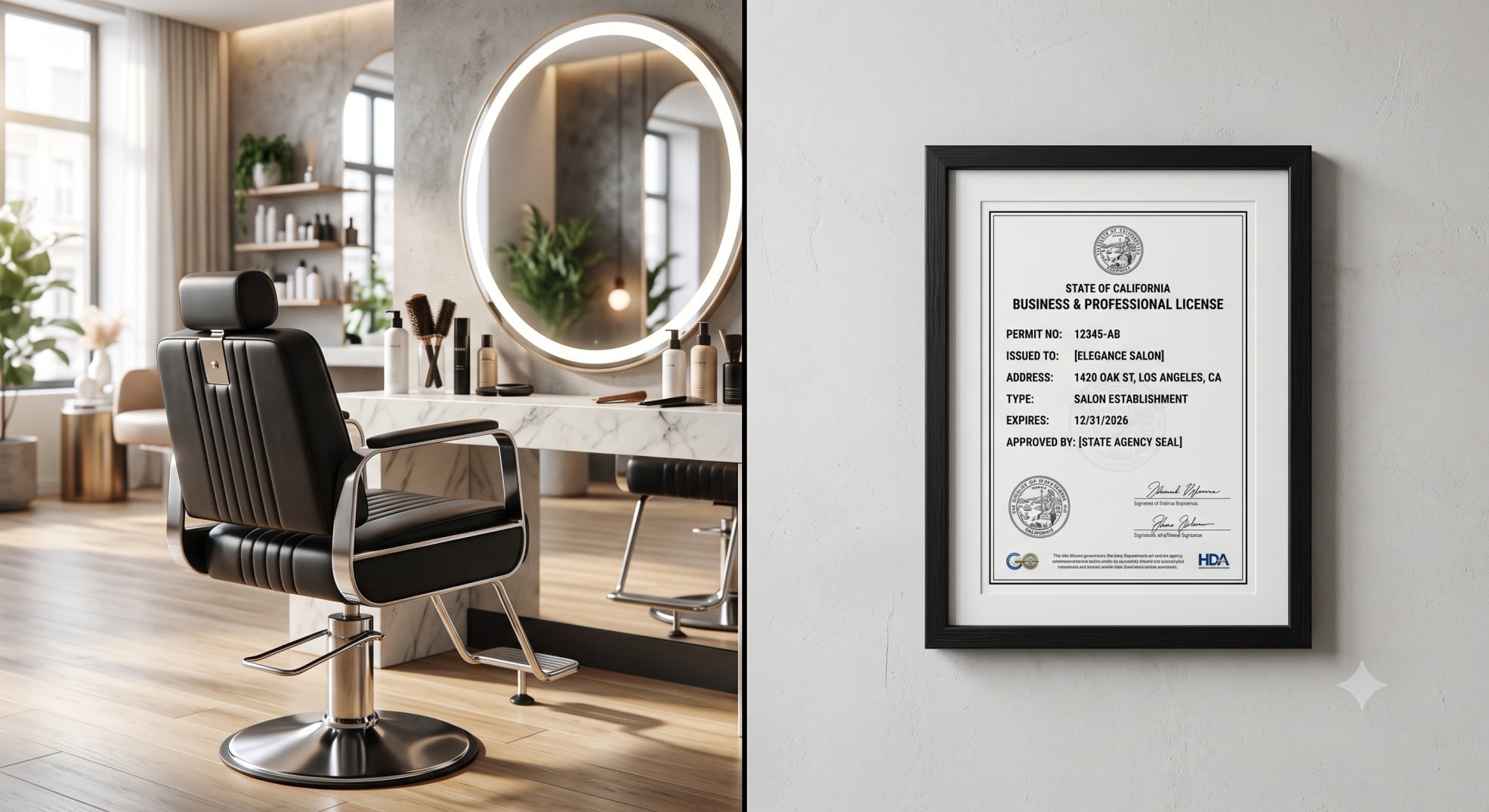
Opening a salon or spa is a massive milestone for any beauty professional. You want to design a beautiful space, build a loyal clientele, and create art every single day. But before you buy a styling chair or sign a commercial lease, you have to face the regulatory reality. The beauty industry is heavily policed by state and local governments to protect public health. Securing your salon permits and cosmetology licenses is the absolute first step to opening your doors.
Many talented stylists assume their personal license is all they need to open a shop. That is a fast track to getting shut down. State agencies separate the person from the physical facility. Your personal license allows you to cut hair or apply makeup, but your building needs its own distinct approval to legally operate as a commercial business.
We are going to break down exactly how this legal framework operates. You will learn the strict state board of cosmetology requirements for facility compliance and sanitation. We will also cover the exact paperwork needed to manage independent contractors, and why specialized licenses for estheticians differ so drastically from the strict health codes governing nail techs and tattoo artists.
⚡ Executive Summary: Beauty Industry Compliance
- Facility vs. Personal: A personal license lets you perform the service. An establishment license lets the physical building host those services. You must have both to operate legally.
- Independent Contractors: If you rent a chair, you are running your own business. You will likely need booth rental permits for independent stylists and your own local business tax receipt.
- The Health Department Split: Cosmetology boards govern hair, skin, and nails. They do not govern ink. Tattooing and microblading almost always require separate health department permits and bloodborne pathogen training.
Table of Contents
- Mastering State Board of Cosmetology Requirements
- The Legalities of Booth Rental Permits for Independent Stylists
- Earning Specialized Licenses for Estheticians
- The Regulatory Divide Between Nail Techs and Tattoo Artists
- Step-by-Step Guide to Opening a Compliant Salon
- Frequently Asked Questions About Salon Permits and Cosmetology Licenses
Mastering State Board of Cosmetology Requirements
Every state board requires salons to hold an active establishment license before opening to the public. This permit proves your facility meets strict safety, plumbing, and sanitation standards to protect clients from chemical exposure and bacterial infections.
Getting your facility approved is a completely separate process from getting your personal styling license. The board wants to know that your physical building is safe for high-volume commercial use. They will scrutinize your floor plan, your plumbing schematics, and your ventilation systems. If you fail to meet these state board of cosmetology requirements, an inspector will red-tag your door and legally halt your grand opening.
Most states mandate specific physical elements for a salon to legally operate. You must have a designated reception area that is physically separated from the chemical mixing station. You need a certain number of mounted, hard-plumbed shampoo bowls based on your square footage. Portable shampoo sinks are universally banned in commercial salons because they lack proper drainage and hair traps.
Ventilation is another massive hurdle for new owners. Salons generate intense chemical fumes from hair color, lighteners, and acrylic nail liquids. Inspectors will check your HVAC system to ensure it actively pulls fumes outside rather than just recirculating toxic air back into the building. You must also maintain strict sanitation logs, proving you use hospital-grade disinfectants like Barbicide daily.
The Legalities of Booth Rental Permits for Independent Stylists
Booth renters are legally classified as independent business owners, not W2 employees. Many states require them to hold specific booth rental permits for independent stylists alongside their personal cosmetology license and local business tax receipt.
The traditional salon model relies on employees earning a commission. Today, the industry is heavily dominated by the booth rental model. But renting a chair does not mean you just hand the owner cash every week and start cutting hair. You are operating a distinct business entity inside another business’s four walls.
Because of this, state boards and local cities require a clear paper trail. Some states, like Texas and Ohio, issue specific permits for renters. This paperwork proves to the state that you are a legitimate independent contractor and not an illegally misclassified employee. You must post this permit at your station right next to your personal license.
Even if your state board does not issue a specific renter license, your local city government will demand action. You must obtain your own local business license for your specific chair. The salon owner’s overarching business license does not cover your independent operations or your tax liabilities.
🏢 Real-World Scenario: The Misclassification Audit
Sarah owns a bustling salon and rents chairs to five stylists. She dictates their daily schedules, requires them to use her front-desk booking software, and provides all their color products. She assumes they are independent contractors. The IRS and the state labor board audit her salon. Because she controls their work and failed to ensure they held proper booth rental permits for independent stylists, the state reclassifies them as W2 employees. Sarah is hit with $40,000 in back taxes, workers’ compensation penalties, and unpaid overtime fines.
Earning Specialized Licenses for Estheticians
Estheticians focus exclusively on skincare and hair removal. Because they perform invasive treatments like chemical peels and extractions, states require specialized licenses for estheticians that demand anywhere from 220 to 1,000 hours of dedicated, hands-on training.
Skincare is a booming, highly profitable sector of the beauty industry. But you cannot perform facials or body waxing with a standard cosmetology license in every state. Many boards require professionals to hold specific credentials to ensure they understand the deep anatomy of the skin and the severe risks of chemical burns.
The training hours required for this license vary wildly across the country. Florida requires a mere 220 hours of training to get licensed. Georgia and Kansas demand a grueling 1,000 hours. This creates massive issues with reciprocity. If you move from Florida to Georgia, your license will not transfer. You will be forced to go back to beauty school to make up the missing 780 hours.
Scope of practice is the most heavily policed aspect of an esthetician’s career. A standard license allows you to perform superficial treatments like basic facials, waxing, and makeup application. It does not allow you to fire medical-grade lasers, inject Botox, or perform deep dermal peels.
The Regulatory Divide Between Nail Techs and Tattoo Artists
Cosmetology boards regulate nail technicians, requiring roughly 250 to 600 hours of training. Tattoo artists and permanent makeup artists are regulated entirely differently, falling under the strict jurisdiction of the local Department of Health.
It is easy to assume that anyone working in a salon or spa falls under the exact same regulatory umbrella. That is legally false. There is a massive jurisdictional wall separating nail techs and tattoo artists. If you plan to offer both manicures and microblading in your facility, you have to answer to two completely different government agencies.
Nail technicians are governed by the state board of cosmetology. To get a nail tech license, you typically need between 250 and 600 hours of schooling. The board focuses heavily on sanitation to prevent fungal infections from foot baths and improper cuticle cutting. Once licensed, a nail tech works under the salon’s standard establishment permit.
Tattoo artists exist in a completely different legal universe. Because tattooing and permanent makeup (like lip blushing and microblading) break the skin and draw blood, they are regulated by the Department of Health. You do not need a cosmetology license to tattoo. You need a body art permit and an OSHA-compliant bloodborne pathogens certification.
Health departments require tattoo stations to be completely isolated from hair cutting areas. They demand non-porous floors, dedicated hand-washing sinks, autoclaves for sterilization, and strict biohazard sharps disposal protocols. You cannot simply set up a tattoo bed next to a hair dryer chair.
Step-by-Step Guide to Opening a Compliant Salon
Navigating the maze of salon permits and cosmetology licenses requires patience and a strict chronological approach. Do not sign a lease or buy expensive equipment until you understand this sequence. Setting up your business entity is just the starting line. Here is exactly how to open your doors legally.
Step 1: Form Your Legal Entity. Register your salon as an LLC or Corporation with your state’s Secretary of State. Obtain an Employer Identification Number (EIN) from the IRS. You will need this EIN for every single permit application moving forward.
Step 2: Secure the Right Location. Find a commercial space that is properly zoned for a salon. Before signing the lease, verify with the city zoning office that a beauty establishment is legally allowed on that specific street. Check the plumbing capacity immediately.
Step 3: Apply for the Establishment License. Submit your floor plans, equipment list, and application to the state board of cosmetology. You must prove you have the required square footage, proper ventilation, and the correct ratio of sinks to styling stations.
Step 4: Pass the Initial Inspection. An inspector from the state board will visit your empty salon. They will check the water temperature at the shampoo bowls, verify the presence of hospital-grade disinfectants, and ensure all required safety and labor law signage is posted conspicuously.
Step 5: Secure Local City Permits. Once the state approves your facility, you must register with your local city or county. You will need a local business tax receipt, a retail sales tax permit (if you sell shampoo or styling products), and a fire department inspection to establish your maximum occupancy limit.
Step 6: Verify Staff Credentials. Before opening day, ensure every W2 employee has an active, unexpired personal license. If you are renting chairs, demand proof of their independent contractor paperwork and their individual professional liability insurance policies. Keep copies of everything in a master compliance binder.
Frequently Asked Questions About Salon Permits and Cosmetology Licenses
Do I need a cosmetology license to own a salon?
No. In most states, anyone can own a salon business as an investor. You just need to secure the proper facility establishment license. However, you cannot legally perform any hair, skin, or nail services on clients yourself unless you hold an active personal cosmetology license.
How often do I need to renew my salon establishment license?
Most states require salons to renew their establishment licenses every one to two years. You must pay a renewal fee and pass a routine, unannounced inspection by the state board to maintain your active legal status.
Can an esthetician do nails legally?
No. A standard esthetician license only covers skincare, makeup, and hair removal. If you want to offer manicures and pedicures, you must hold a dual license or go back to school to meet the specific state requirements for nail technicians.
What happens if I operate without the proper salon permits and cosmetology licenses?
You will face immediate closure. State boards issue massive financial penalties for unlicensed activity, often thousands of dollars per violation. Local municipalities can also issue stop-work orders, and you may face misdemeanor criminal charges for endangering public health.
Do I need a special license to do bridal makeup on location?
It depends entirely on the state. Some states have deregulated makeup application, allowing anyone to do freelance bridal makeup without a license. Other states strictly require you to hold a full cosmetology or esthetician license to charge money for applying cosmetics, even outside of a salon.
Why are the rules so different for nail techs and tattoo artists?
Nail technicians work on the superficial layers of the skin and nails, focusing on cosmetic enhancement. Tattoo artists actively puncture the dermis to deposit ink, creating a high risk for transmitting bloodborne diseases like Hepatitis C and HIV. This pushes tattooing out of cosmetology and into the jurisdiction of the health department.
Can I legally run a salon out of my house?
Yes, but it is highly regulated. You must meet all standard state board of cosmetology requirements for a commercial salon. This usually means building a completely separate entrance, installing a dedicated bathroom just for clients, and ensuring the salon space is physically sealed off from your living quarters.
Do independent stylists need their own liability insurance?
Absolutely. If you hold one of the booth rental permits for independent stylists, you are a solo business owner. The salon’s general liability policy will not cover you if you accidentally burn a client’s scalp with bleach or cut their ear. You must carry your own professional liability insurance.
Building a beauty empire requires mastering the legal landscape. The state does not care how good you are at balayage or volume lashes; they care about public safety, sanitation, and tax compliance. By strictly adhering to facility rules, properly managing your independent contractors, and understanding the distinct regulations for specialized licenses for estheticians versus the health codes for tattoo artists, you protect your business from devastating fines. Treat your salon permits and cosmetology licenses with the same respect you give your craft, and your business will thrive for years to come.
Disclaimer: This content provides general information for educational purposes only. Business regulations, licensing requirements, and laws vary drastically by federal, state, county, and city jurisdictions and change frequently. It is not professional legal, tax, or financial advice. Always consult a qualified attorney, CPA, or your local government agencies for personalized guidance regarding your specific business situation.
