
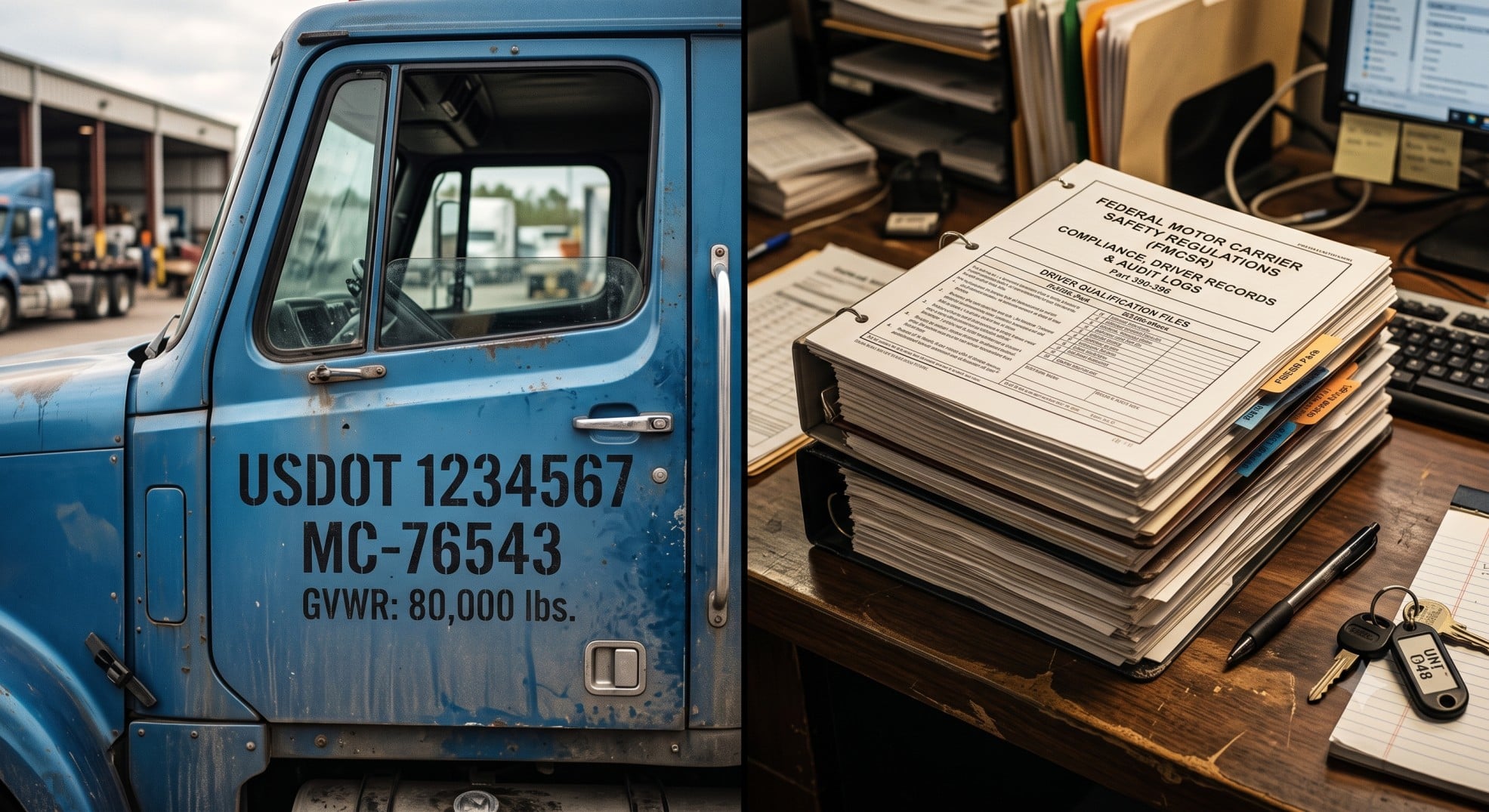
Buying a commercial semi-truck is the easiest part of starting a transport company. Surviving the federal and state regulatory maze is where most new owner-operators fail. The transportation industry is governed by a web of strict safety bureaus, tax agencies, and interstate agreements. If you hit the highway without the proper licenses and registrations for trucking and logistics businesses, you will face immediate out-of-service orders, impounded equipment, and crippling fines.
Many new drivers mistakenly believe that a Commercial Driver’s License (CDL) and a standard business LLC are enough to start booking loads. That is a legally disastrous assumption. The Federal Motor Carrier Safety Administration (FMCSA) and the IRS track every commercial vehicle operating in the United States. They want to know exactly who you are, what you are hauling, and that you have paid your share for the wear and tear on the highway system.
We are going to break down the exact regulatory sequence required to launch your fleet legally. You will learn the critical differences between tracking metrics like USDOT numbers and operating permissions like Motor Carrier (MC) Authority. We will also demystify the complex tax filings, including the Heavy Highway Vehicle Use Tax and the interstate logistics of the International Registration Plan (IRP).
⚡ Executive Summary: Trucking Compliance Essentials
- Federal Tracking: A USDOT number serves as your company’s unique identifier. It tracks your safety record, crash history, and compliance reviews.
- Operating Authority: An MC number grants you the legal right to transport federally regulated commodities across state lines for hire.
- Taxes & Plates: You cannot get commercial license plates without proving you paid the IRS Form 2290 highway tax. Once paid, you register your truck under IRP to legally drive through multiple states.
Table of Contents
- The Federal Foundation: Understanding USDOT Numbers
- Crossing State Lines: Motor Carrier (MC) Authority
- The IRS Toll: Heavy Highway Vehicle Use Tax (Form 2290)
- Apportioned Plates: The International Registration Plan (IRP)
- Step-by-Step Guide to Trucking Compliance
- Frequently Asked Questions About Trucking Licenses
The Federal Foundation: Understanding USDOT Numbers
Before you can haul a single piece of freight, the federal government needs to know you exist. USDOT numbers serve as unique identifiers created by the Federal Motor Carrier Safety Administration (FMCSA). Think of it as a social security number for your trucking business. It allows the government to track your safety record, compliance reviews, crash investigations, and roadside inspections.
Not every truck on the road needs one, but the threshold is surprisingly low. You are required to obtain a DOT number if your vehicle has a gross vehicle weight rating (GVWR) of 10,001 pounds or more and operates in interstate commerce. This means even heavy-duty pickup trucks pulling commercial trailers across state lines fall under FMCSA jurisdiction.
You also need a DOT number if you transport hazardous materials requiring a safety permit, regardless of the vehicle’s weight. Furthermore, roughly 38 states require all commercial motor vehicles to have a DOT number even if they never cross state lines (intrastate commerce). Getting the number is free, but it instantly places your business under the watchful eye of federal safety auditors.
Crossing State Lines: Motor Carrier (MC) Authority
Having a DOT number simply means the government is tracking you. It does not necessarily give you the legal right to charge people money to move their goods. For that, you need Motor Carrier (MC) Authority. Also known as operating authority, this dictates what kind of business you are legally allowed to conduct.
The distinction comes down to “private” versus “for-hire” carriage. If you own a landscaping company and use your own trucks to haul your own mowers to a job site, you are a private carrier. You need a DOT number, but you do not need MC authority. If you own a semi-truck and a client pays you to haul their pallets of electronics from Ohio to Texas, you are a for-hire carrier. You absolutely must have an active MC number.
Securing Motor Carrier (MC) Authority is a rigorous process. After applying and paying the $300 federal fee, you enter a mandatory 21-day protest period. During this time, your authority is listed as “pending.” You cannot legally haul freight. You must use this window to secure specialized commercial liability and cargo insurance, and have your insurance provider file the proof directly with the FMCSA.
The BOC-3 Requirement
Alongside insurance, you must file a BOC-3 form to activate your MC authority. This form designates a legal agent of process in every single state you operate in or travel through. Because you are moving across state lines, the government requires that you have a physical representative available in every state to receive legal documents if your company is sued.
🏢 Real-World Scenario: The “Pending” Authority Trap
James applies for his MC number and sees it listed online. Eager to start, he books a load of lumber from Georgia to Florida through a freight broker. At a weigh station in Florida, a DOT officer runs his DOT and MC numbers. The system shows his MC authority is still in the 21-day “pending” phase. The officer issues an immediate out-of-service order. James’s truck is impounded, the load is delayed, and he is hit with a massive federal fine for operating as a for-hire carrier without active authority.
The IRS Toll: Heavy Highway Vehicle Use Tax (Form 2290)
Trucks destroy roads much faster than passenger cars. To offset the cost of highway maintenance, the federal government requires heavy vehicle operators to pay the Heavy Highway Vehicle Use Tax. This is handled through IRS Form 2290, and it is a non-negotiable prerequisite for getting your commercial license plates.
The tax applies to any highway motor vehicle with a taxable gross weight of 55,000 pounds or more. The standard fee is $100, plus $22 for every 1,000 pounds over the 55,000 threshold, maxing out at $550 per year per vehicle. You must file Form 2290 and pay the tax annually by August 31st for the upcoming tax period.
When you pay the Heavy Highway Vehicle Use Tax, the IRS issues a stamped Schedule 1. This piece of paper is golden. You cannot register your truck at the DMV, you cannot renew your tags, and you cannot apply for apportioned plates without handing the clerk a copy of your stamped Schedule 1 proving you paid your federal highway dues.
Apportioned Plates: The International Registration Plan (IRP)
If you plan to drive a commercial truck across multiple states, you face a logistical nightmare. Historically, a trucker would have to buy a separate license plate for every single state they drove through. Today, that chaos is solved by the International Registration Plan (IRP), a reciprocity agreement among the US states, the District of Columbia, and Canadian provinces.
Under the IRP, you register your truck in your “base jurisdiction” (your home state). You receive one license plate—an “apportioned” plate—and a cab card. The cab card lists all the jurisdictions you are authorized to operate in and the weight limits for each. Instead of paying full registration fees in 50 different states, you pay a blended fee based on the percentage of miles you drive in each state.
For example, if you drive 50% of your total miles in Texas, 30% in Oklahoma, and 20% in Arkansas, your total registration fee is divided and distributed to those states in those exact percentages. When you first apply for the International Registration Plan (IRP), you will estimate your mileage. At the end of the year, you must report your actual miles, and your fees will be adjusted accordingly.
IRP vs. IFTA
It is crucial to distinguish between IRP and IFTA (International Fuel Tax Agreement). The IRP apportions your vehicle registration fees. IFTA apportions your fuel taxes. Both rely on meticulous mileage tracking, but they are separate programs requiring separate applications and separate quarterly or annual filings.
🏢 Real-World Scenario: The Unregistered State Fine
Sarah registers her new trucking company under the IRP but only selects five Midwestern states on her initial application to save money on registration estimates. Six months later, a broker offers her a highly lucrative load going into New York. She takes it. At a New York weigh station, an inspector checks her IRP cab card and sees New York is not listed. She is fined heavily for operating an unregistered vehicle and forced to buy an expensive temporary trip permit just to finish the delivery.
Step-by-Step Guide to Trucking Compliance
Securing the proper licenses and registrations for trucking and logistics businesses requires a strict chronological approach. You cannot walk into a DMV and ask for commercial plates without having your federal ducks in a row first. Setting up your business entity is just the prologue. Here is the exact sequence of operations.
Step 1: Form Your Entity and Get an EIN. Register your LLC or Corporation with your state. Obtain an Employer Identification Number (EIN) from the IRS. Every federal trucking application will require this EIN.
Step 2: Apply for USDOT Numbers. Go to the FMCSA portal and fill out the MCS-150 form. This generates your unique DOT number instantly. You now exist in the federal safety system.
Step 3: Apply for Motor Carrier (MC) Authority. If you are hauling for-hire, apply for your MC number. Pay the $300 fee and enter the 21-day protest period. During this window, secure your commercial auto liability and cargo insurance, and have your agent file the proof with the FMCSA.
Step 4: File the BOC-3 Form. Hire a blanket process agent company to file your BOC-3 with the FMCSA. This satisfies the legal representation requirement across all 50 states. Once insurance and BOC-3 are filed, and the 21 days pass, your MC authority becomes active.
Step 5: Pay the Heavy Highway Vehicle Use Tax. File IRS Form 2290 online and pay your tax. Print out the stamped Schedule 1. You will need this physical paper for the next step.
Step 6: Register for the International Registration Plan (IRP). Take your active DOT number, your active MC number, your proof of insurance, your stamped Schedule 1, and your proof of business address to your state’s DMV or Department of Revenue. Apply for your apportioned plates and cab card.
Step 7: Register for UCR and IFTA. Finally, pay your Unified Carrier Registration (UCR) fee (a state-collected fee based on fleet size) and apply for your IFTA decals to manage your interstate fuel taxes. You are now legally ready to haul.
Frequently Asked Questions About Trucking Licenses
Do I need both USDOT numbers and an MC number?
If you transport passengers or federally regulated commodities across state lines for a fee, you need both. If you only haul your own company’s goods (private carrier) or you never cross state lines (intrastate), you usually only need a DOT number.
How much does it cost to get an MC number?
The federal filing fee for Motor Carrier (MC) Authority is $300. However, the true cost is much higher because you cannot activate the authority without purchasing commercial trucking insurance, which can cost anywhere from $10,000 to $20,000 annually for a new venture.
What happens if I forget to file the Heavy Highway Vehicle Use Tax?
If you fail to file Form 2290, the IRS will assess penalties (usually 4.5% of the total tax due per month) and interest. More importantly, your state DMV will refuse to renew your commercial vehicle registration or IRP plates until you produce a valid Schedule 1.
Does the International Registration Plan (IRP) cover my fuel taxes?
No. The IRP only apportions your vehicle registration fees (your license plates). You must separately apply for the International Fuel Tax Agreement (IFTA) to apportion the taxes you pay on diesel fuel across different states.
Can I haul freight while my MC authority is pending?
Absolutely not. During the 21-day protest period, your authority is inactive. If you haul for-hire freight across state lines while pending, you are operating illegally and will face out-of-service orders and massive federal fines.
What is a BOC-3 filing, and why do I need it?
A BOC-3 designates a legal agent of process in every state. Because interstate truckers can be involved in accidents or lawsuits far from their home state, the federal government requires you to have a designated person in every jurisdiction who can legally receive court documents on your behalf.
Do box trucks need a DOT number?
Yes, if the box truck has a Gross Vehicle Weight Rating (GVWR) of 10,001 pounds or more and crosses state lines, it falls under FMCSA jurisdiction and requires a DOT number. Many states also require it for intrastate travel.
How do I track my mileage for IRP renewals?
You must maintain exact records of every mile driven in every jurisdiction. Most modern fleets use Electronic Logging Devices (ELDs) with built-in GPS tracking to automatically calculate state-by-state mileage for accurate IRP and IFTA reporting.
Mastering the licenses and registrations for trucking and logistics businesses is the true barrier to entry in the transport industry. The FMCSA and the IRS do not accept ignorance as an excuse for non-compliance. By flawlessly securing your USDOT numbers, activating your Motor Carrier (MC) Authority, paying your Heavy Highway Vehicle Use Tax, and maintaining accurate mileage for the International Registration Plan (IRP), you protect your equipment from impoundment and build a legally bulletproof logistics empire.
Disclaimer: This content provides general information for educational purposes only. Business regulations, licensing requirements, and laws vary drastically by federal, state, county, and city jurisdictions and change frequently. It is not professional legal, tax, or financial advice. Always consult a qualified attorney, CPA, or your local government agencies for personalized guidance regarding your specific business situation.
