
⚡ Executive Summary: Retail Tax Compliance
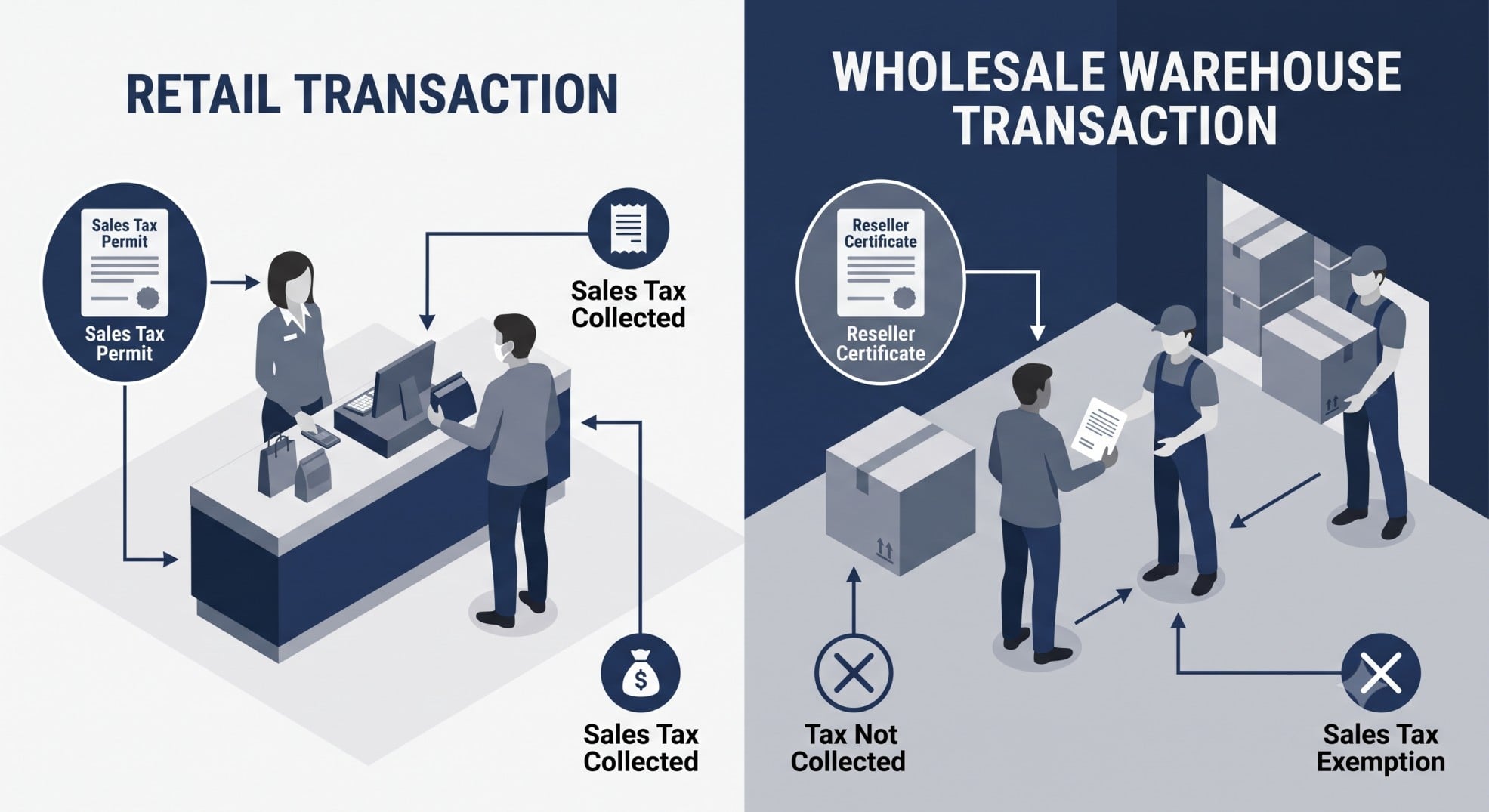
- A sales and tax permit is a state-issued license that legally requires you to collect sales tax from consumers and remit it to the government.
- You must apply for a sales tax certificate in your home state before making your first retail sale, and in other states once you cross economic nexus thresholds.
- A reseller certificate allows you to purchase wholesale inventory without paying sales tax, provided you intend to resell those goods.
- Wholesalers require you to present a valid resale permit license before they will open a B2B account for your business.
Retail and e-commerce businesses operate as unpaid tax collectors for state governments. When a customer buys a product, the state expects a cut of that transaction. You do not pay this tax out of your own profit margins. Instead, you collect it at the point of sale and hold it in trust until your filing deadline.
To facilitate this massive transfer of funds, states require businesses to hold specific registrations. You cannot just start charging customers an extra seven percent and keep it in a jar. You must hold a valid sales and tax permit issued by the state’s Department of Revenue. Operating without one while selling taxable goods is illegal and triggers severe financial penalties.
The system also features built-in exemptions to prevent double taxation. Goods are only supposed to be taxed once—when they reach the final end-user. This guide breaks down exactly how to secure your tax registrations, how to track your e-commerce nexus obligations, and how to leverage a reseller certificate to keep your wholesale inventory costs down.
Table of Contents
- The Core Function of a Sales and Tax Permit
- Economic Nexus: The E-Commerce Trigger
- How to Apply for a Sales Tax Certificate
- Unlocking Wholesale: The Reseller Certificate Explained
- Real-World Scenarios: Navigating Retail Compliance
- Step-by-Step: From Registration to Wholesale Buying
- Edge Cases: Drop-Shipping and Multi-State Exemption
- Frequently Asked Questions About Sales Tax
The Core Function of a Sales and Tax Permit
State governments rely heavily on sales tax to fund public infrastructure, schools, and emergency services. Five states—Alaska, Delaware, Montana, New Hampshire, and Oregon—do not have a statewide sales tax. The other forty-five states, plus the District of Columbia, enforce strict collection mandates.
A sales and tax permit (often called a seller’s permit, vendor’s license, or transaction privilege tax license) is your official authorization to collect these funds. Once registered, you are assigned a specific filing frequency. Depending on your sales volume, you will remit the collected taxes monthly, quarterly, or annually.
Failing to remit collected taxes is considered theft of state funds. Revenue departments audit businesses aggressively. If an auditor discovers you have been selling taxable goods without a permit, they will assess back taxes based on your gross revenue, add steep penalties, and charge compounding interest. They can even pierce the corporate veil of your LLC and hold you personally liable for unpaid trust fund taxes.
Economic Nexus: The E-Commerce Trigger
Historically, a business only had to collect sales tax in states where it had a physical presence—a storefront, a warehouse, or an employee. The internet changed everything. In 2018, the Supreme Court ruled in South Dakota v. Wayfair, Inc. that states could force out-of-state sellers to collect sales tax based entirely on their economic activity.
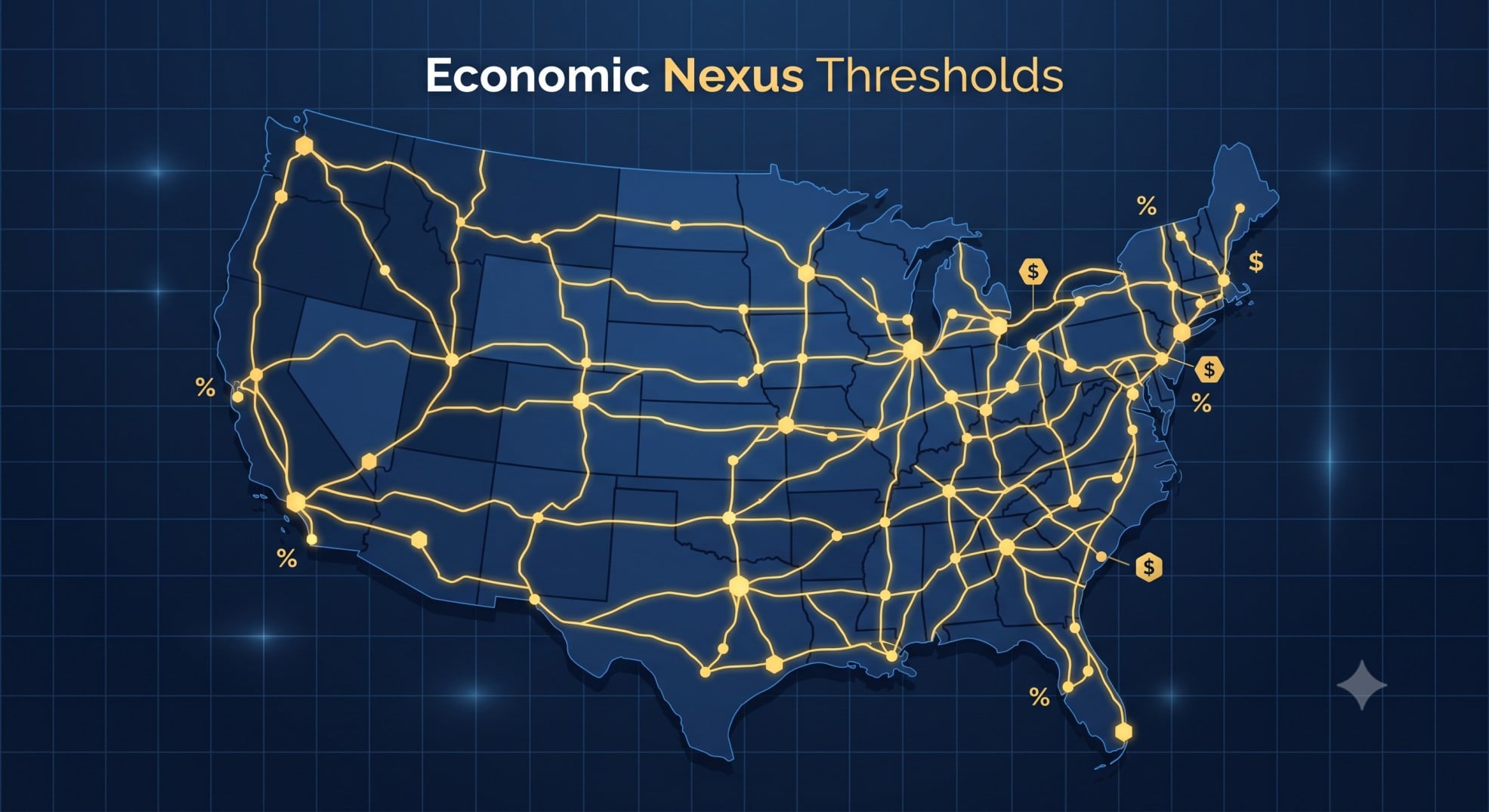
This created the concept of economic nexus. You no longer need a physical building in a state to trigger tax obligations. If your e-commerce sales cross a specific threshold in a target state, you establish economic nexus. Once that happens, you must apply for a sales tax certificate in that foreign state and begin collecting tax from customers located there.
Understanding Thresholds
Every state sets its own economic nexus threshold. The most common baseline is $100,000 in gross sales or 200 separate transactions within a calendar year. However, these limits vary wildly.
- California and Texas set their threshold at $500,000 in gross sales.
- New York sets its threshold at $300,000 AND 100 transactions.
- Kansas has a $100,000 threshold but does not count the number of transactions.
E-commerce sellers must monitor their sales volume across all fifty states simultaneously. The moment you cross a state’s threshold, you are legally obligated to register with their Department of Revenue. Software integrations on platforms like Shopify and BigCommerce can automate this tracking, but the legal liability remains entirely on the business owner.
How to Apply for a Sales Tax Certificate
Securing your registration requires interacting directly with the state’s Department of Revenue or taxation board. You cannot use a federal EIN alone to collect state taxes. You must establish a state-level tax account.
To apply for a sales tax certificate, you will generally need your federal EIN, your state entity formation documents (like your Articles of Organization), and the personal identifying information of the corporate officers. Most states process these applications online through their secure taxpayer portals. Some states issue the permit instantly upon completion of the web form, while others take several weeks to mail the physical document.
Once you receive the permit, you must display it prominently at your place of business. If you operate an e-commerce store, keep the digital record on file. Your registration will include a specific tax ID number, which you will use to file your returns and to generate your exemption documents for wholesale purchasing.
Unlocking Wholesale: The Reseller Certificate Explained
Retailers buy products in bulk at a discount and sell them at a markup. If a retailer had to pay sales tax on their bulk inventory purchases, and then charge sales tax again when selling to the end consumer, the product would be taxed twice. State laws prevent this through the use of exemptions.
A reseller certificate is a document you provide to your wholesale supplier. It proves that you are a legitimate business purchasing goods strictly for resale. When you present this document, the supplier removes the sales tax from your invoice.
The Mechanics of the Exemption
To utilize this exemption, you must possess a valid resale permit license. This is not a separate license you buy; it is simply another term for your active sales tax permit. The state issues you a number, and you write that number on the exemption certificate.
Suppliers are required by law to keep your resale license number on file. If the state audits the supplier and finds they sold goods tax-free without a valid certificate on record, the supplier will be forced to pay the missing tax. Because of this strict liability, reputable wholesalers will refuse to do business with you unless you provide a fully executed sales and use tax license reseller permit.
You cannot use this exemption to buy supplies consumed by your business. If you run a coffee shop, you can use the certificate to buy coffee beans tax-free because you resell the brewed coffee. You cannot use it to buy the mop you use to clean the floor, because the mop is not resold to the customer. Misusing a certificate to dodge taxes on business consumables is tax fraud.
Real-World Scenarios: Navigating Retail Compliance
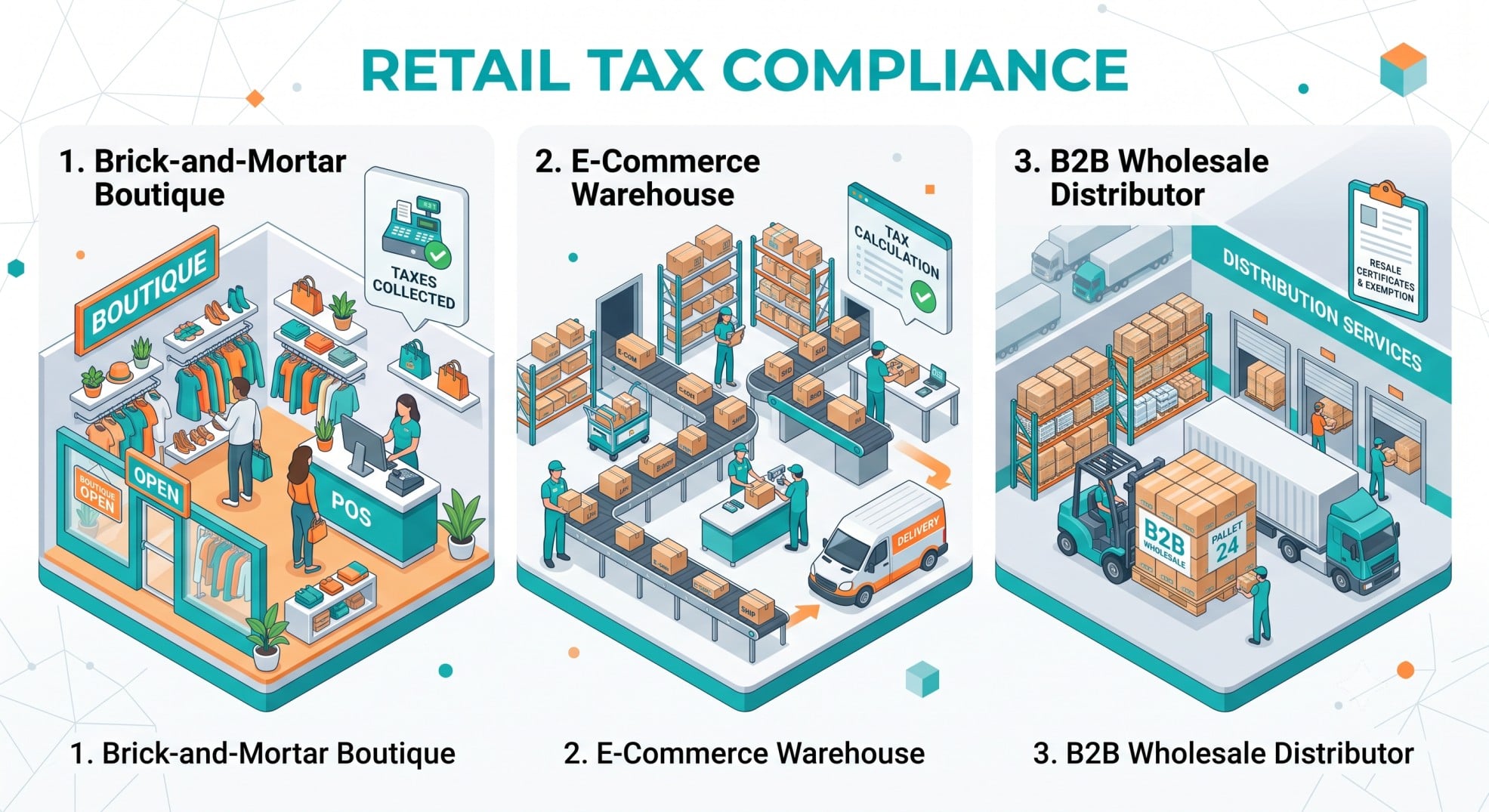
Tax compliance looks completely different depending on your business model. Let us examine four distinct scenarios to see how these permits function in active commerce.
Scenario 1: Emma’s Brick-and-Mortar Boutique
Emma opens a clothing boutique in Austin, Texas. She only sells to customers who walk through her front door. She has physical nexus in Texas.
She registers for a Texas sales and tax permit. When she buys dresses from a wholesale distributor in Los Angeles, she provides the distributor with a Texas reseller certificate. The distributor ships the dresses to Austin without charging sales tax. Emma puts the dresses on her racks. When a local customer buys a dress, Emma charges the 8.25% Austin sales tax, collects the money, and remits it to the Texas Comptroller every quarter.
Scenario 2: David’s Multi-State E-Commerce Brand
David runs a Shopify store selling custom mechanical keyboards from his garage in Florida. He holds a Florida permit and collects tax on orders shipped within Florida.
In November, a viral marketing campaign causes his sales to explode. He ships $150,000 worth of keyboards to customers in Georgia, crossing Georgia’s economic nexus threshold. David must immediately apply for a sales tax certificate with the Georgia Department of Revenue. He updates his Shopify tax settings to begin collecting Georgia state and local taxes on all future orders shipped to that state. He now files tax returns in both Florida and Georgia.
Scenario 3: Chloe’s B2B Wholesale Bakery
Chloe operates a commercial bakery in Chicago, Illinois. She does not sell to the public. She only sells bulk pastries to local coffee shops.
Even though she does not collect tax from the end consumer, Chloe still needs an Illinois sales and tax permit. Why? Because she needs the registration to buy her bulk flour and sugar tax-free. Furthermore, she must collect a valid resale permit license from every single coffee shop she supplies. If a coffee shop owner refuses to provide their resale license number, Chloe must legally charge them sales tax on the pastries.
Scenario 4: The Drop-Shipping Dilemma
Marcus runs a drop-shipping business. A customer in Ohio orders a lamp from Marcus’s website. Marcus forwards the order to his supplier in California. The California supplier ships the lamp directly to the Ohio customer.
If Marcus has economic nexus in Ohio, he must collect Ohio sales tax from the customer. But the California supplier also needs proof that the transaction is tax-exempt. Marcus must provide the supplier with a sales and use tax license reseller permit. Drop-shipping creates complex multi-state exemption requirements, often forcing sellers to register in states purely to generate valid exemption certificates for their suppliers.
Step-by-Step: From Registration to Wholesale Buying
Securing your tax identity and setting up your wholesale supply chain requires a specific sequence of operations. You cannot buy wholesale inventory until your state registrations are fully approved.
| Step | Action Required | Agency / Party | Purpose |
|---|---|---|---|
| 1 | Form Your Legal Entity | Secretary of State | Establishes the LLC or Corporation that will hold the tax liability. |
| 2 | Obtain a Federal EIN | Internal Revenue Service | Secures the federal tax ID required to open state-level accounts. |
| 3 | Register for the Permit | State Dept. of Revenue | Secures your official sales and tax permit for your home state. |
| 4 | Generate the Certificate | Internal / State Template | Fills out the state-specific exemption form using your new tax ID. |
| 5 | Submit to Supplier | Wholesale Distributor | Provides your sales and use tax license reseller permit to open a B2B account. |
| 6 | Monitor Economic Nexus | Internal Accounting | Tracks out-of-state sales volume to determine if new state registrations are needed. |
Once you complete step three, you will receive your official resale license number. Keep this number secure, as it is the key to unlocking tax-free purchasing across your entire supply chain.
Edge Cases: Drop-Shipping and Multi-State Exemption
Accepting out-of-state exemption certificates is a massive pain point in B2B commerce. If you are a retailer in Nevada buying goods from a wholesaler in California, does the California wholesaler accept your Nevada permit?
In most cases, yes. Thirty-six states participate in the Streamlined Sales and Use Tax Agreement (SSUTA) or recognize the Multi-State Tax Commission (MTC) uniform sales and use tax exemption certificate. This allows a retailer to use one standardized form to claim exemptions across multiple participating states.
However, states like California, Florida, and New York do not accept multi-state certificates. If your supplier is located in California, and they drop-ship a product to a California customer on your behalf, the supplier will charge you California sales tax unless you hold a specific California permit. Understanding state-specific tax laws is critical for drop-shippers to avoid margin-crushing tax assessments on their wholesale invoices.
Frequently Asked Questions About Sales Tax
What is the difference between a sales and tax permit and a reseller certificate?
A permit is the actual license issued by the state that legally authorizes you to collect tax from consumers. A certificate is the piece of paper you hand to a wholesale supplier, proving you hold that permit, so you can buy inventory tax-free.
Do I need to apply for a sales tax certificate if I only sell services?
It depends entirely on your state. Most states do not tax professional services (like consulting or accounting). However, states like Texas tax data processing and security services, while Hawaii and South Dakota tax almost all services. You must check your specific state’s taxability matrix.
How much does a resale permit license cost?
In most states, applying for the permit is completely free. A few states charge a nominal registration fee, typically ranging from $10 to $50. You should never pay a third-party service hundreds of dollars to obtain this basic state registration for you.
Does a sales and use tax license reseller permit expire?
The underlying permit usually renews automatically as long as you file your tax returns on time. However, the physical certificates you give to your suppliers often expire every three to four years. Suppliers will ask you to submit an updated form to keep your wholesale account active.
Can I use my resale license number to buy office supplies?
No. You can only use the exemption to purchase items that you intend to resell to an end consumer in the normal course of business. Buying office computers, printer ink, or breakroom snacks tax-free is illegal and will result in audit penalties.
What happens if I cross an economic nexus threshold?
Once you cross a state’s threshold (e.g., $100,000 in sales), you are legally required to register with that state’s Department of Revenue, begin collecting their specific state and local taxes on future orders, and file regular returns in that state.
Do I need a permit if I only sell on Amazon?
Amazon operates as a Marketplace Facilitator. In all states with a sales tax, marketplace facilitator laws require Amazon to calculate, collect, and remit the tax on your behalf. However, many states still require you to hold a permit and file a “zero return” showing your gross sales and the deductions taken by the marketplace.
How often do I have to file sales tax returns?
Your filing frequency is assigned by the state when you register. It is based on your estimated sales volume. High-volume sellers usually file monthly, mid-volume sellers file quarterly, and low-volume sellers file annually. You must file a return even if you had zero sales during the period.
Can I get a permit before I form an LLC?
No. The permit is attached to a specific legal entity. If you apply as a sole proprietor, the permit is attached to your social security number. If you later form an LLC, you must cancel the old permit and apply for a new one under the LLC’s federal EIN.
What should I do if a supplier rejects my certificate?
Suppliers have the right to reject certificates if they believe the form is incomplete, invalid, or if the items being purchased do not logically match your business type. Ensure you are using the correct state-specific form and that your permit number is currently active with the state revenue department.
Disclaimer: This content provides general information for educational purposes only. Business regulations, licensing requirements, and laws vary drastically by federal, state, county, and city jurisdictions and change frequently. It is not professional legal, tax, or financial advice. Always consult a qualified attorney, CPA, or your local government agencies for personalized guidance regarding your specific business situation.
