
⚡ Executive Summary: Mastering Business Acronyms
- A federal ein acts as the social security number for your business, required for hiring employees, opening commercial bank accounts, and filing taxes.
- A dba registration allows your legal entity to operate under a consumer-facing brand name, though it provides zero liability protection on its own.
- The recent August 2026 regulatory updates fundamentally changed the disclosure of beneficial ownership requirements, permanently exempting domestic U.S. companies.
- Foreign entities registered to do business in the U.S. must still file a fincen report within 30 days of their registration becoming effective.
Business formation often feels like drowning in a sea of government acronyms. You file your initial paperwork, only to be told you now need an EIN to get a bank account, a DBA to hang your sign, and a BOI report to avoid federal penalties. Understanding how these distinct registrations interact is the only way to keep your operations legally compliant.
Entrepreneurs frequently confuse these terms, assuming that securing one automatically covers the others. This is a dangerous misconception. Your tax identity, your public branding, and your federal transparency requirements are managed by completely separate agencies at different levels of government.
We are going to break down the exact mechanics of the employer identification number, the legal realities of operating under a fictitious name, and the massive August 2026 regulatory shift that completely rewrote the rules for federal ownership reporting.
Table of Contents
- The Federal EIN: Your Company’s Tax Identity
- DBA Registration: Operating Under a Fictitious Name
- The FinCEN Report and the Disclosure of Beneficial Ownership
- The August 2026 FinCEN Rule Update: A Regulatory Shift
- Step-by-Step: Securing Your EIN and Setting Up a DBA
- Real-World Scenarios: Applying the Alphabet Soup
- Edge Cases: State-Level Ownership Reporting
- Frequently Asked Questions About Business Registration
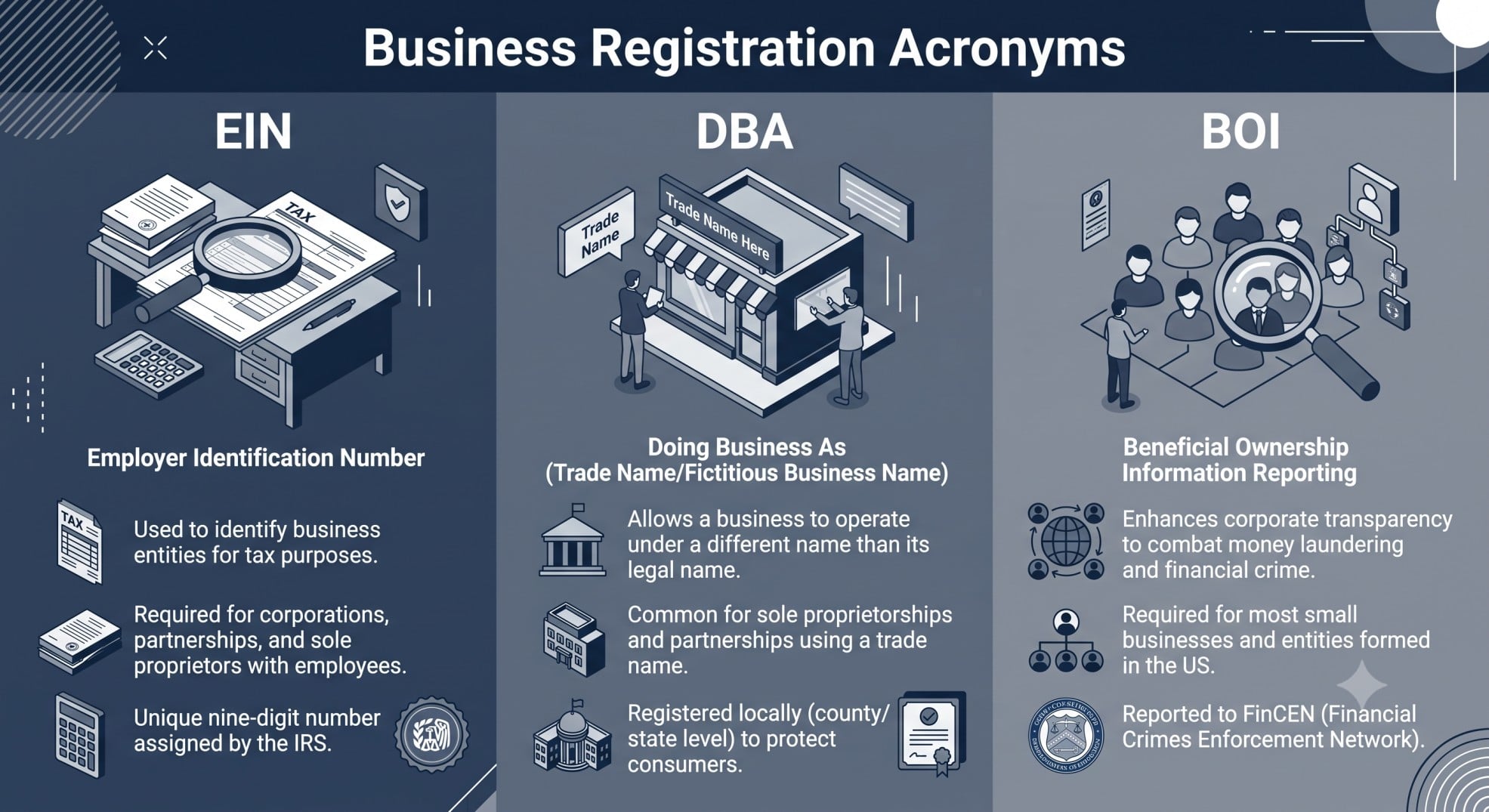
The Federal EIN: Your Company’s Tax Identity
Before you can hire a single employee or process a payroll run, you must establish your company’s identity with the Internal Revenue Service. The federal ein is a unique nine-digit number assigned to your business entity. Think of it as a Social Security Number for your company.
Not every single business legally requires one. If you operate as a sole proprietor with no employees, the IRS allows you to use your personal Social Security Number for tax filing. But relying on your SSN is generally a poor business practice. Providing your personal SSN to dozens of clients for 1099 reporting exposes you to significant identity theft risks. Securing an EIN creates a necessary layer of privacy between your personal identity and your commercial operations.
Who is Legally Required to Have an EIN?
The IRS mandates an employer identification number for specific business structures and activities. You must obtain one if your business meets any of the following criteria:
- You have employees.
- You operate your business as a Corporation or a Partnership.
- You file Employment, Excise, or Alcohol, Tobacco, and Firearms tax returns.
- You withhold taxes on income, other than wages, paid to a non-resident alien.
- You have a Keogh plan.
- You are involved with trusts, estates, real estate mortgage investment conduits, or non-profit organizations.
Single-member LLCs occupy a unique space. By default, the IRS taxes a single-member LLC as a “disregarded entity,” meaning the profits pass through to the owner’s personal tax return. However, almost every commercial bank requires a federal employer id number to open a business checking account, regardless of your tax classification. You cannot effectively separate your personal and business finances without one.
How to Apply for the Number
Applying is a straightforward, free process. You can submit Form SS-4 directly through the official IRS website, and the system will generate your number immediately upon completion. Never pay a third-party service to obtain this number for you; the government does not charge a fee for this registration.
International founders face a slightly different process. If you do not have an SSN or an Individual Taxpayer Identification Number (ITIN), you cannot use the online portal. Instead, you must call the IRS directly or fax the application to secure your irs employer identification number. This manual process can take several weeks, so international entrepreneurs must plan accordingly.
DBA Registration: Operating Under a Fictitious Name
Legal entity names are often clunky. You might form your company as “Smith Holdings and Enterprises LLC,” but you want the sign above your coffee shop to simply read “The Daily Grind.” This is where a dba registration becomes necessary.
DBA stands for “Doing Business As.” Depending on your state, it is also referred to as a Fictitious Business Name, an Assumed Name, or a Trade Name. Registering a dba does not create a new legal entity. It does not provide any limited liability protection. It is simply a public declaration linking your consumer-facing brand name to your underlying legal entity.
The Mechanics of Setting Up a DBA
The process for setting up a dba varies drastically depending on your jurisdiction. In some states, you file the paperwork at the state level with the Secretary of State. In others, you must file at the county level with the local County Clerk’s office. If you operate in multiple counties within a county-level state, you may need to register the name in every single county where you conduct business.
Certain jurisdictions impose strict publication requirements. In states like New York, California, and Illinois, simply filing the form is not enough. You must publish a formal notice of your fictitious name in a local, approved newspaper for several consecutive weeks. Once the publication period ends, the newspaper provides an affidavit of publication, which you must then file with the government to finalize the registration.
Banks enforce these rules strictly. If a customer writes a check payable to “The Daily Grind,” you cannot deposit that check into the bank account of “Smith Holdings and Enterprises LLC” unless you provide the bank with a certified copy of your fictitious name registration. Proper banking compliance relies entirely on matching your legal documentation to your operational reality.
The FinCEN Report and the Disclosure of Beneficial Ownership
For decades, the United States was heavily criticized by international watchdogs for allowing anonymous shell companies to operate within its borders. To combat money laundering, tax evasion, and terrorist financing, Congress passed the Corporate Transparency Act (CTA) in 2021.
The CTA introduced a massive new compliance hurdle: the fincen report. Administered by the Financial Crimes Enforcement Network (FinCEN), this mandate required millions of small businesses to submit a formal disclosure of beneficial ownership to a secure federal database.
The government wanted to know exactly who was pulling the strings behind private companies. The law required entities to report personal identifying information—including names, birthdates, residential addresses, and images of government-issued IDs—for every “beneficial owner.”
Defining a Beneficial Owner
Under the original framework, a beneficial owner was defined as any individual who met at least one of two criteria:
- Ownership Interest: An individual who directly or indirectly owned or controlled 25% or more of the ownership interests of the reporting company.
- Substantial Control: An individual who exercised substantial control over the reporting company, regardless of their equity stake. This included senior officers (CEO, CFO, General Counsel), individuals with the authority to appoint or remove senior officers, and anyone who directed important business decisions.
This dual-pronged definition meant that a company could have multiple beneficial owners who owned zero stock. The initial rollout of this beneficial owner disclosure requirement in early 2024 caused widespread confusion and panic among small business owners.
The August 2026 FinCEN Rule Update: A Regulatory Shift
The landscape of federal reporting changed dramatically in the summer of 2026. Following years of intense litigation, constitutional challenges from small business advocacy groups, and shifting political priorities, the Treasury Department reversed course.
On August 11, 2026, FinCEN issued a final rule that permanently removed the reporting requirement for U.S. companies and U.S. persons. The final fincen rule, which became effective on August 14, 2026, represents one of the most significant rollbacks of corporate compliance in modern history.
Who Still Needs to File?
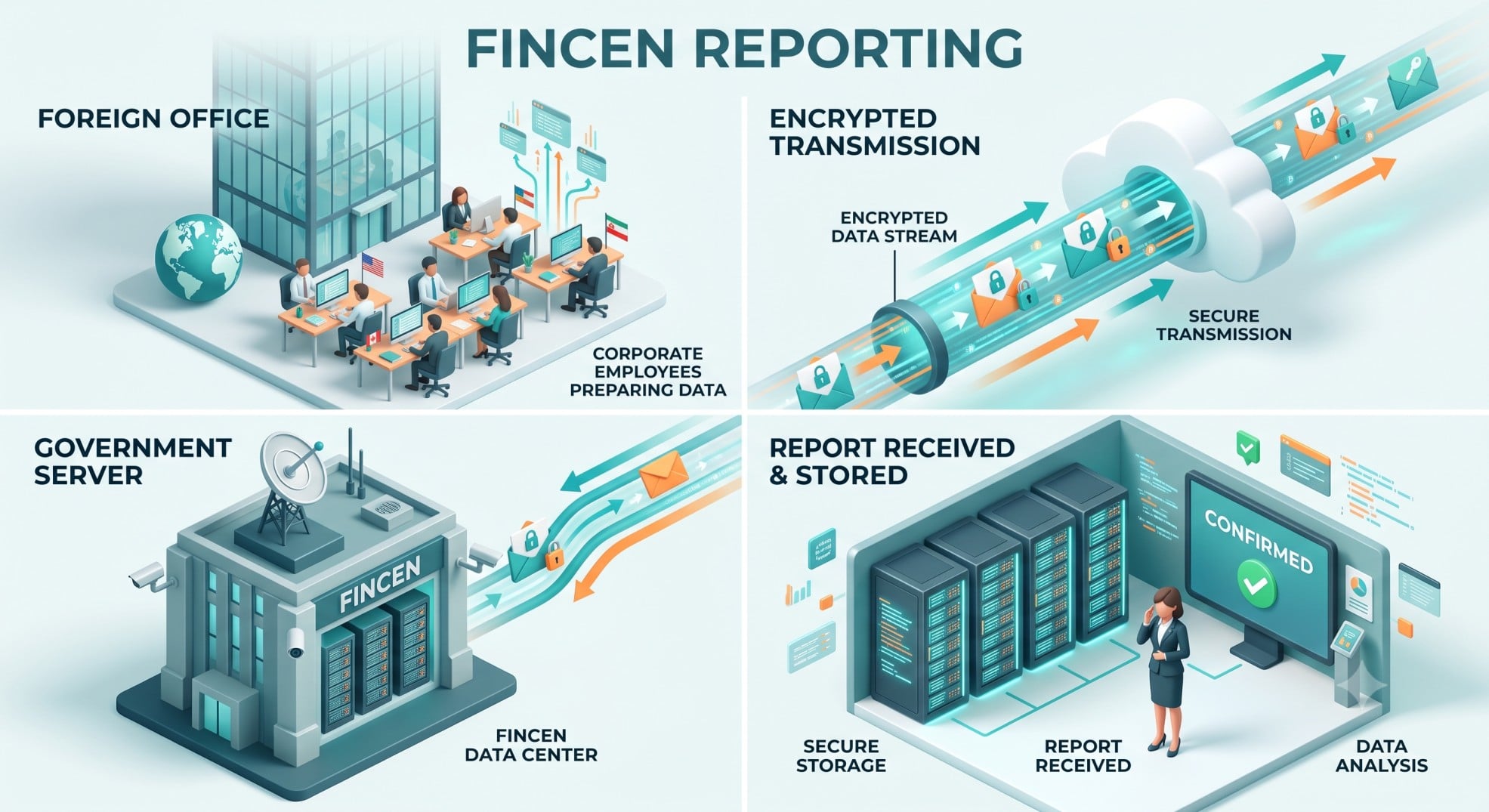
Under the new framework, the mandatory disclosure of beneficial ownership applies almost exclusively to foreign reporting companies. If your entity was formed under the law of a foreign country and has registered to do business in any U.S. state or Tribal jurisdiction, you are still subject to the CTA.
Foreign reporting companies must submit their ownership information to FinCEN within 30 calendar days of receiving notice that their U.S. registration is effective. However, they are only required to report non-U.S. person beneficial owners. They do not need to report the data of U.S. citizens who hold equity or exercise substantial control.
For domestic U.S. businesses—LLCs and Corporations formed within the fifty states—the burden is entirely gone. FinCEN also announced the deletion of all previously reported data submitted by U.S. persons from its database. You no longer have to worry about updating your federal file every time a senior officer changes their home address.
Step-by-Step: Securing Your EIN and Setting Up a DBA
Because the federal ein and local fictitious names serve completely different purposes, you must apply for them in a specific chronological order. Attempting to skip steps will result in rejected applications.
| Step | Action Required | Agency | Purpose |
|---|---|---|---|
| 1 | Form Your Legal Entity | Secretary of State | Establishes the underlying LLC or Corporation. You cannot get an EIN for an LLC that does not legally exist yet. |
| 2 | Obtain Your employer identification number | Internal Revenue Service | Generates your tax ID using your newly formed legal entity name. |
| 3 | File the Fictitious Name | County Clerk / State | Links your desired brand name to your legal entity. The application will require your new EIN. |
| 4 | Complete Publication (If Required) | Local Newspaper | Fulfills state-mandated public notice requirements for the fictitious name. |
| 5 | Open a Business Bank Account | Commercial Bank | Requires your filed entity documents, your EIN confirmation letter, and your stamped DBA certificate. |
Following this exact sequence ensures that your tax identity and your public branding are perfectly aligned before you accept your first dollar of revenue.
Real-World Scenarios: Applying the Alphabet Soup
To fully grasp how these registrations interact, let us look at three distinct business models operating under the current regulatory framework.
Scenario 1: Marcus the Freelance Photographer
Marcus operates as a sole proprietor in Travis County, Texas. His legal business name is simply “Marcus Johnson.” He wants to market his services as “Austin Urban Photography.”
Because he is using a name other than his legal given name, Marcus must file an Assumed Name Certificate (a DBA) with the Travis County Clerk. He does not have employees, so he is not legally required to get a federal ein. He could use his SSN for tax purposes. However, to protect his personal identity from clients, he voluntarily applies for an EIN. Because he is a U.S. citizen operating a domestic sole proprietorship, the disclosure of beneficial ownership rules do not apply to him at all.
Scenario 2: Sarah’s Domestic Tech Startup
Sarah forms “DataFlow Analytics LLC” in Delaware. She plans to hire a team of software developers and raise venture capital. She does not need a fictitious name because she is operating under the exact legal name of her LLC.
She immediately applies for an employer identification number from the IRS so she can set up her payroll systems. Prior to August 2026, Sarah would have been required to file a fincen report listing herself and her senior executives. Thanks to the Final Rule, her domestic reporting company is permanently exempt. She focuses entirely on her state and local compliance.
Scenario 3: Alejandro’s Foreign E-Commerce Expansion
Alejandro owns a successful manufacturing company formed under the laws of Mexico. He decides to expand into the U.S. market by registering his foreign entity to do business in Arizona. He wants to sell his products under a new localized brand name, “Desert Supply Co.”
First, Alejandro registers his foreign entity with the Arizona Corporation Commission. Next, he obtains a federal ein to handle U.S. tax obligations. He then files a trade name registration in Arizona to legally operate as “Desert Supply Co.” Finally, because his company is a foreign entity registered to do business in the U.S., he is subject to the CTA. Alejandro must submit his disclosure of beneficial ownership to FinCEN within 30 days of his Arizona registration becoming effective, detailing the non-U.S. individuals who control the company.
Edge Cases: State-Level Ownership Reporting
While the federal government rolled back its reporting requirements for domestic companies, entrepreneurs must remain vigilant regarding state-level legislation. Nature abhors a vacuum, and several states have stepped in to mandate their own transparency laws.
For example, New York enacted the LLC Transparency Act. This state-level law requires limited liability companies formed or registered to do business in New York to disclose their beneficial owners directly to the state’s Department of State. Unlike the revised federal rules, New York’s law applies to domestic entities operating within its borders.
If you operate in a state with its own transparency act, you must fulfill that state’s specific disclosure of beneficial ownership requirements, regardless of your federal exemption. Always consult your local Secretary of State’s office to confirm if state-level ownership reporting applies to your entity type.
Frequently Asked Questions About Business Registration
How much does a federal ein cost?
Obtaining an EIN is completely free when you apply directly through the official IRS website (irs.gov). You should never pay a third-party service or website to generate this number for you, as the online application takes less than ten minutes to complete.
Does a dba registration protect my personal assets?
No. A fictitious business name provides zero liability protection. It is merely a branding tool. To protect your personal assets from business debts and lawsuits, you must form a distinct legal entity, such as a Limited Liability Company (LLC) or a Corporation.
Who exactly needs an employer identification number?
Any business that hires employees, operates as a corporation or partnership, or files specific excise taxes must have one. Additionally, almost all commercial banks require an EIN to open a business checking account, even for single-member LLCs without employees.
What happens if I miss the fincen report deadline?
For foreign entities still subject to the rule, failing to file within the 30-day window can result in severe civil penalties of up to $591 per day. Willful violations can also lead to criminal penalties, including fines of up to $10,000 and up to two years in federal prison.
How long does a fictitious business name last?
Fictitious name registrations do not last forever. Depending on your state and county, they typically expire every three to five years. You must track your renewal deadlines carefully; if your registration lapses, another business can legally claim your brand name.
Can I use my SSN instead of a federal employer id number?
If you are a sole proprietor with no employees, the IRS allows you to use your SSN for tax filing. However, using an EIN is highly recommended to protect your personal identity and to satisfy the requirements of commercial banks and vendors.
Do I need a new EIN if I change my business structure?
Usually, yes. If you operate as a sole proprietorship and later form an LLC, or if your LLC elects to be taxed as an S-Corporation, the IRS generally requires you to apply for a new tax identification number to reflect the new legal structure.
Does the August 2026 fincen rule apply to trusts?
Most standard revocable living trusts were never considered reporting companies because they are not created by filing a document with a Secretary of State. However, statutory trusts that require state filings are treated as reporting entities. If it is a domestic statutory trust, it is now exempt under the 2026 rule.
Can two businesses have the same fictitious name?
At the county level, it is often possible for two businesses in different counties to register the exact same fictitious name. This is why a fictitious name does not grant you exclusive trademark rights. To secure exclusive national rights to a brand name, you must file a trademark with the USPTO.
Is a beneficial owner disclosure public record?
No. The ownership information submitted to FinCEN is housed in a secure, non-public database. It is only accessible to authorized law enforcement agencies, national security officials, and, under specific circumstances, financial institutions conducting legally mandated customer due diligence.
Disclaimer: This content provides general information for educational purposes only. Business regulations, licensing requirements, and laws vary drastically by federal, state, county, and city jurisdictions and change frequently. It is not professional legal, tax, or financial advice. Always consult a qualified attorney, CPA, or your local government agencies for personalized guidance regarding your specific business situation.
