
Executive Summary
- Schedule E Mechanics: Real estate investors report income and claim rental property tax deductions directly on IRS Schedule E, separating these business activities from their personal standard deductions.
- Depreciation Power: Residential rental buildings are depreciated over 27.5 years using the Modified Accelerated Cost Recovery System (MACRS), providing a massive annual paper loss that shields cash flow from taxes.
- SALT Cap Exemption: While the 2026 OBBBA legislation caps personal state and local taxes at $40,400, income property taxes paid on a rental unit remain 100% deductible as a business expense.
- Passive Loss Limits: Rental real estate is generally considered a passive activity. You can only deduct rental losses against other passive income unless you qualify for the $25,000 active participation allowance or achieve Real Estate Professional Status (REPS).
Transitioning from a primary homeowner to a real estate investor completely rewrites your relationship with the IRS. You are no longer just managing a personal mortgage; you are operating a business entity. The tax code heavily favors real estate investment, offering a specific set of rules designed to offset your rental income and lower your overall tax burden. Understanding these mechanics is the difference between generating tax-free cash flow and surrendering your profits to the federal government.
Many new investors blur the lines between their primary residence, vacation properties, and pure rental units. The IRS treats each of these assets differently. If you own a vacation property that you occasionally rent out on platforms like Airbnb, you must navigate a complex web of allocation rules. Mastering the tax deductions for second homes requires tracking exactly how many days you use the property personally versus how many days it generates income. For pure investment properties, the strategy shifts entirely toward maximizing your Schedule E expenses.
We will break down the exact framework for claiming rental property tax deductions in 2026. You will learn how to calculate MACRS depreciation, how to legally bypass the personal property tax limits, and how the IRS passive activity loss rules dictate exactly when you can use real estate losses to offset your W-2 income.
Table of Contents
- The Core Mechanics of Schedule E
- Repairs vs. Improvements: A Critical Distinction
- Bypassing the SALT Cap: income property taxes
- How do you deduct depreciation on real estate?
- Active Participation vs. Passive Activity Loss Limitations
- Navigating the Rules for Second Homes
- Step-by-Step Guide to Claiming Your Deductions
- Frequently Asked Questions
The Core Mechanics of Schedule E
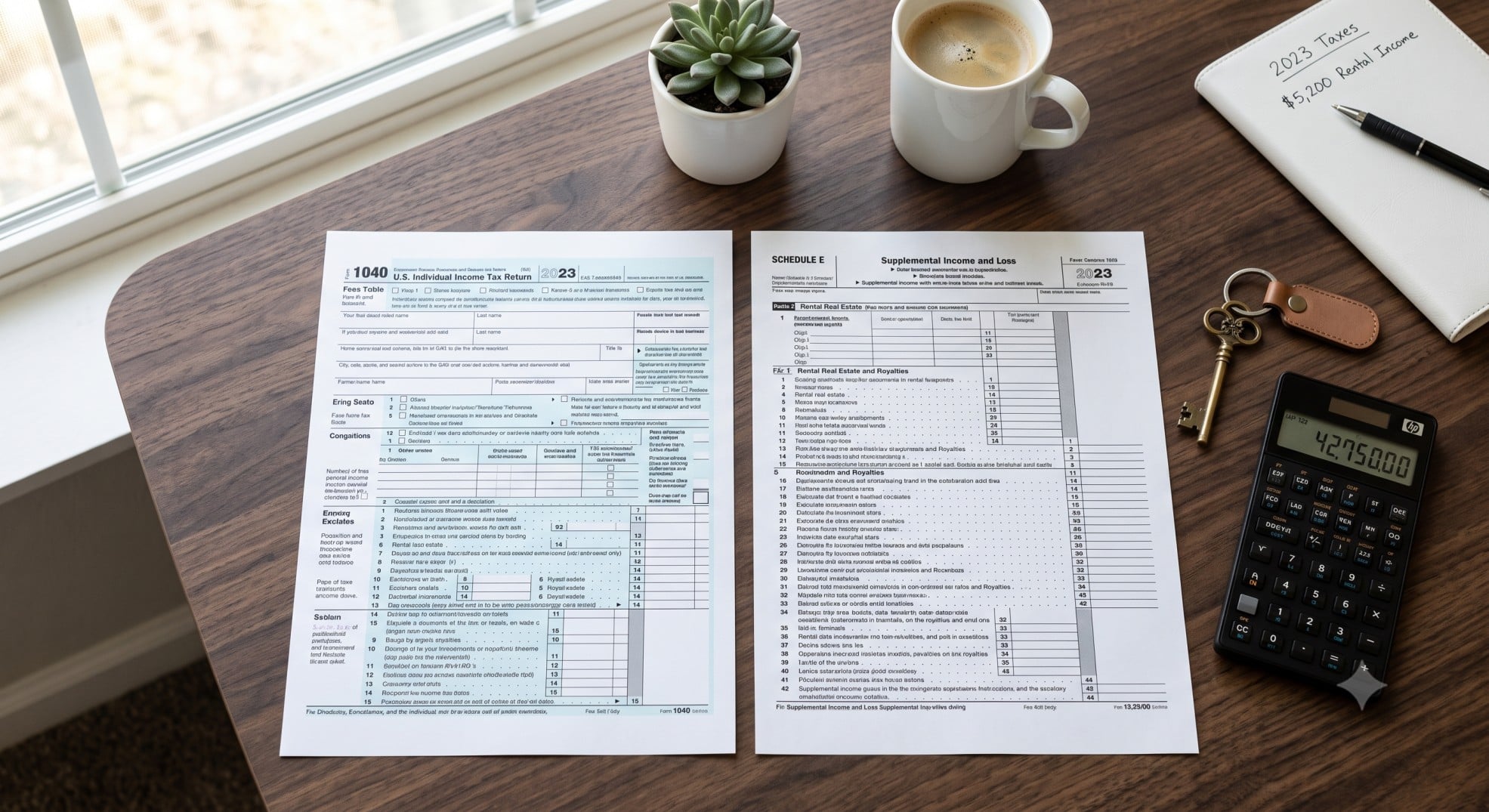
When you own a primary residence, you claim deductions on Schedule A. When you own an investment property, you report your financial activity on Schedule E (Supplemental Income and Loss). This form is the command center for your investment real estate tax deductions.
Schedule E allows you to deduct the ordinary and necessary expenses required to manage, conserve, and maintain your rental property. You subtract these expenses directly from your gross rental income. If your expenses exceed your income, you generate a rental loss, which can potentially offset other taxes depending on your income level.
The most common tax write offs on rental property include:
- Mortgage Interest: You can deduct the interest paid on a loan used to acquire or improve the rental property. Unlike a primary residence, there is no $750,000 debt limit cap for business interest on Schedule E.
- Property Management Fees: If you hire a company to collect rent and handle tenant issues, their monthly fee is fully deductible.
- Insurance Premiums: Landlord insurance policies, flood insurance, and umbrella liability policies tied to the property are deductible expenses.
- Utilities: If you pay for water, trash collection, or electricity for the rental unit, you write off the exact amount paid.
- Professional Fees: You can deduct the portion of your CPA or attorney fees directly related to managing your rental business or preparing Schedule E.
Repairs vs. Improvements: A Critical Distinction
The IRS forces investors to categorize property expenses into two distinct buckets: repairs and improvements. Misclassifying these expenses is a primary trigger for IRS audits.
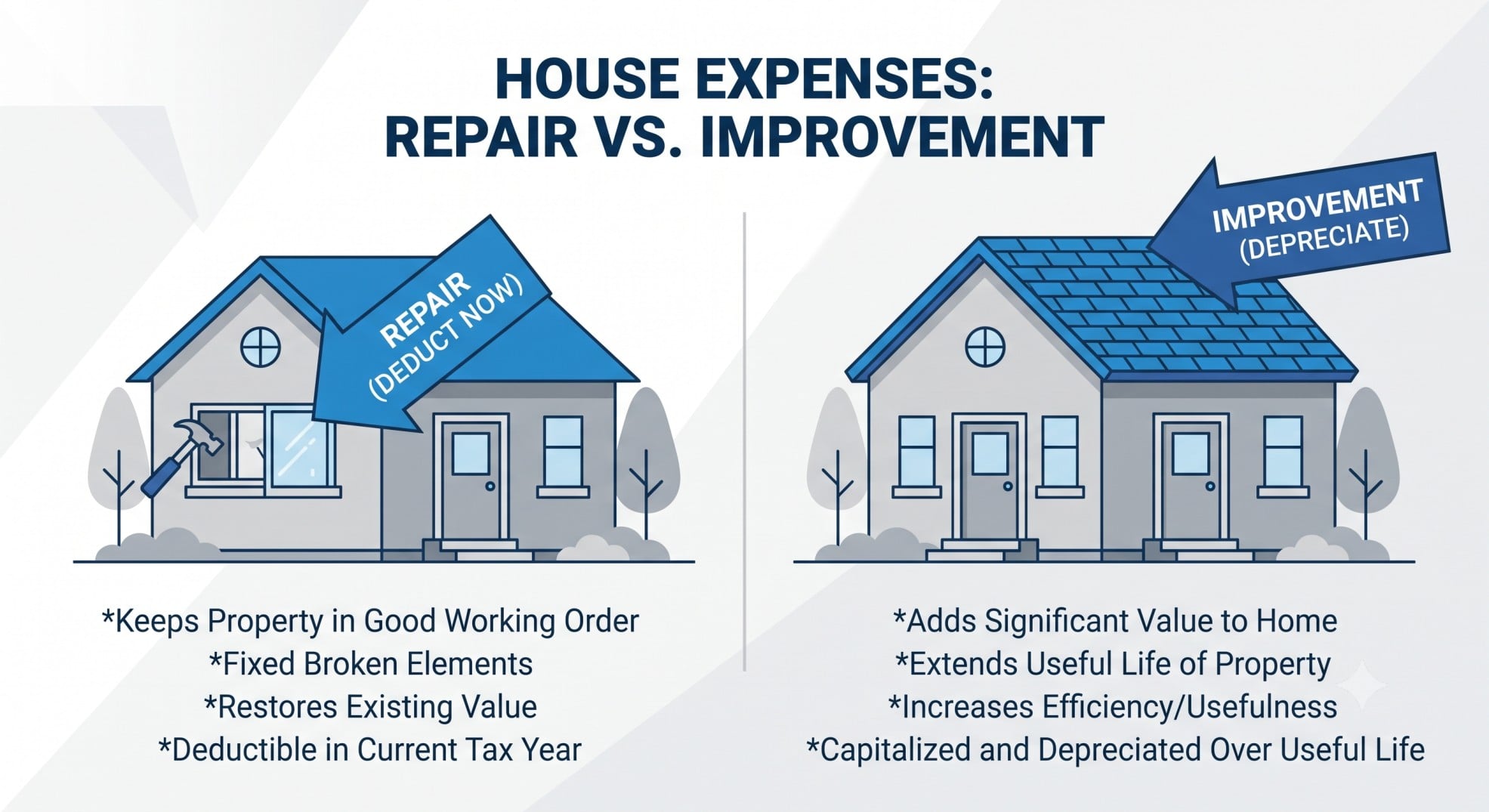
A repair keeps your property in good, working condition. It does not add significant value or extend the life of the property. Examples include fixing a leaky faucet, patching a hole in the drywall, or replacing a broken window pane. You deduct the full cost of a repair in the year you pay for it.
An improvement adds value to the property, adapts it to new uses, or significantly extends its life. Examples include replacing the entire roof, installing a new HVAC system, or adding a deck. You cannot deduct the full cost of an improvement in year one. You must capitalize the expense and depreciate it over its useful life.
Bypassing the SALT Cap: income property taxes
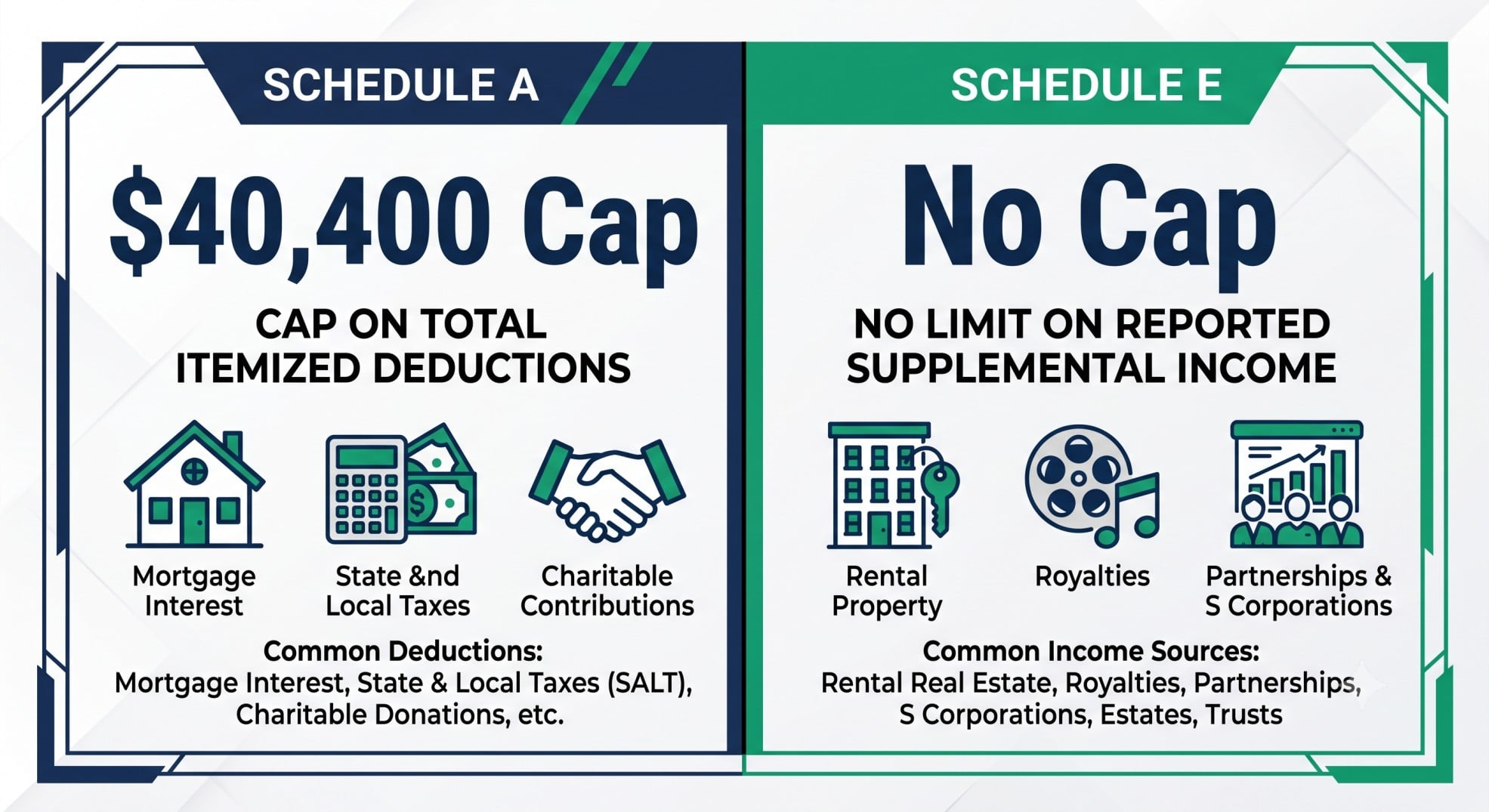
One of the most powerful investment real estate tax deductions involves local property assessments. For personal residences, the 2026 One Big Beautiful Bill Act (OBBBA) caps the State and Local Tax (SALT) deduction at $40,400 for married couples filing jointly. If your personal property taxes and state income taxes exceed that number, you lose the excess deduction.
This cap does not apply to rental properties. The IRS views income property taxes as a standard business expense. You report the property taxes paid on your rental unit on Schedule E, where they are 100% deductible against your rental income, regardless of how high they are. This complete deduction shields your cash flow from federal taxation without eating into your personal SALT cap allowance.
Hypothetical Scenario 1: The Schedule E Tax Shield
Marcus lives in New York and owns a primary residence and a separate rental property. He pays $35,000 in state income taxes and $15,000 in property taxes on his primary home. He also pays $12,000 in income property taxes on his rental unit.
On his personal Schedule A, Marcus combines his state income tax ($35,000) and primary home property tax ($15,000) for a total of $50,000. Because of the 2026 OBBBA SALT cap, he can only deduct $40,400. He loses $9,600 in personal deductions.
However, he reports the $12,000 paid for the rental property directly on Schedule E. This amount bypasses the SALT cap entirely. He deducts the full $12,000 against his rental income, maximizing his tax write offs on rental property without any arbitrary federal limits.
How do you deduct depreciation on real estate?
Depreciation is the holy grail of rental property tax deductions. It is a “phantom expense.” You do not actually spend cash out of your pocket each year, but the IRS allows you to deduct a portion of the property’s value from your taxable income to account for wear and tear.
The IRS mandates that residential rental property is depreciated over 27.5 years using the Modified Accelerated Cost Recovery System (MACRS). Commercial properties are depreciated over 39 years.
You can only depreciate the value of the building, not the land it sits on. Land does not wear out. Before calculating your deduction, you must determine your cost basis (usually the purchase price plus acquisition costs) and allocate that basis between the land and the building. You can use the ratio provided by your county tax assessor to make this allocation.
Hypothetical Scenario 2: Calculating MACRS Depreciation
Sarah purchases a residential duplex for $400,000. She pays $10,000 in deductible closing costs, making her total cost basis $410,000.
She checks her county property tax assessment, which values the land at 20% of the total property value and the building at 80%.
- Step 1: Isolate the Building Value. $410,000 x 0.80 = $328,000.
- Step 2: Apply the MACRS Timeline. She divides the building value by the IRS residential timeline of 27.5 years.
- Step 3: Calculate the Annual Deduction. $328,000 / 27.5 = $11,927.
Sarah gets to deduct $11,927 from her rental income every single year for the next 27.5 years, even if the property is actually appreciating in market value. This massive paper loss often reduces a property’s taxable income to zero, allowing Sarah to pocket her monthly cash flow tax-free.
Active Participation vs. Passive Activity Loss Limitations
Because depreciation creates such massive paper losses, the IRS implemented the Passive Activity Loss (PAL) rules. By default, the IRS classifies all rental real estate as a passive activity. The strict rule is that passive losses can only be used to offset passive income. You generally cannot use a rental loss to offset your active W-2 salary or business income.
If your rental property generates a $10,000 loss on paper, and you have no other passive income, that loss is suspended and carried forward to future tax years. You do not lose it, but you cannot use it today. However, there are two major exceptions to this rule.
The $25,000 Special Allowance
If you “actively participate” in your rental property, the IRS allows you to deduct up to $25,000 of rental losses against your ordinary W-2 income. Active participation simply means you own at least 10% of the property and make major management decisions, such as approving new tenants or authorizing repairs. You do not need to plunge toilets yourself to qualify.
This allowance comes with a strict income phase-out. If your Modified Adjusted Gross Income (MAGI) is under $100,000, you get the full $25,000 allowance. The allowance phases out by 50 cents for every dollar your MAGI exceeds $100,000. Once your MAGI hits $150,000, the special allowance drops to zero, and the strict PAL rules apply.
Hypothetical Scenario 3: The Income Phase-Out
David earns a W-2 salary of $120,000. He actively manages a rental property that generates a $15,000 paper loss due to heavy depreciation.
Because his MAGI is $120,000, he is $20,000 over the $100,000 threshold. His special allowance is reduced by 50% of that overage ($10,000). His maximum allowable deduction drops from $25,000 to $15,000.
Since his actual rental loss is exactly $15,000, he can deduct the entire amount against his W-2 income, lowering his overall tax liability for the year.

Navigating the Rules for Second Homes
If you own a vacation property that you use personally and rent out occasionally, you cannot simply claim all investment real estate tax deductions. The IRS uses the “14-Day Rule” to determine how you report income and expenses.
Scenario A: Rented for fewer than 15 days. If you rent your beach house out for exactly 14 days during a local golf tournament, you do not have to report a single dollar of that rental income to the IRS. It is completely tax-free (often called the Augusta Rule). However, you cannot claim any Schedule E rental property tax deductions for the property.
Scenario B: Rented for 15+ days, used personally for more than 14 days. If you rent the property out for 100 days and use it personally for 30 days, the IRS considers it a personal residence used for rental purposes. You must allocate your expenses based on the ratio of rental days to total days used. You can only deduct rental expenses up to the amount of rental income generated; you cannot claim a loss to offset other income.
Hypothetical Scenario 4: Allocating Second Home Expenses
Emily owns a cabin. In 2026, she rents it to guests for 80 days and uses it personally for 20 days. The cabin was used for a total of 100 days.
Her rental use percentage is 80% (80 rental days / 100 total days). If she pays $5,000 in utility bills for the year, she can only deduct $4,000 (80%) as a rental expense on Schedule E. The remaining 20% is a personal expense and is not deductible.
Step-by-Step Guide to Claiming Your Deductions
Securing your tax write offs on rental property requires meticulous record-keeping throughout the year. Follow this process to ensure your Schedule E is accurate and audit-proof.
Step 1: Open a Dedicated Bank Account. Never commingle personal and business funds. Open a specific checking account for your rental property. All rent must flow into this account, and all expenses must be paid out of it. This creates a clean audit trail.
Step 2: Track Mileage. You can deduct the mileage driven to inspect your property, collect rent, or perform repairs. Use a mileage tracking app on your phone. For 2026, you will multiply your business miles by the IRS standard mileage rate.
Step 3: Separate Repairs from Improvements. When you pay a contractor, ask for an itemized invoice. If they fix a leak (repair) and install a new vanity (improvement) on the same trip, you must separate those costs for tax purposes.
Step 4: Calculate Your Cost Basis. Pull your original closing documents. Identify your purchase price and add your deductible acquisition costs (title fees, legal fees). Use your property tax card to determine the building-to-land ratio.
Step 5: File Form 4562. In your first year of ownership, you must file IRS Form 4562 to establish your depreciation schedule. This form locks in your MACRS calculation for the next 27.5 years.
Frequently Asked Questions
1. What can I write off on a rental property?
You can write off ordinary and necessary operating expenses, including mortgage interest, property management fees, insurance premiums, utilities, repairs, and professional fees. You also write off the depreciation of the building structure over 27.5 years.
2. Are property taxes deductible on rental property?
Yes, property taxes are fully deductible on a rental property. You report them on Schedule E. Unlike your primary residence, rental property taxes are not subject to the personal SALT deduction cap.
3. How do you deduct depreciation on real estate?
You deduct depreciation by determining the cost basis of the building (excluding the land value) and dividing it by 27.5 years for residential property. You claim this calculated amount annually as an expense on Schedule E.
4. Can I deduct the cost of a new roof immediately?
No. A new roof is considered a capital improvement because it extends the life of the property. You must capitalize the cost and depreciate it over a set number of years, rather than deducting the full amount in year one.
5. What is the $25,000 special allowance?
The special allowance permits landlords who actively participate in managing their property to deduct up to $25,000 of rental losses against their ordinary W-2 income. This allowance phases out for taxpayers with a MAGI between $100,000 and $150,000.
6. Do I have to pay taxes on rental income if I only rent my house for a week?
No. Under the 14-day rule (Augusta rule), if you rent your personal residence for fewer than 15 days during the tax year, the income is entirely tax-free. However, you cannot claim any rental deductions.
7. Can I deduct travel expenses to check on my out-of-state rental?
Yes, travel expenses are deductible if the primary purpose of the trip is to manage, maintain, or inspect the rental property. You can deduct airfare, lodging, and 50% of business meals. You cannot deduct expenses for days spent vacationing on the same trip.
8. Are HOA fees deductible on a rental property?
Yes. Homeowners Association (HOA) fees or condo fees paid for a rental property are fully deductible as an operating expense on Schedule E.
9. What happens to suspended passive losses when I sell the property?
If your income is too high to claim rental losses, those losses are suspended and carried forward. When you eventually sell the property in a fully taxable transaction, all suspended losses are unlocked and can be used to offset your capital gains or ordinary income.
10. Can I deduct the time I spend fixing the property myself?
No. You cannot deduct the value of your own labor. You can only deduct the actual cost of the materials and supplies you purchased to complete the repair.
Maximizing your rental property tax deductions requires strategic planning before the tax year ends. By understanding how to leverage MACRS depreciation, properly classify repairs, and navigate the passive activity loss rules, you can significantly reduce your tax liability. Keep immaculate records, separate your business expenses, and consult a professional to ensure you capture every legal deduction available to you.
Disclaimer: The information provided in this article is for general educational purposes only and does not constitute legal, tax, or financial advice. Tax laws, including the 2026 standard deductions and OBBBA provisions, are subject to change. Always consult with a licensed Certified Public Accountant (CPA) or qualified tax professional regarding your specific situation before filing your return or making financial decisions.
