
Executive Summary
- The Core Rule: Yes, you can deduct property taxes on a second home, provided you itemize your deductions on Schedule A.
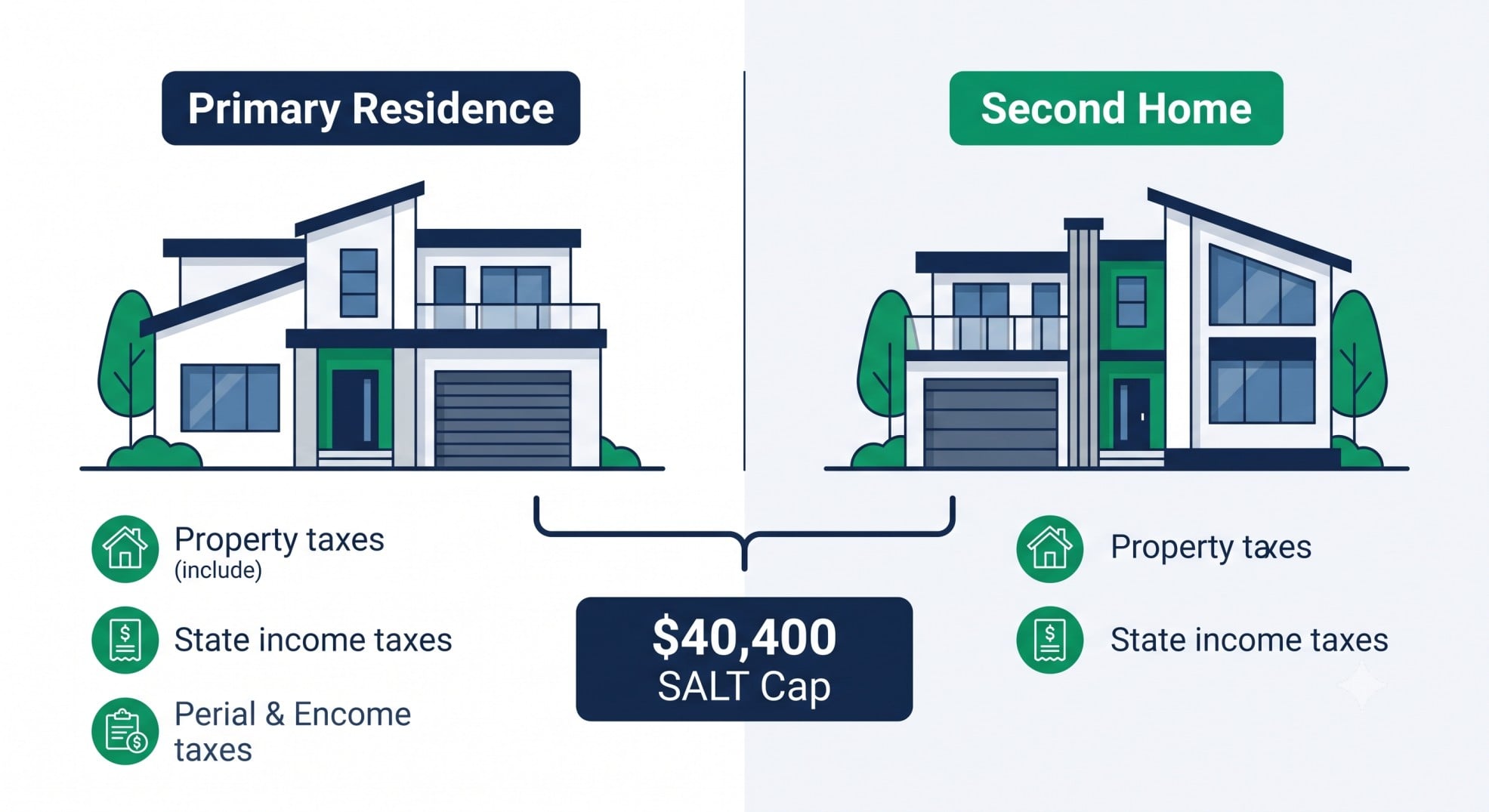
- The 2026 SALT Cap: The One Big Beautiful Bill Act (OBBBA) set the State and Local Tax (SALT) cap at $40,400 for 2026. This cap applies cumulatively to all your personal properties combined.
- Mortgage Limits: You can deduct interest on a second home, but the IRS strictly enforces a $750,000 combined limit on total acquisition debt across both your primary and secondary residences.
- The 14-Day Rule: If you rent out your second home, the IRS uses a strict mathematical formula (the 14-day or 10% rule) to determine if it is a personal residence or a pure rental property.
Purchasing a vacation cabin, a beach house, or a city pied-à-terre introduces an entirely new layer of complexity to your annual tax return. Homeowners naturally want to know how to offset the carrying costs of a new property. You already know the rules for your primary residence, but applying those same rules to a secondary property requires careful navigation of IRS limits. If you plan to rent the property out part-time, you must also understand how rental property tax deductions differ from personal itemized deductions.
The most common question buyers ask their CPA is: can you deduct property taxes on a second home? The answer is yes, but the federal government places strict ceilings on how much you can actually write off. To maximize your second home tax advantages, you must understand how the 2026 tax laws aggregate your expenses. The IRS does not give you a fresh set of deduction limits just because you bought a second house. Your primary home and your vacation home share the exact same deduction buckets.
We will break down exactly how the IRS treats your secondary property in 2026. You will learn how the new $40,400 SALT cap impacts your total write-offs, whether is second home mortgage interest deductible under the permanent $750,000 cap, and how the strict 14-day rule dictates your filing strategy.
The Short Answer: can you deduct property taxes on a second home?
Yes, you can deduct property taxes on a second home. The IRS allows taxpayers to deduct state and local real estate taxes assessed on properties they own, even if they do not live in them full-time. You claim this deduction on Schedule A (Itemized Deductions) of your Form 1040.
To claim this benefit, you must actually pay the tax during the calendar year, and the tax must be based on the assessed value of the property. You cannot deduct flat-rate fees for trash collection, water service, or homeowner association (HOA) dues as property taxes on a personal second home.
You only receive a federal tax benefit from this deduction if your total itemized expenses exceed the 2026 standard deduction. For married couples filing jointly, the 2026 standard deduction is $32,200. If your combined mortgage interest, charitable giving, and property taxes fall below that number, you will take the standard deduction, meaning your second home property taxes provide zero additional federal tax relief.
How does the $40,000 SALT cap apply to multiple properties?
Many taxpayers ask: How does the $40,000 SALT cap apply to multiple properties? For the 2026 tax year, the One Big Beautiful Bill Act (OBBBA) officially set this cap at $40,400 for single filers and married couples filing jointly (and $20,200 for married filing separately).
The SALT (State and Local Tax) deduction includes your state income taxes, your primary home property taxes, and your second home property taxes. The IRS applies the $40,400 cap cumulatively across all your personal assets. You do not get a $40,400 cap for your main house and a separate $40,400 cap for your beach house. All your state and local taxes are poured into one bucket, and anything that overflows the $40,400 rim is lost.
Hypothetical Scenario 1: The Cumulative SALT Cap
David and Sarah live in California and own a primary residence and a vacation home in Lake Tahoe. They file jointly in 2026.
- State Income Taxes Paid: $22,000
- Primary Home Property Taxes: $14,000
- Second Home Property Taxes: $9,000
First, they add all their state and local taxes together. $22,000 + $14,000 + $9,000 = $45,000 in total SALT expenses.
Next, they apply the 2026 OBBBA limit. The maximum allowable deduction is $40,400. David and Sarah can deduct exactly $40,400 on their Schedule A. The remaining $4,600 is completely non-deductible. While they technically can deduct property taxes on a second home, the cumulative cap limits the actual financial value of that deduction.
is second home mortgage interest deductible?
Yes, but with strict limitations. When buyers ask, is second home mortgage interest deductible, they often assume they can deduct the full amount of interest paid on both properties. The IRS allows you to deduct interest on acquisition debt—money borrowed to buy, build, or substantially improve a qualified residence. Your second home qualifies as a residence.
Can I write off interest on a second home? Yes, but the 2026 tax code enforces a permanent $750,000 limit on total eligible acquisition debt. Just like the SALT cap, this limit is cumulative. It applies to the combined mortgage balances of your primary residence and your second home.
If you originated your mortgages after December 15, 2017, you can only deduct the interest paid on the first $750,000 of combined debt. If your combined loan balances exceed $750,000, you must calculate a percentage to determine how much of your total interest is actually deductible.
Hypothetical Scenario 2: The Combined Mortgage Limit
Mark owns a primary residence with a remaining mortgage balance of $500,000. In 2026, he buys a second home and takes out a new $400,000 mortgage.
His total combined acquisition debt is $900,000. Because this exceeds the $750,000 limit, Mark cannot deduct all the interest he pays.
He must divide the IRS limit by his total debt to find his deductible percentage: $750,000 / $900,000 = 83.3%.
If Mark pays a total of $50,000 in interest across both loans in 2026, he can only deduct 83.3% of it. His actual mortgage interest deduction on Schedule A is limited to $41,650. Understanding this math is critical to evaluating your true second home tax advantages.

What is the difference between a second home and an investment property for taxes?
The IRS does not care what you call the property; it cares how you use it. What is the difference between a second home and an investment property for taxes? The answer lies entirely in the ratio of personal use days to rental days. The IRS uses the “14-Day or 10% Rule” to classify your property into one of three distinct tax categories.
Category 1: Pure Personal Residence (The Augusta Rule)
If you rent your second home out for 14 days or fewer during the entire year, the IRS considers it a pure personal residence. You do not have to report a single dollar of the rental income you earned. It is completely tax-free. However, you cannot deduct any rental expenses (like cleaning fees or advertising). You simply deduct your property taxes and mortgage interest on Schedule A, subject to the standard SALT and $750,000 limits.
Category 2: Mixed-Use Property
If you rent the home for more than 14 days, and you use it personally for more than 14 days OR more than 10% of the total days it was rented (whichever is greater), it is a mixed-use property. You must report all rental income. You can deduct rental expenses, but you must strictly allocate them based on the percentage of rental days versus total days used. Crucially, your rental deductions cannot exceed your rental income; you cannot claim a loss to offset your W-2 salary.
Category 3: Pure Rental Property
If you rent the home for more than 14 days, and your personal use is less than 14 days OR less than 10% of the rental days, the IRS classifies it as an investment property. You report all income and expenses on Schedule E. The massive advantage here is that property taxes reported on Schedule E are business expenses. They bypass the $40,400 personal SALT cap entirely.
Hypothetical Scenario 3: The 14-Day Rule in Action
Emily owns a beach house. In 2026, she rents it out to guests for 100 days. She uses it personally for 20 days. The home was used for a total of 120 days.
First, she checks the rule. She rented it for more than 14 days. Her personal use (20 days) is greater than 14 days, and it is also greater than 10% of the rental days (10 days). Therefore, the IRS classifies this as a mixed-use personal residence.
She must allocate her expenses. Her rental use percentage is 83.3% (100 rental days / 120 total days). If she pays $10,000 in property taxes, she allocates $8,330 to Schedule E (rental expense) and $1,670 to Schedule A (personal SALT expense). This allocation strategy is the core of maximizing tax deductions for a vacation home.

can you deduct property taxes on land?
Investors frequently buy raw, undeveloped land with the intention of building a second home later. This raises a specific question: can you deduct property taxes on land?
Yes, you can deduct property taxes paid on vacant land. The IRS allows you to claim these taxes as an itemized personal deduction on Schedule A. You report them under the “Other Taxes” line. Because vacant land is considered an investment asset rather than a personal residence, the property taxes paid on raw land are not subject to the $40,400 personal SALT cap. You can deduct the entire amount of the property tax assessed on the land.
If you finance the purchase of the raw land, the interest you pay is considered “investment interest,” not mortgage interest. Investment interest is deductible on Schedule A, but it is strictly limited to your net investment income for the year. If you have no investment income (like dividends or stock sales), you cannot deduct the land interest in the current year, though you can carry it forward.
Step-by-Step Guide to Claiming tax deductions for a vacation home
Securing your second home tax advantages requires meticulous record-keeping. If you mix personal use with rental use, the IRS will scrutinize your return. Follow this exact process to claim your deductions legally in 2026.
Step 1: Track Every Single Day. Buy a physical calendar or use a dedicated spreadsheet. Log every day you use the home personally, every day a paying guest stays there, and every day you spend repairing the property. Days spent doing full-time maintenance do not count as personal use days.
Step 2: Determine Your IRS Classification. At the end of the year, apply the 14-day or 10% rule to your calendar. Categorize your property as a pure residence, mixed-use, or pure rental.
Step 3: Aggregate Your SALT Expenses. Pull your W-2 to find your state income tax. Add the property taxes from your primary home. Add the personal portion of the property taxes from your second home. If the total exceeds $40,400, cap your Schedule A deduction at that exact number.
Step 4: Calculate Your Mortgage Interest Limit. Add the average principal balances of your primary and secondary mortgages. If the total is under $750,000, deduct all the interest. If it is over $750,000, calculate your deductible percentage.
Step 5: File Schedule A (and Schedule E if renting). Transfer your calculated property taxes and mortgage interest to Schedule A. If you rented the property for more than 14 days, report the allocated rental income and expenses on Schedule E.
Frequently Asked Questions
1. Can you deduct property taxes on a second home?
Yes. You can deduct property taxes on a second home by itemizing your deductions on Schedule A. However, these taxes are combined with your other state and local taxes and are subject to the annual SALT deduction cap.
2. How does the $40,000 SALT cap apply to multiple properties?
For 2026, the OBBBA set the SALT cap at $40,400. This cap is cumulative. You must add your state income taxes, primary home property taxes, and second home property taxes together. You can only deduct a maximum of $40,400 across all personal properties combined.
3. Is second home mortgage interest deductible?
Yes, is second home mortgage interest deductible, but it is subject to a combined limit. You can only deduct the interest paid on the first $750,000 of total acquisition debt across both your primary and secondary homes.
4. Can I write off interest on a second home if I pay cash for my primary home?
Yes. If you own your primary home outright and have zero mortgage debt on it, you can deduct the interest on your second home mortgage, up to the full $750,000 acquisition debt limit.
5. What is the difference between a second home and an investment property for taxes?
The difference is determined by the 14-day rule. If you use the property personally for more than 14 days or 10% of the days it is rented, it is a second home (mixed-use). If your personal use is below those thresholds, it is an investment property, and expenses are reported on Schedule E.
6. Can you deduct property taxes on land?
Yes. Property taxes paid on vacant, unimproved land are deductible as an investment expense on Schedule A. They are not subject to the personal SALT cap.
7. What are the main second home tax advantages?
The primary second home tax advantages include the ability to deduct mortgage interest and property taxes. Additionally, if you rent the home for 14 days or fewer, you can keep 100% of the rental income tax-free under the Augusta Rule.
8. Can I deduct HOA fees on my second home?
If you use the home purely for personal reasons, HOA fees are not deductible. If you rent the home out, you can deduct a prorated portion of the HOA fees as a rental expense on Schedule E.
9. Do I have to report income if I rent my second home for exactly two weeks?
No. If you rent the property for 14 days or fewer during the calendar year, the IRS does not require you to report the income. It is completely tax-free.
10. Can I claim a loss on my taxes if my second home expenses exceed my rental income?
If the IRS classifies the property as a mixed-use personal residence (because you used it personally for more than 14 days), you cannot claim a loss. Your rental deductions are strictly capped at the amount of rental income you generated.
Understanding exactly how can you deduct property taxes on a second home requires looking at your entire financial picture. The IRS does not view your vacation property in a vacuum. By mastering the cumulative SALT cap, the combined mortgage limits, and the strict 14-day rule, you can strategically manage your property usage to maximize your tax deductions for a vacation home in 2026.
Disclaimer: The information provided in this article is for general educational purposes only and does not constitute legal, tax, or financial advice. Tax laws, including the 2026 standard deductions and OBBBA provisions, are subject to change. Always consult with a licensed Certified Public Accountant (CPA) or qualified tax professional regarding your specific situation before filing your return or making financial decisions.
