
⚡ Executive Summary: General Business Licensing Essentials
- Entity Formation vs. Operational Permission: Registering an LLC or Corporation with your Secretary of State creates a legal entity, but it does not grant authorization to conduct commercial business at a physical location.
- Primary Purpose: A general business operating license registers your enterprise with municipal tax authorities, enforces local zoning codes, and certifies basic compliance with city and county ordinances.
- Jurisdictional Nuance: Licensing mandates vary drastically between incorporated cities and unincorporated county land due to local police powers, Home Rule charters, and municipal revenue structures.
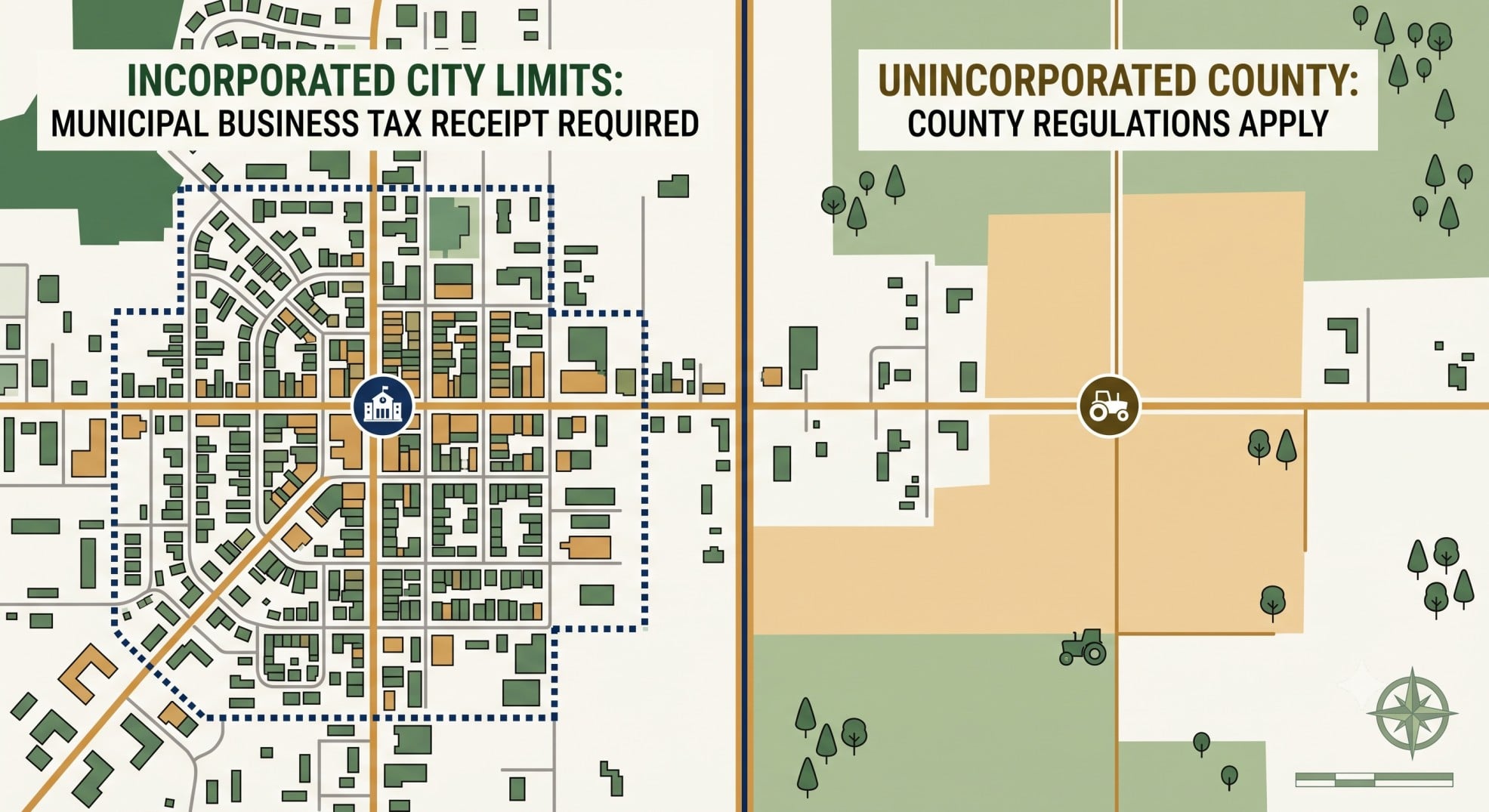
- Strict Compliance Sequence: Securing a general license requires having an established legal structure, an Employer Identification Number (EIN), and local zoning clearance before submitting city or county paperwork.
Every commercial enterprise requires legal authority to operate before opening its doors to paying customers. If you are a new entrepreneur asking how do i get a business license, the answer depends entirely on your exact physical location, your commercial activities, and the regulatory structure of your local municipality. When researching how to, in practical terms, get a business license, many founders confuse basic state corporate filings with the municipal permits required on Main Street.
A general business operating license is not a single, universal federal document. Instead, it is a local regulatory instrument issued by city halls, county clerk offices, or municipal finance departments. Missing this requirement can result in mandatory closures, escalating tax penalties, and civil fines that threaten your company before it turns a profit.
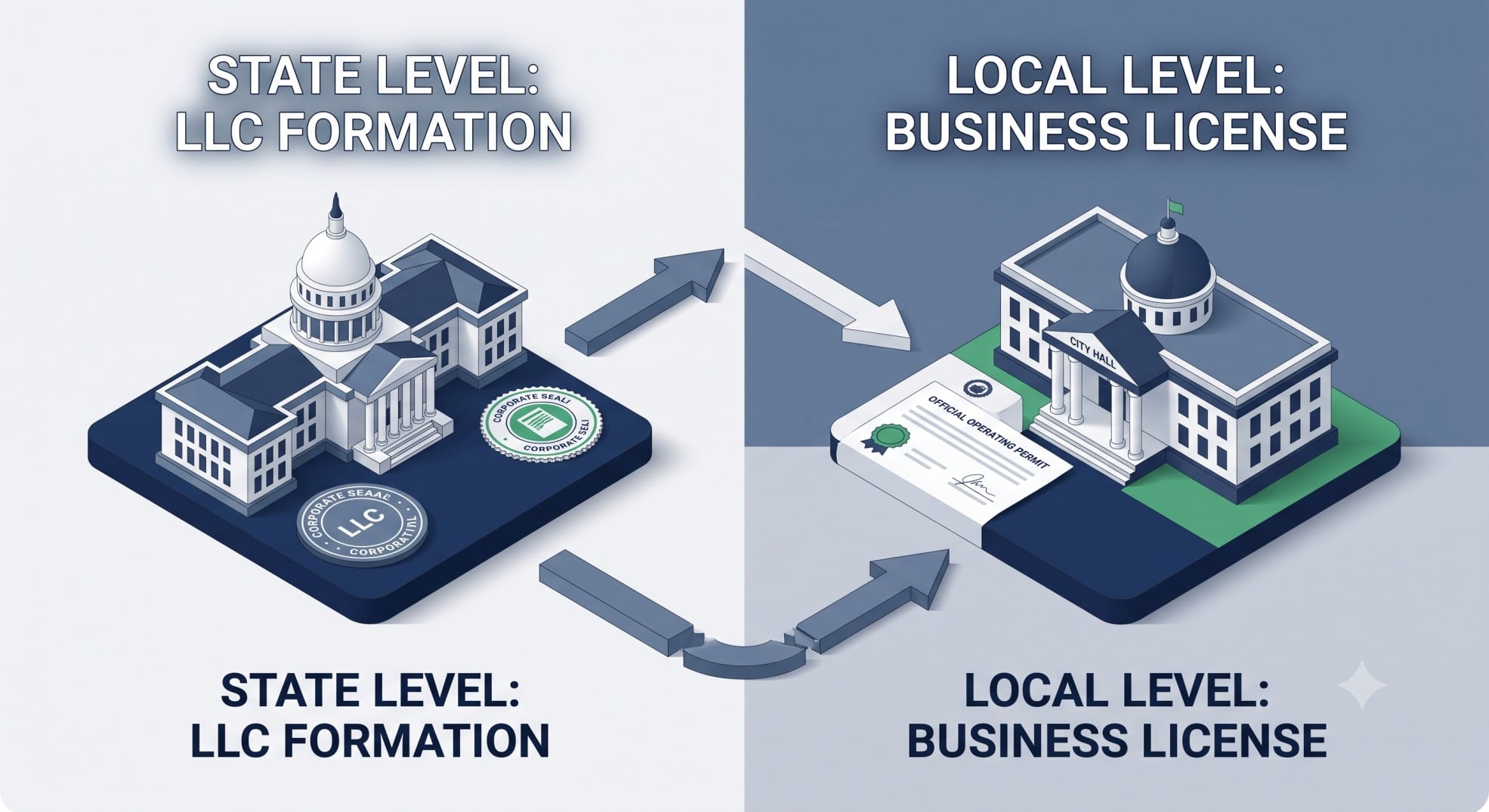
Table of Contents
- What Is a General Business License and What Does It Authorize?
- Business License vs. LLC: Critical Differences Every Founder Must Know
- Why City and County Licensing Rules Vary Across the United States
- Step-by-Step Walkthrough: How Do I Get a Business License?
- Real-World Scenarios: How Licensing Requirements Work in Practice
- The True Cost of Operating Without a Business License
- Frequently Asked Questions: How Do I Get a Business License?
- Final Verdict: How Do I Get a Business License and Keep It Compliant?
What Is a General Business License and What Does It Authorize?
A general business license is a government-issued authorization granting an individual or company permission to conduct commercial transactions within a designated city or county. It functions primarily as a local tax registration mechanism and regulatory tracking tool rather than a professional certification.
Local governments use this blanket permit to identify every commercial entity operating within their geographic boundaries. Holding this document does not mean the government endorses your service quality or technical skills. Instead, it proves you have notified local administrators of your presence, agreed to obey local ordinances, and registered to pay municipal taxes.
Nomenclature varies widely across different states and municipalities. In California, cities like Los Angeles and San Francisco refer to this document as a Business Tax Certificate. Florida counties and cities label it a Local Business Tax Receipt (formerly called an Occupational License). In Alabama, state and county probate courts issue a Business Privilege License. Regardless of the regional title, the administrative function remains identical: granting baseline permission to engage in trade.
Entrepreneurs looking at how do i get license for a business must realize that general licenses serve two distinct public purposes:
- Revenue Generation: Municipalities levy annual license fees or gross receipts taxes to fund civic infrastructure, roads, emergency services, and administrative staff.
- Police Power and Public Safety: Local agencies use the registration process to ensure commercial activities do not violate neighborhood zoning codes, create public health hazards, or breach municipal fire safety standards.
Learning how to obtain a business license is the first line of defense against local regulatory enforcement. It tells city inspectors that your physical location, signage, parking capacity, and operational footprint comply with municipal standards.
Business License vs. LLC: Critical Differences Every Founder Must Know
An LLC establishes a separate legal entity that shields personal assets under state corporate statutes, whereas a general business license grants local operational clearance. Registering an LLC does not give you permission to operate, and holding a business license provides zero personal liability protection.
This structural distinction creates widespread confusion for new business owners. When you file Articles of Organization with your Secretary of State, you create an independent legal “person.” That entity can sign contracts, hold commercial leases, take out business bank loans, and protect your personal home and savings from commercial lawsuits. But the state corporate registry does not notify your local city hall that you intend to run a business down the street.
Founders trying to figure out how to, as a business owner, get a business license often confuse entity formation with municipal licensing. A sole proprietor with no LLC can legally obtain a city operating license, while a multi-member LLC registered with the state remains illegal to operate locally if it neglects municipal licensing.
Review the primary operational differences between these two regulatory instruments in the table below:
| Feature | Limited Liability Company (LLC) | General Business Operating License |
|---|---|---|
| Primary Purpose | Creates a distinct legal entity and provides personal liability protection. | Grants regulatory permission to conduct business and ensures local tax registration. |
| Issuing Authority | State Government (Secretary of State or Division of Corporations). | Local Municipality (City Clerk, County Tax Collector, or Finance Office). |
| Asset Protection | Shields personal assets (home, car, savings) from business debts and lawsuits. | Provides zero liability protection; operates purely as an administrative permit. |
| Mandatory Requirement | Optional structure (businesses can operate as sole proprietorships or partnerships). | Mandatory in most jurisdictions where commercial activity takes place. |
| Renewal Frequency | Annual or biennial corporate report (some states, like Texas, use tax reports). | Typically annual renewal, often tied to gross revenue or flat license fees. |
| Prerequisite Flow | Filed first to establish legal ownership and corporate naming rights. | Filed after entity formation, using your state entity name and federal EIN. |
Understanding how to get the business license requires recognizing this sequence. You cannot substitute one for the other. If you operate an LLC without the municipal permit, local authorities can shut down your physical location. Conversely, if you hold a city business tax receipt as a sole proprietor without an LLC, an injured customer can sue you personally and target your individual assets.
Reviewing our state LLC formation guide can clarify how to file your state entity before initiating local permit paperwork.
Why City and County Licensing Rules Vary Across the United States
Municipal licensing rules vary because state legal frameworks delegate distinct taxing and regulatory authorities to local jurisdictions. While some states centralize general business licensing, most leave operational permitting entirely to independent municipal charters and county boards.
The United States does not maintain a unified commercial licensing code. Instead, local autonomy dictates whether a business owner needs zero permits, one county permit, or multiple overlapping city receipts. This division stems from two primary legal doctrines governing local governance: Home Rule and Dillon’s Rule.
| Legal Framework | Operational Mechanism | Licensing Impact on Small Businesses |
|---|---|---|
| Home Rule States | Municipalities possess broad legislative power to govern and tax unless explicitly banned by state law. | Cities establish independent, highly specific licensing categories, gross receipts taxes, and strict inspections. |
| Dillon’s Rule States | Local governments only have powers expressly granted to them by the state legislature. | Counties and towns have limited authority to create general licenses; requirements remain streamlined. |
Incorporated Municipalities vs. Unincorporated County Land
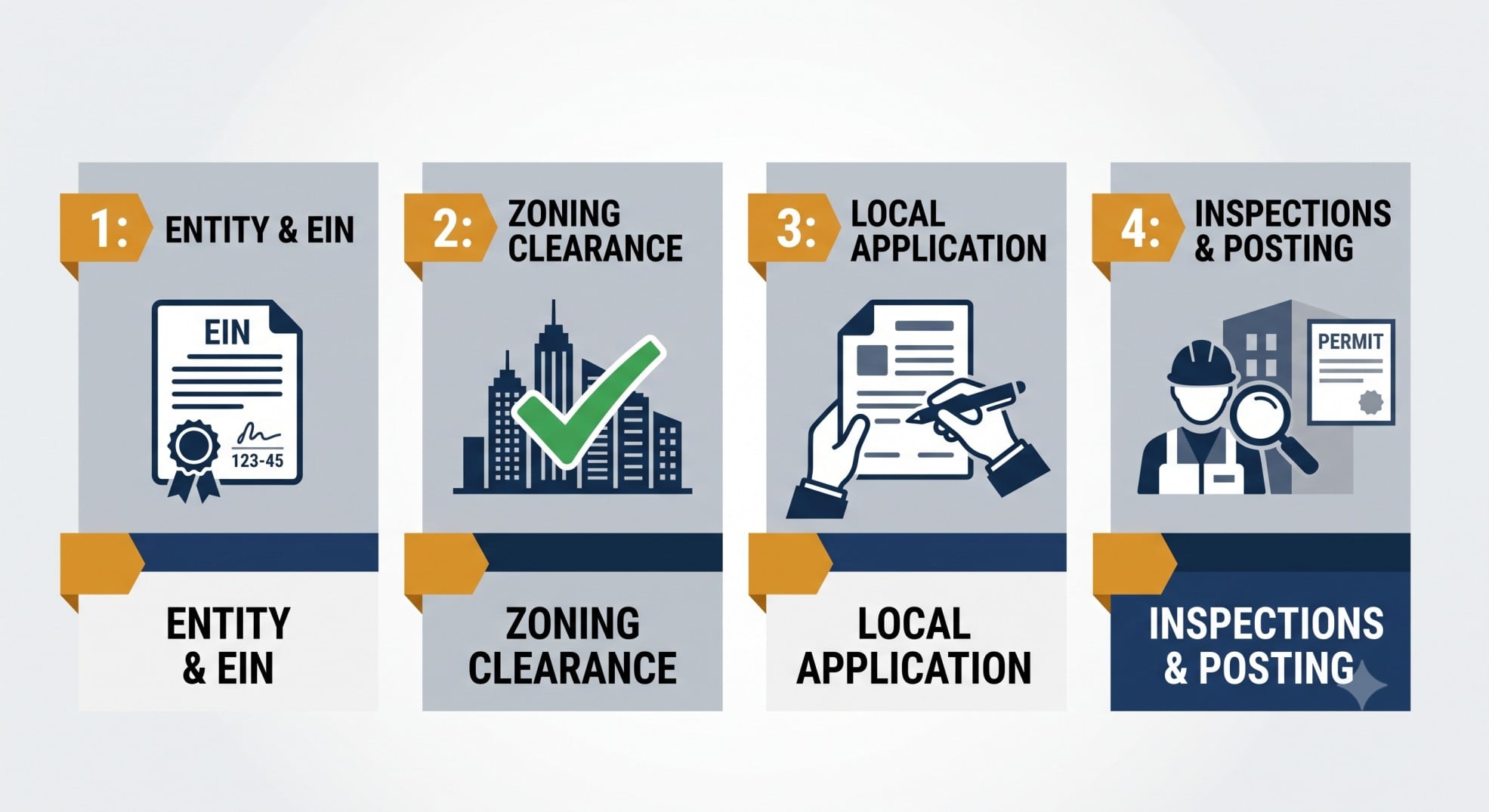
Physical boundaries create the largest regulatory divide. An incorporated municipality (a self-governing city, town, or borough) maintains its own police force, zoning board, and city council. If your business premises sit within city limits, you must follow all municipal licensing ordinances.
An unincorporated area falls outside all city boundaries and answers directly to county government. In many states, counties do not enforce general business licenses for office-based or service companies, reserving permits strictly for specialized operations like scrap yards or mobile food vending. A founder establishing an office in an unincorporated pocket might only need state registrations, while a competitor two miles away inside city limits must pay annual municipal gross receipts fees.
Some regions enforce overlapping jurisdictions. In Florida, businesses located inside incorporated cities must acquire a city Local Business Tax Receipt and a county Local Business Tax Receipt. Escambia County and the City of Pensacola, for example, enforce dual requirements simultaneously.
Statewide General Licenses vs. Local-Only States
A minority of states enforce a statewide general business license that sits above local city registrations. Washington requires nearly every enterprise to complete a Business License Application through the Washington Department of Revenue. Nevada mandates a State Business License issued by the Secretary of State ($200 annually for standard entities), and Alaska requires an Alaska General Business License through the Department of Commerce, Community, and Economic Development.
Major commercial states like Texas, California, and Florida do not have a general statewide operating license. In Texas, the state only regulates specific industries (like cosmetology or electrical contracting), leaving general commercial permitting to individual cities like Houston, Dallas, or Austin. When mapping out how to get the business license, you must identify whether your state operates under a centralized or localized regulatory model.
Step-by-Step Walkthrough: How Do I Get a Business License?
To obtain a general business license, form your legal entity, secure an Employer Identification Number (EIN), verify local zoning approval, submit the municipal application form, pay required processing fees, and pass mandatory safety inspections.
Executing these compliance steps in the correct chronological order prevents rejected filings and wasted application fees. Local clerks will routinely deny or freeze your general license application if your prerequisite state registrations or land-use approvals are missing.
Follow this exact chronological framework when determining how to obtain a business license for your company:
Step 1: Form Your Legal Entity and Obtain Federal Identifiers
Before submitting paperwork to a city or county clerk, establish your legal business foundation. If you choose an LLC, Corporation, or Limited Partnership, file your formation documents with your Secretary of State. Sole proprietors using a trade name must record a Doing Business As (DBA) or Assumed Name Certificate with the county clerk or state agency.
Next, obtain a federal Employer Identification Number (EIN) directly from the Internal Revenue Service (IRS). When evaluating how do i get a business license, you will find that municipal application portals require an EIN or Social Security Number to establish your local tax profile. Ensure the business name on your EIN confirmation letter matches your state entity documents exactly.
Reviewing our detailed federal employer identification number requirements guide will help you secure your tax ID correctly without third-party fees.
Step 2: Pinpoint Your Exact Legal Jurisdiction
Never assume your postal address defines your municipal government. The United States Postal Service assigns ZIP codes for efficient mail delivery, which means a property with an “Atlanta” or “Miami” mailing address may physically sit in unincorporated Fulton or Miami-Dade county land.
Consult your county property appraiser or county geographic information system (GIS) tax map. Confirm whether the physical premises rest inside municipal city limits or within unincorporated territory. Answering how do i get license for a business requires identifying the correct government office—the municipal finance director or the county tax collector.
Step 3: Secure Local Zoning and Land-Use Clearance
Municipalities require proof that your planned commercial activities match the designated zoning district of your property. If you sign a commercial lease in a light-industrial zone to run a retail boutique, the city planning department will reject your business license application.
Securing zoning clearance involves one of two pathways:
- Commercial Properties: Apply for a Certificate of Occupancy (CO) or Certificate of Use (CU). This document certifies that the building meets building codes, egress rules, and parking quotas for your specific business classification.
- Home-Based Businesses: Apply for a Home Occupation Permit. Cities enforce rules regarding home businesses, prohibiting customer foot traffic, visible commercial exterior signage, and outside inventory storage.
Consult our comprehensive commercial zoning permit guidelines before signing a binding commercial lease agreement.
Step 4: Prepare and File the Municipal Application
Once you have zoning approval, complete the municipal business license application. Most mid-sized and large municipalities offer secure online portals, while smaller jurisdictions require paper submissions to the city clerk or tax collector.
Gather the following standard documentation before submitting your filing:
- State Articles of Organization or Certificate of Incorporation.
- IRS Form CP 575 (EIN Assignment Notice).
- Driver’s license or government-issued photo ID of all primary owners.
- Approved Certificate of Occupancy or Home Occupation clearance form.
- Estimated annual gross receipts or projected employee count (used by cities to calculate tiered license taxes).
- State professional license copy (required for contractors, accountants, medical staff, or salons).
When executing how to obtain a business license, be prepared to pay non-refundable processing fees, which typically range from $25 to $150 for baseline administration.
Step 5: Complete Mandatory Local Inspections
For commercial storefronts, warehouses, and offices, submitting the application triggers municipal inspections. Inspectors from the local Fire Department, Building Department, and Health Department must review your site to verify life-safety systems, fire extinguishers, emergency exit signs, and plumbing compliance.
The city will not issue your operational certificate until all inspecting agencies log formal approvals in the municipal database. If an inspector identifies violations, you receive a remediation notice and must schedule a re-inspection before the license is approved.
Step 6: Display the Certificate and Establish Renewal Schedules
Upon final administrative approval, the municipality issues your physical license certificate or business tax receipt. Local ordinances universally require commercial storefronts to post this certificate conspicuously near the main entrance or cash register.
General business licenses expire annually. Cities like Los Angeles set renewal deadlines on the last day of February, while Florida jurisdictions require all business tax receipts to renew between July 1 and September 30. Setting calendar reminders protects your company from late fees, interest penalties, and license revocation.
Real-World Scenarios: How Licensing Requirements Work in Practice
Understanding how general business licenses operate across different jurisdictions requires examining real-world business structures. The following hypothetical scenarios illustrate the exact compliance steps required across varying state laws and property boundaries.
Scenario 1: Retail Boutique in Cook County, Illinois
Marcus wants to open an upscale clothing boutique called “Windy City Threads” in Chicago, Illinois. He forms an Illinois LLC and secures an EIN from the IRS. When Marcus looks at how do i get a business license in Chicago, he discovers the city maintains a rigorous, localized licensing structure.
Because Chicago exercises expansive Home Rule authority, Marcus must apply for a Limited Business License through the City of Chicago Department of Business Affairs and Consumer Protection (BACP). The process requires specific sequential milestones:
- Marcus submits his commercial lease address to the Chicago Department of Planning and Development to confirm commercial B3 retail zoning.
- He registers with the Illinois Department of Revenue for a Certificate of Registration to collect state and local sales tax (Form REG-1).
- He pays the Chicago municipal license fee and schedules an on-site building inspection.
- Upon passing inspection, the BACP issues his Chicago Limited Business License, which Marcus frames and displays by his point-of-sale register.
If Marcus had located his shop in an unincorporated sector of Cook County rather than Chicago proper, he would not have needed the Chicago BACP license, dealing instead with Cook County Building and Zoning regulations.
Scenario 2: Remote Consultant in Unincorporated Travis County, Texas
Elena operates a solo UX design consultancy from her home office in an unincorporated neighborhood of Travis County, outside Austin, Texas. She files Articles of Organization for a Texas LLC and obtains an EIN. Elena researches how do i get license for a business in Travis County to ensure her remote client work remains compliant.
Texas does not have a general statewide business license, and the state does not license management or computer consultants. Because Elena’s home sits outside the municipal city limits of Austin:
- She does not need a City of Austin general business license or commercial tax certificate.
- Travis County does not require a general county operating license for purely digital, home-based consulting businesses that create no environmental or public health hazards.
- Elena verifies that her subdivision deed restrictions allow home office work without commercial signage or client visits.
- She registers for the Texas Franchise Tax with the Texas Comptroller of Public Accounts to ensure her state corporate standing remains active.
Elena operates legally with zero municipal licenses, demonstrating why rural and unincorporated locations offer lower administrative burdens for remote service companies.
Scenario 3: Commercial Bakery in Tampa, Florida
Sarah plans to open an artisanal bakery, “Suncoast Pastries,” inside the incorporated municipal boundaries of Tampa, Florida (located in Hillsborough County). She registers a Florida LLC and secures her federal EIN. Sarah must determine how to get the business license under Florida’s multi-layered system.
Florida requires businesses inside incorporated municipalities to satisfy dual local tax obligations alongside state agency regulations:
- Sarah applies for a commercial food establishment permit from the Florida Department of Agriculture and Consumer Services (FDACS).
- She secures a City of Tampa Business Tax Receipt from the Tampa Revenue and Finance Department after passing municipal zoning and grease trap inspections.
- She takes her approved City of Tampa receipt and FDACS permit to the Hillsborough County Tax Collector’s office to obtain her mandatory Hillsborough County Local Business Tax Receipt.
- She registers with the Florida Department of Revenue to collect sales tax on non-exempt prepared foods.
Sarah must renew both her municipal Tampa receipt and her Hillsborough County receipt annually by September 30 to avoid automatic statutory penalties.
Scenario 4: Mobile HVAC Contractor in Washington State
David operates a mobile heating, ventilation, and air conditioning (HVAC) repair company based in Bellevue, Washington. When evaluating how to, in state and city portals, get a business license across Washington, David must navigate a unified state system with local endorsements.
Washington centralizes licensing through the Department of Revenue (DOR) Business Licensing Service (BLS). David’s regulatory steps involve:
- David files his state business entity and applies for a Washington State Business License through the DOR portal, securing his 9-digit Unified Business Identifier (UBI) number.
- He obtains his specialty contractor license and surety bond through the Washington State Department of Labor & Industries (L&I).
- Because his technicians service clients in Bellevue, Seattle, and Tacoma, David must add municipal city endorsements for all three cities to his state business license.
- The Washington DOR collects the individual city endorsement fees on a single consolidated invoice and distributes the funds to Bellevue, Seattle, and Tacoma.
David’s model highlights how mobile service providers must maintain valid licensing endorsements in every city where they perform billable work, not just their home office location.
The True Cost of Operating Without a Business License
Operating a business without a mandatory general license leads to compounding civil fines, retroactive gross receipts tax assessments, administrative closure orders, and the loss of legal rights to enforce contracts in civil court.
Many founders mistakenly view general business licenses as optional administrative formalities. In reality, municipal code enforcement officers, city tax auditors, and local police departments possess statutory authority to shut down unlicensed operations.
The primary consequences of non-compliance include:
- Daily Compounding Fines: Municipalities assess statutory civil penalties for each day an unlicensed business conducts commerce. In major metro areas, daily fines range from $100 to over $1,000 per violation.
- Back Taxes and Interest: If your city levies a local business tax based on gross revenue, city auditors can examine your historical accounting records, assess back taxes for all operating years, and add penalties up to 25% plus statutory interest.
- Administrative Stop-Work and Padlock Orders: Code enforcement officers can issue a formal Cease and Desist notice. If you fail to comply, local law enforcement can physically padlock your commercial doors until all permits, inspections, and back fees are resolved.
- Loss of Court Access for Contract Disputes: In many state jurisdictions, an unlicensed business lacks legal standing to file a lawsuit in state or local court. If a client refuses to pay an invoice or a vendor breaches an agreement, the court may dismiss your claim because your enterprise operated illegally.
- Commercial Banking Obstacles: Commercial banks and merchant payment processors regularly audit customer accounts. Operating without proof of local licensing can lead to frozen merchant balances and terminated business bank accounts.
“Municipal compliance is not merely an administrative checkbox. Operating without proper local permits invalidates commercial insurance policies in the event of a catastrophic property claim and strips a company of its legal protections in contract disputes.”
Reviewing our business compliance renewal calendar will help your management team avoid unexpected lapses in local licensing.
Frequently Asked Questions: How Do I Get a Business License?
Do I need a business license if I operate an online-only e-commerce store?
Yes, most online businesses require a general business license or home occupation permit from the city or county where their home office or inventory warehouse physically operates. While your customers buy products online, your operational nexus exists at your physical workstation.
Local governments regulate the physical point of administration. Even if 100% of your sales ship out of state, your local city hall requires a business tax registration for tax assessment, zoning oversight, and local recordkeeping.
How much does a general business license cost on average?
A general business license typically costs between $50 and $300 for the initial application, though final fees depend on your industry and municipal fee structure. Some cities charge flat annual rates, while others base the cost on gross annual receipts or employee headcounts.
Jurisdictions assessing gross receipts taxes might charge a baseline fee of $100 plus a calculated percentage (e.g., $1.50 per $1,000 of gross revenue generated within city limits). Always consult your local city fee schedule before budgeting.
Can I get a business license using a virtual address or P.O. Box?
No, municipalities require a physical street address where business activities take place to verify zoning compliance and assign tax districts. You cannot list a P.O. Box or private mailbox (PMB) as the primary business physical location on a license application.
Some cities permit virtual office addresses only if the virtual office facility has an active Certificate of Occupancy for commercial co-working and your business classification is permitted within that specific commercial zone.
What is the difference between a business license and a seller’s permit?
A business license grants local permission to operate within a municipality, while a seller’s permit (sales tax license) authorizes your company to collect and remit state and local sales tax on taxable goods. A business license is issued by a city or county; a seller’s permit comes from the state Department of Revenue.
If you operate a retail shop, you will need both documents simultaneously. The seller’s permit satisfies state tax obligations, while the municipal business tax certificate satisfies local city operating ordinances. Check our state sales tax permit checklist for specific state-level filing guidelines.
How long does it take for a local business license application to be approved?
Standard online applications for simple home-based or digital service businesses are frequently approved within 3 to 7 business days. Applications for physical storefronts that require multi-department inspections often take 2 to 6 weeks.
Delays occur when properties require structural zoning reviews, historical district clearances, or on-site inspections from the fire marshal and county health department. Submitting accurate architectural floor plans speeds up review cycles.
Do independent contractors and 1099 freelancers need a general business license?
Yes, in many cities, independent contractors, gig workers, and 1099 freelancers are legally treated as sole proprietorships and must acquire a local business tax receipt. When exploring how do i get license for a business as a freelancer, verify your local city finance rules.
Cities like Los Angeles strictly enforce their Business Tax Registration Certificate on 1099 independent contractors performing work inside city borders for 7 or more days annually, even if they have no dedicated commercial storefront.
What happens if my company operates across multiple city or county lines?
If your business provides mobile on-site services (such as plumbing, electrical work, or mobile catering) across multiple municipal borders, you may need a primary license in your home base and secondary business licenses in each city where you perform billable services.
Some states enforce reciprocity statutes or inter-local licensing agreements that exempt mobile contractors from buying separate permits in every small town, provided they hold a valid license in their primary base of operations.
Is a Doing Business As (DBA) registration the same as a business license?
No, a DBA (fictitious business name) is simply a public registration that links an alternate trade name to your legal entity or personal name. It provides no operational authority or regulatory clearance to conduct commercial transactions.
When determining how to, under a DBA, get a business license, you must first record the trade name with your county clerk or state agency. Once registered, submit that DBA documentation with your municipal license application to license the trade name locally.
Do home-based businesses need zoning clearance before getting a business license?
Yes, municipal planning departments require home-based business owners to secure a Home Occupation Permit before approving a general business operating license. This permit confirms your residential business will not disrupt neighbors.
Home occupation rules commonly restrict client visits, ban on-street commercial parking, prohibit large inventory deliveries from freight trucks, and limit the percentage of residential square footage dedicated to commercial activities. Read our home occupation permit rules guide for detailed standards.
How often do business licenses need to be renewed?
General business operating licenses universally require annual renewal, though exact filing deadlines depend on the issuing municipal calendar. Some jurisdictions set fixed renewal dates (such as December 31 or September 30), while others renew on the anniversary of your initial filing.
When reviewing how to obtain a business license renewal, calculate your gross receipts accurately and submit filings 30 days before expiration. Operating on an expired license triggers late penalties and risks administrative suspension.
Final Verdict: How Do I Get a Business License and Keep It Compliant?
Securing a general business license is an essential operational requirement that protects your company from municipal fines, tax audits, and sudden closure orders. To resolve how do i get a business license for your commercial venture, always follow the proper regulatory sequence: establish your legal entity, obtain an EIN, confirm local zoning clearance, and file with your local city or county finance clerk.
Operating a legally sound company requires separating your state corporate protections from your local municipal operational permits. Take time to audit your exact physical location, check your incorporated boundaries, and maintain a strict annual renewal schedule to keep your business operating in full compliance.
Disclaimer: This content provides general information for educational purposes only. Business regulations, licensing requirements, and laws vary drastically by federal, state, county, and city jurisdictions and change frequently. It is not professional legal, tax, or financial advice. Always consult a qualified attorney, CPA, or your local government agencies for personalized guidance regarding your specific business situation.
