
⚡ Executive Summary: Navigating US Business Regulations
- Federal permits are only required for businesses in highly regulated industries like alcohol production, aviation, firearms, and commercial agriculture.
- State-level requirements generally focus on entity formation (LLCs, Corporations), sales tax collection, and professional occupational licensing.
- Local jurisdictions (cities and counties) control physical space, requiring zoning permits, health department inspections, and general operating licenses.
- Understanding the exact legal requirements to open a business prevents costly fines, forced closures, and delayed launch dates.
Entrepreneurs often assume a single piece of paper grants them the authority to operate. The reality involves a layered system of federal, state, and local jurisdictions, each with its own specific mandates. Fulfilling the legal requirements to open a business means understanding how these three levels of government interact, overlap, and occasionally conflict.
You cannot simply register an LLC with your state and open a retail storefront the next day. Local zoning boards dictate where you can operate, state revenue departments dictate how you collect taxes, and federal agencies monitor specific types of commerce. Missing a single requirement at any level can halt your operations entirely.
This guide breaks down the exact hierarchy of US business regulations. We will examine which level of government handles specific permits, explore real-world compliance scenarios, and outline the exact sequence of steps you must follow to ensure your operation is fully compliant from day one.
Table of Contents
- The Hierarchy of the Legal Requirements to Open a Business
- Federal Licenses: Highly Regulated Industries
- State-Level Registrations: The Foundation of Setting Up a Business in the US
- Local Permits: County and City Regulations
- What Are the Steps to Getting a Business License?
- Real-World Scenarios: Applying for a Business Permit in Practice
- Edge Cases: Incorporated Cities vs. Unincorporated County Land
- Frequently Asked Questions About Business Permits
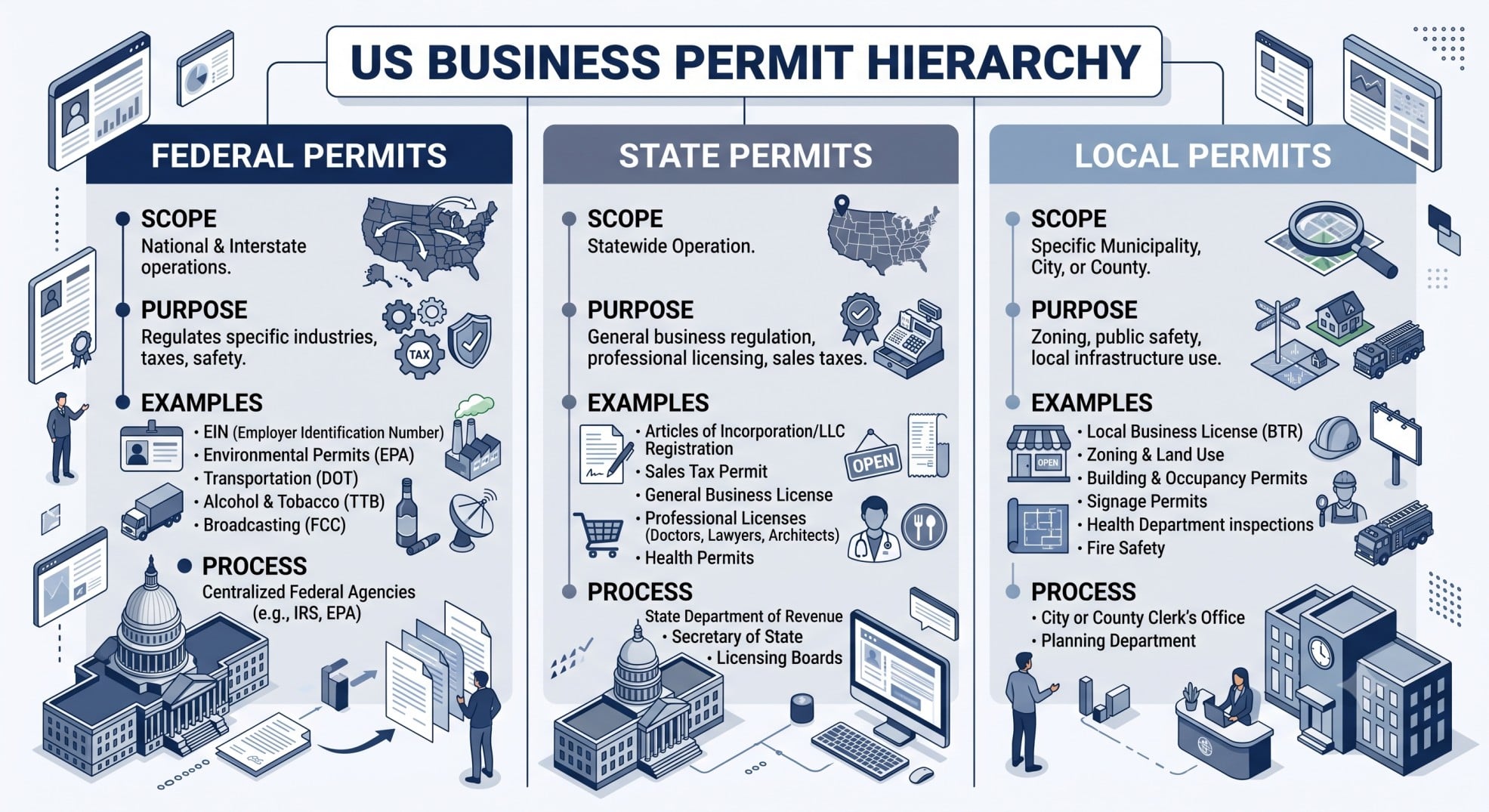
The Hierarchy of the Legal Requirements to Open a Business
Jurisdictional authority in the United States flows downward, but the volume of paperwork flows upward. Federal agencies issue the fewest business licenses, reserving their oversight for industries that impact national security, interstate commerce, or public health. State governments handle the bulk of corporate registrations and tax accounts. Local municipalities issue the highest volume of day-to-day operating permits.
When setting up a business in the us, you must satisfy the requirements of all three tiers simultaneously. A federal permit does not exempt you from a local zoning law. A state LLC registration does not grant you permission to bypass a county health inspection. Each level operates independently, yet they frequently require proof of compliance from the other levels before issuing their own approvals.
For example, a local city clerk will often refuse to issue a general business license until you provide a state-issued Sales Tax ID. A state liquor board will not issue a manufacturing license until you have secured a federal Brewer’s Notice. The legal requirements to open a business form an interlocking chain.
Federal Licenses: Highly Regulated Industries
Most small businesses, such as marketing agencies, independent coffee shops, or freelance consultants, will never need a federal business license. The federal government only intervenes when a business activity falls under the jurisdiction of a specific national agency.
Who Needs a Federal Permit?
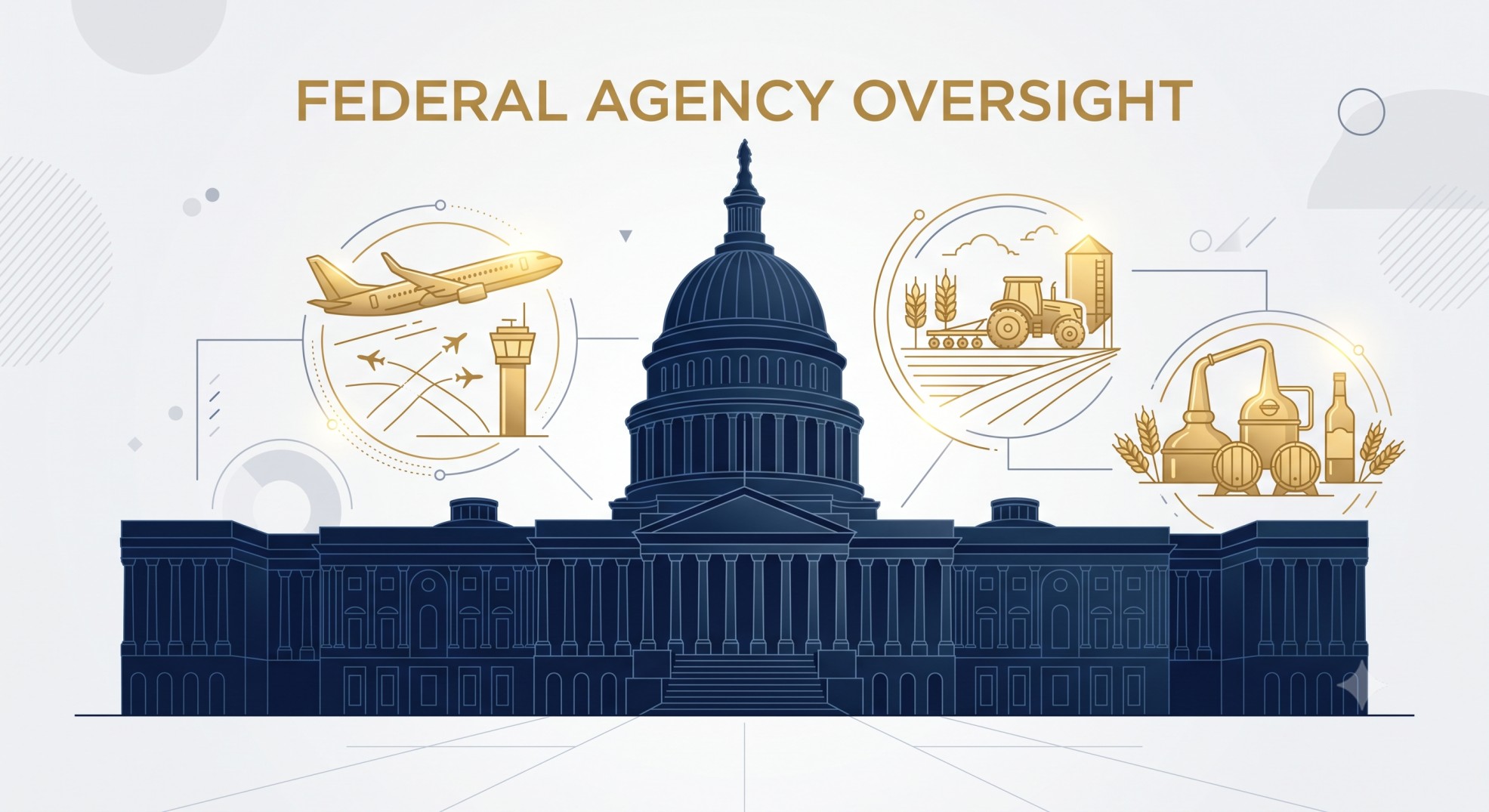
If your business operations involve manufacturing, transporting, or selling highly regulated goods, you will interact with federal agencies. This includes aviation, commercial agriculture, firearms, ammunition, explosives, mining, maritime transportation, and nuclear energy.
Anyone open business in usa within these sectors must secure federal approval long before signing a commercial lease or hiring employees. Federal applications often require extensive background checks, fingerprinting, and months of processing time.
Key Federal Agencies
Different activities trigger oversight from different federal bureaus. Here are the most common agencies that issue federal business permits:
- Alcohol and Tobacco Tax and Trade Bureau (TTB): Regulates the production, wholesale, and importation of alcohol and tobacco products. Breweries, wineries, and distilleries must obtain a permit from the TTB.
- Federal Aviation Administration (FAA): Issues certificates for commercial air transportation, aircraft maintenance facilities, and drone operations used for commercial purposes.
- Bureau of Alcohol, Tobacco, Firearms and Explosives (ATF): Requires a Federal Firearms License (FFL) for anyone manufacturing, dealing, or importing firearms and ammunition.
- Food and Drug Administration (FDA): Facilities that manufacture, process, pack, or hold food for human or animal consumption must register with the FDA.
Even if you do not need a federal operating license, nearly all businesses must obtain an Employer Identification Number (EIN) from the Internal Revenue Service (IRS). Furthermore, under the Corporate Transparency Act, most newly formed entities must file a Beneficial Ownership Information (BOI) report with the Financial Crimes Enforcement Network (FinCEN).
State-Level Registrations: The Foundation of Setting Up a Business in the US
State governments control the legal existence of your company. Before you can hire employees, open a business bank account, or apply for local permits, you must establish your entity at the state level. This is a non-negotiable step when setting up a business in the us.
Entity Formation and Secretary of State
The Secretary of State (or the equivalent state agency, such as the Division of Corporations) handles the formation of Limited Liability Companies (LLCs), Corporations, and Limited Partnerships. Filing your Articles of Organization or Articles of Incorporation creates the legal boundary between your personal assets and your business liabilities.
Sole proprietorships and general partnerships do not typically file formation documents with the state, but they may still need to register a “Doing Business As” (DBA) or Fictitious Business Name if they operate under a name other than their legal given name.
Department of Revenue and Sales Tax Permits
State revenue departments manage taxation. If you sell physical goods, or in some states, specific taxable services, you must obtain a Sales Tax Permit (also known as a Seller’s Permit or Vendor’s License). This permit authorizes you to collect sales tax from customers and remit it to the state.
Operating without a required sales tax permit is a severe violation. States aggressively audit unregistered businesses and will assess back taxes, penalties, and interest on all uncollected revenue. You must research the specific nexus laws in your state to determine exactly when your tax obligations begin.
Professional and Occupational Licenses
States also regulate specific professions to protect public safety and ensure competency. You cannot simply declare yourself a licensed professional. State boards issue occupational licenses for a wide variety of fields, including:
- Medical professionals (doctors, nurses, dentists)
- Legal professionals (attorneys)
- Financial services (CPAs, investment advisors)
- Trades (electricians, plumbers, HVAC technicians)
- Personal services (cosmetologists, barbers, massage therapists)
- Real estate brokers and appraisers
Securing an occupational license usually requires passing a state-administered exam, providing proof of formal education, and completing a certain number of apprenticeship hours. Fulfilling these state-level mandates is a core part of the legal requirements to open a business in these specific industries.
Local Permits: County and City Regulations
While the state governs your corporate structure, local municipalities govern your physical footprint. City halls and county clerk offices are where the day-to-day realities of open business in usa take shape. Local governments use permits to control traffic, manage public health, and ensure commercial activities do not disrupt residential neighborhoods.
Zoning Permits and Certificates of Occupancy
Before signing a commercial lease, you must verify that the local zoning code allows your specific type of business in that exact location. A building previously used as a retail clothing store might not be zoned for a commercial bakery. If your intended use does not match the current zoning, you must apply for a zoning variance or a conditional use permit, which often requires a public hearing.
Once zoning is cleared, you need a Certificate of Occupancy (CO). The local building department issues a CO after inspecting the premises to ensure it complies with building codes, fire safety regulations, and electrical standards. A new CO is typically required whenever a commercial space changes ownership, changes its primary use, or undergoes significant renovations.
Health Department and Safety Inspections
County health departments hold massive authority over businesses that handle food, beverages, or biological materials. Restaurants, food trucks, grocery stores, and even tattoo parlors must pass rigorous health inspections before opening.
Health permits dictate everything from the temperature of your refrigerators to the placement of your hand-washing sinks. Inspectors will evaluate your facility layout, your waste disposal methods, and your employee hygiene protocols. Operating a food service establishment without a valid county health permit will result in immediate closure.
The Nuances of Registering a Home Business
Entrepreneurs operating out of their residences face a unique set of local rules. Registering a home business is not a loophole to avoid municipal oversight. Most cities require a Home Occupation Permit.
These permits place strict limitations on your operations to preserve the residential character of the neighborhood. Common restrictions include bans on exterior signage, limits on the number of daily customer visits, prohibitions on storing hazardous materials, and rules against parking commercial vehicles on the street. Additionally, if you live in a community governed by a Homeowners Association (HOA), you must review their bylaws, as HOA rules can be even more restrictive than city ordinances.
What Are the Steps to Getting a Business License?
The sequence of your applications matters. Applying for local permits before securing your state registrations will result in immediate rejections. If you are wondering what are the steps to getting a business license, follow this chronological progression.
| Step | Action Required | Jurisdiction | Purpose |
|---|---|---|---|
| 1 | Form Your Business Entity | State (Secretary of State) | Creates the legal structure (LLC, Corp) and registers your business name. |
| 2 | Obtain an EIN | Federal (IRS) | Secures your federal tax identification number used for banking and payroll. |
| 3 | Apply for Federal Permits | Federal (Specific Agencies) | Only required if operating in highly regulated industries (e.g., TTB for alcohol). |
| 4 | Register for State Taxes | State (Dept. of Revenue) | Obtains your Sales Tax Permit and registers for state employer taxes. |
| 5 | Verify Local Zoning | Local (City/County Planning) | Ensures your business type is legally allowed to operate at your chosen address. |
| 6 | Obtain Specialized Local Permits | Local (Health, Fire, Police) | Secures health department approvals, fire safety inspections, or police permits. |
| 7 | Apply for General Business License | Local (City/County Clerk) | The final step. Grants the actual authority to open your doors to the public. |
You must complete steps one and two before attempting anything else. Local agencies require your state entity documents and your federal EIN to process a general business license application. Skipping steps will only force you to restart the process.
Real-World Scenarios: Applying for a Business Permit in Practice
Understanding the theory behind the legal requirements to open a business is helpful, but seeing how these rules apply to actual operations clarifies the process. Let us examine three distinct scenarios to see how applying for a business permit works in the real world.
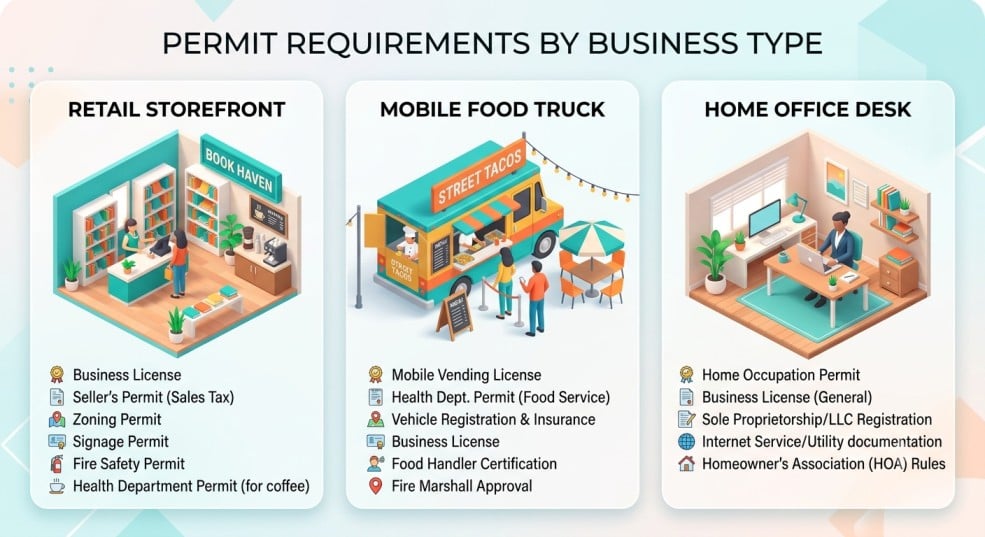
Scenario 1: The Local Craft Brewery (Heavy Regulation)
Marcus decides to open a craft brewery with a small taproom in Cook County, Illinois. Because he is manufacturing alcohol, he faces the highest level of regulatory scrutiny across all three tiers of government.
First, Marcus forms his LLC with the Illinois Secretary of State and gets his EIN from the IRS. Next, he faces a major federal hurdle: he must submit a Brewer’s Notice to the federal TTB. This process requires detailed diagrams of his brewing equipment, background checks, and a surety bond. He cannot brew a single drop of beer until the TTB approves this notice.
Simultaneously, he must apply to the Illinois Liquor Control Commission for a state manufacturing license. Locally, he must secure a zoning variance from the city to allow light manufacturing in a commercial district. He needs a building permit to install his floor drains, a Certificate of Occupancy from the fire marshal, a health permit from the county health department for the taproom, and finally, a local municipal liquor license. If any one of these agencies denies his application, the brewery cannot open.
Scenario 2: The Freelance Consultant (Light Regulation)
Sarah is a graphic designer who wants to start a consulting agency out of her apartment in Travis County, Texas. Her regulatory burden is significantly lighter, but she still has compliance obligations.
She files a Certificate of Formation with the Texas Secretary of State to create her LLC. She obtains her EIN. Because Texas does not generally charge sales tax on graphic design services, she may not need a traditional sales tax permit, but she must still register for the Texas Franchise Tax.
Locally, Sarah is registering a home business. She checks the City of Austin regulations and discovers she needs a Home Occupation Permit. She must agree not to hire employees who work out of her apartment and not to install commercial signage on her door. Once she secures this permit, she is legally compliant.
Scenario 3: The Mobile Food Truck (Multi-Jurisdictional)
David wants to operate a taco truck in Miami-Dade County, Florida. Mobile businesses present unique challenges because they cross municipal borders daily.
David forms his LLC in Florida and registers with the Department of Revenue to collect sales tax on his food sales. At the state level, he must apply for a Mobile Food Dispensing Vehicle license through the Department of Business and Professional Regulation (DBPR).
Locally, the complexity multiplies. He must pass a Miami-Dade County Health Department inspection. Because he operates a vehicle with propane tanks, he needs an inspection from the local fire department. Furthermore, if David parks his truck in the City of Miami on Monday, but drives to the City of Coral Gables on Tuesday, he may need a separate municipal business tax receipt (general business license) from both cities. He also needs a signed Commissary Letter proving he uses a licensed commercial kitchen to prep his food and dump his wastewater.
Edge Cases: Incorporated Cities vs. Unincorporated County Land
Location dictates your local regulatory burden. One of the most confusing aspects of the legal requirements to open a business involves the distinction between incorporated cities and unincorporated county land.
If you lease a commercial space inside the official city limits of a municipality (an incorporated city), you are subject to that city’s zoning laws, building codes, and business license fees. You will apply directly to the city hall.
However, if you lease a space just outside the city limits in an unincorporated area of the county, the city has no jurisdiction over you. In this scenario, you deal exclusively with the county government. County regulations are often, though not always, less restrictive than city regulations. Zoning laws might be looser, and general business license fees might be lower.
Entrepreneurs must verify their exact jurisdictional status before signing a lease. Do not rely on your mailing address. A business can have a “City Name” postal address but actually sit on unincorporated county land. Always check the official county zoning maps. Additionally, be aware of Extraterritorial Jurisdictions (ETJs), where a city can enforce certain building codes or signage rules just outside its official borders in anticipation of future annexation.
Frequently Asked Questions About Business Permits
Do I need a business license if I only sell online?
Yes, e-commerce businesses still require licenses. Even if you operate entirely online, you are physically located somewhere. You must fulfill the local requirements for registering a home business or a commercial warehouse, and you must obtain state sales tax permits for jurisdictions where you have economic nexus.
What is the difference between an LLC and a business license?
An LLC is a legal business structure formed at the state level that protects your personal assets. A business license is a permit issued by a local or state government that grants you the legal authority to operate your specific business activities within their jurisdiction.
How long does it take to get a business license?
Timelines vary drastically. A local general business license might be issued over the counter in a single day. However, state occupational licenses can take weeks, and federal permits (like a TTB Brewer’s Notice) can take several months to process.
What happens if I operate without the required permits?
Operating without proper licenses can result in severe consequences. Local governments can issue daily fines, shut off your utilities, or place a padlock on your doors. State revenue departments can seize your assets for unpaid taxes, and you may lose the liability protection of your LLC.
Do business licenses expire?
Yes, the vast majority of business licenses and permits require periodic renewal. Local general business licenses usually renew annually. State occupational licenses often renew every one to two years. You must track these deadlines carefully to avoid late fees or lapsed authority.
Can I transfer my business license if I move to a new city?
No, local business licenses are tied to the specific physical address and the specific municipality. If you move your operations to a new city, you must close your old license and apply for a completely new set of zoning approvals and business licenses in the new jurisdiction.
Does a DBA count as a business license?
No. A DBA (Doing Business As) or Fictitious Business Name simply registers your operating name with the county or state so the public knows who owns the business. It does not grant you the legal authority to operate, nor does it replace zoning or health permits.
Who can help me figure out exactly which permits I need?
Navigating the legal requirements to open a business can be complex. You can consult a local business attorney, a Certified Public Accountant (CPA), or reach out to your local Small Business Development Center (SBDC). SBDCs are funded in part by the SBA and provide free, localized guidance on permit requirements.
Do independent contractors need a business license?
Generally, yes. If you operate as a 1099 independent contractor, you are considered a sole proprietor. Most cities require sole proprietors to hold a local general business license, even if they provide services entirely from a home office or a laptop.
What are the steps to getting a business license if I buy an existing business?
When you purchase an existing business, licenses rarely transfer to the new owner. You must typically apply for new permits under your new LLC. You will need a new EIN, new state tax accounts, and you must re-apply for local health and operating permits, though the zoning approvals usually remain valid.
Disclaimer: This content provides general information for educational purposes only. Business regulations, licensing requirements, and laws vary drastically by federal, state, county, and city jurisdictions and change frequently. It is not professional legal, tax, or financial advice. Always consult a qualified attorney, CPA, or your local government agencies for personalized guidance regarding your specific business situation.
