
According to Section 3.05 of IRS Revenue Procedure 2026-35, the official child tax credit 2027 maximum amount rises to $2,300 per qualifying child under Internal Revenue Code Section 24(a). For Tax Year 2027, the exact refundable child tax credit 2027 limit—known as the Additional Child Tax Credit (ACTC) under IRC Section 24(d)(1)(A)—increases to $1,800 per qualifying child.
Both the total credit cap and the refundable ceiling rose by $100 per child compared to 2026 thanks to inflation indexing enacted under the One, Big, Beautiful Bill Act (Public Law 119-21). These updated figures apply to your 2027 income tax return, which you’ll file with the IRS in early 2028.
⚡ Quick Numbers: 2027 Child Tax Credit & Refundable ACTC at a Glance
- 2027 Maximum Child Tax Credit (IRC Sec. 24(a)): Up to $2,300 per qualifying child under age 17 at the end of 2027 (up from $2,200 in 2026).
- 2027 Refundable Additional Child Tax Credit Limit (IRC Sec. 24(d)(1)(A)): Up to $1,800 per qualifying child (up from $1,700 in 2026), phased in at 15% of earned income over $2,500.
- 2027 MAGI Phaseout Thresholds (IRC Sec. 24(b)): Credit reduces by $50 for every $1,000 of Modified Adjusted Gross Income over $400,000 (Married Filing Jointly) or $200,000 (Single, Head of Household, and Married Filing Separately).
- Key IRS Forms & Filing Deadline: Calculate on Schedule 8812 (Form 1040) and report on Form 1040, Line 19 (non-refundable) and Line 28 (refundable ACTC) by Monday, April 17, 2028.
Table of Contents
Exact Child Tax Credit 2027 and Refundable ACTC Limits
Under Section 3.05 of IRS Revenue Procedure 2026-35 and IRC Section 24, the child tax credit 2027 provides up to $2,300 per qualifying child under age 17, with up to $1,800 of that credit available as a cash refund if the credit exceeds your federal income tax liability.
| 2027 Child & Dependent Credit Provision | Internal Revenue Code Section | Official 2027 IRS Dollar Limit or Rate |
|---|---|---|
| Maximum Child Tax Credit (CTC) Per Qualifying Child | IRC § 24(a) | $2,300 per child (Under age 17 on Dec. 31, 2027) |
| Refundable Additional Child Tax Credit (ACTC) Maximum | IRC § 24(d)(1)(A) | Up to $1,800 per qualifying child |
| ACTC Earned Income Threshold & Phase-In Rate | IRC § 24(d)(1)(B)(i) | 15% of earned income exceeding $2,500 |
| Credit for Other Dependents (ODC — Non-Refundable) | IRC § 24(h)(4) | Up to $500 per qualifying dependent (Age 17+ or ITIN) |
| Qualifying Relative Gross Income Limit for ODC | IRC § 152(d)(1)(B) | Under $5,500 gross income in 2027 |
| MAGI Phaseout Start — Married Filing Jointly | IRC § 24(b)(2) | $400,000 ($50 reduction per $1,000 over limit) |
| MAGI Phaseout Start — Single, HOH, QSS & MFS | IRC § 24(b)(2) | $200,000 ($50 reduction per $1,000 over limit) |
Why is the credit split into a $2,300 total amount and an $1,800 refundable amount? The baseline Child Tax Credit is a non-refundable credit that directly reduces your federal income tax bill dollar-for-dollar down to $0.
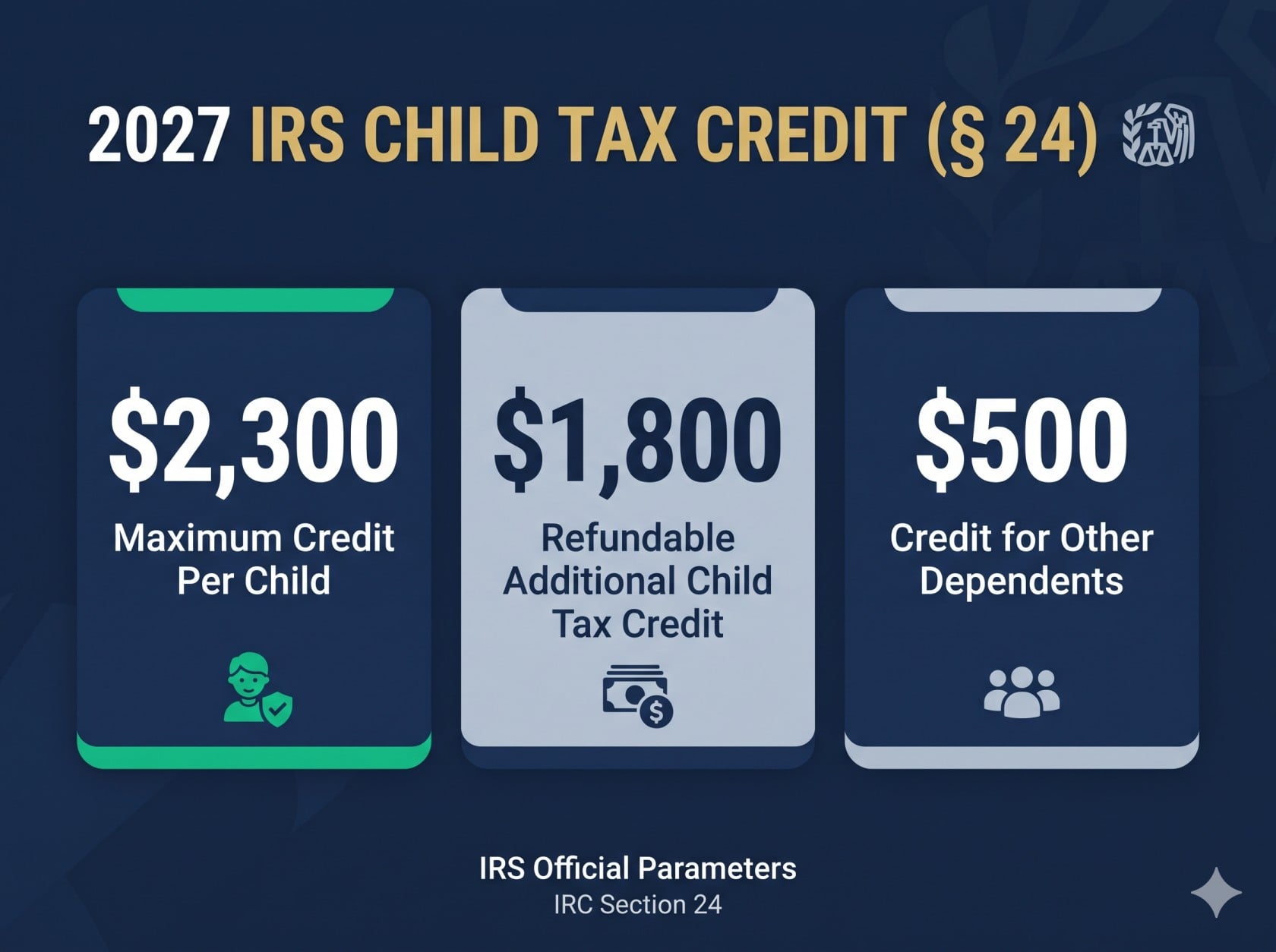
If your total child tax credit 2027 is larger than the federal income tax you owe, you don’t automatically lose the leftover balance. Instead, you can claim the unused portion through the 2027 Additional Child Tax Credit, which refunds up to $1,800 per child as cash back—meaning only the top $500 slice of the $2,300 credit ($2,300 minus $1,800) is strictly non-refundable.
What if your child turns 17 during 2027, or you support a college student or elderly parent? While dependents age 17 or older do not qualify for the $2,300 credit, you can claim the non-refundable $500 Credit for Other Dependents (ODC), provided a non-child qualifying relative has less than $5,500 in gross income for 2027 (Section 3.25 of Revenue Procedure 2026-35).
2026 vs. 2027 Child Tax Credit Comparison: What Changed?
For Tax Year 2027, the IRS increased both the maximum child tax credit 2027 and the refundable child tax credit 2027 cap by $100 per qualifying child compared to 2026, while keeping the $200,000 and $400,000 income phaseout thresholds unchanged.
| Child & Dependent Tax Credit Item | 2026 Official IRS Limit | 2027 Official Limit (Rev. Proc. 2026-35) | Year-Over-Year Change ($ Increase) |
|---|---|---|---|
| Maximum Child Tax Credit Per Child (§ 24(a)) | $2,200 | $2,300 | +$100 per child |
| Maximum Refundable ACTC Per Child (§ 24(d)(1)(A)) | $1,700 | $1,800 | +$100 per child |
| Non-Refundable Only Portion Per Child | $500 | $500 | $0 (Unchanged) |
| ACTC Earned Income Floor (§ 24(d)(1)(B)) | $2,500 | $2,500 | $0 (Statutory Floor) |
| Earned Income Needed for Max $1,800 ACTC (1 Child) | $13,834 | $14,500 | +$666 |
| Credit for Other Dependents (ODC — Age 17+) | $500 | $500 | $0 (Unchanged) |
| Qualifying Relative Gross Income Cap (§ 152(d)(1)(B)) | $5,300 | $5,500 | +$200 |
| Adoption Credit Max / Refundable Portion (§ 23) | $17,670 / $5,120 | $18,250 / $5,280 | +$580 / +$160 |
Why did the maximum credit jump from $2,000 in 2025 to $2,200 in 2026 and $2,300 in 2027? Under the One, Big, Beautiful Bill Act (P.L. 119-21), Congress prevented the Child Tax Credit from dropping back to $1,000, raised the statutory base credit to $2,200, and indexed both the total credit and the refundable ACTC cap for inflation in $100 increments.
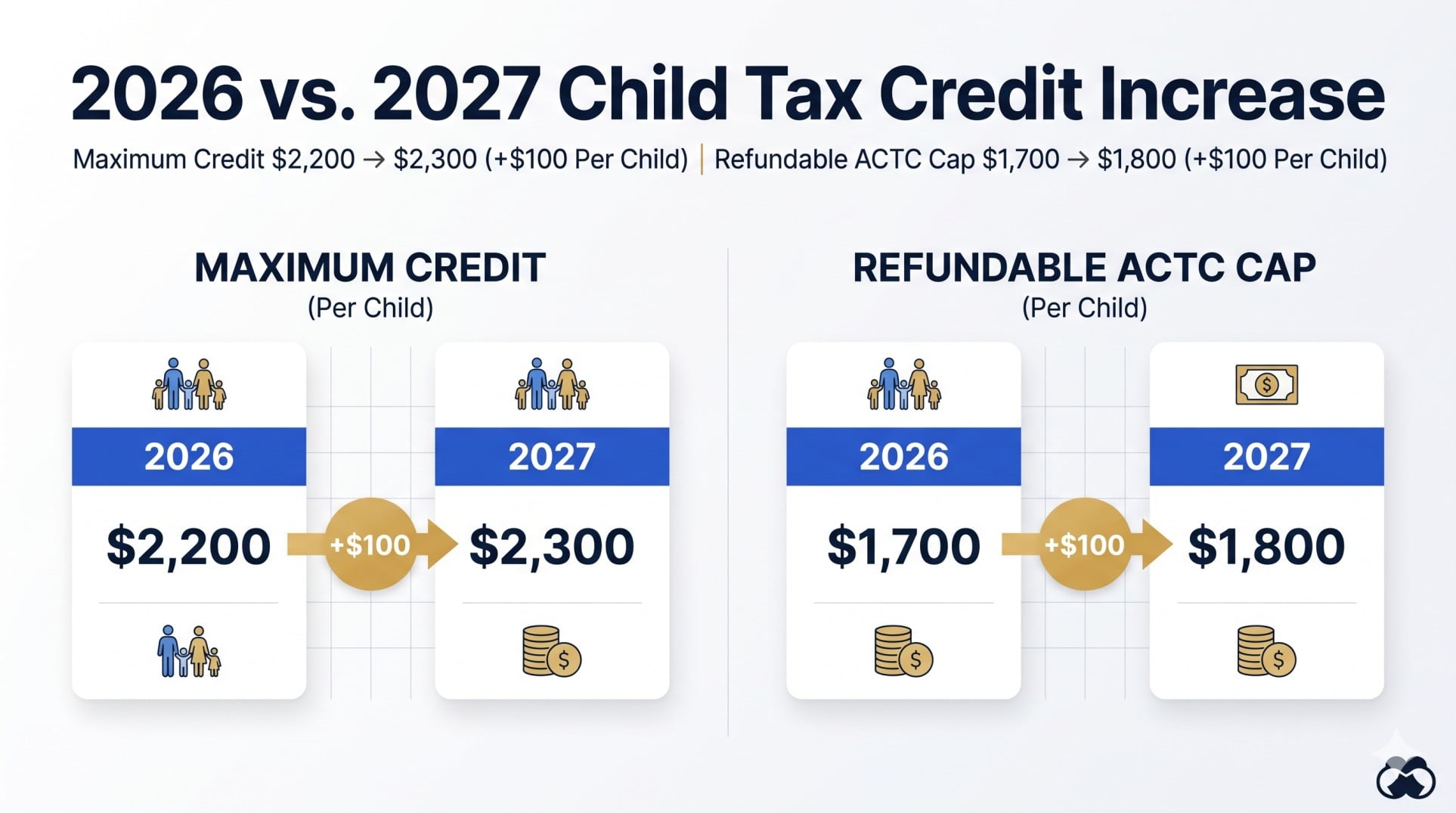
For a family with three qualifying children under age 17, that $100 per-child bump increases their maximum 2027 credit from $6,600 to $6,900, and raises their maximum refundable ACTC payout from $5,100 to $5,400.
Adoptive Parent Bonus in 2027 (IRC Section 23): If you adopt a child in 2027, Section 3.04 of IRS Revenue Procedure 2026-35 raises the maximum federal Adoption Credit to $18,250 per child (with up to $5,280 refundable in 2027), phasing out between $273,680 and $313,680 of MAGI—and you can claim the $2,300 Child Tax Credit in the same year!
How the 2027 Additional Child Tax Credit Works & Who Qualifies
To claim the child tax credit 2027 and the 2027 Additional Child Tax Credit, each child must pass seven strict IRS dependency tests, and your household must satisfy the earned income and Modified Adjusted Gross Income (MAGI) rules.
- Age Test (Under Age 17): The child must be 16 or younger on December 31, 2027. If your child turns 17 on or before December 31, 2027, they only qualify for the $500 Credit for Other Dependents.
- Valid Social Security Number (SSN) Requirement: Every qualifying child claimed for the $2,300 credit or $1,800 refundable ACTC must have a valid SSN issued by the Social Security Administration authorizing employment in the U.S. before the April 17, 2028, filing deadline. Children with an ITIN or ATIN only qualify for the $500 Credit for Other Dependents.
- Relationship, Residency, Support & Citizenship Tests: The child must be your son, daughter, stepchild, eligible foster child, sibling, step-sibling, half-sibling, or a descendant of any of them (such as a grandchild, niece, or nephew); live with you for more than half of 2027; not provide more than half of their own financial support during 2027; be a U.S. citizen, U.S. national, or U.S. resident alien; and be claimed as a dependent on your 2027 Form 1040.
How does the 2027 Child Tax Credit income phaseout work for higher earners? Under IRC Section 24(b)(1), your total credit is reduced by $50 for every $1,000 (or fraction thereof) by which your 2027 MAGI exceeds $200,000 (Single, Head of Household, or Married Filing Separately) or $400,000 (Married Filing Jointly):
| Number of Qualifying Children | 2027 Maximum Total CTC | 2027 Maximum Refundable ACTC | Single, HOH & MFS Phaseout Starts / Ends ($0 Credit) | Married Filing Jointly Phaseout Starts / Ends ($0 Credit) |
|---|---|---|---|---|
| 1 Qualifying Child | $2,300 | $1,800 | $200,000 / $246,000 | $400,000 / $446,000 |
| 2 Qualifying Children | $4,600 | $3,600 | $200,000 / $292,000 | $400,000 / $492,000 |
| 3 Qualifying Children | $6,900 | $5,400 | $200,000 / $338,000 | $400,000 / $538,000 |
| 4 Qualifying Children | $9,200 | $7,200 | $200,000 / $384,000 | $400,000 / $584,000 |
How does the IRS calculate your refundable child tax credit 2027 on Schedule 8812 if your tax liability is less than $2,300 per child? Under the Earned Income Method (used by all families with 1 or 2 children and most families with 3+ children), your refundable ACTC equals the lesser of: (1) your unused Child Tax Credit, (2) $1,800 per qualifying child, or (3) 15% of your 2027 earned income exceeding $2,500. (Families with three or more qualifying children can also test the Payroll Tax Method, which refunds the amount by which their Social Security and Medicare taxes paid exceed their 2027 Earned Income Tax Credit (EITC), capped at $1,800 per child.)
Let’s walk through two clear math examples for Tax Year 2027:
Example 1: Low-Income Single Parent Claiming the Refundable ACTC (Head of Household, 2 Children)
Jasmine files as Head of Household in 2027 with two qualifying children (ages 4 and 7) and earns $26,500 in W-2 wages. After subtracting the $24,925 2027 Head of Household standard deduction, her taxable income is $1,575, resulting in a regular federal income tax liability of $158 (at the 10% bracket rate). Her total available child tax credit 2027 for two children is $4,600 ($2,300 times 2). First, she uses $158 of the non-refundable credit to wipe out her $158 tax bill to $0, leaving $4,442 in unused credit. Next, she calculates her 2027 Additional Child Tax Credit: her earned income above $2,500 is $24,000 ($26,500 minus $2,500), and 15% of $24,000 equals $3,600. Because $3,600 matches the maximum $1,800 per-child refundable cap for two children ($3,600), Jasmine receives a $3,600 cash ACTC refund—plus her federal income tax bill is $0!
Example 2: High-Earner Couple in the 2027 Child Tax Credit Income Phaseout (Married Filing Jointly, 2 Children)
Marcus and Chloe file a joint return in 2027 with two qualifying children (ages 10 and 13) and a Modified Adjusted Gross Income of $431,200. Their starting maximum credit for two children is $4,600. Because their MAGI exceeds the $400,000 Married Filing Jointly threshold by $31,200, the IRS rounds that excess up to the next multiple of $1,000—which is $32,000 (or 32 increments of $1,000). Multiplying 32 by $50 reduces their credit by $1,600, leaving Marcus and Chloe with a net 2027 Child Tax Credit of $3,000 ($4,600 minus $1,600) to subtract from their tax bill.
Also keep in mind that federal IRS credits are separate from state tax credits. Sixteen states—including California, Colorado, Maryland, Minnesota, New Jersey, New York, Oregon, and Vermont—offer their own state-level Child Tax Credit that you can claim on your state return in addition to the federal $2,300 credit.
How to Claim the Child Tax Credit on Schedule 8812 and Form 1040
To claim both the non-refundable child tax credit 2027 and the refundable child tax credit 2027, you must complete Schedule 8812 (Credits for Qualifying Children and Other Dependents) and attach it to your 2027 Form 1040.
- List Every Qualifying Child and Dependent on Form 1040, Page 1: Enter each child’s full name, valid Social Security Number, relationship to you, and check the “Child tax credit” box (for children under age 17 with an SSN) or the “Credit for other dependents” box (for dependents age 17+ or with an ITIN) in the Dependents section of 2027 IRS Form 1040.
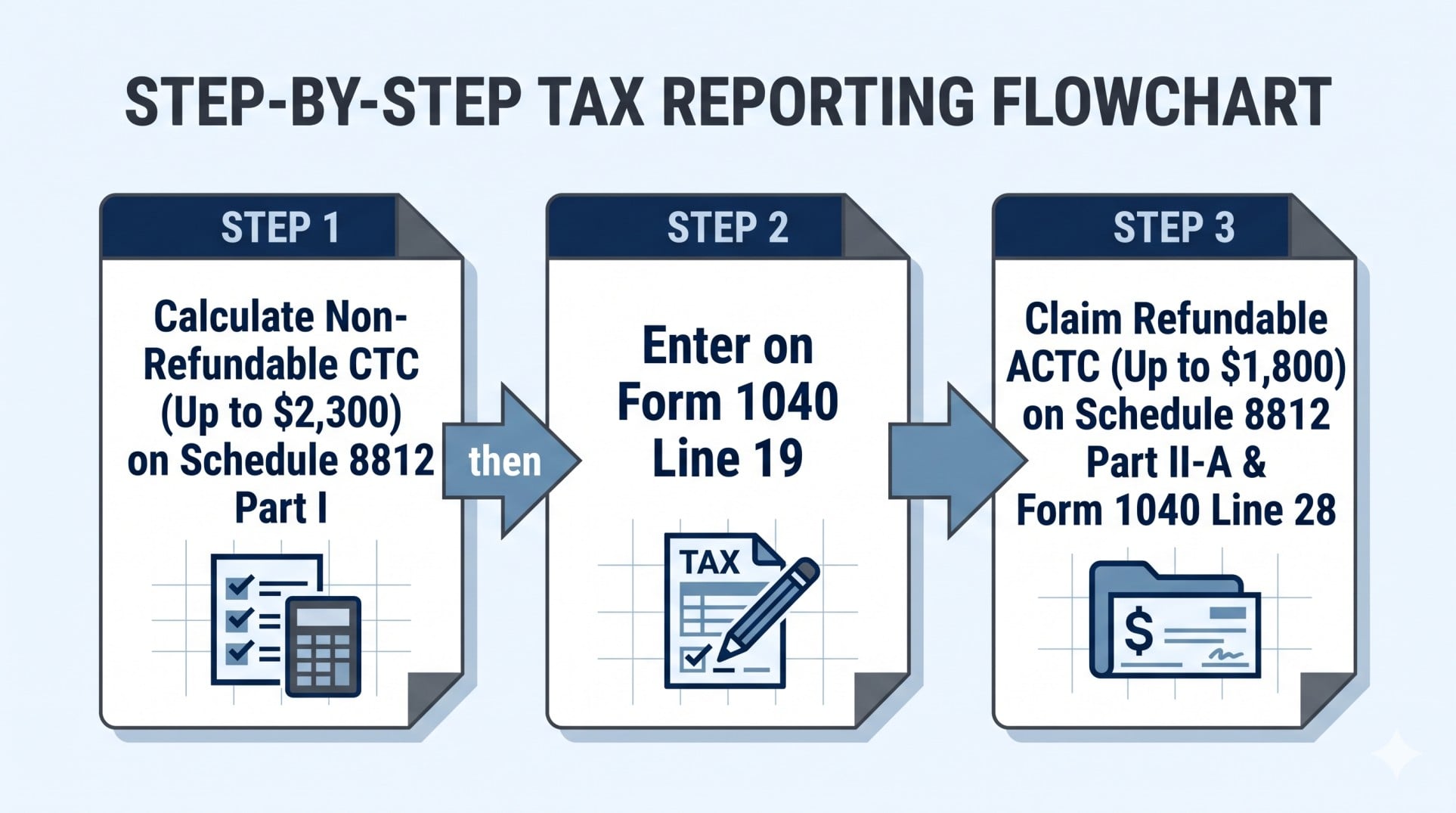
- Calculate Your Total Credit and Phaseout on Schedule 8812, Part I: Enter your 2027 MAGI on Schedule 8812, Line 3, multiply your qualifying children by $2,300 on Line 4a, and multiply other dependents by $500 on Line 4b. Apply the $200,000 or $400,000 phaseout reduction on Lines 8 through 12, and compare the result against your tax liability from the Credit Limit Worksheet to find your non-refundable credit on Schedule 8812, Line 14.
- Enter Your Non-Refundable Child Tax Credit on Form 1040, Line 19: Transfer the amount from Schedule 8812, Line 14, directly to Form 1040, Line 19, to reduce your 2027 federal tax bill.
- Calculate Your Refundable ACTC on Schedule 8812, Part II-A (and Part II-B for 3+ Children): If your total credit on Schedule 8812, Line 12, is greater than your non-refundable credit on Line 14, complete Part II-A (Lines 15 through 20) to multiply your earned income above $2,500 by 15%, capped at $1,800 per qualifying child. If you have three or more qualifying children and Part II-A doesn’t give you the full $1,800 per child, complete Part II-B (Lines 21 through 26) to check the Payroll Tax Method.
- Transfer Your Refundable ACTC to Form 1040, Line 28, and File by April 17, 2028: Enter your final refundable Additional Child Tax Credit from Schedule 8812, Line 27, onto Form 1040, Line 28, and file your return by Monday, April 17, 2028. Remember to attach Form 8862 if your CTC/ACTC was disallowed in a prior year, or Form 8332 if you are a noncustodial parent claiming a child via a signed custodial release.
Note that under the federal PATH Act, if you claim the refundable Additional Child Tax Credit on Form 1040, Line 28, the IRS is required by law to hold your entire refund until at least mid-February 2028.
Frequently Asked Questions
1. How much is the child tax credit 2027 per child?
According to Section 3.05(1) of IRS Revenue Procedure 2026-35, the maximum child tax credit 2027 is $2,300 per qualifying child under IRC Section 24(a), up from $2,200 in 2026. To qualify for the $2,300 credit, the child must be under age 17 on December 31, 2027, and have a valid Social Security Number.
2. What is the maximum refundable child tax credit 2027 amount?
Under Section 3.05(2) of IRS Revenue Procedure 2026-35 and IRC Section 24(d)(1)(A), the maximum refundable child tax credit 2027 (Additional Child Tax Credit) is $1,800 per qualifying child, up from $1,700 in 2026. You can receive up to $1,800 per child as a tax refund even if you owe $0 in federal income tax.
3. How much earned income do I need to get the full $1,800 refundable ACTC in 2027?
To qualify for the 2027 Additional Child Tax Credit, you must have at least $2,500 in earned income for the year, and the credit phases in at 15% of your earned income above $2,500. To receive the full $1,800 refundable amount for one child on Schedule 8812 2027 Child Tax Credit, you need at least $14,500 in 2027 earned income ($14,500 minus $2,500 equals $12,000, times 15% equals $1,800).
4. What is the 2027 Child Tax Credit income phaseout limit?
The 2027 Child Tax Credit income phaseout begins when your Modified Adjusted Gross Income (MAGI) exceeds $400,000 for Married Filing Jointly couples or $200,000 for Single, Head of Household, and Married Filing Separately filers. Above those thresholds, your total credit drops by $50 for every $1,000 (or fraction thereof) of excess income.
5. Can I claim the 2027 Child Tax Credit for a 17-year-old or a college student?
No, a child who turns 17 on or before December 31, 2027, is no longer eligible for the $2,300 Child Tax Credit or the $1,800 refundable ACTC. However, you can claim the non-refundable $500 Credit for Other Dependents on Schedule 8812 2027 Child Tax Credit for qualifying dependents age 17 or older, including full-time college students under age 24.
Disclaimer: This content provides general information for educational purposes only and reflects federal tax laws applicable to Tax Year 2027 (returns filed in 2028). Tax laws are complex and subject to change. This article does not constitute professional tax, legal, or accounting advice. Always consult a certified public accountant (CPA), enrolled agent (EA), or qualified tax attorney regarding your specific financial situation. Ourtaxpartner.com is not responsible for any actions taken based on the information provided herein.
