
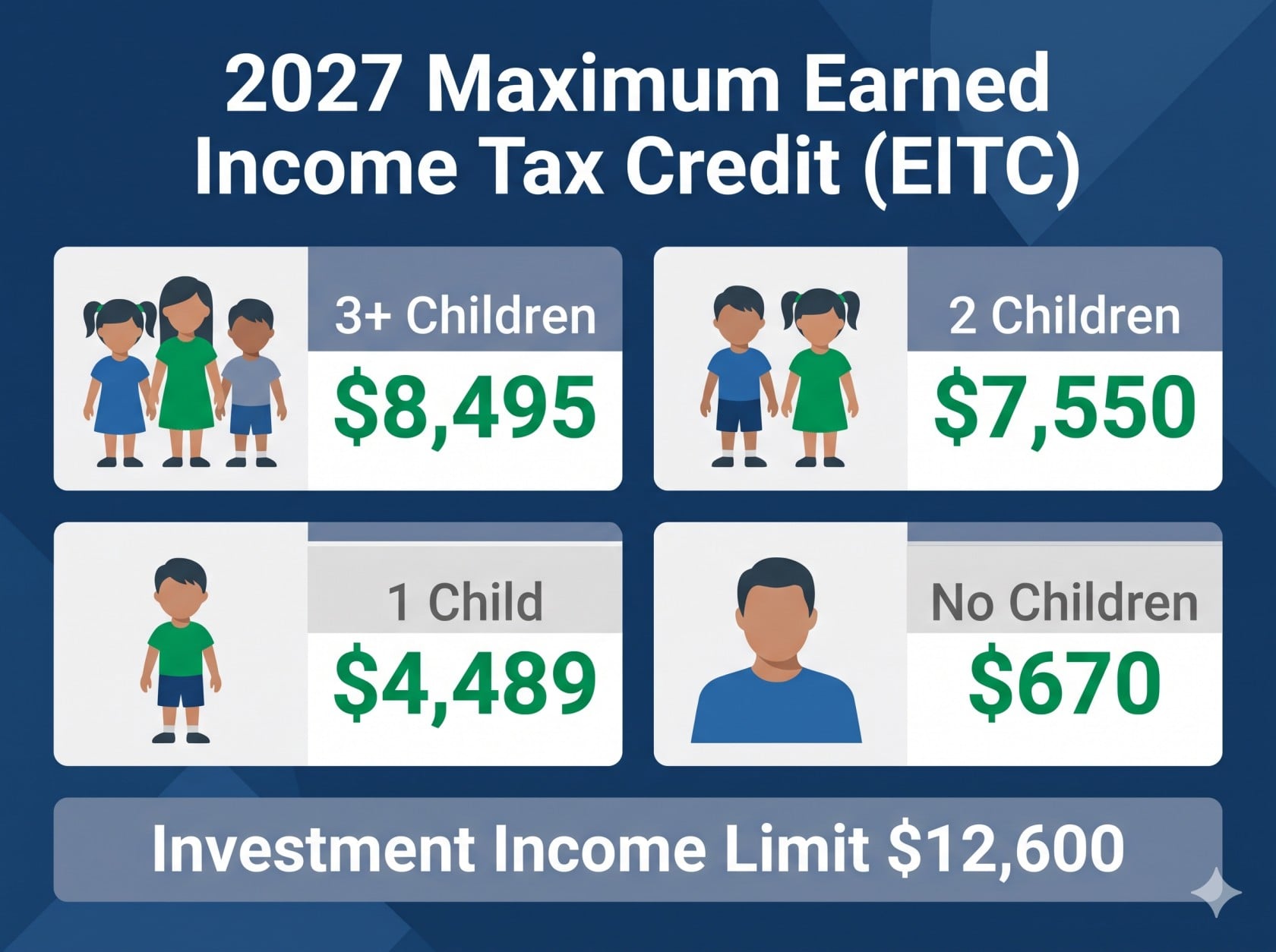
According to IRS Revenue Procedure 2026-35, the official EITC 2027 maximum credit rises to $8,495 for families with three or more qualifying children, $7,550 for two children, $4,489 for one child, and $670 for taxpayers with no qualifying children. Under IRC Section 32(i), the disqualified investment income limit increases to $12,600 for Tax Year 2027.
Because the 2027 Earned Income Tax Credit is a 100% refundable federal tax credit, you receive every dollar of the credit you qualify for as a direct cash refund—even if your federal income tax liability is $0. These updated limits apply to earned income from wages or self-employment during calendar year 2027, which you’ll claim on the tax return you file in early 2028.
⚡ Quick Numbers: 2027 Earned Income Tax Credit (EITC) at a Glance
- 2027 Maximum Credit Amounts (IRC Sec. 32(b)): $8,495 (3+ qualifying children), $7,550 (2 qualifying children), $4,489 (1 qualifying child), and $670 (0 qualifying children).
- 2027 Maximum AGI & Earned Income Ceilings: Up to $71,202 for Married Filing Jointly with 3+ children ($63,792 for Single, Head of Household, or Qualifying Surviving Spouse filers).
- 2027 Disqualified Investment Income Limit (IRC Sec. 32(i)): You cannot claim the credit if your 2027 taxable interest, dividends, net capital gains, and passive rents exceed $12,600 (up from $12,200 in 2026).
- Key IRS Forms & Filing Deadline: Claim the credit on Form 1040 (Line 27) and attach Schedule EIC (if claiming qualifying children) by Monday, April 17, 2028.
Table of Contents
Exact EITC 2027 Numbers and Earned Income Credit 2027 Chart
Under Section 3.06 of IRS Revenue Procedure 2026-35 and IRC Section 32, the earned income credit 2027 chart below lists the exact maximum credit, phase-in earned income amount, and complete income phase-out ceiling by filing status and number of qualifying children.
| Number of Qualifying Children | 2027 Maximum EITC Credit | Earned Income for Max Credit | Single, HOH & QSS Phaseout Starts / Ends (Zero Credit) | Married Filing Jointly Phaseout Starts / Ends (Zero Credit) |
|---|---|---|---|---|
| No Qualifying Children (0) | $670 | $8,750 | $10,950 / $19,700 | $18,350 / $27,100 |
| One Qualifying Child (1) | $4,489 | $13,200 | $24,210 / $52,320 | $31,620 / $59,730 |
| Two Qualifying Children (2) | $7,550 | $18,550 | $24,210 / $59,077 | $31,620 / $66,487 |
| Three or More Qualifying Children (3+) | $8,495 | $18,550 | $24,210 / $63,792 | $31,620 / $71,202 |
To qualify under the earned income credit 2027 chart, both your earned income and your Adjusted Gross Income (AGI) must be less than the “Ends (Zero Credit)” ceiling for your filing status and family size. In addition, your 2027 EITC investment income limit cannot exceed $12,600 for the year.
How does the IRS calculate your exact credit as your income rises? The EITC 2027 follows a three-stage plateau structure—phasing in at a statutory percentage of your first earned dollars, holding steady at the maximum credit across a middle plateau, and phasing out once your income exceeds the threshold:
| EITC Parameter (IRC Section 32(b)) | No Children (0) | One Child (1) | Two Children (2) | Three or More Children (3+) |
|---|---|---|---|---|
| Credit Phase-In Rate (% of Earned Income) | 7.65% | 34.00% | 40.00% | 45.00% |
| Minimum Earned Income for Maximum Credit | $8,750 | $13,200 | $18,550 | $18,550 |
| 2027 Maximum Credit Amount | $670 | $4,489 | $7,550 | $8,495 |
| Credit Phase-Out Rate (% Reduction Above Threshold) | 7.65% | 15.98% | 21.06% | 21.06% |
| 2027 Disqualified Investment Income Cap (IRC § 32(i)) | $12,600 | $12,600 | $12,600 | $12,600 |
Because these limits apply to Adjusted Gross Income before you subtract the 2027 standard deduction ($16,600 for Single filers, $24,925 for Head of Household, or $33,200 for Married Filing Jointly), contributing to an “above-the-line” retirement account or Health Savings Account (HSA) lowers your AGI and can directly increase your EITC refund.
2026 vs. EITC 2027 Comparison: What Changed?
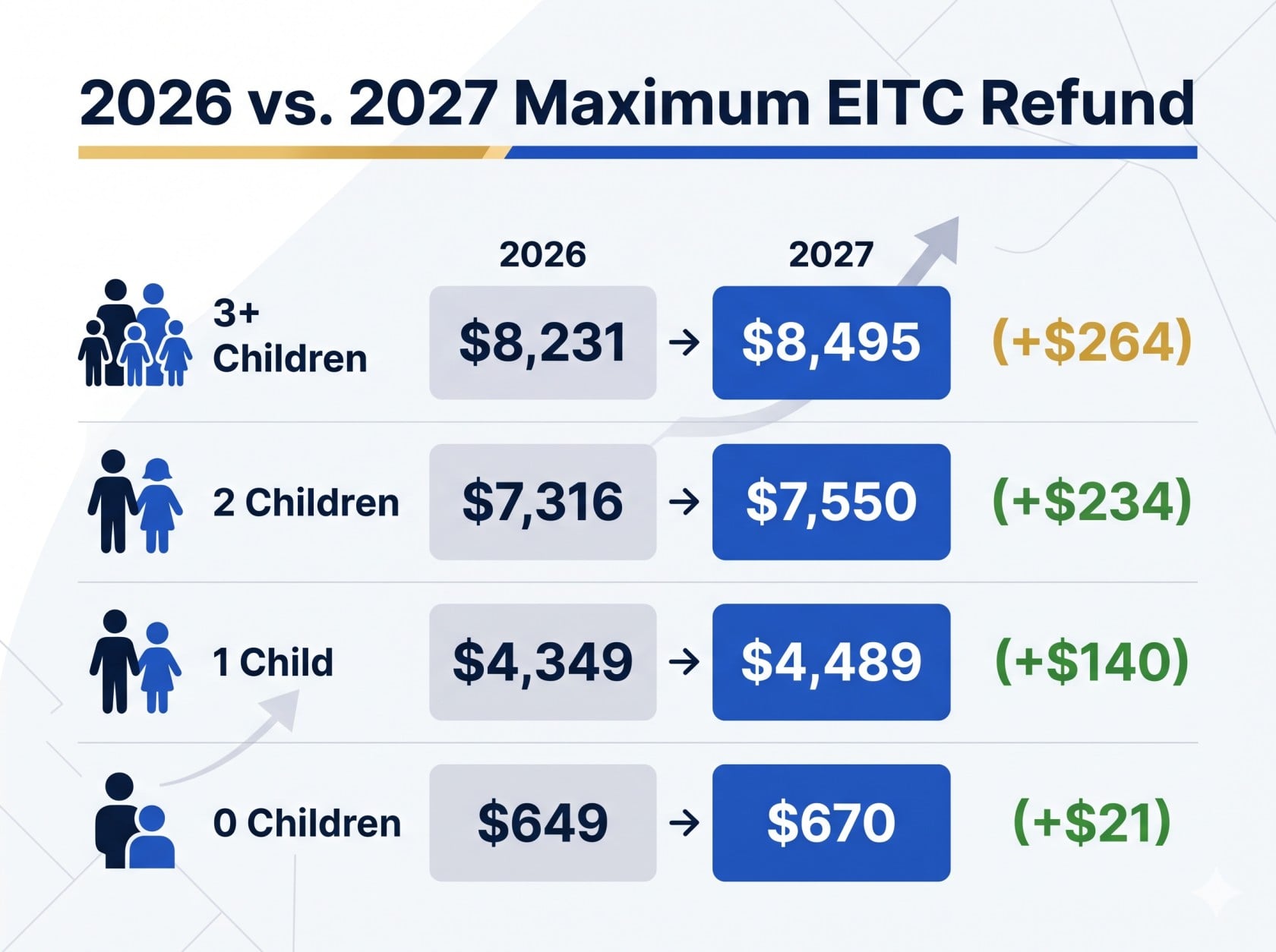
For Tax Year 2027, the IRS raised the EITC 2027 maximum credit and income phaseout limits by roughly 3.2% across all tiers compared to 2026, adding up to $264 to the maximum refund for families with three or more children and bumping the investment income cap up by $400.
| EITC Credit Tier or Income Limit | 2026 Limit (Rev. Proc. 2025-32) | 2027 Limit (Rev. Proc. 2026-35) | Dollar Increase ($ Change) |
|---|---|---|---|
| Max Credit — 3 or More Qualifying Children | $8,231 | $8,495 | +$264 |
| Max Credit — 2 Qualifying Children | $7,316 | $7,550 | +$234 |
| Max Credit — 1 Qualifying Child | $4,349 | $4,489 | +$140 |
| Max Credit — No Qualifying Children (0) | $649 | $670 | +$21 |
| Disqualified Investment Income Limit (Sec. 32(i)) | $12,200 | $12,600 | +$400 |
| Single / HOH Income Ceiling — 3+ Children | $61,810 | $63,792 | +$1,982 |
| Married Filing Jointly Income Ceiling — 3+ Children | $68,997 | $71,202 | +$2,205 |
| Single / HOH Income Ceiling — 2 Children | $57,244 | $59,077 | +$1,833 |
| Married Filing Jointly Income Ceiling — 2 Children | $64,430 | $66,487 | +$2,057 |
| Single / HOH Income Ceiling — 1 Child | $50,692 | $52,320 | +$1,628 |
| Married Filing Jointly Income Ceiling — 1 Child | $57,879 | $59,730 | +$1,851 |
| Single / HOH Income Ceiling — 0 Children | $19,090 | $19,700 | +$610 |
| Married Filing Jointly Income Ceiling — 0 Children | $26,270 | $27,100 | +$830 |
These annual inflation adjustments prevent low- and moderate-income workers from losing their credit when they receive modest cost-of-living raises. A married couple with three children can earn up to $71,202 in 2027 (up from $68,997 in 2026) before their credit completely phases out.
What counts toward the higher $12,600 2027 EITC investment income limit? Under IRC Section 32(i)(2), disqualified investment income is the sum of four specific items on your 2027 return:
- Taxable and Tax-Exempt Interest: Reported on Form 1040, Lines 2a and 2b (such as high-yield savings accounts, CDs, and municipal bond interest).
- Ordinary Dividends: Total dividends reported on Form 1040, Line 3b.
- Net Capital Gains: Net profit from selling stocks, crypto, or investment property reported on Form 1040, Line 7 (if greater than zero; net capital losses do not reduce other investment income).
- Net Passive Rental, Royalty, and Passive Trust/Estate Income: Positive net passive income reported on Schedule E.
Crucial Investment Cap Warning: The $12,600 disqualified investment income threshold is a hard “cliff,” not a gradual phaseout. If your 2027 investment income hits $12,601—just one dollar over the IRS limit—your entire $8,495 EITC drops to $0. Be cautious about realizing large 2027 capital gains in a year you expect to claim the EITC.
How the 2027 Earned Income Tax Credit Works & Who Qualifies
To qualify for the 2027 EITC income limits, you must have positive earned income from working, meet strict Social Security Number and residency rules, and satisfy either the qualifying child tests or the childless worker age rules.
- What Counts as “Earned Income” in 2027: W-2 wages, salaries, tips, union strike benefits, and net self-employment earnings on Schedule C or Schedule F. (Combat zone pay listed in Box 12, Code Q of Form W-2 is nontaxable, but military personnel can elect to include it in earned income if doing so boosts their EITC.) Unemployment compensation, Social Security benefits, pensions, alimony, and child support do not count as earned income.
- Valid Social Security Number (SSN) Requirement: You, your spouse (if filing jointly), and every qualifying child claimed on Schedule EIC must have a valid SSN issued for employment on or before the April 17, 2028, return due date. Individual Taxpayer Identification Numbers (ITINs) and Adoption Taxpayer Identification Numbers (ATINs) do not qualify.
- Four Tests for a Qualifying Child: To claim the 1, 2, or 3+ child tiers on the earned income credit 2027 chart, each child must pass four tests: Relationship (son, daughter, stepchild, foster child, sibling, half-sibling, stepsibling, or a descendant of any of them), Age (under age 19 at the end of 2027, under age 24 if a full-time student for at least 5 months, or any age if permanently and totally disabled), Residency (lived with you in the United States for more than half of 2027), and Joint Return (cannot file a joint return for 2027 except solely to claim a refund).
- Childless Worker Rules (No Qualifying Children): If you do not have a qualifying child, you must be at least age 25 but under age 65 on December 31, 2027, live in the United States for more than half the year, and not be eligible to be claimed as a dependent on anyone else’s 2027 tax return.
- Special Rule for Separated Spouses (IRC Section 32(d)): Although Married Filing Separately taxpayers are normally barred from the EITC, a legally married person who files as Married Filing Separately or Head of Household can still claim the EITC 2027 if they lived with a qualifying child for more than half of 2027 and either lived apart from their spouse for the last 6 months of 2027 or lived apart on December 31, 2027, under a written separation agreement or decree.
Let’s walk through two clear math examples using the verified 2027 IRS formulas:
Example 1: Single Mother (Head of Household) With 2 Qualifying Children in the Phaseout Zone
Maya files as Head of Household in 2027 with two qualifying children (ages 6 and 9). She earns $38,000 in W-2 wages, has $400 in bank interest (well below the $12,600 investment limit), and has an AGI of $38,400. Because the 2027 Earned Income Tax Credit calculations use the greater of earned income or AGI once income passes the phaseout start, the IRS uses her $38,400 AGI. For Head of Household filers with two children, the maximum $7,550 credit begins phasing out above $24,210 at a rate of 21.06%. Maya’s AGI exceeds $24,210 by $14,190 ($38,400 minus $24,210). Multiplying $14,190 by 21.06% reduces her credit by $2,988.41, giving Maya a refundable 2027 EITC of $4,562 ($7,550 minus $2,988), on top of any 2027 Child Tax Credit she claims.
Example 2: Married Couple With 3 Children Using a Traditional IRA to Boost Their EITC
Carlos and Elena file Married Filing Jointly in 2027 with three qualifying children. They earn $41,620 in combined W-2 wages and have no other income. Without tax planning, their AGI of $41,620 is $10,000 above the $31,620 joint phaseout threshold, which reduces their $8,495 maximum credit by 21.06% of $10,000 ($2,106), leaving an EITC of $6,389. However, if Carlos and Elena contribute $10,000 to their traditional IRAs before April 17, 2028—claiming an “above-the-line” adjustment on Schedule 1—their AGI drops to $31,620. Because their Earned Income ($41,620) is still used to check the phaseout unless both Earned Income and AGI are below the threshold, how can self-employed taxpayers or employees lower both? By contributing to a pre-tax 401(k) or cafeteria plan at work (which reduces Box 1 W-2 taxable wages and AGI simultaneously) or deducting business expenses on Schedule C, locking in the full $8,495 maximum credit and saving $2,106!
Also separate federal IRS rules from state tax laws. In addition to the federal credit, 31 states plus the District of Columbia, Puerto Rico, and Guam offer their own state-level Earned Income Tax Credit (typically calculated as 10% to 85% of your federal EITC 2027 amount), and most states make their state EITC fully refundable as well.
How to Claim the EITC on Your 2027 Tax Return
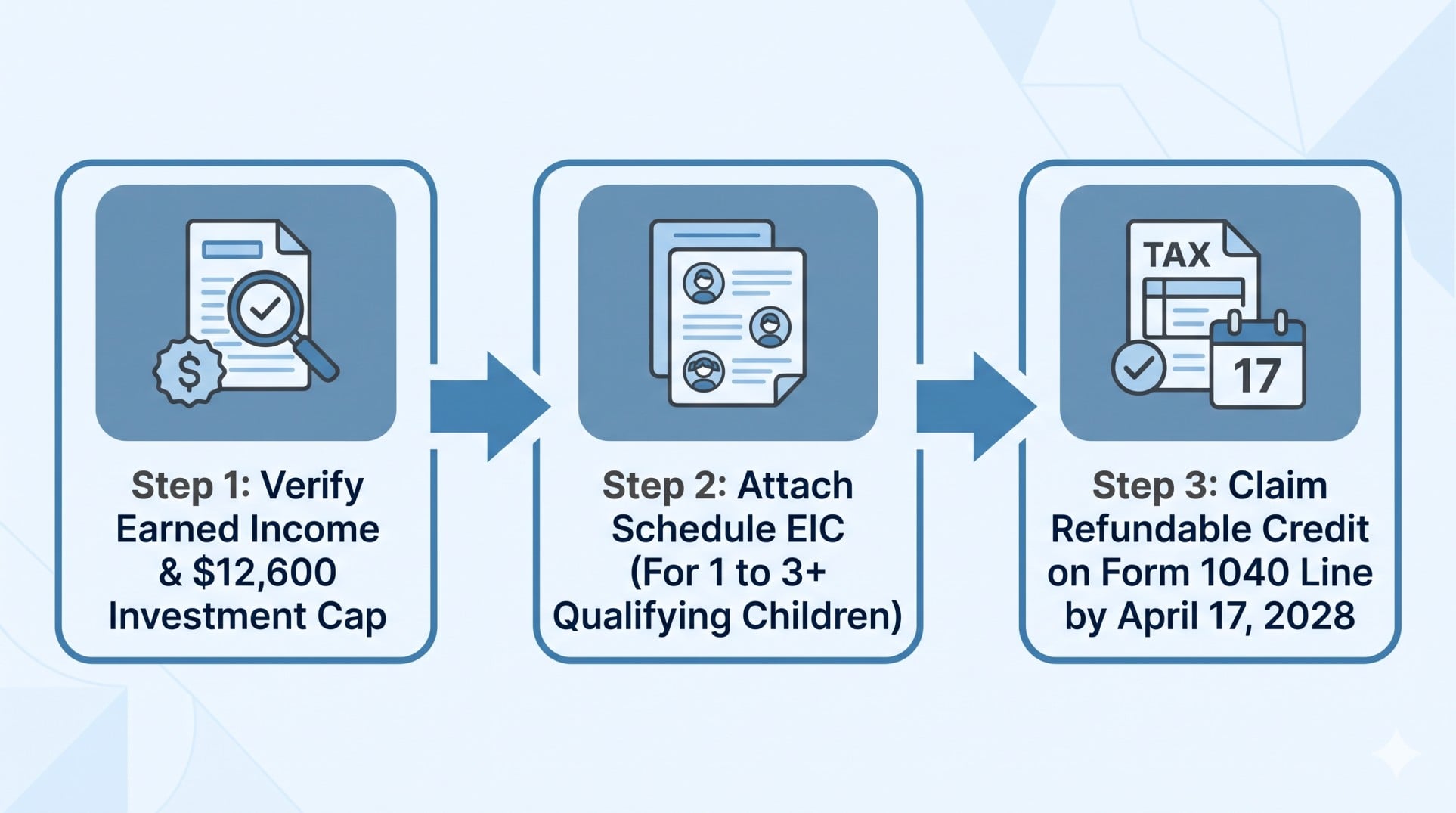
To claim the EITC 2027, you must file a 2027 federal income tax return on Form 1040 (even if your income is below the normal filing requirement), complete the EITC Worksheet, and attach Schedule EIC if you are claiming one or more qualifying children.
- Confirm Your 2027 Earned Income, AGI, and $12,600 Investment Income Limit: Total your W-2 Box 1 wages and net Schedule C self-employment profit (after subtracting half of your self-employment tax on Schedule 1). Check that your taxable/tax-exempt interest, dividends, net capital gains, and passive income do not exceed the $12,600 2027 EITC investment income limit, and verify that you did not file Form 2555 (Foreign Earned Income Exclusion), which automatically disqualifies you from the EITC.
- Complete Schedule EIC (Form 1040) for Up to 3 Qualifying Children: If you are claiming the 1, 2, or 3+ child credit tier, fill out Schedule EIC (Earned Income Credit — Qualifying Child Information). Enter each child’s full legal name, valid Social Security Number, year of birth, student or disability status (if age 19–23 or older), relationship to you, and the number of months the child lived with you in the U.S. during 2027 (must be at least 7 months, or born/died in 2027).
- Calculate Your Credit Using the Form 1040 EIC Worksheet and EIC Tables: Complete EIC Worksheet A (for W-2 employees) or EIC Worksheet B (for self-employed filers) in the Form 1040 instructions, look up your exact credit in the IRS 2027 EIC Table, and enter the dollar amount on Form 1040, Line 27. (If you are a separated spouse qualifying under IRC Section 32(d), check the box on the dotted line next to Line 27.)
- Attach Form 8862 If Your EITC Was Previously Disallowed or Reduced: If the IRS reduced or denied your EITC in any year after 1996 for any reason other than a simple math or clerical error, you must attach Form 8862 (Information To Claim Certain Credits After Disallowance) to your 2027 return, or the IRS will automatically reject your claim.
- File by April 17, 2028, and Track PATH Act Refund Timing: Submit your 2027 Form 1040 electronically by Monday, April 17, 2028. Under the federal Protecting Americans from Tax Hikes (PATH) Act, the IRS is legally required to hold the entire tax refund on any return claiming the EITC or Additional Child Tax Credit until at least mid-February 2028, with most direct deposit refunds arriving in bank accounts by the last week of February or first week of March 2028.
If your income falls below $84,000, you can prepare and e-file both your federal 2027 Form 1040 return and Schedule EIC at zero cost using IRS Free File or an IRS Volunteer Income Tax Assistance (VITA) site.
Frequently Asked Questions
1. What is the maximum EITC 2027 credit amount?
According to Section 3.06 of IRS Revenue Procedure 2026-35, the maximum EITC 2027 credit is $8,495 for taxpayers with three or more qualifying children, $7,550 for two children, $4,489 for one child, and $670 for workers with no qualifying children. Because the credit is 100% refundable, any excess over your tax bill is paid to you as a tax refund.
2. What are the 2027 EITC income limits to qualify?
Under the 2027 EITC income limits, your earned income and Adjusted Gross Income must be less than $63,792 ($71,202 if Married Filing Jointly) with three or more children, $59,077 ($66,487 MFJ) with two children, $52,320 ($59,730 MFJ) with one child, or $19,700 ($27,100 MFJ) with no qualifying children.
3. What is the 2027 EITC investment income limit?
For Tax Year 2027, the disqualified investment income limit under IRC Section 32(i) is $12,600, up from $12,200 in 2026. If your combined taxable interest, tax-exempt interest, ordinary dividends, net capital gains, and net passive rental income exceed $12,600, you cannot claim the Earned Income Tax Credit for 2027.
4. Can I claim the 2027 Earned Income Tax Credit if I have no children?
Yes, childless workers can claim up to $670 on the earned income credit 2027 chart if their 2027 income is below $19,700 (Single) or $27,100 (Married Filing Jointly). To qualify without children, you must be at least age 25 and under age 65 at the end of 2027, live in the U.S. for more than half the year, and not be claimed as a dependent on another taxpayer’s return.
5. What happens if I claim 4 or 5 children on Schedule EIC in 2027?
The federal Earned Income Tax Credit caps at three or more qualifying children ($8,495 maximum credit for 2027). If you have four or five qualifying children, you only need to list three qualifying children on Schedule EIC (Form 1040) to receive the maximum $8,495 EITC, though you should still claim all eligible children on Schedule 8812 for the Child Tax Credit.
Disclaimer: This content provides general information for educational purposes only and reflects federal tax laws applicable to Tax Year 2027 (returns filed in 2028). Tax laws are complex and subject to change. This article does not constitute professional tax, legal, or accounting advice. Always consult a certified public accountant (CPA), enrolled agent (EA), or qualified tax attorney regarding your specific financial situation. Ourtaxpartner.com is not responsible for any actions taken based on the information provided herein.
