
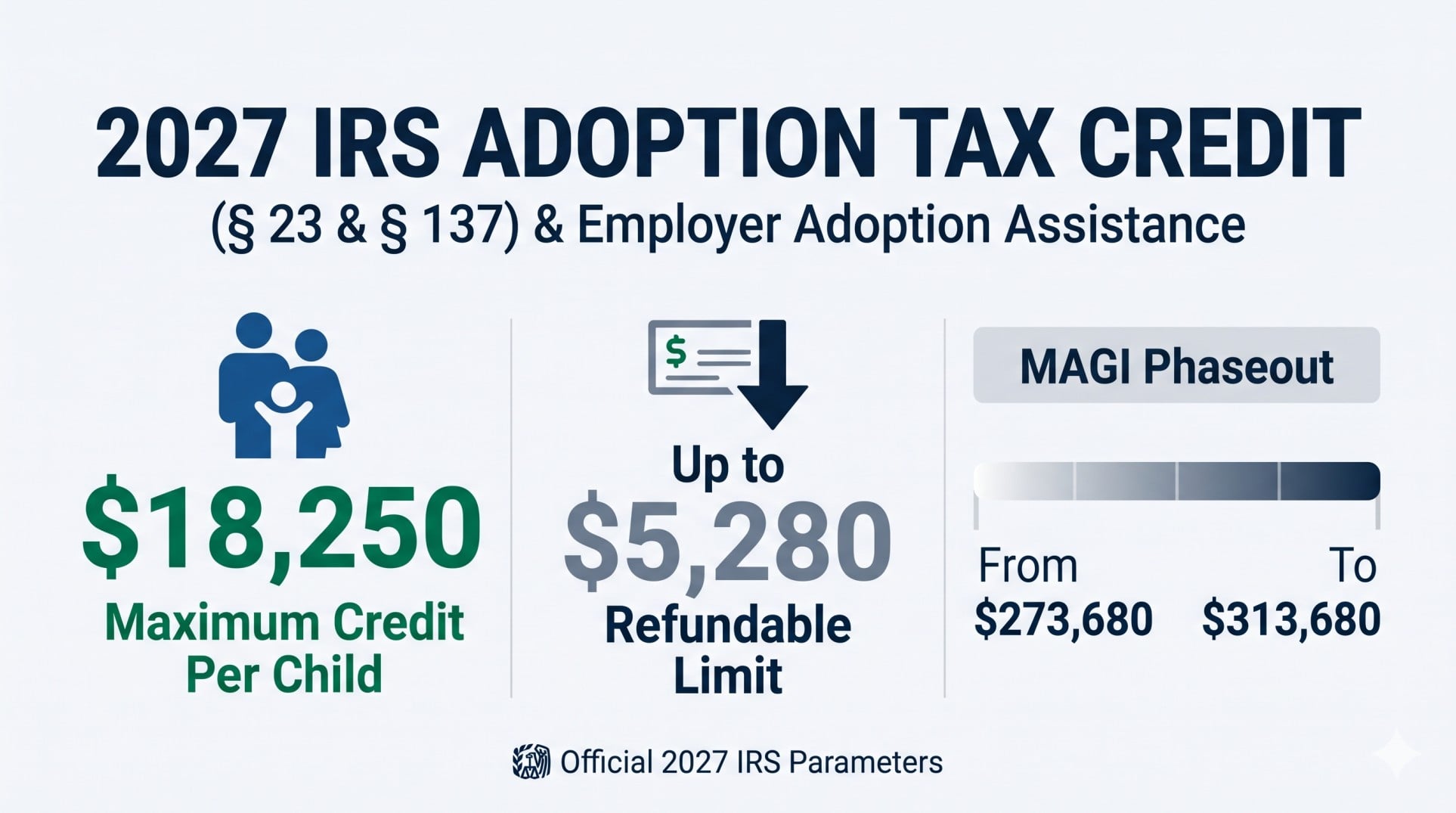
According to Section 3.04 of IRS Revenue Procedure 2026-35, the official adoption tax credit 2027 maximum amount rises to $18,250 per eligible child under Internal Revenue Code Section 23, with up to $5,280 of that credit available as a direct cash refund. For Tax Year 2027, both the credit and the $18,250 employer-provided adoption assistance exclusion under IRC Section 137 phase out for Modified Adjusted Gross Income (MAGI) between $273,680 and $313,680.
Thanks to changes enacted under the One, Big, Beautiful Bill Act (Public Law 119-21), the federal adoption credit is now partially refundable up to $5,280 per child in 2027, while any remaining non-refundable credit exceeding your tax liability can still be carried forward for up to five tax years. These inflation-adjusted figures apply to qualified adoption expenses claimed on your 2027 federal return, which you’ll file in early 2028.
⚡ Quick Numbers: 2027 Adoption Tax Credit & Refundable Limit at a Glance
- 2027 Maximum Adoption Tax Credit (IRC Sec. 23(a)(3) & (b)(1)): Up to $18,250 per eligible child for qualified adoption expenses—or a flat $18,250 for a finalized U.S. special needs adoption regardless of actual out-of-pocket costs.
- 2027 Refundable Portion Limit (IRC Sec. 23): Up to $5,280 per eligible child is refundable in cash even if your federal income tax bill is $0 (up from $5,120 in 2026); the remaining $12,970 is non-refundable with a 5-year carryforward.
- 2027 Employer Adoption Assistance Exclusion & MAGI Phaseout (IRC Sec. 137): Exclude up to $18,250 in employer-paid adoption benefits from income; both the credit and exclusion phase out between $273,680 and $313,680 of MAGI.
- Key IRS Forms & Filing Deadline: Calculate on IRS Form 8839 (Qualified Adoption Expenses) and attach to Form 1040 by Monday, April 17, 2028.
Table of Contents
Exact Adoption Tax Credit 2027 Numbers and Refundable Limits
Under Section 3.04 and Section 3.24 of IRS Revenue Procedure 2026-35, the adoption tax credit 2027 and the employer-provided adoption assistance exclusion both cap at $18,250 per child, with up to $5,280 of the tax credit refundable and a uniform MAGI phaseout range of $273,680 to $313,680.
| 2027 Federal Adoption Tax Provision | Internal Revenue Code Section | Official 2027 IRS Dollar Limit |
|---|---|---|
| Maximum Adoption Tax Credit (Standard Domestic or Foreign) | IRC § 23(b)(1) | Up to $18,250 of qualified expenses per child |
| Special Needs Child Adoption Credit (Finalized in 2027) | IRC § 23(a)(3) | Flat $18,250 per child (Even if actual expenses are $0) |
| Maximum Refundable Adoption Tax Credit Portion | IRC § 23 (P.L. 119-21) | Up to $5,280 per eligible child |
| Maximum Non-Refundable Portion (5-Year Carryforward) | IRC § 23(c) | Up to $12,970 per child ($18,250 minus $5,280) |
| Employer-Provided Adoption Assistance Exclusion | IRC § 137(a)(2) & (b)(1) | Up to $18,250 per child excluded from W-2 income |
| MAGI Phaseout Start Threshold (Single, HOH, QSS & MFJ) | IRC §§ 23(b)(2) & 137(b)(2) | $273,680 |
| MAGI Complete Phaseout Ceiling ($0 Credit/Exclusion) | IRC §§ 23(b)(2) & 137(b)(2) | $313,680 ($40,000 phaseout range) |
Notice two unique features in the table above. First, unlike most personal tax credits, the 2027 adoption credit income phaseout of $273,680 to $313,680 is identical for Single, Head of Household, Qualifying Surviving Spouse, and Married Filing Jointly taxpayers (Married Filing Separately taxpayers generally cannot claim the credit unless they meet strict living-apart exceptions under IRC Section 23(f)(1)).
Second, the $18,250 limit is a per-child lifetime dollar cap across all years of an adoption effort, not an annual cap. If you adopt two siblings in 2027, your maximum potential 2027 adoption tax credit doubles to $36,500 (with up to $10,560 refundable).
What if your employer offers an adoption assistance benefit reported in Box 12 (Code T) of your Form W-2? Under IRC Section 137, you can exclude up to $18,250 of employer-reimbursed expenses from your federal gross income AND claim up to $18,250 for the adoption tax credit for the same child—as long as you don’t “double-dip” by claiming the exact same dollar of expense for both benefits. A family with $36,500 in total adoption costs for one child in 2027 can exclude $18,250 of employer assistance and still claim the full $18,250 tax credit on the remaining out-of-pocket costs.
2026 vs. 2027 Adoption Tax Credit Comparison: What Changed?
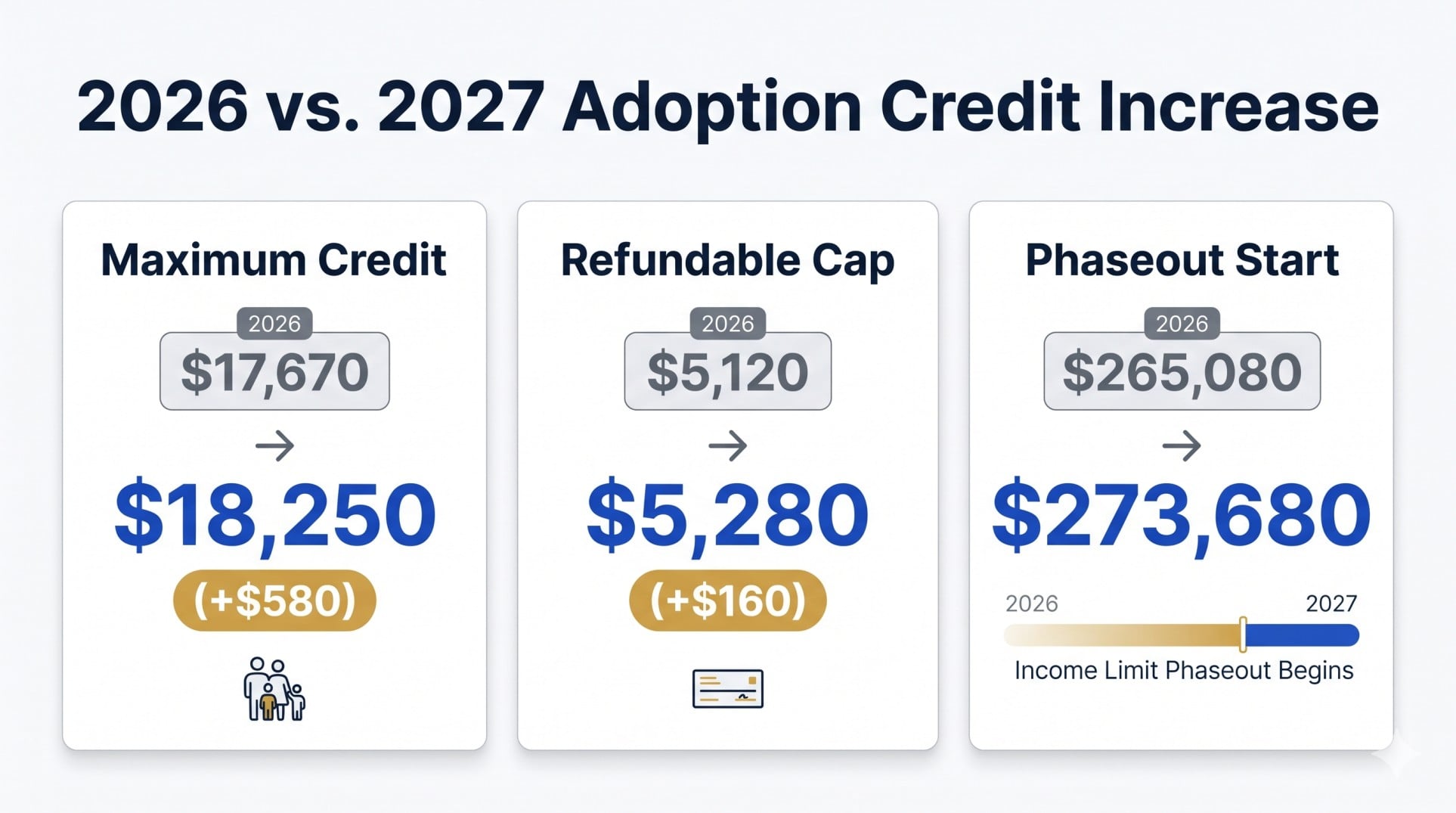
Compared to 2026, the IRS raised the adoption tax credit 2027 maximum limit by $580 per child (a 3.28% inflation increase), bumped the refundable adoption tax credit 2027 cap up by $160 per child, and lifted the MAGI phaseout thresholds by $8,600.
| Adoption Tax Credit or Exclusion Item | 2026 Official IRS Limit | 2027 Official Limit (Rev. Proc. 2026-35) | Year-Over-Year Increase ($ Change) |
|---|---|---|---|
| Maximum Adoption Tax Credit Per Child (§ 23) | $17,670 | $18,250 | +$580 per child |
| Special Needs Adoption Flat Credit (§ 23(a)(3)) | $17,670 | $18,250 | +$580 per child |
| Maximum Refundable Portion Per Child | $5,120 | $5,280 | +$160 per child |
| Non-Refundable Portion (5-Year Carryforward) | $12,550 | $12,970 | +$420 per child |
| Employer Adoption Assistance Exclusion (§ 137) | $17,670 | $18,250 | +$580 per child |
| MAGI Phaseout Start Threshold | $265,080 | $273,680 | +$8,600 |
| MAGI Complete Phaseout Ceiling ($0 Benefit) | $305,080 | $313,680 | +$8,600 |
Why is the refundable adoption tax credit 2027 capped at $5,280 instead of being 100% non-refundable like it was prior to 2025? Under the One, Big, Beautiful Bill Act (Public Law 119-21), Congress created a permanent refundable tier (indexed for inflation from a $5,000 base) so lower- and middle-income adoptive families can receive up to $5,280 per child immediately in their tax refund rather than waiting up to five years to absorb a non-refundable credit against small tax bills.
At the same time, the non-refundable portion (up to $12,970 per child after taking the $5,280 refundable slice, or up to the full $18,250 if you have sufficient tax liability) directly offsets your regular federal income tax and any 2027 Alternative Minimum Tax (AMT) dollar-for-dollar. Any unused non-refundable credit carries forward for up to five subsequent tax years (through Tax Year 2032 for a 2027 credit).
Stacking With the 2027 Child Tax Credit: Claiming the $18,250 adoption credit does not prevent you from also claiming the 2027 Child Tax Credit of $2,300 (including up to $1,800 refundable via the Additional Child Tax Credit) for the same child on your 2027 return. That means a family finalizing an adoption in 2027 can receive up to $20,550 in combined federal child and adoption tax credits per child!
How the 2027 Adoption Tax Credit Works & Who Qualifies
To qualify for the 2027 adoption tax credit, you must adopt an “eligible child”—defined under IRC Section 23(d)(2) as a child who is either under age 18 or physically or mentally incapable of caring for themselves—and follow the strict IRS timing rules on when expenses can be claimed.
| Type of Adoption & Status | When You Claim Qualified Expenses on Form 8839 | 2027 Expense Documentation Required |
|---|---|---|
| Domestic Adoption (U.S. Citizen or Resident Child) — Not Yet Final | Claim expenses in the tax year after the year you pay them (e.g., 2026 payments claimed on your 2027 return) | Receipts for agency fees, court costs, attorney fees & travel |
| Domestic Adoption — Finalized in 2027 | Claim expenses paid in 2027 (plus any unclaimed 2026 payments) on your 2027 return | Final adoption decree + receipts for qualified out-of-pocket expenses |
| Domestic U.S. Special Needs Adoption — Finalized in 2027 | Claim the full flat $18,250 in the year the adoption is finalized (2027) | State Special Needs Determination / Adoption Assistance Agreement (No expense receipts needed) |
| Foreign (International) Adoption — Finalized in 2027 | Claim all prior and current expenses only in the year the adoption becomes final (2027); no credit if never finalized | Final foreign adoption decree / Hague certificate, IR-3/IR-4/IH-3/IH-4 visa & receipts |
| Employer Adoption Assistance Exclusion (§ 137) | Exclude in the year your employer pays or reimburses the expense (or year of finality for foreign/special needs) | Form W-2 Box 12 (Code T) & non-overlapping expense records |
What counts as a “qualified adoption expense” under IRC Section 23(d)(1), and what is strictly disallowed?
- Eligible Expenses: Reasonable and necessary adoption agency fees, home study fees, court costs, legal and attorney fees, re-adoption expenses for a foreign child, and travel expenses (including meals and lodging while away from home overnight for the adoption process).
- Ineligible Expenses (Disallowed by the IRS): Expenses to adopt your spouse’s child (stepchild adoptions never qualify), costs for a surrogate parenting arrangement, expenses reimbursed by your employer or a state/federal grant, and any expenses that violate state or federal law.
- Special Needs Child Exception (IRC Section 23(a)(3)): If a state child welfare agency determines that a U.S. citizen or resident child has special needs (meaning the child cannot be returned to their biological parents and cannot likely be placed without assistance due to age, sibling group status, medical condition, or disability), you qualify for the entire $18,250 credit in the year the adoption is finalized—even if you paid $0 in out-of-pocket adoption expenses!
How does the 2027 adoption credit income phaseout formula work if your MAGI falls inside the $40,000 phaseout window between $273,680 and $313,680? Under IRC Section 23(b)(2), you divide your excess MAGI above $273,680 by $40,000 to find your reduction percentage, and reduce your allowable credit by that exact proportion.
Let’s look at two clear real-world math examples for Tax Year 2027:
Example 1: Utilizing the $5,280 Refundable Limit + Non-Refundable Credit (Domestic Adoption Finalized in 2027)
Liam and Noah file Married Filing Jointly in 2027 with a MAGI of $135,000 and a total federal income tax liability before credits of $11,000. They finalize the domestic adoption of an infant in 2027 after paying $21,000 in qualified agency, legal, and travel fees. Because their MAGI is well below the $273,680 phaseout threshold, their total allowable adoption tax credit 2027 is capped at the $18,250 maximum. On IRS Form 8839 adoption credit 2027, they apply $11,000 of the non-refundable credit to wipe out their entire $11,000 federal tax bill down to $0, leaving $7,250 of remaining credit ($18,250 minus $11,000). Because up to $5,280 is refundable under the refundable adoption tax credit 2027 limit, Liam and Noah receive a $5,280 cash refund on their 2027 return and carry the remaining $1,970 ($7,250 minus $5,280) forward to their 2028 tax return!
Example 2: Calculating the MAGI Phaseout Between $273,680 and $313,680 (Single or Joint Filer)
Sophia and Daniel finalize a U.S. special needs adoption in 2027 and have a 2027 MAGI of $293,680. Their starting special needs adoption credit is the flat $18,250 maximum. Because their MAGI of $293,680 exceeds the $273,680 2027 adoption credit income phaseout start by $20,000, they are exactly halfway through the $40,000 phaseout range ($20,000 divided by $40,000 equals 50%). Reducing $18,250 by 50% ($9,125) leaves Sophia and Daniel with an allowable 2027 adoption tax credit of $9,125.
Keep in mind that federal IRS adoption rules are separate from state tax benefits. More than 15 states—including Georgia, Iowa, Kansas, Missouri, Ohio, South Carolina, Utah, and Wisconsin—offer their own state-level adoption tax credit or state income tax deduction that you can claim alongside the federal $18,250 credit.
How to Claim the Adoption Credit on IRS Form 8839 and Form 1040
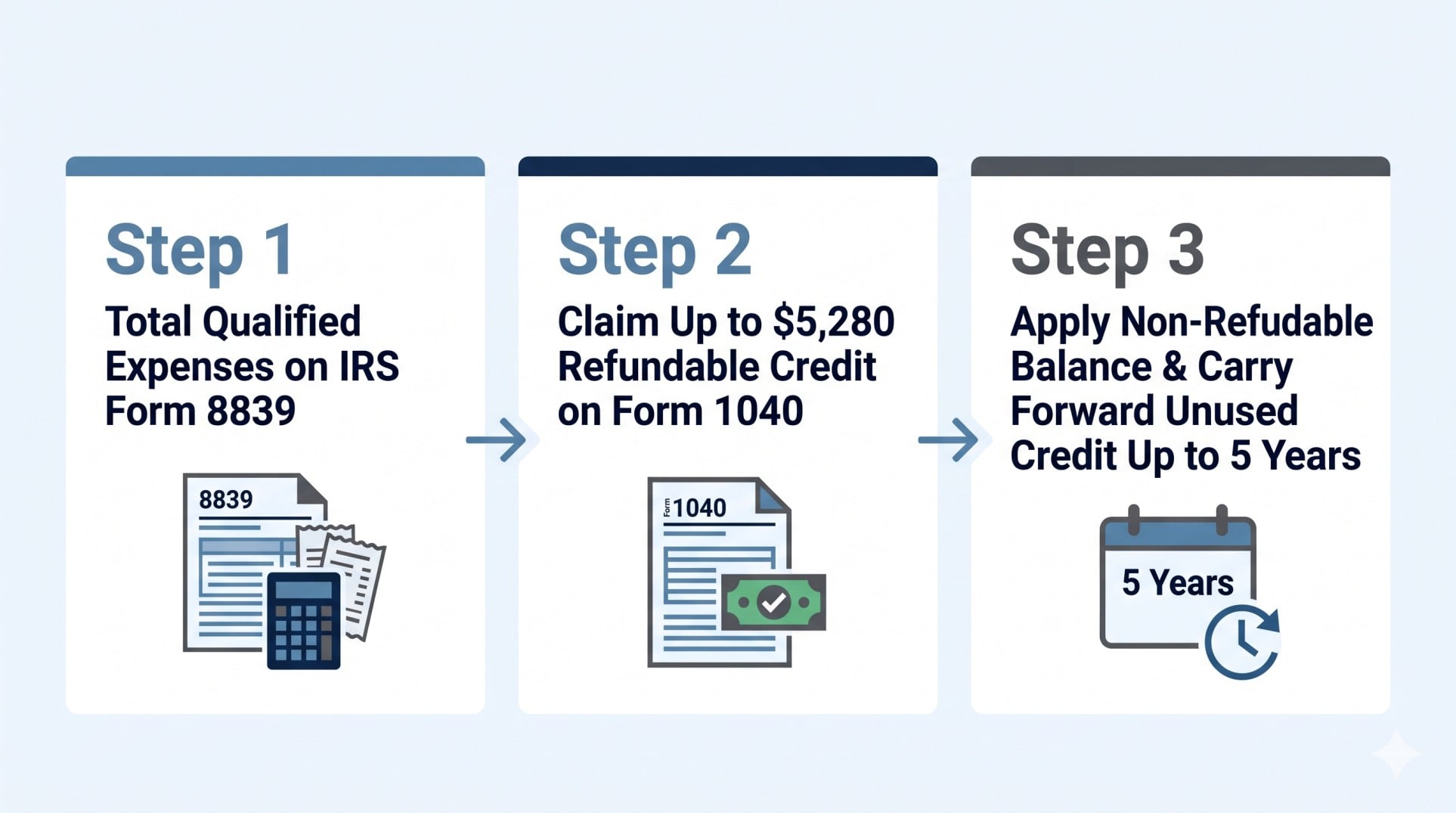
To claim the adoption tax credit 2027 or exclude employer-provided adoption benefits, you must complete IRS Form 8839 (Qualified Adoption Expenses) and attach it to your 2027 Form 1040 by April 17, 2028.
- Obtain an Taxpayer Identification Number for the Child (SSN, ATIN, or ITIN): Enter the child’s name, year of birth, and identifying number in Part I, Line 1 of Form 8839. Unlike the Child Tax Credit (which strictly requires an SSN), if you are in the middle of a domestic adoption and cannot yet obtain an SSN for the child, you can apply for a temporary Adoption Taxpayer Identification Number (ATIN) using IRS Form W-7A to claim the adoption credit on time.
- Calculate the Employer-Provided Adoption Assistance Exclusion (Form 8839, Part III): If your W-2 shows an amount in Box 12 with Code T, complete Part III of Form 8839 first to exclude up to $18,250 per child from your taxable wages (subject to the $273,680–$313,680 MAGI phaseout).
- Compute Your Total 2027 Adoption Tax Credit and Phaseout (Form 8839, Part II): Enter your qualified adoption expenses (up to $18,250 per child, reduced by any prior-year credits for the same child) or the flat $18,250 for a finalized special needs adoption in Part II of Form 8839. Complete the MAGI phaseout lines using your 2027 Form 1040 Adjusted Gross Income (plus any foreign earned income exclusions) and add any unused credit carryforwards from 2022–2026.
- Separate Your Non-Refundable Credit and $5,280 Refundable Credit onto Form 1040: Use the Credit Limit Worksheet on IRS Form 8839 adoption credit 2027 to apply the non-refundable portion against your tax liability on Schedule 3 (Form 1040), Line 6c (which flows to Form 1040, Line 20), and report your refundable adoption credit (up to $5,280 per eligible child) in the Payments/Refundable Credits section of Form 1040. Any remaining unused non-refundable credit automatically carries forward to 2028.
- Retain Adoption Records and File by April 17, 2028: File your 2027 return electronically by Monday, April 17, 2028. Keep copies of your final adoption decree, placement agreements, home study, State Special Needs Determination (if applicable), and all itemized receipts with your tax records in case the IRS requests documentation during processing.
Frequently Asked Questions
1. What is the maximum adoption tax credit 2027 per child?
According to Section 3.04 of IRS Revenue Procedure 2026-35, the maximum adoption tax credit 2027 is $18,250 per eligible child under IRC Section 23, up from $17,670 in 2026. This $18,250 limit applies per child across the entire adoption process, not per parent or per calendar year.
2. How much of the 2027 adoption tax credit is refundable?
Under IRS Revenue Procedure 2026-35 and the One, Big, Beautiful Bill Act, the refundable adoption tax credit 2027 limit is $5,280 per eligible child (up from $5,120 in 2026). You can receive up to $5,280 per child as a direct cash refund even if you owe $0 in federal income tax, while the remaining $12,970 is non-refundable and can be carried forward for up to five years.
3. What is the 2027 adoption credit income phaseout range?
The 2027 adoption credit income phaseout begins when your Modified Adjusted Gross Income (MAGI) exceeds $273,680 and is completely eliminated once your MAGI reaches $313,680 or more. These exact same MAGI thresholds also govern the $18,250 employer-provided adoption assistance exclusion under IRC Section 137.
4. Do I need expense receipts for a special needs adoption in 2027?
No, if you finalize the adoption of a U.S.-born or resident child whom a state child welfare agency has officially certified as having special needs, you can claim the full $18,250 credit on IRS Form 8839 adoption credit 2027 even if you had $0 in out-of-pocket expenses. However, you must keep the state’s official Special Needs Determination or Adoption Assistance Agreement in your tax records.
5. Can I claim the adoption tax credit 2027 for adopting my stepchild or using a surrogate?
No, IRC Section 23(d)(1)(C) explicitly disqualifies expenses paid to adopt your spouse’s child (a stepchild adoption) as well as any expenses incurred in carrying out a surrogate parenting arrangement. Only domestic, international, or foster-care adoptions of non-stepchildren under age 18 (or disabled individuals of any age) qualify for the $18,250 credit.
Disclaimer: This content provides general information for educational purposes only and reflects federal tax laws applicable to Tax Year 2027 (returns filed in 2028). Tax laws are complex and subject to change. This article does not constitute professional tax, legal, or accounting advice. Always consult a certified public accountant (CPA), enrolled agent (EA), or qualified tax attorney regarding your specific financial situation. Ourtaxpartner.com is not responsible for any actions taken based on the information provided herein.
