
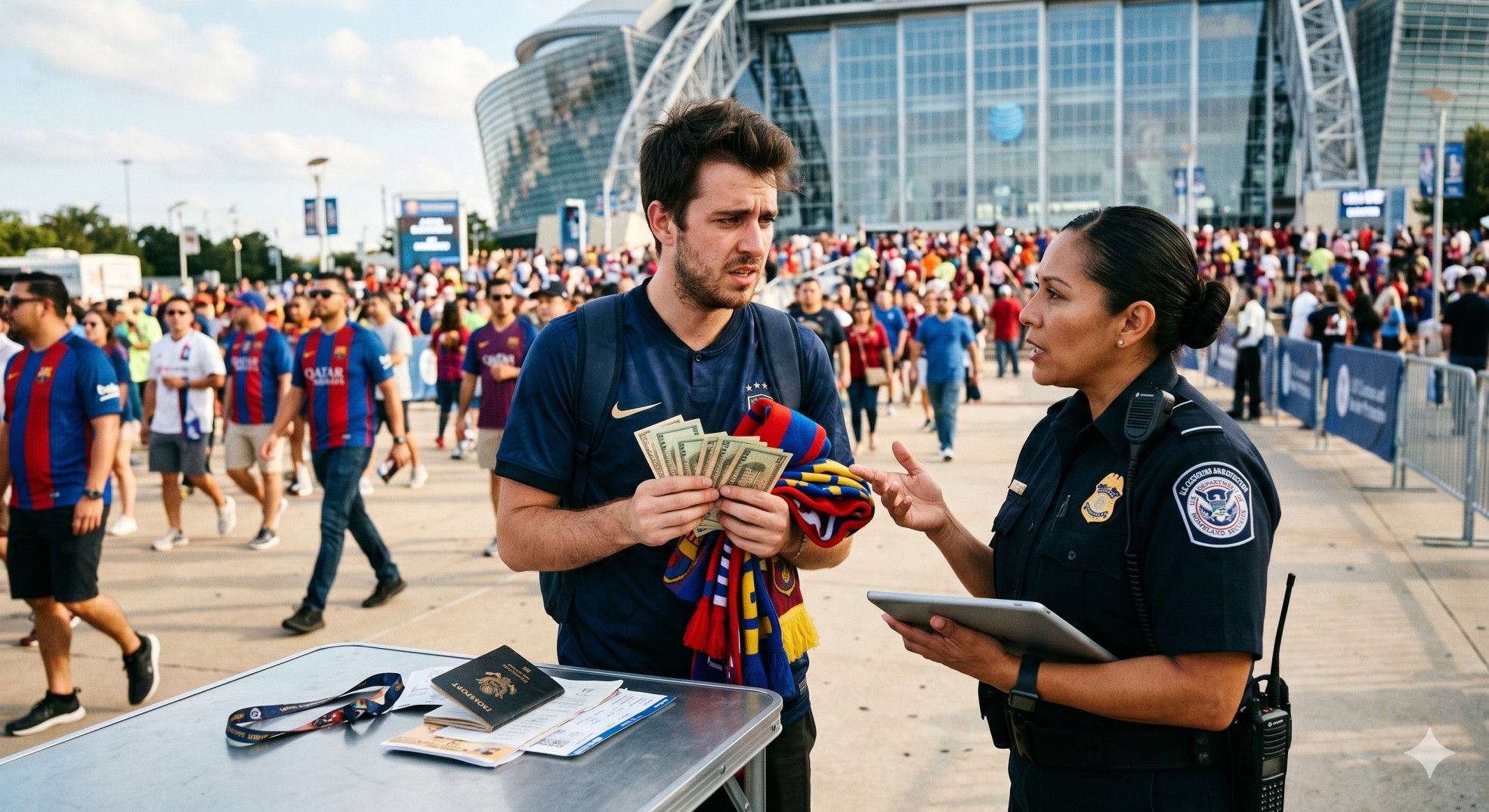
The 2026 FIFA World Cup will bring massive excitement to North America. Millions of passionate fans will travel to watch the games. However, some visitors might try to fund their trip illegally. Specifically, they might consider working on a tourist visa USA.
Furthermore, many travelers assume that selling a few scarves is harmless. They believe the government will not notice a small cash transaction. However, this assumption is incredibly dangerous and entirely false. Therefore, you must understand the strict federal laws before arriving.
In this comprehensive guide, we will explain the severe consequences of illegal employment. Specifically, we will cover deportation risks and massive IRS tax fines. Thus, you can protect your vacation and your future travel privileges.
The Danger of Cash Jobs for Tourists
Many travelers search for cash jobs for tourists USA online. They assume that working under the table is completely safe. Furthermore, they believe the government cannot track physical cash. However, the United States government aggressively prosecutes unauthorized workers.
Therefore, a quick cash job can ruin your entire vacation. In addition, ignorance of the law will not protect you from punishment. Consequently, you must respect the strict limitations of your travel documents.
ESTA and B1/B2 Visa Limitations
If you enter the US on an ESTA, you are strictly a tourist. Similarly, a B1/B2 visa strictly prohibits local employment. Therefore, you cannot legally earn a salary from a US employer. In addition, you cannot operate a retail business on US soil.
Consequently, selling merchandise US tourist visa rules are very clear. You cannot sell scarves, jerseys, or hats for profit. Thus, you must rely entirely on your existing savings during your trip.
The Myth of the Underground Economy
Many tourists believe the American underground economy is safe. They hear stories from friends who worked cash jobs without getting caught. Furthermore, they assume major cities are too busy to notice one illegal worker. However, this is a massive and dangerous misconception.
The US government employs thousands of agents specifically to combat illegal employment. Therefore, the risk of detection is incredibly high. Consequently, relying on outdated rumors will lead to severe legal trouble.
How the IRS and Immigration Share Information
You might wonder how the government catches unauthorized workers. The answer involves massive federal data sharing. Specifically, the IRS and US Customs and Border Protection (CBP) communicate constantly. Therefore, your financial secrets are never truly hidden.
Furthermore, undercover officers frequently patrol major events. They actively look for illegal street vendors in cities like Miami and Dallas. Consequently, getting caught is highly probable during the World Cup.
The Tax Trap of US-Sourced Income
The IRS taxes all income earned within the United States. This is officially known as US sourced income non resident taxation. Therefore, even illegal cash earnings are fully taxable by law. Furthermore, failing to report this income is a serious federal crime.
Consequently, you face two separate legal battles if caught. First, immigration will penalize you for unauthorized work. Second, the IRS will penalize you for tax evasion. Thus, the financial and legal risks are absolutely massive.
The Role of Public Reporting
In addition to undercover officers, the government relies on public tips. Legitimate, tax-paying business owners hate illegal street vendors. Therefore, local shop owners will quickly report you to the police. They do not want unauthorized tourists stealing their customers.
Furthermore, the IRS offers financial rewards to citizens who report tax evasion. Consequently, anyone who sees you working a cash job might report you. Thus, you are constantly surrounded by potential informants.
Severe Consequences of Getting Caught
The penalties for working illegally are swift and severe. The US government does not show mercy to unauthorized workers. Therefore, you must understand exactly what is at stake. Let us review the devastating consequences you might face.
Furthermore, these punishments apply regardless of how much money you made. Consequently, earning just fifty dollars illegally can trigger the maximum penalty.
Immediate Deportation and Visa Cancellation
If officers catch you selling merchandise, they will act immediately. First, they will confiscate all your cash and inventory. Next, they will cancel your tourist visa on the spot. Therefore, your World Cup dream ends instantly.
Furthermore, you will be deported back to your home country. Consequently, you will miss all the matches you paid to see. Thus, a few extra dollars can cost you your entire trip.
Future Travel Bans
Deportation carries long-term consequences for international travelers. If you violate ESTA work rules USA, you face a strict travel ban. Specifically, the US government might ban you for three to ten years. Therefore, you cannot return for future vacations or business trips.
In addition, other countries share immigration data with the US. Consequently, a US deportation might ruin your chances of visiting Canada or the UK. Thus, illegal work damages your global travel privileges permanently.
State vs. Federal Penalties
When you break the law, you face multiple layers of government authority. The United States has both state and federal legal systems. Therefore, working illegally triggers punishments from both levels. Furthermore, these agencies share your fingerprints and biometric data.
Consequently, a single arrest creates a permanent criminal record. Let us explore how these different agencies will penalize you.
Local Police and State Laws
If you sell merchandise without a permit, local police will arrest you. Every host city requires specific commercial licenses for street vendors. Therefore, you will face local fines and potential jail time for violating city ordinances.
In addition, local police will confiscate your goods as criminal evidence. Consequently, you will spend your vacation in a local jail cell. Thus, the immediate local punishment is severe and highly stressful.
ICE and Federal Immigration
Once local police arrest you, they notify federal immigration authorities. Specifically, Immigration and Customs Enforcement (ICE) will take over your case. Therefore, your minor local offense becomes a major federal immigration violation.
Furthermore, ICE has the ultimate authority to deport you. Consequently, they will place you in formal deportation proceedings. Thus, the federal government ensures you cannot remain in the country.
Important IRS Forms and Rules to Know
Even if you do not work, you must follow financial rules. The IRS requires specific paperwork from foreign visitors. Therefore, you must understand these forms to stay out of trouble. Let us review the most critical documents.
Furthermore, filing the correct forms protects your legitimate savings. Consequently, you can travel with total peace of mind.
Declaring Cash with FinCEN Form 105
You might bring legitimate savings to fund your vacation. However, if you bring more than $10,000 USD, you must declare it. Specifically, you must file FinCEN Form 105 at the airport. Therefore, you prove your money is legal and safe.
Furthermore, failing to file this form leads to cash seizure. Consequently, officers might suspect your hidden cash came from illegal work. Thus, filing this free form protects your travel budget completely.
Avoiding Tax Residency with Form 8840
Some fans plan to stay in the US for several months. However, staying too long can accidentally trigger US tax residency. Therefore, the IRS might try to tax your worldwide income. This happens if you pass the Substantial Presence Test.
Fortunately, you can file Form 8840 to claim the Closer Connection Exception. This form proves you are just a visiting tourist. Consequently, you protect your foreign income from IRS taxation. Thus, tracking your travel days is absolutely vital.
Using Form W-8BEN for Passive Income
Perhaps you earn passive income from a US source legally. For example, you might receive royalties or dividends. In this case, you must submit Form W-8BEN to the payer. Therefore, you prove your foreign status and claim tax treaty benefits.
However, this form does not authorize active physical work. Consequently, you cannot use it to justify selling merchandise in New York/New Jersey. Thus, you must understand the difference between active and passive income.
Case Study Scenarios
Real numbers make these complex laws much easier to understand. Therefore, let us examine three different foreign visitors. These examples will highlight the extreme dangers of illegal work.
Furthermore, they will show you how to stay perfectly legal. Thus, you can learn from their specific financial situations.
Scenario 1: The Street Vendor in Los Angeles
Mateo travels from Argentina to Los Angeles for the tournament. He brings 100 unofficial team scarves to sell outside the stadium. He sells 50 scarves and makes $1,000 in cash. However, an undercover police officer spots him.
- The Crime: Working on a tourist visa USA and selling unlicensed goods.
- The Penalty: Officers confiscate his remaining scarves and his $1,000 cash.
- The Result: Mateo is deported immediately and receives a five-year travel ban.
Therefore, Mateo loses his money, his merchandise, and his vacation. Consequently, his attempt to make a quick profit ends in total disaster.
Scenario 2: The Cash Bartender in Miami
Sarah visits Miami from the United Kingdom on an ESTA. She runs out of spending money during the second week. Therefore, she takes a cash job bartending at a local pub. She earns $500 over three nights.
- The Crime: Earning US-sourced income without work authorization.
- The Discovery: The pub is audited, and Sarah’s name appears on a shift schedule.
- The Result: Sarah’s ESTA is permanently revoked.
Furthermore, she must now apply for a complex visa for any future US visits. Consequently, her quick cash job creates a lifetime of immigration headaches.
Scenario 3: The Legal Digital Nomad in Dallas
Kenji visits Dallas from Japan on a B1/B2 visa. He works remotely for his Japanese employer using his laptop. He does not sell anything to US customers. Furthermore, he does not take any local cash jobs.
- The Action: Kenji relies entirely on his foreign salary.
- The Compliance: He files Form 8840 to avoid US tax residency.
- The Result: Kenji enjoys the World Cup legally and safely.
Therefore, Kenji protects his visa status and his finances. Consequently, he can return to the United States whenever he wants.
Safe Alternatives to Illegal Work
You do not need to break the law to enjoy the World Cup. Instead, you should plan your finances carefully before you arrive. Therefore, you can avoid the temptation of illegal cash jobs entirely.
Furthermore, proper budgeting ensures a stress-free vacation. Let us review some safe and legal financial strategies for your trip.
Budgeting and Saving Early
The best defense against financial trouble is aggressive saving. You should calculate your expected daily expenses right now. Therefore, you will know exactly how much money you need. Furthermore, you should add a 20% buffer for unexpected emergencies.
Consequently, you will not run out of cash in the middle of the tournament. Thus, you eliminate the desperate need to find illegal work.
Using Travel Credit Cards
Carrying large amounts of cash is dangerous and suspicious. Instead, you should rely on premium travel credit cards. These cards offer excellent exchange rates and zero foreign transaction fees. Therefore, your money goes much further in the United States.
In addition, credit cards provide a clear, legal paper trail of your spending. Consequently, customs officers will not question your financial stability. Thus, plastic is always safer than physical cash.
Frequently Asked Questions (FAQ)
Can I work on a tourist visa USA if I am paid in cash?
No, you absolutely cannot. Working for cash does not make the work legal. The US government strictly prohibits any local employment on a tourist visa. Therefore, accepting a cash job is a direct violation of federal immigration law. Consequently, you risk immediate deportation if caught.
Is it legal to sell my extra World Cup tickets outside the stadium?
Selling tickets on the street is highly illegal in most host cities. This practice is known as ticket scalping. Furthermore, doing this on a tourist visa constitutes unauthorized commercial activity. Therefore, undercover police will likely arrest you, confiscate your tickets, and cancel your visa.
Does the IRS really track cash jobs for tourists USA?
Yes, the IRS actively investigates the underground cash economy. They frequently audit businesses that hire undocumented workers. Furthermore, they share this information directly with immigration authorities. Therefore, your illegal cash earnings can easily trigger a massive federal investigation.
What happens if I bring $15,000 to pay for my trip?
Bringing $15,000 is completely legal, but you must declare it. You must file FinCEN Form 105 at the airport customs checkpoint. If you fail to file this form, officers can seize all your money. Therefore, honesty is the only way to protect your travel funds.
Conclusion and Next Steps
The 2026 World Cup will be an unforgettable global celebration. You will experience amazing matches and vibrant American cities. However, you must strictly avoid working on a tourist visa USA. The risks of deportation and tax fines are simply too high.
By understanding the law, you can protect your vacation and your future travel rights. Furthermore, proper budgeting eliminates the need for illegal cash jobs. Therefore, start planning your finances today to ensure a safe and thrilling trip.
Did you find this legal guide helpful? Please share this article with your fellow traveling fans! In addition, bookmark this page for your 2026 World Cup trip planning. Finally, explore our other helpful World Cup tax and travel guides on our blog to stay informed.
Disclaimer: This article is strictly for educational and informational purposes. This website does not provide tax or legal services. Therefore, readers should consult a certified CPA or tax professional for their specific situations.
