
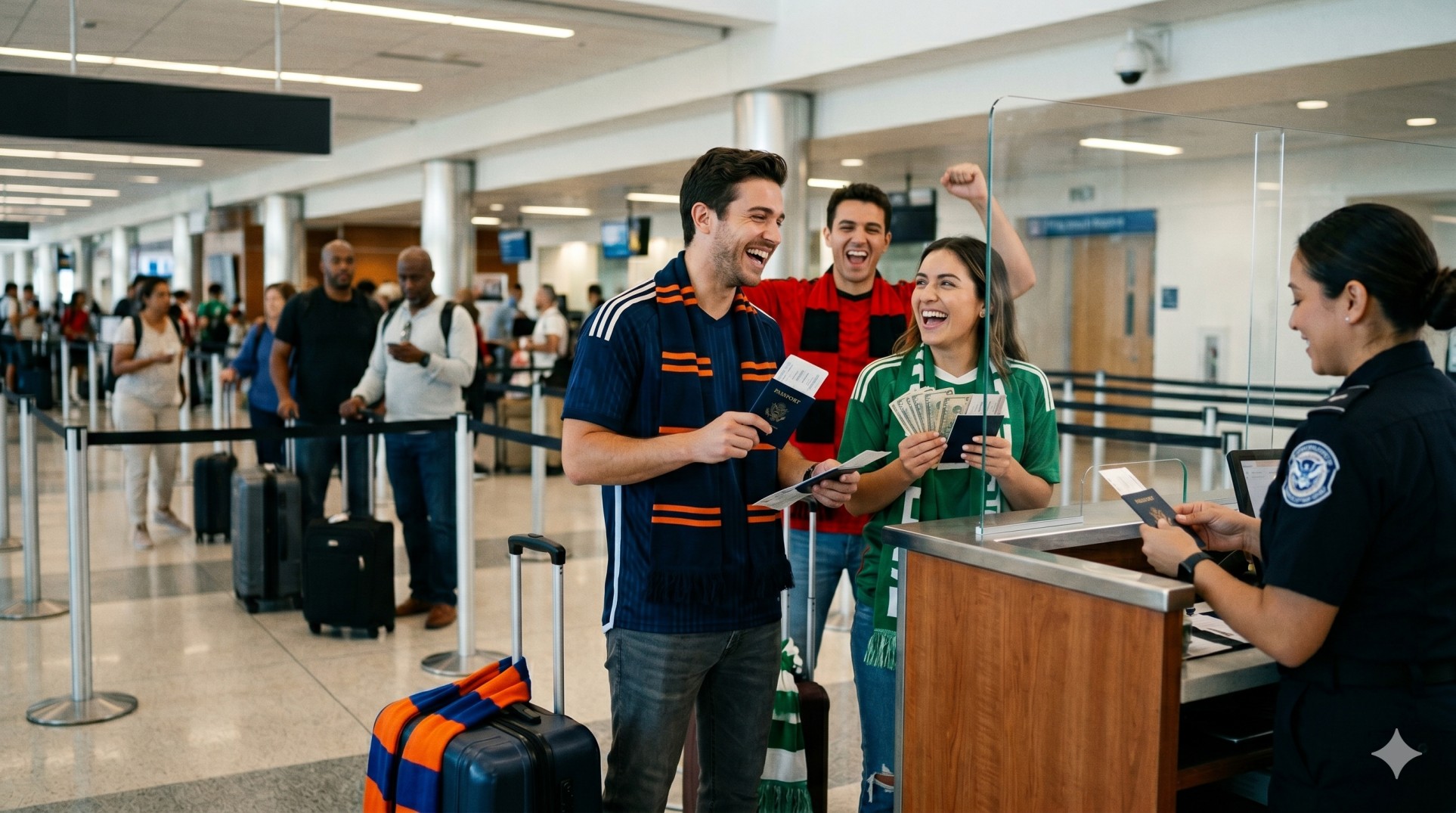
The 2026 FIFA World Cup will bring incredible excitement to North America. Millions of passionate fans will travel to watch the matches. However, you must understand your US customs allowance before you pack your bags. Otherwise, border agents might seize your items or fine you heavily.
Therefore, knowing the rules is absolutely essential for a smooth trip. The United States Customs and Border Protection (CBP) agency enforces very strict laws. Consequently, a simple packing mistake can ruin your entire vacation. Thus, you must prepare your luggage carefully.
In this comprehensive guide, we will explain exactly what you can bring. Specifically, we will cover alcohol limits, cash declarations, and merchandise rules. Therefore, you can clear customs quickly and enjoy the beautiful game.
Understanding Your Duty-Free Limits
Every international traveler receives a specific duty-free exemption. This means you can bring certain items without paying extra taxes. However, this exemption has very strict limits for non-residents. Therefore, you cannot simply bring everything you own for free.
Furthermore, you must declare all items you bring into the country. If you hide items, officers will penalize you severely. Let us explore the exact limits for popular travel items.
The Alcohol and Tobacco Rules
Many fans want to bring their favorite hometown drinks to celebrate. If you are over 21 years old, you can bring alcohol. Specifically, your duty-free limit is exactly one liter of alcoholic beverages. Therefore, bringing a single bottle of wine or spirits is perfectly fine.
In addition, you can bring up to 200 cigarettes or 100 cigars. However, if you exceed these limits, you must pay import taxes. Consequently, bringing a whole case of beer will cost you extra money. Thus, you should buy most of your drinks after you arrive.
Gifts and Personal Items
You might want to bring gifts for your American friends. As a non-resident, you can bring up to $100 worth of gifts duty-free. Therefore, small souvenirs and cheap trinkets will not trigger any taxes. Furthermore, your personal clothing and toiletries are completely exempt from taxes.
However, the $100 gift limit is actually very low. If you bring an expensive watch as a gift, you will pay duties. Consequently, you must keep your receipts to prove the value of your gifts. Thus, honesty and good record-keeping are your best tools.
Bringing Merchandise: Gifts vs. Commercial Goods
Football fans love to trade team merchandise during the World Cup. You might pack extra jerseys to give to other supporters. However, bringing large amounts of merchandise raises massive red flags at customs. Therefore, officers will question your true intentions.
Furthermore, the rules change drastically if officers suspect you are selling items. Let us review the difference between friendly gifts and illegal commercial goods.
Giving Away Team Jerseys
Suppose you bring ten team jerseys to give away for free. Because the total value likely exceeds $100, you must declare them. Therefore, you will have to pay import duties on the extra value. The CBP will charge a flat tax rate on these items.
In addition, you must convince the officer that these are truly gifts. If the officer believes you plan to sell them, you face major problems. Consequently, you should only bring a few extra items to trade. Thus, you avoid looking like a traveling merchant.
The Danger of Selling Merchandise
Some fans try to fund their trip by selling merchandise. They might bring boxes of scarves to sell outside the stadium. However, selling goods on a standard B1/B2 tourist visa is strictly illegal. Therefore, this action violates federal immigration and tax laws.
If customs officers find commercial inventory in your bags, they will act quickly. Specifically, they will seize all your merchandise immediately. Furthermore, they will likely cancel your tourist visa and deport you. Consequently, you must never bring items to sell in the United States.
The Strict $10,000 Cash Declaration Rule
Many international tourists prefer using cash for their daily expenses. You might bring thousands of dollars to pay for hotels and food. However, the US government strictly monitors money crossing its borders. Therefore, you must follow specific financial reporting laws.
Specifically, if you carry more than $10,000 USD, you must declare it. Consequently, hiding your money is a terrible and dangerous idea. Let us explore how this important rule actually works.
How to Calculate Your Total Cash
You might think the rule only applies to US dollars. However, customs officers count every single type of currency you carry. For example, they will combine your Euros, Pesos, and US dollars. If the total combined value exceeds $10,000 USD, you must report it.
In addition, traveler’s checks and money orders count as physical cash. Therefore, you must calculate your total financial instruments very carefully. Consequently, a simple math error can cause massive legal problems. Thus, count your money twice before you board your flight.
Filing FinCEN Form 105
If you exceed the limit, you must file FinCEN Form 105. This form officially reports your cash to the US government. Furthermore, it is completely free to file this required paperwork. The government simply wants to track large international financial movements.
Therefore, filing this form does not mean you pay a tax. You are merely providing required information to federal customs officers. Consequently, you should never fear filling out this simple document. Thus, honesty is always your absolute best policy at the border.
Navigating Customs in Major Host Cities
The 2026 World Cup features incredible host cities across the country. You might land in Miami, New York, Los Angeles, or Dallas. However, every major international airport has a slightly different customs environment. Therefore, you should know what to expect when you land.
Furthermore, these massive airports will be incredibly busy during the tournament. Consequently, patience and preparation will save you hours of waiting.
Arriving in Miami or Dallas
Miami and Dallas are massive hubs for international flights. When you arrive, you will use automated passport control kiosks. Therefore, you will answer customs questions directly on a digital screen. You must declare your cash and merchandise honestly on this machine.
In addition, officers in these cities frequently use trained dogs to sniff luggage. These dogs can easily detect hidden food, agriculture, and large stacks of cash. Consequently, trying to sneak items past them is highly foolish. Thus, declare everything upfront to avoid secondary inspections.
Landing in New York or Los Angeles
New York/New Jersey and Los Angeles will host some of the biggest matches. Therefore, their customs lines will be exceptionally long. If you have nothing to declare, you will move through quickly. However, if you bring commercial goods, you will go to a separate line.
Furthermore, paying import duties takes extra time at the cashier’s desk. Consequently, you should factor this delay into your travel schedule. Thus, do not book a connecting flight too close to your arrival time.
Case Study Scenarios
Real numbers make these complex customs rules much easier to understand. Therefore, let us look at three different traveler scenarios. These examples will show exactly how the declaration rules work in practice.
Furthermore, they highlight the extreme importance of proper travel planning. By studying these cases, you can avoid making expensive mistakes.
Scenario 1: The Generous Fan with Jerseys
Carlos travels from Brazil to Miami for the tournament. He brings 20 authentic team jerseys to give to his American friends. The total value of the jerseys is $2,000. He declares them honestly on his customs form.
- Duty-Free Exemption: $100.
- Taxable Amount: $1,900.
- Result: Carlos must pay a flat import duty rate on the $1,900.
Because he declared them, he simply pays the tax and enters the country. Therefore, he avoids any fines or confiscations. Consequently, his honesty makes the process smooth and legal.
Scenario 2: The Group Sharing Cash
A family of four arrives at the airport in Los Angeles. The father carries $6,000, the mother carries $5,000, and the son carries $1,000. They submit a joint family customs declaration form to the officer.
- Combined Family Cash: $12,000 USD.
- Requirement: Families filing a joint declaration must combine their cash totals.
- Result: They must file FinCEN Form 105 because their total exceeds $10,000.
Therefore, families cannot split money to avoid the reporting requirement. Consequently, they must declare the combined total to stay legal.
Scenario 3: The Fan Selling Scarves
David flies into Dallas with 200 expensive football scarves. He plans to sell them outside the stadium for a large profit. However, he does not declare them on his customs form.
- Goods Value: $5,000 USD.
- Action: Customs officers search his bags and find the commercial inventory.
- Result: Officers seize the scarves and cancel his tourist visa.
Because he lied about commercial goods, he faces immediate deportation. Consequently, his business plan completely fails and he misses the tournament.
What Happens If You Break the Rules?
Some travelers try to hide their items to avoid taxes and paperwork. They might split cash between different bags or jacket pockets. However, customs officers use advanced technology and highly trained dogs. Therefore, they will likely find your hidden items very quickly.
If they catch you lying, the consequences are incredibly severe. Furthermore, ignorance of the law will not save you from punishment. Let us look at the specific penalties you might face.
Confiscation of Goods and Cash
If you fail to declare your cash, officers can seize it. Specifically, they can take every single dollar you are carrying. Furthermore, getting your money back is a long and expensive legal process. You will likely have to hire a specialized US customs lawyer.
In addition, the government can issue massive civil fines against you. Therefore, a simple mistake can cost you your entire vacation budget. Consequently, filing the free form is always the smarter financial choice.
Visa Cancellations and Deportation
The penalties go far beyond just losing your physical money. Lying to a federal customs officer is a serious federal offense. Therefore, you could face criminal smuggling charges. Furthermore, officers will likely cancel your tourist visa immediately.
As a result, you will be deported back to your home country. Consequently, you will miss the entire World Cup tournament. Thus, you must always answer customs questions completely truthfully.
Practical Tips for a Smooth Arrival
You can easily master the American customs system with a little preparation. Specifically, you should organize your bags before you board your flight. Furthermore, keeping your documents handy will reduce your stress at the border. Therefore, you can start your vacation on a positive note.
Let us review some highly practical tips for your upcoming trip. These simple steps will save you time, money, and frustration.
Pack Smartly and Keep Receipts
Always pack your declared items at the top of your suitcase. If an officer wants to inspect your gifts, they can find them easily. Therefore, you will not have to unpack your entire bag in public. Furthermore, keep all your purchase receipts in a single envelope.
Consequently, you can quickly prove the exact value of your merchandise. Thus, the officer will process your import duties much faster.
Always Tell the Truth
Customs officers are trained to detect nervous behavior and lies. If they ask you a question, answer it directly and honestly. Therefore, do not try to hide your extra bottle of alcohol or extra cash. Furthermore, declaring an item does not always mean you will pay taxes.
Sometimes, officers will simply wave you through if the amount is small. Consequently, honesty often results in a faster and cheaper entry. Thus, transparency is your ultimate travel strategy.
Frequently Asked Questions (FAQ)
Is it illegal to bring more than $10,000 into the US?
No, it is completely legal to bring any amount of money. There is absolutely no limit on how much cash you can carry. However, the law strictly requires you to report amounts over $10,000. Therefore, the crime is not having the money; the crime is hiding it from customs.
Can I bring food into the United States?
You can bring commercially packaged snacks, baked goods, and most cheeses. However, fresh fruits, vegetables, and most meats are strictly prohibited. These items can carry foreign pests and diseases. Therefore, you must declare all food items, or you will face a $500 fine.
Do I have to pay taxes on my personal laptop and camera?
No, your personal electronics are not subject to import duties. As long as you plan to take them back home, they are exempt. Therefore, you do not need to declare your used phone or laptop. However, brand new electronics still in the box might be questioned.
What happens if I sell merchandise on a tourist visa?
Selling merchandise on a B1/B2 tourist visa or ESTA is strictly prohibited. These visas do not allow you to engage in local employment or retail business. Therefore, if customs officers discover your commercial inventory, they will deny your entry. Consequently, you will be sent home and your visa will be revoked.
Conclusion and Next Steps
The 2026 World Cup will be a thrilling adventure for international fans. You will experience amazing matches and vibrant host cities. However, you must respect the rules regarding your US customs allowance. By declaring your cash and merchandise, you protect yourself from severe penalties.
Furthermore, filing FinCEN Form 105 ensures your money remains safe and legal. Therefore, take the time to count your currency and organize your receipts before you travel. Thus, you can focus entirely on the beautiful game instead of legal troubles.
Did you find this customs guide helpful? Please share this article with your fellow traveling fans! In addition, bookmark this page for your 2026 trip planning. Finally, explore our other helpful World Cup tax and travel guides on our blog to stay informed.
Disclaimer: This article is strictly for educational and informational purposes. This website does not provide tax or legal services. Therefore, readers should consult a certified CPA or tax professional for their specific situations.
