

As the 2026 tax year approaches, many taxpayers face an important decision: take the standard deduction or itemize? With significant inflation adjustments, the permanence of certain Tax Cuts and Jobs Act (TCJA) provisions, and the introduction of new temporary deductions under the “One Big Beautiful Bill Act” (OBBBA), the choice isn’t always straightforward. This guide provides a clear explanation of the 2026 standard deduction amounts, details when itemizing makes financial sense, and offers strategies to minimize your tax liability, ensuring you don’t leave money on the table.
Executive Summary
- The 2026 standard deduction amounts are $16,100 for Single, $32,200 for Married Filing Jointly, and $24,150 for Head of Household.
- Older adults or blind individuals receive additional standard deduction amounts.
- New temporary deductions from the OBBBA, like the Senior Bonus Deduction ($6,000 per qualifying older adult), can be claimed in addition to your standard or itemized deductions.
- The State and Local Tax (SALT) deduction cap increases to $40,400 for 2026, but a phase-out applies for high-income earners.
- Miscellaneous itemized deductions, subject to a 2% Adjusted Gross Income (AGI) floor, are reinstated for 2026.
- Always compare your potential itemized deductions against the standard deduction to determine your best tax strategy.
Introduction: Understanding Your 2026 Tax Deduction Choices
For the 2026 tax year, taxpayers must make an important decision: claim the standard deduction or itemize their deductions. This choice directly impacts your taxable income and, consequently, your federal tax liability. The 2026 tax environment presents unique considerations, including inflation adjustments, permanent provisions from the Tax Cuts and Jobs Act (TCJA), and new temporary deductions introduced by the “One Big Beautiful Bill Act” (OBBBA). Our goal is to help you understand these changes and make the best tax choices.
Understanding the 2026 Standard Deduction Amounts
What is the Standard Deduction?
The standard deduction is a specific dollar amount that directly reduces the amount of income on which you are taxed. The IRS provides this deduction to simplify tax filing for most Americans. It acts as a baseline reduction, meaning you do not need to track specific expenses to claim it.
Official 2026 Standard Deduction Figures (IRS Revenue Procedure 2025-32)
The Internal Revenue Service (IRS) adjusts these amounts annually for inflation. For the 2026 tax year, the basic standard deduction amounts are:
- Single: $16,100
- Married Filing Jointly / Qualifying Widow(er): $32,200
- Head of Household: $24,150
- Married Filing Separately: $16,100
These figures are crucial for your initial tax planning. You can find more details on these adjustments directly from the IRS website.
Additional Standard Deduction for Age or Blindness
Certain individuals qualify for an additional standard deduction. If you are an older adult or blind, you can claim extra amounts. These additions apply per qualifying condition.
- Single or Head of Household: $2,050 per qualifying condition.
- Married Filing Jointly, Married Filing Separately, or Qualifying Widow(er): $1,650 per qualifying condition per individual.
For example, a married couple filing jointly where both spouses are older adults would receive an additional $3,300 ($1,650 x 2). This significantly increases their total standard deduction.
Standard Deduction for Dependents
Rules for dependents differ. If someone else claims you as a dependent, your standard deduction is limited. It will be the greater of $1,350 or your earned income plus $450. However, this amount cannot exceed the basic standard deduction for their filing status.

When Itemizing Makes Sense: Understanding Deductible Expenses
What are Itemized Deductions?
Itemized deductions are specific, eligible expenses that individual taxpayers can claim on their federal income tax returns. Unlike the standard deduction, you must track and report these expenses. You should itemize only if your total eligible itemized deductions exceed your applicable standard deduction amount.
Key Itemized Deductions for 2026
- Mortgage Interest: This remains a significant deduction for homeowners. You can deduct interest paid on your home mortgage within certain limits.
- State and Local Tax (SALT) Deduction: The cap on the SALT deduction increases to $40,400 for 2026 ($20,200 for married filing separately). However, this cap can be reduced to $10,000 if your Modified Adjusted Gross Income (MAGI) exceeds $505,000 ($252,500 for married filing separately). This change particularly impacts taxpayers in high-tax states.
- Medical Expenses: You can deduct medical expenses exceeding 7.5% of your Adjusted Gross Income (AGI). This threshold means only substantial medical costs will provide a tax benefit.
- Charitable Contributions: You can deduct cash and non-cash contributions to qualified charities. A common strategy is “bunching” deductions, where you concentrate several years’ worth of donations into one year to exceed the standard deduction. Donor-advised funds are also popular for this purpose. New for 2026, an above-the-line deduction for charitable donations (up to $1,000 for single filers or $2,000 for joint filers) is available even for those taking the standard deduction.
- Miscellaneous Itemized Deductions: Reinstated for 2026, these deductions (including unreimbursed employee expenses, tax preparation fees, and investment expenses) are deductible to the extent they exceed 2% of your AGI.
New Temporary Deductions from the OBBBA (2025-2028)
The “One Big Beautiful Bill Act” (OBBBA) introduced several new temporary deductions that can be claimed in addition to your standard or itemized deductions, offering more ways to reduce your taxable income:
- Senior Bonus Deduction: Taxpayers age 65 and older can claim an additional $6,000 deduction per qualifying individual. This deduction begins to phase out for Modified Adjusted Gross Income (MAGI) exceeding $75,000 for single filers and $150,000 for married couples filing jointly, and is completely phased out at $175,000 (single) and $250,000 (MFJ).
- Qualified Overtime Pay Deduction: Nonexempt employees working over 40 hours a week can deduct up to $12,500 ($25,000 for joint filers) of qualified overtime pay.
- Qualified Tips Deduction: Workers in customarily tipped occupations can deduct up to $25,000 in qualified tips.
- Car Loan Interest Deduction: You can deduct up to $10,000 for qualified passenger vehicle loan interest.
Making Your Choice: Standard Deduction vs. Itemizing
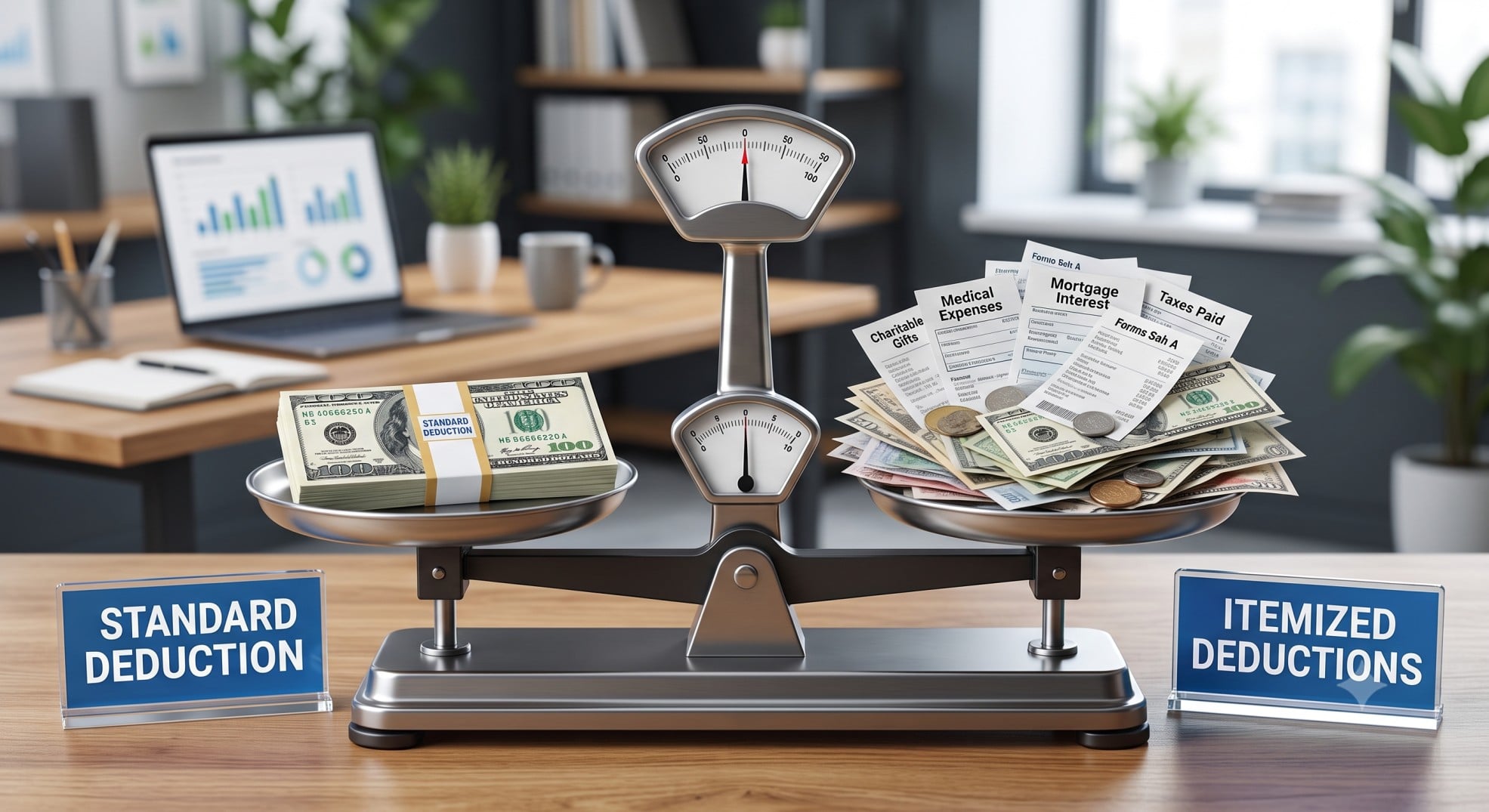
The decision to take the standard deduction or itemize depends on your individual financial situation. For most taxpayers, the increased standard deduction amounts mean it will be the more beneficial option. However, if your total itemized deductions (mortgage interest, state and local taxes, medical expenses above the AGI threshold, charitable contributions, and miscellaneous itemized deductions) exceed your applicable standard deduction, itemizing could significantly reduce your tax bill.
Always calculate both options to determine which provides the greatest tax savings. Consulting with a qualified tax professional can help ensure you make the most informed decision for your 2026 tax return.
