
⚡ Executive Summary: 2026 S-Corp Salary Rules
- The Social Security wage base limit for 2026 has increased to $184,500, making accurate payroll calculations critical for high-earning entrepreneurs.
- The IRS strictly requires shareholder-employees to pay themselves a fair market W-2 salary before taking any tax-advantaged non-wage distributions.
- There is no legal “safe harbor” percentage (like 50/50 or 60/40); compensation must be based on the actual services provided to the corporation.
- Failing to run regular payroll or setting an artificially low salary is the primary trigger for an S-Corp employment tax audit, resulting in severe penalties and back taxes.
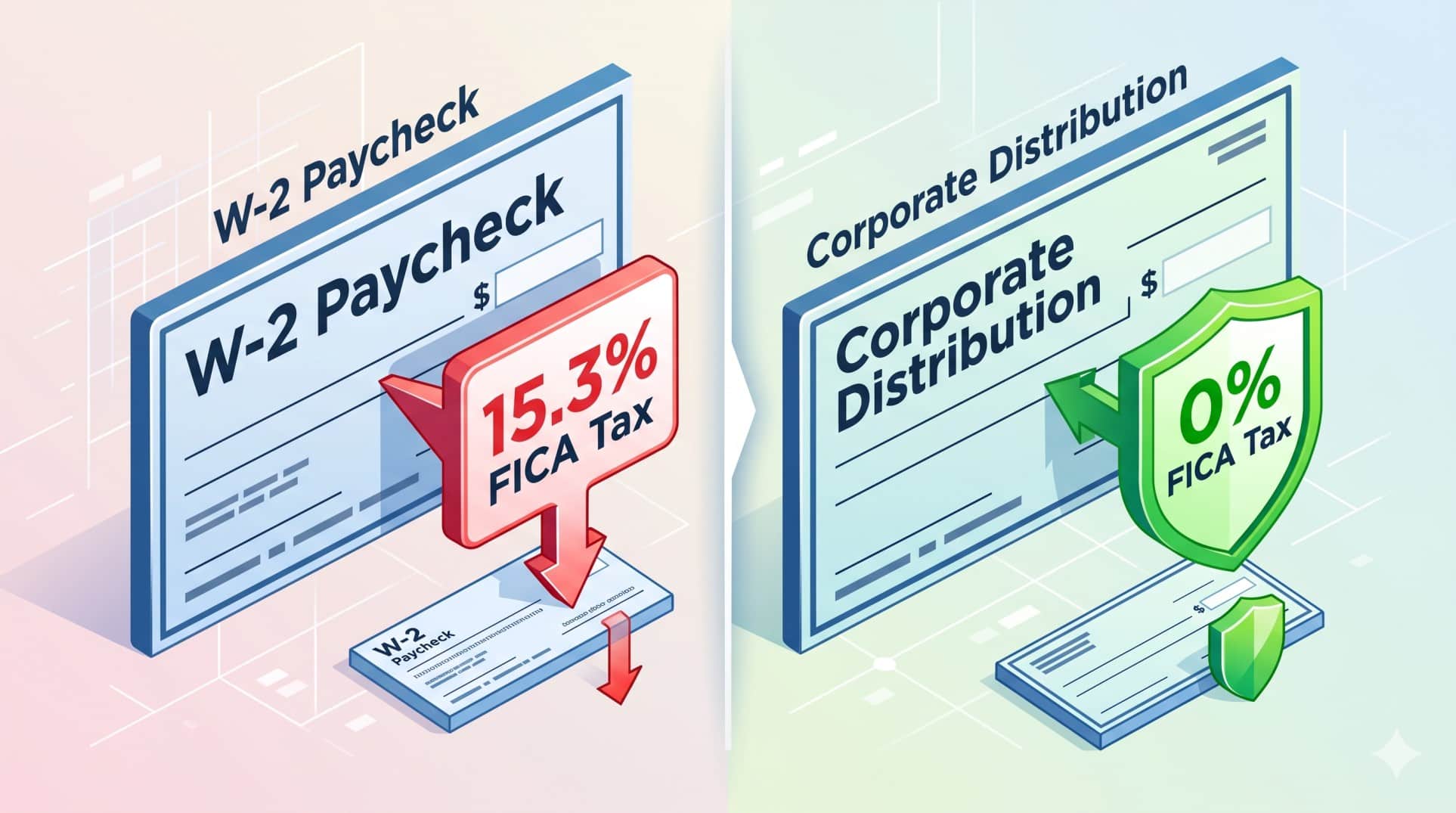
Table of Contents
- The Core Tension: Why S-Corp Salaries Matter
- What the IRS Considers “Reasonable”
- Three Methods to Calculate S-Corp Reasonable Compensation in 2026
- The 2026 FICA Tax Limits and Your Math
- Real-World Examples: How to Minimize Self-Employment Tax Safely
- How to Avoid an IRS Audit: Documentation and Best Practices
- Frequently Asked Questions About S-Corp Salaries
The S-Corporation is the most powerful tax entity available to small business owners. It exists for one primary financial reason: to bypass the 15.3% payroll tax on business profits. But the IRS knows exactly how this loophole works. They actively hunt for taxpayers who abuse the system by taking massive corporate distributions while paying themselves pennies on a W-2.
Calculating your S-Corp Reasonable Compensation in 2026 requires precision. You cannot guess. You cannot use a random percentage you found on a message board. The IRS has developed specialized training materials for its agents specifically to evaluate officer compensation. If your numbers do not align with market realities, they will reclassify your tax-free distributions as taxable wages, hitting you with back taxes, failure-to-deposit penalties, and steep interest.
We are going to break down the exact mechanics of corporate payroll. You will learn how to value your specific job duties, how the 2026 wage base limits affect your math, and how to build an impenetrable defense file to protect your tax savings.
The Core Tension: Why S-Corp Salaries Matter
To understand why the IRS cares so much about S-Corp Salaries, you have to understand the math behind the self-employment tax. If you operate as a sole proprietor or a single-member LLC, every dollar of net profit your business generates is subject to a 15.3% FICA tax (Social Security and Medicare), plus your standard federal and state income taxes.
When you elect S-Corp status, the tax treatment splits. The profit your business makes is no longer subject to that 15.3% FICA tax. It passes through to your personal tax return as a non-wage distribution (reported on Schedule K-1). However, the IRS requires that if you perform services for the corporation, you must pay yourself a W-2 salary. That W-2 salary is subject to the 15.3% FICA tax.
The incentive is obvious. You want to push your W-2 salary as low as possible to minimize self-employment tax, while pushing your K-1 distributions as high as possible. The IRS rule found in IRC Section 3121 blocks this. It mandates that you must pay yourself a fair market wage before you take a single dollar in distributions.
What the IRS Considers “Reasonable”
The tax code does not provide a specific dollar amount or a safe harbor percentage. You cannot simply declare that 40% of your profit is salary and 60% is distribution. Instead, the IRS uses a “facts and circumstances” test.
According to IRS Fact Sheet 2008-25, reasonable compensation is defined as the amount that would ordinarily be paid for like services by like organizations in like circumstances. In plain English: What would you have to pay a stranger to do your exact job?
When evaluating S-Corp Reasonable Compensation in 2026, IRS auditors look at nine specific factors established by the courts:
- Training and experience: A highly specialized surgeon must command a higher salary than a general retail manager.
- Duties and responsibilities: Do you just manage the company, or do you also do the bookkeeping, the marketing, and the janitorial work?
- Time and effort: Do you work 60 hours a week, or is this a passive side hustle where you work 5 hours a week?
- Dividend history: Does the company have a history of paying out all its cash as distributions while ignoring wages?
- Payments to non-shareholder employees: Are you paying your subordinate managers more than you pay yourself?
- Timing and manner of paying bonuses: Do you only run payroll once a year in December after you see how much profit is left?
- What comparable businesses pay: What is the going market rate for your position in your specific geographic location?
- Compensation agreements: Is there a formal employment contract in place?
- The formula used to determine compensation: Did you use actual data, or did you just guess?
Learn more about how the IRS selects corporate tax returns for examination.
Three Methods to Calculate S-Corp Reasonable Compensation in 2026
Because you cannot guess, you must use a defensible valuation method. Tax professionals and valuation experts generally rely on one of three approaches to determine a defensible salary.
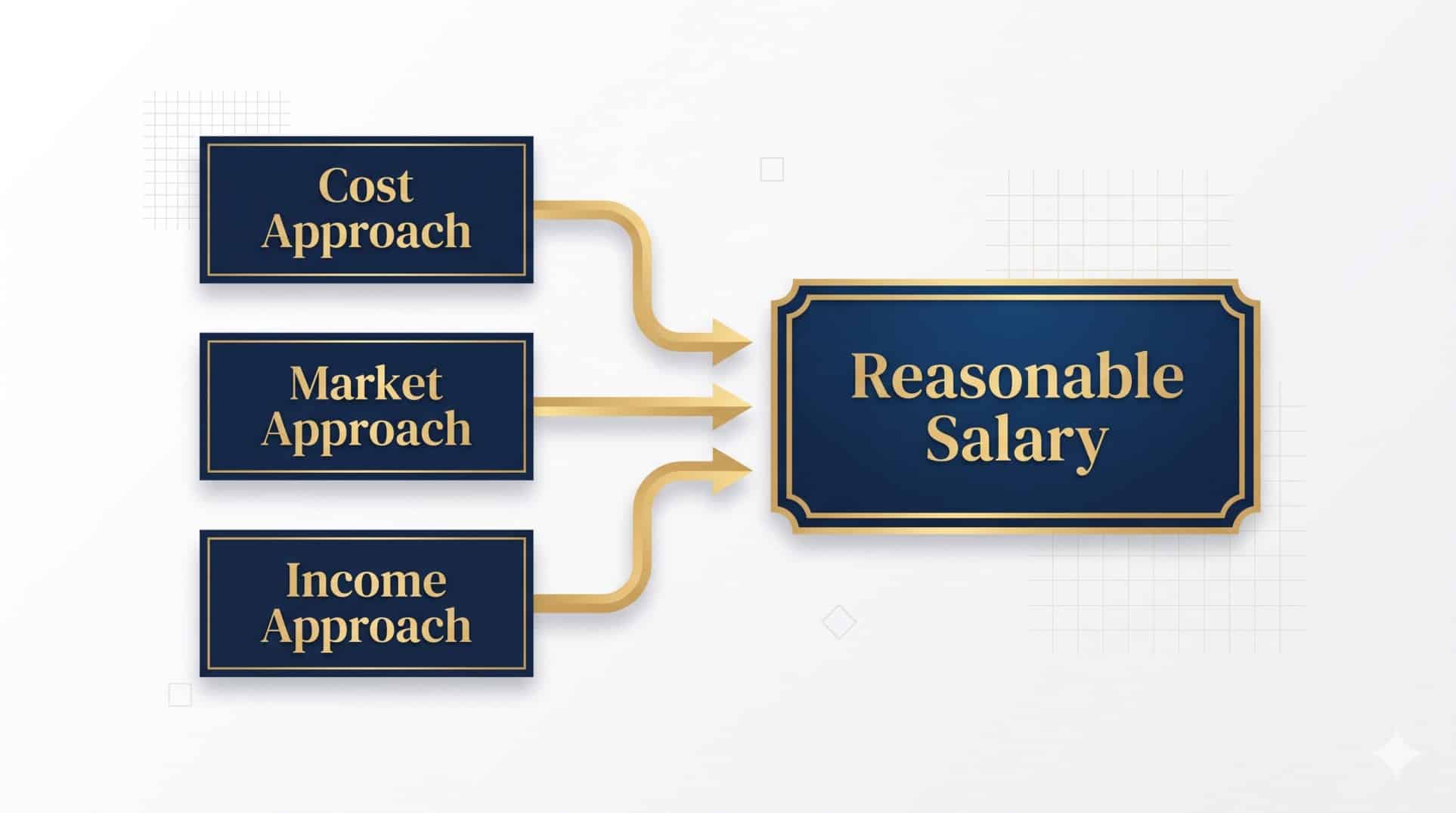
1. The Cost Approach (The “Many Hats” Method)
This is the most common method for solo entrepreneurs and small business owners. In a small business, the owner rarely does just one job. You are the CEO, but you are also the lead salesperson, the social media manager, and the administrative assistant.
The Cost Approach breaks down your time. You document that you spend 10 hours a week on admin work, 20 hours on sales, and 10 hours on executive management. You then find the local market hourly rate for each of those specific jobs and blend them together. Because admin work pays less than executive work, this method often results in a lower, highly defensible overall salary.
2. The Market Approach (The Industry Standard Method)
This method works best for owners who perform a single, clearly defined role. If you own a mid-sized manufacturing company and your only job is acting as the Chief Executive Officer, you use the Market Approach.
You look at industry salary guides (like Robert Half or the Bureau of Labor Statistics) for a CEO of a similarly sized manufacturing company in your specific zip code. If the data says the median salary is $140,000, that becomes your target.
3. The Income Approach (The Independent Investor Test)
This method is used for highly profitable, capital-intensive businesses. The courts established the “Independent Investor Test” to determine if a salary is reasonable. The logic asks: If an outside investor put money into your company, would they be satisfied with the return on their investment after paying your salary?
If your business generates $2 million in profit, and you pay yourself $1.9 million in salary, an independent investor would be furious because there is no profit left for them. Conversely, if you pay yourself $100,000 and leave $1.9 million in profit, the investor is thrilled. This approach balances the value of your labor against the value of the company’s capital assets.
The 2026 FICA Tax Limits and Your Math
To accurately project your tax savings, you have to understand the hard numbers for the current tax year. The Social Security Administration adjusts the taxable wage base annually based on the national average wage index.
For 2026, the Social Security wage base limit is exactly $184,500. This is a critical threshold for business owners.
The FICA tax is composed of two parts:
- Social Security Tax: 12.4% total (6.2% paid by the employer, 6.2% paid by the employee). This tax only applies to the first $184,500 of your W-2 wages in 2026.
- Medicare Tax: 2.9% total (1.45% paid by the employer, 1.45% paid by the employee). This tax has no limit. It applies to every dollar of your W-2 wages.
Once your S-Corp salary crosses the $184,500 mark, the 12.4% Social Security tax completely drops off. You only pay the 2.9% Medicare tax on wages above that limit. (Note: Single filers earning over $200,000 and married couples earning over $250,000 are also subject to an additional 0.9% Medicare surtax).
Because the Social Security tax stops at $184,500, the tax savings generated by taking distributions instead of wages becomes slightly less dramatic once your salary exceeds this threshold. The massive savings happen in the gap between your reasonable salary and the $184,500 limit.
Real-World Examples: How to Minimize Self-Employment Tax Safely
Let’s look at how to minimize self-employment tax safely using real-world math. These scenarios demonstrate how different business models dictate different compensation strategies.
Scenario 1: The Solo IT Consultant
David runs a solo IT consulting firm structured as an S-Corp. His business nets $250,000 in profit before his salary. He uses the Cost Approach to determine his S-Corp Reasonable Compensation in 2026. Based on his geographic location and his mix of technical and administrative duties, the data shows a fair market salary is $110,000.
David pays himself $110,000 on a W-2. He takes the remaining $140,000 as a K-1 distribution.
The Tax Savings: David pays 15.3% FICA tax on his $110,000 salary. He pays 0% FICA tax on his $140,000 distribution. By not operating as a sole proprietor, David saves exactly $21,420 in self-employment taxes ($140,000 x 15.3%).
Scenario 2: The Retail Store Owner
Maria owns a boutique clothing store. The business nets $150,000. Unlike David’s consulting firm, Maria’s business relies heavily on capital (inventory, store fixtures, location) rather than just her personal labor. She works 30 hours a week managing the store.
Using the Market Approach, a retail manager in her city earns $60,000 a year. Maria sets her W-2 salary at $60,000 and takes $90,000 as a distribution.
The Tax Savings: Maria saves $13,770 in FICA taxes on the $90,000 distribution. Her salary is highly defensible because the profit is driven by the retail inventory, not just her personal services.
Read our guide on how to calculate basis before taking corporate distributions.
Scenario 3: The Part-Time Graphic Designer
John has a full-time W-2 job but runs a side-hustle design agency as an S-Corp. The S-Corp nets $80,000. John only works 10 hours a week on the business. Because his time commitment is so low, a full-time salary would be inappropriate.
He calculates that 10 hours a week at a senior designer rate equals $30,000 a year. He pays himself a $30,000 W-2 and takes a $50,000 distribution. The IRS accepts this because the “time and effort” factor justifies the lower total salary.
How to Avoid an IRS Audit: Documentation and Best Practices
The IRS does not audit every S-Corporation. They use automated data matching to flag returns that look suspicious. If your Form 1120-S shows $400,000 in ordinary business income and $10,000 on the “Compensation of Officers” line, a computer algorithm will flag your return for human review.

If you want to Avoid an IRS Audit, you must build your defense file before the IRS ever sends a letter. Here are the non-negotiable best practices:
1. Run Regular Payroll
Do not wait until December 31st to write yourself one massive payroll check. Real businesses pay their employees regularly. Set up a formal payroll schedule (monthly or bi-weekly) using a provider like Gusto, ADP, or QuickBooks Payroll. Remit your payroll taxes electronically via EFTPS on time.
2. Get an Independent Compensation Study
The absolute best way to Avoid an IRS Audit is to have a third party validate your numbers. Use a service like RCReports or hire a CPA to run a formal reasonable compensation study. Keep this 15-page report in your corporate files. If the IRS audits you, handing them an independent, data-backed study usually ends the inquiry immediately.
3. Document it in the Corporate Minutes
S-Corporations are required to hold annual board meetings. During your annual meeting, formally propose, vote on, and record your salary in the corporate minutes. State exactly which valuation method you used and cite the data sources. This proves to the IRS that your salary was a deliberate business decision, not a random guess at tax time.
4. Never Take Distributions First
The IRS rule is clear: compensation comes before non-wage distributions. If your business is struggling with cash flow, you cannot skip your payroll and take a distribution to pay your personal mortgage. If there is cash available to distribute, there is cash available to run payroll.
Frequently Asked Questions About S-Corp Salaries
What is the penalty for failing to pay S-Corp Reasonable Compensation in 2026?
If the IRS determines your salary is too low, they will reclassify your distributions as wages. You will owe the unpaid 15.3% FICA taxes, plus a failure-to-deposit penalty (up to 15%), a failure-to-pay penalty, and compounding interest on the entire balance. It can easily bankrupt a small business.
Can I use a 60/40 split for my salary and distributions?
No. There is no legal safe harbor percentage. The 60/40 or 50/50 split is a dangerous myth perpetuated on the internet. Your salary must be based on the actual fair market value of the services you provide, regardless of what percentage of the total profit it represents.
What is the Social Security wage base for 2026?
The Social Security wage base limit for 2026 is $184,500. You only pay the 12.4% Social Security portion of the FICA tax on W-2 wages up to this amount. Wages above this limit are only subject to the 2.9% Medicare tax.
Do I have to pay myself a salary if the S-Corp loses money?
No. The requirement to pay reasonable compensation is triggered by taking distributions. If the business is operating at a loss and you are not taking any cash out of the company, you are not required to run payroll or pay yourself a salary.
How often should business owners run payroll?
Business owners should run payroll on a regular, consistent schedule—typically bi-weekly or monthly. Running a single payroll in December looks suspicious to the IRS and violates the principle of treating yourself as a bona fide employee.
Can I take distributions before setting up payroll?
No. IRS guidelines explicitly state that reasonable compensation must be paid before non-wage distributions are made. You must establish your W-2 payroll system before you start transferring corporate profits to your personal bank account.
Does health insurance count toward my reasonable compensation?
Yes, but only if it is handled correctly. S-Corp owners who own more than 2% of the company must have their health insurance premiums paid by the corporation and reported in Box 1 of their W-2. This amount counts toward your total reasonable compensation figure.
How does the IRS find out if my salary is too low?
The IRS uses automated matching systems. When you file Form 1120-S, the computer compares the “Compensation of Officers” line to the “Ordinary Business Income” line. If the ratio is wildly out of balance compared to industry norms, the system flags the return for an audit.
What if I work multiple roles in my company?
If you wear many hats, you should use the Cost Approach. Document the hours you spend on administrative tasks, sales, and executive management. Apply local wage rates to each specific role and blend them together to calculate a defensible total salary.
How do I Avoid an IRS Audit on my corporate return?
To Avoid an IRS Audit, you must document your methodology. Commission an independent compensation study, record the salary decision in your annual corporate minutes, run regular payroll, and ensure your W-2 wages are paid before you take any distributions.
Disclaimer: This content provides general information for educational purposes only. Tax laws are complex and change often. It is not professional tax, legal, or financial advice. Always consult a qualified tax professional for personalized guidance regarding your specific situation. Ourtaxpartner.com is not responsible for any actions taken based on the information provided herein.
