
⚡ Executive Summary: First-Year Tax Rules
- Deducting Business Startup Costs in 2026 is governed by IRC Section 195, which allows an immediate deduction of up to $5,000 in the year your business officially opens.
- The Section 195 deduction limits include a strict phase-out threshold. If your total pre-launch expenses exceed $50,000, the $5,000 immediate deduction is reduced dollar-for-dollar.
- Any qualifying Startup Costs that exceed the initial $5,000 deduction must be amortized (deducted in equal monthly installments) over a period of 180 months (15 years).
- Understanding How to Write Off Your First Year requires separating operational startup expenses from capital assets (like equipment) and organizational costs (like LLC filing fees), which are handled under different tax codes.
- This tax strategy is essential for new entrepreneurs looking to minimize their initial tax burden and preserve cash flow during their critical first year of operations.
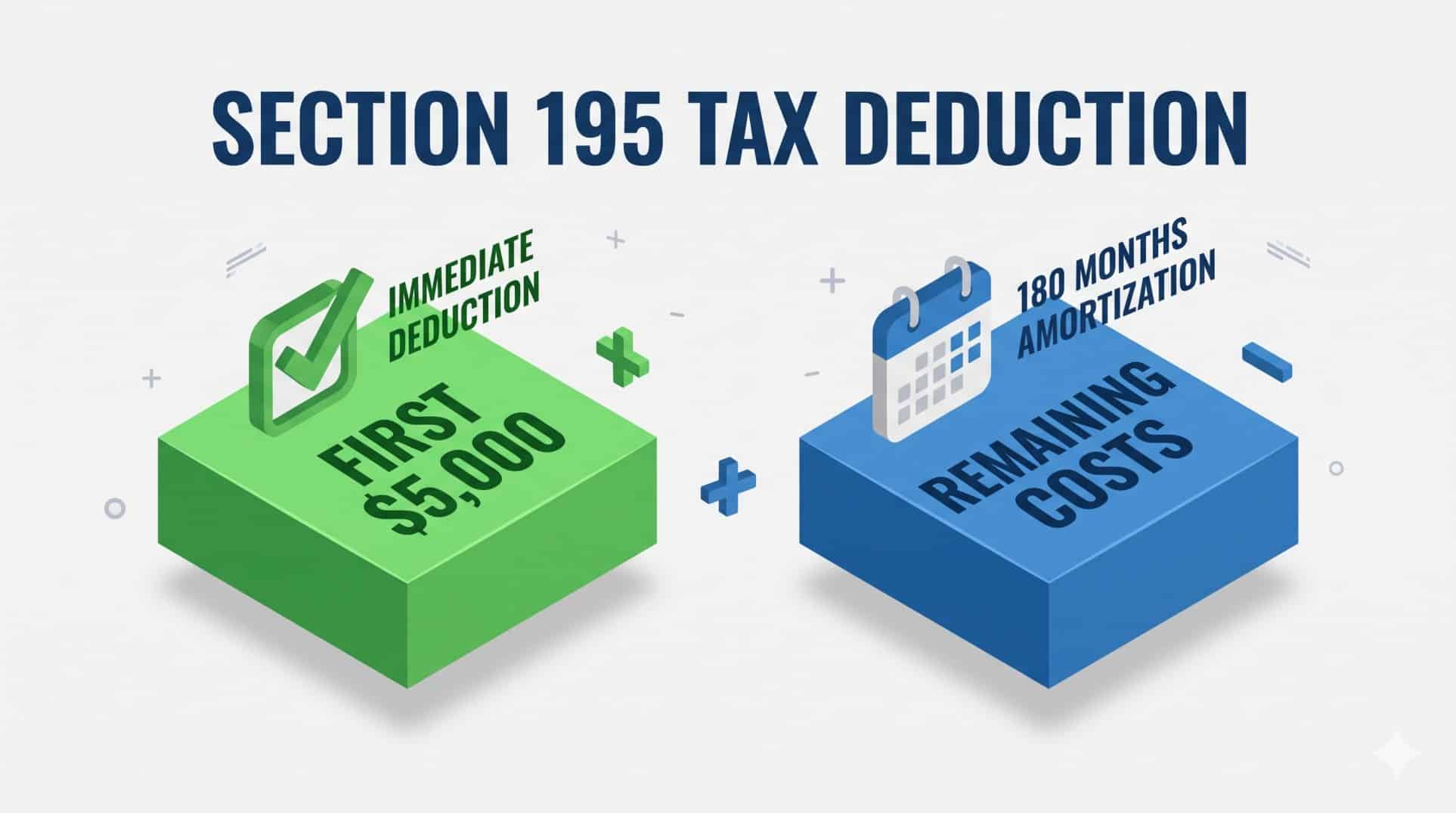
Table of Contents
- The Core Rule: Section 195 Deduction Limits Explained
- Qualifying vs. Non-Qualifying Startup Costs
- Organizational Costs: The Hidden Second Deduction
- How to Write Off Your First Year: The Amortization Math
- Real-World Examples and Calculations
- The “Active Trade or Business” Requirement
- Frequently Asked Questions About Startup Costs
Launching a business requires capital. Before you ever make your first sale, you are spending money on market research, advertising, employee training, and legal fees. The IRS recognizes that these early expenditures are a necessary part of commerce, but they do not allow you to simply write them all off as standard business expenses on day one.
Instead, federal tax law places these pre-launch expenses into a highly specific category. Deducting Business Startup Costs in 2026 requires navigating a strict formula that dictates exactly how much you can deduct immediately and how much you must spread out over the next decade and a half.
Many new entrepreneurs make the mistake of dumping all their early receipts into a general “supplies” or “advertising” bucket on their first tax return. This is a direct violation of the tax code and a massive audit risk. We are going to break down the exact mechanics of Section 195. You will learn how to categorize your expenses correctly, calculate your maximum first-year write-off, and ensure your new business remains fully compliant with the IRS.
The Core Rule: Section 195 Deduction Limits Explained
The rules for Deducting Business Startup Costs in 2026 are found in Internal Revenue Code (IRC) Section 195. This section was designed to encourage entrepreneurship by allowing a portion of pre-opening costs to be deducted immediately, rather than forcing business owners to capitalize and amortize the entire amount.
The Section 195 deduction limits operate on a two-tiered system:
Tier 1: The $5,000 Immediate Deduction
In the tax year that your business officially begins operations, you are allowed to deduct up to $5,000 of qualifying pre-launch expenses immediately against your business income.
Tier 2: The $50,000 Phase-Out Threshold
The IRS targets this tax break at small businesses. If your total pre-launch expenses exceed $50,000, the $5,000 immediate deduction is reduced dollar-for-dollar. For example, if you spend $52,000 before opening, you are $2,000 over the limit. Your immediate deduction is reduced by $2,000, leaving you with a $3,000 first-year deduction. If your pre-launch expenses hit $55,000 or more, the immediate deduction is completely wiped out.
Any qualifying costs that you cannot deduct immediately—either because they exceed the $5,000 limit or because you hit the phase-out threshold—do not disappear. They are capitalized and amortized over 180 months (15 years), beginning in the month your business opens.
Qualifying vs. Non-Qualifying Startup Costs
To master How to Write Off Your First Year, you must understand exactly what the IRS considers a valid pre-launch expense. Not every dollar you spend before opening day qualifies under Section 195.
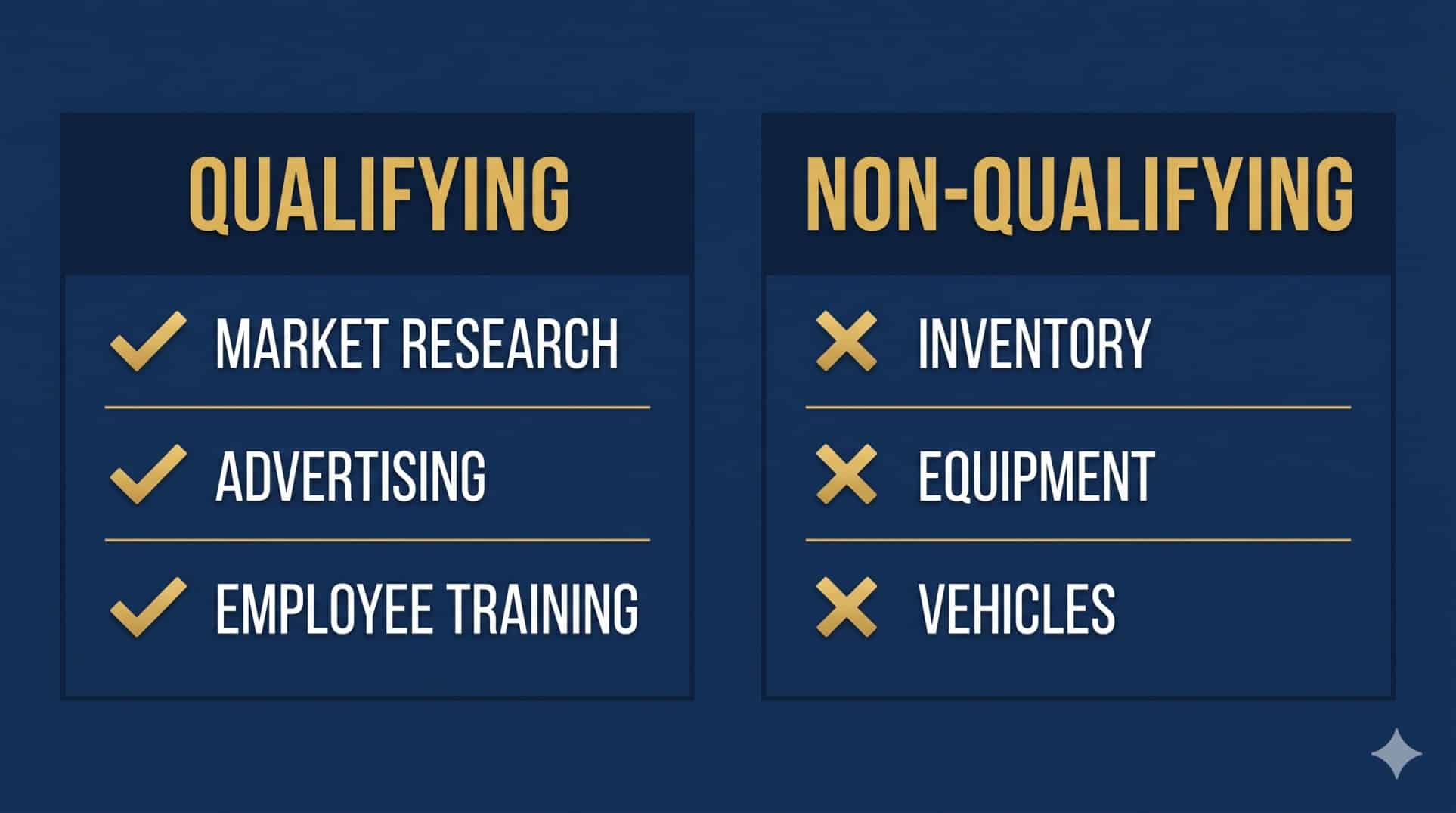
The IRS defines qualifying Startup Costs as amounts paid or incurred in connection with investigating the creation or acquisition of an active trade or business, or creating an active trade or business. These costs must be expenses that would be deductible if they were paid by an existing, operating business.
What Qualifies?
- Investigatory Costs: Market research, surveys of potential markets, product analysis, and travel costs incurred to scout potential business locations.
- Pre-Opening Advertising: Marketing campaigns, website development, and promotional materials designed to build hype before your official launch date.
- Employee Training: Wages paid to employees who are being trained before the business opens, as well as the fees paid to the instructors.
- Professional Fees: Consulting fees paid to executives or industry experts to help you set up the operational side of the business.
What Does NOT Qualify?
- Inventory: Goods purchased for resale are never deducted as startup expenses. They are accounted for as Cost of Goods Sold (COGS) when the items are actually sold to customers.
- Equipment and Vehicles: Tangible assets like computers, machinery, office furniture, and delivery trucks are capital assets. They are depreciated under Section 168 or expensed under Section 179, not Section 195.
- Real Estate: Purchasing a building or land is a capital expense.
- Research and Experimental Costs: Developing a new patent or chemical formula falls under Section 174, which has its own strict amortization rules.
Learn more about how to depreciate business equipment and machinery here.
Organizational Costs: The Hidden Second Deduction
Many new entrepreneurs confuse startup expenses with organizational expenses. The IRS treats them as two completely separate categories, which is actually a massive benefit for business owners.
While Section 195 handles the operational costs of launching, IRC Section 248 (for corporations) and Section 709 (for partnerships) handle the legal costs of forming your business entity. This includes state filing fees, legal fees to draft an operating agreement or corporate bylaws, and accounting fees to set up the initial partnership structure.
The rules for organizational costs mirror the Section 195 deduction limits exactly. You get a separate $5,000 immediate deduction for organizational costs, subject to its own $50,000 phase-out limit, with the remainder amortized over 180 months.
This means a new LLC or Corporation can potentially claim up to $10,000 in immediate deductions in year one ($5,000 for operational startup expenses + $5,000 for legal organizational expenses), provided neither category exceeds the $50,000 phase-out threshold.
How to Write Off Your First Year: The Amortization Math
When you sit down to file your taxes, you must actively elect to amortize your costs. Under current IRS procedures, this election is deemed automatic when you file your first tax return and claim the deduction. You report these figures on IRS Form 4562 (Depreciation and Amortization) in Part VI.

The amortization period is strictly 180 months. You cannot choose to amortize it over 5 years or 10 years. The clock starts ticking in the exact month your business officially opens its doors to customers.
If you launch your business in October, you only get to claim three months of amortization (October, November, December) on your first tax return, in addition to the $5,000 immediate deduction.
Read our complete guide on how to file Form 4562 correctly.
Real-World Examples and Calculations
To fully grasp Deducting Business Startup Costs in 2026, let’s look at the math behind three different launch scenarios.
Scenario 1: The Lean Consulting Firm
David starts a digital marketing agency. Before launching on May 1, 2026, he spends $3,500 on market research, website design, and pre-launch advertising. He also spends $800 on legal fees to form his LLC.
The Math: David’s operational costs ($3,500) are well under the $5,000 limit. His organizational costs ($800) are also under the limit.
The Deduction: David deducts the entire $3,500 under Section 195 and the entire $800 under Section 709 on his 2026 tax return. He has zero amortization to track going forward.
Scenario 2: The Standard Retail Launch
Sarah opens a boutique coffee shop on August 1, 2026. Prior to opening, she spends $23,000 on employee training, pre-opening rent, and marketing. (She also spent $50,000 on espresso machines, but those are equipment, not Section 195 costs).
The Math: Sarah takes the maximum $5,000 immediate deduction. This leaves $18,000 to be amortized over 180 months. $18,000 / 180 = $100 per month. Because she opened in August, she has 5 months of operations in 2026 (August through December).
The Deduction: $5,000 (immediate) + $500 (5 months of amortization) = $5,500 total deduction for 2026. She will deduct $1,200 ($100 x 12 months) every year for the next 14 years, and the final $700 in year 15.
Scenario 3: The Heavy Investment Phase-Out
Marcus launches a tech platform on November 1, 2026. He spent heavily on pre-launch consulting and market analysis, totaling $52,000 in qualifying Section 195 costs.
The Math: Marcus crossed the $50,000 phase-out threshold by $2,000. Therefore, his $5,000 immediate deduction is reduced by $2,000. He is allowed a $3,000 immediate deduction. The remaining $49,000 ($52,000 total – $3,000 immediate) is amortized over 180 months. $49,000 / 180 = $272.22 per month. He operates for 2 months in 2026 (November and December).
The Deduction: $3,000 (immediate) + $544.44 (2 months of amortization) = $3,544.44 total deduction for 2026.
The “Active Trade or Business” Requirement
The most critical rule for new entrepreneurs to understand is that you cannot claim a single dollar of these deductions until the business actually begins. The IRS defines “beginning business” as the moment you are fully ready, willing, and able to receive customers and generate revenue.
If you spend $15,000 researching a business idea in 2025, but you do not officially open your doors until February 2026, you cannot deduct those costs on your 2025 tax return. You must hold those expenses on your books and claim them on your 2026 return when the business goes live.
What if the business never opens?
This is a harsh reality for many startups. If you spend money investigating a general business idea or market, and you ultimately decide not to launch the business, those costs are considered personal expenses. They are completely non-deductible. You cannot write them off.
However, there is a narrow exception. If you move past general investigation and focus on acquiring or starting a specific business, and that specific venture falls through, you may be able to deduct the costs as a capital loss under IRC Section 165. This requires strict documentation proving that you had moved beyond the brainstorming phase and were actively attempting to execute a specific business plan.
Frequently Asked Questions About Startup Costs
What are the Section 195 deduction limits for 2026?
The Section 195 deduction limits allow you to deduct up to $5,000 of qualifying pre-launch expenses in your first year of business. This $5,000 limit is reduced dollar-for-dollar if your total pre-launch expenses exceed $50,000. Any remaining costs are amortized over 180 months.
How do I know How to Write Off Your First Year expenses correctly?
You must separate your expenses into three buckets: operational pre-launch costs (Section 195), legal entity formation costs (Section 248/709), and capital assets like equipment (Section 168/179). You report the amortized portions on IRS Form 4562.
Can I deduct inventory as a startup cost?
No. Inventory is never considered a startup expense. The cost of goods purchased for resale is held on your balance sheet and deducted as Cost of Goods Sold (COGS) only when the specific items are sold to customers.
What happens if my pre-launch expenses exceed $55,000?
If your total qualifying expenses hit $55,000 or more, the $50,000 phase-out rule completely eliminates your $5,000 immediate deduction. You must amortize the entire amount of your expenses over 180 months.
Do new entrepreneurs have to amortize costs over 15 years?
Yes. The 180-month (15-year) amortization period is a strict statutory requirement under the tax code. You cannot choose a shorter amortization schedule, even if you expect the business to close before 15 years.
What if I close my business before the 15-year amortization is over?
If you permanently close or sell your business before the 180-month period ends, you can generally deduct the remaining unamortized balance as an ordinary business loss on your final tax return.
Are website development costs considered startup expenses?
Yes. If you pay a developer to build your initial website before the business officially launches, those costs fall under Section 195. Once the business is open, ongoing website maintenance becomes a standard, immediately deductible business expense.
Can I deduct the cost of buying a franchise?
The initial franchise fee is generally considered an intangible asset and is amortized over 15 years under Section 197, not Section 195. However, other costs incurred while investigating the franchise purchase may qualify as startup expenses.
When exactly does a business “begin” according to the IRS?
A business begins when it has acquired all necessary operating assets and is fully ready to perform the activities for which it was organized. For a retail store, this is opening day. For a service business, it is the day you are officially available to take on clients.
Is Deducting Business Startup Costs in 2026 different from previous years?
No. The $5,000 immediate deduction, the $50,000 phase-out threshold, and the 180-month amortization schedule have remained static for many years and continue to apply exactly the same way for the 2026 tax year.
Disclaimer: This content provides general information for educational purposes only. Tax laws are complex and change often. It is not professional tax, legal, or financial advice. Always consult a qualified tax professional for personalized guidance regarding your specific situation. Ourtaxpartner.com is not responsible for any actions taken based on the information provided herein.
