
⚡ Executive Summary: 2026 Meal Deduction Rules
- Business Meal Deductions in 2026 face strict new limitations, most notably the complete elimination of deductions for breakroom food and catered employee lunches.
- Client meals and overnight travel meals remain strictly 50% deductible, provided a clear business purpose is documented.
- Company-wide social events, such as holiday parties and summer picnics, retain their full 100% deductible status under IRC Section 274(e)(4).
- Under the delayed provisions of the Tax Cuts and Jobs Act (TCJA), employer-provided office snacks and “convenience of the employer” meals dropped to 0% deductible on January 1, 2026.
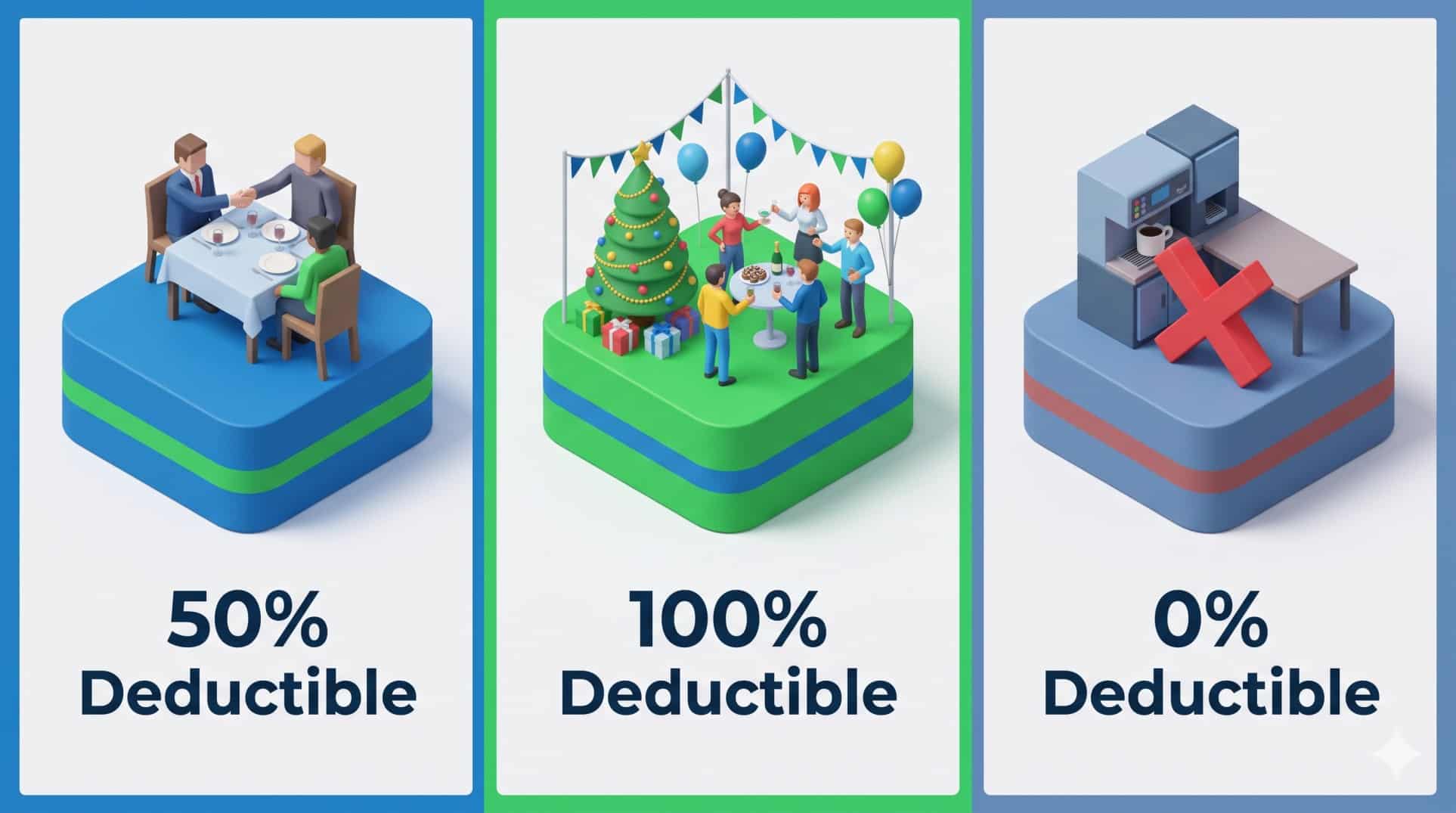
Table of Contents
- The 2026 Tax Landscape: A Shift in Strategy
- What is 50% vs. 100% Deductible? The Core Categories
- The 50% Bucket: Client Dinners and Travel Meals
- The 100% Bucket: Company Parties and Public Events
- The 0% Trap: The End of the Breakroom Deduction
- Real-World Examples and Calculations
- Recordkeeping: How to Audit-Proof Your Receipts
- Frequently Asked Questions About Business Meals
Writing off food expenses used to be simple. You took a client to lunch, handed your receipt to your accountant, and took the deduction. Today, the tax code treats a cup of coffee in your breakroom entirely differently than a cup of coffee at a restaurant with a prospect. Business Meal Deductions in 2026 require precision, strict documentation, and a deep understanding of recent legislative changes.
The temporary 100% deduction for restaurant meals that businesses enjoyed during the pandemic era is long gone. More importantly, a delayed provision from the 2017 Tax Cuts and Jobs Act (TCJA) has finally taken effect this year, completely wiping out a beloved tax break for employee perks. If you are still coding all your food receipts into a single “Meals and Entertainment” account, you are practically begging the IRS for an audit.
We are going to break down exactly how the IRS classifies food expenses this year. You will learn how to maximize your write-offs, avoid the new zero-percent traps, and keep your bookkeeping flawless.
The 2026 Tax Landscape: A Shift in Strategy
Tax law rarely stays static. The rules governing Business Meal Deductions in 2026 are the result of a decade of legislative tweaking. Congress has historically used meal deductions as a dial to either stimulate the restaurant industry or raise corporate tax revenue.
Right now, the dial is turned toward raising revenue. The IRS is actively scrutinizing meal deductions because they are incredibly easy for business owners to overstate. Mixing personal dining with business dining is a classic red flag. To stay compliant, you must separate your expenses into three distinct buckets: 50%, 100%, and 0%.
What is 50% vs. 100% Deductible? The Core Categories
When business owners sit down for tax planning, the first question they ask is always: What is 50% vs. 100% Deductible? The answer dictates how you budget for marketing, travel, and employee benefits.
The general rule of thumb is that routine business operations—like meeting a client or traveling to a conference—are limited to 50%. The IRS assumes there is always some inherent personal benefit to eating a meal, so they only let you deduct half the cost. The 100% bucket is strictly reserved for broad, company-wide morale events or public advertising.
The 50% Bucket: Client Dinners and Travel Meals
The vast majority of your food expenses will fall into the 50% category. Under IRC Section 274(n)(1), you can deduct half the cost of qualifying food and beverages, including tax and tip.
Client Dinners and Meetings
Taking a prospect, customer, vendor, or referral source out for food is 50% deductible. However, the IRS enforces strict parameters around client dinners. First, the meal cannot be “lavish or extravagant” under the circumstances. You do not have to eat at a fast-food joint, but writing off a $4,000 dinner for two people will draw immediate scrutiny.
Second, you or an employee must be present at the meal. You cannot simply buy a client a gift card to a restaurant and call it a meal deduction (that would be a business gift, subject to a strict $25 annual limit per person). Finally, you must actually discuss business. The conversation does not have to last the entire meal, but a clear business purpose must exist.
Travel Meals
When you leave your tax home for business, your food becomes deductible. Travel meals require you to be away overnight, or long enough that you require substantial sleep or rest to complete your duties. If you drive two hours to a neighboring city, have lunch, and drive back the same day, that is not a travel meal. That is a personal lunch, and it is 0% deductible unless you are eating with a client.
If you do stay overnight, your travel meals are 50% deductible. This applies whether you are eating alone at the hotel bar, grabbing a sandwich at the airport, or ordering room service. You can choose to deduct your actual expenses (keeping every receipt) or use the IRS standard daily per diem rate for your destination city.
The 100% Bucket: Company Parties and Public Events
Finding a 100% deduction in the tax code is rare, but they do exist. You just have to know where to look.
Company-Wide Social Events
Under IRC Section 274(e)(4), expenses for recreational, social, or similar activities incurred primarily for the benefit of employees are fully deductible. The classic examples are the annual holiday party, a summer family picnic, or a company-wide milestone celebration.
The catch? The event must be open to all employees. You cannot host a lavish weekend retreat exclusively for the executive team or the highly compensated owners and claim a 100% deduction. If the event discriminates in favor of the owners, it drops out of this protected category.
Public Advertising and Goodwill
Food provided to the general public is 100% deductible. If you are a real estate agent hosting an open house and you cater sandwiches and wine for anyone who walks in, that is fully deductible. If you set up a booth at a trade show and hand out free snacks to attendees, that is an advertising expense, not a standard meal, and it qualifies for the 100% write-off.
The 0% Trap: The End of the Breakroom Deduction
This is the most critical update for Business Meal Deductions in 2026. For decades, employers could write off the cost of providing free coffee, donuts, and snacks to their staff. These were known as “de minimis fringe benefits.”
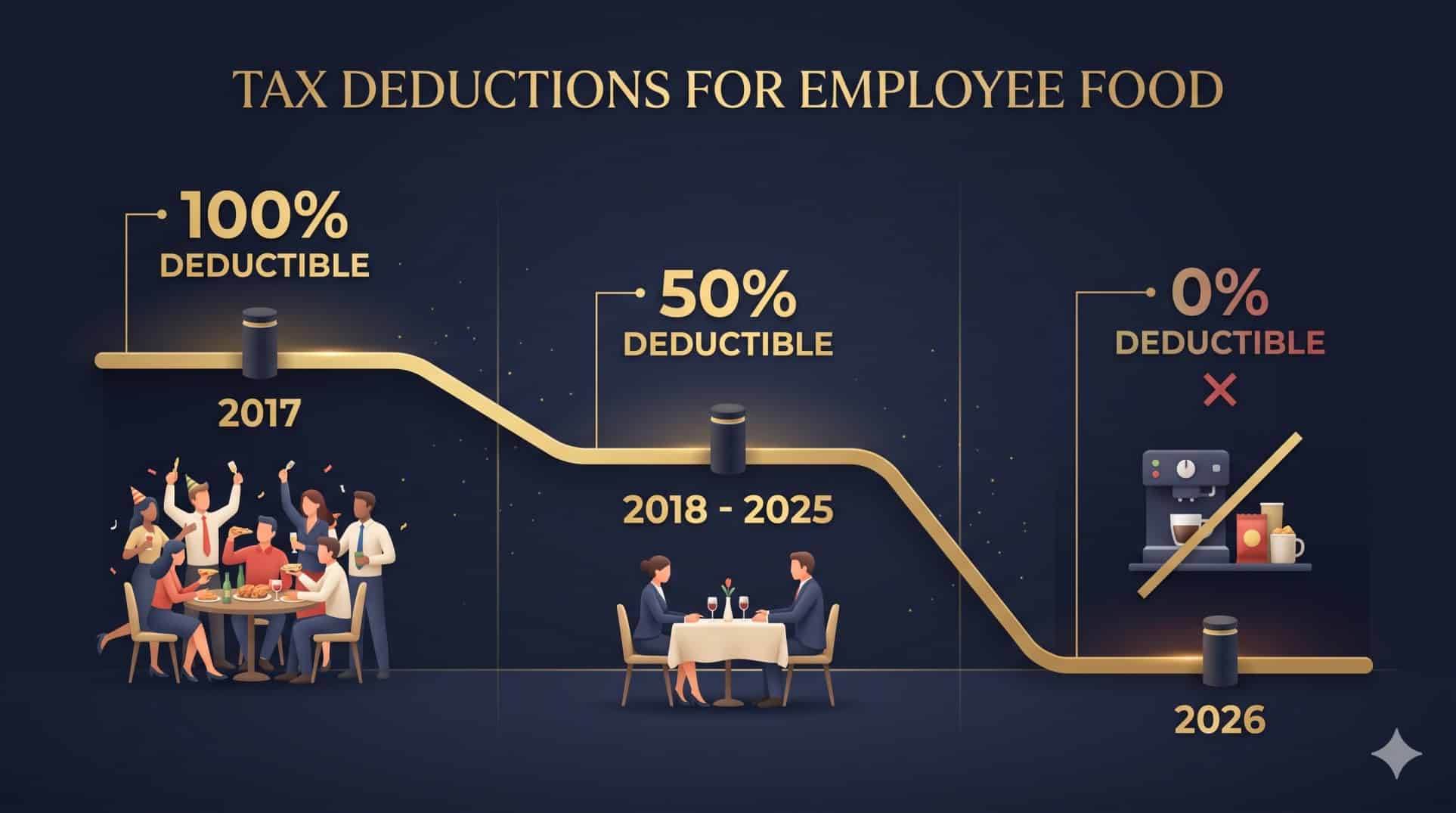
When the TCJA was passed in 2017, it reduced the deduction for office snacks from 100% to 50%. But the law included a delayed sunset provision. Effective for amounts paid or incurred after December 31, 2025, IRC Section 274(o) completely disallows the deduction for these expenses.
In 2026, office snacks are 0% deductible. If you spend $500 a month keeping the breakroom stocked with sparkling water and protein bars, your business eats that entire $6,000 annual cost without a single penny of tax relief. The food remains tax-free to the employee (they do not have to report the coffee as income on their W-2), but the employer loses the write-off.
This 0% rule also applies to meals provided for the “convenience of the employer.” In the past, if you catered dinner to the office so your accounting team could work late through tax season, that was deductible. In 2026, those catered working meals are entirely non-deductible.
Learn more about how fringe benefits impact your overall corporate tax strategy.
The Entertainment Ban Remains
Do not forget that entertainment expenses are still 0% deductible. Taking a client to a golf course, a football game, or a theater show provides zero tax benefit. However, if you buy food at the golf course, and that food is billed separately from the entertainment costs on the invoice, the food portion qualifies as a 50% deductible client meal.
Real-World Examples and Calculations
To understand exactly What is 50% vs. 100% Deductible, let’s look at the math behind three common business scenarios in 2026.
Scenario 1: The Client Pitch
Marcus owns a marketing agency. He takes a prospective client to a high-end steakhouse to pitch a new ad campaign. The total bill, including tax and tip, is $400. During the dinner, they spend 20 minutes discussing the proposal and the rest of the time building rapport.
The Math: Because business was discussed and Marcus was present, this qualifies as a client meal. It is not considered lavish for a high-level B2B pitch. Marcus can deduct 50% of the total cost.
Deduction: $200.
Scenario 2: The Office Manager’s Dilemma
Sarah runs a tech startup. To keep morale high, she spends $1,000 a month on office snacks, premium coffee, and energy drinks for the breakroom. In December, she spends $5,000 on a company-wide holiday party at a local restaurant, inviting all 20 employees.
The Math: The $12,000 spent on office snacks throughout the year falls under the new 2026 TCJA phase-out. It is 0% deductible. The $5,000 holiday party falls under the Section 274(e)(4) exception for company-wide social events. It is 100% deductible.
Deduction: $0 for snacks, $5,000 for the party.
Scenario 3: The Traveling Consultant
David is an IT consultant who lives in Texas. He flies to Chicago for a three-day client installation. While in Chicago, he spends $60 on breakfast, $40 on lunch, and $100 on dinner eating by himself. He also buys a $15 sandwich at the airport on his way home.
The Math: Because David is traveling away from his tax home overnight, all of his personal travel meals qualify for a deduction. His total actual food expense for the trip is $215. Travel meals are strictly limited to 50%.
Deduction: $107.50.
Recordkeeping: How to Audit-Proof Your Receipts
Knowing the rules for Business Meal Deductions in 2026 is only half the battle. Proving them to the IRS is the other half. The IRS strictly enforces the substantiation requirements under IRC Section 274(d). You cannot rely on the “Cohan rule” (estimating expenses) for meals and travel.
A line item on your credit card statement showing “$150 at Joe’s Steakhouse” is not sufficient evidence. If you are audited, the IRS will disallow that deduction immediately. For every meal over $75, you must keep the actual itemized receipt showing exactly what was purchased (to prove you didn’t just buy three bottles of wine and no food).
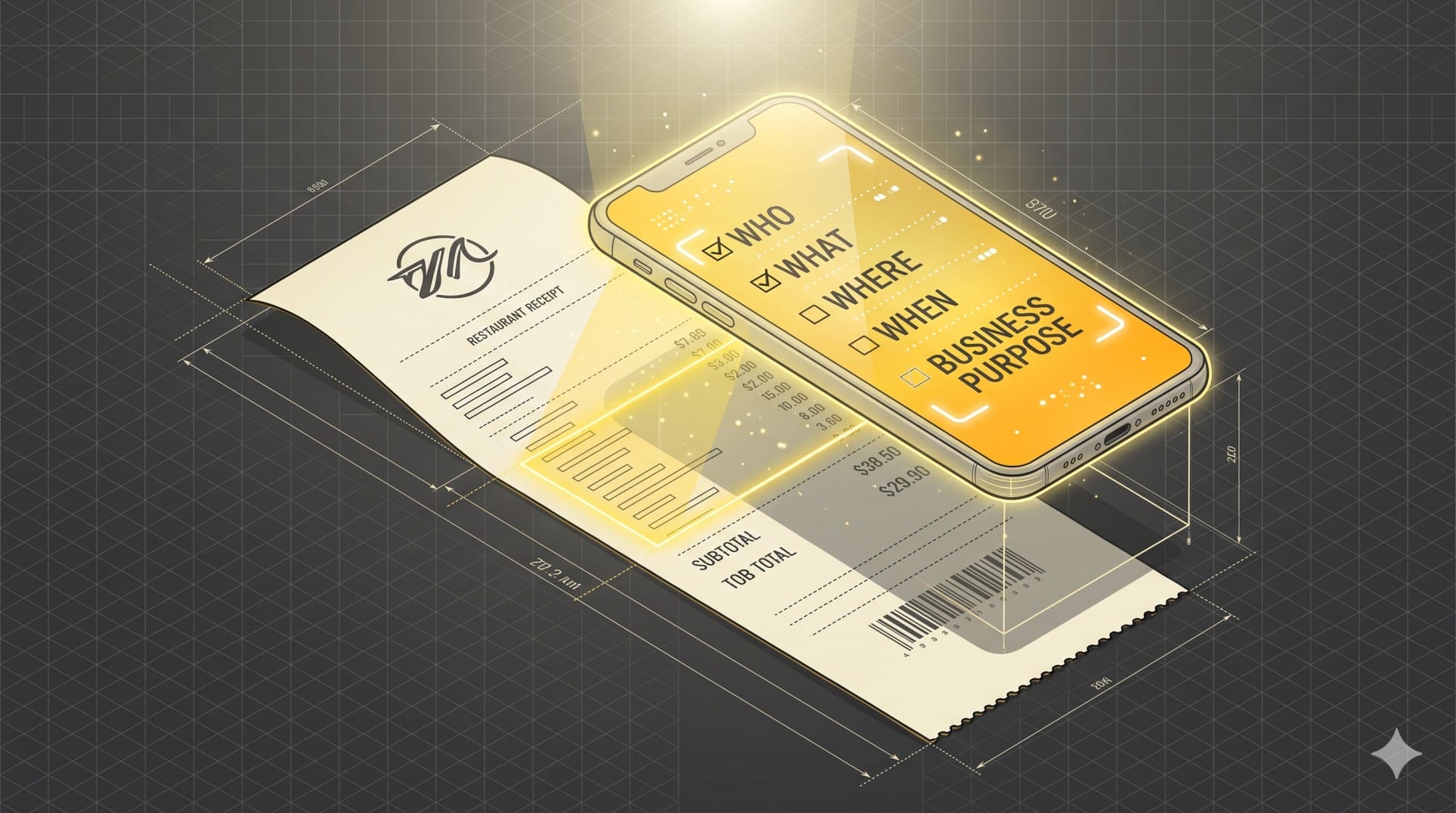
Furthermore, you must document five specific elements for every meal:
- Who: The names and titles of the people at the meal.
- What: The itemized receipt showing the food and beverages purchased.
- Where: The name and location of the restaurant.
- When: The date of the meal.
- Why: The specific business purpose or the nature of the business discussion.
The easiest way to handle this is to write the “Who” and “Why” directly on the back of the physical receipt, snap a photo of it with your bookkeeping app, and throw the paper away. Digital copies are perfectly acceptable to the IRS as long as they are legible.
Read our complete guide on small business bookkeeping best practices.
Frequently Asked Questions About Business Meals
Are Business Meal Deductions in 2026 different from previous years?
Yes. The most significant change for 2026 is the complete elimination of the deduction for office snacks and meals provided for the convenience of the employer. These items dropped from 50% deductible to 0% deductible on January 1, 2026, due to the TCJA sunset provisions.
Can I still deduct 100% of restaurant meals?
No. The temporary 100% deduction for food and beverages provided by a restaurant was a pandemic-era stimulus measure that expired at the end of 2022. Restaurant meals are back to the standard 50% limit.
How do I figure out What is 50% vs. 100% Deductible?
As a general rule, meals involving specific clients, prospects, or overnight travel are 50% deductible. Meals provided to the general public for advertising, or company-wide social events open to all employees, are 100% deductible.
Are client dinners fully deductible if we close a deal?
No. Even if you sign a million-dollar contract at the table, client dinners are strictly limited to a 50% deduction. The IRS assumes you still received a personal benefit by eating the food.
What happens if I buy a client a coffee?
If you sit down and drink the coffee with them while discussing business, it is a 50% deductible meal. If you simply buy them a bag of coffee beans to take home, it is classified as a business gift, which is 100% deductible up to the $25 annual limit per person.
Are travel meals deductible if I do not stay overnight?
Generally, no. To deduct travel meals, your business trip must require you to be away from your tax home substantially longer than an ordinary day’s work, requiring sleep or rest. Day trips usually do not qualify, making those meals personal and non-deductible.
Can I write off the cost of office snacks for my team?
In 2026, you can no longer write off office snacks. The cost of providing breakroom coffee, donuts, and water coolers is now 0% deductible for the employer, though it remains a tax-free fringe benefit for the employees.
Are meals at a golf outing deductible?
The golf itself (greens fees, cart rental) is entertainment and is 0% deductible. However, if you buy lunch at the clubhouse with the client, and the food is billed separately from the entertainment costs, the meal is 50% deductible.
Do I need a receipt for a $10 fast-food lunch on a business trip?
Technically, the IRS requires documentary evidence (like a receipt) for expenses of $75 or more. However, best practice is to keep receipts for all travel meals, regardless of the amount, to easily prove the date, location, and business context if questioned.
Are company holiday parties still deductible in 2026?
Yes. Company-wide holiday parties, summer picnics, and similar recreational events remain 100% deductible. The critical requirement is that the event must be open to all employees, not just executives or highly compensated individuals.
Disclaimer: This content provides general information for educational purposes only. Tax laws are complex and change often. It is not professional tax, legal, or financial advice. Always consult a qualified tax professional for personalized guidance regarding your specific situation. Ourtaxpartner.com is not responsible for any actions taken based on the information provided herein.
