
Filing military taxes accurately requires separating taxable base compensation from dozens of statutory exclusions enacted specifically for the U.S. Armed Forces. Claiming all available 2026 tax benefits for active duty military and **veterans** can legally trim thousands of dollars off your federal and state tax bills when you file in 2027. Service members who treat their Leave and Earnings Statement (LES) like a civilian paycheck often overpay the IRS or miss lucrative refundable credits.
Following the enactment of the One Big Beautiful Bill Act (OBBBA) and the release of IRS Revenue Procedure 2025-32, several inflation-adjusted thresholds, mileage rates, and permanent statutory rules govern Tax Year 2026. Below is the complete, line-by-line technical guide covering tax-free allowances, combat pay rules, permanent change of station (PCS) moving expenses, veteran disability exemptions, and multi-state residency laws.
⚡ Executive Summary: Key 2026 Tax Rules at a Glance
- 2026 Combat Zone Tax Exclusion (IRC § 112): Enlisted personnel and warrant officers exclude 100% of their military pay for any month they serve at least one day in a designated combat zone. For 2026, the commissioned officer exclusion cap rises to $11,391.90 per month ($11,166.90 senior enlisted basic pay cap plus $225 Hostile Fire/Imminent Danger Pay). Individual 2026 returns are due April 15, 2027.
- Permanent PCS Moving Deduction & Split 2026 Mileage Rates: The OBBBA permanently eliminated moving deductions for civilians, leaving active duty service members under PCS orders (and certain intelligence personnel) as the sole taxpayers eligible to file Form 3903. Due to a mid-year IRS adjustment, the 2026 military moving mileage rate is 20.5 cents per mile from January 1 to June 30, 2026, and 23.5 cents per mile from July 1 to December 31, 2026.
- Post-OBBBA Standard Deduction & Child Tax Credit: For Tax Year 2026, the standard deduction is $16,100 for Single/MFS, $32,200 for Married Filing Jointly, and $24,150 for Head of Household. The Child Tax Credit is permanently expanded to $2,200 per qualifying child (with up to $1,700 refundable via the Additional Child Tax Credit).
- Veteran Disability & Retroactive Claims: VA disability compensation and Combat-Related Special Compensation (CRSC) are 100% excluded from federal and state gross income. Under the Strickland doctrine, veterans who receive a retroactive VA disability rating can file Form 1040-X to claim tax refunds on reclassified DoD retirement pay.
Table of Contents
- ⚡ Executive Summary: Key 2026 Tax Rules at a Glance
- Understanding Military Taxes: Taxable Pay vs. Tax-Free Allowances
- Combat Pay Exclusion and 2026 Tax Benefits for Active Duty Military
- Deducting PCS Moving Expenses on Form 3903 in 2026
- SCRA State Tax Rules for Service Members and Military Spouses
- 2026 Tax Benefits for Veterans and Disabled Retirees
- Step-by-Step Guide to Filing Your 2026 Military Tax Return in 2027
- Frequently Asked Questions About Military Taxes in 2026
- Final Year-End Tax Planning Steps for Service Members
Understanding Military Taxes: Taxable Pay vs. Tax-Free Allowances
Under federal military taxes law, all basic pay, special incentive pay, and non-combat bonuses earned by service members are subject to federal income and FICA taxes, whereas living, housing, and subsistence allowances are 100% excluded from gross income under IRC Section 134.
According to IRS Publication 3 (Armed Forces’ Tax Guide), the Defense Finance and Accounting Service (DFAS) automatically separates your compensation before generating your annual Form W-2. Knowing which entitlements enter Box 1 (Taxable Wages) versus which remain permanently off your tax return allows you to project your effective tax bracket and qualify for income-tested tax credits.
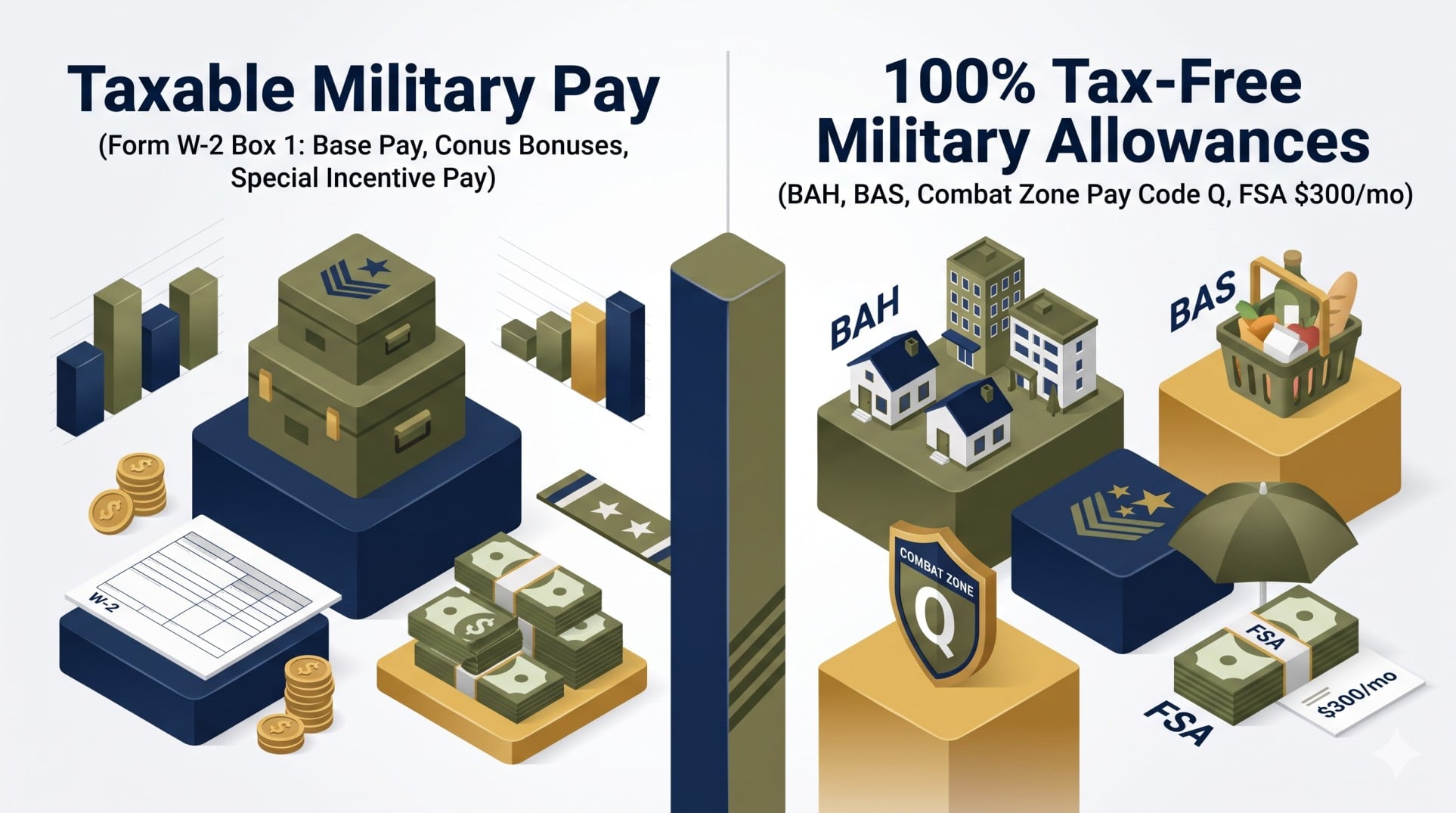
Taxable Military Compensation (Included in Form W-2, Box 1)
Unless earned during a qualifying month in a designated combat zone, the following items are fully subject to federal income tax and the 7.65% FICA payroll tax (6.2% Social Security up to the 2026 wage base of $184,500, plus 1.45% Medicare):
- Active Duty and Reserve Basic Pay: Monthly base compensation for active duty, drill weekends, and annual training.
- Special and Incentive Pays: Aviation career incentive pay (flight pay), submarine duty pay, hazardous duty incentive pay (parachute/demolition), medical/dental officer special pay, and foreign language proficiency pay.
- Enlistment and Reenlistment Bonuses: Lump-sum and installment bonuses signed outside a designated combat zone.
- Armed Forces Health Professions Scholarship Program (AFHPSP) Stipends: Living stipends paid to medical students, though tuition and fee payments remain tax-exempt under OBBBA permanent extensions.
Tax-Free Military Allowances (Excluded Under IRC Section 134)
Congress codified IRC Section 134 to prevent “qualified military benefits” from being taxed. None of the following allowances are subject to federal income tax, state income tax, or FICA payroll tax:
- Basic Allowance for Housing (BAH) and Overseas Housing Allowance (OHA): Completely tax-free whether you live off-base in a rental or own a primary residence.
- Basic Allowance for Subsistence (BAS): Tax-free monthly food allowance for officers and enlisted personnel.
- Family Separation Allowance (FSA): Paid at $300 per month in 2026 when dependents cannot accompany a service member on deployment, shipboard duty, or unaccompanied tours exceeding 30 days.
- Clothing, Dislocation, and Per Diem Allowances: Initial clothing allowances, annual uniform upkeep allowances, Dislocation Allowance (DLA), and Temporary Lodging Expense (TLE) reimbursements.
Homeowner “Double Dip” Rule (IRC Section 265(a)(6)): Just like ordained clergy, active duty service members who use tax-free BAH to pay their home mortgage and real estate property taxes can still deduct 100% of that qualified mortgage interest and property tax on Schedule A if they itemize. With the 2026 State and Local Tax (SALT) deduction cap set at $40,400 under the OBBBA, high-cost-of-living duty stations in California, Virginia, or Washington state often allow military homeowners to exceed the $32,200 joint standard deduction.
Combat Pay Exclusion and 2026 Tax Benefits for Active Duty Military
Among all 2026 tax benefits for active duty military, the Combat Zone Tax Exclusion (CZTE) under IRC Section 112 is the most financially impactful, exempting 100% of enlisted combat pay and up to $11,391.90 per month of commissioned officer pay from federal income tax.
To trigger the CZTE, a service member must perform official duties in an area designated by Presidential Executive Order as a Combat Zone (such as the Arabian Peninsula Areas, Kosovo, or the Sinai Peninsula) or a Qualified Hazardous Duty Area (QHDA) designated by Congress, or serve in direct certified support of military operations in a combat zone while receiving Hostile Fire Pay (HFP) or Imminent Danger Pay (IDP).
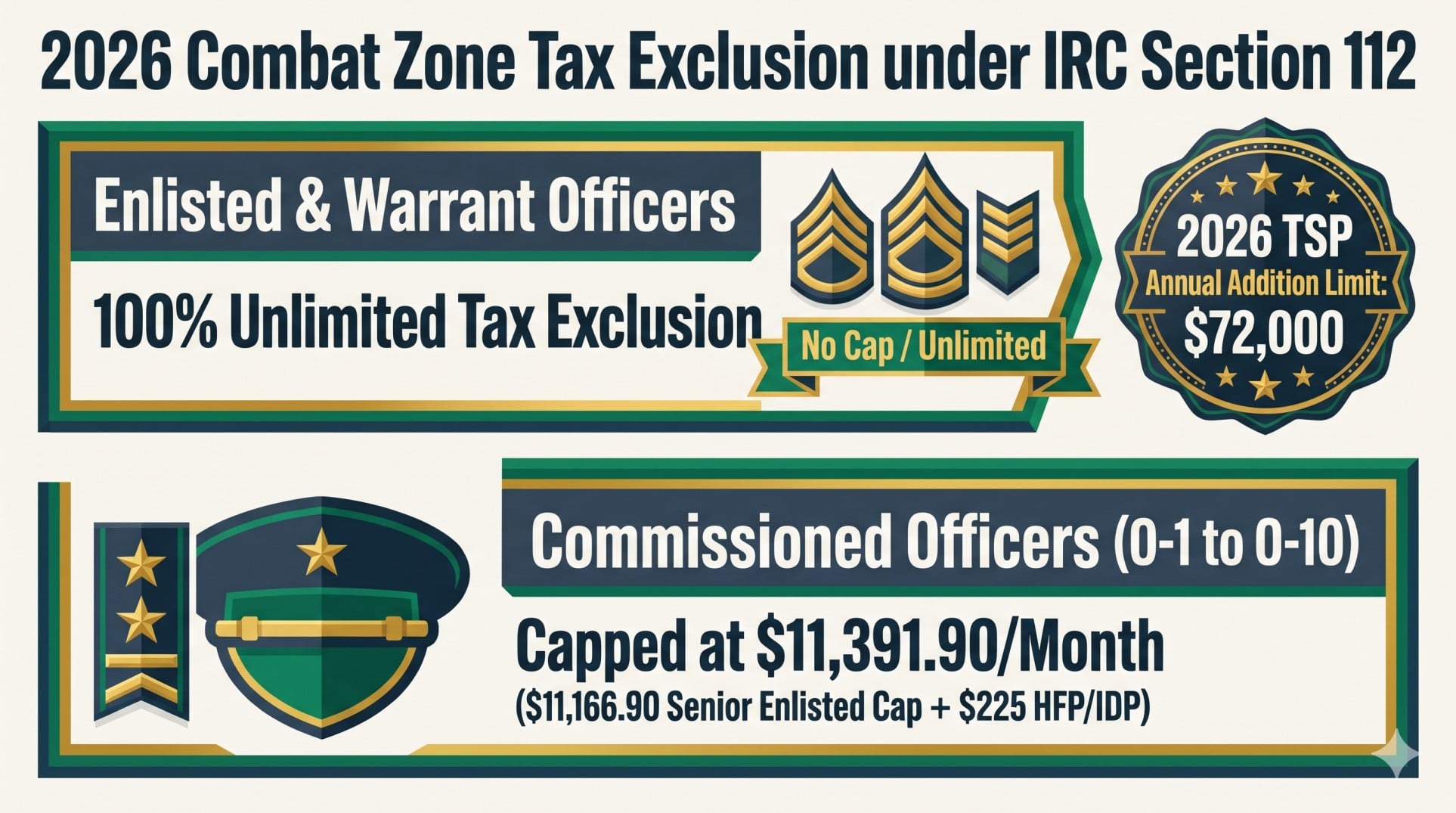
The One-Day Rule and 2026 Officer Cap
Under Treasury Regulation Section 1.112-1, the Combat Zone Tax Exclusion operates on a monthly all-or-nothing trigger known as the One-Day Rule. If you step foot in a designated combat zone on official orders for even a single hour on the 31st day of a month, your qualifying military pay for that entire calendar month is exempt from federal income tax. Note that while combat pay is exempt from federal (and almost all state) income taxes, it remains 100% subject to 6.2% Social Security and 1.45% Medicare taxes.
- Enlisted Members and Warrant Officers (E-1 to E-9 and W-1 to W-5): The exclusion is unlimited. Every dollar of basic pay, HFP/IDP, and special pay earned during a qualifying month is excluded from Box 1 of Form W-2 and reported instead in Box 12 with Code Q.
- Commissioned Officers (O-1 to O-10): Under IRC Section 112(b), a commissioned officer’s monthly income tax exclusion is capped at the highest rate of enlisted basic pay payable to the senior enlisted advisor of a military branch (Sergeant Major of the Army/Marine Corps, Master Chief Petty Officer of the Navy, or Chief Master Sergeant of the Air Force/Space Force), plus the monthly amount of HFP or IDP received by the officer. For calendar year 2026, senior enlisted E-9 basic pay is $11,166.90 per month and full HFP/IDP is $225.00 per month, creating a combined 2026 officer exclusion ceiling of $11,391.90 per month. Any officer basic pay exceeding $11,391.90 in a month remains taxable in W-2 Box 1.
- Reenlistment Bonuses and Leave Sales: If an enlisted member or officer signs a reenlistment contract or sells back accrued leave during a month in which they qualify for CZTE, the entire reenlistment bonus (including future installment payments) and leave payout is exempt from federal income tax.
The EITC Special Combat Pay Election (IRC Section 32(c)(2)(B)(vi))
Because nontaxable combat pay (W-2 Box 12, Code Q) is excluded from gross income, a lengthy deployment can reduce a family’s taxable earned income to near zero—inadvertently disqualifying them from the refundable Earned Income Tax Credit (EITC) or reducing the refundable Additional Child Tax Credit (ACTC).
To prevent this penalty, IRC Section 32(c)(2)(B)(vi) allows service members to make an annual election on Form 1040, Line 1i to include their nontaxable combat pay in earned income solely for calculating the EITC (and for determining earned income thresholds on Schedule 8812). Making this election does not make the combat pay taxable; your income tax remains $0 on that pay while unlocking a 2026 EITC refund of up to $8,231 (for families with three or more qualifying children), $7,316 (two children), or $4,427 (one child). You must include all or none of your nontaxable combat pay when making the election. Check our detailed 2026 Earned Income Tax Credit and Child Tax Credit guide to see how phase-out ranges work.
Stacking Combat Pay with the $72,000 TSP Limit and Roth IRAs
Under the HERO Act (IRC Section 219(f)(7)), nontaxable combat pay counts as eligible compensation for funding a Traditional or Roth Individual Retirement Arrangement (IRA). For 2026, a deployed service member (and a non-working spouse via a Spousal IRA) can each contribute up to $7,500 (or $8,600 if age 50 or older) to a Roth IRA, meaning the money goes in tax-free from Code Q combat pay and grows 100% tax-free for life.
Inside the federal Thrift Savings Plan (TSP), the 2026 employee elective deferral limit under IRC Section 402(g) is $24,500 (plus an $8,000 catch-up for ages 50–59 and 64+, or $11,250 for ages 60–63). However, when deployed to a combat zone, contributions made from tax-exempt combat pay into a Traditional TSP account do not count against the $24,500 elective deferral cap. Instead, they fall under the IRC Section 415(c) Annual Additions Limit, which rises to $72,000 for 2026 (up from $70,000 in 2025).
| Military Tax Provision / Threshold | Tax Year 2025 (Filed in 2026) | Tax Year 2026 (Filed in 2027) | Key IRS Rule / Post-OBBBA Impact |
|---|---|---|---|
| Standard Deduction (Single / MFJ / HOH) | $15,750 / $31,500 / $23,625 | $16,100 / $32,200 / $24,150 | Made permanent and inflation-adjusted by OBBBA / Rev. Proc. 2025-32 |
| Commissioned Officer Combat Zone Cap | $10,803.60 / month | $11,391.90 / month | Equals 2026 Senior Enlisted E-9 pay ($11,166.90) + $225 HFP/IDP |
| PCS Moving Mileage Rate (Form 3903) | 21.0 cents / mile (all year) | 20.5¢/mi (Jan–Jun) / 23.5¢/mi (Jul–Dec) | Rare mid-year IRS fuel adjustment effective July 1, 2026 |
| TSP Elective Deferral Limit (IRC § 402(g)) | $23,500 | $24,500 | Applies to combined Roth TSP + Traditional TSP from taxable pay |
| TSP Combat Zone Annual Addition Limit (§ 415(c)) | $70,000 | $72,000 | Maximum total TSP additions (employee + 5% BRS match + combat pay) |
| IRA / Roth IRA Contribution Limit | $7,000 ($8,000 age 50+) | $7,500 ($8,600 age 50+) | Tax-free Code Q combat pay qualifies as earned income for Roth IRA |
| Child Tax Credit (CTC) & Refundable ACTC | $2,200 ($1,700 refundable) | $2,200 ($1,700 refundable) | OBBBA permanently locked in the $2,200 credit per qualifying child |
| Maximum Earned Income Tax Credit (3+ Kids) | $8,046 | $8,231 | Service members can elect to include Code Q pay on Form 1040 Line 1i |
Scenario 1: Deployed E-6 Staff Sergeant Using the EITC Combat Pay Election (2026 Math)
Let’s trace the math for Staff Sergeant (E-6) Marcus and his spouse Elena, who file Married Filing Jointly for Tax Year 2026 and have two young children under age 6. Elena is a stay-at-home parent with $0 income. Marcus earns $54,000 in total military pay during 2026 (plus $24,000 in tax-free BAH and BAS). Because Marcus was deployed to a designated combat zone in the Arabian Peninsula from January through September 2026 (9 months), $40,500 of his pay is excluded as nontaxable combat pay (reported on Form W-2, Box 12, Code Q), leaving only $13,500 of taxable pay in Form W-2, Box 1.
- Step 1 (Federal Income Tax Liability): Marcus and Elena report $13,500 on Form 1040, Line 1a. After subtracting the 2026 Married Filing Jointly standard deduction of $32,200, their 2026 federal taxable income is $0, and their regular income tax is $0.
- Step 2 (Evaluating EITC Without the Election): Under IRS Revenue Procedure 2025-32, the 2026 EITC for a family with two qualifying children reaches its maximum plateau of $7,316 when earned income is at least $18,290 (and before phase-out begins at $30,470 for MFJ). With only $13,500 in W-2 Box 1 taxable earned income, Marcus and Elena fall short of the maximum credit plateau and would receive a reduced EITC of $5,400 (40% phase-in rate × $13,500).
- Step 3 (Evaluating EITC With the Line 1i Election): If Marcus elects to include all $40,500 of his Code Q combat pay on Form 1040, Line 1i, their total earned income for EITC purposes rises to $54,000 ($13,500 + $40,500). Because $54,000 is near the top of the 2026 MFJ two-child phase-out range (which phases out at 21.06% above $30,470, hitting $0 around $65,209), adding the full $40,500 would shrink their EITC down to $2,361. Therefore, Marcus leaves Line 1i blank for EITC purposes and keeps the higher $5,400 credit based on his $13,500 Box 1 wages!
- Step 4 (Calculating the Refundable Additional Child Tax Credit on Schedule 8812): For the Child Tax Credit ($2,200 × 2 children = $4,400), the refundable ACTC equals 15% of earned income above the $2,500 statutory threshold, up to $1,700 per child ($3,400 maximum refundable for two children). Notice the rule on Schedule 8812: unlike the EITC, nontaxable combat pay is automatically included in earned income when calculating the ACTC threshold! With $54,000 in total earned income ($54,000 – $2,500 = $51,500 × 15% = $7,725), Marcus easily qualifies for the full $3,400 refundable ACTC.
- Step 5 (Total 2026 Tax Refund): Marcus and Elena pay $0 in federal income tax and receive a combined tax-free refund of $8,800 ($5,400 EITC + $3,400 ACTC), plus a 100% refund of any federal income tax withheld during the three months he was stateside.
Deducting PCS Moving Expenses on Form 3903 in 2026
Under IRC Section 217(g), active duty members of the U.S. Armed Forces who relocate pursuant to a military order and incident to a permanent change of station (PCS) can claim an above-the-line deduction for unreimbursed moving expenses on IRS Form 3903.
While the Tax Cuts and Jobs Act originally suspended civilian moving deductions from 2018 through 2025, the One Big Beautiful Bill Act (OBBBA) signed in July 2025 made that repeal permanent for civilian employees and self-employed workers. Active duty service members (along with a narrow statutory carve-out for certain intelligence community employees) remain the only taxpayers in America allowed to exclude government moving reimbursements from income and deduct out-of-pocket PCS expenses on Schedule 1 (Form 1040), Line 14.
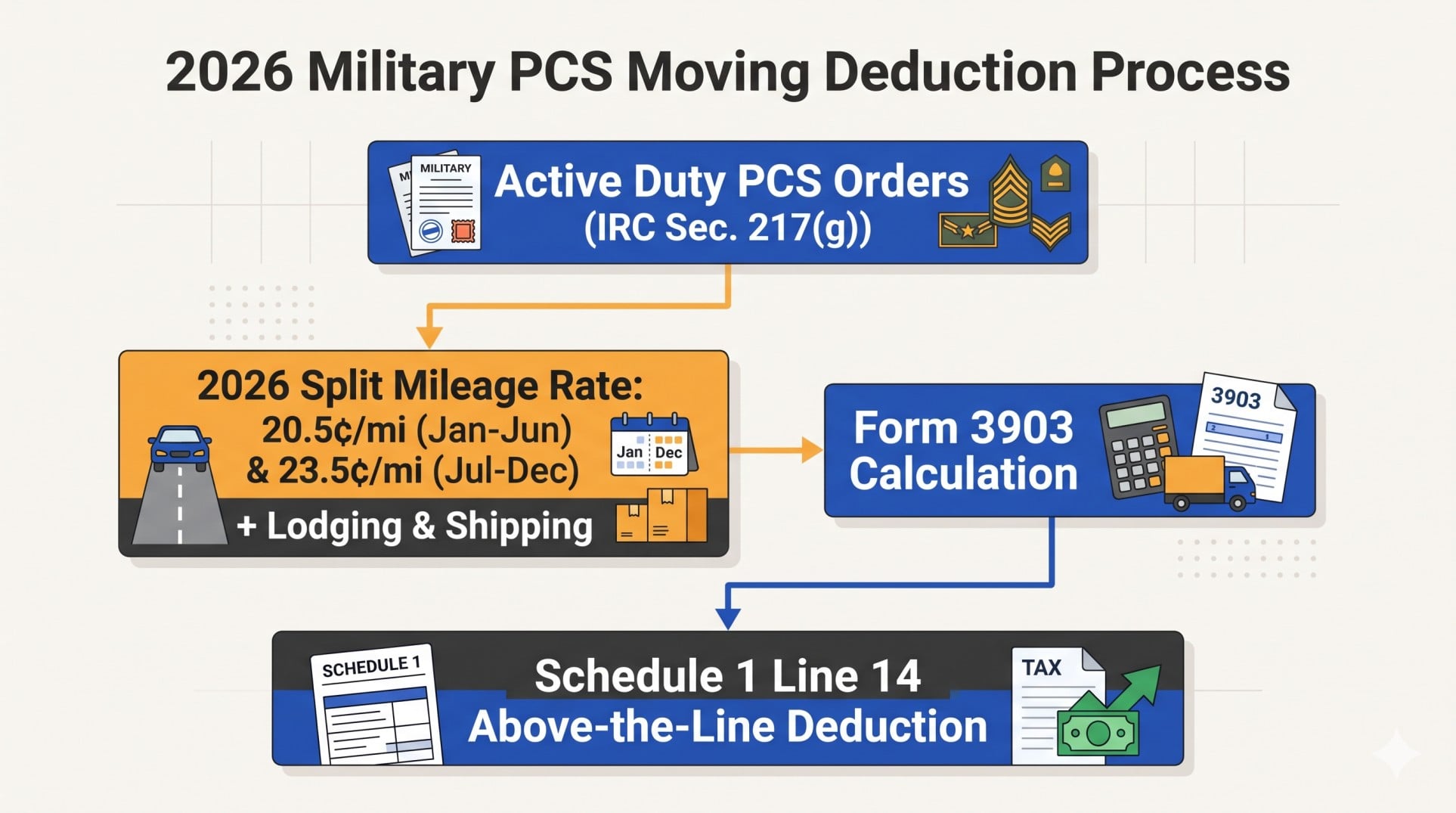
What Counts as a Qualifying PCS Move?
According to IRS Publication 3, active duty military members can claim Form 3903 without meeting any civilian distance or time-worked tests. Three types of military relocations qualify as a PCS:
- A move from your home of record or initial enlistment place to your first post of active duty.
- A move from one permanent duty station to another permanent duty station.
- A move from your last post of duty to your home of record (or to a nearer point in the United States) upon retirement, separation, or discharge, provided the move occurs within one year of ending active duty or within the period allowed under the Joint Travel Regulations (JTR).
The Split 2026 IRS Moving Mileage Rates (Crucial Mid-Year Update)
Because of fuel price volatility in 2026, the IRS took the rare step of issuing two separate standard mileage rates for calendar year 2026. When calculating vehicle expenses on Form 3903, Line 2, you must apply the exact rate in effect on the date your family drove the miles:
- January 1, 2026 through June 30, 2026: 20.5 cents per mile ($0.205) per vehicle driven, plus actual highway tolls and parking fees.
- July 1, 2026 through December 31, 2026: 23.5 cents per mile ($0.235) per vehicle driven, plus actual highway tolls and parking fees.
Alternatively, you may deduct actual out-of-pocket gas and oil expenses (supported by receipts), though you can never deduct depreciation, insurance, or general maintenance repairs on a personal vehicle used in a move. Check our 2026 IRS standard mileage rate breakdown for complete documentation rules.
Deductible vs. Non-Deductible PCS Costs and PPM (DITY) Moves
You can only deduct expenses on Form 3903 that exceed the non-taxable reimbursements and allowances (such as Monetary Allowance in Lieu of Transportation [MALT] and Per Diem) provided by the military:
- Deductible on Form 3903: Commercial moving company charges, rental trucks and trailers, packing boxes and tape, crating, in-transit insurance, shipping pets or personal automobiles, utility disconnection/connection fees related to appliances, up to 30 consecutive days of domestic in-transit storage (or unlimited foreign storage during an OCONUS tour), lodging en route for you and your household members, and vehicle mileage.
- Strictly Non-Deductible: Meals and food en route (meals are permanently disallowed on Form 3903), house-hunting trips prior to the PCS, temporary living expenses after arriving at the new station, security deposits, lease cancellation penalties, vehicle registration/licensing fees at the new state, and home purchase closing costs.
How Personally Procured Moves (PPM / DITY) Are Taxed: When you execute a Personally Procured Move (PPM), the military pays you an incentive equal to 100% of what it would have cost the government to hire a commercial mover. DFAS subtracts your documented moving operating expenses (truck rental, packing supplies, moving pads, and weight scale tickets) and reports the remaining net profit as taxable wages on a separate Travel W-2. Keep every receipt from your PPM—any valid moving expense that you forgot to submit to the military finance office can still be claimed on Form 3903 when you file your 2026 return in 2027.
National Guard and Reserve 100-Mile Travel Deduction
Members of the National Guard and Reserve components who travel more than 100 miles away from home and stay overnight to perform drill or reserve duties can claim an above-the-line deduction for unreimbursed travel, lodging, and 50% of meal expenses on Form 2106, flowing directly to Schedule 1 (Form 1040), Line 12. The deduction is capped at the federal per diem rate for that locality, and mileage is calculated using the 2026 business mileage rate of 72.5 cents per mile (Jan–Jun 2026) and 76.0 cents per mile (Jul–Dec 2026).
Scenario 2: O-3 Captain Executing a Cross-Country PCS Move in July 2026
Consider Captain Sarah, an active duty Army officer (O-3) who receives PCS orders to relocate her household from Fort Liberty, North Carolina, to Joint Base Lewis-McChord, Washington (2,800 miles) in July 2026. The government ships her primary household goods directly via a government bill of lading, but Sarah and her husband drive their two personal vehicles across the country and ship extra fragile heirlooms and their family dog out of pocket.
- Total Qualifying Out-of-Pocket Expenses:
- Driving two vehicles 2,800 miles each in July 2026 (5,600 total miles × $0.235/mile second-half 2026 rate): $1,316
- Highway tolls and hotel parking en route: $144
- 6 nights of hotel lodging en route for the family (excluding all restaurant meals): $1,680
- Out-of-pocket pet transport and overflow crating/shipping: $1,460
- Total Eligible PCS Costs: $4,600
- Subtract Government Reimbursements (Form 3903, Line 4): DFAS pays Sarah a non-taxable MALT and travel lodging reimbursement totaling $2,750 (Note: her Dislocation Allowance [DLA] is a separate tax-free allowance under IRC Section 134 and does not reduce Form 3903 moving expenses unless designated by finance directly for travel/shipping).
- Net Form 3903 Deduction: Sarah enters $1,460 on Form 3903 Line 1 (transportation/storage of goods) and $3,140 on Line 2 (travel and lodging: $1,316 mileage + $144 tolls + $1,680 hotels), totaling $4,600 on Line 3. Subtracting the $2,750 government reimbursement on Line 4 leaves an unreimbursed net moving deduction of $1,850 on Line 5.
- Tax Savings on Form 1040: Sarah transfers the $1,850 directly to Schedule 1, Line 14. Because this is an above-the-line adjustment, it reduces her Adjusted Gross Income (AGI) by $1,850 even though she and her husband claim the $32,200 standard deduction. In the 22% marginal tax bracket, filing Form 3903 saves her $407 in federal income tax.
SCRA State Tax Rules for Service Members and Military Spouses
Under the federal Servicemembers Civil Relief Act (SCRA), active duty service members and their accompanying spouses do not lose or acquire state tax domicile solely by complying with military PCS orders, allowing couples to choose the most favorable of three statutory state residency options under state tax rules.
Without federal protection, moving to a new duty station every three years would force military families to pay income taxes in high-tax states simply because the Pentagon stationed them there. Title 50 U.S.C. Section 4001 blocks host duty states from taxing active duty military pay—and blocks host states from taxing a military spouse’s civilian W-2 or self-employment income—when the couple maintains domicile elsewhere.
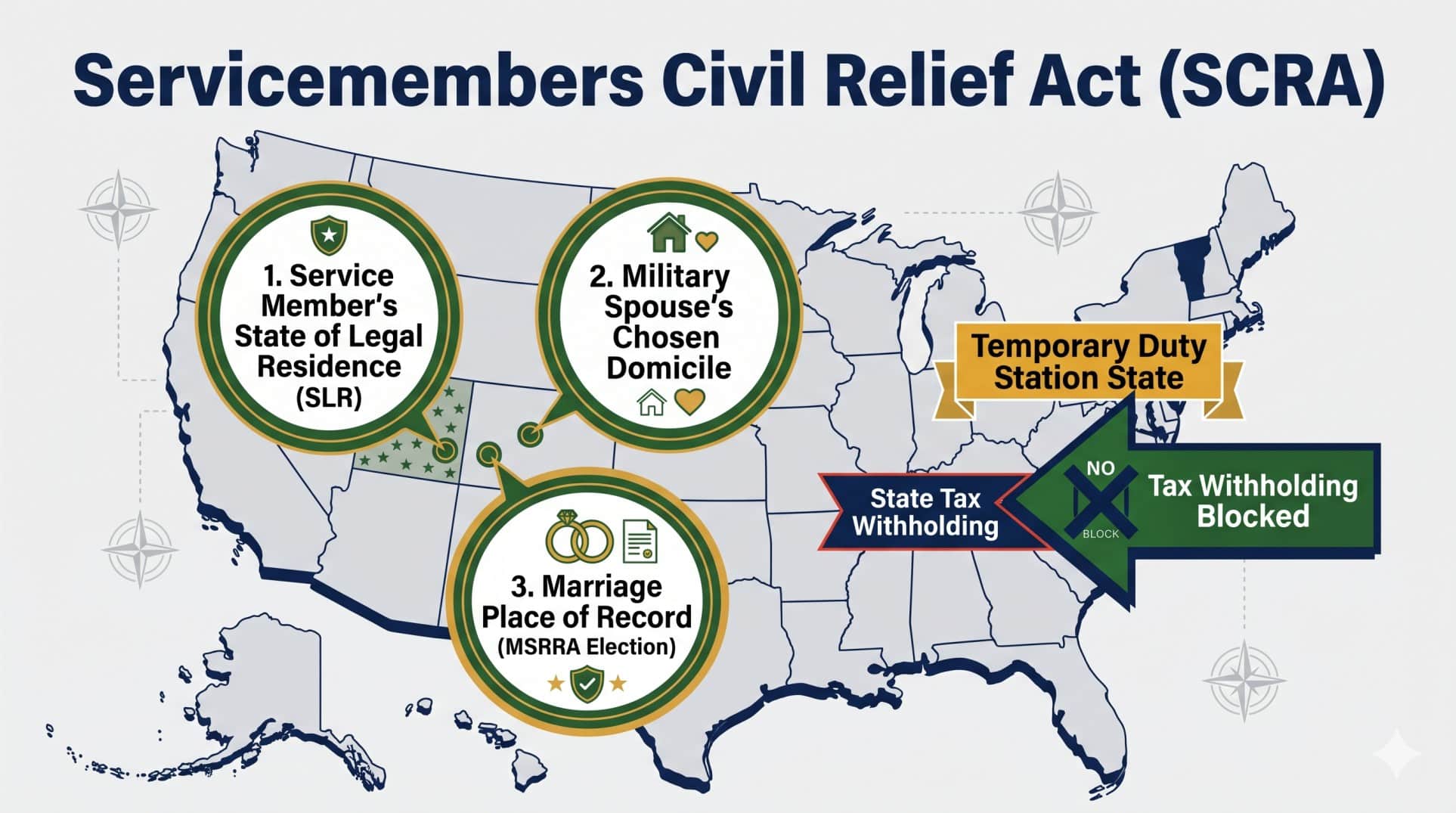
The Three SCRA / MSRRA State Residency Elections
Following the Military Spouses Residency Relief Act (MSRRA), the Veterans Benefits and Transition Act of 2018, and the Veterans Auto and Education Improvement Act (codified at 50 U.S.C. § 4001(a)(3)), an active duty service member and their spouse may elect, for any taxable year of the marriage, to use any of the following three states for state income tax filing, regardless of the date on which they were married:
- The Residence or Domicile of the Service Member: The service member’s official State of Legal Residence (SLR) on file with DFAS via DD Form 2058.
- The Residence or Domicile of the Spouse: The state where the civilian spouse established legal domicile prior to relocating on PCS orders.
- The Permanent Duty Station (PDS) of the Service Member: The state where the service member is currently stationed under PCS orders.
Here is why this matters financially: nine states impose 0% state income tax on earned wages in 2026 (Alaska, Florida, Nevada, New Hampshire, South Dakota, Tennessee, Texas, Washington, and Wyoming). If an Air Force pilot establishes legitimate legal domicile in Texas or Florida during flight training (by registering to vote, getting a driver’s license, registering vehicles, and filing DD Form 2058), and later marries a civilian nurse while stationed in Virginia or California, both the pilot’s military pay and the spouse’s civilian nursing salary in California can be legally exempt from California state income tax by electing the service member’s Texas/Florida residency!
| Income Source / Tax Scenario | Taxable in Legal Domicile State (SLR)? | Taxable in Host Duty Station State (PDS)? | Action Required by Military Family |
|---|---|---|---|
| Active Duty Military Pay (W-2) | Depends on SLR state rules (Many exempt out-of-state active pay) | No — 100% Exempt under SCRA | Maintain valid DD Form 2058 with DFAS payroll |
| Military Spouse W-2 Wages at Duty Station | Yes (0% if SLR is a no-income-tax state like TX, FL, WA) | No — 100% Exempt under SCRA / MSRRA | File state withholding exemption certificate with civilian employer (e.g., CA Form DE 4, VA Form VA-4) |
| Service Member Off-Duty Second Job (Civilian W-2 / Uber) | Yes (Subject to resident credit for taxes paid to host state) | <st

ARUN KP
Author
Entrepreneur | Tax Journalist | India-US Tax Consultant & Professional Accountant. Connect with me on LinkedIn. |