
Handling clergy taxes requires strict adherence to Internal Revenue Code provisions that apply to no other profession in the United States. At the center of ministerial compensation sits the clergy housing allowance, authorized under IRC Section 107. When structured and documented properly, this provision allows duly ordained, commissioned, or licensed ministers to exclude a substantial portion of their gross income from federal income tax.
Missing a single procedural step can invalidate the exclusion entirely. While the One Big Beautiful Bill Act (OBBBA) enacted in July 2025 overhauled major portions of the individual tax code and IRS Revenue Procedure 2025-32 adjusted key thresholds for inflation, the foundational rules governing ministerial compensation remain strictly enforced. Below is the complete technical breakdown of the tax rules for 2026 (for returns filed in 2027), covering the three-part housing limit, dual tax status, and exact IRS form mechanics.
⚡ Executive Summary: Key 2026 Tax Rules at a Glance
- The Three-Part Housing Cap: Under IRC Section 107, a minister’s income-tax-free housing exclusion for Tax Year 2026 cannot exceed the lesser of the church-designated amount, actual 2026 out-of-pocket housing expenses, or the fair market rental value of the furnished home plus utilities. Individual returns are due April 15, 2027.
- Post-OBBBA & Rev. Proc. 2025-32 Baseline: The 2026 Standard Deduction rises to $16,100 for Single filers, $32,200 for Married Filing Jointly, and $24,150 for Head of Household. The itemized State and Local Tax (SALT) cap rises to $40,400 ($20,200 for Married Filing Separately), making it easier for homeowning pastors to itemize on Schedule A.
- SECA Tax & 2026 Wage Base: Housing allowances are exempt from federal income tax but remain 100% subject to the 15.3% Self-Employment Contributions Act (SECA) tax on Schedule SE. The 12.4% Social Security portion applies up to the 2026 wage base limit of $184,500, while the 2.9% Medicare tax applies to all ministerial earnings without limit.
- Prospective Designation Mandate: A church board or authorized committee must officially designate the housing allowance in writing before the minister earns the income. Retroactive designations are completely invalid under Treasury Regulation Section 1.107-1(b).
Table of Contents
- ⚡ Executive Summary: Key 2026 Tax Rules at a Glance
- Who Qualifies as a Minister Under IRS Tax Rules for 2026?
- Understanding the Clergy Housing Allowance and Tax Rules for 2026
- Dual Tax Status and SECA Tax Mechanics in Clergy Taxes
- Double Dipping Mortgage Interest and the $40,400 SALT Cap
- Step-by-Step Guide to Reporting Your 2026 Allowance in 2027
- Retired Ministers and Form 4361 Social Security Opt-Outs
- State Tax Conformity and Church Reporting Changes for 2026
- Frequently Asked Questions About Clergy Taxes and Housing Allowances
- Final Tax Planning Takeaways for 2026 and 2027
Who Qualifies as a Minister Under IRS Tax Rules for 2026?
To claim ministerial tax benefits under the tax rules for 2026, an individual must be a duly ordained, commissioned, or licensed minister who performs sacerdotal functions, conducts religious worship, and administers ordinances or sacraments according to the tenets of a recognized church or religious denomination.
Holding a divinity degree or working on a church payroll does not automatically grant ministerial tax status. According to IRS Publication 517 (Social Security and Other Information for Members of the Clergy and Religious Workers), the IRS evaluates five specific factors established in Tax Court precedent (Knight v. Commissioner and Wingo v. Commissioner) to determine whether a religious worker qualifies for IRC Section 107 treatment.
The Five-Factor IRS Ministerial Test
Every pastor, rabbi, imam, or priest claiming a housing exclusion must satisfy the majority of these five criteria, with ordination, licensing, or commissioning being a mandatory prerequisite:
- Ordination, Licensing, or Commissioning: A church or ecclesiastical body must formally credential the individual to perform ministerial duties.
- Administration of Sacraments: The worker must have the authority to preside over ordinances such as baptisms, communion, weddings, and funerals.
- Conducting Religious Worship: The individual regularly leads congregation members in worship services or spiritual instruction.
- Management Responsibilities: The worker participates in the control, conduct, or maintenance of a local church, religious organization, or integral agency of a denomination.
- Ecclesiastical Recognition: The religious organization and congregation officially recognize the individual as a spiritual leader distinct from lay employees.
Administrative staff, church janitors, IT directors, and non-credentialed worship musicians are treated as standard W-2 employees. Their wages are subject to standard Federal Insurance Contributions Act (FICA) withholding, and they cannot exclude housing costs from gross income.
Understanding the Clergy Housing Allowance and Tax Rules for 2026
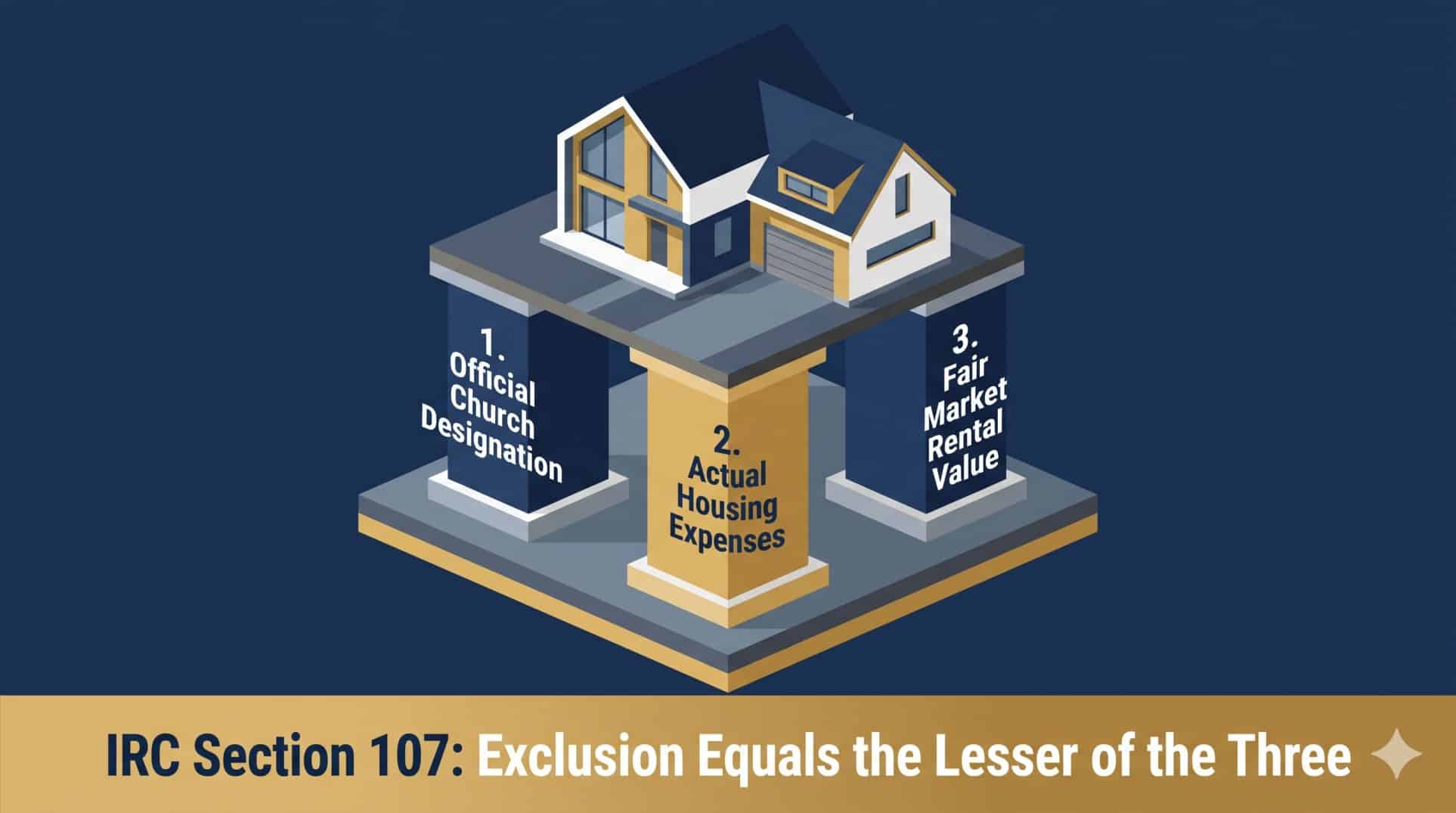
The clergy housing allowance under IRC Section 107 allows qualifying ministers to exclude a designated portion of their ministerial compensation from federal gross income for income tax purposes, capped strictly at the lowest amount produced by the IRS three-part calculation test.
Internal Revenue Code Section 107 splits this benefit into two distinct statutory tracks. IRC Section 107(1) governs a church-owned parsonage or manse provided rent-free to a pastor, allowing the minister to exclude the fair market rental value of the home from gross income. IRC Section 107(2) governs cash allowances paid to ministers who rent an apartment or own their own residence.
The Mandatory Three-Part Limit Test
A church board cannot simply declare 100% of a pastor’s paycheck tax-free without economic substantiation. For a homeowner or renter, the tax-free exclusion under IRC Section 107(2) is strictly limited to the lesser of the following three figures for calendar year 2026:
- The Amount Officially Designated in Advance: The exact dollar figure or compensation percentage formally approved in writing by the church board, elder council, or vestry prior to payment.
- Actual Eligible Housing Expenses Incurred in 2026: The total out-of-pocket cash spent by the minister during the 2026 calendar year to maintain the primary residence.
- Fair Market Rental Value (FMRV): The annual fair market rental value of the home as a furnished residence, plus the actual cost of annual utilities and garage space.
If your church designates $35,000 for 2026, your furnished FMRV plus utilities is $38,000, and your actual out-of-pocket expenses total $31,200, your tax-free exclusion is capped at $31,200. The remaining $3,800 is an “excess housing allowance” that must be added back to taxable wages on Form 1040, Line 1h when you file your return by April 15, 2027.
Eligible vs. Ineligible Housing Expenses
Only expenses directly tied to providing and maintaining a primary home qualify toward your actual expense tally. Tracking these expenditures requires keeping itemized receipts, bank statements, and mortgage year-end summaries throughout 2026. Consider reviewing our guide on tax audit recordkeeping and receipt requirements to ensure your ledger meets IRS standards.
- Qualifying Housing Expenses: Down payments on a primary residence, monthly mortgage principal and interest payments, real estate property taxes, homeowner’s or renter’s insurance premiums, HOA dues, utilities (electricity, natural gas, water, sewer, trash pickup, base landline or residential internet service), structural repairs, new appliances, furniture, rugs, curtains, and lawn care tools.
- Non-Qualifying Expenses: Groceries, paper products, domestic cleaning services or maid wages, personal lawn care labor hired for convenience, commercial home equity loan payments where the proceeds were used for non-housing purposes (such as paying off credit cards, buying a car, or funding college tuition), and expenses for a vacation home or rental property.
Audit Warning — Prepaid Mortgage Interest and Refinancing: Under IRS Publication 517, you can only count housing expenses in the calendar year they are actually paid. You cannot prepay 2027 mortgage payments in December 2026 to artificially inflate your 2026 housing expenses. Similarly, if you take out a home equity line of credit (HELOC), payments only count toward your minister housing allowance if the loan proceeds were spent directly on remodeling or improving your primary residence.
Prospective Designation Rules
Under Treasury Regulation Section 1.107-1(b), a church must designate the allowance prospectively. Most congregations pass an annual housing resolution during their November or December board meeting to cover the upcoming calendar year. If a church hires a new youth pastor in June 2026 or modifies an existing pastor’s allowance mid-year, the board must pass the written resolution before the next payroll cycle is earned. Any income paid prior to the date of the written resolution is permanently ineligible for exclusion.
Dual Tax Status and SECA Tax Mechanics in Clergy Taxes
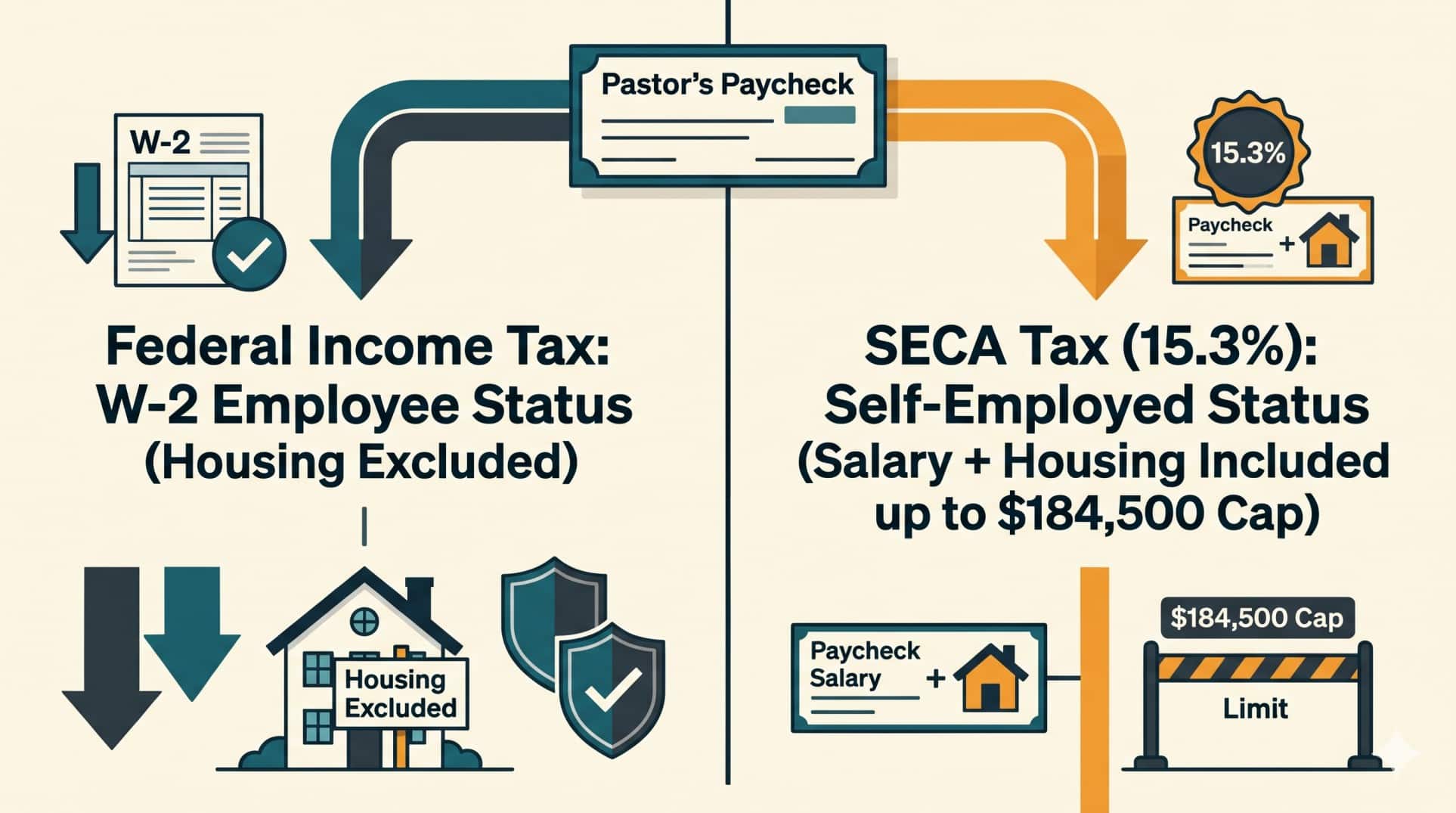
Under federal law, ordained ministers hold a mandatory “dual tax status”: they are classified as common-law employees receiving Form W-2 for federal income tax purposes, but they are classified as self-employed individuals under IRC Section 1402(c) for Social Security and Medicare purposes.
This hybrid classification is the single biggest trap in clergy taxes. Because a minister is treated as self-employed for Social Security and Medicare, a church is legally prohibited from withholding FICA taxes (the standard 7.65% employee share) from a minister’s paycheck. Instead, the minister must pay the full Self-Employment Contributions Act (SECA tax) rate of 15.3% via Schedule SE.
How the 2026 SECA Tax Calculation Works
Here is the rule that surprises newly ordained pastors: while your clergy housing allowance (or the fair rental value of a church-provided parsonage) is excluded from federal income tax, it is 100% included in your net earnings from self-employment when calculating SECA tax on Schedule SE.
For Tax Year 2026, the SECA tax rate consists of two components applied to 92.35% of your combined ministerial income (W-2 Box 1 salary plus your excluded housing allowance plus any net Schedule C ministerial honoraria):
- Social Security Tax (12.4%): Applies to net ministerial earnings up to the 2026 Social Security wage base limit of $184,500 (increased from $176,100 in 2025). The maximum Social Security tax a minister can owe in 2026 is $22,878.
- Medicare Tax (2.9%): Applies to all net ministerial earnings with no income cap. High-earning clergy also face the 0.9% Additional Medicare Tax on earned income exceeding $200,000 for Single filers or $250,000 for Married Filing Jointly.
To soften the blow of paying both the employer and employee halves of Social Security and Medicare, the tax code provides two adjustments. First, when filling out Schedule SE, you multiply your total ministerial earnings by 92.35% (0.9235) before applying the 15.3% tax rate. Second, you claim an “above-the-line” adjustment to income on Schedule 1 (Form 1040), Line 15 for 50% of your total SECA tax liability. This deduction lowers your Adjusted Gross Income (AGI) regardless of whether you take the standard deduction or itemize.
| Tax Provision / Threshold | Tax Year 2025 (Filed in 2026) | Tax Year 2026 (Filed in 2027) | Impact on Clergy Tax Returns |
|---|---|---|---|
| Standard Deduction (Single / MFS) | $15,750 | $16,100 | Reduces W-2 Box 1 taxable ministerial wages |
| Standard Deduction (Married Filing Jointly) | $31,500 | $32,200 | Reduces joint taxable income after housing exclusion |
| Standard Deduction (Head of Household) | $23,625 | $24,150 | Reduces taxable income for qualifying single parents |
| Aged 65+ Additional Standard Deduction | $2,000 (Single) / $1,600 (MFJ) | $2,050 (Single) / $1,650 (MFJ) | Stacks on top of basic standard deduction for seniors |
| OBBBA Senior Bonus Deduction (Age 65+) | $6,000 per qualifying spouse | $6,000 per qualifying spouse | Available to both itemizers and standard deduction filers (phases out at $75k Single / $150k MFJ) |
| Itemized SALT Deduction Cap | $40,000 ($20,000 MFS) | $40,400 ($20,200 MFS) | Expands ability for clergy homeowners to “double dip” property taxes on Schedule A |
| Social Security (SECA) Wage Base | $176,100 | $184,500 | 12.4% portion of SECA applies to salary + housing allowance up to this cap |
| Form 1099-NEC Reporting Threshold | $600 | $2,000 | Churches issue 1099-NEC to guest speakers only when payments hit $2,000+ |
Scenario 1: Full-Time Senior Pastor Owning a Home (2026 Math)
Let’s examine Pastor David, a married senior pastor in Texas filing a joint return (MFJ) for Tax Year 2026. His spouse has no outside income. His church sets his total 2026 compensation package at $95,000. In December 2025, the church elder board passed a resolution designating $35,000 of that package as his 2026 minister housing allowance.
During 2026, Pastor David spends $32,000 on mortgage principal, mortgage interest, property taxes, utilities, and a replacement water heater. A local realtor confirms the fair market rental value of his furnished home plus annual utilities is $36,000.
- Step 1 (Apply Three-Part Housing Test): We compare the designated amount ($35,000), actual expenses ($32,000), and furnished FMRV plus utilities ($36,000). The lowest figure is $32,000. Because the church excluded $35,000 from Box 1 of his Form W-2 (reporting $60,000 in Box 1), Pastor David has an excess housing allowance of $3,000 ($35,000 designated minus $32,000 actual).
- Step 2 (Calculate SECA Tax on Schedule SE): SECA applies to his total ministerial earnings before any excess recapture adjustment. That equals $60,000 W-2 salary + $35,000 designated housing allowance = $95,000. Multiplying $95,000 by 92.35% yields net self-employment earnings of $87,732.50. Since this is well below the $184,500 Social Security cap, we multiply $87,732.50 by 15.3%, resulting in a 2026 SECA tax liability of $13,423.
- Step 3 (Calculate Above-the-Line Deduction): On Schedule 1, Line 15, Pastor David deducts 50% of his SECA tax, which equals $6,712.
- Step 4 (Calculate 2026 Federal Income Tax): On Form 1040, Pastor David reports $60,000 on Line 1a (from W-2 Box 1) and adds the $3,000 excess allowance on Line 1h, bringing total gross income to $63,000. Subtracting the $6,712 Schedule 1 SECA deduction yields an Adjusted Gross Income (AGI) of $56,288. Claiming the 2026 Married Filing Jointly standard deduction of $32,200 reduces his taxable income to $24,088. Under IRS Revenue Procedure 2025-32, the 2026 10% bracket for MFJ covers taxable income up to $24,800. His federal income tax is 10% of $24,088, or $2,409.
- Step 5 (Total 2026 Tax Liability): Combining his $2,409 income tax and $13,423 SECA tax gives a total federal bill of $15,832.
Covering SECA Taxes: Estimated Payments vs. Voluntary W-4 Withholding
Because churches cannot withhold FICA taxes, pastors often face underpayment penalties on April 15 if they don’t plan ahead. You have two compliant ways to pay your combined income and SECA taxes throughout 2026:
- Quarterly Estimated Tax Payments (Form 1040-ES): You can remit quarterly payments directly to the IRS. For Tax Year 2026, the four quarterly deadlines are April 15, 2026; June 15, 2026; September 15, 2026; and January 15, 2027. Look at our detailed breakdown of quarterly estimated tax safe harbor rules to avoid IRS underpayment penalties.
- Voluntary Income Tax Withholding (Form W-4): While federal law prohibits mandatory FICA withholding on ministerial wages, IRC Section 3402(p) allows a minister and church to enter into a voluntary federal income tax withholding agreement. By entering a dollar amount on Step 4(c) (Extra Withholding) of Form W-4, you can instruct your church payroll provider to withhold enough extra federal income tax from each paycheck to cover both your income tax and your 15.3% SECA obligation.
Double Dipping Mortgage Interest and the $40,400 SALT Cap
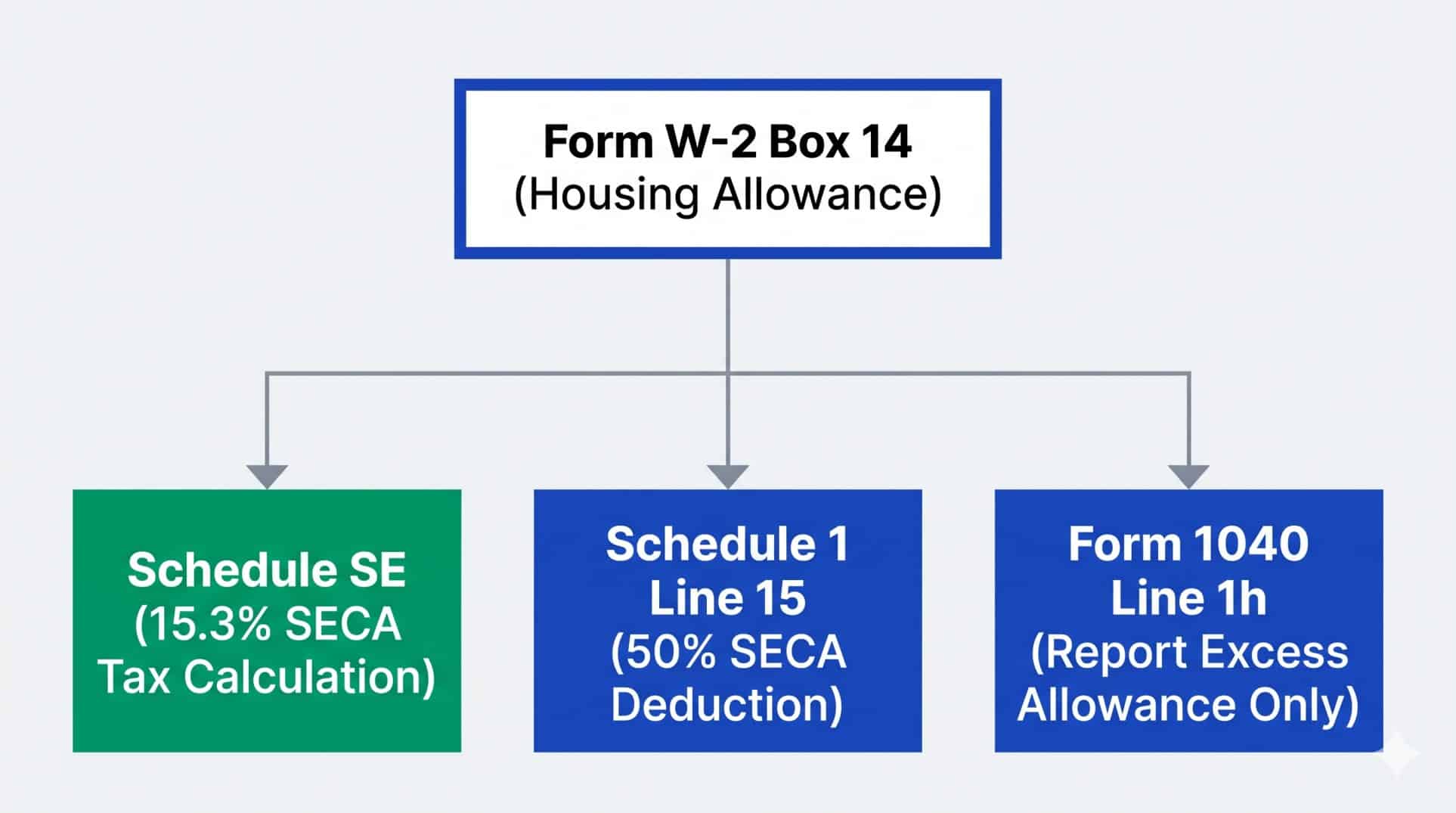
Under IRC Section 265(a)(6), ministers who own their homes are legally permitted to exclude their clergy housing allowance from gross income while simultaneously deducting the exact same qualified mortgage interest and real estate property taxes as itemized deductions on Schedule A.
In general tax law, IRC Section 265 prohibits taxpayers from deducting expenses that were paid using tax-exempt income. Congress carved out a specific statutory exception in Section 265(a)(6) exclusively for ministers and military personnel. This “double dip” allows a pastor to use tax-free housing allowance dollars to pay the bank and county tax assessor, and then deduct those exact mortgage interest and property tax payments a second time if they itemize deductions on Schedule A.
How the OBBBA $40,400 SALT Cap Changes the Math for 2026
Between 2018 and 2024, the $10,000 cap on State and Local Tax (SALT) deductions prevented most pastors from itemizing because their combined mortgage interest, capped SALT, and charitable tithing fell short of the standard deduction. The passage of the One Big Beautiful Bill Act (OBBBA) altered this calculation for 2026.
For Tax Year 2026, the itemized SALT deduction cap is $40,400 for Single, Head of Household, and Married Filing Jointly filers (and $20,200 for Married Filing Separately), phasing out only when Modified Adjusted Gross Income (MAGI) exceeds $505,000 ($252,500 MFS). Pastors living in high-property-tax or high-income-tax states—such as California, New Jersey, New York, Illinois, or Connecticut—who also tithe 10% of their income to their church may now find that their Schedule A itemized deductions exceed the $32,200 joint standard deduction.
What if you don’t itemize? Starting in Tax Year 2026 under the OBBBA, taxpayers who claim the standard deduction can also claim an above-the-line charitable deduction of up to $1,000 for Single filers or $2,000 for Married Filing Jointly for cash contributions made to qualifying churches and charities. You can read more about how this stacks in our 2026 standard deduction vs itemized deduction guide.
Step-by-Step Guide to Reporting Your 2026 Allowance in 2027
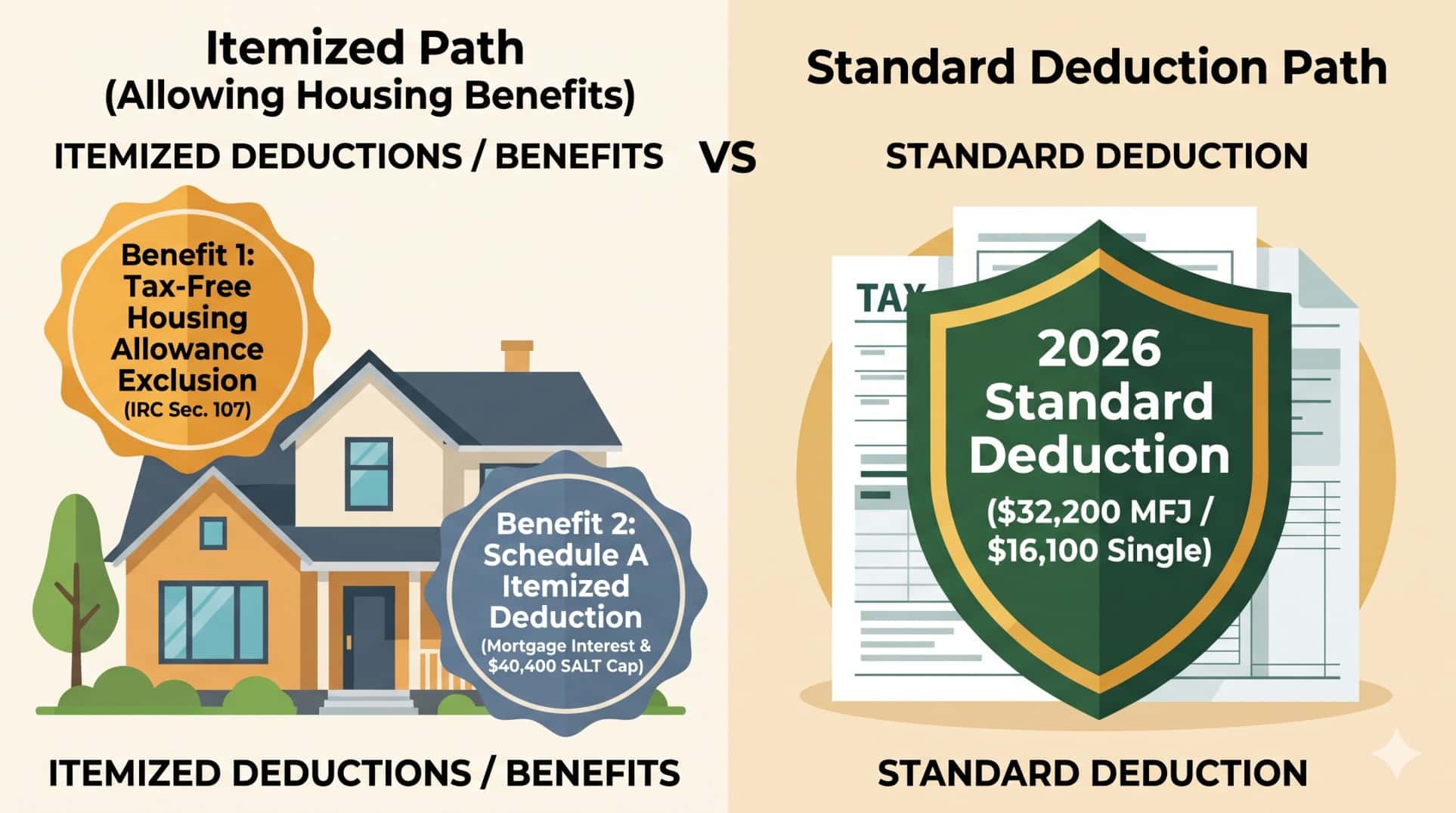
To report a minister housing allowance properly on your 2026 tax return (filed in 2027), you must verify that the excluded amount is omitted from Form W-2 Box 1, include the full allowance on Schedule SE to calculate SECA tax, and report any unspent excess allowance on Form 1040, Line 1h.
Filing errors on clergy returns frequently trigger automated IRS CP2000 underreporter notices—most commonly when a tax preparer sees a W-2 with blank Social Security and Medicare boxes (Boxes 3 through 6) and forgets to attach Schedule SE. Follow these five steps to prepare an audit-proof return.
Step 1: Audit Your Form W-2 from the Church (January 2027)
By February 1, 2027, your church treasurer must issue your 2026 Form W-2. Verify these exact boxes before entering numbers into your tax software:
- Box 1 (Wages, tips, other compensation): Must show ONLY your taxable base salary (and any taxable fringe benefits or grossed-up SECA offsets). It must exclude your officially designated housing allowance.
- Boxes 3, 4, 5, and 6 (Social Security and Medicare wages/tax withheld): Must be completely blank (or $0.00) for all ministerial compensation. If your church withheld FICA taxes in error, ask the treasurer to issue a corrected Form W-2c immediately.
- Box 14 (Other): Should display your designated housing allowance for informational purposes (e.g., “Housing Allowance: $30,000” or “Parsonage Value: $24,000”).
Step 2: Reconcile the Three-Part Test and Apply the Deason Rule
Total your 2026 housing receipts and compare them against the church designation and your home’s furnished FMRV. If you incurred unreimbursed ministry business expenses (such as mileage for hospital visitations or theological books) and you receive side honoraria on Schedule C, you must also apply the Deason allocation rule (derived from Deason v. Commissioner and detailed in IRS Publication 517).
Under the Deason rule, you cannot deduct business expenses on Schedule C that are allocable to tax-free housing allowance income. If 30% of your total ministerial compensation comes from a tax-free housing allowance, you must reduce your otherwise deductible Schedule C ministerial business expenses by 30% using the Worksheets in IRS Publication 517.
Step 3: Report Any Excess Housing Allowance on Form 1040, Line 1h
If your designated allowance was less than or equal to both your actual expenses and your furnished FMRV, you do not report the housing allowance anywhere on the face of Form 1040 for income tax purposes. However, if your designated allowance exceeded either your actual 2026 expenses or your FMRV, the difference is taxable income. Enter that excess dollar amount on Form 1040, Line 1h (Other earned income), and write “Excess allowance” and the dollar amount on the dotted line next to Line 1h.
Step 4: Complete Schedule C for Outside Honoraria and QBI
When congregants or outside individuals pay you directly for performing weddings, funerals, baptisms, or guest preaching, those fees are not W-2 church wages. Report them as gross receipts on Schedule C (Form 1040). If a host church pays you $2,000 or more for guest speaking in 2026, you will receive Form 1099-NEC; even if payments fall under the new $2,000 reporting threshold, every dollar of honoraria must be reported on Schedule C.
Because the OBBBA made the 20% Qualified Business Income (QBI) deduction under IRC Section 199A permanent, net profit reported on Schedule C from outside ministerial services is generally eligible for the 20% QBI deduction on Form 8995, provided your total 2026 taxable income stays below the phase-out thresholds ($201,775 Single / $403,500 Married Filing Jointly, with a $1,000 minimum QBI rule taking effect in 2026).
Step 5: Calculate SECA Tax on Schedule SE
On Schedule SE (Form 1040), Part I, combine your W-2 Box 1 ministerial salary, your full tax-free housing allowance (and/or parsonage FMRV), and your net Schedule C ministerial profit (after applying the Deason reduction). Multiply the sum by 0.9235 on Line 4a, calculate the 15.3% SECA tax (observing the $184,500 Social Security cap), transfer the tax to Schedule 2, Line 4, and claim the 50% deduction on Schedule 1, Line 15.
| Clergy Compensation / Arrangement | Federal Income Tax Treatment (Form 1040) | SECA Tax Treatment (Schedule SE) | Primary IRS Reporting Form & Line |
|---|---|---|---|
| Base Ministerial Salary | 100% Taxable | 100% Taxable (15.3%) | Form W-2 Box 1; Form 1040 Line 1a; Schedule SE |
| Qualifying Cash Housing Allowance (IRC § 107(2)) | 100% Excluded (up to 3-part cap) | 100% Taxable (15.3%) | Form W-2 Box 14; Schedule SE Line 2 |
| Excess Housing Allowance (Unspent / Over Cap) | 100% Taxable | Already included in total designation on Schedule SE | Form 1040 Line 1h (“Excess allowance”) |
| Church-Provided Parsonage Value (IRC § 107(1)) | 100% Excluded | 100% Taxable (Fair Market Rental Value) | Schedule SE Line 2 (Include FMRV + church-paid utilities) |
| Parsonage Utility / Furnishing Allowance | Excluded (to extent spent on parsonage expenses) | 100% Taxable (15.3%) | Form W-2 Box 14; Form 1040 Line 1h if excess |
| Church “SECA Offset” / Social Security Bonus | 100% Taxable as additional wages | 100% Taxable (15.3%) | Included directly in Form W-2 Box 1; Schedule SE |
| Direct Wedding / Funeral Honoraria | 100% Taxable (Eligible for 20% QBI Deduction) | 100% Taxable (15.3%) | Schedule C; Form 8995; Schedule SE |
| 403(b)(9) Retirement Housing Distributions | 100% Excluded (up to 3-part cap) | 100% Exempt from SECA | Form 1099-R; Form 1040 Lines 5a and 5b |
Scenario 2: Youth Pastor Living in a Church Parsonage with Honoraria
Consider Pastor Hannah, a single associate pastor in Ohio who lives rent-free in a church-owned parsonage during 2026. The church pays her a cash salary of $48,000. In December 2025, the church board designated $4,000 of that $48,000 as a “parsonage utility and furnishing allowance.” The fair market rental value of the parsonage is $18,000 per year.
During 2026, Hannah spends $4,300 out of pocket on electric bills, heating oil, and living room furniture for the parsonage. She also officiates six weddings and receives $3,000 in direct cash honoraria from the couples, incurring $0 in business expenses.
- Income Tax Calculation: Because Hannah spent $4,300 on parsonage utilities and furnishings, she fully substantiates her $4,000 parsonage allowance. Her Form W-2 Box 1 shows $44,000 ($48,000 minus $4,000). The $18,000 parsonage rental value is completely excluded from income tax under IRC Section 107(1). She reports her $3,000 wedding honoraria on Schedule C.
- SECA Tax Calculation: For Schedule SE, Hannah must combine her W-2 Box 1 salary ($44,000), her parsonage utility allowance ($4,000), the fair market rental value of the parsonage ($18,000), and her Schedule C wedding fees ($3,000). Her total SECA base is $69,000. Multiplying $69,000 by 92.35% equals $63,721.50. At 15.3%, her 2026 SECA tax is $9,749, generating a 50% Schedule 1 deduction of $4,875.
- QBI and Final Taxable Income: Her Adjusted Gross Income is $44,000 (W-2) + $3,000 (Schedule C) – $4,875 (Half SECA) = $42,125. She claims the 2026 Single standard deduction of $16,100. Because her Schedule C net income is $3,000 (exceeding the 2026 $1,000 minimum QBI threshold), she also claims a 20% QBI deduction on Form 8995 of $563 (20% of $3,000 reduced by the allocable share of her SECA deduction). Her final 2026 taxable income is $25,462.
Retired Ministers and Form 4361 Social Security Opt-Outs
Retired clergy enjoy a unique tax advantage under Revenue Ruling 63-156 and Revenue Ruling 75-22: distributions from a denominational pension or 403(b)(9) church retirement plan can be designated as a tax-free clergy housing allowance, and those retirement distributions are completely exempt from SECA tax.
During active ministry, housing allowances are free from income tax but hit with the 15.3% SECA tax. In retirement, the tax code removes the SECA burden entirely. According to IRS Publication 517, pension payments and retirement housing allowances received for past ministerial services are permanently excluded from net earnings from self-employment.
Rules for 403(b)(9) Retirement Housing Designations
To exclude retirement distributions under IRC Section 107, the distribution must come from a church-sponsored retirement plan (such as a 403(b)(9) Denominational Pension Board account like GuideStone, MMBB, Wespath, or Portico) and the pension board must pass an official housing allowance designation. Keep three strict limits in mind:
- Individual IRAs Do Not Qualify: If a retired pastor rolls a 403(b)(9) church retirement account into a traditional commercial IRA at a retail brokerage, the ability to designate distributions as a tax-free housing allowance is permanently lost.
- Three-Part Test Still Applies: A retired minister can only exclude the lesser of the pension board’s designation, actual 2026 housing expenses, or the furnished FMRV plus utilities.
- No Survivor Inheritance: The housing exclusion is tied strictly to the minister who performed the pastoral services. A non-minister surviving spouse who inherits a 403(b)(9) account cannot exclude distributions as a housing allowance.
Reporting Form 1099-R for Retired Pastors
Denominational pension boards issue Form 1099-R with Box 2b (“Taxable amount not determined”) checked because the pension board does not know what you actually spent on housing. When filing Form 1040 in 2027, enter the gross distribution on Line 5a, subtract your substantiated 2026 housing expenses, and enter only the remaining taxable balance (if any) on Line 5b. On the dotted line next to Line 5b, write “Rev. Rul. 75-22” or “Housing Allowance” as supported by your tax software. For broader retirement rules, review our 2026 retirement distribution and RMD tax guide.
Scenario 3: Retired Pastor Age 67 Claiming 403(b)(9) Housing Plus the OBBBA Senior Deduction
Take Pastor Robert, age 67, and his wife Maria, age 66, filing Married Filing Jointly for 2026. Robert is fully retired from ministry. In 2026, he withdraws $45,000 from his denominational 403(b)(9) retirement plan (which designates up to 100% of distributions as housing allowance), receives $28,000 in taxable pension income from a former secular teaching job, and collects $30,000 in Social Security benefits. In 2026, Robert and Maria spend $26,000 on property taxes, insurance, utilities, and home maintenance, and their home’s furnished FMRV is $34,000.
- 403(b)(9) Exclusion: Robert reports $45,000 on Form 1040, Line 5a, excludes his $26,000 of actual housing expenses, and reports only $19,000 as taxable on Line 5b. He owes $0 in SECA tax on the entire $45,000 distribution.
- Stacking 2026 Senior Deductions: Under the OBBBA and IRS Revenue Procedure 2025-32, Robert and Maria receive massive deductions for 2026:
- Basic 2026 Married Filing Jointly Standard Deduction: $32,200
- Additional Aged 65+ Standard Deduction ($1,650 × 2 spouses): $3,300
- OBBBA Temporary Senior Bonus Deduction ($6,000 × 2 spouses, since their MAGI is well under the $150,000 joint phase-out threshold): $12,000
- Final 2026 Tax Result: Their combined total deductions equal $47,500 ($32,200 + $3,300 + $12,000). Because their combined taxable pension income is $47,000 ($19,000 net church pension + $28,000 secular pension) and only a minor fraction of their Social Security is taxable, the $47,500 deduction stack wipes out almost their entire 2026 federal income tax liability.
Form 4361: Opting Out of Social Security
Under IRC Section 1402(e), a newly ordained minister may file Form 4361 (Application for Exemption From Self-Employment Tax for Use by Ministers, Members of Religious Orders and Christian Science Practitioners) to opt out of SECA tax on ministerial earnings. However, the IRS enforces two strict barriers:
- Conscientious Objection Only: You must certify under penalty of perjury that you are conscientiously opposed to, or opposed because of religious principles to, the acceptance of any public insurance (including Social Security and Medicare) with respect to ministerial services. Opting out for financial or investment reasons is illegal.
- Strict Two-Year Deadline: Form 4361 must be filed on or before the due date of the tax return (including extensions) for the second tax year in which the minister had net earnings from self-employment of $400 or more, any part of which came from ministerial services. If a pastor was ordained and earned $400+ in 2025 and again in 2026, the absolute deadline to file Form 4361 is April 15, 2027 (or October 15, 2027, with a valid extension). Once approved by the IRS, the exemption is permanently irrevocable.
State Tax Conformity and Church Reporting Changes for 2026
While virtually all US states with a state income tax conform to the federal IRC Section 107 exclusion for the clergy housing allowance, notable state decoupling rules exist, and churches must also adapt to new federal payroll and 1099 thresholds for 2026.
State Income Tax Conformity and Pennsylvania’s Exception
Most states begin their personal income tax computation with Federal Adjusted Gross Income (AGI) or Federal Taxable Income. Because a properly substantiated housing allowance is excluded before arriving at Federal AGI, it automatically escapes state income tax in states like California, New York, Ohio, Georgia, and North Carolina.
Pennsylvania is the primary state conformity exception to watch closely. Pennsylvania’s personal income tax operates on a gross-income system that does not conform to every Internal Revenue Code exclusion. Under Pennsylvania Department of Revenue guidance (PA Personal Income Tax Guide, Chapter 7), the fair rental value of a church-provided parsonage is excludable, and a cash housing allowance paid directly for utilities or housing costs required for the convenience of the employer may be excluded in specific circumstances, but Pennsylvania scrutinizes out-of-pocket cash allowances much more aggressively than the IRS. Furthermore, local Earned Income Tax (EIT) collectors across Pennsylvania municipalities frequently attempt to tax cash housing allowances if church documentation is imprecise. Ministers serving in Pennsylvania or New Jersey should verify state-level withholding rules with a local CPA.
Church Administrative Updates Under the OBBBA for 2026
Church business administrators and treasurers managing clergy taxes in 2026 must implement three statutory updates enacted by the One Big Beautiful Bill Act:
- $2,000 Form 1099-NEC / 1099-MISC Threshold: Effective for payments made on or after January 1, 2026, the reporting threshold for issuing Form 1099-NEC (to guest speakers, supply preachers, and freelance musicians) and Form 1099-MISC rises from $600 to $2,000. Check our 2026 Form 1099-NEC reporting rules for organizations for W-9 compliance details.
- Accountable Reimbursement Plans (IRC Section 62): Under the OBBBA, the suspension of miscellaneous itemized deductions for unreimbursed employee W-2 business expenses (formerly the 2%-of-AGI floor on Schedule A) was made permanent. If a pastor pays for church travel, conferences, or ministry supplies out of pocket without reimbursement, those expenses are 0% deductible against W-2 income tax (though they still reduce SECA earnings on Schedule SE). Churches should establish a written Accountable Reimbursement Plan under IRC Section 62(c) so ministers can be reimbursed 100% tax-free for substantiated business mileage (at the IRS standard business rate) and ministry expenses.
- OBBBA Overtime and Tip Deductions: While ordained ministers are generally exempt from Fair Labor Standards Act (FLSA) overtime rules under the ministerial exception, non-exempt lay church employees (such as hourly custodial staff, administrative assistants, or nursery workers) who earn FLSA overtime in 2026 can claim the new OBBBA overtime deduction of up to $12,500 ($25,000 MFJ) on their 2026 personal returns.
Frequently Asked Questions About Clergy Taxes and Housing Allowances
1. Isthere a maximum percentage of a pastor’s salary that can be designated as a housing allowance in 2026?
No, the Internal Revenue Code places no statutory percentage limit (such as 30% or 50%) on how much of a minister’s compensation can be designated as a housing allowance. As long as total compensation is reasonable for the ministerial services performed, up to 100% of a part-time or bi-vocational pastor’s church salary can be designated, provided the exclusion does not exceed actual 2026 housing expenses or the furnished fair market rental value plus utilities.
2. Can a church designate a clergy housing allowance retroactively for 2026?
No, a church cannot designate a housing allowance retroactively under any circumstances. Per Treasury Regulation Section 1.107-1(b), the church board or authorized body must officially adopt the designation in writing before the minister earns the salary. Any compensation paid prior to the formal resolution date is fully taxable for income tax purposes.
3. Do pastors have to pay Social Security and Medicare tax on their housing allowance?
Yes, active ministers must pay the full 15.3% SECA tax on both their cash salary and their excluded housing allowance (or the fair rental value of a parsonage). For Tax Year 2026, the 12.4% Social Security portion applies up to $184,500 of net ministerial earnings on Schedule SE, and the 2.9% Medicare portion applies to all ministerial earnings without a cap.
4. What happens if I don’t spend all of my designated 2026 housing allowance?
If your church-designated housing allowance exceeds your actual 2026 out-of-pocket housing expenses (or exceeds your home’s furnished fair market rental value), the unspent difference is taxable as an excess housing allowance. You must report that excess amount as taxable income on Form 1040, Line 1h when you file your return in 2027, writing “Excess allowance” next to the line.
5. Can a pastor claim a housing allowance on two homes at the same time?
No, according to IRS Publication 517 and Tax Court precedent (Driscoll v. Commissioner), the IRC Section 107 exclusion applies exclusively to a minister’s single primary residence. You cannot include mortgage payments, utilities, or upkeep for a vacation cabin, second home, or commercial rental property in your housing allowance calculation.
6. Does a home equity loan (HELOC) count toward actual housing expenses for a minister?
A home equity loan or HELOC payment only qualifies as an eligible housing expense if the borrowed funds were spent directly on purchasing, remodeling, or maintaining the minister’s primary residence. If a pastor refinances a mortgage or pulls out home equity to pay off auto loans, medical bills, or college tuition, repayments on that portion of the debt cannot be excluded under IRC Section 107.
7. How does a church “SECA offset” or Social Security allowance get taxed?
Many churches pay their pastor an extra 7.65% bonus—often called a SECA offset—to help cover the employer half of Social Security and Medicare. Unlike the housing allowance, a SECA offset is 100% taxable for both federal income tax and SECA tax. The church must add the offset directly into Box 1 of the minister’s Form W-2.
8. Can a bi-vocational pastor designate 100% of their church income as a housing allowance?
Yes, if a bi-vocational minister works a secular daytime job and serves a church part-time for $20,000 a year, the church board can designate all $20,000 as a housing allowance in advance. As long as the pastor’s actual 2026 housing expenses and furnished FMRV equal or exceed $20,000, the entire church paycheck is exempt from federal income tax (though it remains subject to 15.3% SECA tax on Schedule SE).
9. Are love offerings and Christmas gifts from the congregation taxable to a pastor?
Yes, nearly all cash love offerings, pastor appreciation collections, and holiday bonuses given through the church or by congregation members in recognition of ministerial services are taxable compensation under IRC Section 61. If given through the church, they must be included in Form W-2 Box 1; if given directly by individuals for specific services, they are reported on Schedule C.
10. What is the deadline to file 2026 clergy taxes and Form 4361 in 2027?
For Tax Year 2026, fourth-quarter estimated tax payments (Form 1040-ES) are due January 15, 2027, and individual Form 1040 returns are due April 15, 2027 (or October 15, 2027, if you file Form 4868 for an automatic six-month extension). If you are eligible to opt out of Social Security via Form 4361 and 2026 was your second year earning $400+ in ministerial net income, Form 4361 must also be filed by your 2026 return due date in 2027.
Final Tax Planning Takeaways for 2026 and 2027
Maximizing the clergy housing allowance requires proactive coordination between the minister and the church board long before tax season arrives in 2027. Because the IRS enforces the three-part limit strictly on an annual cash-basis calendar year, pastors should review their year-to-date housing receipts every autumn. If you anticipate major home repairs, appliance replacements, or a roof upgrade before December 31, 2026, request an amended prospective designation from your church board before paying those invoices.
At the same time, verify that your church board places your 2027 housing allowance resolution on the December 2026 meeting agenda so your exclusion remains uninterrupted for the new year. By pairing a properly documented housing resolution with an IRC Section 62(c) Accountable Reimbursement Plan and accurate Schedule SE reporting, ministers can legally minimize their tax burden while maintaining 100% compliance with IRS regulations.
Disclaimer: This content provides general information for educational purposes only and reflects federal tax laws applicable to Tax Year 2026 (returns filed in 2027). Tax laws are complex and subject to change. This article does not constitute professional tax, legal, or accounting advice. Always consult a certified public accountant (CPA), enrolled agent (EA), or qualified tax attorney regarding your specific financial situation. Ourtaxpartner.com is not responsible for any actions taken based on the information provided herein.
