
Getting a real, live human being on the phone at the Internal Revenue Service (IRS) can feel like an impossible task. Automated phone trees and long hold times leave many taxpayers frustrated.
This guide combines official IRS phone numbers and hours with the most commonly reported (though unofficial and not guaranteed) menu sequences taxpayers use to reach a representative faster — along with honest caveats about what actually works.
⚡ Quick Summary
- The main IRS individual-taxpayer line is 1-800-829-1040, open 7 a.m. to 7 p.m. local time, Monday–Friday (residents of Alaska and Hawaii should follow Pacific time).
- There is no single official “secret code” guaranteed to reach a live agent — menu paths change periodically. The most widely reported sequence is: Press 1 (English) → 2 (personal income tax) → 1 (form/payment questions) → 3 (all other questions) → 2 (all other questions again). When asked for your SSN/EIN, many users report that not entering it (twice) leads to a new menu.
- Average telephone wait time is about 3 minutes during filing season (January–April) and roughly 15 minutes during the off-season (May–December), per IRS-reported data.
- Wait times are typically shorter Wednesday through Friday; Mondays and Tuesdays see the heaviest call volume.
- Have your SSN/ITIN, filing status, prior-year return, and any IRS notice ready — representatives must verify your identity before discussing account details.
Table of Contents
- Reported IRS Phone Menu Shortcut (Use With Caution)
- Direct IRS Phone Numbers for Specific Needs
- Alternative Ways to Reach a Real Person
- Skip the Phone Queue: Digital IRS Tools
- Strategic Tips to Reduce Your Hold Times
- Checklist: What to Have Ready Before You Call
- ⚠️ How to Spot an IRS Phone Scam
- Frequently Asked Questions
Reported IRS Phone Menu Shortcut (Use With Caution)
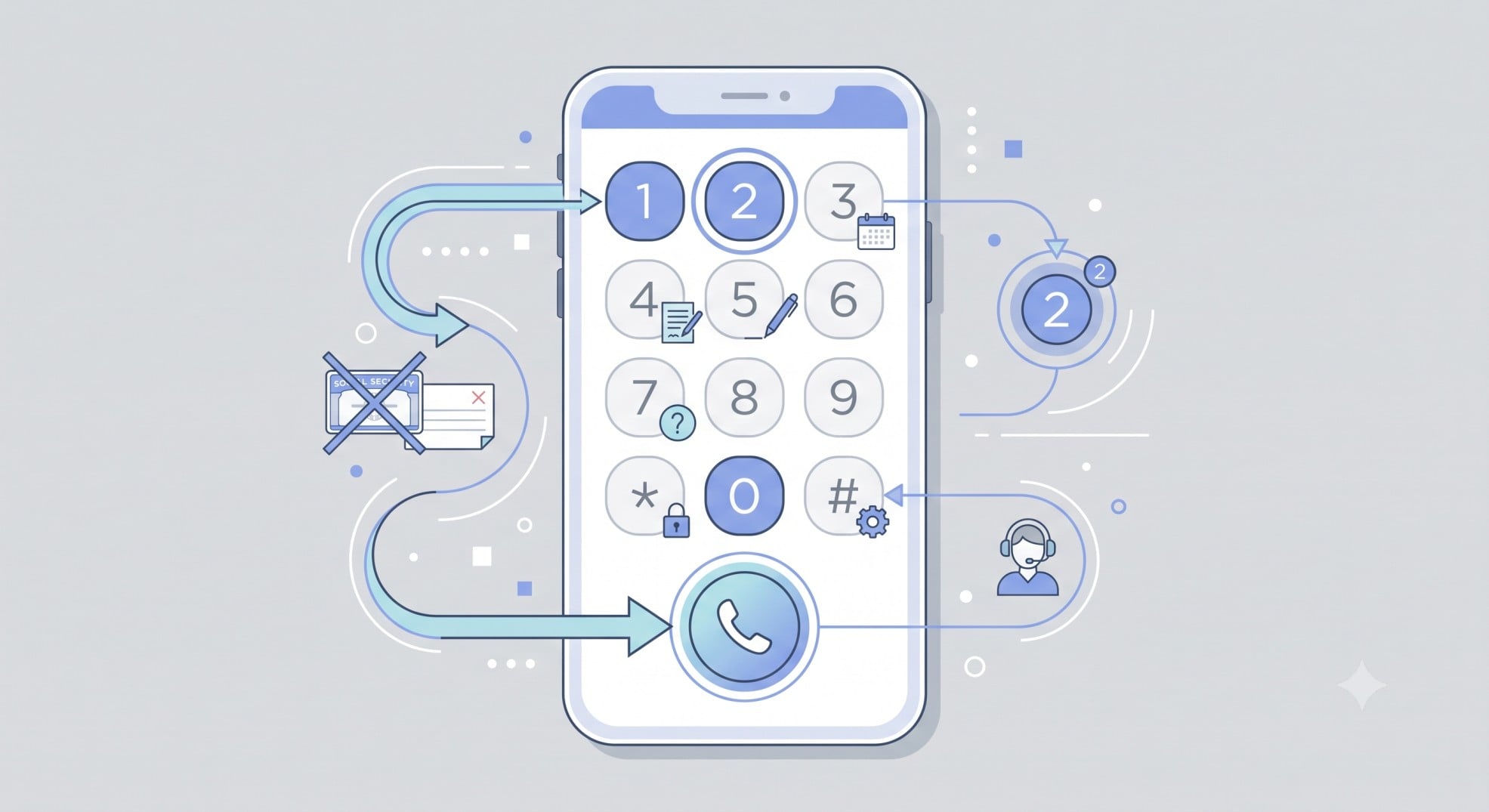
Important: The IRS does not publish an official “secret code” to bypass its phone tree. The sequence below is the one most frequently reported by taxpayers and tax professionals across multiple independent sources. It is not guaranteed to work, and the IRS updates its phone menus periodically.
The main customer service number for individual taxpayers is 1-800-829-1040, available 7 a.m. to 7 p.m. local time, Monday through Friday.
- Dial 1-800-829-1040 during operating hours.
- Select your language: Press
1for English or2for Spanish. - Choose tax type: Press
2for questions about personal income taxes (avoid the refund-status option if your question isn’t strictly about a refund). - Choose sub-category: Press
1for questions about a form already filed or a payment. - Navigate further: Press
3for “all other questions.” - Confirm: Press
2for “all other questions” again. - The SSN prompt: The system will ask for your Social Security Number (SSN) or Employer Identification Number (EIN), typically twice. Many users report that not entering anything and simply waiting through both prompts leads to a new menu, though this is not an officially documented feature and may not work every time.
- Final menu: If a new menu appears, press
2for personal or individual tax questions, then3or4(this varies) for all other inquiries.
If this sequence doesn’t work on your call, don’t keep repeating it — hang up, try again at a different time of day, or use one of the specialized numbers below instead.
Direct IRS Phone Numbers for Specific Needs
Calling the right specialized line for your specific issue is generally more reliable than hoping for a menu shortcut on the main line:
| Tax Department / Need | Phone Number | Hours (Local Time) |
|---|---|---|
| Individual Tax Returns (Form 1040) | 1-800-829-1040 | 7 a.m. – 7 p.m., Mon–Fri |
| Business & Specialty Taxes | 1-800-829-4933 | 7 a.m. – 7 p.m., Mon–Fri |
| Refund Status (Automated) | 1-800-829-1954 | 24/7, automated |
| Refund Being Held / Offset | 866-897-3315 | 7 a.m. – 7 p.m. CDT, daily |
| Debts Offsetting Your Refund | 800-304-3107 | 7:30 a.m. – 5 p.m. CDT, Mon–Fri |
| Taxpayer Advocate Service (TAS) | 1-877-777-4778 | 8 a.m. – 8 p.m., Mon–Fri |
| In-Person Appointment (TAC) | 1-844-545-5640 | 7 a.m. – 7 p.m., Mon–Fri |
| Practitioner Priority Service (Tax Pros Only) | 1-866-860-4259 | 8 a.m. – 5 p.m., Mon–Fri |
| Non-Profit & Exempt Organizations | 1-877-829-5500 | 8 a.m. – 5 p.m., Mon–Fri |
| Identity Theft Support | 1-800-908-4490 | 7 a.m. – 7 p.m., Mon–Fri |
| Order Free Forms & Publications | 1-800-829-3676 | 7 a.m. – 7 p.m., Mon–Fri |
| International / Overseas Taxpayers | 267-941-1000 (not toll-free) | 6 a.m. – 11 p.m. ET, Mon–Fri |
| Puerto Rico & U.S. Virgin Islands | 800-829-1040 | 7 a.m. – 10 p.m., Mon–Fri |
| Hearing Impaired (TTY/TDD) | 1-800-829-4059 | 7 a.m. – 7 p.m., Mon–Fri |
Multi-Language Support
- Spanish: Call the main line 1-800-829-1040.
- All Other Languages: Call 1-833-553-9895 for an over-the-phone interpreter, or the IRS can schedule a local appointment with interpreter support.
- Accessibility Helpline: Call 1-833-690-0598.
Alternative Ways to Reach a Real Person
1. Schedule an Appointment at a Local IRS Office
The IRS operates Taxpayer Assistance Centers (TACs) nationwide for face-to-face help. These offices generally operate weekdays and require an appointment for most services — call 1-844-545-5640 to book. As of 2026, the IRS has also opened many TACs on select Saturdays (typically 9 a.m.–4 p.m.) through the filing season, with walk-in service accepted on those specific Saturday dates; check the IRS Local Office Locator for participating locations, since availability varies by office.
2. Contact the Taxpayer Advocate Service (TAS)
If your tax problem is causing significant financial hardship, or you’ve made repeated unsuccessful attempts to resolve an issue with the IRS, the Taxpayer Advocate Service — an independent organization within the IRS — may be able to help. Call 1-877-777-4778 to see if you qualify for an assigned case advocate.
Skip the Phone Queue: Digital IRS Tools
- IRS2Go Mobile App: Track your refund and make secure payments from your phone.
- Your IRS Online Account (irs.gov/account): View your balance, payment history, tax transcripts, and digital copies of select notices — often faster than waiting on hold for the same information a phone agent would read from the same screen.
- Where’s My Refund? (irs.gov/refunds): The definitive source for refund status; calling will not get you different information.
Strategic Tips to Reduce Your Hold Times
Average telephone service wait times run about 3 minutes during filing season (January–April) and roughly 15 minutes during the off-season (May–December), though this varies by line and time of day.
- Call early: Lines open at 7 a.m. local time; calling near opening often means shorter queues.
- Avoid Mondays and Tuesdays: These days consistently see the heaviest call volume; Wednesday–Friday tends to be quieter.
- Avoid the weeks around the April filing deadline and Presidents Day if your question can wait.
- Take the callback option if offered: When wait times exceed 15 minutes on many toll-free lines, the IRS may offer to call you back instead of holding.
Checklist: What to Have Ready Before You Call
IRS representatives must verify your identity before discussing personal tax information. Have these ready:
- Personal ID: Full legal name, date of birth, SSN or ITIN.
- Tax Documentation: The specific tax return (e.g., Form 1040) for the year in question.
- Official Letters: Any IRS notices (have the notice number, top right corner, ready).
- Supporting Records: W-2s, 1099s, or payment receipts relevant to your issue.
- Third-Party Authorization: If calling on someone else’s behalf, have a processed Form 8821 or Form 2848 on file.
⚠️ How to Spot an IRS Phone Scam

The IRS typically initiates contact by mail first, not by phone. The agency will never demand immediate payment via gift cards, prepaid debit cards, or wire transfers, and will never threaten immediate arrest. If you receive a suspicious call, hang up and verify your account status directly through your IRS Online Account or by calling the number on an official notice you’ve received.
Frequently Asked Questions
What is the fastest way to reach a live person at the IRS?
Call 1-800-829-1040 early in the morning, Wednesday through Friday, and have your documents ready. There is no guaranteed shortcut, but calling the specific number for your issue (rather than the general line) and avoiding peak days/times generally produces the shortest waits.
Does the IRS have a secret phone code to skip to an agent?
No official code exists. Various unofficial sequences are widely shared online and sometimes work, but the IRS updates its phone menus periodically, so no sequence is guaranteed.
Can I visit an IRS office without an appointment?
Generally no — most Taxpayer Assistance Centers require an appointment booked through 1-844-545-5640. However, some locations offer walk-in service on select Saturdays during filing season; check the local office locator for details.

I called the IRS for myself regarding individual taxes and I did say agent multiple times, but it won’t let me get through to a real person. What do I do? Please let me know ASAP!!!!!!!