
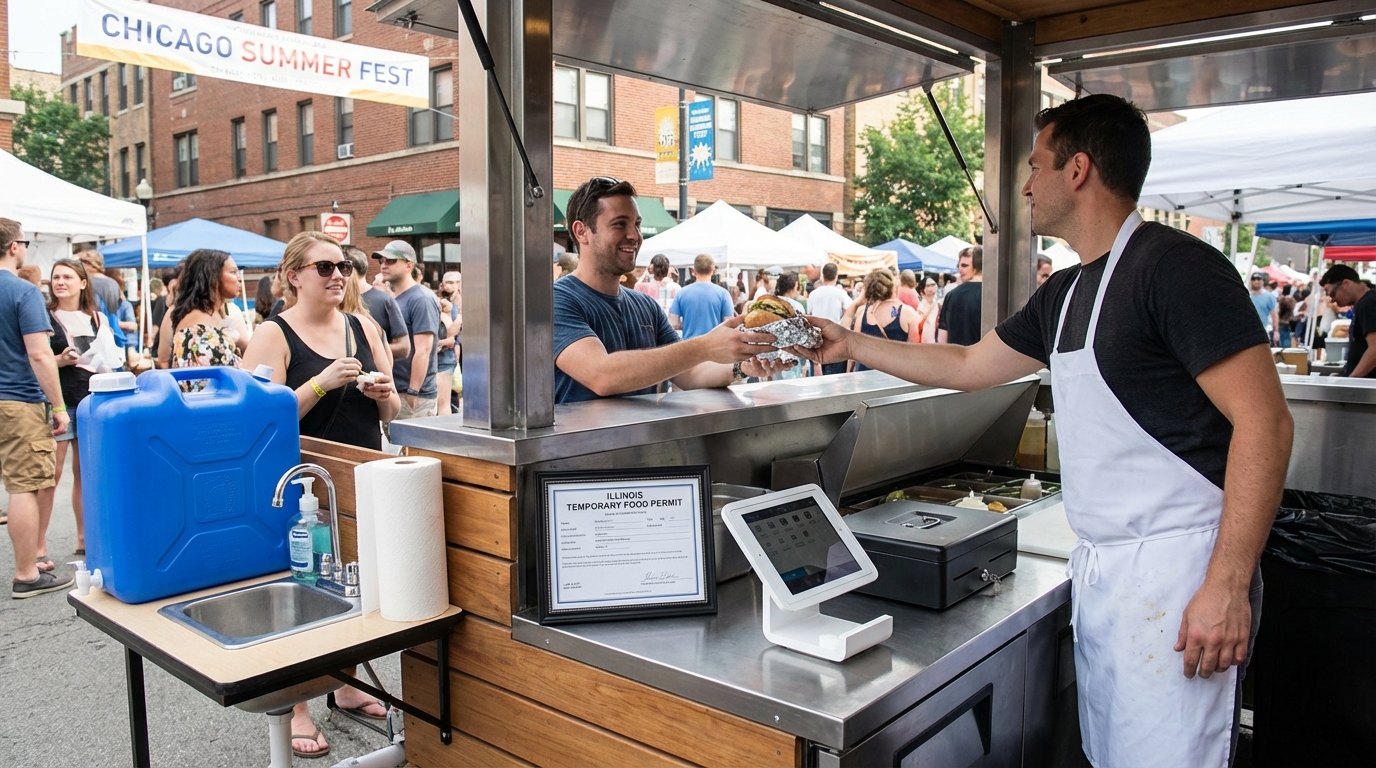
So, you have a killer recipe for street tacos or a craft cold brew that everyone in your neighborhood is raving about. You are ready to take the leap and start a pop-up food business Illinois style. It is an exciting time to be a food entrepreneur in the Land of Lincoln. However, before you fire up the grill or set up your booth at the local street fest, we need to talk about the paperwork. As a consultant who has helped hundreds of small businesses get off the ground, I can tell you that the Illinois Temporary Food Permit is your most important ingredient.
Navigating the world of health departments and municipal codes can feel like trying to read a menu in the dark. But do not worry. This guide will walk you through exactly what you need to do to stay compliant in 2026. We will cover everything from the Illinois cottage food law to the specific tiers of licensing in Chicago. Grab a coffee, and let’s get your business legal.
What is the Illinois Temporary Food Permit?
In layman’s terms, an Illinois Temporary Food Permit is a short-term license that allows you to sell food or beverages to the public at a fixed location for a limited time. Usually, this is defined as no more than 14 consecutive days in conjunction with a single event, such as a fair, festival, or farmers’ market. The primary goal of this permit is public safety. The health department wants to ensure that you have the equipment and knowledge to prevent foodborne illnesses.
The issuing authority is almost always your local county or city health department. While the Illinois Department of Public Health (IDPH) sets the overarching Food Service Sanitation Code, the boots-on-the-ground enforcement happens at the local level. This means if you are popping up in Naperville, you deal with DuPage County; if you are in Peoria, you deal with the Peoria City-County Health Department.
Who Needs This License? (Eligibility)
If you are selling food or drink to the public, you likely need a temporary food service license. This applies to professional chefs, hobbyists, and even non-profit organizations in many jurisdictions. Here is a breakdown of who needs to apply:
- Standard Food Vendors: Anyone preparing and serving “Time/Temperature Control for Safety” (TCS) foods. This includes meats, dairy, cooked vegetables, and cut melons.
- Beverage Vendors: Even if you are just selling fresh-squeezed lemonade or craft sodas, you generally need an Illinois health department permit.
- Cottage Food Operators: Under the Illinois cottage food law (updated via the Home-to-Market Act), you can sell many home-made goods. However, if you want to prepare or assemble food on-site at an event (like putting your home-made jam on a fresh-baked biscuit), you still need a temporary permit for that on-site activity.
Exemptions: Generally, if you are only selling commercially pre-packaged, shelf-stable items (like sealed bags of chips or canned sodas), some counties may waive the permit or offer a lower-cost “Tier I” version. Private events, like a family reunion or a members-only club dinner, are also typically exempt.
Checklist: Documents and Equipment Required
Before you even open the application portal, you need to have your ducks in a row. The health department will not issue a permit based on a promise; they need proof of your setup. Here is the 2026 essential checklist:
| Requirement | Details | Why It Is Needed |
|---|---|---|
| CFPM Certificate | ANSI-accredited Certified Food Protection Manager certificate. | Ensures at least one person on-site understands food safety science. |
| Commissary Agreement | A signed contract with a licensed commercial kitchen. | Proves you aren’t washing your lettuce in a bathtub at home. |
| Site Plan | A sketch of your booth layout, including equipment placement. | Helps inspectors see if your handwashing station is accessible. |
| Menu Approval | A full list of ingredients and preparation steps. | Allows the sanitarian to identify high-risk processes. |
| Handwashing Station | A 5-gallon container with a stay-open spigot, warm water, soap, and paper towels. | The #1 defense against cross-contamination. |
| Thermometers | Metal stem probe thermometers (0-220°F). | To verify that hot foods stay above 135°F and cold foods below 41°F. |
Step-by-Step Application Procedure
Getting your Illinois health department permit is a linear process. Do not skip steps, or you will find yourself stuck in bureaucratic limbo.
- Register Your Business: Before applying for a food permit, ensure your business is legal. This means having an LLC or Sole Proprietorship registered with the Illinois Secretary of State and obtaining an EIN from the IRS.
- Obtain Your Sales Tax ID: You must register with the Illinois Department of Revenue (IDOR) via the MyTax Illinois portal. For temporary events, you will often use the Special Event Tax Collection Report (IDOR-6-SETR) to remit taxes after the event.
- Choose Your Location & Event: You cannot get a “floating” permit in most of Illinois (Chicago is a rare exception). Your permit is tied to a specific event and date.
- Submit the Application: Visit the website of the local health department where the event is held. Most now use online portals like CitizenServe or HealthSpace. Submit your application at least 14 to 30 days before the event.
- The Consultation: Especially in Chicago, you may be required to have a consultation with a sanitarian. They will review your menu and equipment. This is the time to ask questions!
- The On-Site Inspection: On the day of the event, an inspector will visit your booth before you start serving. They will check your water temperature, sanitizer concentration (using test strips), and food storage temperatures.
- Permit Issuance: Once you pass the inspection, the inspector will hand you a physical permit. You must display this prominently in your booth.
Fees and Processing Time
Fees for a temporary food service license vary significantly across the state. In 2026, expect the following price ranges:
- Chicago Pop-up Licenses: Chicago uses a tiered system. A 5-day Tier II or III license costs approximately $50, while a 90-day license can be $150. If you already have a Retail Food License, adding “Pop-up User” activity is often free.
- Suburban & Downstate Counties: Most counties (like Woodford or Rock Island) charge between $45 and $75 for a single-event permit. Some offer a “Multiple Use” permit for $55 to $100 that covers you for the entire calendar year at various events within that specific county.
- Late Fees: Almost every department will double the fee if you apply less than 7-10 days before the event. Plan ahead!
Processing Time: While the physical inspection happens on-site, the application review takes 10 to 14 business days. If you are a first-time applicant, give yourself a full month.
Validity and Renewal Process
A standard Illinois Temporary Food Permit is valid only for the duration of the specific event listed on the application, up to 14 days. If you are doing a series of pop-ups at different locations, you will need a separate permit for each jurisdiction.
For those operating under the Illinois cottage food law, your registration with the county is typically annual. You must renew your cottage food registration every January and provide an updated CFPM certificate if yours has expired (they are usually valid for 5 years).
Penalties for Non-Compliance
I cannot stress this enough: do not try to “fly under the radar.” Health inspectors regularly patrol festivals and farmers’ markets. If you are caught operating without a temporary food service license, the consequences are swift:
- Immediate Closure: You will be ordered to stop serving and potentially discard all prepared food. This is a massive financial loss.
- Fines: Fines can range from $250 to $1,000 per day of unauthorized operation.
- Blacklisting: Many health departments keep records of non-compliant vendors and may deny your permit applications for future events.
Frequently Asked Questions
1. Can I prepare food in my home kitchen for a pop-up?
Generally, no. Unless you are a registered cottage food operator selling specific allowed items, all prep must be done in a licensed commercial kitchen (commissary) or on-site at the event booth.
2. Do I need insurance for a pop-up?
While the health department might not require it for the permit, most event organizers will require a General Liability policy of at least $1,000,000. It is a smart move to protect your personal assets.
3. What is the difference between a Tier II and Tier III license in Chicago?
Tier II is for food prepared off-site at a shared kitchen with only minimal assembly on-site. Tier III is for full-service cooking and preparation directly at the pop-up location.
4. Is the 1% grocery tax still a thing in 2026?
As of January 1, 2026, the state-level 1% grocery tax on food for off-premises consumption has been eliminated. However, “prepared food for immediate consumption” (which is what most pop-ups sell) is still subject to the full state sales tax rate of 6.25% plus local surtaxes.
Conclusion & Next Steps
Starting a pop-up food business Illinois style is a fantastic way to test a concept without the overhead of a brick-and-mortar restaurant. Yes, the Illinois Temporary Food Permit process requires some legwork, but it builds a foundation of safety and professionalism for your brand. Start by contacting your local health department today to get their specific 2026 application forms.
If you found this guide helpful, share it with a fellow entrepreneur! The more we support each other in the local food scene, the more our communities thrive. Now, go get that permit and start cooking!
Disclaimer: This article is for informational purposes only and does not constitute legal advice. Always consult with a local attorney or CPA.
