
Executive Summary
- The 2026 Reality: There is currently no broad, universal federal first time homebuyer tax credit available for the 2026 tax year. The popular $8,000 program from 2008-2010 expired and has not been reinstated.
- The MCC Alternative: The Mortgage Credit Certificate (MCC) remains the most powerful federal tax incentive, offering a dollar-for-dollar credit of up to $2,000 annually on mortgage interest paid.
- 2026 Tax Law Updates: The standard deduction for married couples filing jointly has increased to $32,200. The SALT deduction cap has increased to $40,400 under the newly enacted OBBBA legislation.
- Retirement Account Access: First-time buyers can withdraw up to $10,000 from a Traditional IRA without the 10% early withdrawal penalty, though ordinary income taxes still apply.
Purchasing your first property changes your financial profile entirely. You transition from a renter with a simple standard deduction to a homeowner managing property taxes, mortgage interest, and new IRS forms. Understanding how buying a house changes your tax return is the first step to maximizing your financial return on this investment. Many new buyers search for a first time homebuyer tax credit to offset their closing costs and down payments.
While the tax code offers several incentives, the rules for 2026 have shifted. You need to know exactly which tax credits for first time home buyers are active, which proposed bills are just rumors, and how the latest IRS inflation adjustments impact your bottom line. We will break down the exact mechanics of the Mortgage Credit Certificate, the 2026 standard deduction increases, and the penalty-free IRA withdrawal rules so you can claim every tax break for buying a house legally available to you. Securing a buying a home tax credit requires planning before you close on the property, not just when you file your return in April.
Table of Contents
- Is There a Federal Tax Credit for Buying a House in 2026?
- The Mortgage Credit Certificate (MCC): The Best first time homebuyer tax credit
- Tax Deductions vs. tax credits for first time home buyers
- Penalty-Free IRA Withdrawals for First-Time Buyers
- State-Level Programs and Down Payment Assistance
- How to Claim Your buying a home tax credit (Step-by-Step)
- Frequently Asked Questions About First-Time Homebuyer Tax Credits
Is There a Federal Tax Credit for Buying a House in 2026?
No, there is no broad, universal federal tax credit for buying a house in 2026. The famous program that offered up to $8,000 to new buyers existed between 2008 and 2010 to stimulate the economy during the housing crisis. Congress allowed that specific program to expire, and it has not been reinstated for the current tax year.
You might see headlines about proposed legislation, such as the First Time Homebuyer Tax Credit Act. Lawmakers frequently introduce bills aiming to provide a refundable credit for new buyers. None of these proposals have passed into law for 2026. Relying on proposed legislation to fund your down payment is a dangerous financial strategy.
Instead of waiting for a new law, you must focus on the incentives that actually exist today. The IRS currently offers targeted programs, specific deductions, and penalty waivers that can save you thousands of dollars in your first year of homeownership.
The Mortgage Credit Certificate (MCC): The Best first time homebuyer tax credit
When people search for a first time homebuyer tax credit, they are usually looking for a direct reduction of their tax bill. The Mortgage Credit Certificate (MCC) delivers exactly that. Issued by state and local housing finance agencies, an MCC allows eligible buyers to claim a percentage of their annual mortgage interest as a dollar-for-dollar federal tax credit.
The credit rate varies by state but typically ranges from 20% to 40% of the interest you pay each year. The IRS strictly caps the maximum annual credit at $2,000 if your certificate rate is over 20%. You can claim this credit every single year for the life of your original mortgage, provided you continue to live in the home as your primary residence. This makes the MCC the most powerful buying a home tax credit available today.
To qualify, you generally must meet income limits and purchase price limits set by your state. You also cannot have owned a primary residence in the past three years. Veterans are often exempt from the first-time buyer requirement.
Hypothetical Scenario 1: The MCC Cap in Action
Sarah and John purchase a $350,000 home in Texas. They secure a 30-year fixed mortgage at a 6.5% interest rate. During their first year of homeownership, they pay exactly $22,500 in mortgage interest.
Before closing, they applied for and received a Mortgage Credit Certificate from their state housing finance agency with a 25% credit rate.
- Step 1: Calculate the base credit. $22,500 x 0.25 = $5,625.
- Step 2: Apply the IRS limit. Because their certificate rate is over 20%, the IRS strictly caps their maximum annual credit at $2,000.
- Step 3: Calculate the remaining deduction. They subtract the $2,000 credit from their total interest paid. They can still claim the remaining $20,500 as an itemized mortgage interest deduction on Schedule A.
Sarah and John reduce their actual tax bill by $2,000, keeping that cash in their bank account rather than sending it to the IRS.
The MCC Recapture Tax Warning
If you receive an MCC and sell your home within nine years, you might be subject to a recapture tax. The IRS designed this rule to prevent buyers from flipping houses subsidized by federal tax credits. You only pay the recapture tax if three specific conditions are met simultaneously: you sell the home within nine years, you sell the home at a profit, and your household income has increased significantly beyond the original program limits. Most homeowners never actually pay this tax because their income does not cross the threshold, but you must report the sale on Form 8828 regardless.
Tax Deductions vs. tax credits for first time home buyers
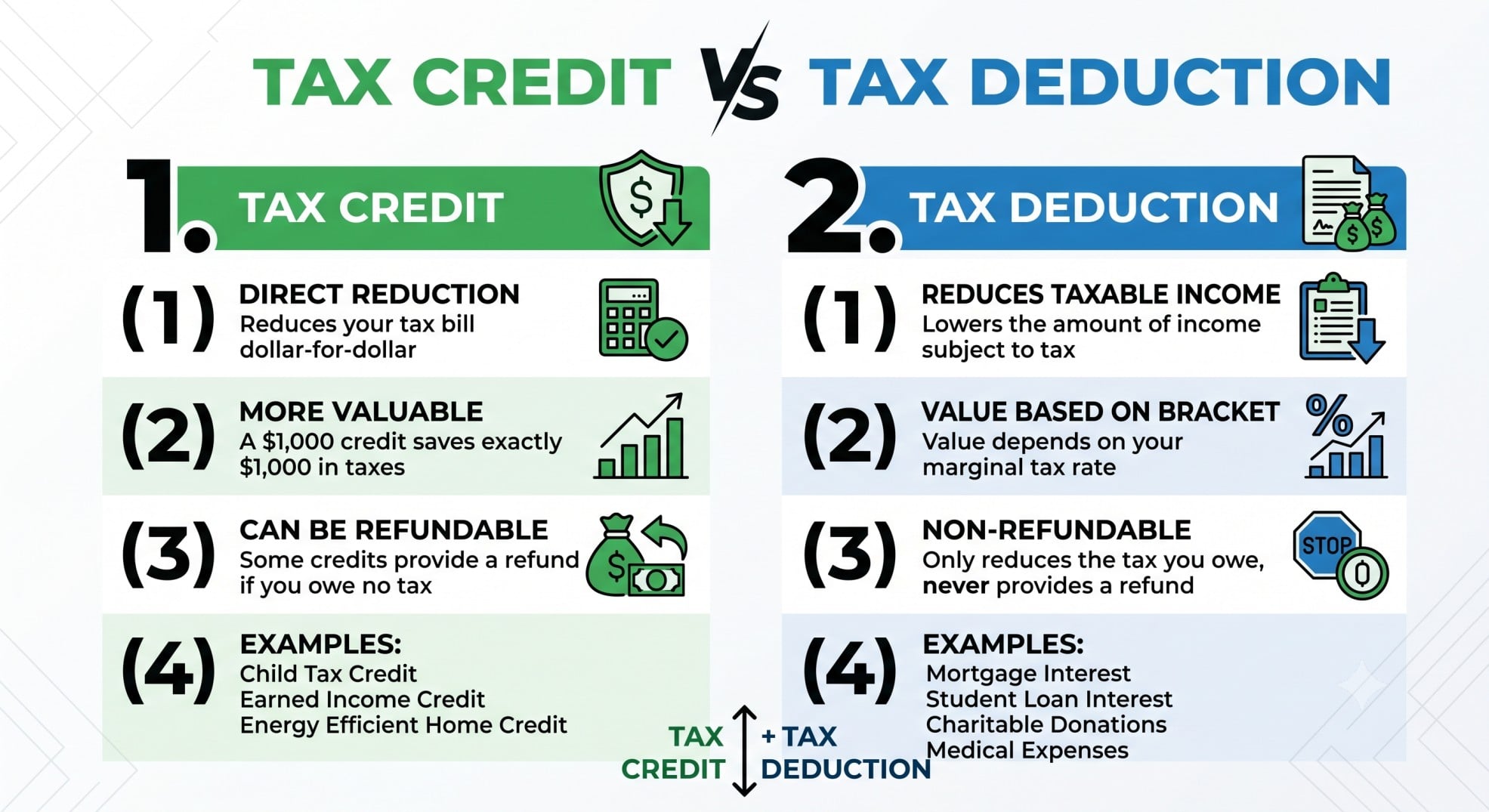
Understanding the difference between deductions and tax credits for first time home buyers is critical for your 2026 planning. A tax credit reduces your final tax bill dollar-for-dollar. A tax deduction simply reduces your taxable income, meaning its actual value depends entirely on your marginal tax bracket.
The most common tax break for buying a house is the mortgage interest deduction. You can deduct the interest paid on the first $750,000 of your mortgage debt. You can also deduct your property taxes and state income taxes, known as the SALT deduction.
In July 2025, the One Big Beautiful Bill Act (OBBBA) was signed into law. This legislation drastically altered the tax math for homeowners in 2026. Previously, the Tax Cuts and Jobs Act capped the SALT deduction at $10,000. For the 2026 tax year, the OBBBA increased the SALT deduction cap to $40,400 for single filers and married couples filing jointly (and $20,200 for married filing separately). This means you can now deduct significantly more of your property taxes on your federal return.
| Filing Status | 2026 SALT Deduction Cap (OBBBA) |
|---|---|
| Single / Head of Household | $40,400 |
| Married Filing Jointly | $40,400 |
| Married Filing Separately | $20,200 |
To claim these deductions, you must itemize on Schedule A. You only itemize if your total deductions exceed the standard deduction for your filing status. For 2026, the IRS increased the standard deduction amounts to account for inflation.
| Filing Status | 2025 Standard Deduction | 2026 Standard Deduction |
|---|---|---|
| Single / Married Filing Separately | $15,750 | $16,100 |
| Married Filing Jointly | $31,500 | $32,200 |
| Head of Household | $23,625 | $24,150 |
Hypothetical Scenario 2: The 2026 Standard Deduction Math
David and Emily are married and file a joint return for 2026. They bought a house and paid $18,000 in mortgage interest. They also paid $9,000 in property taxes and $4,000 in state income taxes.
Under the new 2026 OBBBA rules, their total SALT amount is $13,000, which falls well below the new $40,400 cap. They add their deductions together: $18,000 (interest) + $13,000 (SALT) = $31,000 in total itemized deductions.
The 2026 standard deduction for married couples filing jointly is $32,200. Because $32,200 is greater than $31,000, David and Emily will take the standard deduction. They receive absolutely no additional federal tax benefit from their mortgage interest or property taxes this year. This scenario highlights exactly why securing a direct tax credit like the MCC is far more valuable than relying on deductions.
Penalty-Free IRA Withdrawals for First-Time Buyers
Finding cash for a down payment is the biggest hurdle for new buyers. The IRS provides a specific exception that allows you to tap into your retirement savings without facing the standard penalties.
First-time homebuyers can withdraw up to $10,000 from an Individual Retirement Account (IRA) without paying the 10% early withdrawal penalty. Married couples can each withdraw $10,000 from their respective accounts, providing up to $20,000 in penalty-free cash. The IRS defines a first-time buyer broadly for this rule: you simply cannot have owned a primary residence in the past three years.
The $10,000 limit is a lifetime cap. You cannot withdraw $10,000 for one house, sell it, wait three years, and withdraw another $10,000 penalty-free for the next house.
You must understand the difference between Traditional and Roth IRAs when using this strategy. Withdrawals from a Traditional IRA avoid the 10% penalty, but they are still subject to ordinary income taxes. Withdrawals of contributions from a Roth IRA are always tax-free and penalty-free, regardless of what you use the money for.
Hypothetical Scenario 3: The Traditional IRA Tax Trap
Michael is a single filer in the 22% federal tax bracket. He needs extra cash for his down payment and decides to withdraw $10,000 from his Traditional IRA.
Because he meets the IRS definition of a first-time homebuyer, he avoids the 10% early withdrawal penalty. He saves $1,000 right there. However, Traditional IRA contributions were made with pre-tax dollars. The IRS still taxes this $10,000 withdrawal as ordinary income.
Michael owes 22% on the withdrawal, resulting in a $2,200 federal tax bill. His net usable cash for the home purchase is only $7,800. He must plan for this tax liability so he isn’t caught off guard when he files his return.
Hypothetical Scenario 4: Missing the 120-Day Window
Lisa withdraws $10,000 from her IRA on May 1st to cover construction costs on her first home. Due to severe supply chain delays, the home does not close, and the funds are not officially spent until September 15th—exactly 137 days later.
The IRS strictly mandates that IRA funds must be used for qualified acquisition costs within 120 days of the withdrawal. Because Lisa missed this window, the $10,000 loses its exempt status. She now owes the 10% penalty ($1,000) plus her standard ordinary income tax on the distribution. Her tax break for buying a house is completely wiped out by a scheduling delay.
State-Level Programs and Down Payment Assistance
While the federal government relies primarily on the MCC and standard deductions, individual states are much more aggressive in incentivizing homeownership. Your state might offer its own first time homebuyer tax credit or down payment assistance grant.
For example, proposed legislation in Virginia aims to create a one-time $5,000 state income tax credit for first-time buyers between 2026 and 2030. Other states offer forgivable loans that cover your closing costs. These state-level benefits are entirely separate from your federal return. You should search for your state’s Housing Finance Agency website to find localized grants and credits before you start touring homes.

How to Claim Your buying a home tax credit (Step-by-Step)
Claiming a buying a home tax credit requires specific timing. You cannot simply check a box on your tax software in April and expect a refund. Follow these steps to secure your benefits.
Step 1: Apply Before You Close. You cannot get a Mortgage Credit Certificate after you buy the house. You must apply through an approved lender during the underwriting process. The agency will charge an application fee (usually a few hundred dollars), which pays for itself in the first year of tax savings.
Step 2: Pay Your Mortgage. The credit is based on the actual interest you pay during the calendar year. Make your payments on time.
Step 3: Receive Form 1098. Your loan servicer will send you Form 1098 in January. This document details the exact amount of mortgage interest and property taxes you paid during the previous year.
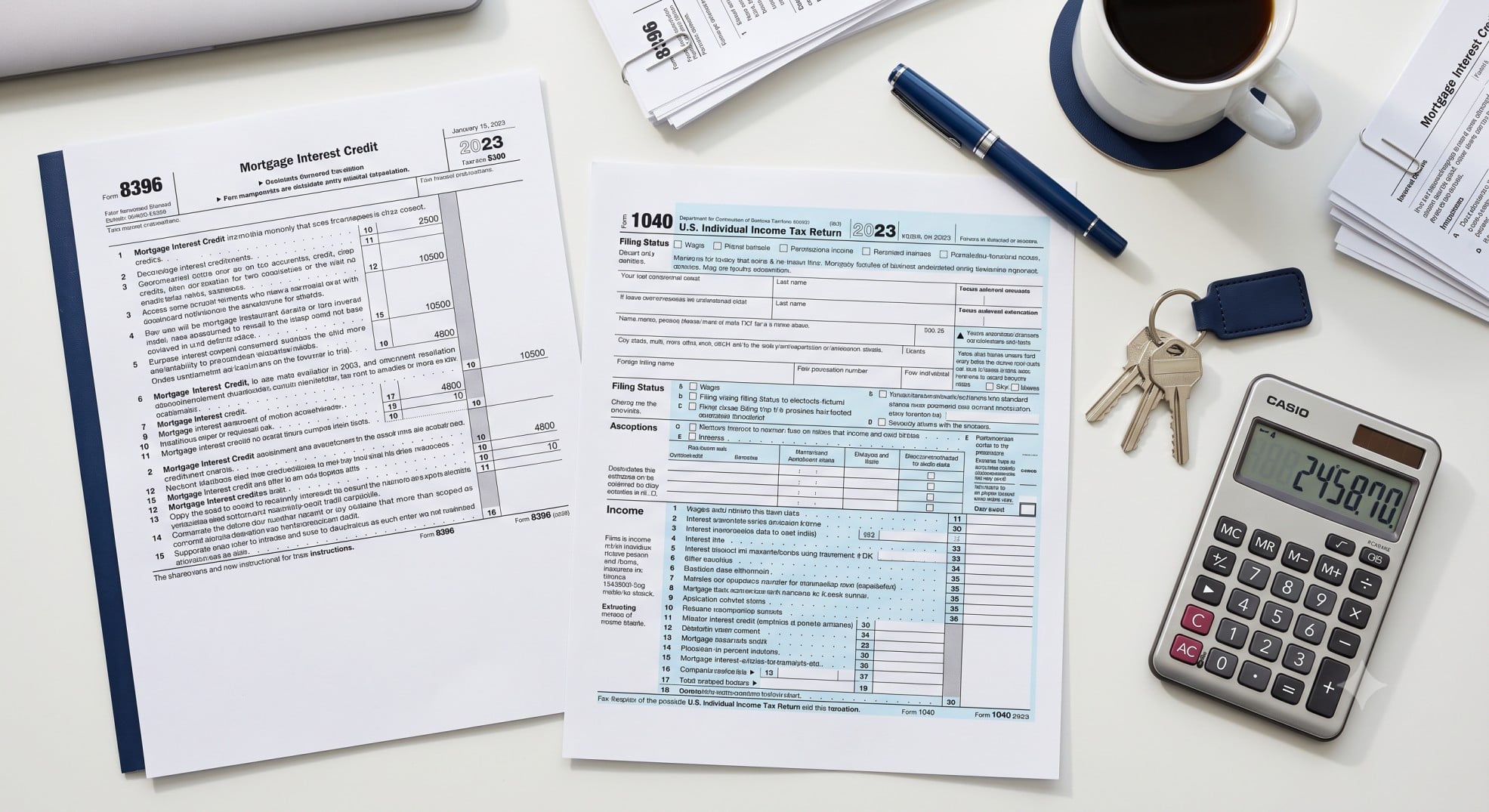
Step 4: File Form 8396. To claim the MCC, you must fill out Form 8396 (Mortgage Interest Credit) and attach it to your standard Form 1040. This form calculates your exact credit amount and carries forward any unused credit to the next tax year.
Step 5: Adjust Your W-4. Instead of waiting for a large refund in April, you can submit a new W-4 to your employer. By reducing your per-paycheck withholding, you keep more cash in your monthly budget to help pay the mortgage.

Frequently Asked Questions About First-Time Homebuyer Tax Credits
1. Is there a federal tax credit for buying a house in 2026?
No, there is no broad federal tax credit for buying a house in 2026. The $8,000 credit from 2008 expired. The primary federal incentive available today is the Mortgage Credit Certificate (MCC), which is issued at the state level but provides a federal tax credit.
2. Do you get a tax break for buying a house?
Yes, you get a tax break for buying a house through deductions and specific credits. You can deduct mortgage interest and property taxes if you itemize. You can also claim a direct tax credit if you qualify for an MCC.
3. What is a Mortgage Credit Certificate (MCC)?
A Mortgage Credit Certificate (MCC) is a document issued by your state housing finance agency that allows you to claim a percentage of your annual mortgage interest as a dollar-for-dollar federal tax credit, up to $2,000 per year.
4. Can I deduct my down payment on my 2026 tax return?
No. The IRS does not allow you to deduct your down payment. A down payment is considered an acquisition of an asset, not a deductible expense.
5. How does the new 2026 SALT cap affect homeowners?
The One Big Beautiful Bill Act (OBBBA) increased the SALT deduction cap to $40,400 for 2026. This allows homeowners in high-tax states to deduct significantly more of their property and state income taxes on their federal returns, provided they itemize.
6. Can married couples withdraw $20,000 from an IRA for a house?
Yes. The IRS allows a $10,000 penalty-free withdrawal per person for a first-time home purchase. A married couple can withdraw $10,000 from each of their respective IRAs, totaling $20,000.
7. Do I have to pay back the MCC if I sell my house?
You might have to pay a recapture tax if you sell the house within nine years, realize a profit on the sale, and experience a significant increase in your household income. Most sellers do not trigger all three conditions.
8. Are closing costs tax-deductible in 2026?
Most closing costs are not tax-deductible. You cannot deduct appraisal fees, title insurance, or legal fees. You can deduct mortgage discount points (prepaid interest) and prorated property taxes paid at closing.
9. Does a first time homebuyer tax credit apply to second homes?
No. A first time homebuyer tax credit, including the MCC, strictly requires the property to be your primary residence. Investment properties and vacation homes do not qualify.
10. How long do I have to live in the house to keep the tax benefits?
To keep claiming the MCC, you must live in the house as your primary residence. If you convert the home to a rental property, you can no longer claim the credit for that year.
Securing a first time homebuyer tax credit requires proactive planning. While federal tax credits for first time home buyers are limited to specific programs like the MCC, the newly expanded 2026 SALT cap and standard deduction increases offer substantial savings. Don’t leave your buying a home tax credit on the table by failing to apply before closing.
Disclaimer: The information provided in this article is for general educational purposes only and does not constitute legal, tax, or financial advice. Tax laws, including the 2026 standard deductions and OBBBA provisions, are subject to change. Always consult with a licensed Certified Public Accountant (CPA) or qualified tax professional regarding your specific situation before filing your return or making financial decisions.
