
Collecting and remitting your monthly per-milliliter or wholesale vapor tax is no longer enough to keep your convenience store, smoke shop, or distribution warehouse open. Across the 2025–2026 legislative sessions, a sweeping wave of FDA vape directory laws has fused state excise tax reporting directly with product-level Premarket Tobacco Product Application (PMTA) registries. With at least 26 states introducing or enacting directory bills—and 16+ states actively enforcing or phasing in mandatory state-managed directories across 2026 and 2027—selling an unlisted disposable e-cigarette or pod is now a dual tax and regulatory offense.
Many retail store owners and out-of-state distributors operate under a fatal misconception: they assume that as long as they pay the state’s vapor excise tax on an invoice, the state Department of Revenue doesn’t care which brand of vape is inside the box. In reality, state tax authorities and alcohol/tobacco enforcement boards share itemized electronic excise tax schedules and federal PACT Act manifests to hunt down unlisted SKUs.
If you sell a single unlisted vape in states like Alabama, Louisiana, Oklahoma, Kentucky, North Carolina, Wisconsin, or Pennsylvania, paying the excise tax won’t save you. Your inventory will be seized as contraband without a tax refund, you will face daily civil fines up to $1,000 to $5,000+, and the state will suspend or permanently revoke your retail license to sell all cigarettes, nicotine pouches, and tobacco products. Here is your 2026–2027 survival guide.
⚡ Executive Summary: Key 2026–2027 Tax Compliance Rules at a Glance
- The Federal PMTA Baseline & 26+ State Directory Surge: Although the U.S. Food and Drug Administration (FDA) has issued Marketing Granted Orders (MGOs) to fewer than 50 e-cigarette products nationwide (primarily tobacco- and menthol-flavored closed systems), 26+ states have introduced or enacted state-level PMTA directory laws. As of late 2026, active or newly effective enforcement spans Alabama, Louisiana, Oklahoma, Kentucky, North Carolina, Florida, Wisconsin, Virginia, Utah, Arkansas, Mississippi, California, West Virginia (eff. Sept 1, 2026), Pennsylvania (eff. Oct 19, 2026), and Tennessee (eff. Jan 1, 2027).
- Alabama’s Double Overhaul (New $0.10/mL Tax Eff. Oct 1, 2026 + HB 8 Directory Rules): Under Alabama Act 2025-377 (Code of Ala. § 40-25-81), Alabama launched a new statewide excise tax of $0.10 per milliliter on nicotine consumable vapor products effective October 1, 2026, paired with its My Alabama Taxes (MAT) ENDS Directory ($2,000 initial / $500 renewal manufacturer fee) and Act 2025-403 (HB 8) specialty retailer licensing and U.S.-manufacturing/FDA-authorization mandates.
- Louisiana’s $0.15/mL Tax, Three-Tier Mandate & Quadrupled Permit Fees (Eff. Aug 1, 2026): Louisiana enforces its ATC VAPE Directory alongside a $0.15 per milliliter vapor excise tax (reported monthly on Form R-5608 / R-5604 via LaTAP by the 20th). Effective August 1, 2026, Act 820 (R.S. 26:914.1) banned all direct-to-consumer (DtC) vape shipping and forced retailers to buy exclusively from Louisiana-permitted wholesalers, while Act 920 quadrupled retail permit fees from $25 to $100/year and wholesale permits to $300/year.
- Kentucky & Oklahoma License Revocation Traps: In Kentucky, retailers must verify products under HB 11 (KRS 438.316), hold the brand-new $50 Kentucky ABC Tobacco, Nicotine, or Vapor Product License required since January 1, 2026 under SB 100 (KRS 438.3063), and ensure distributors remit the $1.50 per closed cartridge and 15% wholesale open-system tax on Form 73A422 (due the 20th). In Oklahoma (63 O.S. § 1-229.35), even though the state charges $0.00 vapor excise tax, selling a vape missing from the Oklahoma ABLE Commission Directory triggers contraband seizure and loss of your Oklahoma Tax Commission (OTC) tobacco license.
Table of Contents
- ⚡ Executive Summary: Key 2026–2027 Tax Compliance Rules at a Glance
- How FDA Vape Directory Laws Tie Product Registries to Excise Tax Audits
- Alabama & Louisiana: New October 2026 Vapor Tax & Strict Three-Tier Rules
- Oklahoma & Kentucky: ABLE Attestations, HB 11 Fines & New 2026 ABC Licenses
- 2026–2027 Nationwide State PMTA Vape Directory & Excise Tax Matrix
- 2026–2027 Business Scenarios: Contraband Seizures, Fines & License Loss Math
- Step-by-Step SKU Audit, Directory Verification & Excise Filing Playbook
- Frequently Asked Questions About FDA Vape Directory Laws & Excise Taxes
- Protecting Your Retail Tobacco License & Wholesale Distribution Permits
How FDA Vape Directory Laws Tie Product Registries to Excise Tax Audits
FDA vape directory laws require e-cigarette manufacturers to certify under penalty of perjury that each specific SKU holds either an FDA Marketing Granted Order (MGO) or a qualifying timely-filed Premarket Tobacco Product Application (PMTA) submitted on or before September 9, 2020, making any unlisted vapor product illegal contraband subject to seizure and license revocation even if state excise taxes were paid.
Why did 26+ state legislatures copy this exact framework from the 1998 Master Settlement Agreement (MSA) cigarette directories? Under the federal Family Smoking Prevention and Tobacco Control Act, the FDA lacks the field manpower to inspect hundreds of thousands of convenience stores, gas stations, and smoke shops selling unauthorized disposable vapes (such as non-compliant imported fruit- and candy-flavored devices). By passing state-level PMTA directory statutes, states deputized their own Department of Revenue (DOR) tax auditors and Alcoholic Beverage Control (ABC/ATC/ABLE) enforcement agents to police federal FDA status at the local cash register.
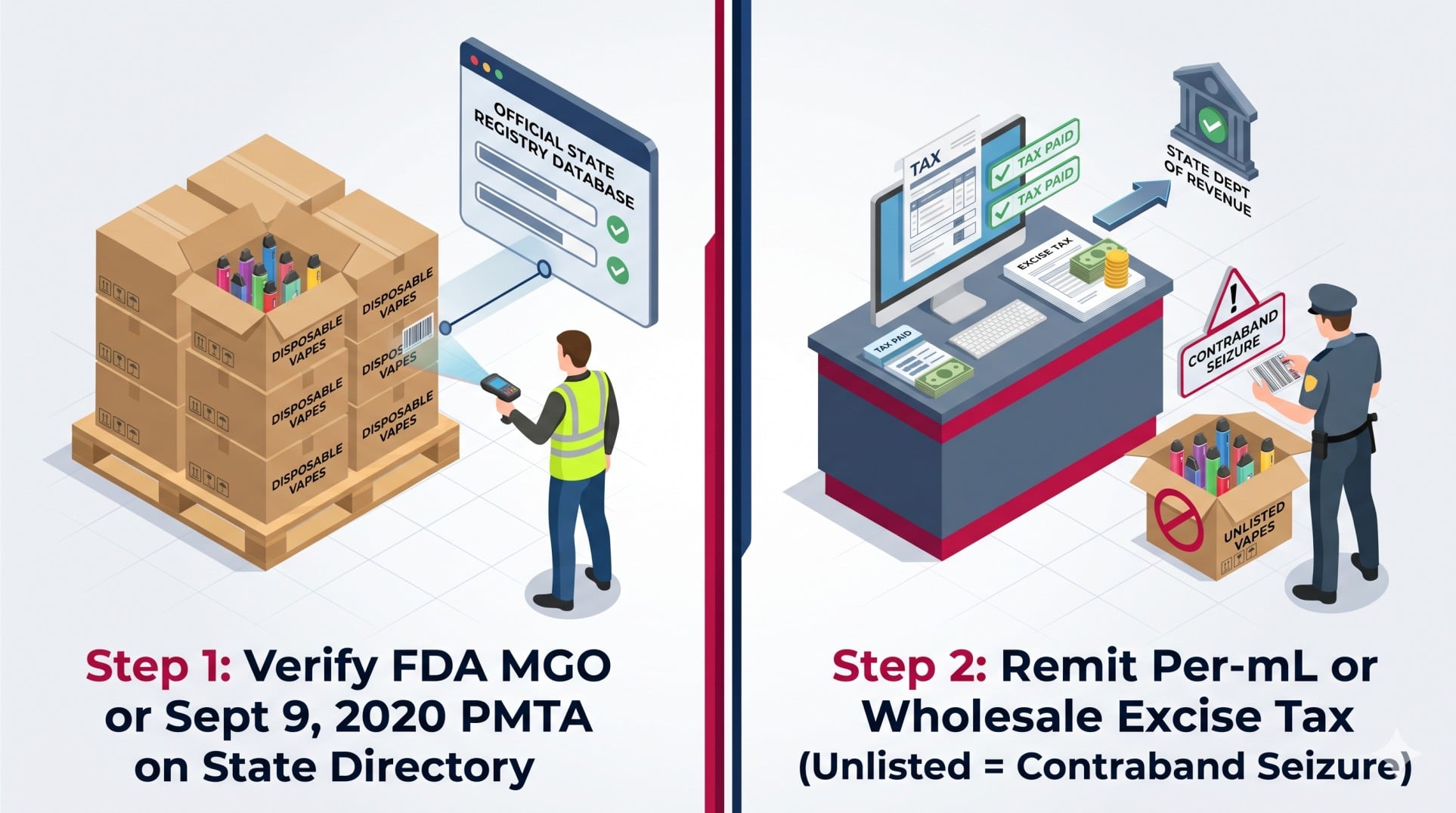
The Two Eligibility Tiers: “Strict MGO-Only” vs. “September 9, 2020 PMTA Safe Harbor”
Not every state directory allows the same products onto store shelves. When managing state PMTA vape registry compliance across multiple jurisdictions in 2026–2027, you must distinguish between the two statutory eligibility standards:
- The Three-Prong PMTA “Safe Harbor” Standard (e.g., Alabama, Louisiana, Oklahoma, Kentucky, North Carolina, Pennsylvania, Wisconsin): In these states, a manufacturer can list a product on the state directory if it certifies under penalty of perjury that the product was commercially marketed in the U.S. as of August 8, 2016 (for tobacco-derived nicotine) and meets one of three criteria: (a) it has received an official FDA Marketing Granted Order (MGO); (b) a PMTA was submitted to the FDA on or before September 9, 2020 and remains pending under FDA review without a denial; or (c) the product received an FDA Marketing Denial Order (MDO), but the MDO has been stayed by the FDA or a federal court, rescinded, or vacated pending active litigation.
- The Strict “FDA MGO-Only” or “Unflavored-Only” Standard (e.g., California’s Unflavored Tobacco List & Hawaii’s 2026 Directory Law): Several states have slammed the door on pending applications. In California (which banned all flavored vapes under Proposition 31 and banned all disposable vapes under AB 762 effective January 1, 2026), only products explicitly approved on the Attorney General’s Unflavored Tobacco List may be sold. Similarly, Hawaii’s 2026 registry legislation requires proof of an actual FDA Marketing Granted Order (alongside banning non-refillable/non-rechargeable disposables effective January 1, 2027).
How Your Monthly Excise Tax Return Triggers a Directory Raid
Here is the exact enforcement mechanism that catches wholesalers and retailers off guard: When an out-of-state or in-state distributor ships vapor products into a state, federal law (the Preventing Online Sales of E-Cigarettes to Children Act / PACT Act, 15 U.S.C. § 376) and state excise tax returns require the seller to submit monthly invoice-level schedules listing the exact brand name, SKU description, quantity, milliliter volume, wholesale price, and retail customer name and address.
The “Catch-22” Contraband Trap for Wholesalers & Retailers
If a distributor ships 500 cases of an unlisted disposable vape to a convenience store in Louisiana or Alabama and leaves it off the monthly excise tax return, both parties commit felony/misdemeanor tax evasion and PACT Act violations. Conversely, if the distributor reports the unlisted brand on its monthly excise return (or PACT Act report) and pays the $0.15/mL or $0.10/mL tax, the Department of Revenue’s automated cross-check flags the SKU as missing from the state directory—and dispatches ATC/ABC agents to the retailer’s store to seize the inventory, levy per-unit fines, and suspend the store’s tobacco permit—with zero refund of the excise tax paid!
Distributors and multi-state retailers looking to audit their product catalogs and tax filings simultaneously should review our multi-state vapor, OTP, and synthetic nicotine excise tax compliance guide to ensure their SKU tables are locked down.
Alabama & Louisiana: New October 2026 Vapor Tax & Strict Three-Tier Rules
In 2026, both Alabama and Louisiana—two of the earliest pioneers of state PMTA registries—enacted major statutory overhauls that pair strict directory enforcement with new statewide vapor excise taxes, mandatory three-tier distribution rules, and quadrupled permit fees.
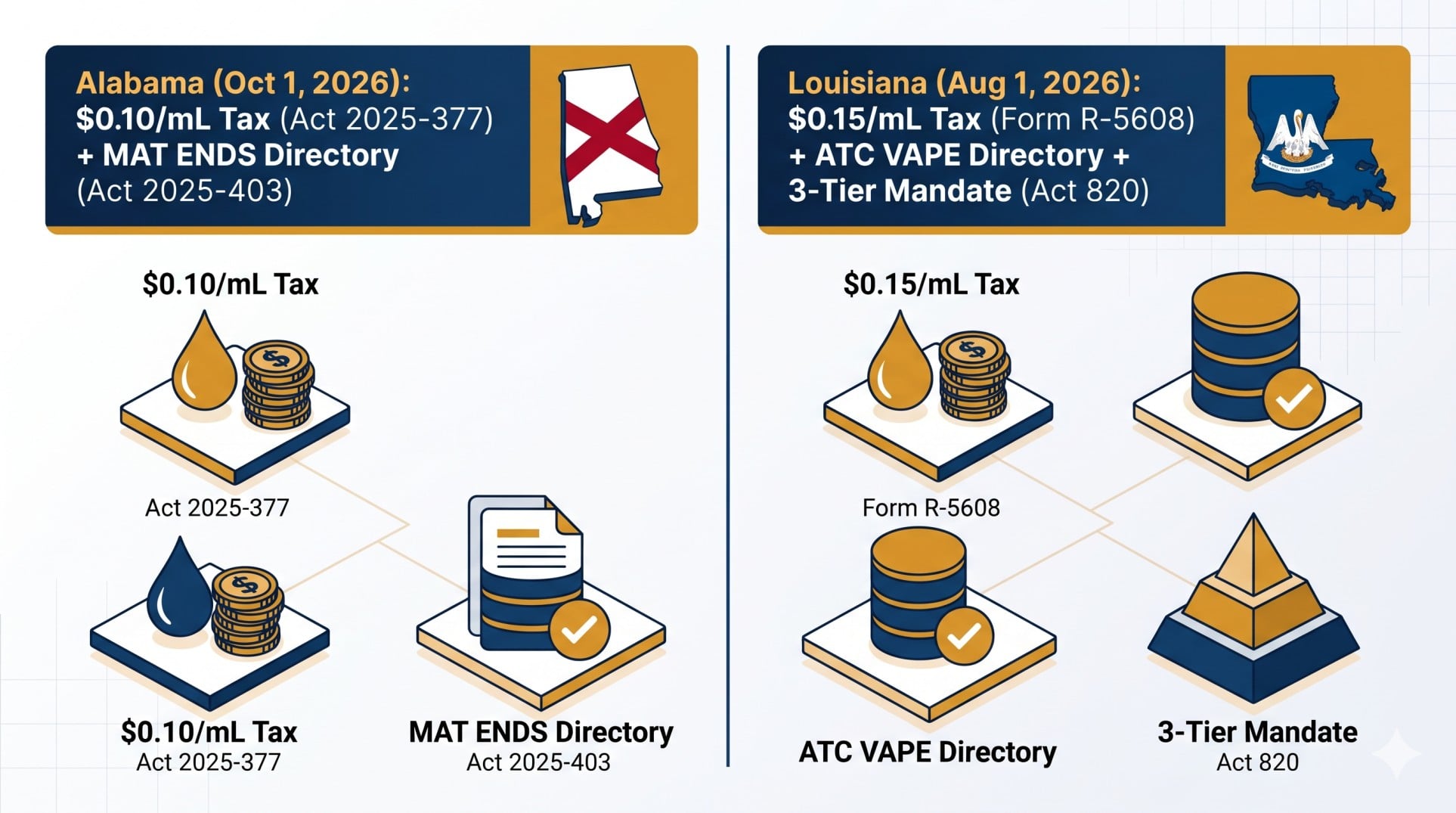
1. Alabama: The MAT ENDS Directory, HB 8 (Act 2025-403) & New $0.10/mL Tax (Eff. Oct 1, 2026)
Alabama was the first state in the nation to launch an Electronic Nicotine Delivery System (ENDS) directory on May 1, 2022 (under Act 2021-453, administered by the Alabama Department of Revenue via the My Alabama Taxes (MAT) portal). However, across 2025 and 2026, the Alabama Legislature passed two transformative laws that completely rewrote the compliance playbook for Alabama ENDS directory and vapor tax obligations:
- New $0.10 per Milliliter Statewide Vapor Excise Tax (Act 2025-377 / HB 529 — Effective October 1, 2026): Prior to October 2026, Alabama had no statewide vapor excise tax (only a patchwork of local county/municipal fees). Under Code of Alabama § 40-25-81 (enacted by Act 2025-377), beginning October 1, 2026, Alabama levies a statewide excise tax of $0.10 per milliliter on all “consumable vapor products” (defined as any nicotine liquid solution or nicotine-containing material depleted when a vapor product is used, including closed pods, cartridges, and bottled nicotine e-liquid; zero-nicotine liquid is excluded). For a 30 mL bottle of nicotine salt e-liquid, the new state tax is $3.00; for a 15 mL disposable vape, the tax is $1.50. Wholesalers and importers must obtain a Consumable Vapor Products Wholesaler/Importer License and remit the tax monthly via My Alabama Taxes (MAT), while retailers must obtain a new Vapor Products Tax License from ALDOR. (Note: Act 2025-377 froze local vapor taxes as of October 1, 2025—voiding volume-based county business license fees while allowing pre-existing local per-mL taxes enacted on or before October 1, 2025 to remain operative.)
- Act 2025-403 (HB 8) Directory Tightening & Specialty Retailer Rules: Enacted in May 2025 (effective June 1 / October 1, 2025 and heavily enforced throughout 2026 alongside the Alabama ABC Board), HB 8 restricted new directory listings to products that are either FDA-authorized or manufactured, packaged, and labeled in the United States (a provision that triggered a federal Foreign Commerce Clause lawsuit by the Vapor Technology Association). Manufacturers must pay a $2,000 initial certification fee and a $500 annual renewal fee due every April 30 via MAT. Furthermore, HB 8 created a mandatory “Specialty Retailer” license category ($50 non-refundable filing fee + $150 annual permit fee) for any store with “vape” or “vapor” in its name or deriving 50%+ of its inventory from vapor products, prohibiting anyone under age 21 from entering the store and imposing fines up to $5,000 and permit revocation for selling unlisted products!
2. Louisiana: ATC VAPE Directory, $0.15/mL Excise Tax & Act 820 / Act 920 (Eff. Aug 1, 2026)
Since November 2023 (following Act 414 of 2023), the Louisiana Office of Alcohol and Tobacco Control (ATC) and the Louisiana Department of Revenue (LDR) have operated one of the most aggressive joint enforcement regimes in the country. If you do business in Louisiana in 2026–2027, you must master three overlapping mandates:
- The $0.15 per Milliliter Vapor Excise Tax (Form R-5608 / LaTAP): Under La. R.S. 47:841(F) (tripled from $0.05/mL to $0.15 per milliliter on July 1, 2023), Louisiana taxes all consumable nicotine liquid solutions and nicotine-containing vapor materials at $0.15 per mL (e.g., $4.50 on a 30 mL bottle or $2.25 on a 15 mL disposable). The tax is reported and paid electronically via the Louisiana Taxpayer Access Point (LaTAP) on Form R-5608 / Form R-5604 by the 20th day of the following month.
- Mandatory Three-Tier System & Total DtC Shipping Ban (Act 820 of 2026 — Effective August 1, 2026): Signed June 8, 2026 and effective August 1, 2026, Act 820 (HB 623) enacted La. R.S. 26:914.1, locking vapor products into a rigid alcohol-style three-tier distribution system. Starting August 1, 2026: (1) Direct-to-consumer (DtC) shipping of vapor products to Louisiana residents is 100% illegal for both in-state and out-of-state online sellers; (2) Manufacturers are strictly prohibited from selling or shipping directly to Louisiana retail vape shops or convenience stores; and (3) Louisiana retail dealers may only purchase vapor products from a wholesale dealer holding a valid Louisiana ATC Wholesale Dealer Permit!
- Quadrupled Permit Fees & Escalated Fines (Act 920 of 2026 — Effective August 1, 2026): On the exact same day (August 1, 2026), Act 920 quadrupled Louisiana’s annual ATC tobacco/vapor retail dealer permit fee under La. R.S. 26:902 from $25 to $100 per year per outlet (with zero proration), hiked the wholesale dealer permit and vending machine operator permit to $300 per year, and amended La. R.S. 26:918(A) so that selling unlisted products off the Louisiana ATC VAPE directory enforcement list carries civil fines of $50 to $1,000 for a first offense and $500 to $4,000 for a third offense within two years—where each individual unlisted vape pen on the shelf counts as a separate violation, alongside seizure and permit revocation!
Oklahoma & Kentucky: ABLE Attestations, HB 11 Fines & New 2026 ABC Licenses
Comparing Kentucky HB 11 and Oklahoma ABLE vape directory rules reveals how states enforce PMTA product registries both with a hybrid excise tax (Kentucky) and without a state vapor excise tax (Oklahoma)—using retail tobacco license revocation as the ultimate hammer.
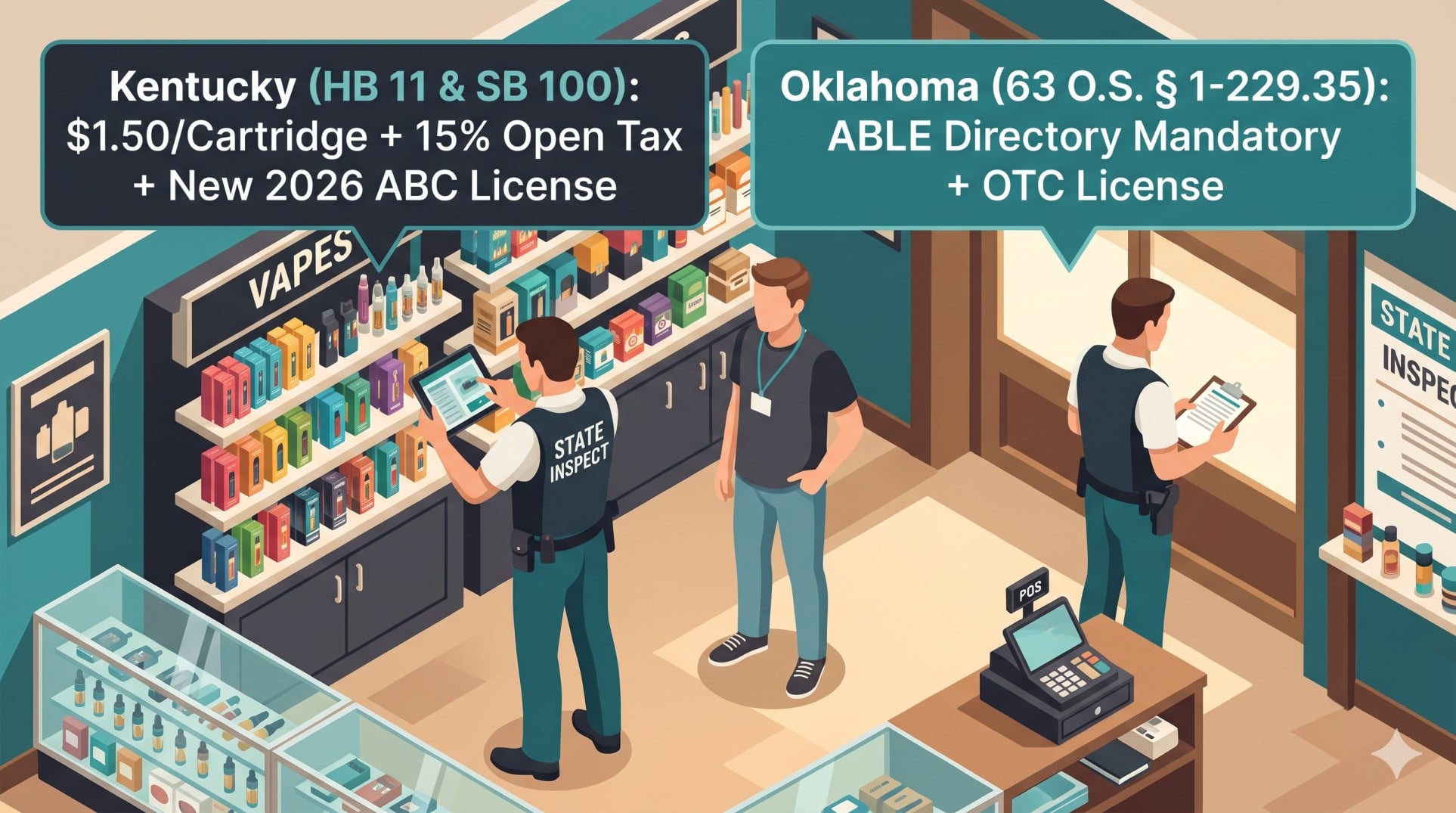
1. Kentucky: HB 11 Directory (KRS 438.316), Hybrid Excise Tax & New 2026 ABC License (SB 100)
For decades, Kentucky did not even require a statewide retail license to open a smoke shop or sell tobacco. Over the past 18 months, Frankfort lawmakers enacted a two-stage clampdown that has forced dozens of non-compliant vape stores to close or relocate across the river to Indiana:
- Stage 1 — Kentucky HB 11 Safe Harbor & Retailer Directory (Effective January 1, 2025): Enacted under KRS 438.310 to 438.316, House Bill 11 banned the sale or distribution of any nicotine vapor product in Kentucky unless it holds an FDA Marketing Granted Order or a “Safe Harbor Certification” proving a PMTA for tobacco-derived nicotine was filed by September 9, 2020 and remains under FDA review or active court stay. The Kentucky Secretary of State maintains the database of authorized products/retailers and the tobacco noncompliance database. Wholesalers face fines of $5,000 per violation, and retailers face escalating fines up to $1,000 per day for repeat violations.
- Stage 2 — Mandatory Kentucky ABC Retailer License (SB 100 — Effective January 1, 2026): Enacted under 2025 Ky. Acts Ch. 323 (Senate Bill 100) and codified at KRS 438.3063, beginning January 1, 2026, every single business selling tobacco, nicotine, or vapor products in Kentucky must hold an active unified Tobacco, Nicotine, or Vapor Product License issued by the Kentucky Department of Alcoholic Beverage Control (ABC) ($50 non-refundable annual fee). Why does this matter for directory enforcement? Because prior to January 1, 2026, Kentucky couldn’t revoke a smoke shop’s retail tobacco license if no statewide license existed! Now, selling unlisted vapes triggers ABC license suspension or revocation—shutting down 100% of the store’s cigarette, pouch, and vape sales.
- Kentucky’s Hybrid Vapor Excise Tax (Form 73A422 — Due the 20th): On the tax side, the Kentucky Department of Revenue imposes a bifurcated excise tax under KRS 138.140: $1.50 per closed-system cartridge (one of the highest per-pod taxes in the U.S.) and 15% of the distributor’s actual wholesale selling price on open vaping systems and bottled e-liquids. Licensed distributors (and retail distributors buying untaxed goods from unlicensed out-of-state suppliers) must file Kentucky Form 73A422 (Monthly Report of Tobacco Products, Snuff, and Chewing Tobacco / Vapor Products) by the 20th day of the following month.
2. Oklahoma: The ABLE Commission Directory (63 O.S. § 1-229.35) & OTC License Tie-In
What about Oklahoma? As of late 2026, Oklahoma imposes $0.00 in state vapor excise tax on e-cigarettes and e-liquids (only standard state 4.5% plus local retail sales tax applies, while cigarettes are taxed at $2.03/pack and smokeless tobacco at 60%–80% of factory list price). Furthermore, an Oklahoma retail smoke shop or convenience store tobacco license from the Oklahoma Tax Commission (OTC) costs just $30 for a three-year permit (with January 2026 OTC rule amendments requiring separate sales tax permits for each vending machine and prohibiting retail sales from vehicles).
Do not let Oklahoma’s $0 vapor excise tax lull you into a false sense of security. Under Oklahoma Statute Title 63, Section 1-229.35 (enforced since October 1, 2023), every vapor manufacturer must submit a sworn affidavit under penalty of perjury—along with an Excel product template, FDA PMTA submission receipts, and any federal court stay orders—to the Oklahoma Alcoholic Beverage Laws Enforcement (ABLE) Commission. Under § 1-229.35, it is unlawful for any wholesaler or retailer to knowingly distribute, sell, barter, or furnish any vapor product not listed on the Oklahoma ABLE Vape Directory. ABLE agents and OTC tax auditors work in tandem: if ABLE inspectors find unlisted disposable vapes in your shop, they seize the contraband inventory and refer your business to the Oklahoma Tax Commission to revoke your retail cigarette and tobacco license!
Retailers and wholesalers navigating licensing revocations or audit assessments across the South and Midwest should connect with our excise tax audit defense and tobacco licensing compliance specialists for immediate support.
2026–2027 Nationwide State PMTA Vape Directory & Excise Tax Matrix
Across the United States in 2026–2027, 16+ states enforce or are actively rolling out mandatory PMTA/FDA vapor product directories alongside state vapor excise taxes ranging from $0.00 (Oklahoma, Florida, Mississippi) to 95% of taxable sales price (Washington).
Use this comprehensive 2026–2027 compliance matrix to track directory enforcement agencies, statutory effective dates, current vapor excise tax rates, and non-compliance penalties across the key directory states:
| State | Directory Enforcement Agency & Statute | Directory Effective / Enforcement Date | 2026–2027 State Vapor Excise Tax Rate | Primary Excise Tax Form & Due Date | Unlisted Product Seizure & License Penalties |
|---|---|---|---|---|---|
| Alabama | AL Dept. of Revenue (MAT) & ABC Board (Act 2021-453 & Act 2025-403 / HB 8) |
Active (May 1, 2022; tightened June/Oct 2025) | $0.10 per mL on nicotine e-liquid (New statewide tax eff. Oct 1, 2026 under Act 2025-377) |
MAT Consumable Vapor Return (Monthly via My Alabama Taxes) | Daily per-unit civil fines up to $5,000; contraband seizure; revocation of Specialty/Tobacco Permit. |
| Louisiana | LA Office of Alcohol & Tobacco Control (ATC) (Act 414 of 2023; Acts 820 & 920 of 2026) |
Active (Nov 2023; 3-Tier & DtC Ban eff. Aug 1, 2026) | $0.15 per mL of consumable nicotine liquid | LA Form R-5608 / R-5604 (via LaTAP – Due 20th) | $50–$1,000 (1st offense) up to $4,000 (3rd offense) per unit; seizure; loss of $100/$300 ATC permit. |
| Oklahoma | OK ABLE Commission & OK Tax Commission (63 O.S. § 1-229.35) |
Active (Published Oct 1, 2023; ongoing 2026 audits) | $0.00 State Vapor Excise Tax (Standard 4.5% + local retail sales tax applies) |
OK Sales Tax Return (Due 20th); OTC Cigarette/OTP Returns | Immediate ABLE contraband seizure; civil fines; revocation of OTC retail tobacco license. |
| Kentucky | KY Secretary of State & Dept. of ABC (HB 11 / KRS 438.316 & SB 100 / KRS 438.3063) |
Directory eff. Jan 1, 2025; New ABC License eff. Jan 1, 2026 | $1.50 per closed cartridge + 15% of wholesale price on open systems | KY Form 73A422 (Monthly – Due 20th) | $5,000 wholesaler fine; up to $1,000/day retailer fine; revocation of new $50 KY ABC license. |
| North Carolina | NC Dept. of Revenue (NCDOR) (S.L. 2024-49; Tech. Corrections eff. Oct 1, 2026) |
Active (Eff. July 1, 2025; revised definitions eff. Oct 1, 2026) | $0.05 per mL on consumable product + $0.10/can pouches | NC Form B-A-101 (Monthly – Due 20th) | ALE contraband seizure; daily civil penalties per unlisted product; NCDOR license revocation. |
| Pennsylvania | PA Office of Attorney General & PA DOR (Act 57 of 2025) |
Directory published June 20, 2026; Seizures eff. Oct 19, 2026 | 40% of wholesale price | PA Form REV-679 (Quarterly – Due 20th after quarter) | Mandatory contraband seizure starting Oct 19, 2026; civil fines; PA DOR vape license revocation. |
| Wisconsin | WI Dept. of Revenue (WDOR) (2023 Wis. Act 73 / Wis. Stat. § 995.15) |
Active (Enforced 2025–2026) | $0.05 per mL of vapor product liquid | WI Form TT-100 (Monthly via My Tax Account – Due 15th) | $1,000 per day per unauthorized product offered for sale; WDOR seizure & permit revocation. |
| West Virginia | WV Alcohol Beverage Control Admin. (ABCA) (2026 Vape Safety Act) |
Enforcement effective September 1, 2026 | $0.075 per mL of e-cigarette liquid | WV Form WV/TPT-801 (Monthly – Due 15th) | Contraband seizure beginning Sept 1, 2026; civil fines; vape/smoke shop license revocation. |
| Florida | FL Office of Attorney General & DBPR (ABT) (HB 1007 / Fla. Stat. § 569.31 et seq.) |
Active (Enforced March 1, 2025–2026; prohibits listed unlawful products) | $0.00 State Vapor Excise Tax (6.0% + local sales tax applies; 85% OTP tax on leaf) |
FL DBPR Monthly Wholesale Reports (Due 10th) | $1,000 per day fine; immediate ABT contraband seizure; suspension/revocation of retail nicotine permit. |
| Tennessee | TN Alcoholic Beverage Commission (TABC) (SB 1301 / HB 1415 — Tenn. Code Ann. § 57-4-101) |
Full retail directory enforcement eff. January 1, 2027 | 10% of wholesale cost (12.5% of tax allocated to TABC enforcement) | TN Vapor Products Tax Return (via TNTAP – Due 15th) | At least 2 random TABC compliance checks/year; contraband seizure; civil fines & license loss. |
| California | CA Office of Attorney General & CDTFA (Prop 31 Flavor Ban; AB 762 Disposable Ban; Unflavored Tobacco List) |
Full Unflavored Tobacco List & AB 762 Disposable Ban eff. Jan 1, 2026 | 51.08% of wholesale (OTP rate FY26–27) + 12.5% retail CECET tax | CDTFA OTP Distributor Return (Due 25th) & CECET Return | Up to $2,000–$10,000+ civil penalties; felony/misdemeanor seizures; CDTFA license revocation. |
| Utah, Virginia & Iowa | UT Tax Commission / VA Attorney General / IA DOR | Litigation Update: Enacted for 2025–2026; subject to federal court injunctions/stays during 2026 appeals | Utah: 71% of MSP (eff. July 1, 2026) Virginia: $0.11 per mL Iowa: Standard sales tax |
UT Form TC-553 (Quarterly) VA Form TT-8 (Monthly – Due 20th) |
Monitor active Fourth/Eighth/Tenth Circuit preemption rulings; excise taxes remain 100% enforced! |
2026–2027 Business Scenarios: Contraband Seizures, Fines & License Loss Math
To understand the true financial devastation of selling unlisted vapor products in 2026–2027, you have to calculate the combined hit of confiscated wholesale inventory, forfeited state excise taxes, per-unit/per-day statutory fines, and lost cigarette/pouch revenue during a tobacco permit suspension.
Let’s walk through four realistic business scenarios across Alabama, Louisiana, Kentucky, and Oklahoma.
Scenario 1: Mobile, Alabama Specialty Vape Shop Caught With Unlisted Disposables in November 2026
The Setup: Gulf Coast Vapor Lounge in Mobile, Alabama holds an Alabama Specialty Retailer of Electronic Nicotine Delivery Systems Permit ($150/year under Act 2025-403 / HB 8) and the newly required Alabama Vapor Products Tax License (effective October 1, 2026 under Act 2025-377). In October 2026, the store owner purchases 600 fruit-flavored disposable vapes (each containing 18 mL of 5% nicotine liquid) from an out-of-state distributor at a wholesale price of $9.00 per device ($5,400.00 invoice base). The brand is manufactured overseas, does not hold an FDA Marketing Granted Order, and is not listed on the My Alabama Taxes (MAT) Approved ENDS Products Directory.
The Double-Whammy Tax & Seizure Math:
- New October 1, 2026 Alabama Vapor Excise Tax Paid ($0.10/mL): Under Code of Alabama § 40-25-81, 600 devices × 18 mL per device = 10,800 total milliliters × $0.10/mL = $1,080.00 in Alabama Consumable Vapor Products Tax charged on the wholesale invoice (bringing the shop’s landed cash outlay to $6,480.00).
- The ABC / ALDOR Inspection: In November 2026, Alabama ABC Board enforcement agents inspect Gulf Coast Vapor Lounge and scan the 600 devices against the MAT ENDS Directory. Because the devices are unlisted, all 600 units are immediately confiscated as illegal contraband.
- Total Financial Loss:
- Confiscated Inventory Cost (Non-Recoverable): $5,400.00.
- Forfeited Alabama $0.10/mL Vapor Excise Tax (Zero Refund for Seized Contraband): $1,080.00.
- Act 2025-403 Administrative Fine & Permit Suspension: Up to $5,000.00 in civil fines plus suspension/revocation of the shop’s Specialty Retailer and Tobacco Permit.
- Net Direct Hit (Before Lost Business During Closure): $11,480.00+ wiped out from a single 600-unit order!
Scenario 2: Baton Rouge Convenience Store Violating Louisiana’s August 1, 2026 Three-Tier Law
The Setup: Bayou Quick Stop, a gas station and convenience store in Baton Rouge, Louisiana, renews its Louisiana ATC Retail Dealer Permit on August 1, 2026 at the newly quadrupled rate of $100.00 (under Act 920 of 2026). Trying to boost margins in September 2026, the store manager orders 200 disposable vapes (15 mL each = 3,000 mL total) directly from an out-of-state manufacturer’s B2B website in Texas for $1,600.00 ($0.00 Louisiana excise tax charged). Half of the SKUs (100 units) are listed on the Louisiana ATC VAPE Directory, while the other 100 units are unlisted flavors.
Step-by-Step 2026 Louisiana Audit & Enforcement Math:
- Violation #1 — Three-Tier Purchasing Ban (Act 820 / La. R.S. 26:914.1): Even for the 100 vapes that were listed on the ATC VAPE Directory, buying them directly from an out-of-state manufacturer instead of a Louisiana-permitted wholesale dealer on or after August 1, 2026 violates Act 820!
- Violation #2 — Unpaid $0.15/mL Louisiana Vapor Tax (La. R.S. 47:841(F)): Because the out-of-state seller was not a registered Louisiana wholesaler remitting tax on Form R-5608, Bayou Quick Stop is assessed the unpaid $0.15/mL excise tax on all 3,000 mL = $450.00 tax principal, plus up to 25% late filing/payment penalties and interest by the Louisiana Department of Revenue.
- Violation #3 — Unlisted VAPE Directory Units (Act 920 / La. R.S. 26:918(A)): Under Louisiana ATC rules, each of the 100 unlisted units is a separate violation carrying a fine of $50 to $1,000 per offense (1st offense) or $500 to $4,000 (repeat offense), plus physical seizure of the devices and a 30-day suspension of the gas station’s ATC permit. During that 30-day ATC suspension, Bayou Quick Stop cannot legally sell a single pack of Marlboros, Copenhagen, or ZYN pouches—costing the gas station $35,000+ in lost monthly tobacco gross sales!
Scenario 3: Louisville Smoke Shop Operating Under Kentucky HB 11 & SB 100 in 2026
The Setup: Bluegrass Smoke & Vape in Louisville, Kentucky obtained its new mandatory $50 Kentucky ABC Tobacco, Nicotine, or Vapor Product License on January 1, 2026 under Senate Bill 100 (KRS 438.3063). In July 2026, the store buys 400 closed-system 4-pod packs (1,600 closed cartridges total) of a compliant, directory-listed menthol pod brand, plus 150 unlisted disposable vapes from an unlicensed out-of-state distributor for $1,200.00 wholesale.
Step-by-Step Kentucky DOR & ABC Exposure:
- Compliant Closed Cartridges ($1.50/Cartridge Tax): On the 1,600 compliant closed pods, the licensed Kentucky distributor properly paid $2,400.00 in Kentucky Closed Vaping System excise tax (1,600 cartridges × $1.50) on Form 73A422.
- Unlisted Disposables Bought From Unlicensed Distributor: When the unlicensed out-of-state supplier files its mandatory federal PACT Act report with the Kentucky Department of Revenue, DOR cross-checks the invoice against Form 73A422 filings and the Kentucky HB 11 authorized product directory.
- The Assessment & License Loss: Under Form 73A422 rules, a Kentucky retailer in possession of untaxed vapor products purchased from an unlicensed distributor is directly liable for the Kentucky excise tax (either $1.50/unit closed or 15% of purchase price open). Worse yet, DOR shares the PACT Act manifest with the Kentucky Department of Alcoholic Beverage Control (ABC), which levies HB 11 civil fines (up to $1,000 per day for repeat retail violations and $5,000 against the wholesaler) and revokes Bluegrass Smoke & Vape’s 2026 ABC license!
Scenario 4: Tulsa, Oklahoma Distributor Caught on PACT Act Cross-Check
The Setup: Red River Wholesale distributes vapor products to 85 convenience stores across Tulsa and Oklahoma City. Because Oklahoma charges $0.00 state vapor excise tax, Red River’s compliance officer assumes Oklahoma doesn’t audit vape invoices. However, Red River distributes 3,000 disposable vapes of a brand whose FDA Marketing Denial Order (MDO) court stay was vacated by a federal appeals court two months earlier—causing the Oklahoma ABLE Commission to remove the brand from the official Oklahoma Vape Registry.
The Outcome: Even without a vapor excise tax return, ABLE Commission agents inspect retail convenience stores across Tulsa, trace the wholesale invoices back to Red River Wholesale under 63 O.S. § 1-229.35, seize the remaining warehouse stock, and initiate revocation proceedings against Red River’s Oklahoma Tax Commission tobacco wholesale license.
Need to outsource your monthly PACT Act reporting and excise returns so your invoices never trigger an enforcement raid? Explore our automated PACT Act and state vapor excise tax filing services.
Step-by-Step SKU Audit, Directory Verification & Excise Filing Playbook
To protect your retail stores and distribution warehouses from contraband seizures and license revocations in 2026–2027, you must implement a four-step pre-purchase verification and excise filing workflow.
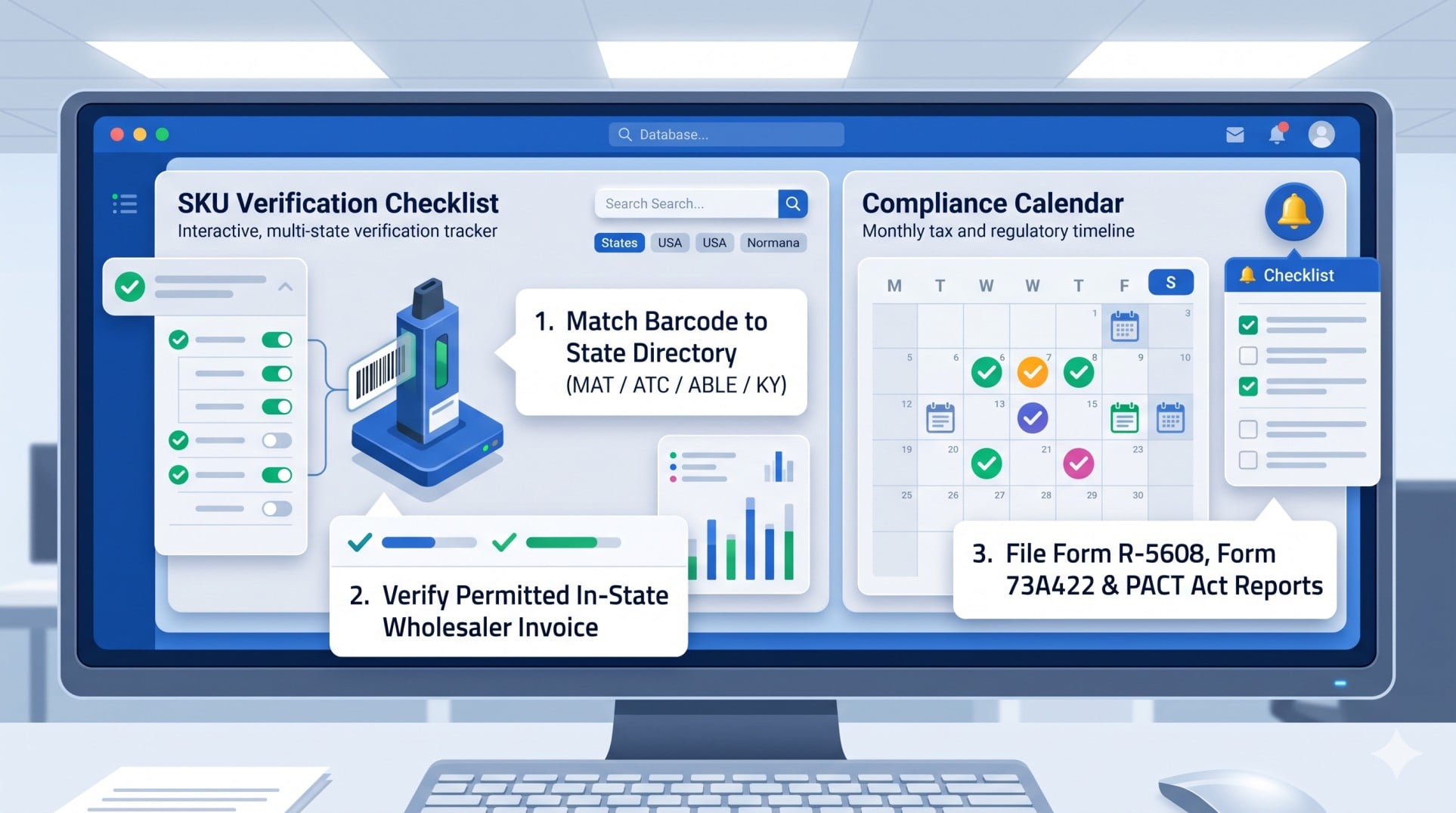
Step 1: Cross-Check Every SKU Against Official State Directories Monthly
State directories are dynamic databases—not static PDF lists. When the FDA issues a new Marketing Denial Order (MDO) or a federal court lifts a stay, state agencies delist those SKUs on the 1st of the following month (giving wholesalers and retailers a narrow statutory grace period, typically 15 to 60 days, to remove delisted stock from shelves or return it to the manufacturer). Bookmark and audit your active SKU master against these official portals on the 1st of every month:
- Alabama: Log into My Alabama Taxes (MAT) (`myalabamataxes.alabama.gov`), navigate to the “Businesses” section, click “View or upload a report,” and under “Tobacco Reports” select the Approved ENDS Products Directory (alongside the Alabama ABC Board specialty retailer rules).
- Louisiana: Check the Louisiana Office of Alcohol and Tobacco Control (ATC) VAPE Directory on the official ATC portal before ordering a single case.
- Oklahoma: Download the current Oklahoma Vape Registry / Vape Attestation List published by the Oklahoma ABLE Commission.
- Kentucky: Verify manufacturer Safe Harbor Certifications and authorized product/retailer listings via the Kentucky Secretary of State / Kentucky ABC portal under KRS 438.316.
- North Carolina, Pennsylvania, Wisconsin & Florida: Check the NCDOR Vapor Products & Consumable Products Directory, the Pennsylvania Attorney General ENDS Directory (enforced starting October 19, 2026), the Wisconsin DOR Electronic Vaping Device Directory, and the Florida Attorney General Unlawful Nicotine Dispensing Device Directory.
Step 2: Enforce Strict “Permitted In-State Wholesaler” Purchasing Controls
Instruct your store managers and buyers to never purchase disposable vapes, pods, or e-liquids from unverified B2B websites, trade show cash-and-carry vendors, or unlicensed out-of-state jobbers. In states like Louisiana (under Act 820, effective August 1, 2026), buying from anyone other than a Louisiana-permitted wholesale dealer is an automatic statutory violation—even if the product is listed on the ATC directory! Demand two documents from every supplier before issuing payment:
- A copy of the supplier’s active 2026–2027 in-state Wholesale Tobacco/Vapor Permit (e.g., LA ATC Wholesale Permit, AL Consumable Vapor Products Wholesaler License, KY DOR Distributor License).
- Written manufacturer attestation numbers or state directory SKU confirmation codes printed directly on the commercial invoice.
Step 3: Maintain All Required Dual-Agency Licenses (DOR + ABC/ATC)
In almost every directory state, two separate state agencies govern your business: the Department of Revenue collects the excise tax, while the Alcoholic Beverage Control (ABC/ATC/ABLE) board issues the retail/wholesale permit and enforces the directory. Verify that every location holds both:
- In Alabama: Hold your ALDOR Retail Tobacco/Vapor Products Tax License (required for the new $0.10/mL tax effective October 1, 2026) plus your Alabama ABC Board Tobacco Permit (and the $150 Specialty Retailer Permit if 50%+ of your inventory is vapor or “vape” is in your store name).
- In Louisiana: Hold your LDR excise tax account on LaTAP plus your renewed $100/year ATC Retail Dealer Permit (or $300/year ATC Wholesale Dealer Permit, effective August 1, 2026 under Act 920).
- In Kentucky: Hold your KY DOR Sales/Tobacco Tax account plus the mandatory $50/year Kentucky ABC Tobacco, Nicotine, or Vapor Product License required since January 1, 2026 under SB 100.
- In Oklahoma: Hold your 3-year $30 Oklahoma Tax Commission (OTC) Retail Tobacco License (and separate vending permits under the January 2026 OTC rules) while complying with Oklahoma ABLE Commission inspections.
Step 4: File Monthly Vapor Excise Returns & PACT Act Reports on Time
Ensure your accounting team files every monthly or quarterly vapor excise tax return and federal PACT Act Schedule by the exact statutory deadline:
- 10th of the Month: File Florida DBPR wholesale reports and PACT Act interstate ENDS shipment reports in states with 10th-of-the-month cut-offs.
- 15th of the Month: File Wisconsin Form TT-100 (via My Tax Account), West Virginia Form WV/TPT-801, and Tennessee Vapor Products Tax Returns (via TNTAP).
- 20th of the Month: File Louisiana Form R-5608 / R-5604 (via LaTAP, remitting $0.15/mL), Kentucky Form 73A422 (remitting $1.50/cartridge and 15% open-system wholesale tax), Alabama Consumable Vapor Products Tax Return (via MAT, remitting $0.10/mL starting with the October 2026 period due November 20, 2026), and North Carolina Form B-A-101 (remitting $0.05/mL).
If your business has received an audit notice, a cease-and-desist letter, or a proposed license suspension from a state DOR or ABC board, visit our SALT & Excise Tax controversy and license defense consultation page immediately.
Frequently Asked Questions About FDA Vape Directory Laws & Excise Taxes
1. How many states have enacted or considered FDA vape directory laws as of 2026?
At least 26 states have introduced or enacted state-level PMTA vapor product directory legislation, with 16+ states actively operating or phasing in mandatory state directories across 2026 and 2027—including Alabama, Louisiana, Oklahoma, Kentucky, North Carolina, Florida, Wisconsin, Pennsylvania (eff. October 19, 2026), West Virginia (eff. September 1, 2026), and Tennessee (eff. January 1, 2027).
2. If I pay the state vapor excise tax on a vape product, is it legal to sell in a directory state?
No, paying state vapor excise tax does not make an unlisted vape legal to sell. In directory states, any product missing from the state’s official registry is illegal contraband. If you report and pay tax on an unlisted SKU, state auditors use your tax schedule to seize the inventory and fine your business without refunding the tax.
3. What is the new Alabama vape excise tax effective October 1, 2026?
Under Alabama Act 2025-377 (Code of Ala. § 40-25-81), beginning October 1, 2026, Alabama imposes a statewide excise tax of $0.10 per milliliter on all nicotine-containing consumable vapor products sold at wholesale or imported into Alabama. This tax operates alongside the mandatory Alabama ENDS directory and vapor tax licensing rules on My Alabama Taxes (MAT).
4. How did Louisiana change its vape laws and permit fees on August 1, 2026?
On August 1, 2026, Louisiana Act 820 banned all direct-to-consumer (DtC) vape shipping into Louisiana and created a strict three-tier system requiring retailers to buy only from Louisiana-permitted wholesalers. Simultaneously, Act 920 quadrupled retail tobacco/vape permit fees from $25 to $100 per year and wholesale permits to $300 per year alongside Louisiana ATC VAPE directory enforcement.
5. Does Oklahoma charge an excise tax on vapes, and is the ABLE directory mandatory?
Oklahoma charges $0.00 in state vapor excise tax as of 2026 (only standard state and local retail sales tax applies). However, under 63 O.S. § 1-229.35, all vapor products sold in Oklahoma must be listed on the Oklahoma ABLE Commission Vape Directory; selling unlisted vapes results in contraband seizure and loss of your Oklahoma Tax Commission tobacco license.
6. What are Kentucky’s 2026 vape excise tax rates and new ABC licensing rules?
Kentucky taxes closed-system vapor cartridges at $1.50 per cartridge and open-system e-liquids at 15% of the wholesale selling price, reported monthly by distributors on Form 73A422 by the 20th. Additionally, effective January 1, 2026 under SB 100 (KRS 438.3063), every Kentucky retailer must hold a $50 annual Kentucky ABC Tobacco, Nicotine, or Vapor Product License and sell only vapes compliant with HB 11.
7. Why are almost all flavored disposable vapes banned under state PMTA directories?
Most state directories require a product to either hold an official FDA Marketing Granted Order (MGO)—which fewer than 50 products (all tobacco or menthol flavored) have received—or have a timely PMTA filed by September 9, 2020 for tobacco-derived nicotine. Because most fruit- and candy-flavored disposables launched after 2020 using synthetic nicotine, they do not qualify for directory listing.
8. What happens when a product listed on a state vape directory gets delisted?
State agencies update their directories monthly (such as ALDOR via MAT or Louisiana ATC). When a product is delisted because the FDA denies its PMTA or a federal court lifts a stay, wholesalers and retailers are given a short statutory grace period to remove the SKU from store shelves and return it to the manufacturer or export it out of state before it becomes seizable contraband.
9. Are state PMTA vape directory laws being challenged in federal court in 2026?
Yes, industry groups (including the Vapor Technology Association) have filed federal lawsuits challenging state directories on Federal Food, Drug, and Cosmetic Act (FDCA) preemption and Foreign Commerce Clause grounds. While injunctions or stays have temporarily affected enforcement in states like Virginia, Iowa, and Utah, directories in Alabama, Louisiana, Oklahoma, Kentucky, North Carolina, Florida, Wisconsin, and Pennsylvania are actively enforced.
10. Can a convenience store lose its license to sell Marlboro cigarettes for selling an unlisted vape?
Yes! Because states like Louisiana, Kentucky, Alabama, Oklahoma, Florida, and Wisconsin tie vapor compliance directly to unified retail tobacco/nicotine permits, getting caught with unlisted disposable vapes allows the state ABC/ATC or DOR to suspend or revoke your master tobacco permit—barring you from selling cigarettes, cigars, and nicotine pouches.
Protecting Your Retail Tobacco License & Wholesale Distribution Permits
The convergence of FDA vape directory laws and state excise tax audits has turned 2026–2027 into a minefield for convenience stores, smoke shops, and multi-state distributors. Whether you are adapting to Alabama’s new $0.10/mL vapor tax effective October 1, 2026, restructuring your supply chain for Louisiana’s August 1, 2026 three-tier mandate and $0.15/mL tax, licensing your storefronts under Kentucky’s new 2026 ABC license and HB 11 directory, or auditing your shelves against the Oklahoma ABLE Directory and Pennsylvania’s October 19, 2026 enforcement launch, tax and regulatory compliance are now inseparable.
Don’t risk a contraband raid, thousands of dollars in daily per-SKU civil fines, or the suspension of your store’s high-revenue cigarette and tobacco license over an unverified wholesale invoice. Contact the SALT & Excise Tax compliance specialists at Ourtaxpartner.com today to audit your multi-state SKU catalogs, register your wholesale and retail vapor tax accounts, and manage your monthly excise and PACT Act filings with zero compliance gaps.
Disclaimer: This content provides general information for educational purposes only and reflects state, local, and federal sales, use, and excise tax laws applicable to the 2026–2027 compliance periods. State and local tax rates, nexus thresholds, and excise regulations change frequently across jurisdictions. This article does not constitute professional tax, legal, or accounting advice. Always consult a certified public accountant (CPA), enrolled agent (EA), or qualified SALT advisor at Ourtaxpartner.com regarding your specific business compliance obligations. Ourtaxpartner.com is not responsible for any actions taken based on the information provided herein.
