
Whenever state lawmakers enact 2026 cigarette excise tax hikes, the rate increase does not just apply to new shipments leaving the manufacturer’s loading dock. To prevent wholesalers, jobbers, and convenience store chains from stockpiling months of lower-taxed cartons right before the statutory effective date, states enforce an immediate transitional “Floor Stock Tax” (also called a Cigarette Stamp Inventory Tax) on existing inventory held at the exact stroke of midnight when the rate jumps.
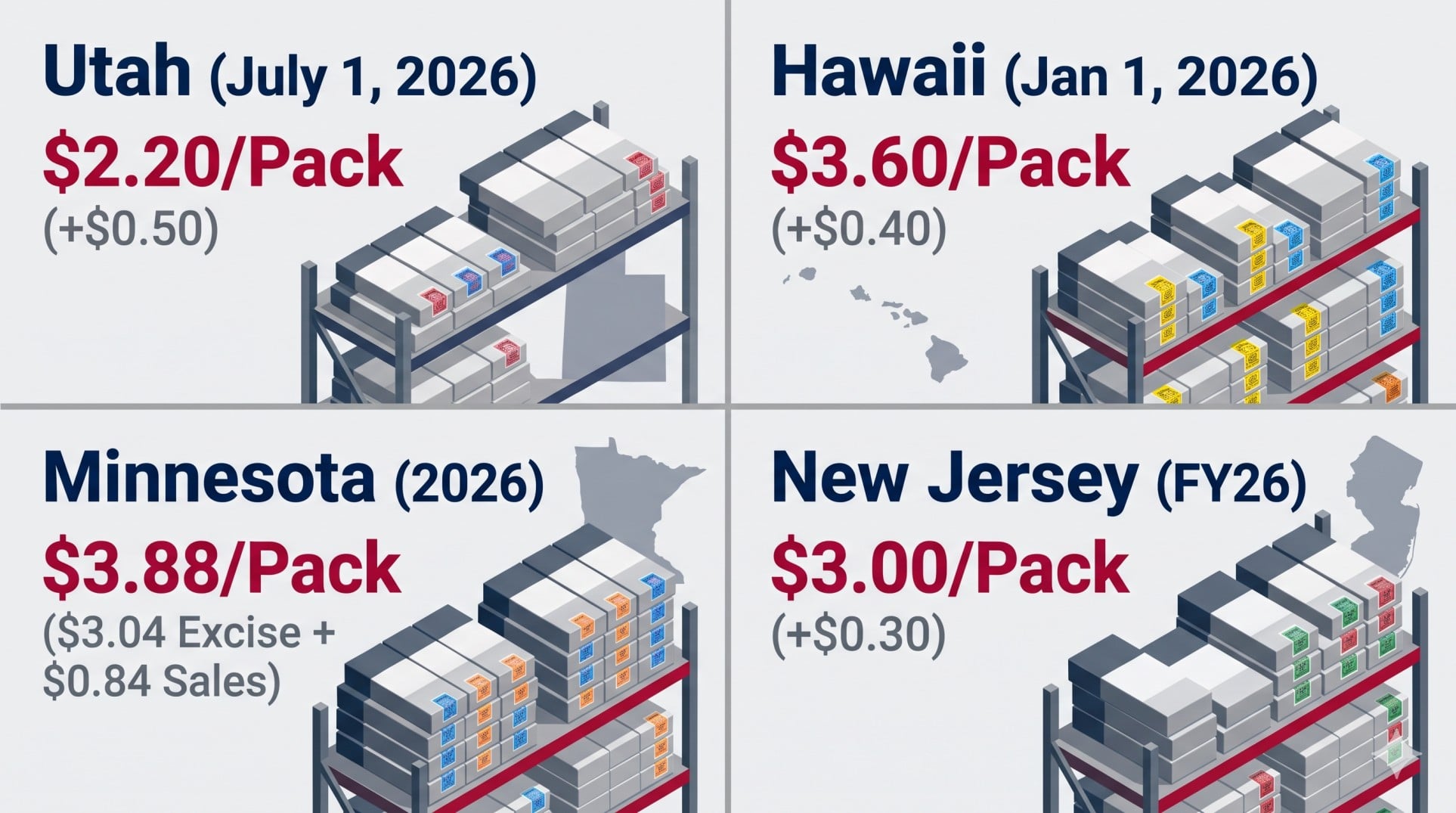
Across the 2025–2026 budget cycles, four states—Utah ($2.20 per pack as of July 1, 2026), Hawaii ($3.60 per pack as of January 1, 2026), Minnesota ($3.88 per pack combined in 2026, rising again on January 1, 2027), and New Jersey ($3.00 per pack under the FY 2026 budget)—implemented pivotal cigarette tax rate increases. Each of these four states enforces vastly different rules on who bears the legal incidence of the floor tax, how stamping discounts affect the per-pack math, and which exact tax form must be filed.
For wholesale distributors and gas station owners operating in Utah, Hawaii, Minnesota, and New Jersey, missing a floor stock inventory count or filing the wrong state schedule doesn’t just trigger a late penalty—it turns every pack of old-stamped cigarettes on your shelves into seizable contraband. Here is your step-by-step 2026–2027 calculation and filing guide.
⚡ Executive Summary: Key 2026–2027 Tax Compliance Rules at a Glance
- Utah ($2.20/Pack Effective July 1, 2026 — Form TC-563): Under Utah House Bill 337 (2026) and Utah State Tax Commission Bulletin 10-26, Utah raised its Participating Manufacturer (PM) cigarette tax from $1.70 to $2.20 per pack of 20 (+$0.50/pack; or $2.75 per pack of 25) and Non-Participating Manufacturer (NPM) cigarettes from $2.05 to $2.55 per pack of 20. Every retailer, distributor, stamper, and jobber holding stamped inventory at midnight on June 30, 2026 had to file Form TC-563 (Cigarette Stamp Inventory Tax Report) via TAP and remit the $0.50/pack differential by July 31, 2026.
- Hawaii ($3.60/Pack Effective January 1, 2026 — Form M-107): Under Act 95, Session Laws of Hawaii 2025 (HB 441), Hawaii increased its cigarette tax from $0.16 to $0.18 per cigarette (jumping from $3.20 to $3.60 per pack of 20) and transitioned from light gray stamps to green stamps. Licensed wholesalers and dealers had to file Form M-107 (Rev. 2025) by January 20, 2026 and pay a net stamp price differential of $0.4052 per stamp on all affixed and unused light gray stamps held at the close of business on December 31, 2025 (or return unused rolls on Form M-108).
- Minnesota ($3.88/Pack Combined in 2026; $3.917/Pack Eff. Jan 1, 2027): Under Minnesota Statutes 297F.05 and 297F.25, Minnesota levies a fixed $3.04 per pack ($0.152/stick) excise tax plus an annually indexed Cigarette Sales Tax collected upfront when distributors buy stamps on Form CT-101. On January 1, 2026, the stamp sales tax rose from $0.786 to $0.840 per pack (totaling $3.88 per pack), and on January 1, 2027, it rises again to $0.877 per pack (totaling $3.917 per pack of 20, or $1.05 sales tax per pack of 25) with no retail-level floor stock return required.
- New Jersey ($3.00/Pack Effective August 1, 2025 for FY 2026–2027 — Form COM-ATTD-901): Enacted under P.L. 2025, c. 68 (the FY 2026 New Jersey Budget), New Jersey hiked its cigarette tax by $0.30 per pack from $2.70 to $3.00 per pack of 20 (and liquid nicotine from $0.10/mL to $0.30/mL). Every distributor, wholesaler, and retail gas station was required to file a separate Form COM-ATTD-901 (Cigarette Floor Tax Return) for each licensed location and remit the $0.30/pack floor tax by October 1, 2025, or face contraband confiscation during 2026–2027 field inspections.
Table of Contents
- ⚡ Executive Summary: Key 2026–2027 Tax Compliance Rules at a Glance
- Breaking Down the 2026 Cigarette Excise Tax Hikes Across 4 Key States
- How a Cigarette Floor Stock Tax Return Works for Wholesalers & Gas Stations
- State-by-State Floor Stock Rules: Utah, Hawaii, Minnesota & New Jersey
- 2026–2027 Business Scenarios: Step-by-Step Floor Stock Tax Math
- Minimum Legal Pricing Laws & Retail Sales Tax-on-Tax Mechanics
- Step-by-Step Guide to Counting Inventory, Calculating Differential & Filing
- Frequently Asked Questions About 2026 Cigarette Floor Stock Taxes
- Protecting Your Wholesale or Retail Tobacco License From Contraband Audits
Breaking Down the 2026 Cigarette Excise Tax Hikes Across 4 Key States
The 2026 cigarette excise tax hikes pushed combined state tax burdens to $2.20 per pack in Utah (effective July 1, 2026), $3.60 per pack in Hawaii (effective January 1, 2026), $3.88 per pack in Minnesota (effective January 1, 2026, rising to $3.917 on January 1, 2027), and $3.00 per pack in New Jersey (governing all 2026–2027 sales following the FY 2026 budget enactment).
On top of these state-level rates, every pack of 20 cigarettes sold in the United States carries the federal Alcohol and Tobacco Tax and Trade Bureau (TTB) excise tax of $1.0066 per pack (commonly rounded to $1.01 per pack under 26 U.S.C. § 5701(b)(1), paid by the manufacturer or importer on TTB Form 5000.24). When a state legislature raises its per-cigarette mill rate or per-pack stamp price, that hike cascades through the entire three-tier tobacco supply chain—from licensed stamping distributors and sub-jobbers down to independent gas stations, truck stops, and convenience stores.
Why These Four State Hikes Demand Special Attention in 2026–2027
Not all cigarette rate increases are structured the same way. If you operate convenience stores or wholesale distribution warehouses across multiple states, look at the structural differences driving the 2026–2027 compliance rules in these four jurisdictions:
- Utah’s Mid-Year Jump & PM vs. NPM Split (Effective July 1, 2026): Under Utah House Bill 337 (Nicotine Product Tax Amendments, signed March 2026) and Utah State Tax Commission Bulletin 10-26, lawmakers scaled back an initial proposal of $3.70/pack and settled on a $0.50 per pack increase effective July 1, 2026. For Participating Manufacturers (PMs under the Master Settlement Agreement), the rate rose from $1.70 to $2.20 per pack of 20 ($0.11 per stick, or $2.75 per pack of 25). For Non-Participating Manufacturers (NPMs, which carry an extra $0.35/pack equity assessment under Utah Code § 59-14-214), the rate rose from $2.05 to $2.55 per pack of 20 (or $3.1875 per pack of 25).
- Hawaii’s Stamp Color Transition (Effective January 1, 2026): Enacted on May 27, 2025 under Act 95, Session Laws of Hawaii 2025 (H.B. 441) and detailed in Department of Taxation (DOTAX) Announcement No. 2025-07, Hawaii raised its excise tax under HRS § 245-3 from $0.16 to $0.18 per cigarette or little cigar on January 1, 2026. That boosted the tax on a 20-pack by $0.40—from $3.20 to $3.60 per pack—ranking Hawaii 6th highest in the nation. To enforce the hike visually, DOTAX replaced the pre-2026 light gray stamps ($3.20 denomination) with brand-new green stamps ($3.60 denomination) sold through First Hawaiian Bank at $54,702.00 per roll of 15,000 stamps.
- Minnesota’s Dual-Component Stamp Rate ($3.88 in 2026; $3.917 in 2027): Minnesota is unique because every cigarette tax stamp purchased by a distributor under Minnesota Chapter 297F combines two statutory taxes: (1) a fixed Cigarette Excise Tax of $3.04 per pack of 20 (152 mills / 15.2 cents per cigarette under M.S. 297F.05), and (2) an annually indexed Cigarette Sales Tax calculated by the Commissioner of Revenue every October and effective every January 1 under M.S. 297F.25. On January 1, 2026, Minnesota’s Cigarette Sales Tax jumped by $0.054 per pack (from $0.786 to $0.840 per pack of 20, or 4.2 cents per stick), bringing the combined 2026 stamp tax to $3.88 per pack ($38.80 per carton). And per the Minnesota Department of Revenue’s October 27, 2026 official notice, the Cigarette Sales Tax will increase again on January 1, 2027 to $0.877 per pack of 20 (4.385 cents per stick, or $1.05 per pack of 25), pushing Minnesota’s combined 2027 stamp burden to $3.917 per pack!
- New Jersey’s FY 2026 Budget Hike ($3.00/Pack & Contraband Sweeps): Enacted under P.L. 2025, c. 68 as part of Governor Phil Murphy’s FY 2026 budget (effective August 1, 2025 and governing all 2026–2027 periods), New Jersey increased its cigarette tax under N.J.S.A. 54:40A-8 by $0.30 per pack—from $2.70 to $3.00 per pack of 20 ($0.15 per stick)—while simultaneously tripling its liquid nicotine vape tax from $0.10/mL to $0.30/mL. Throughout 2026, the New Jersey Division of Taxation’s Office of Criminal Investigation has conducted ongoing retail inspections targeting gas stations and bodegas that failed to file their mandatory floor stock returns for old-stamped packs.
Businesses tracking broader non-cigarette rate changes across these same jurisdictions should also bookmark our 2026–2027 multi-state nicotine pouch and OTP excise tax compliance guide, as Utah, Hawaii, Minnesota, and New Jersey all enforce strict parallel rules on vapes and smokeless products.
How a Cigarette Floor Stock Tax Return Works for Wholesalers & Gas Stations
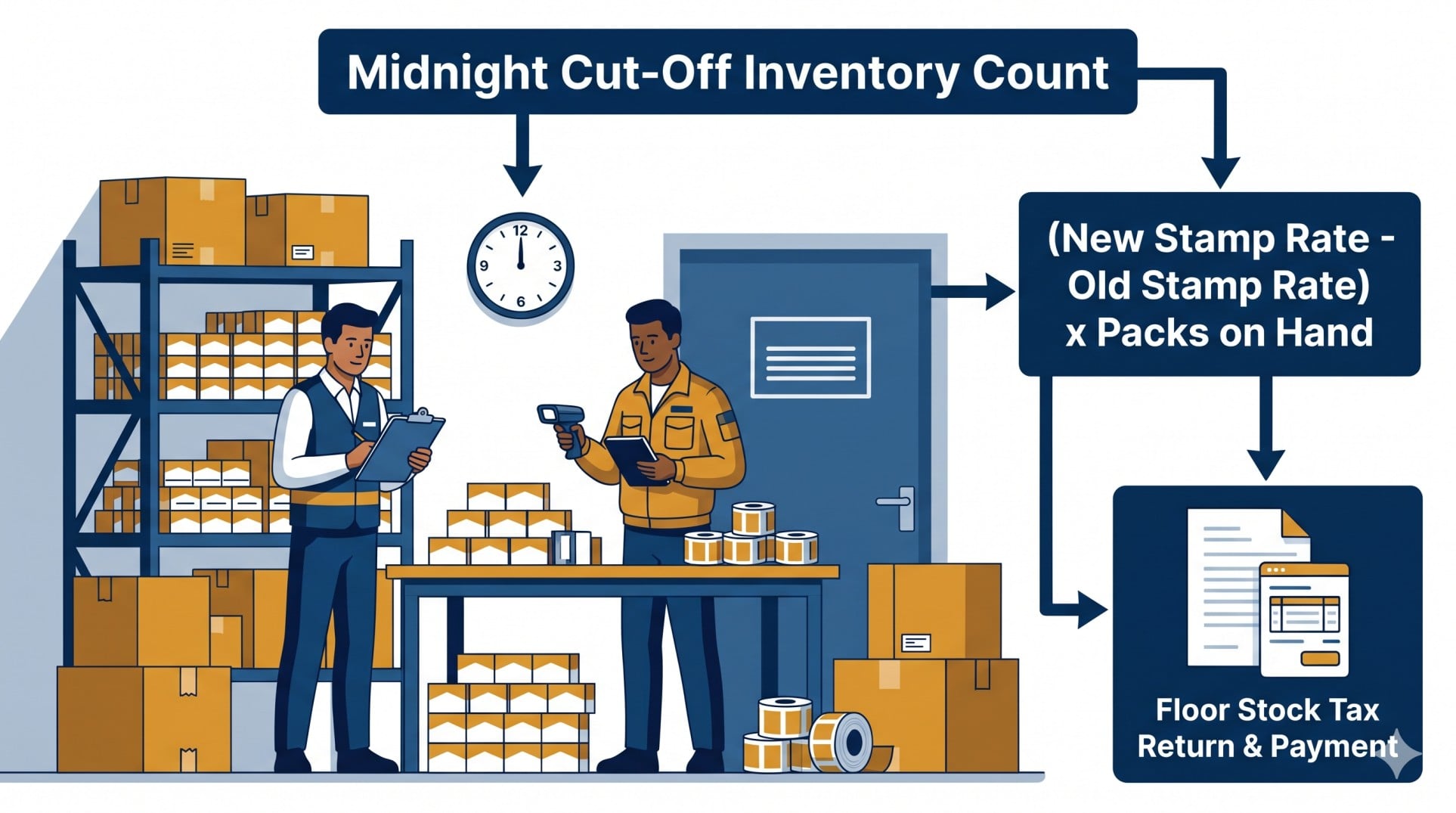
A cigarette floor stock tax return is a mandatory one-time excise tax filing that requires wholesalers, stampers, and—in most states—retail gas stations to count all stamped cigarette packs and unaffixed tax stamps in their possession at midnight on the date of a tax hike and pay the exact dollar difference between the old rate and the new rate.
Why do states impose a floor tax on packs that already have a valid state tax stamp glued to the bottom of the cellophane? Because under state excise law, the cigarette tax is a tax on the sale, use, or possession of cigarettes on or after the effective date of the statutory rate change. Since the stamping distributor only paid the old tax rate when buying the stamp weeks earlier, selling that pack after the effective date without paying the differential would create an windfall or allow high-capital chains to hoard cheap inventory.
The Two Supply-Chain Floor Tax Models: All-Tier vs. Wholesaler-Only
Before you count a single pack, you must determine which supply-chain tier bears the legal incidence of the floor tax in your state:
- Model A: All-Tier Retail & Wholesale Floor Tax (Utah & New Jersey): In both Utah (Form TC-563) and New Jersey (Form COM-ATTD-901), the law imposes the floor stock tax on every single licensed entity in the supply chain—including manufacturers, licensed stampers, wholesalers, sub-jobbers, and every retail gas station, convenience store, grocery store, and smoke shop. Even if you only own a single gas station in Salt Lake City or Newark and buy 100% of your cartons pre-stamped from a wholesaler like Core-Mark or McLane, you are legally required to count your shelf and backroom packs at midnight and file your own floor stock tax return.
- Model B: Stamping Wholesaler / Dealer Floor Tax (Hawaii): Under Hawaii Act 95 (2025) and DOTAX Announcement No. 2025-07, the floor stock return (Form M-107) applies specifically to licensees approved to purchase cigarette tax stamps (wholesalers and dealers defined under HRS § 245-1) who hold affixed or unused light gray stamps at the close of business on December 31, 2025. Retail gas stations in Hawaii that purchase pre-stamped cigarettes from licensed wholesalers are not required to file Form M-107, and DOTAX explicitly permits Hawaii retailers to continue selling light gray-stamped packs held in their retail inventory on January 1, 2026 (or received from a licensed wholesaler who paid the Form M-107 differential).
- Model C: Annual Upfront Stamp Sales Tax Adjustment Without a Floor Return (Minnesota): In Minnesota, while a legislative hike to the base Excise Tax under M.S. 297F.05 triggers a statutory floor stock inventory tax, the annual January 1 adjustment to the Cigarette Sales Tax component under M.S. 297F.25 (from $0.786 to $0.840 per pack on January 1, 2026, and to $0.877 per pack on January 1, 2027) is collected directly by the Minnesota Department of Revenue when licensed distributors purchase cigarette tax stamps on Form CT-101 on or after January 1. Neither Minnesota gas stations nor distributors are required to file a separate floor stock return for the annual M.S. 297F.25 sales tax adjustment on previously stamped packs!
Critical Trap: Who Owes the Floor Tax on Cartons “In Transit” at Midnight?
What happens if a wholesale distributor loads a pallet of 6,000 cigarette packs onto a common-carrier freight truck on June 29, 2026, and the truck is still rolling down I-15 at 12:00 a.m. midnight on June 30 / July 1, 2026 when Utah’s $0.50/pack tax hike takes effect?
Audit Warning: The “FOB Origin” vs. “FOB Destination” Transit Rule
As explicitly stated by the Utah State Tax Commission in its Form TC-563 guidance, inventory tax on cigarettes in transit between two parties at the midnight cut-off is the legal responsibility of whichever party holds legal title during shipping. If the distributor ships the cigarettes “FOB Origin” (or FOB Shipping Point), title passed to the retail gas station the moment the cartons left the distributor’s warehouse—meaning the retailer must include that in-transit shipment on its midnight floor stock return! Conversely, if shipped “FOB Destination” (or delivered on the wholesaler’s own company truck), title has not yet passed, and the wholesaler owes the floor tax.
| State | Old Per-Pack Rate (20-Pack) | New 2026–2027 Per-Pack Rate (20-Pack) | Effective Date of Rate Hike | Floor Stock Tax Rate Differential | Who Must File Floor Tax Return? | Official Floor Stock Form & Filing Due Date |
|---|---|---|---|---|---|---|
| Utah (HB 337 / Bulletin 10-26) | $1.70 (PM) $2.05 (NPM) |
$2.20 (PM) $2.55 (NPM) ($2.75 / $3.1875 for 25-pack) |
July 1, 2026 (Inventory at Midnight June 30, 2026) |
+$0.50 / pack of 20 +$0.625 / pack of 25 |
All Licensees: Retailers, Distributors, Stampers, Jobbers, Wholesalers & Manufacturers | Utah Form TC-563 (via TAP Portal) Due: July 31, 2026 |
| Hawaii (Act 95, SLH 2025 / HB 441) | $3.20 ($0.16 / cigarette; Light Gray Stamp) |
$3.60 ($0.18 / cigarette; Green Stamp) |
January 1, 2026 (Inventory at Close of Business Dec 31, 2025) |
+$0.40 / pack gross +$0.4052 / stamp net on Form M-107 |
Stamping Licensees: Wholesalers & Dealers approved to buy stamps (Retailers exempt) | Hawaii Form M-107 (Rev. 2025) (or Form M-108 for credit) Due: January 20, 2026 |
| Minnesota (M.S. 297F.05 & 297F.25) | $3.826 (2025) ($3.04 Excise + $0.786 Sales Tax) |
$3.880 (2026: $3.04 + $0.840) $3.917 (Eff. Jan 1, 2027: $3.04 + $0.877) |
January 1, 2026 & January 1, 2027 |
+$0.054 / pack (2026) +$0.037 / pack (2027) on new stamp orders |
Collected on New Stamp Orders Only: No retail or wholesale floor stock return required for M.S. 297F.25 adjustment | MN Form CT-101 (Stamp Order) & Form CT-102 (Monthly Return due 18th) |
| New Jersey (P.L. 2025, c. 68) | $2.70 ($0.135 / cigarette) |
$3.00 ($0.15 / cigarette; +$0.30/mL liquid nicotine) |
August 1, 2025 (Governing FY 2026–2027; Inventory at 12:01 a.m. Aug 1) |
+$0.30 / pack of 20 +$0.375 / pack of 25 |
All Licensees: Distributors, Wholesalers, and Retailers (Separate return per location!) | NJ Form COM-ATTD-901 (Cigarette Floor Tax Return) Due: October 1, 2025 (Late audits active in 2026) |
State-by-State Floor Stock Rules: Utah, Hawaii, Minnesota & New Jersey
To file an error-free cigarette floor stock tax return in 2026–2027, you must follow the exact form instructions, stamp discount adjustments, and location-by-location reporting rules established by each state’s tax department.
1. Utah: Form TC-563 Cigarette Stamp Inventory Tax (Effective July 1, 2026)
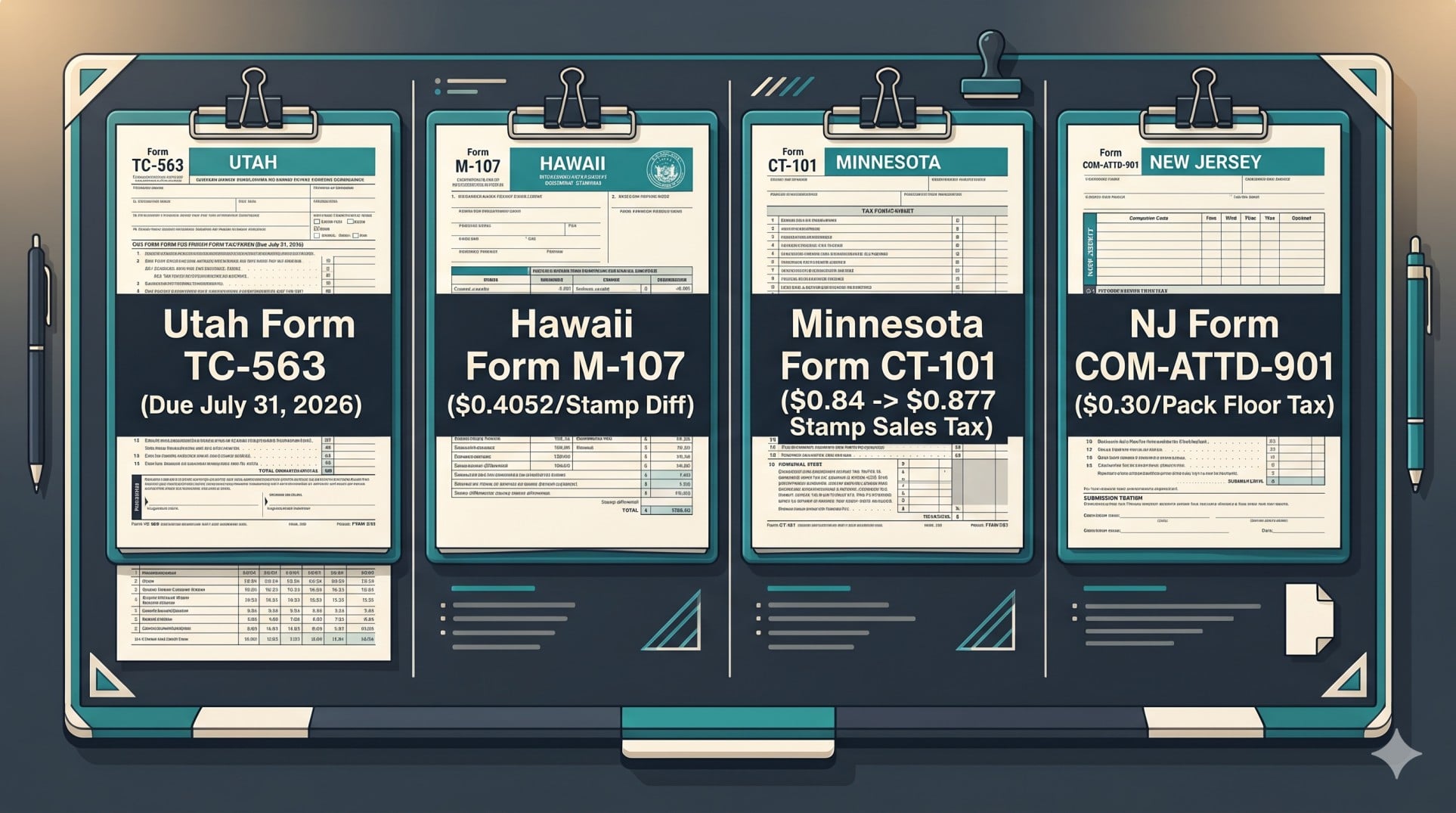
Under Utah House Bill 337 and Utah State Tax Commission Bulletin 10-26, every retailer, distributor, stamper, jobber, wholesaler, or manufacturer holding cigarettes in inventory at midnight on June 30, 2026 that were taxed at the old June 30 rate ($1.70/pack PM or $2.05/pack NPM) was required to file Utah Form TC-563 cigarette inventory tax reports online via the Taxpayer Access Point (TAP) portal and remit full payment by July 31, 2026.
- 20-Pack vs. 25-Pack Differential: While the tax on a standard pack of 20 cigarettes (both PM and NPM) increased by $0.50 per pack ($1.70 to $2.20 for PM; $2.05 to $2.55 for NPM), the tax on a pack of 25 cigarettes increased by $0.625 per pack (from $2.125 to $2.75 per pack for PM, and from $2.5625 to $3.1875 per pack for NPM).
- Stamp Transition & Unaffixed Stamps (Form TC-79): The last day licensed Utah stampers could purchase cigarette stamps at the pre-July 1 rate was June 30, 2026; new stamps at the $2.20/$2.55 rate went on sale beginning June 22, 2026 via Form TC-79 (Cigarette Revenue Stamps Order Form) on TAP (where licensed stampers receive a 4% stamping discount under Utah Code § 59-14-206). Note that the Form TC-563 inventory tax applies only to stamped cigarettes in unsold inventory at midnight on June 30, 2026—unaffixed stamps held by stampers follow the stamp transition rules.
- Companion July 1, 2026 Utah Nicotine & Vape Hikes: Do not overlook the rest of HB 337! Effective July 1, 2026, Utah also raised the tax on electronic cigarette products and nontherapeutic nicotine devices from 56% to 71% of the manufacturer’s sales price (expanding the definition to include non-nicotine inhalation products), set non-pouch alternative nicotine products at 73% of the manufacturer’s sales price, and switched nicotine pouches to $1.00 per can (≤ 20 pouches, plus $0.05 per pouch over 20)—with a subsequent 50% MRTP tax reduction to $0.50/can for ZYN pouches effective October 1, 2026! However, Utah’s floor stock tax on Form TC-563 applied strictly to cigarettes, not vapes or pouches.
2. Hawaii: Form M-107 & Why the Stamp Differential Is $0.4052 (Not $0.40)
Under Act 95, Session Laws of Hawaii 2025, Hawaii’s cigarette tax jumped from $3.20 to $3.60 per pack of 20 on January 1, 2026. Every wholesaler or dealer approved to purchase cigarette tax stamps was required to count all affixed and unused light gray stamps ($3.20) in their ending inventory at the close of business on December 31, 2025 and file Hawaii Form M-107 cigarette floor stock returns with payment by January 20, 2026.
Here is the #1 mathematical nuance that confuses accountants reviewing a Hawaii Form M-107 (Rev. 2025) return: Why does Line 4 of Form M-107 multiply your December 31, 2025 stamp inventory by $0.4052 per stamp instead of $0.40?
- The 0.4% Hawaii Stamping Fee & 1.7% Discount Mechanics (HAR § 18-245-3): Under Hawaii Administrative Rules, cigarette tax stamps are sold to licensed wholesalers at their face value plus a 0.4% state administrative fee, minus a 1.7% wholesaler stamping discount—which equals a net reduction of 1.3% off face value (meaning the wholesaler pays 98.7% of face value, plus a $27.00 shipping/insurance fee per roll of 15,000 stamps). Wait—on a roll of 15,000 green stamps ($3.60 face value = $54,000), First Hawaiian Bank charges $54,702.00 per roll ($3.6468 per stamp), whereas a roll of 15,000 light gray stamps ($3.20 face value = $48,000) cost $48,624.00 per roll ($3.2416 per stamp).
- The Exact $0.4052 Differential: Subtract the old stamp price ($3.2416) from the new green stamp price ($3.6468): $3.6468 − $3.2416 = $0.4052 per stamp ($6,078.00 per roll of 15,000 stamps)! That is why Line 4 of Form M-107 prints a pre-set multiplier of .4052.
- Damaged Stamps Exclusion & Unused Roll Credits (Form M-108): Per Form M-107 instructions, stamps that were physically damaged during the stamping process prior to January 1, 2026 are excluded from Lines 1 and 2 of Form M-107 (instead, the wholesaler claims a refund for damaged stamps on Form M-106). Furthermore, if a wholesaler held full, unopened rolls of 15,000 unused light gray stamps on December 31, 2025, it could return those full rolls to DOTAX using Form M-108 (Cigarette Tax Stamps Credit Application) for a dollar-for-dollar credit toward new green stamps instead of paying the floor tax on them. Warning: Failing to file Form M-107 and pay by January 20, 2026 results in immediate suspension of the wholesaler’s approval to purchase cigarette stamps at First Hawaiian Bank!
3. Minnesota: Upfront Cigarette Sales Tax Indexing ($0.84 in 2026; $0.877 in 2027)
Why don’t Minnesota convenience stores collect standard 6.875% state and local sales tax at the cash register when a customer buys a pack of Marlboros or Camels? Because under Minnesota Statute 297F.25, Minnesota replaces retail sales tax on cigarettes with a fixed, per-pack “Cigarette Sales Tax” that is paid upfront by the licensed distributor at the exact same moment the distributor buys the Minnesota excise tax stamp on Form CT-101 (Cigarette Tax Stamp Order Form).
- The 2026 Rate ($3.88 Combined): From January 1, 2026 through December 31, 2026, every 20-pack stamp purchased by a Minnesota distributor includes $3.04 in Cigarette Excise Tax (15.2 cents/stick) plus $0.840 in Cigarette Sales Tax (4.2 cents/stick, up from $0.786 in 2025) = $3.88 per pack of 20 ($38.80 per 10-pack carton).
- The Upcoming January 1, 2027 Hike ($3.917 Combined): On October 27, 2026, the Minnesota Department of Revenue published its official notice setting the 2027 Cigarette Sales Tax at $0.877 per pack of 20 (4.385 cents/stick, or $1.05 per pack of 25) effective January 1, 2027. Combined with the $3.04 excise tax, the total Minnesota stamp burden rises to $3.917 per pack of 20 ($39.17 per carton) on January 1, 2027.
- Why Gas Stations Still Must Update Their POS on January 1: Even though Minnesota does not require a floor stock tax return for the annual M.S. 297F.25 sales tax adjustment, wholesale distributors immediately pass the extra $0.54 per carton (in 2026) and $0.37 per carton (on January 1, 2027) through on wholesale invoices, raising Minnesota’s statutory minimum wholesale and retail cigarette prices under M.S. Chapter 325D. (Note: For all Other Tobacco Products like cigars, vapes, and pouches—which are taxed at 95% of wholesale on Form TP-1—retailers do collect standard Minnesota state and local retail sales tax at checkout!)
4. New Jersey: Form COM-ATTD-901 & The “No Consolidated Returns” Rule
When New Jersey raised its cigarette tax by $0.30 per pack (from $2.70 to $3.00 per pack of 20) under P.L. 2025, c. 68 to fund the FY 2026 state budget, the New Jersey Division of Taxation mandated that every licensed distributor, wholesaler, and retailer conduct a physical inventory at 12:01 a.m. on August 1, 2025 (before selling a single pack) and file New Jersey Form COM-ATTD-901 cigarette floor tax returns by October 1, 2025.
- Separate Return Mandatory for Every Gas Station Location: If you own a chain of 15 gas stations or convenience stores in New Jersey, pay close attention to Instruction #4 on Form COM-ATTD-901: “No consolidated returns are allowed for this tax increase. Each licensee must file a separate return for each licensed location.” (While a chain owner could remit a single check covering multiple stores, a separate signed Form COM-ATTD-901 had to be attached for each store’s license number.)
- 2026–2027 Contraband Confiscation Sweeps: Under Form COM-ATTD-901 and N.J.S.A. 54:40A-30, any cigarettes held on August 1 for which the $0.30/pack floor tax was not timely remitted are legally classified as contraband subject to immediate confiscation by the Division of Taxation, alongside penalties under the State Uniform Tax Procedure Law. Furthermore, if your New Jersey convenience store also held liquid nicotine pods or container e-liquid on that date, you were required to file a second separate floor stock return paying the $0.20 per fluid milliliter differential (when liquid nicotine jumped from $0.10/mL to $0.30/mL) and hold an active NJ Vapor Business License!
If your retail chain or distribution company missed the October 2025 New Jersey deadline, the January 20, 2026 Hawaii deadline, or the July 31, 2026 Utah deadline, contact our state excise and sales tax audit defense and voluntary disclosure team immediately to file delinquent returns and request penalty abatement before field inspectors visit your locations.
2026–2027 Business Scenarios: Step-by-Step Floor Stock Tax Math
To calculate your exact floor stock tax liability, you must separate 20-stick packs from 25-stick packs, identify in-transit “FOB Origin” shipments, apply the state’s exact per-stamp or per-pack differential, and verify whether wholesaler stamping discounts alter the multiplier.
Let’s walk through four detailed, real-world mathematical scenarios across Utah, Hawaii, New Jersey, and Minnesota.
Scenario 1: Utah Multi-Site Gas Station Chain Filing Form TC-563 (July 2026)
The Setup: Wasatch Fuel & Mart LLC operates eight gas stations across Salt Lake County and Utah County. At 12:00 a.m. midnight on June 30, 2026, the chain conducts its mandatory physical cigarette count for the July 1, 2026 Utah rate hike ($1.70 to $2.20/pack PM; $2.05 to $2.55/pack NPM).
The Midnight Inventory Breakdown:
- On-Shelf & Backroom PM 20-Packs: 1,450 cartons (10 packs per carton) = 14,500 packs of 20.
- On-Shelf & Backroom NPM 20-Packs: 120 cartons = 1,200 packs of 20.
- On-Shelf PM 25-Packs (Specialty 25-stick packs): 40 cartons (8 packs of 25 per carton) = 320 packs of 25.
- In-Transit Shipment (FOB Origin): On June 30, 2026, an out-of-state licensed stamper shipped 250 cartons (2,500 packs of 20 PM cigarettes) stamped at the old $1.70 rate via third-party carrier marked “FOB Origin / Shipping Point.” The truck arrives at Wasatch Fuel’s Salt Lake warehouse at 10:00 a.m. on July 1, 2026.
Step-by-Step Utah Form TC-563 Calculation (Due July 31, 2026 via TAP):
- Include the FOB Origin In-Transit Shipment: Because the 2,500 packs were shipped “FOB Origin” on June 30, legal title belonged to Wasatch Fuel & Mart at midnight on June 30. Under Utah State Tax Commission rules, Wasatch Fuel must add those 2,500 packs to its midnight count!
- Total 20-Stick Packs Subject to $0.50 Differential: 14,500 (on-hand PM) + 1,200 (on-hand NPM) + 2,500 (in-transit PM) = 18,200 packs of 20 × $0.50/pack ($0.025/stick increase) = $9,100.00. (Notice that both PM and NPM 20-packs increased by the exact same $0.50 differential: $2.20 − $1.70 = $0.50, and $2.55 − $2.05 = $0.50.)
- Total 25-Stick Packs Subject to $0.625 Differential: 320 packs of 25 × $0.625/pack ($2.75 new rate − $2.125 old rate) = $200.00.
- Total Utah Cigarette Inventory Tax Due on Form TC-563 by July 31, 2026: $9,100.00 + $200.00 = $9,300.00.
Scenario 2: Honolulu Tobacco Wholesaler Reconciling Form M-107 & Form M-108
The Setup: Aloha Pacific Wholesale Inc. is a licensed Hawaii cigarette wholesaler in Honolulu approved by DOTAX to purchase cigarette tax stamps from First Hawaiian Bank. At the close of business on December 31, 2025 (ahead of the January 1, 2026 hike from $3.20 to $3.60 per pack under Act 95), Aloha Pacific Wholesale holds the following inventory of light gray ($3.20) stamps:
- Affixed Light Gray Stamps on Cigarette Packs in Warehouse: 4,200 cartons = 42,000 affixed stamps.
- Unused Light Gray Stamps on Partially Used Stamp Machine Rolls: 8,500 unaffixed stamps.
- Damaged Light Gray Stamps (Torn on Stamping Machine on Dec 30–31, 2025): 400 damaged stamps.
- Unopened Full Rolls of Unused Light Gray Stamps (15,000 stamps/roll): 2 full unopened rolls (30,000 stamps), which Aloha Pacific elects to return to DOTAX for credit toward new green stamps.
Step-by-Step Hawaii Form M-107 & M-108 Calculation (Due January 20, 2026):
- Handle the 2 Unopened Full Rolls on Form M-108: Aloha Pacific submits the 2 unopened rolls (30,000 stamps) to DOTAX with Form M-108 (Cigarette Tax Stamps Credit Application), receiving a credit of $97,248.00 (2 rolls × $48,624.00/roll) to apply toward purchasing new green stamp rolls ($54,702.00/roll). Those 30,000 returned stamps are excluded from Form M-107.
- Exclude the 400 Damaged Stamps (Claim on Form M-106): Per Form M-107 instructions, the 400 stamps damaged prior to January 1, 2026 are excluded from the floor stock count and claimed separately for a refund on Form M-106.
- Calculate Form M-107 Lines 1, 2, and 3:
- Line 1 (Affixed light gray stamps in ending inventory): 42,000
- Line 2 (Unused/unaffixed light gray stamps not returned): 8,500
- Line 3 (Total subject to floor stock differential): 42,000 + 8,500 = 50,500 stamps.
- Apply Line 4 Multiplier ($0.4052 per stamp): 50,500 stamps × $0.4052 = $20,462.60 total floor stock tax due on Line 5 of Form M-107 by January 20, 2026! Once paid, Aloha Pacific may legally affix the remaining 8,500 light gray stamps and distribute all 50,500 packs to Hawaii gas stations during 2026.
Scenario 3: New Jersey Distributor & 3-Store Retailer Filing Form COM-ATTD-901
The Setup: Garden State C-Stores Inc. operates three licensed retail convenience stores in Edison, Woodbridge, and Paramus, New Jersey, while Garden State Tobacco Distributors LLC (a licensed NJ resident distributor) holds both stamped packs and unaffixed meter/stamp rolls.
Step-by-Step New Jersey Floor Tax Math ($0.30/Pack Increase to $3.00):
- For the 3 Retail Stores (Lines 1 and 3 of Form COM-ATTD-901): Store #1 holds 1,800 stamped packs ($540.00 tax due); Store #2 holds 2,200 stamped packs ($660.00 tax due); Store #3 holds 1,500 stamped packs ($450.00 tax due). Because consolidated returns are strictly prohibited, Garden State C-Stores prepares three separate Form COM-ATTD-901 returns (one per store license) and mails all three returns together with a single check for $1,650.00 payable to “State of New Jersey – Cigarette Floor Tax.”
- For the Licensed Distributor (Lines 1, 2, and 3 of Form COM-ATTD-901): The distributor holds 60,000 stamped 20-packs on Line 1 (60,000 × $0.30 = $18,000.00) plus 90,000 unaffixed New Jersey revenue stamps on Line 2 (90,000 × $0.30 = $27,000.00). Total Line 3 Floor Tax Due = $45,000.00. (Note: On ongoing 2026–2027 monthly Form CR-1 filings, New Jersey resident distributors receive a tiny 0.00166667 (0.166667%) stamping discount—which equals $1.80 per roll of 360 stamps worth $1,080—on purchases of 1,000 or more stamps.)
Scenario 4: Minnesota Distributor Stamp Purchase Transition (2026 vs. Jan 1, 2027)
The Setup: North Star Wholesale Distributing in Minneapolis orders 10 rolls of 30,000 Minnesota 20-pack cigarette stamps (300,000 stamps total) on Form CT-101 in December 2026 versus January 2027.
Step-by-Step Stamp Cost Comparison:
- In Calendar Year 2026 ($3.88/Pack): Each stamp carries $3.04 Excise Tax + $0.840 Cigarette Sales Tax = $3.88 per stamp. For 300,000 stamps, the gross tax is:
- Excise Tax (300,000 × $3.04): $912,000.00
- Cigarette Sales Tax (300,000 × $0.840): $252,000.00
- Total 2026 Gross Stamp Order: $1,164,000.00.
- Effective January 1, 2027 ($3.917/Pack): When the Cigarette Sales Tax component rises by $0.037 per pack to $0.877 per pack on January 1, 2027, the same 300,000-stamp order on Form CT-101 costs:
- Excise Tax (300,000 × $3.04): $912,000.00
- Cigarette Sales Tax (300,000 × $0.877): $263,100.00
- Total 2027 Gross Stamp Order: $1,175,100.00 (an immediate $11,100.00 working-capital increase per 300,000 stamps!).
Wholesalers and convenience store chains looking to streamline monthly reconciliations across these states can rely on our outsourced cigarette, tobacco, and vapor excise tax return preparation services for guaranteed accuracy.
Minimum Legal Pricing Laws & Retail Sales Tax-on-Tax Mechanics
When cigarette excise taxes rise, both state Minimum Legal Pricing laws (in New Jersey and Minnesota) and retail checkout sales tax calculations (in Utah, Hawaii, and New Jersey) automatically increase on a “Tax-on-Tax” basis.
Gas station owners often ask two vital questions the morning a cigarette tax hike takes effect: “Can I absorb the floor tax to keep my regular customers from driving to a competitor?” and “Does retail sales tax apply on top of the new cigarette excise tax?”
1. State Minimum Legal Cigarette Pricing Laws (NJ & MN)
In states with Unfair Cigarette Sales Acts—specifically New Jersey (N.J.S.A. 56:7-18 et seq.) and Minnesota (M.S. 325D.30 et seq.)—it is strictly illegal for a wholesaler or retailer to absorb the excise tax hike and sell cigarettes below the state-published statutory minimum cost!
- New Jersey Minimum Legal Prices: The New Jersey Division of Taxation publishes an updated Minimum Legal Prices on Cigarettes schedule every time manufacturers change list prices or the state hikes the excise tax (incorporating the manufacturer’s list price, the $3.00 per pack excise tax, and statutory wholesale and retail percentage markups to cover the cost of doing business). Furthermore, New Jersey strictly prohibits retailers from accepting or offering price-reduction coupons, rebates, or multi-pack discounts that drop the checkout price below the statutory minimum—or on any vapor/tobacco products where prohibited.
- Minnesota Minimum Cigarette Prices: Similarly, the Minnesota Department of Commerce enforces minimum wholesale and retail cigarette prices that automatically step up every January 1 when the M.S. 297F.25 Cigarette Sales Tax increases.
- Hawaii’s Pass-Through Rule (Act 95): In Hawaii, DOTAX Announcement No. 2025-07 notes that if a wholesaler passes the additional $0.40/pack tax on to a retailer, the retailer may pass the additional tax on to the consumer, though Act 95 does not legally force a retailer selling pre-existing inventory to raise its shelf price.
2. Retail “Tax-on-Tax” Mechanics Across All Four States
Because state and federal cigarette excise taxes are imposed prior to the final retail sale, examine how retail sales tax (or GET) interacts with the new 2026–2027 cigarette excise rates at the gas station register:
- Utah (Sales Tax Applies on Top of the $2.20 Excise Tax): Under Utah Code § 59-12-102, neither the $1.01 federal cigarette tax nor the $2.20 per pack Utah state cigarette excise tax is excluded from the retail sales price. When a Salt Lake City gas station sells a pack of cigarettes for $9.50 (which embeds the $2.20 Utah stamp), the retailer must charge full Utah state and local retail sales tax (e.g., 7.75% in Salt Lake City) on the entire $9.50!
- Hawaii (4.5% GET Applies on Top of the $3.60 Excise Tax): Under HRS Chapter 237, Hawaii’s 4.0% state General Excise Tax plus 0.5% county surcharge (4.5% total, visibly passed on to the customer at the maximum 4.712% rate) applies to the retailer’s gross proceeds of sale—which includes the embedded $3.60 per pack cigarette stamp tax.
- New Jersey (6.625% Sales Tax Applies on Top of the $3.00 Excise Tax): Under N.J.S.A. 54:32B-2(oo), New Jersey’s 6.625% state Sales and Use Tax is calculated on the full retail selling price of the cigarettes, including the $3.00 per pack New Jersey cigarette excise tax and the minimum retail markup.
- Minnesota (No Additional State Sales Tax at the Register—Paid in the Stamp!): Because Minnesota collects the $0.840 per pack (2026) / $0.877 per pack (2027) Cigarette Sales Tax upfront inside the stamp price under M.S. 297F.25, Minnesota gas stations do not charge the 6.875% state sales tax on cigarette packs at the register (though standard retail sales tax does apply to cigars, vapes, pouches, and lighters).
Step-by-Step Guide to Counting Inventory, Calculating Differential & Filing
Whether you are preparing for an upcoming rate transition (like Minnesota’s January 1, 2027 adjustment) or auditing your 2026 floor stock filings in Utah, Hawaii, or New Jersey, follow this exact five-step compliance protocol.
Step 1: Freeze Sales & Conduct a Physical Count at the Exact Statutory Cut-Off
Never rely solely on your POS perpetual inventory software for a floor stock return—shoplifting shrinkage, scan errors, and unposted wholesale deliveries will skew your numbers and trigger an audit mismatch when the state cross-checks your distributor’s monthly sales schedules against your floor return.
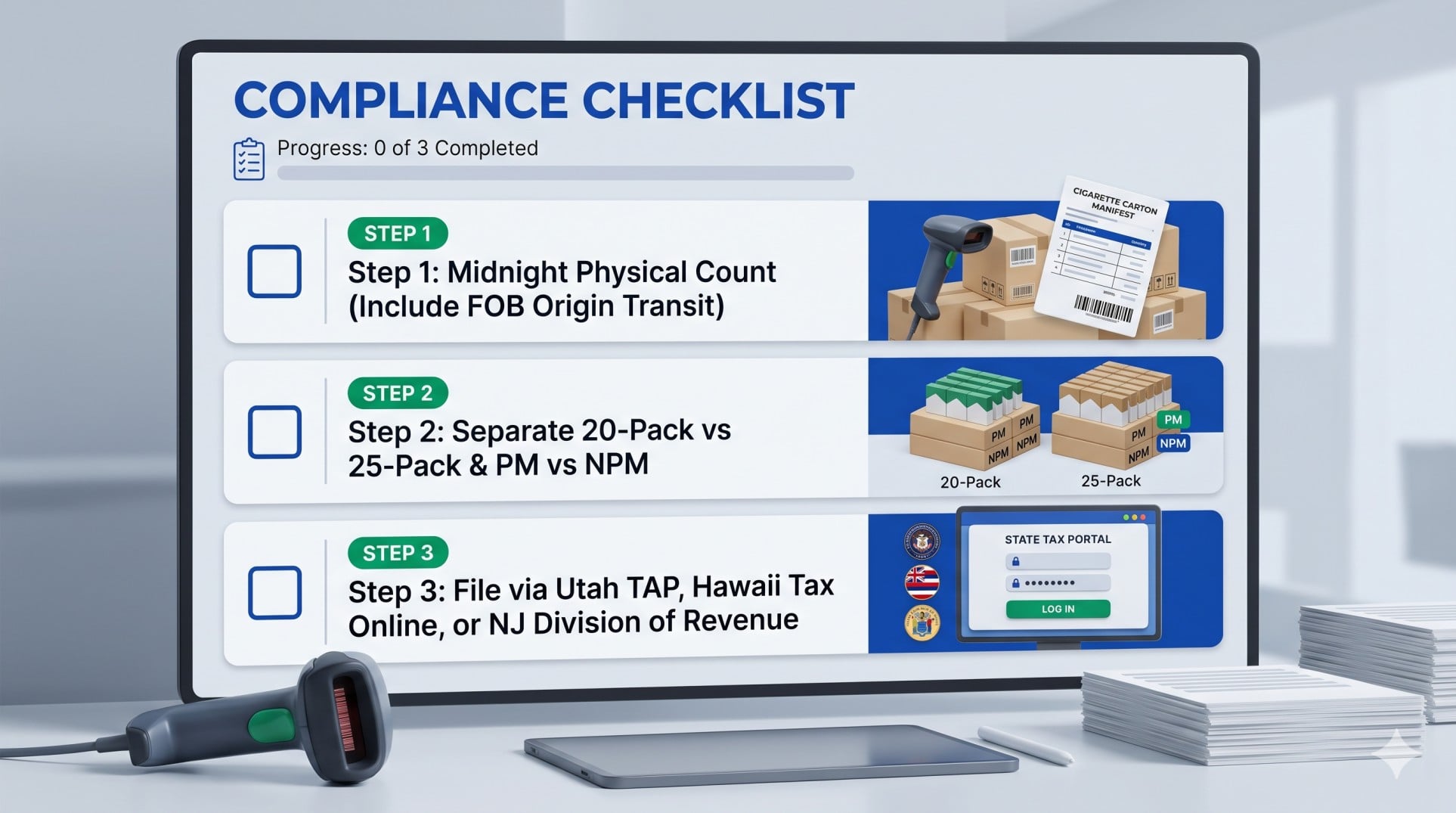
At the exact statutory cut-off (e.g., Midnight June 30, 2026 in Utah; Close of Business December 31, 2025 in Hawaii; 12:01 a.m. August 1, 2025 in New Jersey), physically count every stamped pack on your overhead racks, under-counter drawers, vending machines, and backroom safes. Record each location’s count on a signed, dated physical inventory worksheet kept on-site for state inspectors.
Step 2: Audit In-Transit Deliveries & Unaffixed Stamp Rolls
- Check Wholesale Bills of Lading: Pull all cigarette invoices dated within 5 days before and after the rate change. Any shipment in transit at midnight marked “FOB Origin” must be added to the buyer’s physical count; any shipment marked “FOB Destination” stays on the seller’s floor count.
- Count Unaffixed Stamps (Distributors Only): If you are a licensed stamping distributor in Hawaii (Form M-107) or New Jersey (Form COM-ATTD-901 Line 2), physically count all unaffixed old stamps on your stamping machines and in your vault, excluding torn/damaged stamps documented for credit on damaged-stamp schedules (such as Hawaii Form M-106).
Step 3: Segregate Pack Sizes (20s vs. 25s) and Brand Status (PM vs. NPM)
On your calculation schedule, separate standard 20-cigarette packs from 25-cigarette packs (and in Utah, track Participating Manufacturer packs separately from Non-Participating Manufacturer packs for ongoing Form TC-553 reporting, even though both carry a $0.50/pack differential for 20-packs and $0.625/pack for 25-packs on Form TC-563).
Step 4: File the Exact State Floor Stock Return & Ongoing Monthly Returns
- Utah (Taxpayer Access Point — TAP): Log into tap.utah.gov, select your Cigarette/Tobacco account, and complete Form TC-563 (Cigarette Stamp Inventory Tax Report / Worksheet) (due July 31, 2026). For ongoing quarterly/monthly tobacco and stamp reporting, file Form TC-553 and order new stamps via Form TC-79.
- Hawaii (DOTAX / Hawaii Tax Online): Complete Form M-107 (Rev. 2025), Cigarette Tax Stamps Floor Stock Return multiplying total light gray stamps on Line 3 by .4052 on Line 4 (due January 20, 2026), or submit unopened rolls with Form M-108. For ongoing monthly cigarette and tobacco reporting, file Form M-19 (Cigarette and Tobacco Products Monthly Tax Return) by the last day of the following month.
- New Jersey (NJ Division of Taxation / Revenue & Enterprise Services): Prepare a separate Form COM-ATTD-901 (Cigarette Floor Tax Return) in duplicate for each licensed retail or wholesale location (multiplying 20-packs by $0.30), keeping one copy on-site for Division of Taxation field inspectors and mailing the original with payment to PO Box 250, Trenton, NJ 08646-0250. Resident distributors file ongoing monthly returns on Form CR-1 (and brand-family schedule Form CR-1G) by the 20th day of the following month; non-resident distributors file Form CNR-1 / CNR-5.
- Minnesota (MN e-Services): Order stamps incorporating the $0.840/pack (2026) and $0.877/pack (effective January 1, 2027) Cigarette Sales Tax on Form CT-101, and file your monthly distributor cigarette tax return on Form CT-102 via Minnesota e-Services by the 18th day of the following month (with accelerated June estimated payment rules applying to high-volume filers).
Step 5: Reprogram Your POS Register & Scan Data Loyalty Tiers
Update your store point-of-sale (POS) pricebook at midnight to reflect the new per-pack and per-carton retail prices, verify compliance with New Jersey and Minnesota minimum legal price floors, and adjust your tobacco manufacturer Scan Data (Altria/RJR) loyalty buydown tiers so promotional discounts do not violate state minimum pricing laws. For comprehensive multi-state tax management, visit our SALT & Indirect Tax compliance hub.
Frequently Asked Questions About 2026 Cigarette Floor Stock Taxes
1. What is a cigarette floor stock tax return?
A cigarette floor stock tax return is a mandatory tax filing required when a state increases its cigarette excise tax rate. It requires wholesalers and/or retailers to count their existing stamped cigarette inventory on the effective date of the hike and pay the exact dollar difference between the old and new tax rates.
2. How much did Utah’s cigarette tax increase on July 1, 2026, and what form is required?
Effective July 1, 2026 under House Bill 337, Utah increased its cigarette tax by $0.50 per pack of 20—from $1.70 to $2.20 per pack for Participating Manufacturers (PM) and from $2.05 to $2.55 per pack for Non-Participating Manufacturers (NPM). All retailers and distributors had to file Utah Form TC-563 cigarette inventory tax reports via TAP by July 31, 2026.
3. Do retail gas stations in Utah have to file Form TC-563, or just wholesalers?
Every retail gas station, convenience store, grocery store, distributor, stamper, and jobber holding a Utah Cigarette and Tobacco License that had cigarettes in inventory at midnight on June 30, 2026 taxed at the old rate was legally required to file Form TC-563 and pay the $0.50 per pack ($0.625 per 25-pack) floor tax.
4. Who owes the Utah floor stock tax on cigarettes in transit at midnight on June 30, 2026?
Under Utah State Tax Commission rules for Form TC-563, the floor tax on cigarettes in transit at midnight is owed by the party that holds legal title during shipping. If shipped “FOB Origin,” the buyer (retailer) must report and pay the floor tax; if shipped “FOB Destination,” the seller (wholesaler) owes the tax.
5. Why does Hawaii Form M-107 charge $0.4052 per stamp instead of $0.40?
Although Act 95 increased Hawaii’s face-value cigarette tax by $0.40 per pack (from $3.20 to $3.60 per pack on January 1, 2026), Hawaii stamp rolls include a statutory administrative fee and discount calculation ($54,702.00 per 15,000 green stamps vs. $48,624.00 per 15,000 light gray stamps). The exact net price difference is $0.4052 per stamp on Hawaii Form M-107 cigarette floor stock returns.
6. Do Hawaii convenience stores and gas stations have to file Form M-107?
No, only licensed Hawaii wholesalers and dealers approved to purchase cigarette tax stamps were required to file Form M-107 by January 20, 2026. Per DOTAX Announcement No. 2025-07, Hawaii retailers may continue selling cigarettes with light gray stamps held in their inventory on January 1, 2026 without filing a floor return.
7. Why is Minnesota’s cigarette tax $3.88 per pack in 2026 and rising again on January 1, 2027?
Minnesota’s per-pack cigarette stamp combines a fixed $3.04 Excise Tax (M.S. 297F.05) with an annually adjusted upfront Cigarette Sales Tax (M.S. 297F.25). The Cigarette Sales Tax rose from $0.786 to $0.840 per pack on January 1, 2026 (totaling $3.88/pack) and increases to $0.877 per pack on January 1, 2027 (totaling $3.917/pack).
8. Does Minnesota require a retail floor stock tax return when the Cigarette Sales Tax changes on January 1?
No, when Minnesota adjusts the upfront Cigarette Sales Tax component on January 1 under M.S. 297F.25, the new rate is collected directly from licensed distributors when they order stamps on Form CT-101 on or after January 1. Neither retailers nor distributors file a floor stock return for that annual adjustment.
9. Can a New Jersey gas station chain file one consolidated Form COM-ATTD-901 for all its stores?
No, instructions for the New Jersey Form COM-ATTD-901 cigarette floor tax return strictly prohibit consolidated returns. A multi-unit retailer must complete and sign a separate Form COM-ATTD-901 for each licensed store location, though it may mail a single check covering all attached location returns.
10. What happens if a retailer sells old-stamped cigarettes without paying the required floor stock tax?
In states like New Jersey and Utah, any cigarette packs held on the date of the rate hike for which the mandatory floor tax was not timely remitted are classified as illegal contraband. State tax investigators can confiscate the entire cigarette inventory, assess late penalties and interest, and suspend your retail tobacco license.
Protecting Your Wholesale or Retail Tobacco License From Contraband Audits
Navigating the 2026 cigarette excise tax hikes across Utah ($2.20/pack), Hawaii ($3.60/pack), Minnesota ($3.88/pack in 2026; $3.917/pack in 2027), and New Jersey ($3.00/pack) requires pinpoint execution at midnight on the date of each rate change. Because state revenue departments cross-reference wholesale distributor delivery manifests against retail floor stock filings—and dispatch field inspectors to check stamp colors and serial numbers in gas station backrooms—skipping a floor stock return is one of the fastest ways to lose your tobacco license.
If your distribution warehouse or convenience store chain needs to file a delinquent Utah Form TC-563, reconcile Hawaii Form M-107 stamp differentials, resolve an unfiled New Jersey Form COM-ATTD-901 notice, or automate your monthly multi-state cigarette and OTP tax returns, contact the SALT & Excise Tax specialists at Ourtaxpartner.com today for immediate compliance representation.
Disclaimer: This content provides general information for educational purposes only and reflects state, local, and federal sales, use, and excise tax laws applicable to the 2026–2027 compliance periods. State and local tax rates, nexus thresholds, and excise regulations change frequently across jurisdictions. This article does not constitute professional tax, legal, or accounting advice. Always consult a certified public accountant (CPA), enrolled agent (EA), or qualified SALT advisor at Ourtaxpartner.com regarding your specific business compliance obligations. Ourtaxpartner.com is not responsible for any actions taken based on the information provided herein.
2026 Cigarette Excise Tax Hikes in Utah, Hawaii, Minnesota & New Jersey: How to Calculate and File Your Floor Stock Tax
Whenever state lawmakers enact 2026 cigarette excise tax hikes, the rate increase does not just apply to new shipments leaving the manufacturer’s loading dock. To prevent wholesalers, jobbers, and convenience store chains from stockpiling months of lower-taxed cartons right before the statutory effective date, states enforce an immediate transitional “Floor Stock Tax” (also called a Cigarette Stamp Inventory Tax) on existing inventory held at the exact stroke of midnight when the rate jumps.
Across the 2025–2026 budget cycles, four states—Utah ($2.20 per pack as of July 1, 2026), Hawaii ($3.60 per pack as of January 1, 2026), Minnesota ($3.88 per pack combined in 2026, rising again on January 1, 2027), and New Jersey ($3.00 per pack under the FY 2026 budget)—implemented pivotal cigarette tax rate increases. Each of these four states enforces vastly different rules on who bears the legal incidence of the floor tax, how stamping discounts affect the per-pack math, and which exact tax form must be filed.
For wholesale distributors and gas station owners operating in Utah, Hawaii, Minnesota, and New Jersey, missing a floor stock inventory count or filing the wrong state schedule doesn’t just trigger a late penalty—it turns every pack of old-stamped cigarettes on your shelves into seizable contraband. Here is your step-by-step 2026–2027 calculation and filing guide.
⚡ Executive Summary: Key 2026–2027 Tax Compliance Rules at a Glance
- Utah ($2.20/Pack Effective July 1, 2026 — Form TC-563): Under Utah House Bill 337 (2026) and Utah State Tax Commission Bulletin 10-26, Utah raised its Participating Manufacturer (PM) cigarette tax from $1.70 to $2.20 per pack of 20 (+$0.50/pack; or $2.75 per pack of 25) and Non-Participating Manufacturer (NPM) cigarettes from $2.05 to $2.55 per pack of 20. Every retailer, distributor, stamper, and jobber holding stamped inventory at midnight on June 30, 2026 had to file Form TC-563 (Cigarette Stamp Inventory Tax Report) via TAP and remit the $0.50/pack differential by July 31, 2026.
- Hawaii ($3.60/Pack Effective January 1, 2026 — Form M-107): Under Act 95, Session Laws of Hawaii 2025 (HB 441), Hawaii increased its cigarette tax from $0.16 to $0.18 per cigarette (jumping from $3.20 to $3.60 per pack of 20) and transitioned from light gray stamps to green stamps. Licensed wholesalers and dealers had to file Form M-107 (Rev. 2025) by January 20, 2026 and pay a net stamp price differential of $0.4052 per stamp on all affixed and unused light gray stamps held at the close of business on December 31, 2025 (or return unused rolls on Form M-108).
- Minnesota ($3.88/Pack Combined in 2026; $3.917/Pack Eff. Jan 1, 2027): Under Minnesota Statutes 297F.05 and 297F.25, Minnesota levies a fixed $3.04 per pack ($0.152/stick) excise tax plus an annually indexed Cigarette Sales Tax collected upfront when distributors buy stamps on Form CT-101. On January 1, 2026, the stamp sales tax rose from $0.786 to $0.840 per pack (totaling $3.88 per pack), and on January 1, 2027, it rises again to $0.877 per pack (totaling $3.917 per pack of 20, or $1.05 sales tax per pack of 25) with no retail-level floor stock return required.
- New Jersey ($3.00/Pack Effective August 1, 2025 for FY 2026–2027 — Form COM-ATTD-901): Enacted under P.L. 2025, c. 68 (the FY 2026 New Jersey Budget), New Jersey hiked its cigarette tax by $0.30 per pack from $2.70 to $3.00 per pack of 20 (and liquid nicotine from $0.10/mL to $0.30/mL). Every distributor, wholesaler, and retail gas station was required to file a separate Form COM-ATTD-901 (Cigarette Floor Tax Return) for each licensed location and remit the $0.30/pack floor tax by October 1, 2025, or face contraband confiscation during 2026–2027 field inspections.
Table of Contents
- ⚡ Executive Summary: Key 2026–2027 Tax Compliance Rules at a Glance
- Breaking Down the 2026 Cigarette Excise Tax Hikes Across 4 Key States
- How a Cigarette Floor Stock Tax Return Works for Wholesalers & Gas Stations
- State-by-State Floor Stock Rules: Utah, Hawaii, Minnesota & New Jersey
- 2026–2027 Business Scenarios: Step-by-Step Floor Stock Tax Math
- Minimum Legal Pricing Laws & Retail Sales Tax-on-Tax Mechanics
- Step-by-Step Guide to Counting Inventory, Calculating Differential & Filing
- Frequently Asked Questions About 2026 Cigarette Floor Stock Taxes
- Protecting Your Wholesale or Retail Tobacco License From Contraband Audits
Breaking Down the 2026 Cigarette Excise Tax Hikes Across 4 Key States
The 2026 cigarette excise tax hikes pushed combined state tax burdens to $2.20 per pack in Utah (effective July 1, 2026), $3.60 per pack in Hawaii (effective January 1, 2026), $3.88 per pack in Minnesota (effective January 1, 2026, rising to $3.917 on January 1, 2027), and $3.00 per pack in New Jersey (governing all 2026–2027 sales following the FY 2026 budget enactment).
On top of these state-level rates, every pack of 20 cigarettes sold in the United States carries the federal Alcohol and Tobacco Tax and Trade Bureau (TTB) excise tax of $1.0066 per pack (commonly rounded to $1.01 per pack under 26 U.S.C. § 5701(b)(1), paid by the manufacturer or importer on TTB Form 5000.24). When a state legislature raises its per-cigarette mill rate or per-pack stamp price, that hike cascades through the entire three-tier tobacco supply chain—from licensed stamping distributors and sub-jobbers down to independent gas stations, truck stops, and convenience stores.
Why These Four State Hikes Demand Special Attention in 2026–2027
Not all cigarette rate increases are structured the same way. If you operate convenience stores or wholesale distribution warehouses across multiple states, look at the structural differences driving the 2026–2027 compliance rules in these four jurisdictions:
- Utah’s Mid-Year Jump & PM vs. NPM Split (Effective July 1, 2026): Under Utah House Bill 337 (Nicotine Product Tax Amendments, signed March 2026) and Utah State Tax Commission Bulletin 10-26, lawmakers scaled back an initial proposal of $3.70/pack and settled on a $0.50 per pack increase effective July 1, 2026. For Participating Manufacturers (PMs under the Master Settlement Agreement), the rate rose from $1.70 to $2.20 per pack of 20 ($0.11 per stick, or $2.75 per pack of 25). For Non-Participating Manufacturers (NPMs, which carry an extra $0.35/pack equity assessment under Utah Code § 59-14-214), the rate rose from $2.05 to $2.55 per pack of 20 (or $3.1875 per pack of 25).
- Hawaii’s Stamp Color Transition (Effective January 1, 2026): Enacted on May 27, 2025 under Act 95, Session Laws of Hawaii 2025 (H.B. 441) and detailed in Department of Taxation (DOTAX) Announcement No. 2025-07, Hawaii raised its excise tax under HRS § 245-3 from $0.16 to $0.18 per cigarette or little cigar on January 1, 2026. That boosted the tax on a 20-pack by $0.40—from $3.20 to $3.60 per pack—ranking Hawaii 6th highest in the nation. To enforce the hike visually, DOTAX replaced the pre-2026 light gray stamps ($3.20 denomination) with brand-new green stamps ($3.60 denomination) sold through First Hawaiian Bank at $54,702.00 per roll of 15,000 stamps.
- Minnesota’s Dual-Component Stamp Rate ($3.88 in 2026; $3.917 in 2027): Minnesota is unique because every cigarette tax stamp purchased by a distributor under Minnesota Chapter 297F combines two statutory taxes: (1) a fixed Cigarette Excise Tax of $3.04 per pack of 20 (152 mills / 15.2 cents per cigarette under M.S. 297F.05), and (2) an annually indexed Cigarette Sales Tax calculated by the Commissioner of Revenue every October and effective every January 1 under M.S. 297F.25. On January 1, 2026, Minnesota’s Cigarette Sales Tax jumped by $0.054 per pack (from $0.786 to $0.840 per pack of 20, or 4.2 cents per stick), bringing the combined 2026 stamp tax to $3.88 per pack ($38.80 per carton). And per the Minnesota Department of Revenue’s October 27, 2026 official notice, the Cigarette Sales Tax will increase again on January 1, 2027 to $0.877 per pack of 20 (4.385 cents per stick, or $1.05 per pack of 25), pushing Minnesota’s combined 2027 stamp burden to $3.917 per pack!
- New Jersey’s FY 2026 Budget Hike ($3.00/Pack & Contraband Sweeps): Enacted under P.L. 2025, c. 68 as part of Governor Phil Murphy’s FY 2026 budget (effective August 1, 2025 and governing all 2026–2027 periods), New Jersey increased its cigarette tax under N.J.S.A. 54:40A-8 by $0.30 per pack—from $2.70 to $3.00 per pack of 20 ($0.15 per stick)—while simultaneously tripling its liquid nicotine vape tax from $0.10/mL to $0.30/mL. Throughout 2026, the New Jersey Division of Taxation’s Office of Criminal Investigation has conducted ongoing retail inspections targeting gas stations and bodegas that failed to file their mandatory floor stock returns for old-stamped packs.
Businesses tracking broader non-cigarette rate changes across these same jurisdictions should also bookmark our 2026–2027 multi-state nicotine pouch and OTP excise tax compliance guide, as Utah, Hawaii, Minnesota, and New Jersey all enforce strict parallel rules on vapes and smokeless products.
How a Cigarette Floor Stock Tax Return Works for Wholesalers & Gas Stations
A cigarette floor stock tax return is a mandatory one-time excise tax filing that requires wholesalers, stampers, and—in most states—retail gas stations to count all stamped cigarette packs and unaffixed tax stamps in their possession at midnight on the date of a tax hike and pay the exact dollar difference between the old rate and the new rate.
Why do states impose a floor tax on packs that already have a valid state tax stamp glued to the bottom of the cellophane? Because under state excise law, the cigarette tax is a tax on the sale, use, or possession of cigarettes on or after the effective date of the statutory rate change. Since the stamping distributor only paid the old tax rate when buying the stamp weeks earlier, selling that pack after the effective date without paying the differential would create an windfall or allow high-capital chains to hoard cheap inventory.
The Two Supply-Chain Floor Tax Models: All-Tier vs. Wholesaler-Only
Before you count a single pack, you must determine which supply-chain tier bears the legal incidence of the floor tax in your state:
- Model A: All-Tier Retail & Wholesale Floor Tax (Utah & New Jersey): In both Utah (Form TC-563) and New Jersey (Form COM-ATTD-901), the law imposes the floor stock tax on every single licensed entity in the supply chain—including manufacturers, licensed stampers, wholesalers, sub-jobbers, and every retail gas station, convenience store, grocery store, and smoke shop. Even if you only own a single gas station in Salt Lake City or Newark and buy 100% of your cartons pre-stamped from a wholesaler like Core-Mark or McLane, you are legally required to count your shelf and backroom packs at midnight and file your own floor stock tax return.
- Model B: Stamping Wholesaler / Dealer Floor Tax (Hawaii): Under Hawaii Act 95 (2025) and DOTAX Announcement No. 2025-07, the floor stock return (Form M-107) applies specifically to licensees approved to purchase cigarette tax stamps (wholesalers and dealers defined under HRS § 245-1) who hold affixed or unused light gray stamps at the close of business on December 31, 2025. Retail gas stations in Hawaii that purchase pre-stamped cigarettes from licensed wholesalers are not required to file Form M-107, and DOTAX explicitly permits Hawaii retailers to continue selling light gray-stamped packs held in their retail inventory on January 1, 2026 (or received from a licensed wholesaler who paid the Form M-107 differential).
- Model C: Annual Upfront Stamp Sales Tax Adjustment Without a Floor Return (Minnesota): In Minnesota, while a legislative hike to the base Excise Tax under M.S. 297F.05 triggers a statutory floor stock inventory tax, the annual January 1 adjustment to the Cigarette Sales Tax component under M.S. 297F.25 (from $0.786 to $0.840 per pack on January 1, 2026, and to $0.877 per pack on January 1, 2027) is collected directly by the Minnesota Department of Revenue when licensed distributors purchase cigarette tax stamps on Form CT-101 on or after January 1. Neither Minnesota gas stations nor distributors are required to file a separate floor stock return for the annual M.S. 297F.25 sales tax adjustment on previously stamped packs!
Critical Trap: Who Owes the Floor Tax on Cartons “In Transit” at Midnight?
What happens if a wholesale distributor loads a pallet of 6,000 cigarette packs onto a common-carrier freight truck on June 29, 2026, and the truck is still rolling down I-15 at 12:00 a.m. midnight on June 30 / July 1, 2026 when Utah’s $0.50/pack tax hike takes effect?
Audit Warning: The “FOB Origin” vs. “FOB Destination” Transit Rule
As explicitly stated by the Utah State Tax Commission in its Form TC-563 guidance, inventory tax on cigarettes in transit between two parties at the midnight cut-off is the legal responsibility of whichever party holds legal title during shipping. If the distributor ships the cigarettes “FOB Origin” (or FOB Shipping Point), title passed to the retail gas station the moment the cartons left the distributor’s warehouse—meaning the retailer must include that in-transit shipment on its midnight floor stock return! Conversely, if shipped “FOB Destination” (or delivered on the wholesaler’s own company truck), title has not yet passed, and the wholesaler owes the floor tax.
| State | Old Per-Pack Rate (20-Pack) | New 2026–2027 Per-Pack Rate (20-Pack) | Effective Date of Rate Hike | Floor Stock Tax Rate Differential | Who Must File Floor Tax Return? | Official Floor Stock Form & Filing Due Date |
|---|---|---|---|---|---|---|
| Utah (HB 337 / Bulletin 10-26) | $1.70 (PM) $2.05 (NPM) |
$2.20 (PM) $2.55 (NPM) ($2.75 / $3.1875 for 25-pack) |
July 1, 2026 (Inventory at Midnight June 30, 2026) |
+$0.50 / pack of 20 +$0.625 / pack of 25 |
All Licensees: Retailers, Distributors, Stampers, Jobbers, Wholesalers & Manufacturers | Utah Form TC-563 (via TAP Portal) Due: July 31, 2026 |
| Hawaii (Act 95, SLH 2025 / HB 441) | $3.20 ($0.16 / cigarette; Light Gray Stamp) |
$3.60 ($0.18 / cigarette; Green Stamp) |
January 1, 2026 (Inventory at Close of Business Dec 31, 2025) |
+$0.40 / pack gross +$0.4052 / stamp net on Form M-107 |
Stamping Licensees: Wholesalers & Dealers approved to buy stamps (Retailers exempt) | Hawaii Form M-107 (Rev. 2025) (or Form M-108 for credit) Due: January 20, 2026 |
| Minnesota (M.S. 297F.05 & 297F.25) | $3.826 (2025) ($3.04 Excise + $0.786 Sales Tax) |
$3.880 (2026: $3.04 + $0.840) $3.917 (Eff. Jan 1, 2027: $3.04 + $0.877) |
January 1, 2026 & January 1, 2027 |
+$0.054 / pack (2026) +$0.037 / pack (2027) on new stamp orders |
Collected on New Stamp Orders Only: No retail or wholesale floor stock return required for M.S. 297F.25 adjustment | MN Form CT-101 (Stamp Order) & Form CT-102 (Monthly Return due 18th) |
| New Jersey (P.L. 2025, c. 68) | $2.70 ($0.135 / cigarette) |
$3.00 ($0.15 / cigarette; +$0.30/mL liquid nicotine) |
August 1, 2025 (Governing FY 2026–2027; Inventory at 12:01 a.m. Aug 1) |
+$0.30 / pack of 20 +$0.375 / pack of 25 |
All Licensees: Distributors, Wholesalers, and Retailers (Separate return per location!) | NJ Form COM-ATTD-901 (Cigarette Floor Tax Return) Due: October 1, 2025 (Late audits active in 2026) |
State-by-State Floor Stock Rules: Utah, Hawaii, Minnesota & New Jersey
To file an error-free cigarette floor stock tax return in 2026–2027, you must follow the exact form instructions, stamp discount adjustments, and location-by-location reporting rules established by each state’s tax department.
1. Utah: Form TC-563 Cigarette Stamp Inventory Tax (Effective July 1, 2026)
Under Utah House Bill 337 and Utah State Tax Commission Bulletin 10-26, every retailer, distributor, stamper, jobber, wholesaler, or manufacturer holding cigarettes in inventory at midnight on June 30, 2026 that were taxed at the old June 30 rate ($1.70/pack PM or $2.05/pack NPM) was required to file Utah Form TC-563 cigarette inventory tax reports online via the Taxpayer Access Point (TAP) portal and remit full payment by July 31, 2026.
- 20-Pack vs. 25-Pack Differential: While the tax on a standard pack of 20 cigarettes (both PM and NPM) increased by $0.50 per pack ($1.70 to $2.20 for PM; $2.05 to $2.55 for NPM), the tax on a pack of 25 cigarettes increased by $0.625 per pack (from $2.125 to $2.75 per pack for PM, and from $2.5625 to $3.1875 per pack for NPM).
- Stamp Transition & Unaffixed Stamps (Form TC-79): The last day licensed Utah stampers could purchase cigarette stamps at the pre-July 1 rate was June 30, 2026; new stamps at the $2.20/$2.55 rate went on sale beginning June 22, 2026 via Form TC-79 (Cigarette Revenue Stamps Order Form) on TAP (where licensed stampers receive a 4% stamping discount under Utah Code § 59-14-206). Note that the Form TC-563 inventory tax applies only to stamped cigarettes in unsold inventory at midnight on June 30, 2026—unaffixed stamps held by stampers follow the stamp transition rules.
- Companion July 1, 2026 Utah Nicotine & Vape Hikes: Do not overlook the rest of HB 337! Effective July 1, 2026, Utah also raised the tax on electronic cigarette products and nontherapeutic nicotine devices from 56% to 71% of the manufacturer’s sales price (expanding the definition to include non-nicotine inhalation products), set non-pouch alternative nicotine products at 73% of the manufacturer’s sales price, and switched nicotine pouches to $1.00 per can (≤ 20 pouches, plus $0.05 per pouch over 20)—with a subsequent 50% MRTP tax reduction to $0.50/can for ZYN pouches effective October 1, 2026! However, Utah’s floor stock tax on Form TC-563 applied strictly to cigarettes, not vapes or pouches.
2. Hawaii: Form M-107 & Why the Stamp Differential Is $0.4052 (Not $0.40)
Under Act 95, Session Laws of Hawaii 2025, Hawaii’s cigarette tax jumped from $3.20 to $3.60 per pack of 20 on January 1, 2026. Every wholesaler or dealer approved to purchase cigarette tax stamps was required to count all affixed and unused light gray stamps ($3.20) in their ending inventory at the close of business on December 31, 2025 and file Hawaii Form M-107 cigarette floor stock returns with payment by January 20, 2026.
Here is the #1 mathematical nuance that confuses accountants reviewing a Hawaii Form M-107 (Rev. 2025) return: Why does Line 4 of Form M-107 multiply your December 31, 2025 stamp inventory by $0.4052 per stamp instead of $0.40?
- The 0.4% Hawaii Stamping Fee & 1.7% Discount Mechanics (HAR § 18-245-3): Under Hawaii Administrative Rules, cigarette tax stamps are sold to licensed wholesalers at their face value plus a 0.4% state administrative fee, minus a 1.7% wholesaler stamping discount—which equals a net reduction of 1.3% off face value (meaning the wholesaler pays 98.7% of face value, plus a $27.00 shipping/insurance fee per roll of 15,000 stamps). Wait—on a roll of 15,000 green stamps ($3.60 face value = $54,000), First Hawaiian Bank charges $54,702.00 per roll ($3.6468 per stamp), whereas a roll of 15,000 light gray stamps ($3.20 face value = $48,000) cost $48,624.00 per roll ($3.2416 per stamp).
- The Exact $0.4052 Differential: Subtract the old stamp price ($3.2416) from the new green stamp price ($3.6468): $3.6468 − $3.2416 = $0.4052 per stamp ($6,078.00 per roll of 15,000 stamps)! That is why Line 4 of Form M-107 prints a pre-set multiplier of .4052.
- Damaged Stamps Exclusion & Unused Roll Credits (Form M-108): Per Form M-107 instructions, stamps that were physically damaged during the stamping process prior to January 1, 2026 are excluded from Lines 1 and 2 of Form M-107 (instead, the wholesaler claims a refund for damaged stamps on Form M-106). Furthermore, if a wholesaler held full, unopened rolls of 15,000 unused light gray stamps on December 31, 2025, it could return those full rolls to DOTAX using Form M-108 (Cigarette Tax Stamps Credit Application) for a dollar-for-dollar credit toward new green stamps instead of paying the floor tax on them. Warning: Failing to file Form M-107 and pay by January 20, 2026 results in immediate suspension of the wholesaler’s approval to purchase cigarette stamps at First Hawaiian Bank!
3. Minnesota: Upfront Cigarette Sales Tax Indexing ($0.84 in 2026; $0.877 in 2027)
Why don’t Minnesota convenience stores collect standard 6.875% state and local sales tax at the cash register when a customer buys a pack of Marlboros or Camels? Because under Minnesota Statute 297F.25, Minnesota replaces retail sales tax on cigarettes with a fixed, per-pack “Cigarette Sales Tax” that is paid upfront by the licensed distributor at the exact same moment the distributor buys the Minnesota excise tax stamp on Form CT-101 (Cigarette Tax Stamp Order Form).
- The 2026 Rate ($3.88 Combined): From January 1, 2026 through December 31, 2026, every 20-pack stamp purchased by a Minnesota distributor includes $3.04 in Cigarette Excise Tax (15.2 cents/stick) plus $0.840 in Cigarette Sales Tax (4.2 cents/stick, up from $0.786 in 2025) = $3.88 per pack of 20 ($38.80 per 10-pack carton).
- The Upcoming January 1, 2027 Hike ($3.917 Combined): On October 27, 2026, the Minnesota Department of Revenue published its official notice setting the 2027 Cigarette Sales Tax at $0.877 per pack of 20 (4.385 cents/stick, or $1.05 per pack of 25) effective January 1, 2027. Combined with the $3.04 excise tax, the total Minnesota stamp burden rises to $3.917 per pack of 20 ($39.17 per carton) on January 1, 2027.
- Why Gas Stations Still Must Update Their POS on January 1: Even though Minnesota does not require a floor stock tax return for the annual M.S. 297F.25 sales tax adjustment, wholesale distributors immediately pass the extra $0.54 per carton (in 2026) and $0.37 per carton (on January 1, 2027) through on wholesale invoices, raising Minnesota’s statutory minimum wholesale and retail cigarette prices under M.S. Chapter 325D. (Note: For all Other Tobacco Products like cigars, vapes, and pouches—which are taxed at 95% of wholesale on Form TP-1—retailers do collect standard Minnesota state and local retail sales tax at checkout!)
4. New Jersey: Form COM-ATTD-901 & The “No Consolidated Returns” Rule
When New Jersey raised its cigarette tax by $0.30 per pack (from $2.70 to $3.00 per pack of 20) under P.L. 2025, c. 68 to fund the FY 2026 state budget, the New Jersey Division of Taxation mandated that every licensed distributor, wholesaler, and retailer conduct a physical inventory at 12:01 a.m. on August 1, 2025 (before selling a single pack) and file New Jersey Form COM-ATTD-901 cigarette floor tax returns by October 1, 2025.
- Separate Return Mandatory for Every Gas Station Location: If you own a chain of 15 gas stations or convenience stores in New Jersey, pay close attention to Instruction #4 on Form COM-ATTD-901: “No consolidated returns are allowed for this tax increase. Each licensee must file a separate return for each licensed location.” (While a chain owner could remit a single check covering multiple stores, a separate signed Form COM-ATTD-901 had to be attached for each store’s license number.)
- 2026–2027 Contraband Confiscation Sweeps: Under Form COM-ATTD-901 and N.J.S.A. 54:40A-30, any cigarettes held on August 1 for which the $0.30/pack floor tax was not timely remitted are legally classified as contraband subject to immediate confiscation by the Division of Taxation, alongside penalties under the State Uniform Tax Procedure Law. Furthermore, if your New Jersey convenience store also held liquid nicotine pods or container e-liquid on that date, you were required to file a second separate floor stock return paying the $0.20 per fluid milliliter differential (when liquid nicotine jumped from $0.10/mL to $0.30/mL) and hold an active NJ Vapor Business License!
If your retail chain or distribution company missed the October 2025 New Jersey deadline, the January 20, 2026 Hawaii deadline, or the July 31, 2026 Utah deadline, contact our state excise and sales tax audit defense and voluntary disclosure team immediately to file delinquent returns and request penalty abatement before field inspectors visit your locations.
2026–2027 Business Scenarios: Step-by-Step Floor Stock Tax Math
To calculate your exact floor stock tax liability, you must separate 20-stick packs from 25-stick packs, identify in-transit “FOB Origin” shipments, apply the state’s exact per-stamp or per-pack differential, and verify whether wholesaler stamping discounts alter the multiplier.
Let’s walk through four detailed, real-world mathematical scenarios across Utah, Hawaii, New Jersey, and Minnesota.
Scenario 1: Utah Multi-Site Gas Station Chain Filing Form TC-563 (July 2026)
The Setup: Wasatch Fuel & Mart LLC operates eight gas stations across Salt Lake County and Utah County. At 12:00 a.m. midnight on June 30, 2026, the chain conducts its mandatory physical cigarette count for the July 1, 2026 Utah rate hike ($1.70 to $2.20/pack PM; $2.05 to $2.55/pack NPM).
The Midnight Inventory Breakdown:
- On-Shelf & Backroom PM 20-Packs: 1,450 cartons (10 packs per carton) = 14,500 packs of 20.
- On-Shelf & Backroom NPM 20-Packs: 120 cartons = 1,200 packs of 20.
- On-Shelf PM 25-Packs (Specialty 25-stick packs): 40 cartons (8 packs of 25 per carton) = 320 packs of 25.
- In-Transit Shipment (FOB Origin): On June 30, 2026, an out-of-state licensed stamper shipped 250 cartons (2,500 packs of 20 PM cigarettes) stamped at the old $1.70 rate via third-party carrier marked “FOB Origin / Shipping Point.” The truck arrives at Wasatch Fuel’s Salt Lake warehouse at 10:00 a.m. on July 1, 2026.
Step-by-Step Utah Form TC-563 Calculation (Due July 31, 2026 via TAP):
- Include the FOB Origin In-Transit Shipment: Because the 2,500 packs were shipped “FOB Origin” on June 30, legal title belonged to Wasatch Fuel & Mart at midnight on June 30. Under Utah State Tax Commission rules, Wasatch Fuel must add those 2,500 packs to its midnight count!
- Total 20-Stick Packs Subject to $0.50 Differential: 14,500 (on-hand PM) + 1,200 (on-hand NPM) + 2,500 (in-transit PM) = 18,200 packs of 20 × $0.50/pack ($0.025/stick increase) = $9,100.00. (Notice that both PM and NPM 20-packs increased by the exact same $0.50 differential: $2.20 − $1.70 = $0.50, and $2.55 − $2.05 = $0.50.)
- Total 25-Stick Packs Subject to $0.625 Differential: 320 packs of 25 × $0.625/pack ($2.75 new rate − $2.125 old rate) = $200.00.
- Total Utah Cigarette Inventory Tax Due on Form TC-563 by July 31, 2026: $9,100.00 + $200.00 = $9,300.00.
Scenario 2: Honolulu Tobacco Wholesaler Reconciling Form M-107 & Form M-108
The Setup: Aloha Pacific Wholesale Inc. is a licensed Hawaii cigarette wholesaler in Honolulu approved by DOTAX to purchase cigarette tax stamps from First Hawaiian Bank. At the close of business on December 31, 2025 (ahead of the January 1, 2026 hike from $3.20 to $3.60 per pack under Act 95), Aloha Pacific Wholesale holds the following inventory of light gray ($3.20) stamps:
- Affixed Light Gray Stamps on Cigarette Packs in Warehouse: 4,200 cartons = 42,000 affixed stamps.
- Unused Light Gray Stamps on Partially Used Stamp Machine Rolls: 8,500 unaffixed stamps.
- Damaged Light Gray Stamps (Torn on Stamping Machine on Dec 30–31, 2025): 400 damaged stamps.
- Unopened Full Rolls of Unused Light Gray Stamps (15,000 stamps/roll): 2 full unopened rolls (30,000 stamps), which Aloha Pacific elects to return to DOTAX for credit toward new green stamps.
Step-by-Step Hawaii Form M-107 & M-108 Calculation (Due January 20, 2026):
- Handle the 2 Unopened Full Rolls on Form M-108: Aloha Pacific submits the 2 unopened rolls (30,000 stamps) to DOTAX with Form M-108 (Cigarette Tax Stamps Credit Application), receiving a credit of $97,248.00 (2 rolls × $48,624.00/roll) to apply toward purchasing new green stamp rolls ($54,702.00/roll). Those 30,000 returned stamps are excluded from Form M-107.
- Exclude the 400 Damaged Stamps (Claim on Form M-106): Per Form M-107 instructions, the 400 stamps damaged prior to January 1, 2026 are excluded from the floor stock count and claimed separately for a refund on Form M-106.
- Calculate Form M-107 Lines 1, 2, and 3:
- Line 1 (Affixed light gray stamps in ending inventory): 42,000
- Line 2 (Unused/unaffixed light gray stamps not returned): 8,500
- Line 3 (Total subject to floor stock differential): 42,000 + 8,500 = 50,500 stamps.
- Apply Line 4 Multiplier ($0.4052 per stamp): 50,500 stamps × $0.4052 = $20,462.60 total floor stock tax due on Line 5 of Form M-107 by January 20, 2026! Once paid, Aloha Pacific may legally affix the remaining 8,500 light gray stamps and distribute all 50,500 packs to Hawaii gas stations during 2026.
Scenario 3: New Jersey Distributor & 3-Store Retailer Filing Form COM-ATTD-901
The Setup: Garden State C-Stores Inc. operates three licensed retail convenience stores in Edison, Woodbridge, and Paramus, New Jersey, while Garden State Tobacco Distributors LLC (a licensed NJ resident distributor) holds both stamped packs and unaffixed meter/stamp rolls.
Step-by-Step New Jersey Floor Tax Math ($0.30/Pack Increase to $3.00):
- For the 3 Retail Stores (Lines 1 and 3 of Form COM-ATTD-901): Store #1 holds 1,800 stamped packs ($540.00 tax due); Store #2 holds 2,200 stamped packs ($660.00 tax due); Store #3 holds 1,500 stamped packs ($450.00 tax due). Because consolidated returns are strictly prohibited, Garden State C-Stores prepares three separate Form COM-ATTD-901 returns (one per store license) and mails all three returns together with a single check for $1,650.00 payable to “State of New Jersey – Cigarette Floor Tax.”
- For the Licensed Distributor (Lines 1, 2, and 3 of Form COM-ATTD-901): The distributor holds 60,000 stamped 20-packs on Line 1 (60,000 × $0.30 = $18,000.00) plus 90,000 unaffixed New Jersey revenue stamps on Line 2 (90,000 × $0.30 = $27,000.00). Total Line 3 Floor Tax Due = $45,000.00. (Note: On ongoing 2026–2027 monthly Form CR-1 filings, New Jersey resident distributors receive a tiny 0.00166667 (0.166667%) stamping discount—which equals $1.80 per roll of 360 stamps worth $1,080—on purchases of 1,000 or more stamps.)
Scenario 4: Minnesota Distributor Stamp Purchase Transition (2026 vs. Jan 1, 2027)
The Setup: North Star Wholesale Distributing in Minneapolis orders 10 rolls of 30,000 Minnesota 20-pack cigarette stamps (300,000 stamps total) on Form CT-101 in December 2026 versus January 2027.
Step-by-Step Stamp Cost Comparison:
- In Calendar Year 2026 ($3.88/Pack): Each stamp carries $3.04 Excise Tax + $0.840 Cigarette Sales Tax = $3.88 per stamp. For 300,000 stamps, the gross tax is:
- Excise Tax (300,000 × $3.04): $912,000.00
- Cigarette Sales Tax (300,000 × $0.840): $252,000.00
- Total 2026 Gross Stamp Order: $1,164,000.00.
- Effective January 1, 2027 ($3.917/Pack): When the Cigarette Sales Tax component rises by $0.037 per pack to $0.877 per pack on January 1, 2027, the same 300,000-stamp order on Form CT-101 costs:
- Excise Tax (300,000 × $3.04): $912,000.00
- Cigarette Sales Tax (300,000 × $0.877): $263,100.00
- Total 2027 Gross Stamp Order: $1,175,100.00 (an immediate $11,100.00 working-capital increase per 300,000 stamps!).
Wholesalers and convenience store chains looking to streamline monthly reconciliations across these states can rely on our outsourced cigarette, tobacco, and vapor excise tax return preparation services for guaranteed accuracy.
Minimum Legal Pricing Laws & Retail Sales Tax-on-Tax Mechanics
When cigarette excise taxes rise, both state Minimum Legal Pricing laws (in New Jersey and Minnesota) and retail checkout sales tax calculations (in Utah, Hawaii, and New Jersey) automatically increase on a “Tax-on-Tax” basis.
Gas station owners often ask two vital questions the morning a cigarette tax hike takes effect: “Can I absorb the floor tax to keep my regular customers from driving to a competitor?” and “Does retail sales tax apply on top of the new cigarette excise tax?”
1. State Minimum Legal Cigarette Pricing Laws (NJ & MN)
In states with Unfair Cigarette Sales Acts—specifically New Jersey (N.J.S.A. 56:7-18 et seq.) and Minnesota (M.S. 325D.30 et seq.)—it is strictly illegal for a wholesaler or retailer to absorb the excise tax hike and sell cigarettes below the state-published statutory minimum cost!
- New Jersey Minimum Legal Prices: The New Jersey Division of Taxation publishes an updated Minimum Legal Prices on Cigarettes schedule every time manufacturers change list prices or the state hikes the excise tax (incorporating the manufacturer’s list price, the $3.00 per pack excise tax, and statutory wholesale and retail percentage markups to cover the cost of doing business). Furthermore, New Jersey strictly prohibits retailers from accepting or offering price-reduction coupons, rebates, or multi-pack discounts that drop the checkout price below the statutory minimum—or on any vapor/tobacco products where prohibited.
- Minnesota Minimum Cigarette Prices: Similarly, the Minnesota Department of Commerce enforces minimum wholesale and retail cigarette prices that automatically step up every January 1 when the M.S. 297F.25 Cigarette Sales Tax increases.
- Hawaii’s Pass-Through Rule (Act 95): In Hawaii, DOTAX Announcement No. 2025-07 notes that if a wholesaler passes the additional $0.40/pack tax on to a retailer, the retailer may pass the additional tax on to the consumer, though Act 95 does not legally force a retailer selling pre-existing inventory to raise its shelf price.
2. Retail “Tax-on-Tax” Mechanics Across All Four States
Because state and federal cigarette excise taxes are imposed prior to the final retail sale, examine how retail sales tax (or GET) interacts with the new 2026–2027 cigarette excise rates at the gas station register:
- Utah (Sales Tax Applies on Top of the $2.20 Excise Tax): Under Utah Code § 59-12-102, neither the $1.01 federal cigarette tax nor the $2.20 per pack Utah state cigarette excise tax is excluded from the retail sales price. When a Salt Lake City gas station sells a pack of cigarettes for $9.50 (which embeds the $2.20 Utah stamp), the retailer must charge full Utah state and local retail sales tax (e.g., 7.75% in Salt Lake City) on the entire $9.50!
- Hawaii (4.5% GET Applies on Top of the $3.60 Excise Tax): Under HRS Chapter 237, Hawaii’s 4.0% state General Excise Tax plus 0.5% county surcharge (4.5% total, visibly passed on to the customer at the maximum 4.712% rate) applies to the retailer’s gross proceeds of sale—which includes the embedded $3.60 per pack cigarette stamp tax.
- New Jersey (6.625% Sales Tax Applies on Top of the $3.00 Excise Tax): Under N.J.S.A. 54:32B-2(oo), New Jersey’s 6.625% state Sales and Use Tax is calculated on the full retail selling price of the cigarettes, including the $3.00 per pack New Jersey cigarette excise tax and the minimum retail markup.
- Minnesota (No Additional State Sales Tax at the Register—Paid in the Stamp!): Because Minnesota collects the $0.840 per pack (2026) / $0.877 per pack (2027) Cigarette Sales Tax upfront inside the stamp price under M.S. 297F.25, Minnesota gas stations do not charge the 6.875% state sales tax on cigarette packs at the register (though standard retail sales tax does apply to cigars, vapes, pouches, and lighters).
Step-by-Step Guide to Counting Inventory, Calculating Differential & Filing
Whether you are preparing for an upcoming rate transition (like Minnesota’s January 1, 2027 adjustment) or auditing your 2026 floor stock filings in Utah, Hawaii, or New Jersey, follow this exact five-step compliance protocol.
Step 1: Freeze Sales & Conduct a Physical Count at the Exact Statutory Cut-Off
Never rely solely on your POS perpetual inventory software for a floor stock return—shoplifting shrinkage, scan errors, and unposted wholesale deliveries will skew your numbers and trigger an audit mismatch when the state cross-checks your distributor’s monthly sales schedules against your floor return.
At the exact statutory cut-off (e.g., Midnight June 30, 2026 in Utah; Close of Business December 31, 2025 in Hawaii; 12:01 a.m. August 1, 2025 in New Jersey), physically count every stamped pack on your overhead racks, under-counter drawers, vending machines, and backroom safes. Record each location’s count on a signed, dated physical inventory worksheet kept on-site for state inspectors.
Step 2: Audit In-Transit Deliveries & Unaffixed Stamp Rolls
- Check Wholesale Bills of Lading: Pull all cigarette invoices dated within 5 days before and after the rate change. Any shipment in transit at midnight marked “FOB Origin” must be added to the buyer’s physical count; any shipment marked “FOB Destination” stays on the seller’s floor count.
- Count Unaffixed Stamps (Distributors Only): If you are a licensed stamping distributor in Hawaii (Form M-107) or New Jersey (Form COM-ATTD-901 Line 2), physically count all unaffixed old stamps on your stamping machines and in your vault, excluding torn/damaged stamps documented for credit on damaged-stamp schedules (such as Hawaii Form M-106).
Step 3: Segregate Pack Sizes (20s vs. 25s) and Brand Status (PM vs. NPM)
On your calculation schedule, separate standard 20-cigarette packs from 25-cigarette packs (and in Utah, track Participating Manufacturer packs separately from Non-Participating Manufacturer packs for ongoing Form TC-553 reporting, even though both carry a $0.50/pack differential for 20-packs and $0.625/pack for 25-packs on Form TC-563).
Step 4: File the Exact State Floor Stock Return & Ongoing Monthly Returns
- Utah (Taxpayer Access Point — TAP): Log into tap.utah.gov, select your Cigarette/Tobacco account, and complete Form TC-563 (Cigarette Stamp Inventory Tax Report / Worksheet) (due July 31, 2026). For ongoing quarterly/monthly tobacco and stamp reporting, file Form TC-553 and order new stamps via Form TC-79.
- Hawaii (DOTAX / Hawaii Tax Online): Complete Form M-107 (Rev. 2025), Cigarette Tax Stamps Floor Stock Return multiplying total light gray stamps on Line 3 by .4052 on Line 4 (due January 20, 2026), or submit unopened rolls with Form M-108. For ongoing monthly cigarette and tobacco reporting, file Form M-19 (Cigarette and Tobacco Products Monthly Tax Return) by the last day of the following month.
- New Jersey (NJ Division of Taxation / Revenue & Enterprise Services): Prepare a separate Form COM-ATTD-901 (Cigarette Floor Tax Return) in duplicate for each licensed retail or wholesale location (multiplying 20-packs by $0.30), keeping one copy on-site for Division of Taxation field inspectors and mailing the original with payment to PO Box 250, Trenton, NJ 08646-0250. Resident distributors file ongoing monthly returns on Form CR-1 (and brand-family schedule Form CR-1G) by the 20th day of the following month; non-resident distributors file Form CNR-1 / CNR-5.
- Minnesota (MN e-Services): Order stamps incorporating the $0.840/pack (2026) and $0.877/pack (effective January 1, 2027) Cigarette Sales Tax on Form CT-101, and file your monthly distributor cigarette tax return on Form CT-102 via Minnesota e-Services by the 18th day of the following month (with accelerated June estimated payment rules applying to high-volume filers).
Step 5: Reprogram Your POS Register & Scan Data Loyalty Tiers
Update your store point-of-sale (POS) pricebook at midnight to reflect the new per-pack and per-carton retail prices, verify compliance with New Jersey and Minnesota minimum legal price floors, and adjust your tobacco manufacturer Scan Data (Altria/RJR) loyalty buydown tiers so promotional discounts do not violate state minimum pricing laws. For comprehensive multi-state tax management, visit our SALT & Indirect Tax compliance hub.
Frequently Asked Questions About 2026 Cigarette Floor Stock Taxes
1. What is a cigarette floor stock tax return?
A cigarette floor stock tax return is a mandatory tax filing required when a state increases its cigarette excise tax rate. It requires wholesalers and/or retailers to count their existing stamped cigarette inventory on the effective date of the hike and pay the exact dollar difference between the old and new tax rates.
2. How much did Utah’s cigarette tax increase on July 1, 2026, and what form is required?
Effective July 1, 2026 under House Bill 337, Utah increased its cigarette tax by $0.50 per pack of 20—from $1.70 to $2.20 per pack for Participating Manufacturers (PM) and from $2.05 to $2.55 per pack for Non-Participating Manufacturers (NPM). All retailers and distributors had to file Utah Form TC-563 cigarette inventory tax reports via TAP by July 31, 2026.
3. Do retail gas stations in Utah have to file Form TC-563, or just wholesalers?
Every retail gas station, convenience store, grocery store, distributor, stamper, and jobber holding a Utah Cigarette and Tobacco License that had cigarettes in inventory at midnight on June 30, 2026 taxed at the old rate was legally required to file Form TC-563 and pay the $0.50 per pack ($0.625 per 25-pack) floor tax.
4. Who owes the Utah floor stock tax on cigarettes in transit at midnight on June 30, 2026?
Under Utah State Tax Commission rules for Form TC-563, the floor tax on cigarettes in transit at midnight is owed by the party that holds legal title during shipping. If shipped “FOB Origin,” the buyer (retailer) must report and pay the floor tax; if shipped “FOB Destination,” the seller (wholesaler) owes the tax.
5. Why does Hawaii Form M-107 charge $0.4052 per stamp instead of $0.40?
Although Act 95 increased Hawaii’s face-value cigarette tax by $0.40 per pack (from $3.20 to $3.60 per pack on January 1, 2026), Hawaii stamp rolls include a statutory administrative fee and discount calculation ($54,702.00 per 15,000 green stamps vs. $48,624.00 per 15,000 light gray stamps). The exact net price difference is $0.4052 per stamp on Hawaii Form M-107 cigarette floor stock returns.
6. Do Hawaii convenience stores and gas stations have to file Form M-107?
No, only licensed Hawaii wholesalers and dealers approved to purchase cigarette tax stamps were required to file Form M-107 by January 20, 2026. Per DOTAX Announcement No. 2025-07, Hawaii retailers may continue selling cigarettes with light gray stamps held in their inventory on January 1, 2026 without filing a floor return.
7. Why is Minnesota’s cigarette tax $3.88 per pack in 2026 and rising again on January 1, 2027?
Minnesota’s per-pack cigarette stamp combines a fixed $3.04 Excise Tax (M.S. 297F.05) with an annually adjusted upfront Cigarette Sales Tax (M.S. 297F.25). The Cigarette Sales Tax rose from $0.786 to $0.840 per pack on January 1, 2026 (totaling $3.88/pack) and increases to $0.877 per pack on January 1, 2027 (totaling $3.917/pack).
8. Does Minnesota require a retail floor stock tax return when the Cigarette Sales Tax changes on January 1?
No, when Minnesota adjusts the upfront Cigarette Sales Tax component on January 1 under M.S. 297F.25, the new rate is collected directly from licensed distributors when they order stamps on Form CT-101 on or after January 1. Neither retailers nor distributors file a floor stock return for that annual adjustment.
9. Can a New Jersey gas station chain file one consolidated Form COM-ATTD-901 for all its stores?
No, instructions for the New Jersey Form COM-ATTD-901 cigarette floor tax return strictly prohibit consolidated returns. A multi-unit retailer must complete and sign a separate Form COM-ATTD-901 for each licensed store location, though it may mail a single check covering all attached location returns.
10. What happens if a retailer sells old-stamped cigarettes without paying the required floor stock tax?
In states like New Jersey and Utah, any cigarette packs held on the date of the rate hike for which the mandatory floor tax was not timely remitted are classified as illegal contraband. State tax investigators can confiscate the entire cigarette inventory, assess late penalties and interest, and suspend your retail tobacco license.
Protecting Your Wholesale or Retail Tobacco License From Contraband Audits
Navigating the 2026 cigarette excise tax hikes across Utah ($2.20/pack), Hawaii ($3.60/pack), Minnesota ($3.88/pack in 2026; $3.917/pack in 2027), and New Jersey ($3.00/pack) requires pinpoint execution at midnight on the date of each rate change. Because state revenue departments cross-reference wholesale distributor delivery manifests against retail floor stock filings—and dispatch field inspectors to check stamp colors and serial numbers in gas station backrooms—skipping a floor stock return is one of the fastest ways to lose your tobacco license.
If your distribution warehouse or convenience store chain needs to file a delinquent Utah Form TC-563, reconcile Hawaii Form M-107 stamp differentials, resolve an unfiled New Jersey Form COM-ATTD-901 notice, or automate your monthly multi-state cigarette and OTP tax returns, contact the SALT & Excise Tax specialists at Ourtaxpartner.com today for immediate compliance representation.
Disclaimer: This content provides general information for educational purposes only and reflects state, local, and federal sales, use, and excise tax laws applicable to the 2026–2027 compliance periods. State and local tax rates, nexus thresholds, and excise regulations change frequently across jurisdictions. This article does not constitute professional tax, legal, or accounting advice. Always consult a certified public accountant (CPA), enrolled agent (EA), or qualified SALT advisor at Ourtaxpartner.com regarding your specific business compliance obligations. Ourtaxpartner.com is not responsible for any actions taken based on the information provided herein.
