
⚡ Executive Summary: 2026 EITC Updates
- Understanding the earned income credit 2026 income limits is the first step to claiming this massive refundable tax benefit.
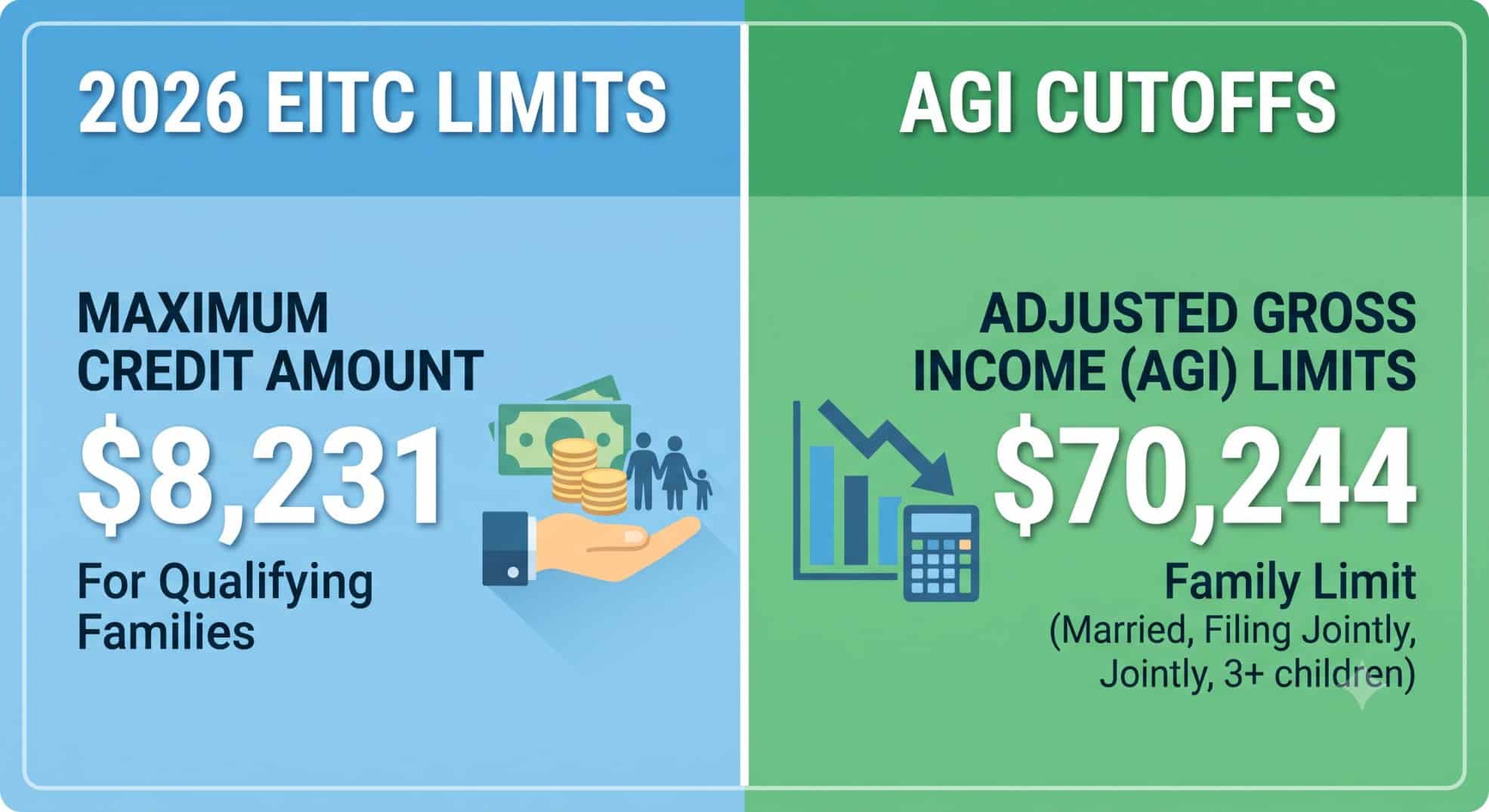
- The maximum EITC amount 3 kids 2026 has increased to $8,231, up from $8,046 in the previous tax year.
- Childless workers can claim up to $664, and OBBBA exceptions now allow qualified former foster youth to claim the credit at age 18.
- Due to mandatory PATH Act holds, early filers should expect their EITC refund date 2027 to arrive in late February or early March.
Table of Contents
- Understanding the Earned Income Credit 2026 Income Limits
- The Official EITC 2026 Table: AGI Cutoffs
- Maximum Credit Amounts for 2026
- The $12,200 Investment Income Limit
- OBBBA Exceptions: Foster and Homeless Youth
- The PATH Act and Your EITC Refund Date 2027
- Real-World Scenarios: Calculating the EITC
- Step-by-Step Guide: How to Claim the EITC
- Frequently Asked Questions About the EITC
Understanding the Earned Income Credit 2026 Income Limits
The IRS caps the amount of money you can earn while still claiming the EITC. These limits depend entirely on your filing status and how many qualifying children you claim on your return.
The Earned Income Tax Credit is designed specifically for low-to-moderate-income working individuals and families. To qualify, you must have actual earned income. This means wages from a W-2 job, net earnings from self-employment, or other taxable employee compensation. Passive income sources like unemployment benefits, pensions, or alimony do not count as earned income.
However, having earned income is only half the battle. The IRS also looks at your Adjusted Gross Income (AGI) to determine your eligibility. Your AGI includes your earned income plus other types of taxable income, minus specific deductions. If your AGI exceeds the statutory thresholds, you lose the credit entirely.
The earned income credit 2026 income limits have been adjusted upward to account for inflation. This means taxpayers who may have barely missed the cutoff in 2025 might find themselves eligible this year. Tracking these exact numbers is critical before you file your return.
The Official EITC 2026 Table: AGI Cutoffs
Your Adjusted Gross Income (AGI) must fall below specific thresholds to qualify. If your income exceeds these numbers by even one dollar, you lose eligibility for the credit entirely.
Review the EITC 2026 table below to find your specific threshold. The IRS strictly enforces these cutoffs. There is no grace period or partial credit if you earn slightly over the limit. You are either under the cap, or you are disqualified.
| Number of Qualifying Children | Single, Head of Household, or Widowed | Married Filing Jointly |
|---|---|---|
| Zero Children | $19,540 | $26,820 |
| One Child | $51,593 | $58,863 |
| Two Children | $58,629 | $65,899 |
| Three or More Children | $62,974 | $70,244 |
Married couples must file jointly to use the higher income thresholds shown in the right-hand column. Filing separately generally disqualifies you from claiming the EITC, barring a few very narrow exceptions for spouses who have lived apart for more than six months.
Maximum Credit Amounts for 2026
The IRS has increased the maximum payouts across the board to account for inflation. The exact amount you receive depends on where your income falls on the phase-in and phase-out curves.
Families hitting the maximum EITC amount 3 kids 2026 will see a significant boost to their tax refunds. The credit is fully refundable. This means if the credit amount is larger than the federal income tax you owe, the IRS will send you the difference as a cash deposit.
Here are the absolute maximum credit amounts for the 2026 tax year:
- Three or more qualifying children: $8,231 (up from $8,046)
- Two qualifying children: $7,316
- One qualifying child: $4,427
- Zero qualifying children: $664
You do not automatically get the maximum amount just by being under the income limit. The EITC operates on a bell curve. As you start earning money, the credit phases in and grows. It eventually hits a “plateau” where you receive the maximum payout. Once your income crosses a certain threshold, the credit begins to phase out, shrinking gradually until it hits zero at the absolute income limit.
The $12,200 Investment Income Limit
Earned income is not the only metric the IRS tracks. You are strictly prohibited from claiming the EITC if your investment income for the year exceeds $12,200.
This is one of the most common traps for taxpayers. You could have a W-2 income of just $30,000 and three qualifying children, making you a prime candidate for the credit. But if you sold stock, collected rental income, or earned significant interest that totals $12,201, you are instantly disqualified.
Investment income includes taxable interest, tax-exempt interest, capital gains, dividends, and net rental income. The IRS aggregates all of these sources. If you actively trade in a brokerage account or recently sold a piece of property, you must calculate this figure carefully before attempting to claim the credit. Read our guide on reporting capital gains to ensure you calculate your investment income correctly.
OBBBA Exceptions: Foster and Homeless Youth
Recent legislation has expanded access to the childless EITC for vulnerable young adults. Qualified former foster youth and homeless youth can now claim the credit at age 18.
Historically, the childless EITC was restricted to older workers, usually requiring the taxpayer to be at least 25 years old. The One Big Beautiful Bill Act (OBBBA) permanently altered these age brackets to support younger workers entering the labor force.
Under the OBBBA provisions, the minimum age to claim the childless EITC drops to 19 for most taxpayers. More importantly, it creates a specific carve-out for qualified former foster youth and qualified homeless youth, allowing them to claim the credit as early as age 18.
To utilize this exception, the 18-year-old must have earned income, cannot be claimed as a dependent on anyone else’s tax return, and must meet the standard income limits for a single filer with zero children. Learn more about tax benefits for young adults if you fall into this category.
The PATH Act and Your EITC Refund Date 2027
Federal law requires the IRS to hold all tax refunds associated with the EITC until mid-February. This mandatory delay gives the government time to verify income and prevent fraud.
If you rely on this credit for a fast cash infusion in January, you need to adjust your expectations. The Protecting Americans from Tax Hikes (PATH) Act legally prohibits the IRS from issuing refunds for returns claiming the EITC or the Additional Child Tax Credit (ACTC) before mid-February.

Your EITC refund date 2027 will be delayed until at least February 15th, even if you file your return on the very first day the IRS opens for the season. The IRS uses this holding period to match the income reported on your tax return against the W-2s submitted by your employer, drastically reducing identity theft.
If you file early, choose direct deposit, and have no errors on your return, expect your EITC refund date 2027 to land around late February or early March. Paper checks will take significantly longer to arrive in the mail.
Real-World Scenarios: Calculating the EITC
Tax rules make more sense when applied to real life. Let’s look at four distinct taxpayer situations to see how the income limits, age exceptions, and investment caps work in practice.
Scenario 1: The Phase-Out Reality
Maria is a single mother with one qualifying child. Her W-2 shows $35,000 in earned income for 2026. Because her income falls below the earned income credit 2026 income limits of $51,593, she qualifies for the credit.
However, Maria will not receive the maximum $4,427. The maximum credit plateaus at a much lower income level. Because she earns $35,000, she is squarely in the phase-out range. The IRS will calculate a reduced, partial credit based on her exact income.
Scenario 2: The Investment Income Cliff
David and Sarah are married with two children. Their combined W-2 income is $45,000. According to the EITC 2026 table, the cutoff for a married couple with two children is $65,899. They easily pass the earned income test.
But David sold some stock this year, generating $13,500 in capital gains. Because their investment income exceeds the $12,200 hard cap, they are completely disqualified from the EITC. They get zero credit, despite their low W-2 wages.
Scenario 3: Maximizing the Family Credit
Elena and Tom are married with three qualifying children. Their combined earned income is $28,000. They are well below the $70,244 limit.
Because their income falls squarely in the “plateau” range for families with three or more children, they are hoping to claim the full EITC amount 3 kids 2026. They will receive the maximum $8,231 credit. This massive credit will wipe out any federal income tax they owe, and the remainder will be sent to them as a cash refund.
Scenario 4: The OBBBA Age Exception
Marcus is 18 years old, single, and a qualified former foster youth. He works part-time and earned $14,000 in 2026. He has no children.
Normally, an 18-year-old without children cannot claim the EITC. But under the OBBBA exception, Marcus qualifies. His income is below the $19,540 limit for single filers with no kids. He will receive a portion of the $664 maximum childless credit. To ensure you don’t miss out on exceptions like this, read our comprehensive post on common EITC filing mistakes.
Step-by-Step Guide: How to Claim the EITC
Claiming this credit requires specific documentation and exact calculations. Follow these five steps to ensure your return is accurate and your refund is not delayed.
Step 1: Gather All Income Documents
You cannot guess your income. Collect every W-2, 1099-NEC, and Schedule C related to your employment. You need an exact figure to determine where you fall on the phase-in or phase-out curve. Check out our checklist for organizing tax documents before you begin.
Step 2: Verify Your Qualifying Children
A qualifying child must pass relationship, age, residency, and joint return tests. They must be under 19 (or under 24 if a full-time student), or permanently disabled. They must have lived with you in the US for more than half the year. Crucially, every child must have a valid Social Security Number issued before the due date of the return.
Step 3: Check the Investment Income Cap
Add up your interest, dividends, and capital gains. If the total is $12,201 or higher, stop here. You do not qualify for the EITC this year.
Step 4: Compare Against the Limits
Compare your total earnings against the earned income credit 2026 income limits based on your filing status. If you are under the limit, proceed to file.
Step 5: File Schedule EIC
When you file Form 1040, you must attach Schedule EIC to provide the IRS with information about your qualifying children. If you are claiming the childless credit, you do not need Schedule EIC, but you must still claim the credit on the appropriate line of your 1040. Track your EITC refund date 2027 using the IRS “Where’s My Refund” tool after mid-February.
Frequently Asked Questions About the EITC
What is the maximum EITC amount 3 kids 2026?
The absolute maximum payout for a family with three or more qualifying children is $8,231. You must hit the specific income plateau to receive this exact amount.
Can I claim the EITC if I have no children?
Yes. Childless workers can claim a maximum credit of $664 for the 2026 tax year. Your adjusted gross income must remain below $19,540 if you are single, or $26,820 if married filing jointly.
How does the investment income limit work for 2026?
The IRS enforces a strict $12,200 cap on investment income. Earning even one dollar over this limit instantly disqualifies you from the entire credit, regardless of your earned income.
When is the exact EITC refund date 2027?
There is no single universal date. The PATH Act forces the IRS to hold these funds until mid-February. Most early filers who use direct deposit will see their money by late February or early March.
Do unemployment benefits count as earned income for the EITC?
No. Unemployment compensation is taxable income, but it is not considered “earned” income. You must have wages from a job or net earnings from self-employment to qualify.
Can married couples filing separately claim the EITC?
Generally, no. The “Married Filing Separately” status disqualifies you from the EITC in most situations. There are narrow exceptions for spouses who have lived apart for more than six months, but filing jointly is usually required.
What are the OBBBA exceptions for 18-year-olds?
Standard rules require childless workers to be older to claim the credit. The One Big Beautiful Bill Act (OBBBA) lowers this age requirement to 18 specifically for qualified former foster youth and qualified homeless youth.
How do I prove my child lived with me for the residency test?
Your qualifying child must live with you in the United States for more than half the year. School records, medical bills, or a lease agreement can serve as proof if the IRS requests documentation.
Will claiming the EITC trigger an IRS audit?
Returns claiming refundable credits do face higher scrutiny. Ensuring your dependents have valid Social Security numbers and your income matches your W-2s will minimize your audit risk.
Does the EITC 2026 table apply to state taxes as well?
No. The federal limits apply only to your IRS return. However, many states offer their own version of the EITC, which usually piggybacks off your federal eligibility but may have different payout structures. See our state-by-state EITC guide for local details.
Disclaimer: This content provides general information for educational purposes only. Tax laws are complex and change often. It is not professional tax, legal, or financial advice. Always consult a qualified tax professional for personalized guidance regarding your specific situation. Ourtaxpartner.com is not responsible for any actions taken based on the information provided herein.
