
⚡ Executive Summary: 2026 HSA Rules & Caps
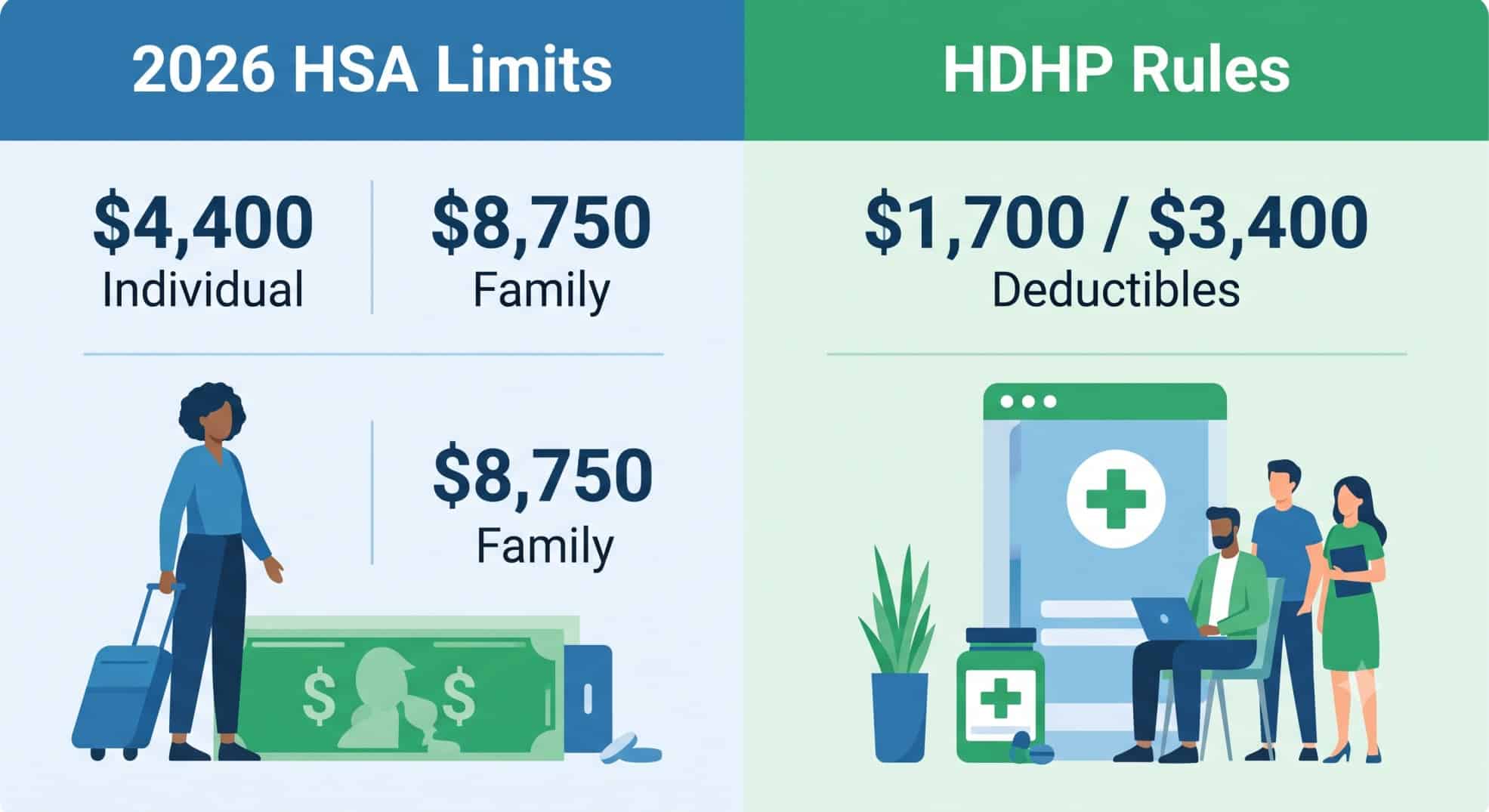
- The official HSA contribution limits 2026 are $4,400 for self-only coverage and $8,750 for family coverage.
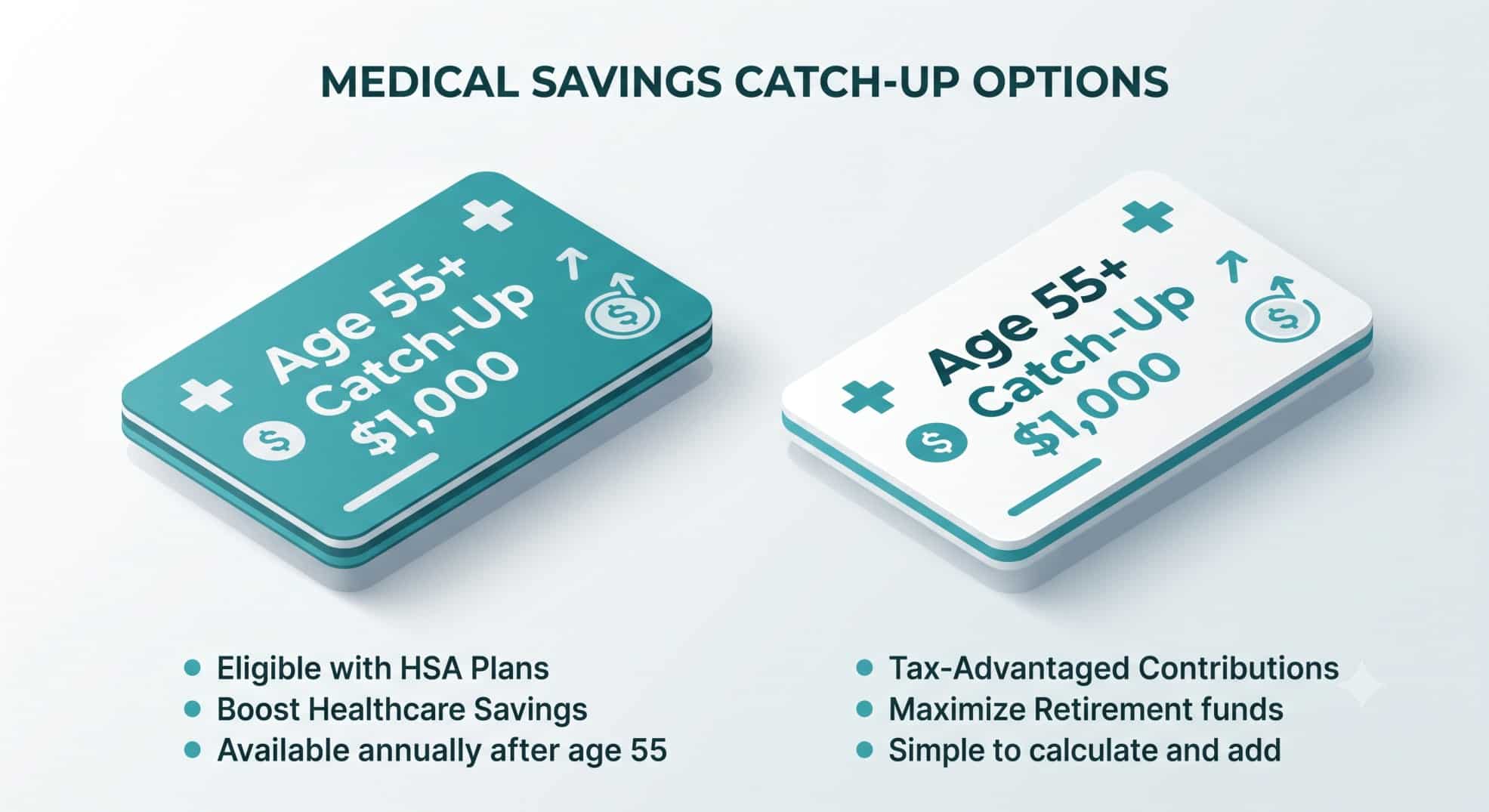
- Taxpayers aged 55 and older can make an additional $1,000 catch-up contribution, provided they are not enrolled in Medicare.
- To qualify, your health insurance must meet the HDHP minimum deductible 2026 requirements of $1,700 (self-only) or $3,400 (family).
- Looking ahead, the IRS has already announced the HSA limits 2027, which will increase to $4,500 for individuals and $9,000 for families.
Table of Contents
- Understanding the HSA Contribution Limits 2026
- HDHP Minimum Deductible 2026: Do You Qualify?
- The $1,000 Catch-Up Contribution for Age 55+
- Per-Spouse Catch-Up Account Rules
- Looking Ahead: HSA Limits 2027 Preview
- Real-World Scenarios: Calculating Your Maximums
- Step-by-Step Guide: How to Maximize Your HSA
- Frequently Asked Questions About 2026 HSA Limits
Understanding the HSA Contribution Limits 2026
The IRS adjusts Health Savings Account caps annually to keep pace with inflation. For the 2026 tax year, the limits have increased, giving taxpayers more room to shield their income from federal and state taxes. The HSA contribution limits 2026 are officially set at $4,400 for individuals with self-only coverage and $8,750 for those with family coverage.
These figures represent the absolute maximum amount of money that can enter your account during the calendar year. You must count every dollar from every source. If your employer deposits money into your account as a workplace benefit, that amount directly reduces what you can contribute out of your own paycheck.
For example, if you have family coverage and your employer seeds your account with $1,000 in January, your personal contribution ceiling drops to $7,750. Hitting the exact HSA family limit 2026 requires careful coordination between your payroll department and your personal deposits.
The tax advantages of hitting these maximums are unmatched in the US tax code. Money goes in tax-free, grows tax-free when invested, and comes out tax-free when used for qualified medical expenses. No other investment vehicle offers this triple-tax advantage. But to get these benefits, you have to play by strict eligibility rules regarding your health insurance plan.
HDHP Minimum Deductible 2026: Do You Qualify?
You cannot simply open an HSA because you want one. The IRS requires you to be enrolled in a qualifying High-Deductible Health Plan (HDHP) on the first day of the month to contribute for that month. Not every plan with a high deductible meets the legal definition of an HDHP.
The IRS sets specific floor and ceiling numbers for these plans. The HDHP minimum deductible 2026 is $1,700 for self-only coverage and $3,400 for family coverage. If your health insurance plan has a deductible even one dollar lower than these thresholds, you are legally barred from contributing to an HSA.
There is also a ceiling on your out-of-pocket maximums. For 2026, an HDHP cannot force you to pay more than $8,500 out-of-pocket for self-only coverage, or $17,000 for family coverage, for in-network services. These out-of-pocket maximums include your deductibles, copayments, and coinsurance, but they do not include your monthly premiums.
| Coverage Type (2026) | Minimum Deductible | Maximum Out-of-Pocket | HSA Contribution Limit |
|---|---|---|---|
| Self-Only | $1,700 | $8,500 | $4,400 |
| Family | $3,400 | $17,000 | $8,750 |
You must also ensure you have no other disqualifying health coverage. If you are enrolled in a general-purpose Flexible Spending Account (FSA) through your spouse’s employer, or if you are enrolled in Medicare, you lose your HSA eligibility immediately, regardless of whether your primary insurance meets the HDHP minimum deductible 2026 standards.
The $1,000 Catch-Up Contribution for Age 55+
Older taxpayers get a bonus. If you are 55 or older by the end of the tax year, the IRS allows you to make an additional $1,000 catch-up contribution. This rule is designed to help individuals accelerate their healthcare savings as they approach retirement.
Unlike the base HSA contribution limits 2026, this $1,000 catch-up figure is set by statute and does not adjust for inflation. It has remained at $1,000 for years. If you have self-only coverage and are 55 or older, your total limit becomes $5,400. If you are the primary policyholder on a family plan, your total limit becomes $9,750.
Timing matters here. You do not need to be 55 for the entire year. As long as you turn 55 by December 31 of the tax year, you are entitled to the full $1,000 catch-up contribution. However, the moment you enroll in Medicare—even just Part A—your eligibility to contribute to an HSA stops completely. You must prorate your contributions for the months prior to your Medicare enrollment.
Per-Spouse Catch-Up Account Rules
Married couples often make a critical administrative error when trying to maximize the HSA family limit 2026 alongside their catch-up contributions. The rules for spouses are highly specific and strictly enforced by the IRS.
If both you and your spouse are 55 or older, you are both entitled to a $1,000 catch-up contribution. This means a married couple on a family HDHP could theoretically contribute $10,750 in 2026 ($8,750 base + $1,000 for Spouse A + $1,000 for Spouse B).
But you cannot put all $10,750 into a single account. Health Savings Accounts are individual accounts. There is no such thing as a joint HSA. While the base family limit of $8,750 can be deposited entirely into one spouse’s account, or split between two accounts in any ratio you choose, the catch-up contributions are tied to the individual.
To claim both catch-ups, Spouse A must deposit their $1,000 into an HSA in their own name, and Spouse B must open a separate HSA in their own name to deposit their $1,000. If you try to dump the entire $10,750 into Spouse A’s account, the IRS will flag a $1,000 excess contribution, subjecting you to a 6% excise tax penalty.
Looking Ahead: HSA Limits 2027 Preview
Because the IRS calculates inflation adjustments early, we already have the official numbers for the following tax year. Forward-thinking taxpayers and HR departments use this data to set up open enrollment systems well in advance.
The HSA limits 2027 will see another standard increase. For individuals with self-only coverage, the maximum contribution will rise to $4,500. For those with family coverage, the limit will jump to $9,000. The $1,000 catch-up contribution for those 55 and older will remain unchanged.
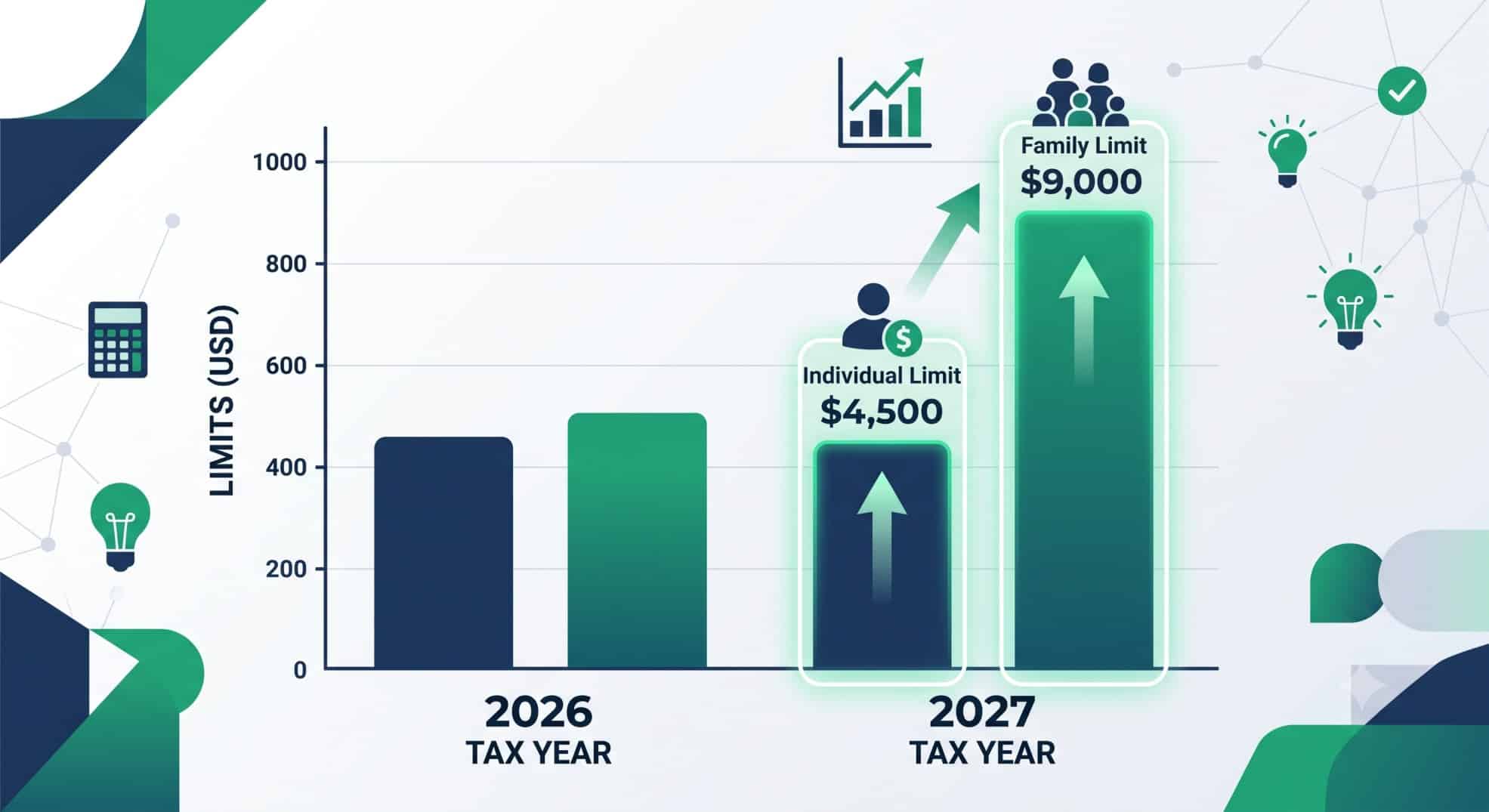
The qualifying insurance metrics will also shift. The minimum deductible for 2027 will increase to $1,750 for self-only plans and $3,500 for family plans. The maximum out-of-pocket limits will rise to $8,700 and $17,400, respectively.
Knowing the HSA limits 2027 now allows you to plan your cash flow. If you max out your account via payroll deductions, you will need to adjust your per-paycheck withholding amounts in December 2026 to ensure you hit the new $4,500 or $9,000 targets evenly throughout the 2027 calendar year.
Real-World Scenarios: Calculating Your Maximums
Tax rules are easiest to understand when applied to real life. Let’s look at four distinct scenarios to see how the HSA contribution limits 2026 operate in practice.
Scenario 1: The Single Employee with an Employer Match
David is 30 years old and has self-only HDHP coverage. His plan meets the HDHP minimum deductible 2026 requirement. His employer contributes $500 to his HSA every January as a wellness incentive.
David’s total limit for 2026 is $4,400. Because his employer already put in $500, David can only contribute $3,900 out of his own pocket. If he gets paid bi-weekly (26 pay periods), he should set his payroll deduction to $150 per paycheck to exactly hit the maximum without going over.
Scenario 2: The Married Couple Maximizing Catch-Ups
Robert (58) and Susan (56) are married and covered under Robert’s family HDHP. They want to maximize their tax savings for the year. The base HSA family limit 2026 is $8,750. Because both are over 55, they are each entitled to a $1,000 catch-up.
Robert contributes the $8,750 base family limit plus his $1,000 catch-up into his HSA, totaling $9,750. Susan opens her own HSA and contributes her $1,000 catch-up. Between the two accounts, they successfully shield $10,750 from taxable income.
Scenario 3: Mid-Year Plan Change and Proration
Elena starts 2026 on a traditional PPO plan. On July 1, 2026, she gets a new job and switches to a self-only HDHP. Because she was only eligible for 6 months of the year (July through December), the IRS default rule states she must prorate her limit.
Her prorated limit is 6/12 of $4,400, which equals $2,200. However, Elena can utilize the “Last-Month Rule.” Because she is eligible on December 1, 2026, the IRS allows her to contribute the full $4,400 for the year. The catch? She must remain in an eligible HDHP through December 31, 2027 (the testing period). If she drops HDHP coverage in 2027, the extra $2,200 she contributed becomes taxable income and gets hit with a 10% penalty.
Scenario 4: The Over-Contribution Mistake
Marcus has family coverage and sets his payroll deductions to hit the $8,750 HSA family limit 2026. In November, his wife’s grandmother gifts them $1,000 and deposits it directly into Marcus’s HSA to help with medical bills. Marcus has now contributed $9,750, exceeding his limit by $1,000.
If Marcus does nothing, he will owe a 6% excise tax ($60) on that excess amount every single year it remains in the account. To fix this, Marcus must contact his HSA administrator before the tax filing deadline (usually April 15, 2027) and request a “withdrawal of excess contributions.” The administrator will remove the $1,000 plus any earnings it generated, and Marcus will avoid the 6% penalty.
Step-by-Step Guide: How to Maximize Your HSA in 2026
Hitting the HSA contribution limits 2026 requires more than just knowing the numbers. You need a strategy to fund the account, invest the assets, and optimize your withdrawals. Here is how to execute a flawless HSA strategy.
Step 1: Audit Your Health Plan
Before you contribute a dime, verify your plan documents. Confirm that your deductible meets the HDHP minimum deductible 2026 of $1,700 (self) or $3,400 (family). Ensure your out-of-pocket maximum does not exceed the IRS limits. Look for the letters “HDHP” or “HSA-Eligible” on your insurance card.
Step 2: Calculate Your Target
Determine your maximum limit based on your coverage tier and age. Subtract any known employer contributions. Divide the remaining number by your remaining pay periods in the year. Update your HR portal to deduct this exact amount pre-tax.
Step 3: Invest the Funds
An HSA is not a checking account; it is an investment vehicle. Once your cash balance exceeds your provider’s minimum threshold (usually $1,000 or $2,000), move the excess funds into low-cost index funds or ETFs. Leaving the money in cash destroys the long-term tax-free growth potential of the account.
Step 4: Implement the Shoebox Strategy
If you have the cash flow to pay for your current medical expenses out of your regular checking account, do it. Leave your HSA funds invested so they can compound tax-free. Save your medical receipts digitally. The IRS has no time limit on when you can reimburse yourself. You can let the money grow for 20 years, then use those old receipts to pull the money out tax-free in retirement. Read our full guide on the HSA shoebox strategy here.
Step 5: Plan for Retirement
Once you turn 65, the rules change in your favor. You can withdraw funds for non-medical expenses without paying the standard 20% penalty. You will simply pay ordinary income tax on the withdrawal, exactly like a Traditional IRA. Learn more about using your HSA after 65 in our dedicated post.
Frequently Asked Questions About 2026 HSA Limits
What is the absolute maximum I can put in my HSA for 2026?
The absolute maximum depends on your coverage. It is $4,400 for self-only coverage and $8,750 for family coverage. If you are 55 or older, you can add a $1,000 catch-up contribution to those totals.
Do employer contributions count toward the 2026 HSA limits?
Yes. Every dollar your employer puts into your account counts against your annual limit. If your limit is $4,400 and your employer contributes $1,000, you can only contribute $3,400 out of your own pocket.
What is the HSA family limit 2026 if my spouse is on Medicare?
If you hold a family HDHP but your spouse is enrolled in Medicare, you can still contribute up to the $8,750 family limit in your own HSA, provided you are not on Medicare yourself. Your spouse’s Medicare status does not invalidate your family HDHP coverage.
What happens if my deductible is lower than the HDHP minimum deductible 2026?
If your deductible is below $1,700 for self-only or $3,400 for family coverage, your plan is not HSA-eligible. You cannot make any contributions for the year. If you do, they will be considered excess contributions subject to a 6% penalty.
Can I contribute to an HSA if I have a Flexible Spending Account (FSA)?
Generally, no. A standard medical FSA is considered “other health coverage” by the IRS and disqualifies you from contributing to an HSA. However, you can have a Limited-Purpose FSA (which only covers dental and vision) alongside an HSA.
Are the HSA limits 2027 already finalized?
Yes. The IRS has announced the 2027 limits. They will increase to $4,500 for self-only coverage and $9,000 for family coverage. The $1,000 catch-up contribution will remain the same.
Can my spouse and I share one HSA account?
No. Health Savings Accounts are strictly individual accounts. While you can use funds from your HSA to pay for your spouse’s medical expenses, you cannot have joint ownership of the account itself.
How do I fix an excess HSA contribution?
You must contact your HSA provider and request a “withdrawal of excess contributions” before your tax filing deadline (typically April 15). The provider will remove the excess amount and any earnings, which you will then report as taxable income, avoiding the 6% excise tax.
Does the $1,000 catch-up contribution adjust for inflation?
No. Unlike the base HSA contribution limits 2026, the $1,000 catch-up amount is fixed by statute. It has not changed in over a decade and will not change for 2027.
Can I use my 2026 HSA contributions to pay for 2025 medical bills?
No. You can only use HSA funds to pay for qualified medical expenses incurred after the date your HSA was officially established. You cannot reimburse yourself for expenses that happened before the account existed.
Disclaimer: This content provides general information for educational purposes only. Tax laws are complex and change often. It is not professional tax, legal, or financial advice. Always consult a qualified tax professional for personalized guidance regarding your specific situation. Ourtaxpartner.com is not responsible for any actions taken based on the information provided herein.
