
⚡ Executive Summary: 2026 FSA Updates
- The dependent care FSA 2026 limit has officially increased to $7,500 per household, marking the first permanent raise since 1986.
- Married taxpayers filing separately are strictly capped at a $3,750 contribution limit for the year.
- Employers are not legally mandated to adopt the new $7,500 ceiling, meaning your specific workplace plan may still enforce lower limits.
- The 2026 Health FSA contribution limit rises to $3,400, with a maximum allowable carryover of $680 into 2027.
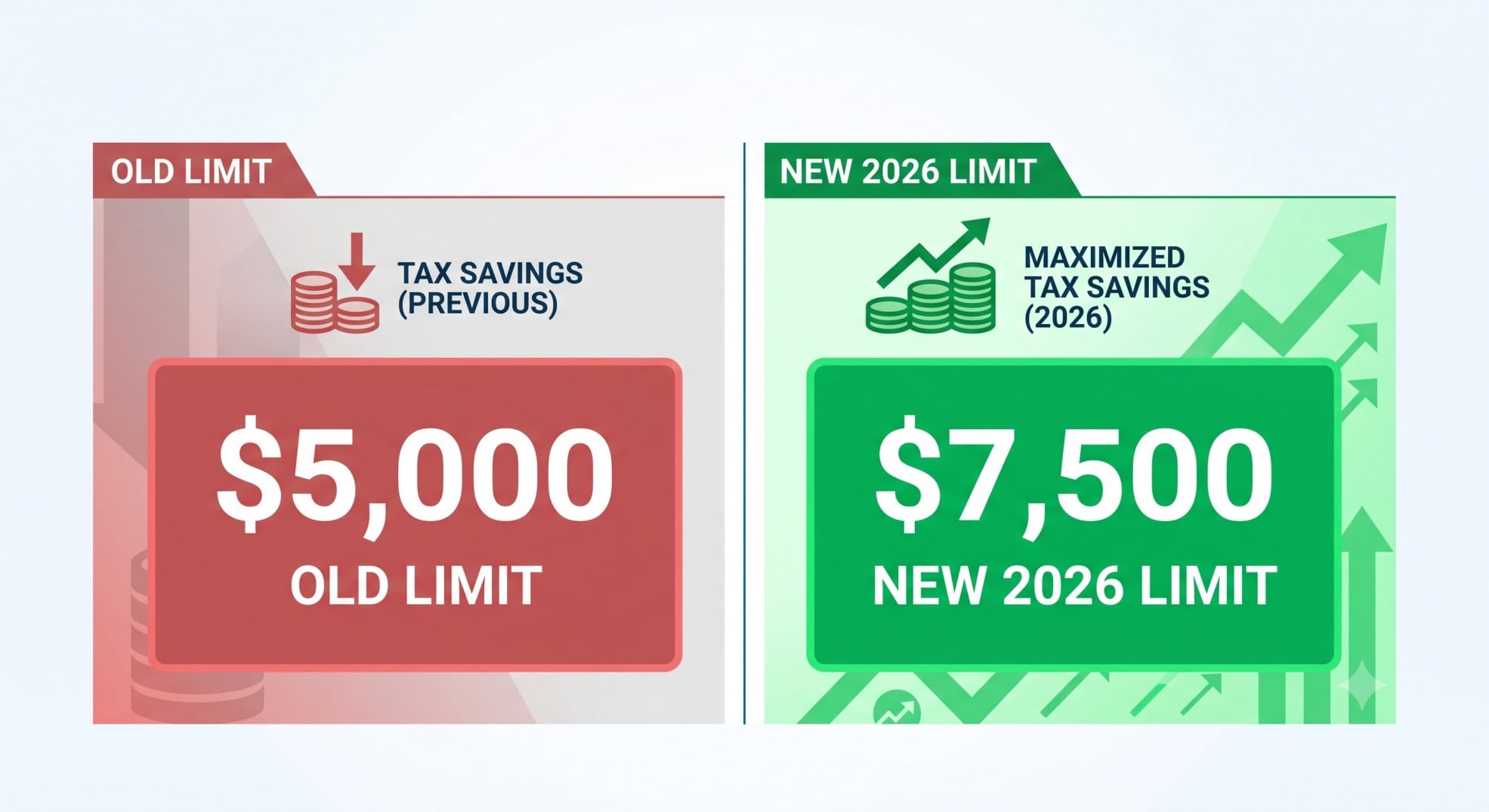
Table of Contents
- What is the Dependent Care FSA 2026 Limit?
- Did Dependent Care FSA Increase for 2026? The OBBB Act Explained
- Household Rules: Married Filing Jointly vs. Separately
- The Employer Catch: Why Your Employer Didn’t Raise the Limit
- Dependent Care FSA vs Child Care Credit 2026: Which is Better?
- Rules, Rollovers, and Mid-Year Changes
- Companion Guide: Health FSA Limits 2026
- Frequently Asked Questions About the 2026 Limits
Working parents finally have some structural tax relief. When planning for the upcoming year, understanding the dependent care FSA 2026 limit is essential. For decades, families watched childcare costs skyrocket while the federal tax benefits remained entirely stagnant. That dynamic changes on January 1, 2026.
Thanks to sweeping legislative updates, you can now shield significantly more of your income from federal, state, and payroll taxes. But taking advantage of this new $7,500 dependent care FSA requires proactive planning during your employer’s open enrollment period. You cannot simply assume your payroll deductions will automatically adjust.
We are breaking down exactly how the DCFSA increase 2026 works, how it interacts with your tax filing status, and the mathematical reality of choosing between workplace accounts and traditional tax credits.
What is the Dependent Care FSA 2026 Limit?
The baseline has shifted. The dependent care FSA 2026 limit is officially set at $7,500 per household. This account allows you to redirect a portion of your paycheck into a specialized tax-free bucket before the IRS takes its cut.
You use these funds to pay for eligible out-of-pocket expenses required for you (and your spouse, if married) to work or look for work. Common eligible expenses include daycare tuition, after-school programs, summer day camps, and adult daycare for dependent relatives who cannot care for themselves.
By routing your childcare budget through this account, you effectively bypass your top marginal tax rate. If you fall into the 24% federal tax bracket, face a 5% state income tax, and pay 7.65% in FICA taxes, every dollar you put into the FSA saves you over 36 cents. Maxing out the new $7,500 dependent care FSA can easily generate over $2,700 in pure tax savings for a middle-class family.
Did Dependent Care FSA Increase for 2026? The OBBB Act Explained
Yes. The irs dependent care fsa limits 2026 represent a massive legislative victory for working families. Signed into law in July 2025, the One Big Beautiful Bill (OBBB) Act permanently rewrote the rules governing these accounts.
To understand the magnitude of this change, you have to look at the history. Since 1986, the maximum dependent care fsa 2026 ceiling had been stubbornly locked at $5,000. Aside from a brief, temporary bump during the 2021 pandemic relief efforts, the limit ignored nearly four decades of inflation. Childcare costs tripled, but the tax benefit stayed flat.
The OBBB Act finally modernizes the code. But there is a critical caveat hidden in the legislation. The new $7,500 limit is not indexed for inflation. Unlike 401(k) limits or standard deductions, this number will not automatically tick upward in 2027 or 2028. It will remain at $7,500 until Congress actively passes another bill to raise it.
So, did dependent care fsa increase for 2026 across the board? At the federal level, yes. But as we will explore later, your specific ability to claim that full amount depends entirely on your employer’s plan documents and your household filing status.
Household Rules: Married Filing Jointly vs. Separately
The IRS views childcare tax benefits through a household lens. The dependent care fsa household limit is an absolute cap per family unit, not a per-employee entitlement.
If you are married and file a joint tax return, your combined 2026 dependent care fsa contribution limits cannot exceed the $7,500 maximum. This rule trips up many dual-income couples during open enrollment.

Can both spouses contribute to fsa accounts at their respective jobs? Absolutely. You are fully permitted to split the contributions across two different employers. However, the combined total across both of your W-2s must stay at or below the $7,500 threshold. If you accidentally overcontribute, the excess amount becomes taxable income, and you will face a headache when filing your Form 2441 in April.
What happens if you file separate tax returns? The IRS penalizes this filing status heavily when it comes to childcare benefits. The dependent care fsa limit for 2026 married filing separately is strictly capped at $3,750. You cannot bypass the household maximum by filing separate returns; the IRS simply cuts the benefit exactly in half.
Hypothetical Scenario 1: The Dual-Income Coordination
Mark and Sarah are married filing jointly. They have two toddlers in daycare costing $18,000 a year. Both of their employers offer a DCAP (Dependent Care Assistance Program). They want to maximize their tax savings without triggering an IRS penalty.
During open enrollment, Mark elects to contribute $4,000 to his employer’s plan. Sarah must restrict her election to $3,500. Their combined total perfectly hits the $7,500 dependent care FSA maximum. Because they fall into a combined 32% marginal tax bracket (federal, state, and FICA), this coordinated strategy saves them $2,400 in actual taxes.
If you are a single parent filing as Head of Household, you are entitled to the full $7,500 limit. The IRS treats single filers with dependents the same as married couples filing jointly for the purposes of this specific account.
The Employer Catch: Why Your Employer Didn’t Raise the Limit
Just because the federal government raised the ceiling does not mean your HR department will immediately follow suit. This is the most frustrating aspect of the DCFSA increase 2026.
Employers are not legally required to adopt the higher limits. The OBBB Act permits the $7,500 cap, but it does not mandate it. Companies must actively amend their Section 125 cafeteria plan documents to allow the higher contributions. If you log into your benefits portal and wonder why employer didn’t raise dcfsa limit options, it usually comes down to administrative delays or compliance fears.
This brings us to the complex world of the dependent care fsa limit for 2026 highly compensated employee rules. The IRS requires companies to perform annual nondiscrimination testing on their benefit plans. These tests ensure that tax-advantaged accounts do not disproportionately favor executives and high earners.
The most difficult hurdle is the 55% Average Benefits Test. This rule mandates that the average dependent care benefit provided to non-highly compensated employees must be at least 55% of the average benefit provided to highly compensated employees (HCEs). Because lower-income workers often cannot afford to divert thousands of dollars into an FSA, plans frequently fail this test.
When a plan fails, the hce dcfsa limit is forcibly capped to bring the averages back into compliance.
Hypothetical Scenario 2: The Mid-Year HCE Cap
David earns $170,000 a year as a marketing director, classifying him as a Highly Compensated Employee under IRS definitions. During open enrollment, he elects the full dependent care FSA 2026 limit of $7,500.
In August, his HR department notifies him that the company failed its nondiscrimination testing dependent care fsa audit. To correct the failure and avoid plan disqualification, David’s allowable contribution is retroactively capped at $2,100 for the year. The remaining $5,400 he intended to shield from taxes is returned to him as taxable income on his next paycheck. David must now pay federal and state taxes on that money, drastically reducing his expected tax savings.
If you are a high earner, you should always ask your benefits administrator if the company historically passes its nondiscrimination tests before relying entirely on the FSA for your tax planning.
Dependent Care FSA vs Child Care Credit 2026: Which is Better?
Parents constantly face a mathematical dilemma at tax time. You have childcare expenses, but you must choose the most efficient way to claim them. The dependent care FSA vs child care credit 2026 debate ultimately comes down to your marginal tax bracket and your total out-of-pocket costs.
First, what is dependent care credit? The Child and Dependent Care Credit is a non-refundable tax credit that directly reduces your tax bill dollar-for-dollar. For 2026, the credit allows you to claim up to $3,000 in eligible expenses for one child, or $6,000 for two or more children. The credit percentage ranges from 20% to 35% based on your Adjusted Gross Income (AGI).
However, the credit phases down rapidly. Once your AGI exceeds $43,000, the credit percentage drops to the 20% floor. This means a middle-class family with two kids maxes out the credit at exactly $1,200 ($6,000 in expenses multiplied by 20%).
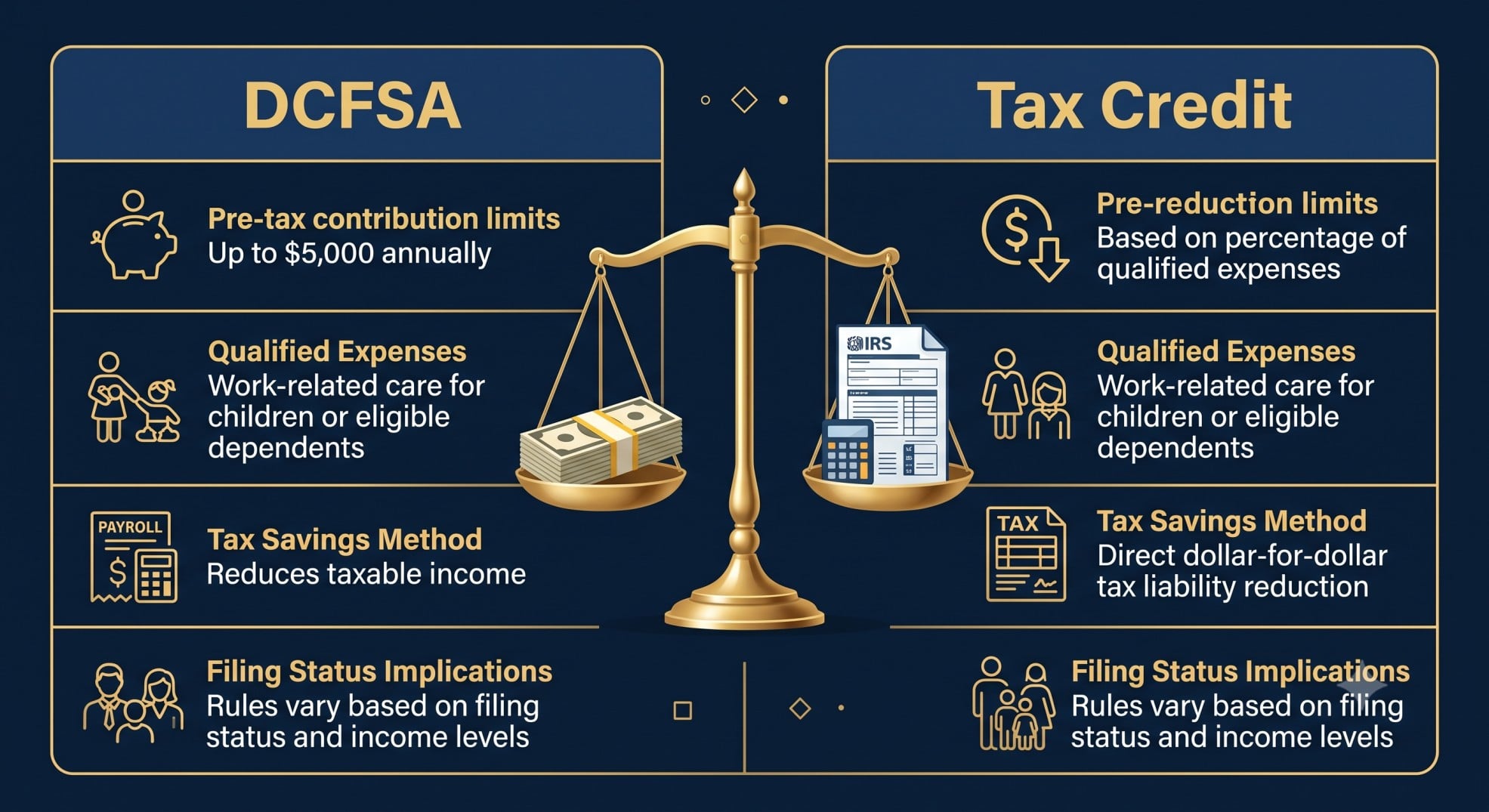
Can you claim dependent care credit and fsa at the same time? Yes, but you cannot double-dip on the exact same dollars. The IRS strictly prohibits using pre-tax FSA funds and then claiming a tax credit on those identical expenses.
If you have two kids and $12,000 in daycare costs, you can run $7,500 through the DCFSA. You have $4,500 in remaining out-of-pocket expenses. However, the IRS caps the total eligible expenses for the credit at $6,000 for two kids. Because you already used $7,500 tax-free through the FSA, you have zero eligible expenses left to apply toward the credit. The FSA wiped out your credit eligibility.
Hypothetical Scenario 3: The Decision Math
Elena is a single mother earning $95,000. She pays $9,000 a year for her daughter’s preschool. (Note: Are preschool tuition tax deductible? No, they are not a direct deduction, but they qualify as eligible expenses for both the FSA and the credit).
Option A: The FSA Route. Elena uses the dependent care FSA 2026 limit. She contributes $7,500 pre-tax. She avoids 22% federal income tax, 5% state tax, and 7.65% FICA tax. Her total marginal tax rate is 34.65%. Her tax savings: $2,598.
Option B: The Tax Credit Route. Elena skips the FSA and takes the tax credit. Her $95,000 AGI puts her at the 20% credit rate. She claims the maximum $3,000 in expenses allowed for one child. Her tax savings: $600.
The math is undeniable. The DCFSA increase 2026 makes the workplace account vastly superior for almost all taxpayers above the lowest income brackets.
Rules, Rollovers, and Mid-Year Changes
Flexible spending accounts come with strict IRS regulations. The most notorious of these is the “use-it-or-lose-it” rule. You must estimate your daycare tax deductions for 2026 with pinpoint accuracy.
Does dcfsa rollover? Generally, no. Unlike health-focused accounts, the IRS does not mandate a standard carryover provision for dependent care funds. If your employer does not explicitly offer a 2.5-month grace period (which extends your spending window to March 15 of the following year), any unused dependent care fsa money is permanently forfeited at midnight on December 31st.
Because the funds are locked in, many employees wonder: can you change dependent care fsa contribution mid year? You cannot arbitrarily lower or raise your contributions just because you miscalculated your household budget. The IRS only allows mid-year adjustments if you experience a dcfsa qualifying life event.
Valid qualifying events include:
- The birth, adoption, or death of a dependent child.
- Marriage, divorce, or legal separation.
- A change in employment status for you or your spouse (e.g., losing a job or transitioning from part-time to full-time).
- A significant change in the cost of your childcare provider (this exception does not apply if the provider is a relative).
- Changing daycare providers entirely, resulting in a different fee structure.
If you experience one of these events, you typically have 30 days to notify your HR department and adjust your payroll deductions accordingly.
Companion Guide: Health FSA Limits 2026
While childcare accounts received the most dramatic legislative overhaul, medical accounts also saw standard inflation adjustments. When reviewing your FSA limits 2026 options, you must clearly distinguish between dependent care and healthcare accounts. They operate under entirely different IRS codes.
The health care fsa limit 2026 is officially set at $3,400. This represents a $100 bump from the previous tax year. You can use these pre-tax funds to cover copayments, deductibles, prescription medications, vision care, and dental treatments.
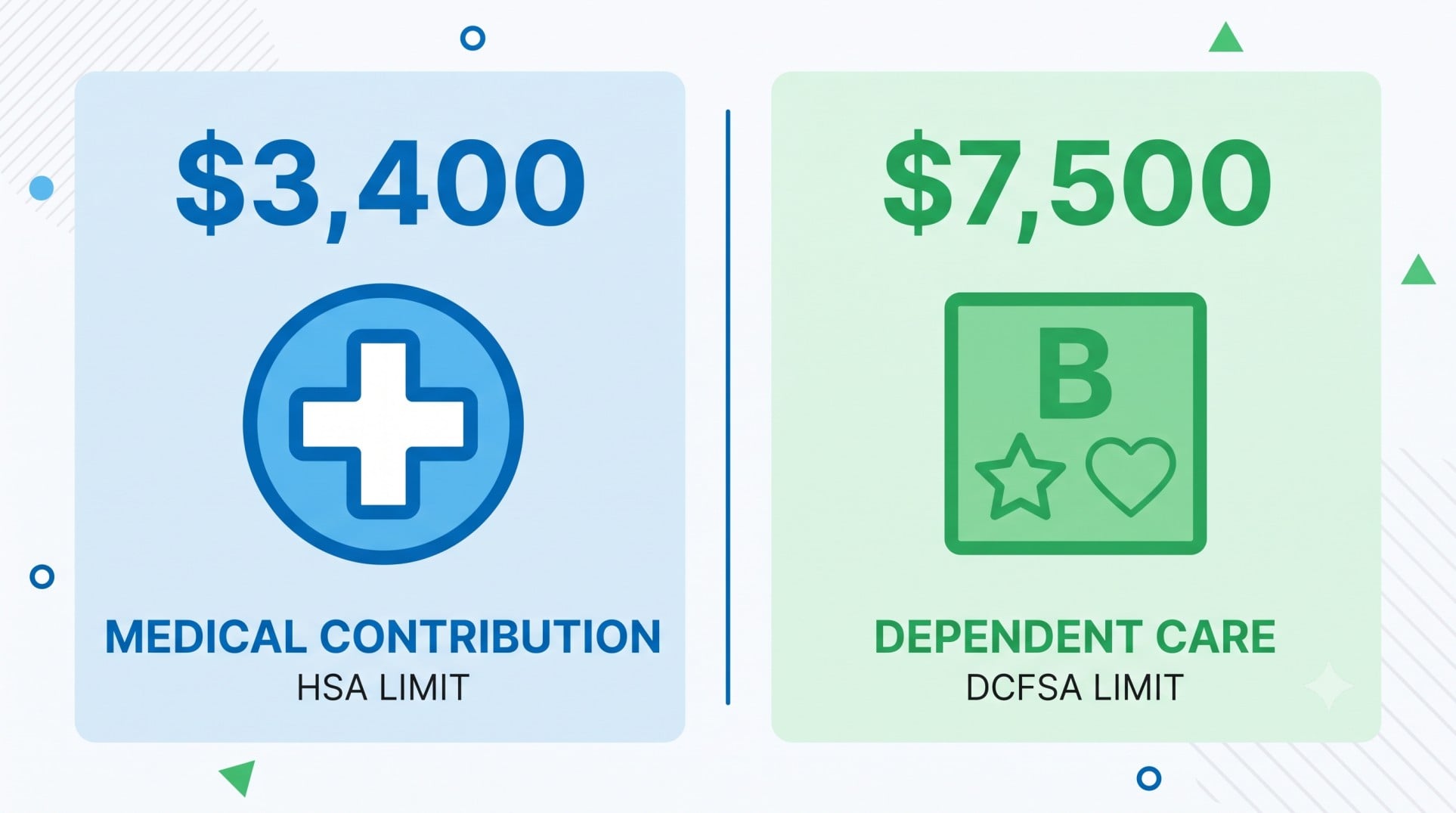
Unlike the household cap applied to childcare, the fsa max contribution 2026 for healthcare applies strictly on a per-employee basis. If you and your spouse both have access to a Health FSA through your respective employers, you can each contribute the maximum $3,400. This allows a married couple to shield a total of $6,800 from taxes for medical expenses.
The fsa rollover limit 2026 also increased. To combat the harsh use-it-or-lose-it rule, the IRS allows employers to let participants carry over a portion of unused medical funds into the next plan year. The 2026 health fsa carryover limit is $680.
Hypothetical Scenario 4: Managing the Health FSA Carryover
Marcus elects the $3,400 maximum for his Health FSA. By December, he has only spent $2,500 on physical therapy and prescriptions. He has $900 remaining in his account. Because his employer adopted the maximum IRS carryover provision, $680 automatically rolls into his 2027 account balance. The remaining $220 is permanently forfeited and returned to the employer.
Always check your specific open enrollment materials. Employers are permitted to set their own internal limits lower than the IRS maximums, and they are not required to offer the $680 carryover provision.
Frequently Asked Questions About the 2026 Limits
What is the irs dependent care fsa limits 2026?
For 2026, the IRS limit is $7,500 per household for single filers and married couples filing jointly. This is a permanent increase established by the OBBB Act, replacing the old $5,000 limit that had been in place since 1986.
Did dependent care fsa increase for 2026 automatically for everyone?
No. While the federal ceiling increased to $7,500, employers are not legally required to adopt the new limit. Your company must amend its plan documents to allow the higher contributions. Check your open enrollment portal to verify your specific workplace limit.
What is the dependent care fsa limit 2026 married filing jointly?
Married couples filing jointly share a combined household limit of $7,500. You can split this amount between two employer plans (e.g., you contribute $4,000 and your spouse contributes $3,500), but your combined total cannot exceed the $7,500 cap.
Can you claim dependent care credit and fsa for the same child?
Yes, but you cannot use both tax benefits on the exact same expenses. If you max out the $7,500 FSA, you must have additional out-of-pocket expenses beyond that amount to even consider claiming the credit. Because the credit caps eligible expenses at $6,000 for two kids, maxing the FSA usually eliminates your ability to claim the credit.
Does dcfsa rollover into the next year?
Generally, no. Dependent care accounts are strictly “use-it-or-lose-it.” Unless your employer specifically offers a 2.5-month grace period (allowing you to spend funds through March 15), any unspent money remaining on December 31st is permanently forfeited.
Why is the dependent care fsa limit 2026 highly compensated employee capped?
The IRS requires companies to run nondiscrimination tests to ensure tax benefits do not heavily favor executives. If a plan fails the 55% Average Benefits Test, the employer must cap the contributions of Highly Compensated Employees (often around $2,100) to bring the plan back into IRS compliance.
What qualifies as a dcfsa qualifying life event?
You can only change your contribution mid-year if you experience a qualifying event. This includes the birth or adoption of a child, marriage, divorce, a change in employment status, or a significant change in the cost charged by your non-relative childcare provider.
What is the fsa dependent care limit 2026 for single filers?
Single parents filing as Head of Household are entitled to the full $7,500 maximum limit. The IRS treats single filers with qualifying dependents the same as married couples filing jointly for this specific tax-advantaged account.
Are daycare tax deductions 2026 changing?
Daycare expenses are not a direct “deduction” on your tax return. Instead, they qualify for either the pre-tax FSA or the Child and Dependent Care Credit. The major change for 2026 is the FSA limit increasing to $7,500, allowing you to shield more income from taxes to pay for daycare.
What is the 2026 health fsa carryover limit?
The maximum allowable carryover for a Health FSA in 2026 is $680. This allows you to roll up to $680 of unused medical funds into the 2027 plan year, provided your employer has opted to include the carryover provision in their plan design.
Disclaimer: This content provides general information for educational purposes only. Tax laws are complex and change often. It is not professional tax, legal, or financial advice. Always consult a qualified tax professional for personalized guidance regarding your specific situation. Ourtaxpartner.com is not responsible for any actions taken based on the information provided herein.
