
Accurate Child and Dependent Care Credit information can save working families thousands of dollars on their 2026 federal income taxes. If you paid a daycare center, nanny, summer day camp, or home health aide to care for a child under age 13 or an incapacitated adult dependent during 2026 so you could work or actively look for work, Internal Revenue Code (IRC) Section 21 lets you claim a direct, dollar-for-dollar reduction against your tax bill.
Tax Year 2026 marks the largest overhaul to family care tax benefits in nearly four decades. Following the enactment of the One Big Beautiful Bill Act (OBBBA) in July 2025, Congress permanently expanded both the nonrefundable tax credit percentages and the pre-tax employer Dependent Care Flexible Spending Account (DCFSA) limits beginning January 1, 2026.
Because this tax break is a nonrefundable tax credit rather than an above-the-line adjustment or an itemized deduction, it directly offsets your federal tax liability on Form 1040 regardless of whether you take the 2026 standard deduction ($16,100 for Single filers, $32,200 for Married Filing Jointly, or $24,150 for Head of Household per IRS Revenue Procedure 2025-32). However, coordinating the expanded 50% credit tier with the new $7,500 employer FSA cap requires careful math before you file your return by April 15, 2027.
⚡ Executive Summary: Key 2026 Tax Rules at a Glance
- Higher Maximum Credit Value for 2026: The maximum credit rate increases from 35% to 50% of qualifying expenses up to $3,000 for one qualifying person (a $1,500 max credit) and $6,000 for two or more qualifying persons (a $3,000 max credit) for returns filed by April 15, 2027.
- Post-OBBBA Income Threshold Expansion: Under the One Big Beautiful Bill Act, the 35% credit rate now holds steady for middle-income households up to $75,000 AGI ($150,000 Married Filing Jointly), and the 20% minimum floor does not kick in until AGI exceeds $103,000 ($206,000 for joint filers).
- $7,500 Employer Dependent Care FSA Cap: Starting in 2026, IRC Section 129 allows employees to exclude up to $7,500 ($3,750 if Married Filing Separately) in pre-tax Dependent Care Assistance Program (DCAP) benefits, up from the historic $5,000 limit.
- Mandatory IRS Reporting Forms: Taxpayers must complete IRS Form 2441 (including the care provider’s SSN or EIN in Part I) and transfer the calculated nonrefundable credit to Schedule 3 (Form 1040), Line 2.
Table of Contents
- ⚡ Executive Summary: Key 2026 Tax Rules at a Glance
- What’s New for Tax Year 2026: OBBBA Rate Jumps and FSA Increases
- Who Is Eligible to Claim the Credit in 2026?
- Who Qualifies You for the Credit? Defining a Qualifying Person
- Who Is an Eligible Care Provider Under IRS Rules?
- How Is the Credit Calculated for Tax Year 2026?
- What If I Receive Dependent Care Benefits From My Employer?
- How Do I Claim the Credit on My 2026 Tax Return?
- 2026 Real-World Calculation Scenarios
- State Child Care Tax Credits and Federal Conformity Rules
- Frequently Asked Questions About Child and Dependent Care Credit Information
- Final Tax Planning Takeaways for 2026 Filers
What’s New for Tax Year 2026: OBBBA Rate Jumps and FSA Increases
When reviewing what’s new for tax year 2026, two statutory changes dominate: the One Big Beautiful Bill Act raised the top Child and Dependent Care Credit rate from 35% to 50% and increased the pre-tax employer Dependent Care FSA exclusion cap from $5,000 to $7,500.
For decades, the parameters governing IRC Section 21 and Section 129 remained largely stagnant outside of a single temporary pandemic expansion in 2021. The OBBBA permanently rewrote the calculation brackets starting with care expenses paid between January 1, 2026, and December 31, 2026. While the statutory cap on eligible work-related care expenses stays locked at $3,000 for one qualifying dependent and $6,000 for two or more qualifying dependents, the percentage of those expenses you can claim as a credit has expanded significantly for both lower- and upper-middle-income households.
In 2025, any household with an Adjusted Gross Income (AGI) above $43,000 was immediately pushed down to the minimum 20% credit rate. That meant a married couple earning $45,000 received the exact same 20% credit percentage as a couple earning $450,000. For Tax Year 2026, the IRS Form 2441 instructions introduce a two-tier phase-down schedule that preserves a 35% credit rate for single and head-of-household filers earning up to $75,000 and joint filers earning up to $150,000.
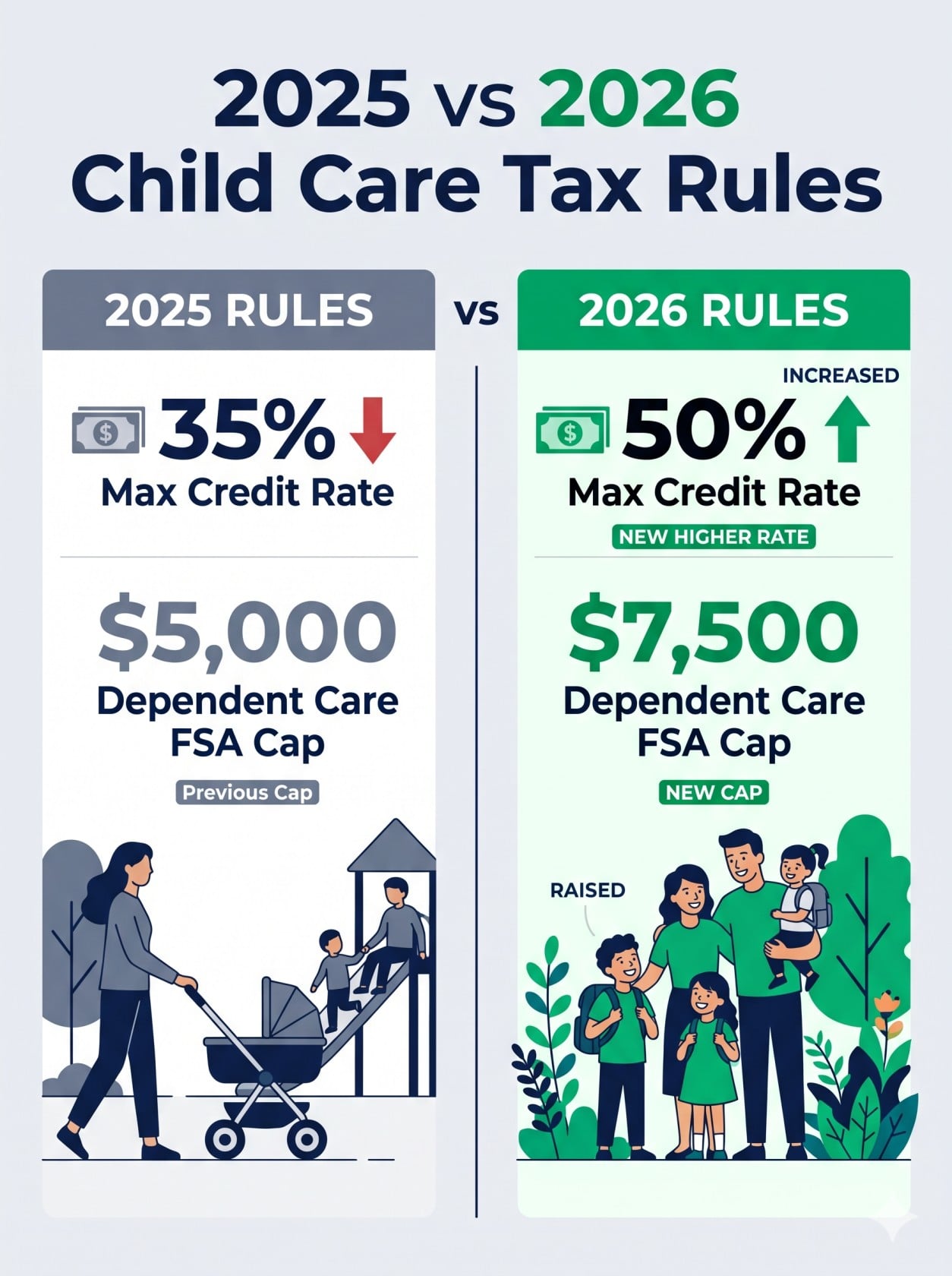
Here is a side-by-side breakdown comparing the 2025 rules against the updated 2026 rules for returns filed in 2027:
| Tax Provision / Threshold | Tax Year 2025 Rules | Tax Year 2026 Rules (Filed in 2027) |
|---|---|---|
| Maximum Expense Limit (1 Qualifying Person) | $3,000 | $3,000 |
| Maximum Expense Limit (2+ Qualifying Persons) | $6,000 | $6,000 |
| Maximum Credit Percentage | 35% (for AGI up to $15,000) | 50% (for AGI up to $15,000) |
| Maximum Dollar Credit (1 Qualifying Person) | $1,050 (35% of $3,000) | $1,500 (50% of $3,000) |
| Maximum Dollar Credit (2+ Qualifying Persons) | $2,100 (35% of $6,000) | $3,000 (50% of $6,000) |
| Middle-Income 35% Plateau Window | None (dropped to 20% at $43,001 AGI) | $43,001 to $75,000 AGI ($43,001 to $150,000 MFJ) |
| AGI Threshold Where 20% Minimum Rate Applies | Over $43,000 (all filing statuses) | Over $103,000 (Over $206,000 for Married Filing Jointly) |
| Dependent Care FSA (DCAP) Exclusion Limit | $5,000 ($2,500 Married Filing Separately) | $7,500 ($3,750 Married Filing Separately) |
| Credit Refundability Status | Nonrefundable | Nonrefundable (offsets tax liability down to $0) |
Understanding what’s new for tax year 2026 also requires looking at how this credit interacts with other family tax breaks. Unlike the Child Tax Credit—which the OBBBA permanently increased to $2,200 per child with up to $1,700 refundable via Schedule 8812—the Child and Dependent Care Credit remains strictly nonrefundable. If your calculated credit on Form 2441 is $2,100 but your total federal income tax liability on Form 1040, Line 18 is only $1,400, your credit is capped at $1,400 and the remaining $700 is forfeited. For families evaluating their broader tax picture, reviewing our guide on 2026 Child Tax Credit rules and refundable limits can help you stack both credits properly.
Who Is Eligible to Claim the Credit in 2026?
To determine who is eligible to claim the credit, the IRS enforces four strict tests: you must have earned income, incur care expenses to work or look for work, use an eligible filing status, and report your care provider’s taxpayer identification number.
Missing even one of these statutory pillars disqualifies your entire claim on Form 2441. Below is how the IRS evaluates each eligibility requirement under Publication 503 (Child and Dependent Care Expenses).
1. The Earned Income Requirement (And the Lower-Earner Cap)
You—and your spouse, if you file a joint return—must have earned income during the 2026 calendar year. Under IRS rules, earned income includes W-2 wages, salaries, tips, bonuses, taxable employee compensation, and net earnings from self-employment reported on Schedule C (Form 1040) or Schedule SE. It also includes nontaxable combat pay if you elect to include it in earned income.
Passive or unearned income does not count. You cannot use interest, dividends, capital gains, pensions, Social Security benefits, IRA distributions, unemployment compensation, or workers’ compensation to satisfy the earned income test. Furthermore, your allowable care expenses cannot exceed your earned income for the year. If you are married filing jointly, your eligible care expenses are strictly capped at the smaller of your earned income or your spouse’s earned income.
2. The Student or Disabled Spouse Exception (Deemed Earned Income)
What if one spouse stays home to attend college full-time or cannot work due to a physical or mental disability? The tax code provides a crucial relief valve known as the “deemed earned income” rule.
If you or your spouse was a full-time student (enrolled for the number of hours the school considers full-time during some part of five calendar months in 2026) or was physically or mentally incapable of self-care while living in the same home for more than half the year, the IRS treats that non-working spouse as having earned income for each month they met the condition. For 2026, this deemed monthly earned income is fixed at:
- $250 per month if you have one qualifying person (up to $3,000 for 12 months).
- $500 per month if you have two or more qualifying persons (up to $6,000 for 12 months).
CPA Audit Warning on Online Schooling: Per the IRS Form 2441 instructions, a full-time student must attend a regular educational institution with a faculty and student body. The IRS explicitly states that a school does not include an on-the-job training course, correspondence school, or a school offering courses exclusively through the internet. Also, if both spouses were full-time students or disabled in the same calendar month, only one spouse can be treated as having deemed earned income for that month.
3. The Work-Related Expense Test
Expenses only qualify if you pay them so you (and your spouse, if filing jointly) can work or actively look for work. If you pay a babysitter on Saturday night for a dinner date, or hire a tutor strictly to help your child pass math, those costs fail the work-related test. Similarly, if you look for work during 2026 but never find a job and finish the year with $0 in earned income, you cannot claim the credit because your allowable expenses are limited to your earned income ($0).
4. Filing Status Rules and the Married Filing Separately Exception
Generally, taxpayers who are eligible to claim the credit must file as Single, Head of Household, Qualifying Surviving Spouse, or Married Filing Jointly. If you choose the Married Filing Separately (MFS) status, you are automatically barred from claiming the Child and Dependent Care Credit unless you meet all three criteria to be “considered unmarried” under IRC Section 21(e)(4):
- You lived apart from your spouse during the last 6 months of 2026 (July 1 through December 31).
- Your home was the qualifying person’s main home for more than half of 2026.
- You paid more than half the cost of keeping up that home for 2026.
If you satisfy all three requirements, you check the box on Form 2441, Line A and calculate the credit using the single/other filer rules. For a broader look at how filing separately impacts your return, check out our comparison of Married Filing Jointly vs. Married Filing Separately in 2026.
Who Qualifies You for the Credit? Defining a Qualifying Person
When determining who qualifies you for the credit, your care expenses must be paid for at least one of three specific individuals: a qualifying child under age 13, a disabled spouse incapable of self-care, or a disabled dependent incapable of self-care.
Knowing who is eligible to claim the credit is only half the equation; you must also verify that the person receiving the care meets the strict definition of a “qualifying person” on the exact days the care was provided.
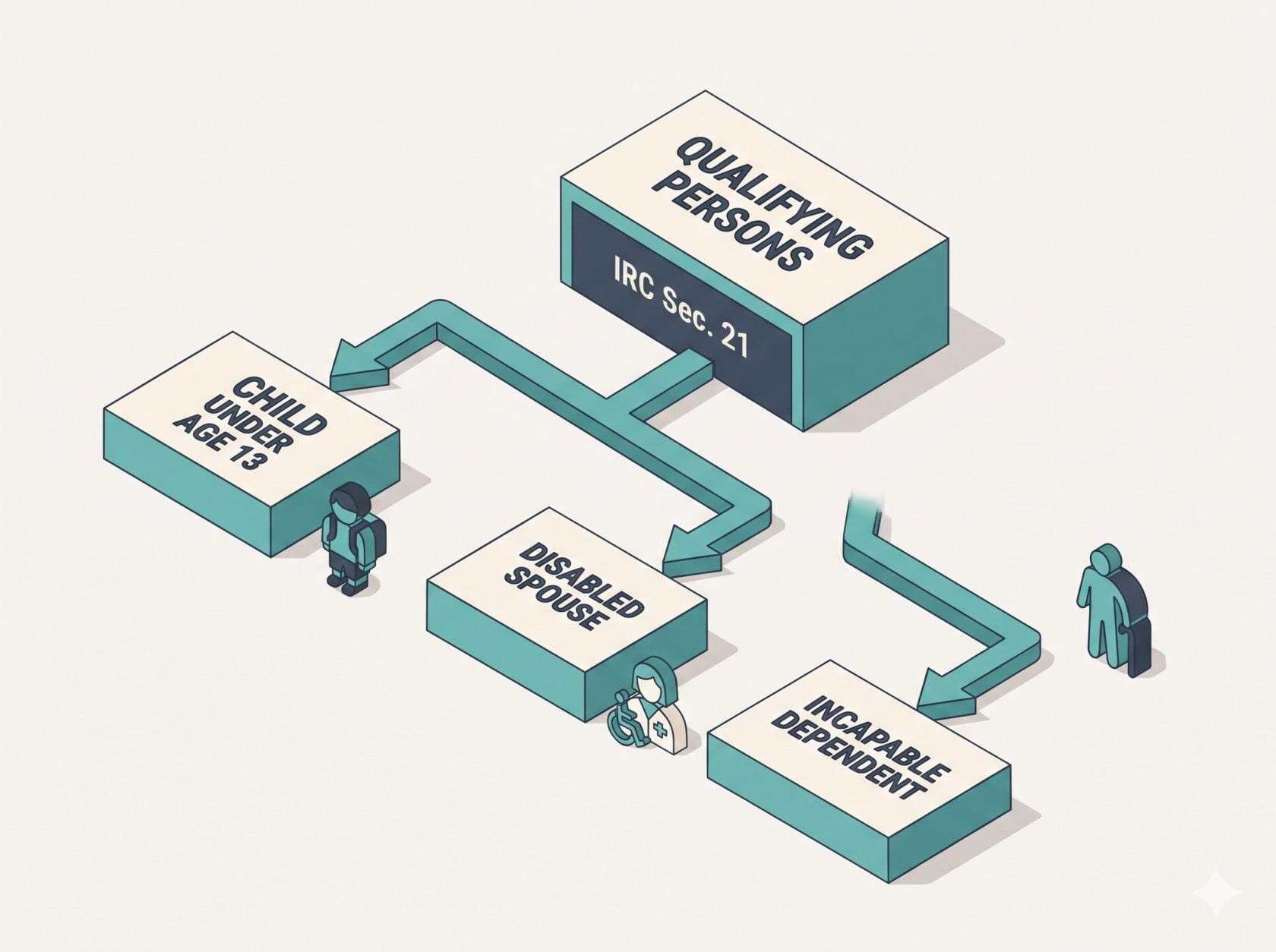
Category 1: Your Qualifying Child Under Age 13
Your dependent child qualifies you for the credit if they were under age 13 when the care was provided and lived with you for more than half the year. What happens if your child turns 13 during 2026? You do not lose the entire year’s credit. Instead, you prorate your expenses: you can count all eligible work-related care expenses paid from January 1, 2026, right up through the day before their 13th birthday. Any care provided on or after their 13th birthday is ineligible (unless the child is physically or mentally incapable of self-care).
Category 2: Your Disabled Spouse
Your spouse qualifies you for the credit if they were physically or mentally incapable of self-care and lived with you for more than half of 2026. Under IRS regulations, individuals are “incapable of self-care” if they cannot dress, clean, or feed themselves because of physical or mental defects, or if they require constant attention to prevent them from injuring themselves or others.
Category 3: Your Disabled Dependent (Of Any Age)
An older child, elderly parent, or other relative qualifies you if they were physically or mentally incapable of self-care, lived with you for more than half of 2026, and were either your tax dependent or would have been your dependent except that:
- They received gross income equal to or exceeding the 2026 gross income limit for a qualifying relative, or
- They filed a joint tax return, or
- You (or your spouse, if filing jointly) could be claimed as a dependent on someone else’s 2026 return.
Special Rule for Divorced or Separated Parents (Custodial vs. Noncustodial)
Taxpayers frequently confuse the dependency release rules for the Child Tax Credit with the rules for the Child and Dependent Care Credit. Even if a custodial parent signs IRS Form 8332 releasing the right to claim the child as a dependent to the noncustodial parent for Child Tax Credit purposes, only the custodial parent (the parent with whom the child lived for the greater number of nights in 2026) can treat the child as a qualifying person for the Child and Dependent Care Credit. The noncustodial parent can never claim Form 2441 care expenses, even if they paid the daycare bill directly.
Who Is an Eligible Care Provider Under IRS Rules?
Knowing who is an eligible care provider is straightforward: you can pay a licensed daycare center, summer day camp, after-school program, in-home nanny, or adult care aide, provided the caregiver is not your spouse, your dependent, your child under age 19, or the child’s other parent.
The IRS does not require your caregiver to be a licensed corporate facility, meaning you can pay a neighbor or an older relative (such as the child’s grandmother or aunt) to watch your child while you work. However, to prevent taxpayers from shifting income within the same household to manufacture a tax credit, IRC Section 21(e)(6) strictly prohibits payments made to four categories of related individuals:
- Your spouse.
- A parent of your qualifying child (if your qualifying person is your child under age 13—for example, you cannot pay your ex-spouse or unmarried co-parent to watch your shared child).
- Anyone you (or your spouse) can claim as a dependent on your 2026 Form 1040.
- Your own child (including a stepchild or foster child) who was under age 19 at the end of 2026, even if that child is not your tax dependent.
What Care Expenses Qualify vs. Disqualify?
Even when you hire an eligible provider, the primary purpose of the expense must be the protection and well-being of the qualifying person while you work. Use these IRS Publication 503 boundaries to separate eligible costs from disallowed expenses:
- Preschool vs. Kindergarten: Tuition for nursery school, pre-K, or similar programs for children below the kindergarten level qualifies in full as care. Once a child enters kindergarten or a higher grade, tuition is considered an educational expense and is strictly disallowed. However, payments for before-school and after-school care programs for children in kindergarten through age 12 remain 100% eligible.
- Summer Day Camps vs. Overnight Camps: The full cost of sending your child to a day camp—even a specialized camp focused on soccer, coding, or music—is an eligible care expense if it enables you to work. Conversely, the cost of an overnight camp is never allowed.
- Household Services and Nanny Taxes: If you hire an in-home nanny, housekeeper, or cook whose duties include caring for your qualifying person, the portion of their wages attributable to dependent care and incidental household upkeep qualifies. Be aware that if you pay a household employee cash wages of $3,000 or more in 2026, you cross the nanny tax threshold and must withhold and pay FICA taxes (Social Security and Medicare at 15.3% combined) on Schedule H (Form 1040). The employer’s share of payroll taxes you pay on a nanny’s qualifying wages also counts as an eligible care expense on Form 2441!
How Is the Credit Calculated for Tax Year 2026?
If you are wondering how is the credit calculated for 2026, you multiply your allowable work-related care expenses (capped at $3,000 for one qualifying person or $6,000 for two or more) by an AGI-based percentage ranging from 50% down to 20%.
Before applying the percentage, let’s clear up a common misconception about the $6,000 expense cap for two or more qualifying persons. You do not need to spend $3,000 equally on each child. Suppose you have a 3-year-old in full-time daycare costing $9,000 a year and an 11-year-old who attends public school and only incurs $400 in after-school care. Because you have two qualifying persons and incurred expenses for them, you can combine their costs ($9,400 total) and apply the full $6,000 maximum limit on Form 2441. Even if you spent $6,000 on the 3-year-old and $0 on the 11-year-old, the IRS Form 2441 instructions allow you to list both children in Part II (entering $6,000 for the toddler and $0 for the 11-year-old) to unlock the $6,000 expense limit.
The 2026 Two-Stage AGI Phase-Down Formula
Under the OBBBA statutory revisions reflected in the 2026 Form 2441 instructions, your credit percentage (entered as a decimal on Form 2441, Line 8) phases down in two distinct waves based on your Adjusted Gross Income (Form 1040, Line 11):
- First Phase-Down (50% to 35%): All filers with an AGI of $15,000 or less receive the maximum 50% decimal (0.50). For every $2,000 (or fraction thereof) that your AGI exceeds $15,000, the credit rate drops by 1 percentage point until it reaches 35% at an AGI over $43,000.
- The Middle-Income 35% Plateau: Instead of dropping straight to 20% like in prior years, the credit rate holds steady at 35% (0.35) for Single, Head of Household, and MFS filers with an AGI between $43,001 and $75,000, and for Married Filing Jointly filers with an AGI between $43,001 and $150,000.
- Second Phase-Down (35% to 20%): Once AGI exceeds $75,000 for Single/HoH filers (by $2,000 increments) or $150,000 for Married Filing Jointly filers (by $4,000 increments), the percentage drops by 1% per increment until it floors at 20% (0.20) for Single/HoH filers above $103,000 and Joint filers above $206,000.
The table below details the exact 2026 decimal rates and maximum dollar credits across key AGI tiers:
| 2026 AGI (Single / HoH / Qualifying Surviving Spouse / Eligible MFS) | 2026 AGI (Married Filing Jointly) | Form 2441 Line 8 Credit Percentage | Max Credit: 1 Qualifying Person ($3,000 Cap) | Max Credit: 2+ Qualifying Persons ($6,000 Cap) |
|---|---|---|---|---|
| $0 – $15,000 | $0 – $15,000 | 50% (0.50) | $1,500 | $3,000 |
| $15,001 – $17,000 | $15,001 – $17,000 | 49% (0.49) | $1,470 | $2,940 |
| $23,001 – $25,000 | $23,001 – $25,000 | 45% (0.45) | $1,350 | $2,700 |
| $33,001 – $35,000 | $33,001 – $35,000 | 40% (0.40) | $1,200 | $2,400 |
| $43,001 – $75,000 | $43,001 – $150,000 | 35% (0.35) | $1,050 | $2,100 |
| $75,001 – $77,000 | $150,001 – $154,000 | 34% (0.34) | $1,020 | $2,040 |
| $83,001 – $85,000 | $166,001 – $170,000 | 30% (0.30) | $900 | $1,800 |
| $93,001 – $95,000 | $186,001 – $190,000 | 25% (0.25) | $750 | $1,500 |
| $101,001 – $103,000 | $202,001 – $206,000 | 21% (0.21) | $630 | $1,260 |
| Over $103,000 | Over $206,000 | 20% (0.20) | $600 | $1,200 |
Notice that there is no upper income cutoff that completely eliminates the credit. Even if a married couple earns $600,000 in 2026, they still qualify for the 20% floor, generating up to $600 for one child or $1,200 for two or more children. And because your credit rate hinges directly on your AGI, making above-the-line contributions to a 401(k), traditional IRA, or Health Savings Account (HSA) can lower your AGI into a more generous percentage tier. You can explore more ways to trim your AGI in our guide to above-the-line tax deductions for 2026.
What If I Receive Dependent Care Benefits From My Employer?
To answer what if I receive dependent care benefits from my employer: you can exclude up to $7,500 ($3,750 if Married Filing Separately) from your 2026 taxable wages on Form 2441 Part III, but every pre-tax dollar you exclude reduces your $3,000 or $6,000 tax credit expense limit dollar-for-dollar.
Under IRC Section 129, employer-provided dependent care assistance programs (DCAPs)—most commonly offered as a pre-tax Dependent Care Flexible Spending Account (DCFSA)—received a major boost for 2026. The One Big Beautiful Bill Act raised the maximum annual income exclusion from $5,000 to $7,500 per household ($3,750 for Married Filing Separately). Your employer reports the total benefits provided or set aside via salary reduction in Box 10 of your 2026 Form W-2 (or Box 13, Code O of Schedule K-1 for partners in a partnership).
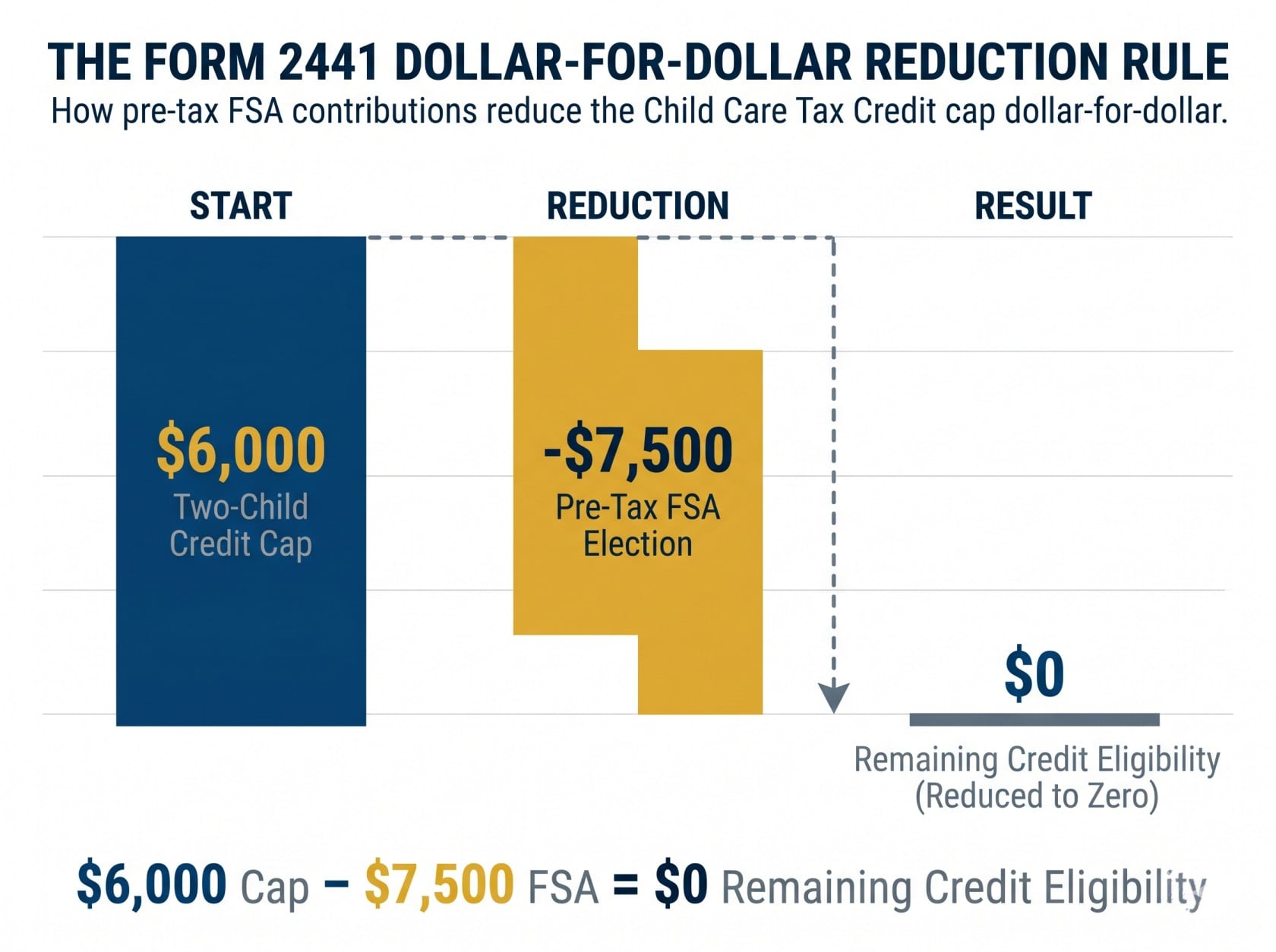
The Form 2441 Dollar-for-Dollar Offset Trap
The IRS strictly prohibits “double-dipping” with the same care dollars. More importantly, the tax code does not merely subtract your FSA reimbursement from your total daycare bill—it subtracts your excluded FSA benefits directly from the $3,000 or $6,000 statutory credit cap on Part III of Form 2441 (Lines 27 through 31).
Look at how the math plays out under the new 2026 limits:
- If you contribute the full $7,500 to a Dependent Care FSA in 2026: Your $3,000 cap (for one child) or $6,000 cap (for two or more children) is reduced by $7,500, dropping your remaining eligible credit limit to $0. In short, maxing out a $7,500 DCFSA in 2026 completely wipes out your ability to claim any Child and Dependent Care Credit on Form 2441, even if you paid $25,000 out of pocket for two kids in daycare!
- If your employer kept its plan cap at $5,000 and you have two children: Because employer plan amendments for the $7,500 OBBBA limit are optional, some employer plans still cap DCFSA elections at $5,000 in 2026. If you exclude $5,000 via an FSA and paid $12,000 in daycare for two children, your $6,000 credit cap is reduced by $5,000, leaving $1,000 of excess expenses eligible for the tax credit (worth an extra $200 to $500 depending on your AGI).
Strategic Comparison: Dependent Care FSA vs. 2026 Tax Credit
Prior to 2026, almost every middle- and high-income worker saved more money using a pre-tax FSA than claiming the 20% tax credit. With the OBBBA expanding the 35% credit rate up to $150,000 AGI for joint filers, the math has shifted dramatically.
When you contribute to a pre-tax Dependent Care FSA, you avoid federal income tax (10% to 37%), state income tax, and FICA payroll taxes (7.65% for Social Security and Medicare up to the 2026 Social Security wage base of $184,500). Here is how to decide which tool wins in 2026:
- Households in the 10% or 12% Federal Tax Bracket (AGI under $150,000 MFJ): Your combined federal tax (12%) plus FICA (7.65%) equals 19.65% in federal tax savings via an FSA. Meanwhile, the 2026 Child and Dependent Care Credit gives you a 35% to 50% direct credit! Even after factoring in state income taxes, families in the 10% or 12% federal bracket almost always come out ahead by skipping the FSA (or limiting it) to claim the 35%–50% tax credit on their first $3,000 or $6,000 of expenses.
- Households in the 22% or 24% Bracket with AGI Under $150,000 MFJ: In the 22% bracket, an FSA saves 22% federal + 7.65% FICA = 29.65% (plus state tax of roughly 4%–6%), putting it right around 34%–35% total savings—virtually tied with the 35% tax credit, except the FSA lets you shelter up to $7,500 instead of just $3,000 or $6,000.
- High Earners (AGI Over $103,000 Single / $206,000 MFJ): Once your credit percentage drops to the 20% floor and your marginal tax bracket sits at 24%, 32%, 35%, or 37%, maxing out the $7,500 Dependent Care FSA is the clear mathematical winner.
How Do I Claim the Credit on My 2026 Tax Return?
To answer how do I claim the credit, you must complete IRS Form 2441 (Child and Dependent Care Expenses), attach it to your 2026 Form 1040, and carry the final credit amount to Schedule 3 (Form 1040), Line 2 by the April 15, 2027 filing deadline.
Gathering accurate Child and Dependent Care Credit information before tax season starts prevents automated IRS processing notices. Follow this exact line-by-line workflow when preparing your 2026 return:
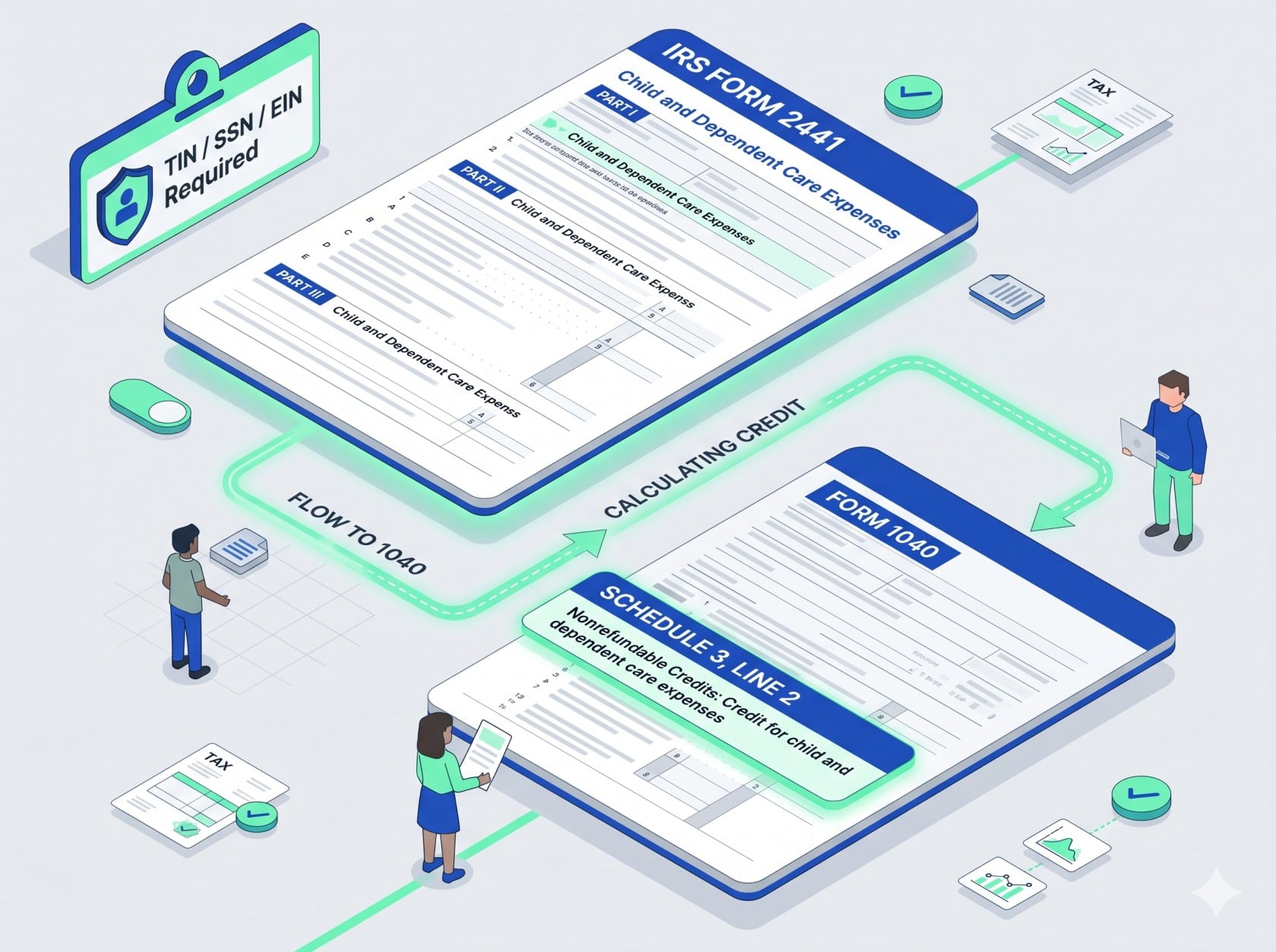
Step 1: Obtain Form W-10 and Complete Form 2441, Part I (Care Provider Details)
In Part I (Lines 1a through 1d) of Form 2441, you must list the legal name, street address, Taxpayer Identification Number (either a Social Security Number for an individual babysitter or an Employer Identification Number for a daycare business), and the exact dollar amount paid in 2026 for each care provider. You must also specify whether the provider was your household employee.
- Pro-Tip: Ask your daycare or nanny to fill out IRS Form W-10 (Dependent Care Provider’s Identification and Certification) when you hire them. Keep Form W-10 in your tax records (do not mail it to the IRS).
- Tax-Exempt Provider Exception: If your care provider is a tax-exempt organization under IRC Section 501(c)(3)—such as a church-run preschool, synagogue day camp, or nonprofit YMCA after-school program—you do not need to enter an EIN. Simply write “Tax-Exempt” in the TIN box on Line 1c.
- What if the provider refuses to give their SSN/EIN? If an individual babysitter refuses to provide their SSN, you can still claim the credit if you prove “due diligence.” Complete Part I with all known information (name and address), check the box or attach a statement explaining that you requested the TIN and the provider refused to supply it.
Step 2: Complete Part III First If You Received Employer Benefits
If Box 10 of your Form W-2 shows any dependent care benefits (even if you forfeited funds under the FSA “use-it-or-lose-it” rule), you must complete Part III of Form 2441 before Part II. On Line 21 of the 2026 Form 2441, enter the maximum statutory exclusion of $7,500 (or $3,750 if Married Filing Separately). Part III reconciles your pre-tax benefits against your actual care expenses and earned income. Any benefits exceeding your eligible expenses or earned income become taxable wages and must be added back to Form 1040, Line 1e. Lines 27 through 31 then compute how much of your $3,000 or $6,000 credit limit remains available for Part II.
Step 3: Calculate Your Credit in Part II of Form 2441
- Line 2: Enter each qualifying person’s name, Social Security Number (a valid SSN is mandatory—an ITIN for the child does not qualify), and the qualified expenses paid for them in 2026.
- Line 3: Enter the smaller of your total qualified expenses or the statutory cap ($3,000 for one person; $6,000 for two or more—or the reduced cap from Part III, Line 31 if you used an FSA).
- Lines 4 and 5: Enter your earned income on Line 4 and, if filing jointly, your spouse’s earned income on Line 5 (applying the $250/$500 monthly deemed income rule and checking Box B at the top of Form 2441 if either spouse was a full-time student or disabled).
- Line 6: Enter the smallest of Line 3, Line 4, or Line 5.
- Lines 7 and 8: Enter your 2026 AGI from Form 1040, Line 11 on Line 7, then look up your corresponding 2026 decimal rate (0.50 to 0.20) from the Line 8 phase-out table.
- Lines 9, 10, and 11: Multiply Line 6 by the decimal on Line 8, apply the tax liability limit worksheet on Line 10, and enter your final allowable credit on Line 11.
Step 4: Transfer to Schedule 3 and Form 1040
Take the final dollar amount from Form 2441, Line 11 and enter it on Schedule 3 (Form 1040), Part I, Line 2. That total flows from Schedule 3, Line 8 directly to Form 1040, Line 20, reducing your 2026 federal tax bill dollar-for-dollar.
2026 Real-World Calculation Scenarios
To see how the 2026 OBBBA rates, earned income caps, and $7,500 FSA exclusions work in practice, review these four step-by-step tax scenarios using verified 2026 IRS thresholds.
Scenario 1: Single Parent Maximizing the New 35% Middle-Income Tier
Taxpayer Profile: Maya is a single mother in Texas filing as Head of Household for Tax Year 2026. She works as a dental hygienist earning $58,000 in W-2 wages (her AGI on Form 1040, Line 11 is also $58,000). She has two children—ages 4 and 8—and paid $8,400 to a licensed daycare and after-school program in 2026. Her employer does not offer a Dependent Care FSA.
- Step 1 (Standard Deduction & Tax Liability Check): Maya claims the 2026 Head of Household standard deduction of $24,150, leaving $33,850 in taxable income. Before credits, her 2026 federal income tax liability is roughly $3,760.
- Step 2 (Expense & Earned Income Cap): Maya paid $8,400 for two qualifying children, which is capped at the statutory maximum of $6,000 on Form 2441, Line 3. Because her earned income ($58,000) exceeds $6,000, her allowable expense base on Line 6 is $6,000.
- Step 3 (2026 Credit Rate): Under the old 2025 rules, an AGI of $58,000 would have pushed Maya down to the 20% credit floor ($1,200 credit). Under the new 2026 OBBBA rules, Head of Household filers with an AGI between $43,001 and $75,000 stay locked in the 35% tier (decimal 0.35 on Line 8).
- Final 2026 Tax Result: $6,000 × 0.35 = $2,100 nonrefundable credit (a $900 increase over 2025). Combined with her Child Tax Credits, Maya wipes out her entire federal income tax liability.
Scenario 2: Married Couple Coordinating a $5,000 FSA With the 2026 Credit
Taxpayer Profile: Elena and David are married filing jointly in Ohio with a combined 2026 AGI of $135,000 (Elena earns $80,000; David earns $55,000). They have two toddlers in full-time daycare costing $16,000 for the year. Elena’s employer did not amend its plan document for 2026, so her pre-tax Dependent Care FSA remained capped at $5,000, which appears in Box 10 of her W-2.
- Step 1 (Part III FSA Exclusion): On Form 2441, Part III, Elena and David exclude the full $5,000 DCFSA from their taxable income (saving $1,100 in the 22% federal tax bracket plus $382.50 in FICA taxes, totaling $1,482.50 in pre-tax payroll savings).
- Step 2 (Dollar-for-Dollar Cap Reduction): On Lines 27–31 of Form 2441, their $6,000 two-child credit limit is reduced by their $5,000 FSA exclusion: $6,000 − $5,000 = $1,000 remaining credit limit. Because they paid $11,000 out of pocket ($16,000 total minus $5,000 FSA), they can apply the remaining $1,000 cap in Part II.
- Step 3 (Part II Credit Math): Because their joint AGI of $135,000 falls within the 2026 MFJ plateau window ($43,001 to $150,000), their credit rate on Line 8 is 35% (0.35).
- Final 2026 Tax Result: $1,000 × 0.35 = $350 Child and Dependent Care Credit on Schedule 3, Line 2. Added to their $1,482.50 in pre-tax FSA savings, their combined 2026 federal tax savings reach $1,832.50.
Scenario 3: Full-Time Student Spouse Using the Deemed Earned Income Rule
Taxpayer Profile: Marcus and Priya file a joint 2026 return in Florida. Marcus works as an software engineer earning $92,000. Priya had $0 in W-2 wages because she attended a brick-and-mortar state university full-time for 9 months during 2026 (January through May, and September through December). They paid $7,200 in daycare for their 2-year-old daughter so Marcus could work and Priya could attend classes.
- Step 1 (Statutory Expense Cap): Because they have one qualifying child, their maximum expense cap on Form 2441, Line 3 is $3,000.
- Step 2 (Deemed Earned Income Limit): Marcus enters $92,000 on Line 4. For Priya on Line 5, they check Box B on Form 2441 and apply the student deemed income rule of $250 per month for one qualifying child across the 9 months she was a full-time student: 9 months × $250 = $2,250.
- Step 3 (Applying the Smaller Earned Income Cap): On Line 6, their allowable care expenses are limited to the smallest of Line 3 ($3,000), Line 4 ($92,000), or Line 5 ($2,250). Thus, their eligible expense base is capped at Priya’s deemed earned income of $2,250.
- Final 2026 Tax Result: With a joint AGI of $92,000 (inside the $43,001–$150,000 MFJ 35% bracket), they multiply $2,250 by 0.35 to claim a $787.50 (rounded to $788) tax credit.
Scenario 4: High-Income Household Utilizing the New $7,500 FSA Cap
Taxpayer Profile: Chloe and Liam are married filing jointly in California with a combined 2026 AGI of $260,000, placing them in the 24% federal marginal tax bracket. They pay $24,000 a year for a nanny to watch their two children (ages 1 and 5). Chloe’s employer amended its Section 125 Cafeteria Plan for 2026 to allow the new $7,500 Dependent Care FSA maximum.
- Option A (Claiming the Credit Only): Because their joint AGI ($260,000) exceeds $206,000, their credit rate on Form 2441 floors at 20%. Multiplying the $6,000 two-child limit by 20% yields a maximum tax credit of just $1,200.
- Option B (Maxing Out the $7,500 DCFSA): By contributing $7,500 pre-tax to the DCFSA, Chloe reduces their taxable income by $7,500. In the 24% federal bracket, that saves $1,800 in federal income tax ($7,500 × 24%). Furthermore, because Chloe’s individual salary is $130,000 (below the $184,500 Social Security wage cap for 2026), she also saves 7.65% in FICA taxes ($573.75).
- Final 2026 Tax Result: The $7,500 FSA election saves them $2,373.75 in federal income and payroll taxes (plus California state income tax savings), beating the $1,200 tax credit by nearly $1,174. Because the $7,500 FSA reduces their $6,000 Form 2441 cap to $0, they complete Part III of Form 2441 to exclude the $7,500 and stop there.
State Child Care Tax Credits and Federal Conformity Rules
When reviewing Child and Dependent Care Credit information, never overlook your state return: over 25 states and the District of Columbia offer a state-level child and dependent care tax credit or deduction that piggybacks directly off federal Form 2441.
Unlike the federal credit, which is strictly nonrefundable, roughly half of the states offering a dependent care credit make their state credit fully or partially refundable—meaning low- and middle-income families can receive a cash state refund even if they owe $0 in state income tax. However, state conformity to the 2026 federal OBBBA enhancements varies widely by state Department of Revenue rules:
- Percentage-of-Federal-Credit States (Rolling Conformity): States like New York (offering up to 110% of the federal credit for lower incomes), Colorado, Nebraska, and Louisiana calculate their state credit as a direct percentage of your federal credit on Form 2441. Where state tax codes conform automatically to current IRC Section 21 percentages, the jump from a 35% to a 50% federal rate in 2026 automatically boosts the state payout as well.
- Expense-Based or Fixed-Schedule States: States such as California (Form 3506), Maryland, and Minnesota link to federal qualifying expenses on Form 2441 but apply their own statutory state AGI phase-out brackets and state credit percentages. In California, for instance, the state credit phases out completely once AGI exceeds $100,000, whereas the federal credit continues at 20% for all upper incomes.
- Dependent Care Deduction States: A few jurisdictions, such as Idaho, Massachusetts, Montana, and Virginia, allow taxpayers to claim an itemized or above-the-line state income tax deduction for actual child care expenses (often matching the $3,000/$6,000 federal expense caps) rather than, or alongside, a tax credit.
If you are self-employed or run an S-Corporation and want to explore how business-level state tax rules interact with your personal return, review our 2026 small business tax deductions and state conformity guide.
Frequently Asked Questions About Child and Dependent Care Credit Information
1. Is the Child and Dependent Care Credit refundable for tax year 2026?
No, the Child and Dependent Care Credit remains strictly nonrefundable for Tax Year 2026. While the One Big Beautiful Bill Act increased the top credit percentage to 50% (up to $1,500 for one qualifying person or $3,000 for two or more), the credit can only reduce your federal income tax liability on Form 1040 down to $0; any excess credit amount is not refunded to you.
2. Can I claim both the Child and Dependent Care Credit and the Child Tax Credit in 2026?
Yes, you can claim both credits for the same child on your 2026 tax return because they cover different tax provisions. The Child and Dependent Care Credit (Form 2441) offsets work-related daycare costs for children under age 13, whereas the Child Tax Credit (Schedule 8812) provides up to $2,200 per qualifying child under age 17 simply for raising a dependent child.
3. Can I pay a family member or grandparent to babysit and still claim the credit?
Yes, you can claim the credit for payments made to a relative—such as your child’s grandparent, aunt, uncle, or adult sibling age 19 or older—as long as that relative is not your tax dependent. However, the relative must give you their Social Security Number for Part I of Form 2441 and must report the babysitting payments as taxable income on their own tax return.
4. What happens if my child turns 13 during 2026?
If your child turns 13 during calendar year 2026, you can still claim the credit for all eligible work-related care expenses paid from January 1, 2026, through the day before their 13th birthday. Expenses for care provided on or after the day they turn 13 do not qualify unless the child is physically or mentally incapable of self-care.
5. Do private elementary school or kindergarten tuition fees count toward the credit?
No, tuition paid for kindergarten or any higher grade (first grade and up) is classified by the IRS as an education expense rather than a care expense and cannot be claimed on Form 2441. Only preschool or nursery school below the kindergarten level—along with before-school care, after-school care, and summer day camps for children under age 13—qualifies for the credit.
6. Can I use both the $7,500 Dependent Care FSA and the Child and Dependent Care Credit in 2026?
If you exclude the full $7,500 maximum through an employer Dependent Care FSA in 2026, you cannot claim any Child and Dependent Care Credit because your $3,000 or $6,000 credit limit is reduced dollar-for-dollar by your FSA exclusion on Form 2441, Part III. You can only stack both benefits if you have two or more qualifying dependents, spend more than your FSA election, and contribute less than $6,000 to your Dependent Care FSA.
7. What if I paid for 2026 daycare in December 2025 or January 2027?
Individual taxpayers file on a cash basis, meaning you generally claim care expenses in the tax year you actually pay them. However, under IRS Publication 503 rules, if you pay in 2026 for care to be provided in 2027 (prepaid expenses), you cannot claim those costs until 2027 when the care actually occurs; conversely, if you received care in 2025 but paid the bill in 2026, you calculate that late payment separately using your 2025 AGI percentage on a Form 2441 worksheet.
8. Can self-employed freelancers and LLC owners claim the Child and Dependent Care Credit?
Yes, self-employed sole proprietors, independent contractors, and single-member LLC owners qualify for the credit to the extent of their net earnings from self-employment reported on Schedule C and Schedule SE. Bear in mind that you cannot deduct personal daycare costs as a business expense on Schedule C, and if your business reports a net loss ($0 earned income), you cannot claim the credit for that year.
9. What is the income limit for the Child and Dependent Care Credit in 2026?
There is no upper Adjusted Gross Income limit that disqualifies you from claiming the Child and Dependent Care Credit in 2026. Instead, the credit percentage phases down from 50% (at $15,000 AGI or less) to 35% (for AGI up to $75,000 Single/HoH or $150,000 MFJ) and eventually plateaus at a permanent floor of 20% once AGI exceeds $103,000 for Single/HoH filers or $206,000 for Married Filing Jointly filers.
Final Tax Planning Takeaways for 2026 Filers
Having complete, verified Child and Dependent Care Credit information allows you to coordinate your workplace benefits and tax return before the April 15, 2027 filing deadline (or October 15, 2027 if you file an extension on Form 4868). With the One Big Beautiful Bill Act boosting the top credit rate to 50%, expanding the 35% credit bracket up to $150,000 AGI for joint filers, and lifting the pre-tax Dependent Care FSA cap to $7,500, working families have far more flexibility than in prior tax years.
Before submitting your 2026 Form 1040, verify that you have a signed Form W-10 or year-end receipt showing the legal name, address, and SSN or EIN for every daycare center, day camp, or nanny you paid during the year. And if your household income sits near the $75,000 (Single/HoH) or $150,000 (Married Filing Jointly) phase-out thresholds, consider maximizing pre-tax retirement or HSA contributions to keep your AGI inside the 35% credit window. For a complete checklist of every credit and deduction available before you file in 2027, review our comprehensive 2026 federal tax filing checklist.
Disclaimer: This content provides general information for educational purposes only and reflects federal tax laws applicable to Tax Year 2026 (returns filed in 2027). Tax laws are complex and subject to change. This article does not constitute professional tax, legal, or accounting advice. Always consult a certified public accountant (CPA), enrolled agent (EA), or qualified tax attorney regarding your specific financial situation. Ourtaxpartner.com is not responsible for any actions taken based on the information provided herein.
