
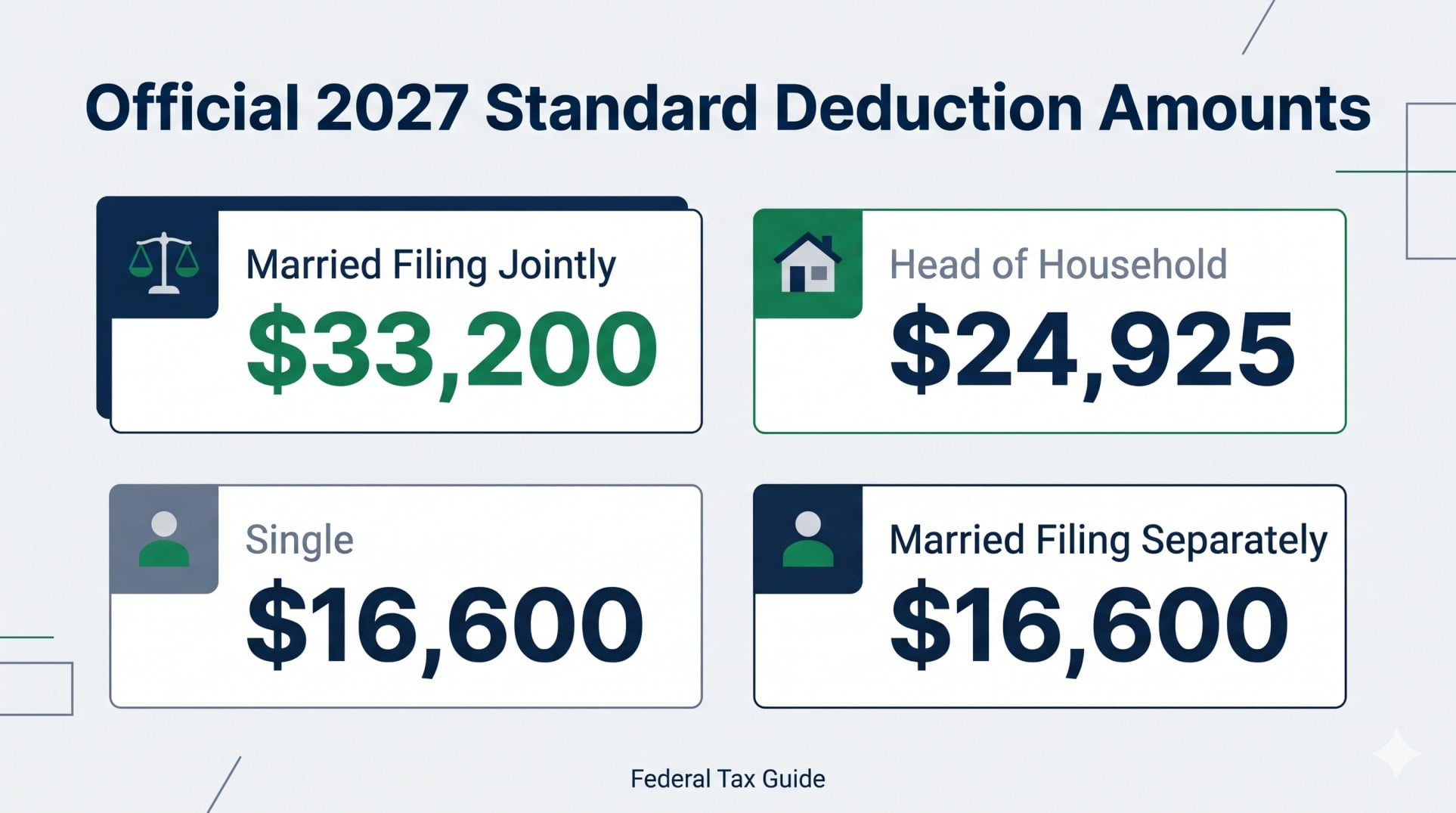
The official IRS standard deduction for 2027 is $33,200 for Married Filing Jointly and Qualifying Surviving Spouses, $24,925 for Head of Household, and $16,600 for Single and Married Filing Separately, according to IRS Revenue Procedure 2026-35 . Taxpayers who are age 65 or older or blind can claim an extra $1,700 per qualifying spouse on a married return or an extra $2,100 if unmarried .
These updated 2027 standard deduction amounts apply to income earned between January 1, 2027, and December 31, 2027, which you’ll report on the federal tax return due in April 2028. Following the permanent extension of the expanded standard deduction framework under Internal Revenue Code (IRC) Section 63(c)(2) by the One, Big, Beautiful Bill Act (Public Law 119-21), the IRS raised the 2027 baseline figures by roughly 3.1% over 2026 levels to keep pace with inflation.
⚡ Quick Numbers: 2027 Standard Deduction at a Glance
- 2027 Base Standard Deduction: $33,200 for Married Filing Jointly, $24,925 for Head of Household, and $16,600 for Single or Married Filing Separately under IRC Section 63(c)(2) .
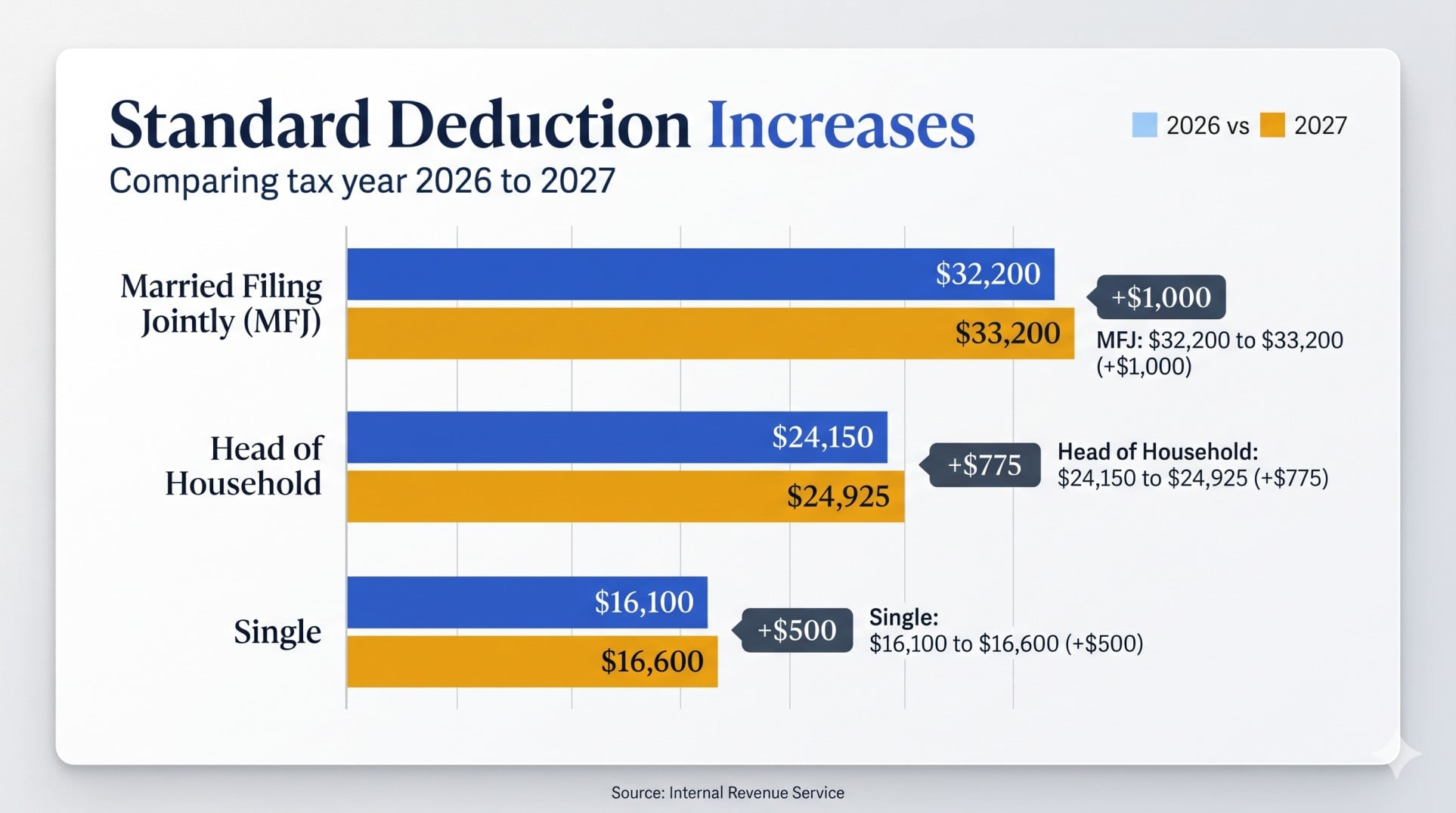
- 2026 vs. 2027 Dollar Increase: Up $1,000 for Married Filing Jointly (from $32,200), up $775 for Head of Household (from $24,150), and up $500 for Single/MFS (from $16,100).
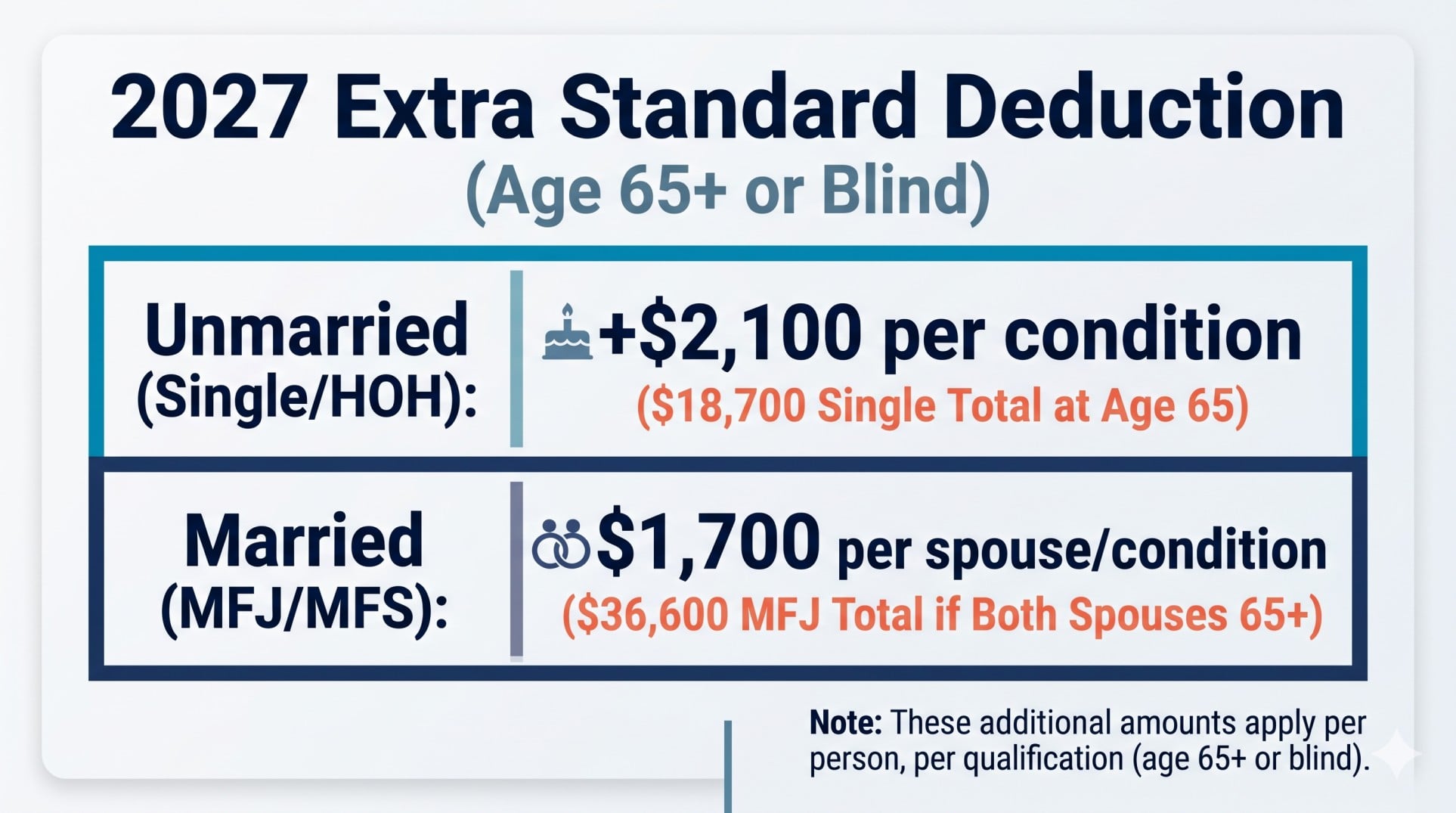
- Additional Senior (65+) or Blind Amount: Extra $1,700 per qualifying condition for married filers and $2,100 for unmarried filers under IRC Section 63(f) .
- 2027 Dependent Standard Deduction: Capped at the greater of $1,400 or the dependent’s earned income plus $500 (not to exceed the regular base standard deduction) on Form 1040, Line 12 .
Table of Contents
- Exact 2027 Standard Deduction Amounts by Filing Status
- 2026 vs. 2027 Standard Deduction Comparison: What Changed?
- Additional Standard Deduction for Seniors (65+), Blind & Dependents
- How the Standard Deduction Works & Real-World Tax Math Examples
- How to Claim the Standard Deduction on Form 1040
- Frequently Asked Questions
Exact 2027 Standard Deduction Amounts by Filing Status
Under Section 3.15(1) of IRS Revenue Procedure 2026-35, the base standard deduction for 2027 ranges from $16,600 to $33,200 depending on your filing status . This flat dollar amount automatically shields a major portion of your income from federal income tax without requiring receipts.
| Filing Status | Internal Revenue Code Reference | 2027 Standard Deduction Amount |
|---|---|---|
| Married Filing Jointly | IRC § 63(c)(2) & § 1(j)(2)(A) | $33,200 |
| Qualifying Surviving Spouse | IRC § 63(c)(2) & § 1(j)(2)(A) | $33,200 |
| Head of Household | IRC § 63(c)(2) & § 1(j)(2)(B) | $24,925 |
| Single (Unmarried Individuals) | IRC § 63(c)(2) & § 1(j)(2)(C) | $16,600 |
| Married Filing Separately | IRC § 63(c)(2) & § 1(j)(2)(D) | $16,600 |
The standard deduction is a “below-the-line” deduction that you subtract from your Adjusted Gross Income (AGI) to lower the taxable income exposed to the 2027 federal income tax brackets. Nearly 90% of U.S. households claim the standard deduction rather than itemizing on Schedule A because their combined mortgage interest, state and local taxes (SALT), and charitable donations fall below these thresholds.
2026 vs. 2027 Standard Deduction Comparison: What Changed?
Comparing IRS Revenue Procedure 2025-32 (for Tax Year 2026) against Revenue Procedure 2026-35 (for Tax Year 2027) shows that the IRS standard deduction for 2027 increased by $1,000 for joint filers, $775 for heads of household, and $500 for single filers. Every supplementary threshold for older, blind, and dependent taxpayers also stepped up by $50.
| Deduction Category / Filing Status | 2026 Amount (Rev. Proc. 2025-32) | 2027 Amount (Rev. Proc. 2026-35) | Year-over-Year Dollar Increase | Percentage Change |
|---|---|---|---|---|
| Married Filing Jointly & Surviving Spouses | $32,200 | $33,200 | +$1,000 | +3.11% |
| Head of Household | $24,150 | $24,925 | +$775 | +3.21% |
| Single Filers | $16,100 | $16,600 | +$500 | +3.11% |
| Married Filing Separately | $16,100 | $16,600 | +$500 | +3.11% |
| Additional 65+ or Blind (Married / Surviving Spouse) | $1,650 | $1,700 | +$50 | +3.03% |
| Additional 65+ or Blind (Unmarried / Single / HOH) | $2,050 | $2,100 | +$50 | +2.44% |
| Dependent Minimum Standard Deduction (§ 63(c)(5)) | $1,350 | $1,400 | +$50 | +3.70% |
| Dependent Earned Income Add-On (§ 63(c)(5)) | Earned Income + $450 | Earned Income + $500 | +$50 | +11.11% |
Additional Standard Deduction for Seniors (65+), Blind & Dependents
Under Section 3.15(3) of Revenue Procedure 2026-35 and IRC Section 63(f), the 2027 additional standard deduction over 65 or for blindness is $1,700 for married individuals and qualifying surviving spouses, or $2,100 for unmarried taxpayers . If you are both age 65 or older and legally blind, that extra amount doubles .
| Filing Status & Qualifying Condition(s) in 2027 | Base 2027 Deduction | Extra 65+ / Blind Amount | Total 2027 Standard Deduction |
|---|---|---|---|
| Single — Age 65+ OR Blind (1 Box Checked) | $16,600 | +$2,100 | $18,700 |
| Single — Age 65+ AND Blind (2 Boxes Checked) | $16,600 | +$4,200 | $20,800 |
| Head of Household — Age 65+ OR Blind (1 Box Checked) | $24,925 | +$2,100 | $27,025 |
| Head of Household — Age 65+ AND Blind (2 Boxes Checked) | $24,925 | +$4,200 | $29,125 |
| Married Filing Jointly — One Spouse 65+ OR Blind (1 Box) | $33,200 | +$1,700 | $34,900 |
| Married Filing Jointly — Both Spouses 65+ (2 Boxes Checked) | $33,200 | +$3,400 | $36,600 |
| Married Filing Jointly — Both 65+ & One Blind (3 Boxes) | $33,200 | +$5,100 | $38,300 |
| Married Filing Jointly — Both 65+ & Both Blind (4 Boxes) | $33,200 | +$6,800 | $40,000 |
| Married Filing Separately — Age 65+ OR Blind (1 Box) | $16,600 | +$1,700 | $18,300 |
To qualify for the age 65 addition for Tax Year 2027, you must be born on or before January 1, 1963 (the IRS treats individuals born on January 1 as having reached age 65 on December 31 of the prior year). To qualify for the blindness addition, you must have total vision loss or corrected visual acuity of no better than 20/200 in your better eye (or a field of vision of 20 degrees or less) as of December 31, 2027.
2027 Dependent Standard Deduction Rule (§ 63(c)(5))
If someone else (such as a parent) can claim you as a dependent on their 2027 tax return, you cannot automatically take the full $16,600 Single deduction. Under Section 3.15(2) of Revenue Procedure 2026-35, the 2027 dependent standard deduction cannot exceed the greater of :
- $1,400 (up from $1,350 in 2026) , OR
- The sum of $500 (up from $450 in 2026) plus the dependent’s 2027 earned income (up to the regular $16,600 Single standard deduction cap) .
How the Standard Deduction Works & Real-World Tax Math Examples
The standard deduction for 2027 reduces your Adjusted Gross Income (AGI) dollar-for-dollar before you calculate your tax bill. You can claim all of your “above-the-line” adjustments on Schedule 1 (Form 1040)—like traditional IRA contributions, 2027 HSA contribution limits, or up to $350 in educator classroom expenses—and still take the full below-the-line 2027 standard deduction amounts.
Important Exception — Who Cannot Take the Standard Deduction: Under IRC Section 63(c)(6), three main groups are barred from claiming the standard deduction and must itemize on Schedule A: (1) a Married Filing Separately taxpayer whose spouse itemizes deductions on their separate return, (2) a nonresident alien or dual-status alien during the year (with limited treaty exceptions for students/apprentices from India), and (3) an individual filing a short-year return due to a change in their annual accounting period.
Example 1: Married Senior Couple (Both Age 67) Earning $95,000 in 2027
Suppose Robert and Linda are both age 67 and file a joint return for 2027 with $95,000 in combined pension and taxable retirement income. Because both spouses are 65 or older, they start with the base Married Filing Jointly standard deduction of $33,200 and add $1,700 for Robert plus $1,700 for Linda ($3,400 total extra) .
Their total 2027 standard deduction is $36,600. Subtracting $36,600 from their $95,000 AGI leaves them with just $58,400 in taxable income—keeping their entire income inside the 10% (up to $25,600) and 12% (up to $104,050) tax brackets.
Example 2: College Student Claimed as a Dependent in 2027
Suppose Ethan is a 19-year-old college student claimed as a dependent on his parents’ 2027 return. During 2027, Ethan earns $6,200 from a summer W-2 job and receives $1,100 in taxable bank interest ($7,300 total gross income).
Under the 2027 dependent standard deduction formula, Ethan compares $1,400 against his earned income of $6,200 plus $500 (which equals $6,700) . Because $6,700 is greater than $1,400 and under the $16,600 Single cap, Ethan claims a $6,700 standard deduction , leaving only $600 of his income subject to the 10% federal tax rate (a $60 tax bill).
How to Claim the Standard Deduction on Form 1040
Claiming the IRS standard deduction for 2027 takes less than a minute on page 1 of IRS Form 1040 (or Form 1040-SR for seniors) when you file your return by April 17, 2028. Follow these four steps:
- Select Your Filing Status (Top of Page 1): Check the box for Single, Married Filing Jointly, Married Filing Separately, Head of Household, or Qualifying Surviving Spouse.
- Check the Age 65+ or Blindness Boxes: In the “Standard Deduction” section right above Line 1, check the applicable boxes if someone can claim you as a dependent, or if you (and your spouse, if filing jointly) were born before January 2, 1963, or are blind.
- Compare Against Schedule A Itemized Deductions: Add up your potential itemized deductions—medical expenses exceeding 7.5% of AGI, state and local taxes, home mortgage interest, and charitable gifts. If that sum is less than your $33,200 (MFJ), $24,925 (HOH), or $16,600 (Single/MFS) threshold , skip Schedule A.
- Enter Your Amount on Form 1040, Line 12: Write your exact 2027 standard deduction on Line 12, add any Qualified Business Income (QBI) deduction on Line 13, and subtract the combined total from your AGI (Line 11) to get your taxable income on Line 15 before applying refundable and non-refundable tax credits.
Keep in mind that these figures apply strictly to your federal IRS return. State income tax rules vary widely—some states conform to federal standard deduction amounts, while others set much lower state standard deductions or allow you to itemize on your state return even when taking the federal standard deduction.
Frequently Asked Questions
1. What is the standard deduction for 2027?
The standard deduction for 2027 is $33,200 for Married Filing Jointly and Qualifying Surviving Spouses, $24,925 for Head of Household, and $16,600 for Single and Married Filing Separately . These official figures were announced in Section 3.15 of IRS Revenue Procedure 2026-35 for Form 1040 returns filed in 2028 .
2. How much did the standard deduction increase from 2026 to 2027?
Between Revenue Procedure 2025-32 (for 2026) and Revenue Procedure 2026-35 (for 2027), the standard deduction rose by roughly 3.1%. Married Filing Jointly increased by $1,000 (from $32,200 to $33,200), Head of Household increased by $775 (from $24,150 to $24,925), and Single increased by $500 (from $16,100 to $16,600) .
3. What is the 2027 additional standard deduction over 65 or for blindness?
In 2027, taxpayers who are age 65 or older or blind receive an additional standard deduction of $1,700 per qualifying spouse on a married return or $2,100 if unmarried . A single senior age 65 claims $18,700 total, while a married couple where both spouses are 65 or older claims $36,600 total on Form 1040.
4. What is the 2027 standard deduction for a dependent?
Under IRC Section 63(c)(5), the 2027 dependent standard deduction is limited to the greater of $1,400 or the dependent’s earned income plus $500, up to the regular $16,600 Single deduction cap . For example, a dependent with no job gets a $1,400 deduction, while a dependent earning $5,000 gets a $5,500 deduction.
5. Can I take the 2027 standard deduction if my spouse itemizes on a separate return?
No, if you file as Married Filing Separately and your spouse itemizes deductions on Schedule A, IRC Section 63(c)(6)(A) reduces your standard deduction to $0. Both spouses must either itemize or both must take the $16,600 standard deduction on their separate Form 1040 returns.
Disclaimer: This content provides general information for educational purposes only and reflects federal tax laws applicable to Tax Year 2027 (returns filed in 2028). Tax laws are complex and subject to change. This article does not constitute professional tax, legal, or accounting advice. Always consult a certified public accountant (CPA), enrolled agent (EA), or qualified tax attorney regarding your specific financial situation. Ourtaxpartner.com is not responsible for any actions taken based on the information provided herein.
