
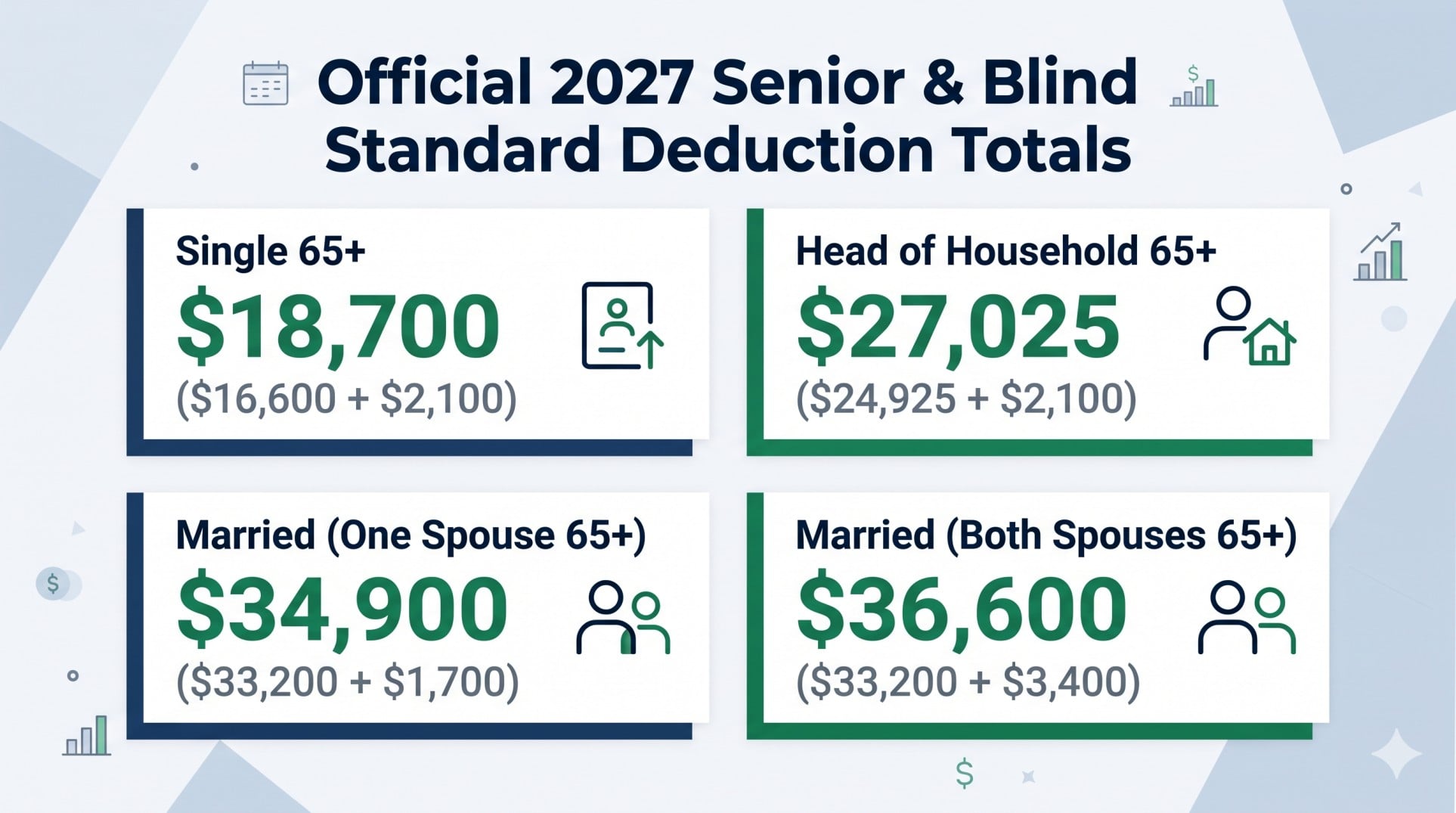
The official IRS 2027 standard deduction for Seniors adds an extra $1,700 per qualifying spouse for married filers and an extra $2,100 for unmarried single or Head of Household filers, according to Section 3.15(3) of IRS Revenue Procedure 2026-35. When combined with the base 2027 standard deduction, a Single senior age 65 or older claims $18,700 total, while a Married Filing Jointly couple where both spouses are 65 or older claims $36,600 total.
Taxpayers who are both age 65 or older and legally blind double their additional amount to $3,400 per married spouse or $4,200 if unmarried. These updated senior standard deduction 2027 figures apply to income earned between January 1, 2027, and December 31, 2027, for federal tax returns filed on Form 1040 or Form 1040-SR by April 17, 2028.
⚡ Quick Numbers: 2027 Senior (65+) & Blind Standard Deduction at a Glance
- Unmarried (Single / Head of Household) Extra Amount: $2,100 for age 65+ OR blind ($4,200 if both 65+ and blind) under IRC Section 63(f).
- Married (Joint / Separate / Surviving Spouse) Extra Amount: $1,700 per spouse for age 65+ OR blind ($3,400 if one spouse is both 65+ and blind, or if both spouses are 65+).
- 2027 Combined Retiree Totals: $18,700 for Single (65+), $27,025 for Head of Household (65+), $34,900 for Married Filing Jointly (one spouse 65+), and $36,600 for Married Filing Jointly (both spouses 65+).
- 2026 vs. 2027 Total Increase: Combined deduction rises by $550 for a Single senior (65+) and by $1,100 for a Married Filing Jointly couple where both spouses are 65+.
Table of Contents
Exact 2027 Standard Deduction for Seniors Over 65 & Blind Taxpayers
Under Internal Revenue Code (IRC) Section 63(c)(2) and Section 63(f), your total 2027 standard deduction for seniors or blind individuals equals your base filing status deduction plus $1,700 (married) or $2,100 (unmarried) for each qualifying age or vision condition. Below are separate tables for unmarried and married retirees showing the exact combined math from IRS Revenue Procedure 2026-35.
Table 1A: Unmarried Seniors & Blind Taxpayers (Single & Head of Household — 2027)
Unmarried individuals receive a $2,100 bonus deduction if they are age 65 or older OR blind, and $4,200 if they meet both conditions at the end of 2027.
| Filing Status & Qualifying Condition(s) | 2027 Base Standard Deduction | 2027 Extra 65+ / Blind Addition | Total 2027 Combined Standard Deduction |
|---|---|---|---|
| Single — Under 65 & Not Blind (Baseline) | $16,600 | $0 | $16,600 |
| Single — Age 65+ OR Blind (1 Condition) | $16,600 | +$2,100 | $18,700 |
| Single — Age 65+ AND Blind (Both Conditions) | $16,600 | +$4,200 | $20,800 |
| Head of Household — Under 65 & Not Blind (Baseline) | $24,925 | $0 | $24,925 |
| Head of Household — Age 65+ OR Blind (1 Condition) | $24,925 | +$2,100 | $27,025 |
| Head of Household — Age 65+ AND Blind (Both Conditions) | $24,925 | +$4,200 | $29,125 |
Table 1B: Married Seniors, Blind Taxpayers & Surviving Spouses (2027)
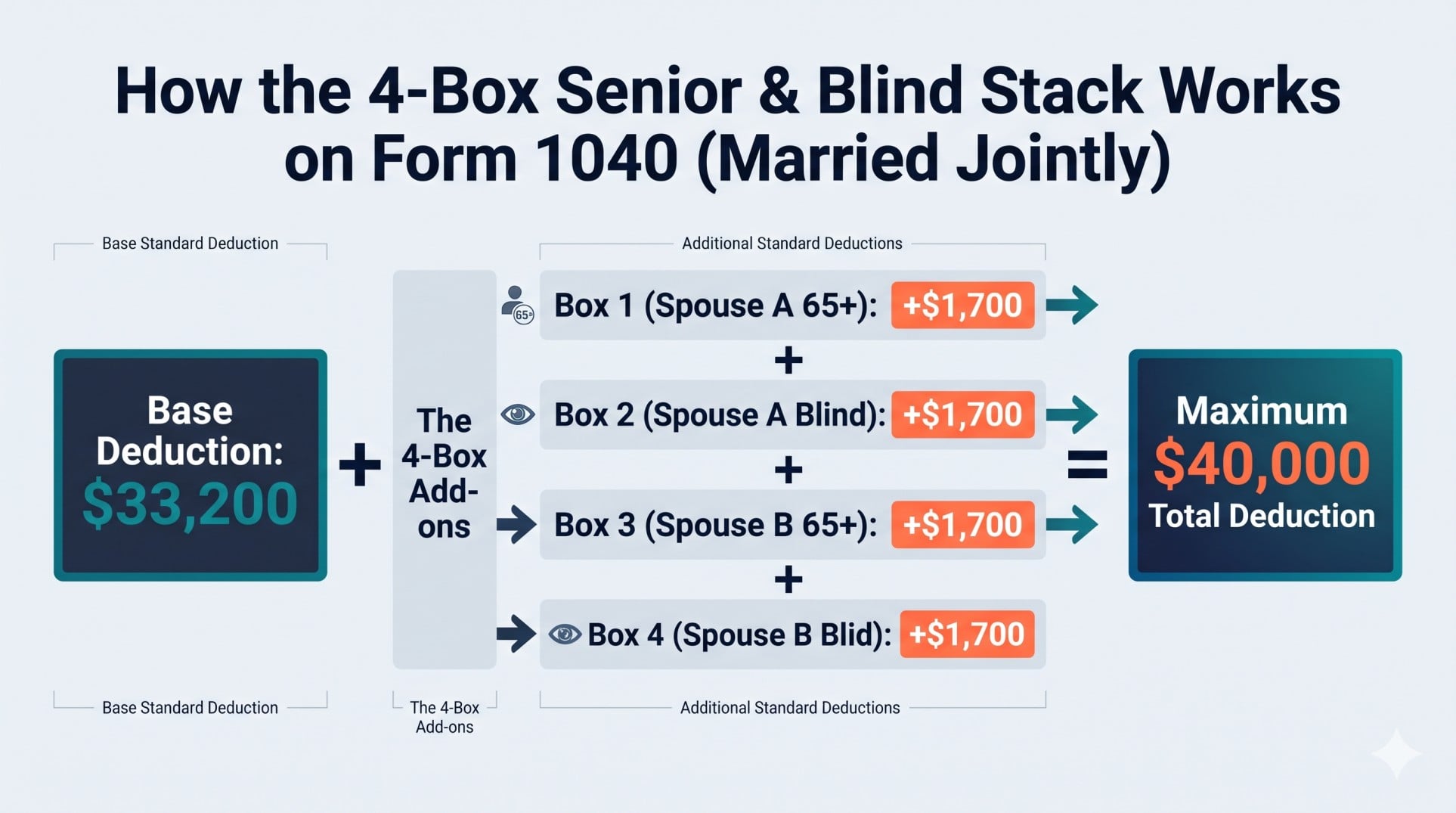
Married taxpayers and Qualifying Surviving Spouses add $1,700 per qualifying box checked on their return, stacking up to $6,800 in extra deductions if both spouses are 65 or older and both are legally blind.
| Filing Status & Qualifying Condition(s) | 2027 Base Standard Deduction | 2027 Extra 65+ / Blind Addition | Total 2027 Combined Standard Deduction |
|---|---|---|---|
| Married Filing Jointly — Neither 65+ Nor Blind (Baseline) | $33,200 | $0 | $33,200 |
| Married Filing Jointly — One Spouse 65+ OR Blind (1 Box) | $33,200 | +$1,700 | $34,900 |
| Married Filing Jointly — Both Spouses 65+ (2 Boxes) | $33,200 | +$3,400 | $36,600 |
| Married Filing Jointly — One Spouse Both 65+ AND Blind (2 Boxes) | $33,200 | +$3,400 | $36,600 |
| Married Filing Jointly — Both 65+ & One Spouse Blind (3 Boxes) | $33,200 | +$5,100 | $38,300 |
| Married Filing Jointly — Both Spouses 65+ AND Both Blind (4 Boxes) | $33,200 | +$6,800 | $40,000 |
| Qualifying Surviving Spouse — Age 65+ OR Blind (1 Box) | $33,200 | +$1,700 | $34,900 |
| Qualifying Surviving Spouse — Age 65+ AND Blind (2 Boxes) | $33,200 | +$3,400 | $36,600 |
| Married Filing Separately — Age 65+ OR Blind (1 Box) | $16,600 | +$1,700 | $18,300 |
| Married Filing Separately — Age 65+ AND Blind (2 Boxes) | $16,600 | +$3,400 | $20,000 |
Like the regular 2027 standard deduction, the extra age and blindness allowance is a “below-the-line” deduction subtracted from your Adjusted Gross Income (AGI) to reduce the taxable income exposed to the 2027 federal income tax brackets.
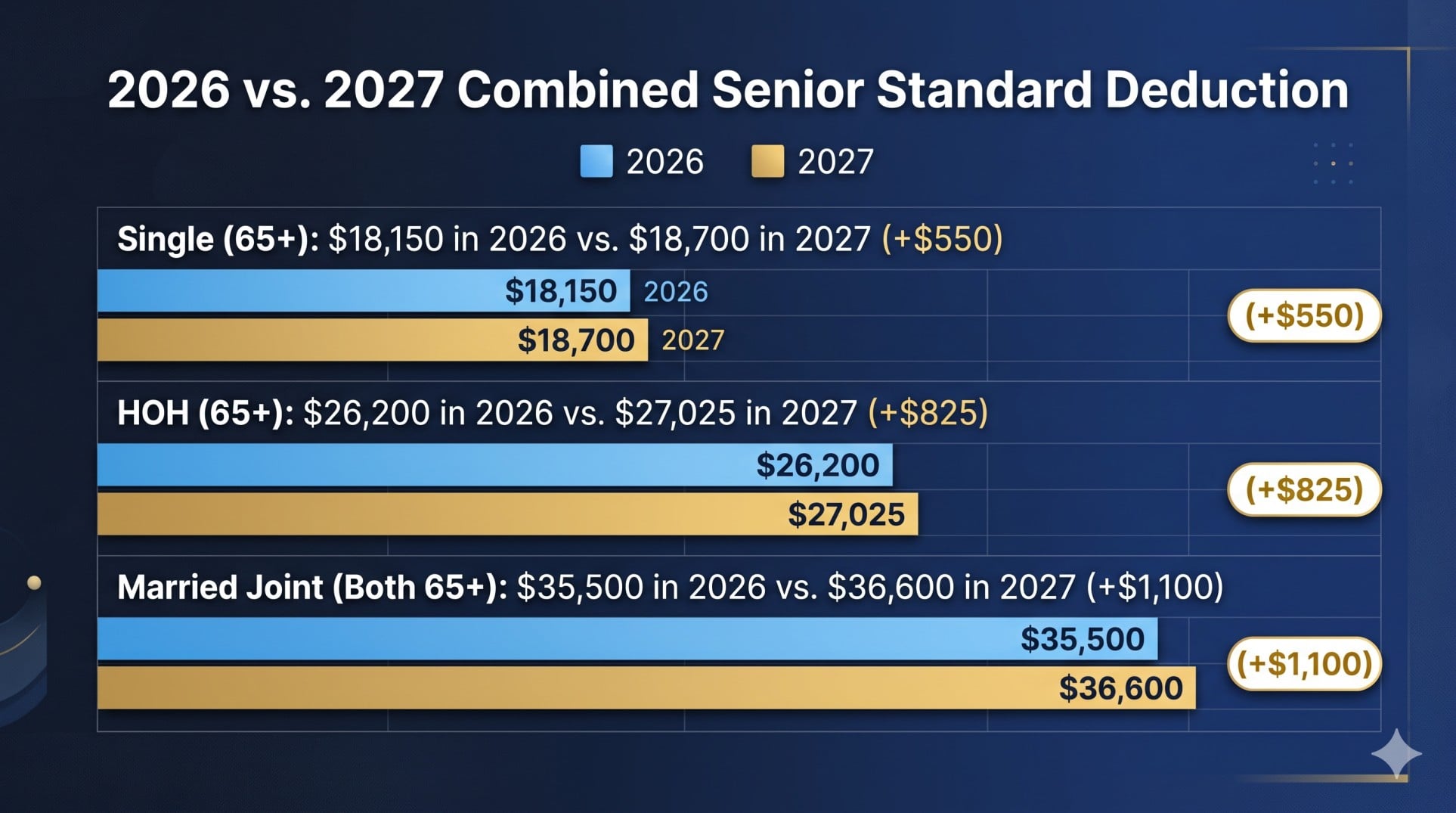
2026 vs. 2027 Senior Standard Deduction Comparison: What Changed?
Comparing IRS Revenue Procedure 2025-32 (for 2026) against Revenue Procedure 2026-35 (for 2027) shows that the standard deduction for 2027 over 65 rose by $50 per qualifying box—from $1,650 to $1,700 for married filers and from $2,050 to $2,100 for unmarried filers. When stacked on top of the 2027 base deduction increases, married senior couples gain up to $1,100 in extra tax-free income.
| Senior / Blind Tax Scenario | 2026 Amount (Rev. Proc. 2025-32) | 2027 Amount (Rev. Proc. 2026-35) | Year-over-Year Dollar Increase | Percentage Increase |
|---|---|---|---|---|
| Extra Per-Box Amount — Married / Surviving Spouse | $1,650 | $1,700 | +$50 | +3.03% |
| Extra Per-Box Amount — Unmarried (Single / HOH) | $2,050 | $2,100 | +$50 | +2.44% |
| Combined Single — Age 65+ OR Blind (1 Box) | $18,150 | $18,700 | +$550 | +3.03% |
| Combined Single — Age 65+ AND Blind (2 Boxes) | $20,200 | $20,800 | +$600 | +2.97% |
| Combined Head of Household — Age 65+ OR Blind (1 Box) | $26,200 | $27,025 | +$825 | +3.15% |
| Combined Head of Household — Age 65+ AND Blind (2 Boxes) | $28,250 | $29,125 | +$875 | +3.10% |
| Combined Married Joint — One Spouse 65+ (1 Box) | $33,850 | $34,900 | +$1,050 | +3.10% |
| Combined Married Joint — Both Spouses 65+ (2 Boxes) | $35,500 | $36,600 | +$1,100 | +3.10% |
| Combined Married Joint — Both 65+ & Both Blind (4 Boxes) | $38,800 | $40,000 | +$1,200 | +3.09% |
How the 65+ & Blindness Rules Work + Retiree Tax Math Examples
To claim the 2027 IRS standard deduction for retirees or blind taxpayers under IRC Section 63(f), you must meet specific IRS birthday or vision definitions by the final day of the tax year. Unlike income-tested tax credits, the regular Section 63(f) age and blindness additions have zero income phase-outs—you receive the full $1,700 or $2,100 per box regardless of how high your retirement income is.
- The January 1 Birthday Rule for Age 65: You qualify for the senior standard deduction in 2027 if you turn 65 on or before January 1, 2028 (meaning you were born on or before January 1, 1963). Under federal tax law, the IRS considers you to have reached age 65 on the day before your actual birthday.
- Deceased Spouse Rule: If your spouse was age 65 or older (or blind) and passed away during 2027 before remarriage, you can still claim their $1,700 (or $3,400) extra deduction on your 2027 joint return. However, if your spouse passed away in 2027 at age 64—even if they would have turned 65 later in the year—they do not qualify for the age addition.
- Legal Blindness Definition: To claim the additional standard deduction for blind in 2027, you must be completely blind as of December 31, 2027, or have a statement from an eye doctor (ophthalmologist or optometrist) certifying that central visual acuity in your better eye does not exceed 20/200 with corrective lenses, or that your field of vision is 20 degrees or less.
- Elderly or Blind Dependents: If an elderly parent or blind child is claimed as a dependent on someone else’s return, their 2027 base deduction is capped at the greater of $1,400 or their earned income plus $500 (up to $16,600), plus they still get to add their full $1,700 (married) or $2,100 (unmarried) age 65+ or blindness addition on top.
CPA Note on the Temporary OBBBA $6,000 Senior Bonus Deduction: Under the One, Big, Beautiful Bill Act (Public Law 119-21), taxpayers age 65 and older may also qualify for a separate, temporary $6,000 per-person senior deduction ($12,000 if both spouses are 65+) available for Tax Years 2025 through 2028. Unlike the permanent IRC Section 63(f) addition of $1,700 or $2,100 covered in the tables above—which has no income cap—the temporary $6,000 bonus begins phasing out once Modified Adjusted Gross Income (MAGI) exceeds $75,000 for Single filers or $150,000 for Married Filing Jointly.
Example 1: Retired Married Couple (Both Age 68) With $88,000 Income in 2027
Suppose Arthur and Evelyn are both 68 years old and file a joint 2027 return with $88,000 in taxable 401(k) withdrawals, pensions, and taxable Social Security benefits. Neither spouse is blind, and they take the standard deduction rather than itemizing on Schedule A.
- Base 2027 Married Filing Jointly Deduction: $33,200.
- Arthur’s Age 65+ Addition: +$1,700.
- Evelyn’s Age 65+ Addition: +$1,700.
- Total Section 63 Standard Deduction: $36,600 (up from $35,500 in 2026).
Subtracting their $36,600 combined standard deduction from $88,000 reduces their taxable income to $51,400. Using the 2027 Married Filing Jointly brackets, they pay 10% on the first $25,600 ($2,560.00) and 12% on the remaining $25,800 ($3,096.00), resulting in a base tax of just $5,656.00 before any senior tax credits or temporary OBBBA deductions.
Example 2: Single Taxpayer Age 70 Who Is Also Legally Blind
Suppose Clara is a 70-year-old Single retiree with $50,000 in AGI from a corporate pension and 2027 Required Minimum Distributions (RMDs), and she has a certified vision impairment meeting the IRS blindness definition. She checks both the “Born before January 2, 1963” box and the “Blind” box on Form 1040-SR.
- Base 2027 Single Deduction: $16,600.
- Age 65+ Addition: +$2,100.
- Blindness Addition: +$2,100.
- Total Section 63 Standard Deduction: $20,800 (up from $20,200 in 2026).
Subtracting $20,800 from her $50,000 AGI leaves Clara with $29,200 in taxable income. She pays 10% on the first $12,800 ($1,280.00) and 12% on the next $16,400 ($1,968.00), for a federal tax bill of $3,248.00—saving $504.00 in actual taxes solely from her two $2,100 additions in the 12% bracket.
How to Claim the Extra Deduction on Form 1040-SR or Form 1040
You claim the 2027 standard deduction for seniors and blind individuals directly on page 1 of Form 1040 or Form 1040-SR (the U.S. Tax Return for Seniors, which features larger print and a built-in standard deduction chart). Follow these four steps when preparing your return in early 2028:
- Check the Age and Blindness Boxes on Page 1: Locate the “Standard Deduction” checkbox section right above Line 1. Check “You: Were born before January 2, 1963” and/or “Are blind.” If filing jointly, check the matching boxes for your spouse if they also qualify.
- Verify You Aren’t Itemizing on Schedule A: Only claim the standard deduction if your combined 2027 deduction (such as $18,700 Single 65+ or $36,600 Married Joint both 65+) is higher than your itemized medical expenses (above 7.5% of AGI), state and local taxes, mortgage interest, and charity on Schedule A.
- Use the Standard Deduction Chart for People Who Were Born Before January 2, 1963, or Were Blind: Count the total number of age/blindness boxes you checked (from 1 to 4) and match that number to your filing status chart on the last page of Form 1040-SR (or in the Form 1040 instructions, which mirrors Tables 1A and 1B above).
- Enter the Combined Total on Line 12: Write your full combined deduction on Form 1040, Line 12, subtract it from your AGI on Line 11, and report your reduced taxable income on Line 15. Do not attach your eye doctor’s blindness certification letter to your return; simply keep it with your tax records in case of an IRS inquiry.
Remember that these IRC Section 63(f) amounts apply strictly to your federal IRS return. Many states offer separate senior property tax freezes, pension exclusions, or state-level age 65 exemptions that follow different age cutoffs and income limits.
Frequently Asked Questions
1. What is the standard deduction for 2027 over 65?
The standard deduction for 2027 over 65 adds $2,100 for unmarried filers and $1,700 per qualifying spouse for married filers on top of the base deduction. Under IRS Revenue Procedure 2026-35, that brings the total 2027 deduction to $18,700 for Single seniors, $27,025 for Head of Household seniors, $34,900 for Married Filing Jointly with one spouse 65+, and $36,600 when both spouses are 65+.
2. How much did the senior standard deduction increase from 2026 to 2027?
Between Revenue Procedure 2025-32 (for 2026) and Revenue Procedure 2026-35 (for 2027), the extra age 65+ or blindness amount increased by $50 per box (from $1,650 to $1,700 for married filers and from $2,050 to $2,100 for unmarried filers). Combined with base deduction increases, a Single senior gets $550 more in 2027 and a Married Filing Jointly couple (both 65+) gets $1,100 more.
3. What is the additional standard deduction for blind taxpayers in 2027?
The additional standard deduction for blind in 2027 is $2,100 for Single or Head of Household filers and $1,700 for Married Filing Jointly, Married Filing Separately, or Qualifying Surviving Spouse filers. If a taxpayer is both age 65 or older and legally blind, they claim both additions for an extra $4,200 (unmarried) or $3,400 (married) on Form 1040.
4. What birthdate qualifies for the 2027 over-65 standard deduction?
You must be born on or before January 1, 1963, to claim the over-65 standard deduction for Tax Year 2027. Because the IRS treats you as turning 65 on the day before your birthday, anyone whose 65th birthday falls on January 1, 2028, legally qualifies for Tax Year 2027.
5. Can I claim the extra $1,700 or $2,100 senior deduction if I itemize on Schedule A?
No, the IRC Section 63(f) age 65+ and blindness additions of $1,700 and $2,100 only apply if you take the standard deduction on Form 1040, Line 12. If your itemized deductions on Schedule A exceed your combined senior standard deduction (such as $36,600 for a married couple both 65+), you will itemize instead of taking the standard deduction.
Disclaimer: This content provides general information for educational purposes only and reflects federal tax laws applicable to Tax Year 2027 (returns filed in 2028). Tax laws are complex and subject to change. This article does not constitute professional tax, legal, or accounting advice. Always consult a certified public accountant (CPA), enrolled agent (EA), or qualified tax attorney regarding your specific financial situation. Ourtaxpartner.com is not responsible for any actions taken based on the information provided herein.
