
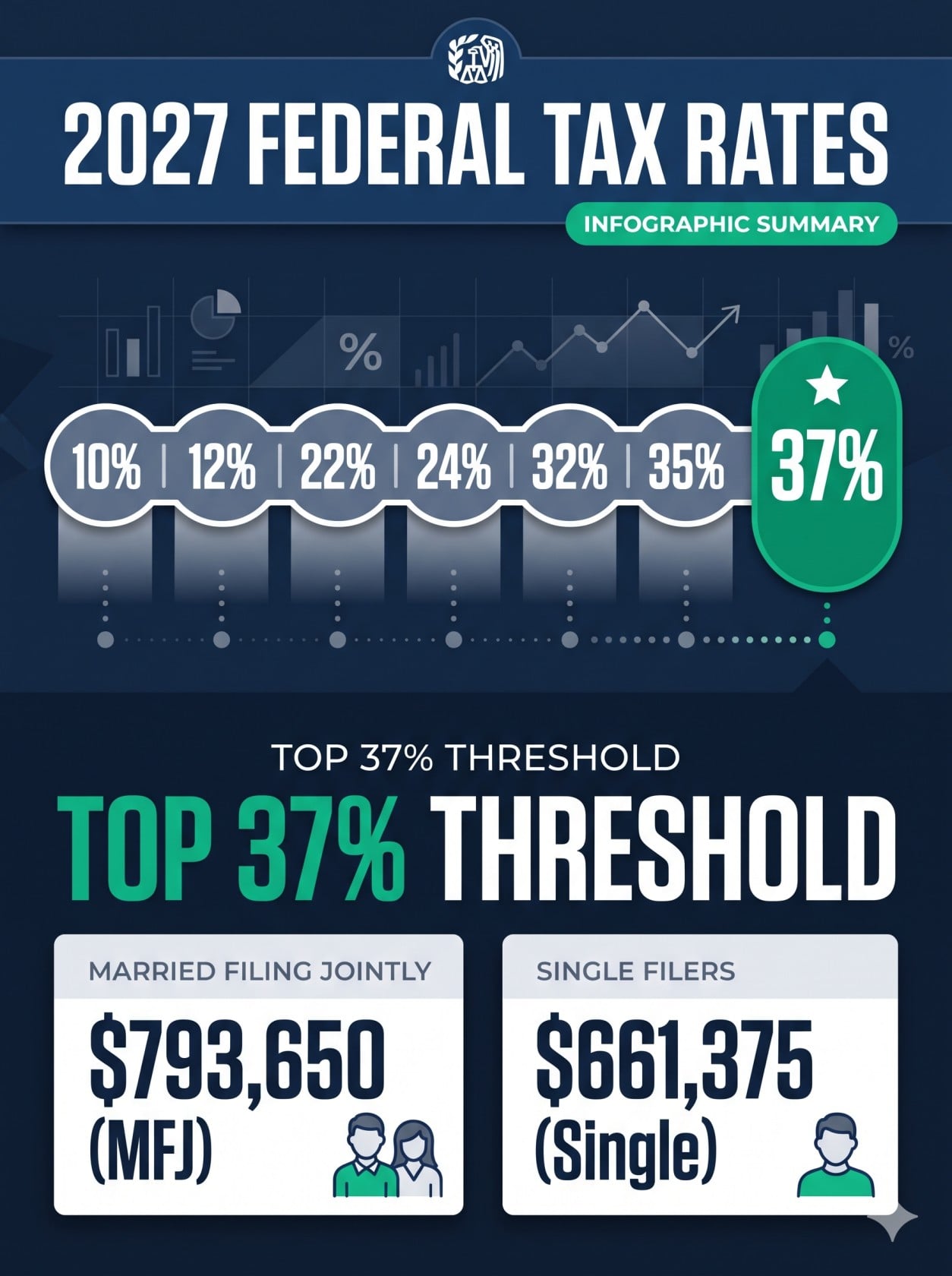
The IRS officially released the 2027 tax brackets in Revenue Procedure 2026-35, keeping the seven federal marginal rates at 10%, 12%, 22%, 24%, 32%, 35%, and 37%. For Tax Year 2027, the entry 10% rate covers taxable income up to $25,600 for Married Filing Jointly ($12,800 for Single filers and $18,250 for Head of Household), while the top 37% rate starts over $793,650 for joint filers and $661,375 for single filers.
These updated federal tax brackets for 2027 apply to income earned between January 1, 2027, and December 31, 2027, for tax returns due in April 2028. Because the One, Big, Beautiful Bill Act (Public Law 119-21) permanently extended the seven-tier rate structure under Internal Revenue Code (IRC) Section 1(j), the IRS expanded every bracket threshold by roughly 3.2% over 2026 levels to protect taxpayers from inflation-driven bracket creep.
⚡ Quick Numbers: 2027 Federal Income Tax Brackets at a Glance
- Seven Marginal Tax Rates: The 2027 tax rates remain 10%, 12%, 22%, 24%, 32%, 35%, and 37% under IRC Section 1(j)(2).
- 10% Entry Bracket Ceilings: Applies to the first $25,600 of taxable income for Married Filing Jointly (up $800 from 2026), $18,250 for Head of Household (up $550), and $12,800 for Single or Married Filing Separately (up $400).
- 37% Top Bracket Thresholds: Applies to taxable income over $793,650 for Married Filing Jointly, $661,375 for Single, $661,350 for Head of Household, and $396,825 for Married Filing Separately.
- 2027 Standard Deduction: Rises to $33,200 for Married Filing Jointly, $24,925 for Head of Household, and $16,600 for Single and Married Filing Separately on Form 1040.
Table of Contents
Exact 2027 Tax Brackets by Filing Status (Separate Tables)
The 2027 federal income tax brackets divide your taxable income into seven progressive tiers from 10% to 37% based on your filing status. Below are separate, easy-to-read tables for each filing status showing your exact income thresholds and the official IRS base-tax computation formula from Revenue Procedure 2026-35.
1. Married Filing Jointly & Qualifying Surviving Spouses (2027)
Married couples filing a joint return and qualifying surviving spouses receive the widest bracket thresholds under IRC Section 1(j)(2)(A), with the 10% bracket covering up to $25,600 of taxable income.
| 2027 Tax Rate | Married Filing Jointly Taxable Income Bracket | Official IRS 2027 Tax Computation Formula |
|---|---|---|
| 10% | $0 to $25,600 | 10% of taxable income |
| 12% | Over $25,600 to $104,050 | $2,560.00 plus 12% of the excess over $25,600 |
| 22% | Over $104,050 to $218,250 | $11,974.00 plus 22% of the excess over $104,050 |
| 24% | Over $218,250 to $416,650 | $37,098.00 plus 24% of the excess over $218,250 |
| 32% | Over $416,650 to $529,100 | $84,714.00 plus 32% of the excess over $416,650 |
| 35% | Over $529,100 to $793,650 | $120,698.00 plus 35% of the excess over $529,100 |
| 37% | Over $793,650 | $213,290.50 plus 37% of the excess over $793,650 |
2. Single Filers / Unmarried Individuals (2027)
For Single taxpayers under IRC Section 1(j)(2)(C), the first five brackets are exactly half the width of the Married Filing Jointly brackets, while the 35% tier extends up to $661,375.
| 2027 Tax Rate | Single Filer Taxable Income Bracket | Official IRS 2027 Tax Computation Formula |
|---|---|---|
| 10% | $0 to $12,800 | 10% of taxable income |
| 12% | Over $12,800 to $52,025 | $1,280.00 plus 12% of the excess over $12,800 |
| 22% | Over $52,025 to $109,125 | $5,987.00 plus 22% of the excess over $52,025 |
| 24% | Over $109,125 to $208,325 | $18,549.00 plus 24% of the excess over $109,125 |
| 32% | Over $208,325 to $264,550 | $42,357.00 plus 32% of the excess over $208,325 |
| 35% | Over $264,550 to $661,375 | $60,349.00 plus 35% of the excess over $264,550 |
| 37% | Over $661,375 | $199,237.75 plus 37% of the excess over $661,375 |
3. Head of Household Filers (2027)
Unmarried taxpayers supporting a qualifying child or dependent under IRC Section 1(j)(2)(B) get wider 10% and 12% brackets than Single filers, keeping more income taxed at 12% or less up to $69,650.
| 2027 Tax Rate | Head of Household Taxable Income Bracket | Official IRS 2027 Tax Computation Formula |
|---|---|---|
| 10% | $0 to $18,250 | 10% of taxable income |
| 12% | Over $18,250 to $69,650 | $1,825.00 plus 12% of the excess over $18,250 |
| 22% | Over $69,650 to $109,100 | $7,993.00 plus 22% of the excess over $69,650 |
| 24% | Over $109,100 to $208,300 | $16,672.00 plus 24% of the excess over $109,100 |
| 32% | Over $208,300 to $264,550 | $40,480.00 plus 32% of the excess over $208,300 |
| 35% | Over $264,550 to $661,350 | $58,480.00 plus 35% of the excess over $264,550 |
| 37% | Over $661,350 | $197,360.00 plus 37% of the excess over $661,350 |
4. Married Filing Separately (2027)
Married individuals filing separate returns under IRC Section 1(j)(2)(D) match Single filers through the 32% bracket, but hit the top 37% tax rate at $396,825 (exactly half of the Married Filing Jointly threshold).
| 2027 Tax Rate | Married Filing Separately Taxable Income Bracket | Official IRS 2027 Tax Computation Formula |
|---|---|---|
| 10% | $0 to $12,800 | 10% of taxable income |
| 12% | Over $12,800 to $52,025 | $1,280.00 plus 12% of the excess over $12,800 |
| 22% | Over $52,025 to $109,125 | $5,987.00 plus 22% of the excess over $52,025 |
| 24% | Over $109,125 to $208,325 | $18,549.00 plus 24% of the excess over $109,125 |
| 32% | Over $208,325 to $264,550 | $42,357.00 plus 32% of the excess over $208,325 |
| 35% | Over $264,550 to $396,825 | $60,349.00 plus 35% of the excess over $264,550 |
| 37% | Over $396,825 | $106,645.25 plus 37% of the excess over $396,825 |
Non-grantor estates and trusts follow a separate four-bracket schedule under IRC Section 1(j)(2)(E): 10% on taxable income up to $3,400; $340.00 plus 24% on income over $3,400 to $12,100; $2,428.00 plus 35% on income over $12,100 to $16,500; and $3,968.00 plus 37% on taxable income over $16,500.
2026 vs. 2027 Tax Brackets Comparison: What Changed?
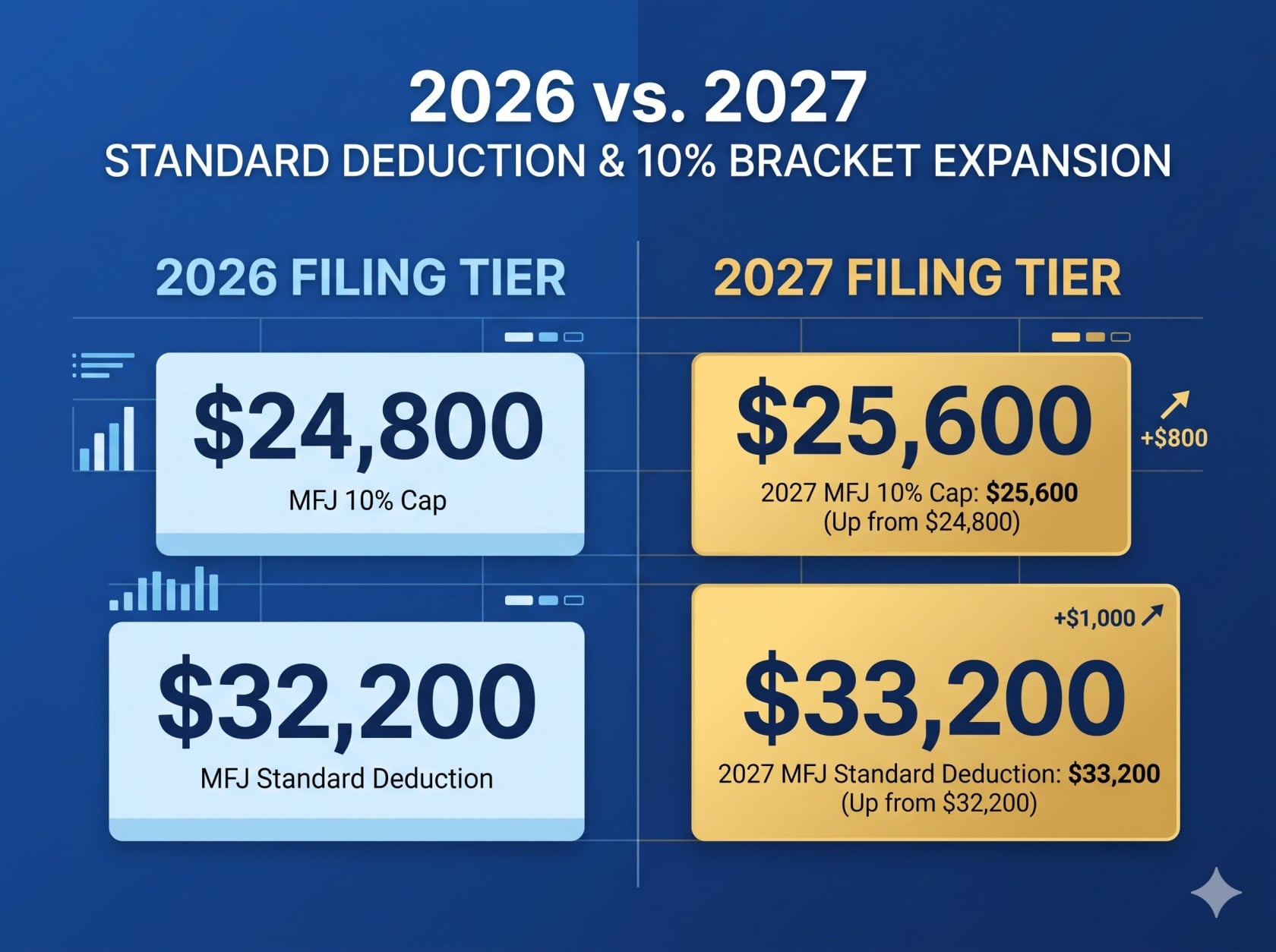
Comparing the 2026 figures in IRS Revenue Procedure 2025-32 against the 2027 tax brackets in Revenue Procedure 2026-35 shows an inflation expansion of roughly 3.2% across every tier. For Married Filing Jointly, the 10% ceiling rises by $800, while the 37% threshold jumps by $24,950.
| Filing Status & Rate | 2026 Taxable Income Threshold (Rev. Proc. 2025-32) | 2027 Taxable Income Threshold (Rev. Proc. 2026-35) | Year-over-Year Ceiling / Start Increase |
|---|---|---|---|
| MFJ — 10% | Up to $24,800 | Up to $25,600 | +$800 |
| MFJ — 12% | Over $24,800 to $100,800 | Over $25,600 to $104,050 | +$3,250 (ceiling) |
| MFJ — 22% | Over $100,800 to $211,400 | Over $104,050 to $218,250 | +$6,850 (ceiling) |
| MFJ — 24% | Over $211,400 to $403,550 | Over $218,250 to $416,650 | +$13,100 (ceiling) |
| MFJ — 32% | Over $403,550 to $512,450 | Over $416,650 to $529,100 | +$16,650 (ceiling) |
| MFJ — 35% | Over $512,450 to $768,700 | Over $529,100 to $793,650 | +$24,950 (ceiling) |
| MFJ — 37% | Over $768,700 | Over $793,650 | +$24,950 (start) |
| Single — 10% | Up to $12,400 | Up to $12,800 | +$400 |
| Single — 12% | Over $12,400 to $50,400 | Over $12,800 to $52,025 | +$1,625 (ceiling) |
| Single — 22% | Over $50,400 to $105,700 | Over $52,025 to $109,125 | +$3,425 (ceiling) |
| Single — 24% | Over $105,700 to $201,775 | Over $109,125 to $208,325 | +$6,550 (ceiling) |
| Single — 32% | Over $201,775 to $256,225 | Over $208,325 to $264,550 | +$8,325 (ceiling) |
| Single — 35% | Over $256,225 to $640,600 | Over $264,550 to $661,375 | +$20,775 (ceiling) |
| Single — 37% | Over $640,600 | Over $661,375 | +$20,775 (start) |
| HOH — 10% | Up to $17,700 | Up to $18,250 | +$550 |
| HOH — 12% | Over $17,700 to $67,450 | Over $18,250 to $69,650 | +$2,200 (ceiling) |
| HOH — 22% | Over $67,450 to $105,700 | Over $69,650 to $109,100 | +$3,400 (ceiling) |
| HOH — 24% | Over $105,700 to $201,750 | Over $109,100 to $208,300 | +$6,550 (ceiling) |
| HOH — 32% | Over $201,750 to $256,200 | Over $208,300 to $264,550 | +$8,350 (ceiling) |
| HOH — 35% | Over $256,200 to $640,600 | Over $264,550 to $661,350 | +$20,750 (ceiling) |
| HOH — 37% | Over $640,600 | Over $661,350 | +$20,750 (start) |
Alongside the wider IRS 2027 tax brackets, the standard deduction under IRC Section 63(c)(2) also grew from 2026 to 2027: Married Filing Jointly increased by $1,000 (from $32,200 in 2026 to $33,200 in 2027), Head of Household increased by $775 (from $24,150 to $24,925), and Single or Married Filing Separately increased by $500 (from $16,100 to $16,600).
How the 2027 Tax Brackets Work & Real-World Examples
The United States uses a progressive marginal tax system, meaning your highest tax rate only applies to the portion of your taxable income above that bracket’s starting threshold. Earning an extra dollar that pushes you into the next tier of the federal tax brackets for 2027 never raises the tax rate on money you earned in the lower brackets.
Every threshold in the tables above applies to taxable income, which you calculate by reducing your gross income in two steps:
- Above-the-Line Adjustments: You first subtract adjustments on Schedule 1 (Form 1040)—such as traditional IRA contributions, Health Savings Account (HSA) contributions, student loan interest, or up to $350 in educator classroom expenses—to find your Adjusted Gross Income (AGI).
- Below-the-Line Deductions: From your AGI, you subtract either your itemized deductions on Schedule A or the 2027 standard deduction ($33,200 for Married Filing Jointly, $24,925 for Head of Household, or $16,600 for Single and Married Filing Separately). Taxpayers age 65 or older or blind also receive an additional standard deduction in 2027 of $1,700 per qualifying spouse (up from $1,650 in 2026) or $2,100 if unmarried (up from $2,050 in 2026).
CPA Tax Tip: Long-term capital gains and qualified dividends use separate, lower brackets under IRC Section 1(j)(5). In 2027, you pay a 0% federal tax rate on long-term capital gains if your taxable income is up to $102,100 for Married Filing Jointly (up from $98,900 in 2026), $68,350 for Head of Household (up from $66,200), or $51,050 for Single filers (up from $49,450). Above those thresholds, the 15% rate applies up to $633,600 for joint filers ($564,650 for Single and $599,100 for Head of Household) before the top 20% capital gains rate begins. Check our full guide to 2027 capital gains tax rates for more details.
Example 1: Single Filer Earning $85,000 in 2027
Suppose Maya is a Single filer with $85,000 in W-2 wages during 2027 and takes the Single standard deduction of $16,600. Subtracting $16,600 from $85,000 leaves her with $68,400 in taxable income, placing her top dollars in the 22% bracket.
- 10% Bracket ($0 to $12,800): She pays 10% on her first $12,800 = $1,280.00.
- 12% Bracket ($12,800 to $52,025): She pays 12% on the next $39,225 ($52,025 minus $12,800) = $4,707.00.
- 22% Bracket (Over $52,025): She pays 22% only on the remaining $16,375 ($68,400 minus $52,025) = $3,602.50.
Adding the three tiers together (or using the Single formula of $5,987.00 plus 22% over $52,025), Maya’s 2027 federal income tax before tax credits is $9,589.50. Although her marginal tax rate is 22%, her effective tax rate on her $85,000 gross salary is just 11.28%.
Example 2: Married Couple Filing Jointly Earning $153,200 in 2027
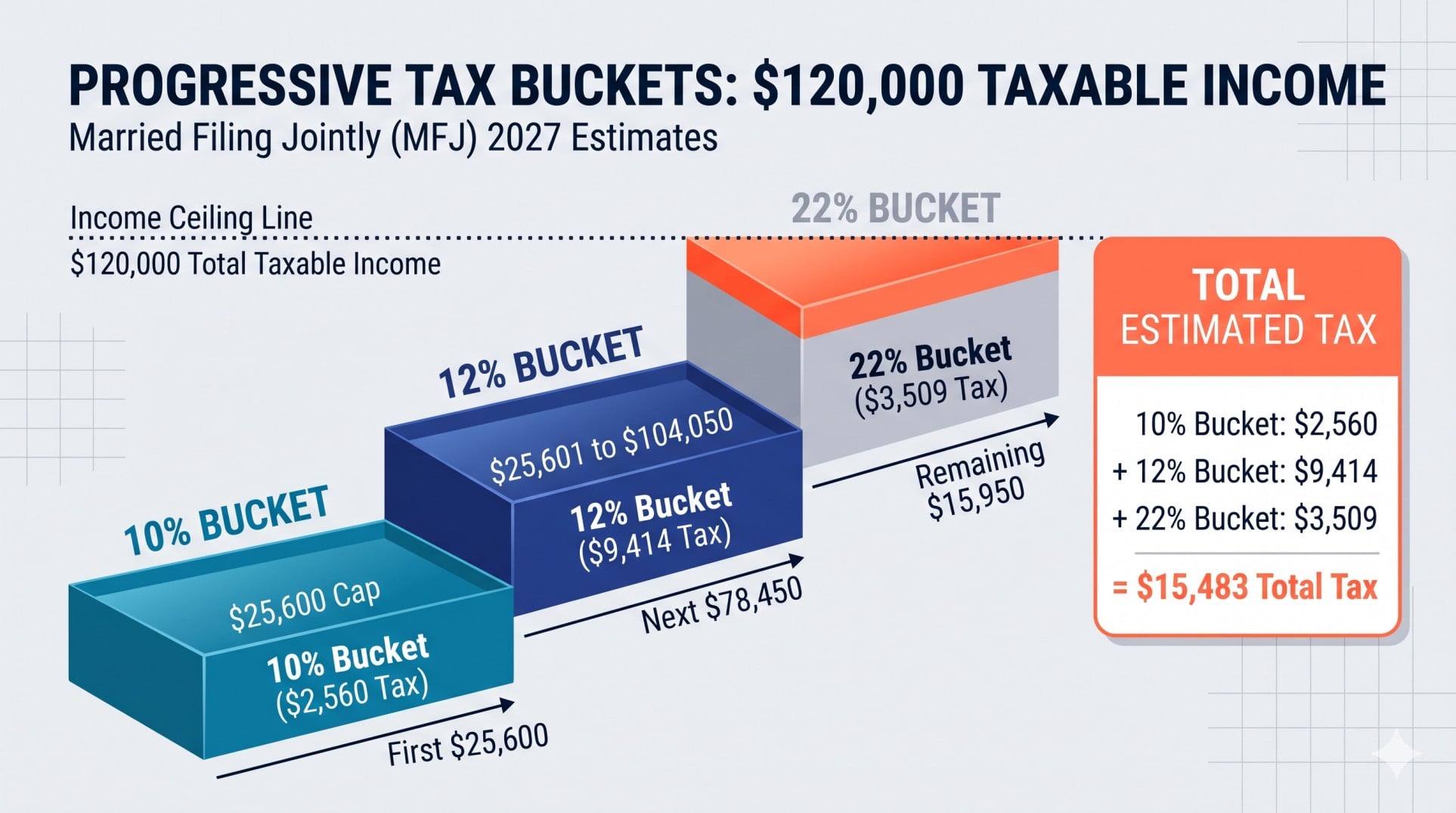
Suppose Marcus and Elena file a joint return with $153,200 in combined AGI in 2027. After subtracting their $33,200 Married Filing Jointly standard deduction, their taxable income is exactly $120,000.
- 10% Bracket ($0 to $25,600): 10% on the first $25,600 = $2,560.00.
- 12% Bracket ($25,600 to $104,050): 12% on the next $78,450 = $9,414.00.
- 22% Bracket (Over $104,050): 22% on the remaining $15,950 ($120,000 minus $104,050) = $3,509.00.
Their total 2027 tax under the 2027 tax rates is $15,483.00, which equals an effective federal tax rate of 10.11% on their total income.
How to Calculate and Report Your Tax on Form 1040
You apply the 2027 federal income tax brackets on page 1 and page 2 of IRS Form 1040 when you file your 2027 federal return by April 17, 2028. Here is the exact step-by-step flow on your tax return:
- Calculate Adjusted Gross Income (Line 11): Total all wages, interest, dividends, and business income on Form 1040, Line 9, then subtract above-the-line adjustments from Schedule 1, Line 26 to arrive at your AGI on Line 11.
- Claim Your Standard or Itemized Deduction (Lines 12 to 14): Enter your 2027 standard deduction ($33,200 MFJ, $24,925 HOH, or $16,600 Single/MFS) or your itemized deductions from Schedule A on Line 12. Eligible business owners also subtract their 20% Qualified Business Income (QBI) deduction on Line 13 using Form 8995 (for 2027, the QBI phase-in threshold starts at $416,600 for Married Filing Jointly and $208,300 for all other filing statuses).
- Compute Taxable Income and Base Tax (Lines 15 and 16): Subtract Line 14 from Line 11 to determine your taxable income on Form 1040, Line 15. If Line 15 is under $100,000, find your tax in the IRS Tax Table; if it is $100,000 or more, use the Tax Computation Worksheet (matching the formulas in our filing status tables above) and enter the result on Line 16.
- Subtract Tax Credits (Lines 19 to 31): Apply non-refundable credits such as the Child Tax Credit on Line 19 and refundable credits like the Earned Income Tax Credit on Line 27. While tax deductions only reduce the income subject to your marginal bracket, tax credits reduce your final tax bill dollar-for-dollar.
Remember that these brackets apply strictly to federal income taxes administered by the IRS. Unless you live in a state without an individual income tax—such as Florida, Texas, Nevada, Washington, or Wyoming—you must also calculate state income taxes using your state’s separate tax brackets.
Frequently Asked Questions
1. What are the 2027 tax rates and brackets?
The seven 2027 tax rates are 10%, 12%, 22%, 24%, 32%, 35%, and 37%. Under IRS Revenue Procedure 2026-35, the 10% bracket covers taxable income up to $25,600 for Married Filing Jointly, $18,250 for Head of Household, and $12,800 for Single filers, while the top 37% rate starts over $793,650 for joint returns.
2. When do I use the IRS 2027 tax brackets to file my tax return?
You use the IRS 2027 tax brackets for income earned between January 1, 2027, and December 31, 2027. You will report this income on Form 1040 during the 2028 filing season, with federal returns due in April 2028.
3. How much did the tax brackets increase from 2026 to 2027?
Between Revenue Procedure 2025-32 (for 2026) and Revenue Procedure 2026-35 (for 2027), the IRS expanded bracket thresholds by roughly 3.2% for inflation. For example, the Married Filing Jointly 10% ceiling rose by $800 (from $24,800 to $25,600) and the 37% threshold rose by $24,950 (from $768,700 to $793,650).
4. What is the standard deduction for 2027 vs. 2026?
For Tax Year 2027, the standard deduction on Form 1040 is $33,200 for Married Filing Jointly (up from $32,200 in 2026), $24,925 for Head of Household (up from $24,150), and $16,600 for Single or Married Filing Separately (up from $16,100).
5. Does moving into a higher 2027 tax bracket mean all my income is taxed at that rate?
No, only the taxable dollars above that specific bracket’s starting threshold are taxed at the higher rate. For a Single filer in 2027, every dollar of taxable income up to $12,800 is always taxed at 10%, and income from $12,800 to $52,025 is always taxed at 12%, regardless of how much total money you earn.
Disclaimer: This content provides general information for educational purposes only and reflects federal tax laws applicable to Tax Year 2027 (returns filed in 2028). Tax laws are complex and subject to change. This article does not constitute professional tax, legal, or accounting advice. Always consult a certified public accountant (CPA), enrolled agent (EA), or qualified tax attorney regarding your specific financial situation. Ourtaxpartner.com is not responsible for any actions taken based on the information provided herein.
