

The 2026 tax year hands high-net-worth individuals something they haven’t had in years: certainty. The “One Big Beautiful Bill Act” (OBBBA) locked in many key provisions permanently, giving you a clearer runway for strategic planning. These 2026 tax changes map out a straighter path for tax strategy, wealth management, and estate decisions.
Your investments, your business income, and your estate plan all sit at the center of these updates. This guide walks through what changed, what stayed the same, and what it means for your bottom line. Consider it your HNWI tax updates briefing for the year ahead.
Table of Contents
- Executive Summary: What HNWIs Need to Know for 2026
- Permanent Tax Provisions: What OBBBA Locked In for Good
- Key Adjustments and New Opportunities Reshaping HNWI Planning
- Real-World Scenario: How the Doe Family’s 2026 Tax Bill Shapes Up
- Proactive Tax Planning Strategies to Consider for 2026
- Working With Your Tax Advisor Going Forward
⚡ Executive Summary: What HNWIs Need to Know for 2026
- OBBBA made many individual tax provisions permanent, giving your planning more stability.
- The 37% top individual income tax bracket stays in place for high earners.
- The Qualified Business Income (QBI) deduction is now permanent, with wider income ranges for limitations.
- The estate tax exemption jumped to $15 million per individual ($30 million per married couple).
- Alternative Minimum Tax (AMT) rules changed, with lower phase-out thresholds and a doubled phase-out rate.
- The State and Local Tax (SALT) deduction cap temporarily rose to $40,400 for joint filers.
- New deductions arrived, including an extra $6,000 for adults over 65 and “Trump Accounts” for children.
Permanent Tax Provisions: What OBBBA Locked In for Good
Enacted in July 2025, the OBBBA brought a rare dose of stability to the tax code. Lawmakers made permanent several individual tax provisions that originated in the 2017 Tax Cuts and Jobs Act. High-income earners now get to plan around rules that won’t disappear at the end of a sunset clause.

Does the 37% Top Income Tax Bracket Still Apply in 2026?
Yes, the top rate stays at 37%. The seven-bracket structure for individual income tax remains intact, and that top marginal rate continues to apply to the highest earners. Single filers hit this bracket once taxable income passes $640,600, while married couples filing jointly cross the line at $768,700. Revenue Procedure 2025-32 spells out these inflation-adjusted thresholds in detail.
Is the Qualified Business Income Deduction Permanent Now?
Yes, the 20% QBI deduction under Section 199A now has permanent status, and that’s a major win for business owners. The OBBBA also widened the income ranges tied to its limitations. For married couples filing jointly, the phase-in range now starts above $403,500 and stretches across $150,000 rather than a narrower band. A new minimum deduction of $400 also kicks in for active businesses with at least $1,000 of QBI, opening the door to fresh QBI deduction planning opportunities for 2026.
Are Capital Gains Tax Rates Changing for 2026?
No, long-term capital gains rates hold steady at 0%, 15%, or 20%, depending on your income level. The 3.8% Net Investment Income Tax (NIIT) still applies on top of that for higher earners. This means investment tax strategies should keep focusing on efficiency, since holding assets longer than a year remains the surest way to qualify for those lower long-term rates.
Key Adjustments and New Opportunities Reshaping HNWI Planning
Not everything stayed frozen in place. Other areas of the tax code saw real adjustments, creating new angles for high-income tax strategies. Knowing where things shifted helps you position your finances correctly before year-end.
Standard Deduction Amounts Climb Higher
Inflation adjustments plus a boost from OBBBA pushed standard deduction amounts up for 2026. Single filers now see $16,100, married couples filing jointly get $32,200, and heads of household land at $24,150. Most high-net-worth taxpayers will still rely on itemized deductions instead, but these higher baseline numbers are worth noting when you run the comparison each year.
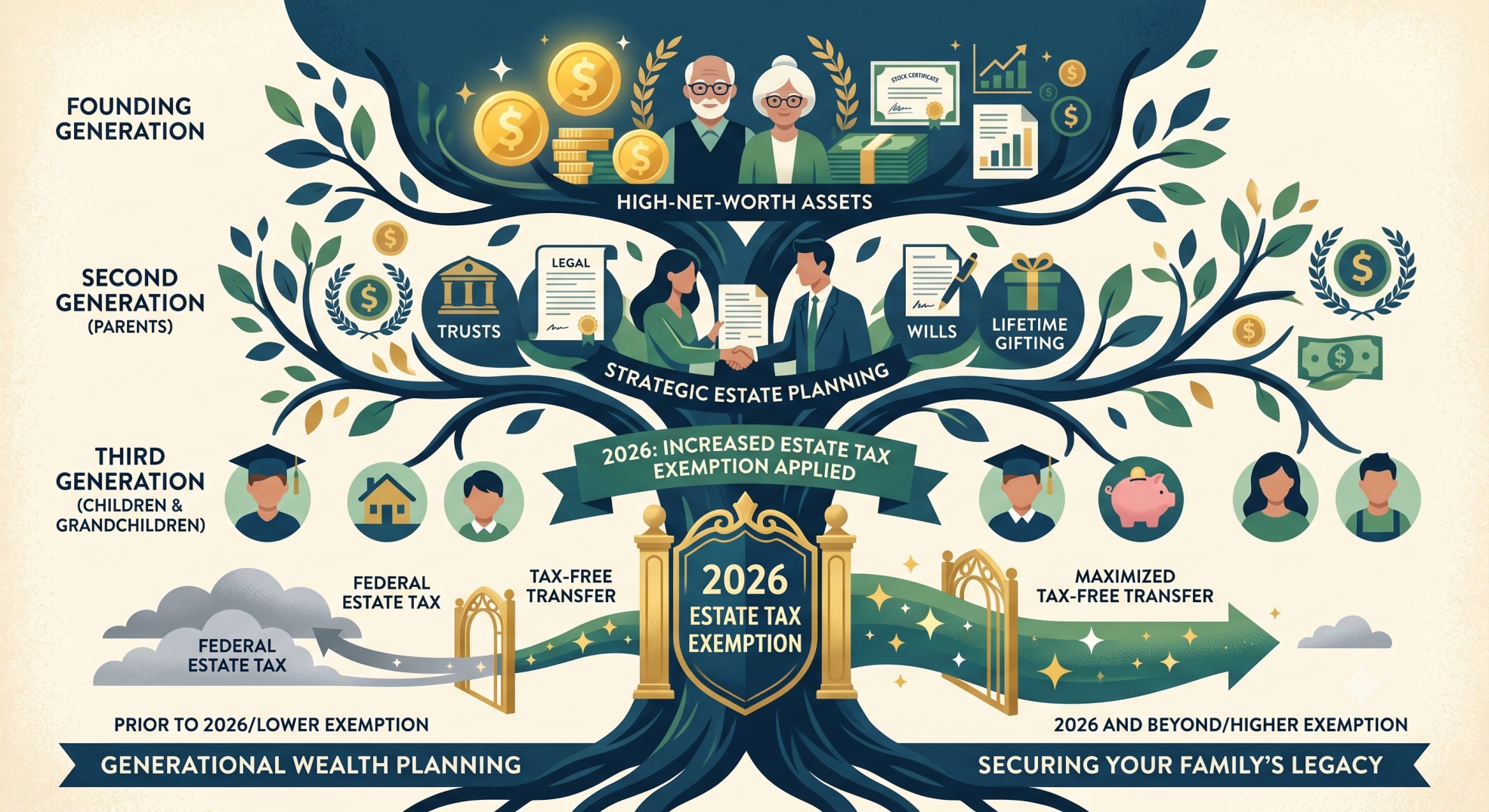
Estate and Gift Tax Exemption Jumps to $15 Million
The federal lifetime estate tax exemption climbed to $15 million per individual, or $30 million for a married couple, and this increase is now permanent. That opens serious room for wealth transfer planning. The annual gift tax exclusion sits at $19,000 per recipient, while gifts to a non-U.S. citizen spouse carry a higher exclusion of $194,000. These numbers deserve a spot on your next estate planning conversation.
How Did the OBBBA Change AMT Rules for 2026?
The OBBBA tightened how quickly the AMT exemption disappears as income rises. Exemption amounts sit at $90,100 for single filers and $140,200 for married joint filers, but the phase-out thresholds dropped to $500,000 for single filers and $1,000,000 for joint filers. On top of that, the phase-out rate doubled from 25% to 50%, meaning your exemption erodes twice as fast once you cross the threshold. More high-net-worth taxpayers will likely find themselves caught by AMT as a result.
What Is the SALT Deduction Cap for 2026?
The SALT deduction cap temporarily rose to $40,400 for joint filers in 2026. That cap phases down once Modified Adjusted Gross Income (AGI) passes $500,000, though it still offers welcome relief if you live in a high-tax state. Even with the higher SALT deduction cap, a meaningful chunk of your state and local taxes may remain undeductible, so factor that into your planning.
New Deductions and Savings Vehicles Worth Knowing
Several new deductions arrive for 2026. Adults over 65 get an additional $6,000 deduction, phased out once MAGI passes $75,000 for single filers or $150,000 for joint filers. Tips, overtime pay, and passenger vehicle loan interest all picked up new deduction treatment as well. On the savings side, “Trump Accounts” under IRC Section 530A introduce a tax-advantaged option for children born between 2025 and 2028, with contributions opening on July 4, 2026. Revenue Procedure 2026-25 clarifies how gift tax rules apply to these accounts.
Real-World Scenario: How the Doe Family’s 2026 Tax Bill Shapes Up
Numbers make abstract rules concrete. Here’s how these changes play out for a real-world composite high-net-worth family filing for 2026.
Meet the Does: A California Household in the Top Bracket
John and Jane Doe live in California and file jointly with two dependent children.
Their income and investments place them firmly in the highest tax brackets, making them a useful case study for how OBBBA plays out in 2026.
Their 2026 Income at a Glance
Total gross income and federal AGI both land at $2,200,000.00, made up of:
- W-2 Salary (John): $1,200,000.00
- W-2 Salary (Jane): $300,000.00
- Interest Income: $50,000.00
- Qualified Dividends: $150,000.00
- Long-Term Capital Gains: $200,000.00
- Qualified Business Income (QBI): $300,000.00, from Jane’s consulting business, a Specified Service Trade or Business
Their deductions include:
- Property Taxes: $25,000.00
- Mortgage Interest: $40,000.00
- Charitable Contributions: $100,000.00
- Estimated California State Income Tax: $245,630.00
Which 2026 Rules Hit This Family Hardest?
The OBBBA’s permanent provisions shape most of their tax picture. The 37% top rate applies to their income, standard deductions have gone up (though they won’t use them), and personal exemptions still don’t exist. The increased federal SALT cap of $40,400 for joint filers matters a lot here, given their California tax bill. Adjusted AMT rules, with their lower phase-out thresholds and doubled phase-out rate, also come into play.
Running the Numbers
Personal exemptions contribute nothing to their return, since those were never reintroduced.
Itemized deductions tell a different story. Their SALT deduction caps out at $40,400.00, even though combined state and local taxes run well above that (and this deduction phases down further for MAGI over $500,000). Add mortgage interest of $40,000.00 and charitable contributions of $100,000.00, and total itemized deductions reach $180,400.00, comfortably beating the $32,200 standard deduction for joint filers, so they itemize.
Subtracting itemized deductions from AGI puts federal taxable income at $2,200,000 minus $180,400, or $2,019,600.00.
- Regular Federal Income Tax (2026 MFJ brackets): $675,757.00
- Long-Term Capital Gains Tax (20% on $200,000): $40,000.00
- QBI Deduction: $0.00, since their high AGI and the fact that Jane’s consulting business qualifies as a Specified Service Trade or Business phases the deduction out completely
- Net Investment Income Tax: $15,200.00, since the 3.8% NIIT applies to their $400,000 of net investment income once MAGI clears the $250,000 MFJ threshold
- AMT Calculation: regular tax of $715,757 exceeds their AMT Tentative Minimum Tax of $572,386, so they pay regular tax rather than AMT
Add it up and their total federal income tax comes to $675,757 (ordinary) plus $40,000 (LTCG) plus $15,200 (NIIT), for a combined $730,957.00. Layer on California state income tax of $245,630.00, and their total combined federal-plus-state tax burden lands at $976,587.00.
What This Means for the Doe Family
Stability doesn’t mean a light tax bill. The 37% top rate and higher standard deductions are locked in for good, but the missing personal exemptions and tighter AMT rules still demand attention. Their higher federal SALT cap offers some relief as California residents, though a real portion of their state and local taxes still isn’t deductible. Net Investment Income Tax remains a factor given their substantial investment income. For a household like this, sophisticated, proactive tax planning isn’t optional, it’s essential.
Proactive Tax Planning Strategies to Consider for 2026
The 2026 rules reward a proactive approach. Give your financial plan a fresh look this year, since several updates create room to improve your position. A qualified tax advisor should be part of that conversation.
Revisit Your Estate Plan With the Higher Exemption in Mind
Review your existing estate plan now that the estate tax exemption sits at $15 million per individual on a permanent basis. This higher ceiling allows for considerably more tax-free wealth transfer than before. Lifetime gifting strategies deserve a fresh look too, since using these higher limits now can meaningfully shrink your taxable estate down the road.
Fine-Tune Business Structures Around the QBI Deduction
Permanent status and wider income ranges for the QBI deduction change the calculus for business owners. Take a fresh look at your entity structure and how income flows through it. Understanding the widened phase-in ranges matters for anyone doing QBI deduction 2026 planning, since getting this right determines whether you capture the full 20% deduction.
Model Your AMT Exposure Before It Surprises You
Reduced phase-out thresholds and a doubled phase-out rate mean more high-net-worth taxpayers could land inside AMT territory this year. Work with your advisor to project your liability under the new rules well before year-end. That modeling identifies your exposure early, giving you time to build strategies that soften the impact.
Make the Most of the Expanded SALT Cap
Temporary relief through the higher SALT cap of $40,400 still phases down as AGI climbs. If you live in a high-tax state, understanding exactly how this cap applies to your return matters. Talk with your advisor about how to structure things to make full use of this expanded deduction and keep your overall tax burden in check.
Weigh New Savings Options Like Trump Accounts
Trump Accounts under IRC Section 530A give you a new option for children born between 2025 and 2028. These tax-advantaged accounts offer a fresh way to shift wealth toward younger generations. Understanding the gift tax rules and contribution limits attached to these accounts helps you decide whether they fit into your longer-term financial plan.
Working With Your Tax Advisor Going Forward
OBBBA-driven changes for 2026 bring stability, but they don’t erase complexity. High-net-worth individuals still need a proactive plan built around these rules. Personalized advice matters more than ever given how these updates interact with your specific income, business structure, and estate goals. A qualified tax advisor helps translate these rules into decisions that protect your financial future. For further reading, official guidance from IRS.gov and analysis from The Tax Foundation offer additional depth.
Disclaimer: This content provides general information for educational purposes only. Tax laws are complex and change often. It is not professional tax, legal, or financial advice. Always consult a qualified tax professional for personalized guidance regarding your specific situation. Ourtaxpartner.com is not responsible for any actions taken based on the information provided herein.
