
Reviewed and updated May 9, 2026.
If you’ve ever heard that “credit utilization matters” and wondered what that actually means, here’s the short version: credit utilization is the percentage of your available revolving credit that you’re using. On a credit card, that means your balance compared with your credit limit. Credit scores are built from information in your credit reports, and you can have more than one score because lenders use different scoring models and different data.
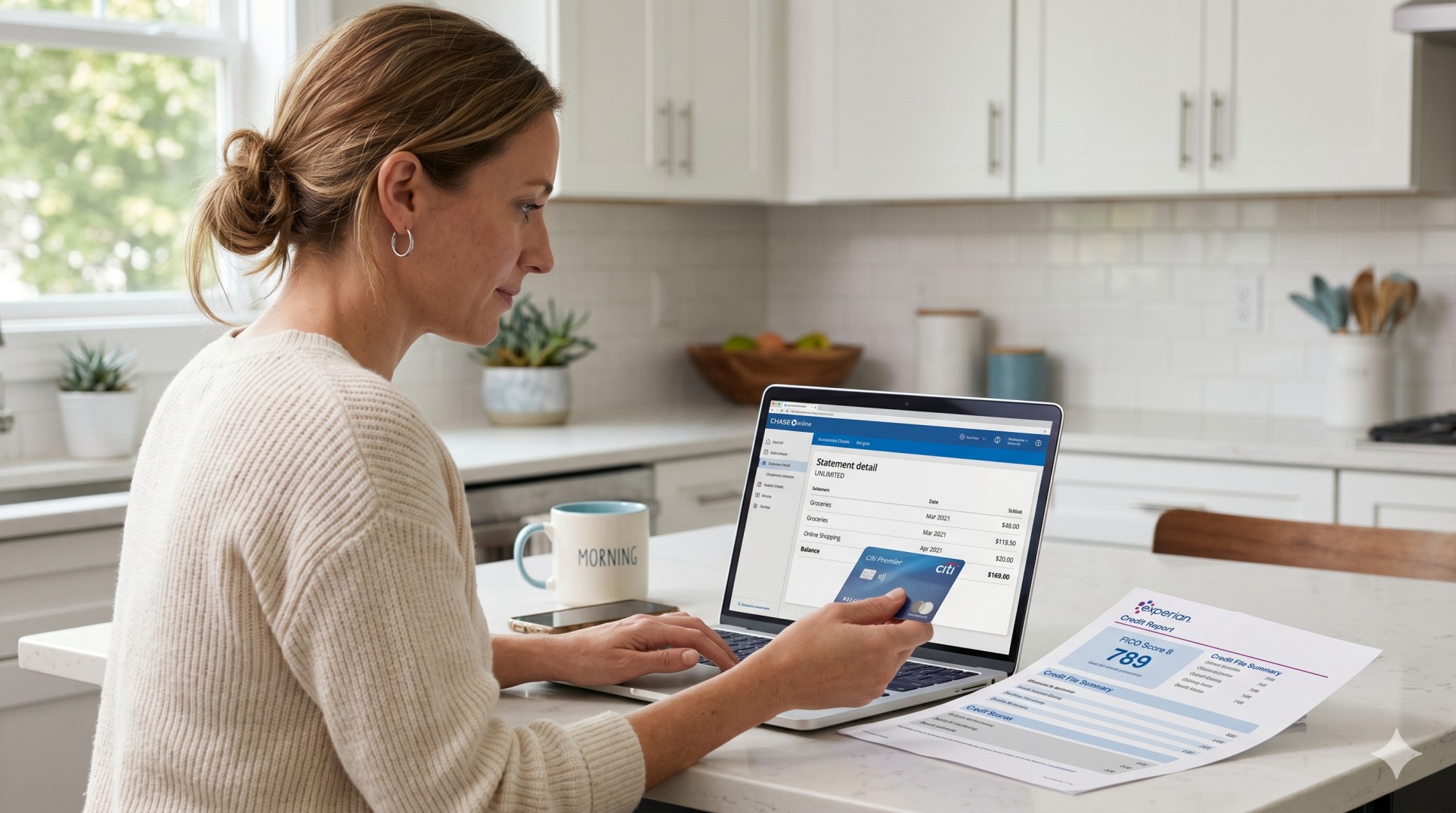
Here’s the part many people miss: your score may reflect the balance that gets reported to the credit bureaus, not necessarily the balance you see in your app right after you make a payment. VantageScore says bureaus use the balances card issuers report, which are often the balances from your monthly statements. That means timing can matter.
Definition box Credit utilization = balance ÷ credit limit, shown as a percentage. Example: a $200 balance on a $1,000 card limit equals 20% utilization. FICO says utilization is one part of the “amounts owed” category and can be looked at both on individual revolving accounts and across all revolving credit.
What credit cards and credit scores actually are
Credit cards are a form of revolving credit. You can borrow, pay some or all of the balance, and use the card again as long as the account stays open and in good standing. Credit scores, meanwhile, are predictions of how likely you are to pay back borrowed money on time. They’re based on the information in your credit reports.
You also do not have just one credit score. The CFPB says scores can differ because lenders use different scoring formulas, different credit reporting sources, and different scores for different loan products. A credit card score can be different from a mortgage score, and a score you see online can differ from the one a lender uses.
What this means for you: don’t get hung up on one “perfect” number. Credit scoring is not one-size-fits-all, and your utilization can look slightly different depending on the scoring model and the timing of the report.
How credit utilization is calculated
The math is simple:
Credit utilization = balance ÷ credit limit
If one card has a $1,000 limit and a $250 balance, utilization on that card is 25%. If you have multiple cards, scoring models may look at both the individual card level and your total revolving credit use. FICO says utilization can be calculated for each revolving account and in aggregate across your revolving accounts. VantageScore also says a maxed-out card can hurt even if your overall ratio looks low.
That reporting detail matters. VantageScore says bureaus use balances card issuers report, and those figures are often the monthly statement balances. So if you pay a card down after the statement closes, your app may show a lower balance while the bureau still sees the earlier reported amount. That’s an inference from how reporting works, and it’s one reason utilization can move before you expect it to.
What this means for you: if you’re trying to lower reported utilization for a credit application, the timing of your payment can matter almost as much as the payment itself.
How credit utilization affects credit scores
Utilization matters because it gives lenders a snapshot of how heavily you rely on revolving credit. FICO says the “amounts owed” category accounts for about 30% of a typical FICO Score, and utilization is one part of that category. The CFPB also says credit scoring models look at how close you are to your limit.
But there is not one universal cutoff where your score suddenly falls off a cliff. FICO says the common advice to stay below 30% is just a guideline, not a hard threshold backed by a guaranteed score drop. Lower utilization is generally better, but the score effect depends on the rest of your credit profile and the model being used.
Scoring models also differ in how they treat utilization. FICO and VantageScore both include utilization in their models, but they do not use identical formulas. That’s another reason your score can change even when you haven’t done anything “wrong.”
The score factors that matter most
The CFPB says credit scores typically consider:
- how often you pay on time,
- how much debt you currently owe,
- how many and what types of accounts you have,
- how long your accounts have been open,
- how much of your available credit you’re using,
- how often you apply for new credit, and
- certain serious events such as collections, foreclosure, or bankruptcy.
FICO says payment history is the most important factor, while utilization is part of the amount-owed category. In plain English: on-time payments matter most, but high utilization can still drag your score down even if you never miss a due date.
What this means for you: think of utilization as a fast-moving part of your score. Payment history builds over time, but utilization can change with a single charge, payment, or credit limit change.
What helps your credit score
A lower utilization rate usually helps, especially when you keep it low across both individual cards and your total revolving credit. FICO says higher utilization generally means higher risk, and VantageScore says lower balances are better for your score.
Here are the habits that usually help most:
- Pay on time, every time. The CFPB says payment history has the greatest impact on your score.
- Keep balances low relative to your limits. FICO and the CFPB both say staying far from maxed out helps.
- Keep some available credit. More unused credit can help keep your utilization down.
- Review your statements and reports regularly. Errors can hurt your score, and checking your own report does not hurt it.
A small but important nuance: FICO says a 0% reported revolving balance is not always the absolute best-looking profile. In some cases, a small reported balance can be slightly better than no reported revolving balance at all. That does not mean you should carry debt or pay interest on purpose. It just means the scoring math is more nuanced than “zero is always best.”
What hurts your credit score
High utilization is the obvious one, but there are a few common ways people accidentally make it worse.
- Maxing out a card. VantageScore says even if your overall ratio is okay, a maxed-out individual card can still hurt your score.
- Closing cards and moving balances onto one card. The CFPB warns that if you close some cards and pile balances onto one card, it can hurt your score because you’re using a bigger share of your total credit limit.
- Letting a card issuer reduce your credit limit. If your limit drops and your balance stays the same, your utilization rises automatically. The CFPB says issuers can reduce limits, and it advises keeping utilization well below 30% to leave a cushion.
- Applying for lots of credit in a short period. The CFPB says frequent applications can make it look like your financial situation has worsened.
- Missing payments. Utilization matters, but late payments are still a major hit because payment history carries the most weight in many scoring models.
What this means for you: a score can fall even if your spending didn’t change. A lower credit limit, a transferred balance, or one big card purchase can all push utilization higher.
What helps your credit score vs what hurts it
| What helps your credit score | What hurts your credit score | Why it matters |
|---|---|---|
| Paying on time | Late or missed payments | CFPB says payment history has the greatest impact on your score. |
| Keeping balances low | High utilization or maxed-out cards | FICO ties utilization to the “amounts owed” category, and VantageScore says maxed-out cards can still hurt. |
| Leaving room under your limits | Closing cards or shifting balances onto one card | CFPB says this can reduce available credit and raise the share you’re using. |
| Using credit carefully | Applying for many accounts in a short time | CFPB says a burst of applications can signal financial stress. |
| Checking reports for errors | Ignoring incorrect balances or accounts | Errors can hurt your score, and you can check reports for free weekly. |
Real-world example
Example: Suppose you have two credit cards.
- Card 1: $2,000 limit, $1,000 balance
- Card 2: $8,000 limit, $1,000 balance
Your overall utilization is $2,000 divided by $10,000, or 20%. But Card 1 is sitting at 50% utilization. FICO says utilization can be looked at both individually and overall, and VantageScore says a high-balance individual card can still hurt even if the total ratio looks manageable.
That’s why a person can say, “My overall utilization is fine,” and still see score pressure from one card. The overall number matters, but the card-by-card detail matters too.
Myths vs facts
Myth: You have to carry a balance to build credit. Fact: Carrying debt is not required to build credit. FICO says a 0% reported revolving balance is not always ideal for maximum points, but that is very different from saying you need to pay interest. Paying on time and keeping utilization low are still the core habits.
Myth: 30% utilization is a hard rule. Fact: It’s a common guideline, not a cliff. FICO says the data does not support a guaranteed score drop exactly at 30%, and lower is generally better.
Myth: Checking your own credit report hurts your score. Fact: It doesn’t. The CFPB says checking your own report is not a credit inquiry and has no effect on your score.
Myth: Everyone has one credit score. Fact: You can have many scores because lenders use different models and different credit data.
Myth: If your overall utilization is low, one maxed card doesn’t matter. Fact: It can still matter. VantageScore says a maxed card can hurt even when the total ratio is relatively low.
How to check and monitor your credit safely
The safest place to check your credit reports for free is AnnualCreditReport.com, which the FTC says is the only authorized website for the free annual credit reports you’re entitled to by law. Federal law gives you one free credit report every 12 months from each of the three nationwide credit bureaus, and the bureaus have permanently extended weekly free online access through AnnualCreditReport.com. The CFPB also says everyone in the U.S. can get six free Equifax reports per year through December 2026.
Your credit score may be available for free through a card issuer, another lender, or a nonprofit counselor. The CFPB warns that some “free score” offers are really paid trials or educational scores, so it’s smart to know which score you’re getting.
The most useful habit is to compare what you see on your credit report with what your card issuer says it reported. That’s how you catch mistakes, outdated balances, or accounts you don’t recognize. The CFPB says report errors can hurt your score, and reviewing your report regularly helps keep your information current.
Practical checklist
- Pull your credit reports from AnnualCreditReport.com.
- Check the balances and credit limits that were reported.
- Look for accounts you didn’t open or balances that don’t match your records.
- Dispute errors with the credit bureau and the company that provided the information.
- Use free score access from a lender or card issuer to track trends, but remember the score may not match a lender’s exact model.
When to review your card terms and credit report
Credit card terms are not static. The CFPB says issuers can change terms for future purchases, and for significant changes they generally must give 45 days’ notice. The CFPB also says APRs can be fixed or variable, and the cardholder agreement explains how the APR can change over time.
That matters for utilization, too. If a card issuer lowers your credit limit, your utilization can rise even if your spending doesn’t change. If you’re carrying a balance, opening a balance transfer offer, or comparing cards, it’s worth reading the cardholder agreement before you act.
For your credit reports, the safest habit is to review them at least once a year, and more often if you’re actively managing credit or planning a major purchase. The CFPB says checking your reports regularly can help you catch errors, and weekly free access at AnnualCreditReport.com makes that easier than it used to be.
Practical takeaways for everyday readers
If you want the shortest possible version of credit utilization, here it is:
- Keep balances low compared with your limits.
- Avoid maxing out any single card.
- Pay on time every month.
- Don’t assume 30% is a magic line.
- Check your credit reports and correct errors quickly.
- Remember that your score can change because reporting timing changes, not just because your behavior changed.
Conclusion
Credit utilization is one of the easiest parts of your credit profile to understand, but it’s also one of the easiest to misread. The basic idea is simple: use less of your available revolving credit, keep an eye on how much gets reported, and make on-time payments a habit. Because lenders use different scoring models, there’s no single magic number that works for everyone—but low utilization, careful card use, and clean credit reports are still the safest everyday habits.
If you remember one thing, remember this: credit utilization is not about never using credit. It’s about using it in a way that leaves room to breathe. That’s the part that tends to help your credit score over time.
K. FAQ
1. What is credit utilization in simple terms? Credit utilization is the percentage of your available revolving credit that you’re using. If your card has a $1,000 limit and a $200 balance, your utilization is 20%.
2. Is 30% credit utilization good? It’s a common guideline, but not a hard cutoff. FICO says the data does not support a guaranteed score drop exactly at 30%, and lower utilization is generally better.
3. Does paying my card off every month mean my utilization is 0%? Not necessarily. Issuers often report balances on a monthly statement cycle, so the balance used in scoring may be different from the balance you paid after the statement closed.
4. Do all credit scores use utilization the same way? No. The CFPB says you can have many credit scores because lenders use different formulas, different data, and different scoring models for different products.
5. How can I check my credit safely? Use AnnualCreditReport.com for free credit reports, review them for errors, and use free score tools from your card issuer or lender only after confirming whether the score is educational or lender-used. Checking your own report does not hurt your score.
