
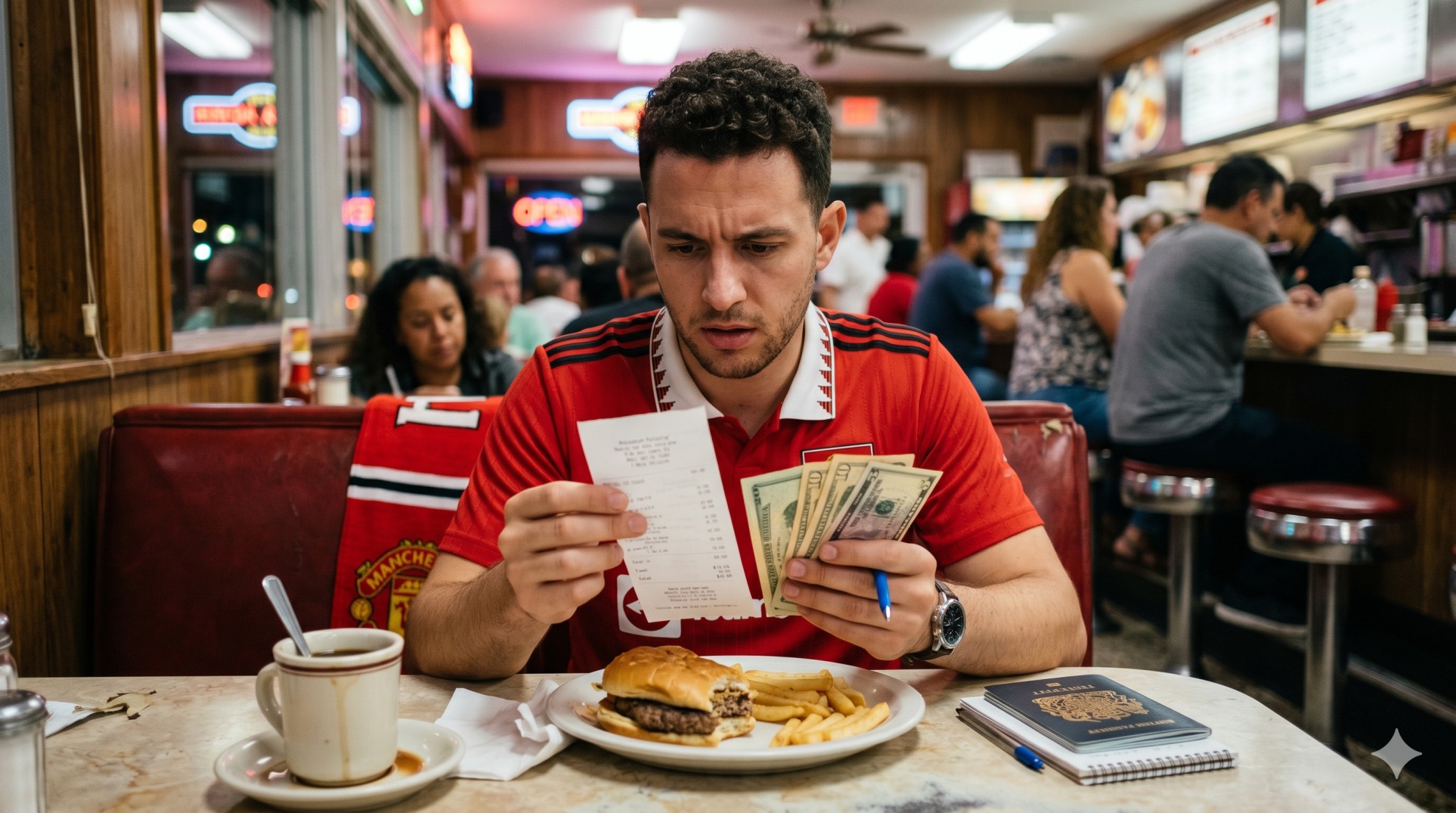
The 2026 FIFA World Cup will bring incredible excitement to North America. You will likely celebrate your team’s victory at a local American restaurant. However, you might experience a massive shock when the final bill arrives. Therefore, understanding US restaurant tax and tipping is absolutely essential for your trip.
Many foreign visitors are notoriously confused by the American pricing system. Specifically, the price you see on the menu is never the final price. Furthermore, you must add local taxes and a mandatory gratuity at the end. Consequently, a simple $20 burger can quickly become a $30 expense.
In this comprehensive guide, we will decode the typical American restaurant receipt. We will explain state sales taxes, local hospitality fees, and tipping expectations. Thus, you can budget your World Cup vacation perfectly without any financial surprises.
The Menu Price Illusion
In most countries, the menu price includes all taxes and service fees. However, the United States uses a completely different retail pricing model. Here, the menu price only covers the raw cost of the food. Therefore, you must mentally calculate the extra costs before you order.
Furthermore, the federal government does not set a national food tax. Instead, individual states and cities create their own specific tax rates. Consequently, a meal in Los Angeles will have different taxes than a meal in Dallas. Thus, you must research your specific host city before dining out.
Understanding State Sales Tax
Almost every US state charges a base sales tax on prepared food. For example, if you eat at a restaurant in New York/New Jersey, you pay state tax. This tax is automatically added to your bill by the restaurant’s computer system. Therefore, you cannot negotiate or avoid this mandatory government fee.
In addition, this tax only applies to the food and drinks you consume. It does not apply to the tip you leave for the server. Consequently, you should always calculate your tip based on the pre-tax subtotal. Thus, you avoid paying a tip on top of a government tax.
Local Hospitality Taxes
State sales tax is only the first part of the equation. Many popular tourist destinations also add a local hospitality tax. Specifically, cities like Miami charge an extra resort tax on food and beverages. Therefore, your final tax rate is a combination of state and city taxes.
Furthermore, these local taxes help fund city infrastructure and tourism boards. Consequently, you are directly paying for the beautiful beaches and clean streets you enjoy. Thus, you should expect higher tax rates in major World Cup host cities.
The American Tipping Culture
Tipping is the most confusing aspect of American dining for international tourists. In Europe, tipping is often just a small bonus for exceptional service. However, in the United States, tipping is a mandatory part of the server’s income. Therefore, you must leave a tip unless the service was absolutely terrible.
Furthermore, the standard tipping rate has increased significantly over the years. Currently, a 20% tip is considered the standard for good service. Consequently, you must factor this massive percentage into your daily food budget. Let us explore why this system exists in America.
Why 20% is the Standard
American restaurant owners pay their servers a very low minimum wage. In many states, servers earn less than $3.00 per hour from their employer. Therefore, they rely entirely on customer tips to pay their rent and bills. Consequently, your tip is literally paying the worker’s salary.
In addition, servers must often share their tips with bartenders and bussers. This process is called “tipping out” the support staff. Thus, if you leave a small tip, the server might actually lose money on your table. Therefore, leaving 20% ensures everyone gets paid fairly.
Fun Fact: How the IRS Taxes Tips
You might wonder if servers pay taxes on the cash you leave on the table. Yes, the IRS strictly taxes all tip income earned by restaurant workers. Furthermore, servers must report their daily tips to their employer at the end of their shift. Therefore, the government tracks this income very closely.
In addition, if a server fails to report their tips, they face severe IRS penalties. Consequently, the IRS assumes a certain percentage of sales will be tipped. Thus, your server pays income tax on the money you leave them. This makes tipping a highly regulated financial transaction.
Hidden Fees on Your Receipt
Beyond taxes and tips, you might notice other strange charges on your bill. Since the global pandemic, many restaurants have introduced new hidden fees. Therefore, you must read your receipt very carefully before handing over your credit card. Furthermore, you can sometimes ask the manager to remove these specific fees.
Let us review the most common hidden charges you will encounter. Knowing these terms will protect your travel budget during the tournament.
The Automatic Gratuity
If you dine with a large group of friends, watch out for auto-gratuity. Many restaurants automatically add an 18% or 20% service charge for parties of six or more. Therefore, you do not need to leave an additional tip on the table. Furthermore, the menu usually states this policy in very small print at the bottom.
Consequently, many tourists accidentally tip twice because they do not read the receipt. Thus, you should always check the bottom of your bill for a “Service Charge” line. If you see it, you can simply sign the receipt and leave.
Credit Card Surcharges
Credit card companies charge restaurants a processing fee for every transaction. Recently, many American restaurants started passing this fee directly to the customer. Therefore, you might see a 3% “Credit Card Surcharge” added to your final bill. Furthermore, this fee is completely legal in most US states.
However, you can easily avoid this extra fee by paying with physical cash. Consequently, carrying some US dollars is a very smart financial strategy. Thus, you can save a few dollars on every single meal you eat.
Important IRS Rules for Foreign Visitors
Dining out in the US can sometimes intersect with federal tax laws. This is especially true if you are a foreign business owner entertaining clients. Furthermore, bringing large amounts of cash to pay for luxury meals triggers customs rules. Therefore, you must understand specific IRS forms to stay legal.
Let us review the essential paperwork you might need during your trip. Proper preparation prevents expensive legal problems later.
Declaring Cash with FinCEN Form 105
You might bring thousands of dollars in cash to avoid credit card fees. However, if you bring more than $10,000 USD into the country, you must declare it. Specifically, you must file FinCEN Form 105 with customs officers at the airport. Therefore, you cannot secretly carry large stacks of money for your restaurant budget.
Furthermore, failing to file this form can result in the seizure of all your cash. Consequently, you must be completely honest about your travel funds. Thus, filing this free form protects your money and your vacation.
Deducting Meals and Form W-8BEN
Many foreign executives will use the World Cup to entertain US clients. If you own a foreign corporation, you might want to deduct these expensive meals. However, the IRS has strict rules about deducting business entertainment. Therefore, you can generally only deduct 50% of a legitimate business meal.
In addition, if you conduct business in the US, clients might request Form W-8BEN. This form proves your foreign status and prevents mandatory tax withholding. Consequently, you should keep this form handy if you are mixing business with football. Thus, you protect your corporate profits effectively.
Avoiding Tax Residency with Form 8840
Some passionate fans plan to stay in the US for several months. They want to eat at every famous restaurant in every host city. However, staying too long can accidentally trigger US tax residency under the Substantial Presence Test. Therefore, the IRS might try to tax your worldwide income.
Fortunately, you can file Form 8840 to claim the Closer Connection Exception. This form proves you are just a visiting tourist with strong ties to your home country. Consequently, you can enjoy your extended culinary tour without fearing the IRS. Thus, tracking your travel days is absolutely vital.
Case Study Scenarios
Real numbers make these complex restaurant rules much easier to understand. Therefore, let us look at three different dining scenarios. These examples will show exactly how taxes and tips inflate the final bill.
Furthermore, they highlight the importance of budgeting correctly. By studying these cases, you will know exactly what to expect.
Scenario 1: The Solo Tourist in Miami
Carlos visits Miami and orders a steak listed at $50.00 on the menu. He assumes he will only pay fifty dollars. However, Miami has a 7% state sales tax and a 2% local hospitality tax.
- Menu Price: $50.00
- Combined Taxes (9%): $4.50
- Subtotal: $54.50
- Standard Tip (20% of $50): $10.00
- Final Out-of-Pocket Cost: $64.50
Therefore, Carlos pays almost $15 more than the advertised menu price. Consequently, he learns to mentally add 30% to every menu item he orders.
Scenario 2: The Large Group in New York
A group of eight friends eats at a popular restaurant in New York City. Their total food and drink cost is $400.00. New York City has a combined sales tax rate of 8.875%. Furthermore, the restaurant automatically adds an 18% gratuity for large parties.
- Menu Price: $400.00
- NYC Tax (8.875%): $35.50
- Auto-Gratuity (18%): $72.00
- Final Bill: $507.50
Because the tip was automatically included, the friends do not need to leave extra cash. Therefore, they simply split the final $507.50 bill and leave. Thus, reading the receipt saved them from double-tipping.
Scenario 3: The Business Owner in Dallas
Sarah is a UK business owner entertaining a potential US client in Dallas. The total restaurant bill, including tax and tip, comes to $300.00. She pays with her corporate credit card.
- Total Bill: $300.00
- IRS Deductible Amount (50%): $150.00
- Non-Deductible Amount: $150.00
Therefore, Sarah can only write off half of the meal as a business expense. Consequently, her foreign corporation must absorb the remaining cost. Thus, she budgets her corporate entertainment funds very carefully.
Practical Tips for Dining Out
You can easily master the American dining system with a little preparation. Specifically, you should always carry a mix of cash and credit cards. Furthermore, downloading a simple tip calculator app on your phone is a brilliant idea. Therefore, you will never struggle with the math after a few drinks.
Let us review some highly practical tips for your upcoming culinary adventure. These simple steps will save you time, money, and embarrassment.
Check the Receipt Carefully
Always take a moment to review your itemized receipt before paying. Look specifically for lines labeled “Service Charge” or “Gratuity Included.” If you see these lines, you do not need to add a 20% tip. Therefore, you protect yourself from overpaying.
In addition, check for any unexpected credit card surcharges. If you see a 3% fee, you can ask the server if cash payment removes it. Consequently, you keep more money in your own pocket. Thus, vigilance is your best financial tool.
Tipping at Bars and Cafes
The 20% rule generally applies to full-service sit-down restaurants. However, the rules are slightly different at bars and coffee shops. If you order a beer at a busy bar, leaving $1 or $2 per drink is standard. Therefore, you do not need to calculate exactly 20% for a simple beverage.
Furthermore, if you buy a coffee at a counter, tipping is entirely optional. You might see a digital screen asking for a tip, but you can politely decline. Consequently, you should save your generous tips for the hardworking restaurant servers. Thus, you balance your budget effectively.
Frequently Asked Questions (FAQ)
Is it illegal to not leave a tip in the US?
No, tipping is not legally required in the United States. It is technically a voluntary payment. However, it is a massive cultural expectation. Therefore, failing to tip is considered extremely rude and disrespectful to the server. You should always budget for a tip when dining out.
Do I calculate the tip before or after taxes?
You should always calculate your tip based on the pre-tax subtotal. You do not need to tip the server on the government’s tax money. Therefore, look at the subtotal line on your receipt, calculate 20%, and add that amount. This is the most financially accurate way to tip.
What happens if I bring $15,000 in cash to pay for my vacation?
It is completely legal to bring $15,000 in cash. However, you must declare it to customs by filing FinCEN Form 105. If you fail to file this form, the government can seize all your money. Therefore, always declare your cash to avoid severe legal penalties.
Can a restaurant force me to pay an automatic gratuity?
Yes, restaurants can legally enforce an automatic gratuity, especially for large groups. However, they must clearly disclose this policy on the menu or before you order. If it is clearly stated, it becomes a legally binding part of your bill. Therefore, always read the menu’s fine print carefully.
Conclusion and Next Steps
The 2026 World Cup will be an unforgettable celebration of football and culture. Furthermore, it offers a fantastic opportunity to enjoy incredible American cuisine. By understanding US restaurant tax and tipping, you can dine out with total confidence. Therefore, you will never be shocked by a hidden fee again.
Remember to mentally add 30% to every menu price you see. In addition, always check your receipt for automatic gratuities and credit card surcharges. Thus, you can manage your travel budget perfectly and enjoy every single meal.
Did you find this dining guide helpful? Please share this article with your fellow traveling fans! In addition, bookmark this page for your 2026 World Cup trip planning. Finally, explore our other helpful World Cup tax and travel guides on our blog to stay informed.
Disclaimer: This article is strictly for educational and informational purposes. This website does not provide tax or legal services. Therefore, readers should consult a certified CPA or tax professional for their specific situations.
