
⚡ Executive Summary: Family Employment Rules for 2026
- The 2026 standard deduction for single filers is $16,100, allowing your child to earn up to this amount completely free of federal income tax.
- Under IRC Section 3121(b)(3)(A), wages paid to a child under age 18 by a parent’s sole proprietorship or single-member LLC are 100% exempt from Social Security and Medicare (FICA) taxes.
- Wages paid to a child under age 21 are also exempt from Federal Unemployment Tax (FUTA).
- S-Corporations and C-Corporations do not directly qualify for the FICA exemption, requiring owners to use a Family Management Company strategy to capture the tax savings.
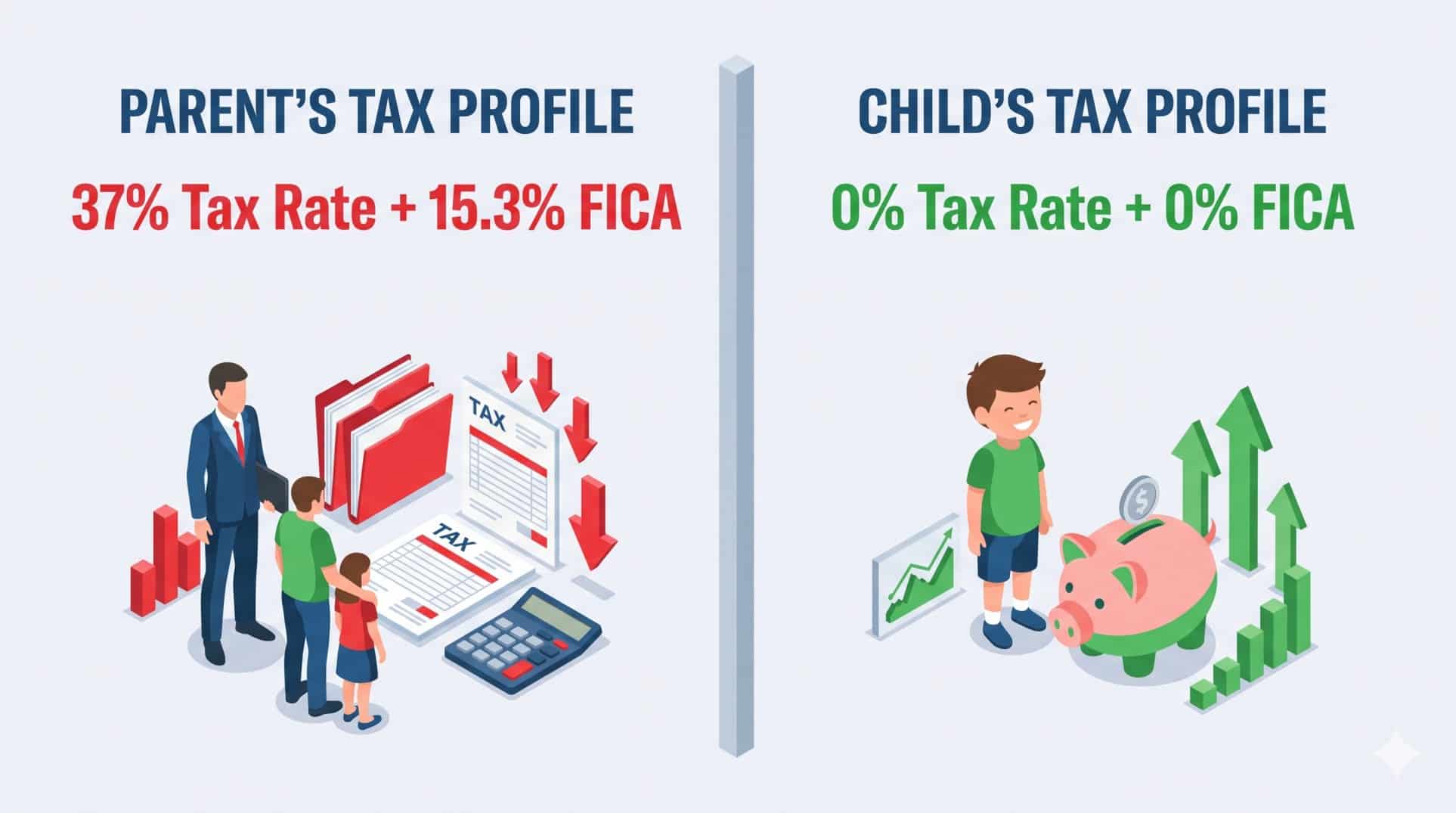
Table of Contents
- The Core Strategy: How to Shift Income to a Lower Tax Bracket
- The Payroll Tax Exemption: How to Avoid FICA Taxes
- Entity Types Matter: Who Qualifies for the Exemption?
- The S-Corp Workaround: The Family Management Company
- IRS Compliance: Rules for Hiring Family Legally
- Supercharging the Strategy: Funding a Roth IRA
- Real-World Examples and Calculations
- Frequently Asked Questions About Hiring Your Kids
You run a profitable business. You pay high taxes. You also spend a significant amount of your after-tax money supporting your children. Combining these facts presents a unique financial opportunity. The Tax Benefits of Hiring Your Children in 2026 represent one of the most powerful, legally sound wealth-building strategies in the federal tax code.
Most business owners pay for their kids’ sports equipment, tutoring, and college savings out of their own pocket. That money has already been taxed at the highest marginal rates, plus self-employment taxes. By formally employing your child to perform legitimate work for your business, you transform those personal expenses into deductible business expenses.
We are going to break down exactly how this strategy works for the current tax year. You will learn the specific IRS rules required to shift income to a lower tax bracket, the entity structures needed to avoid FICA taxes, and how to keep your family payroll completely audit-proof.
The Core Strategy: How to Shift Income to a Lower Tax Bracket
The foundation of this strategy relies on the massive gap between your tax rate and your child’s tax rate. The U.S. tax system is progressive. As you earn more, your next dollar is taxed at a higher percentage. Your child, however, starts at zero.
When you pay your child a wage, your business gets a tax deduction. This reduces your taxable income at your highest marginal bracket. If you are in the 32% federal income tax bracket and you pay 15.3% in self-employment taxes, every dollar you deduct saves you nearly 50 cents in taxes.
That money then lands on your child’s tax return. Thanks to the permanent extension of the Tax Cuts and Jobs Act provisions, the 2026 standard deduction for a single filer is $16,100. This means your child can earn up to $16,100 in W-2 wages this year and pay exactly zero dollars in federal income tax.
You effectively take money that the IRS was going to tax at 40% or more, and you move it into an environment where it is taxed at 0%. This is the textbook definition of how to shift income to a lower tax bracket legally. You keep the money inside your household, but the government’s share disappears.
The Payroll Tax Exemption: How to Avoid FICA Taxes
Shifting income saves you on federal income tax, but what about payroll taxes? Normally, when you hire an employee, you must withhold 7.65% of their pay for Social Security and Medicare (FICA), and you must match that with another 7.65% from the business side. That is a 15.3% tax hit right off the top.
This is where the tax code heavily favors Hiring Family. Under IRC Section 3121(b)(3)(A), if you hire your own child who is under the age of 18, their wages are completely exempt from FICA taxes. You do not withhold the 7.65% from their paycheck, and your business does not pay the 7.65% employer match. The tax simply does not apply.
Furthermore, under IRC Section 3306(c)(5), wages paid to a child under the age of 21 are exempt from the Federal Unemployment Tax Act (FUTA). This saves your business an additional 6% on the first $7,000 of their wages.
To successfully avoid FICA taxes, the employment relationship must be strictly between the parent and the child. The IRS is very specific about which business structures qualify for this exemption.
Entity Types Matter: Who Qualifies for the Exemption?
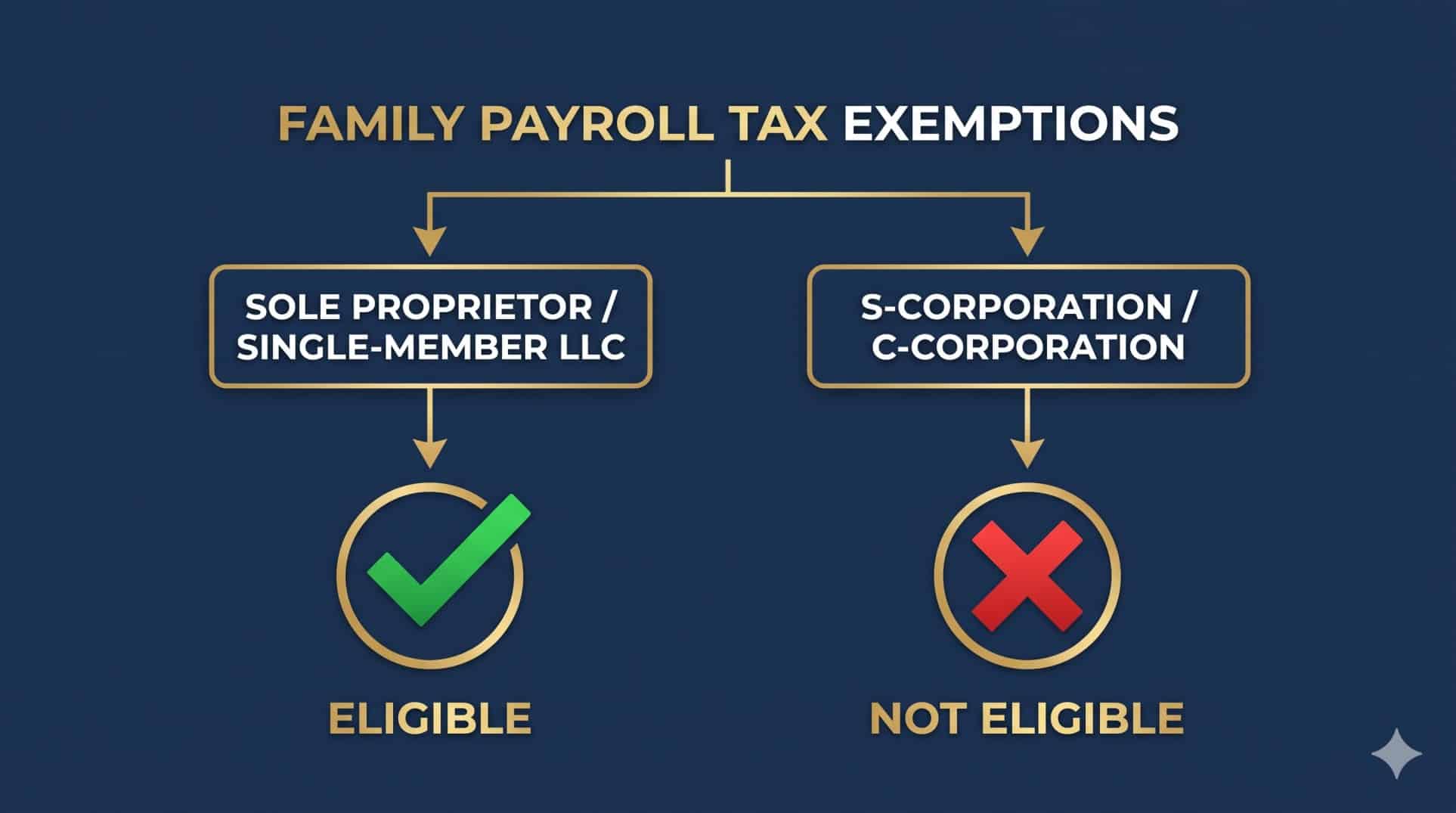
The biggest mistake business owners make when attempting to claim the Tax Benefits of Hiring Your Children in 2026 is assuming the rules apply to every company. They do not. The IRS looks at who the legal employer is.
| Business Entity Type | FICA Exemption (Under 18) | FUTA Exemption (Under 21) |
|---|---|---|
| Sole Proprietorship | Yes – 100% Exempt | Yes – 100% Exempt |
| Single-Member LLC (Disregarded) | Yes – 100% Exempt | Yes – 100% Exempt |
| Partnership (Both parents are partners) | Yes – 100% Exempt | Yes – 100% Exempt |
| Partnership (Includes non-parent partner) | No – Fully Taxable | No – Fully Taxable |
| S-Corporation | No – Fully Taxable | No – Fully Taxable |
| C-Corporation | No – Fully Taxable | No – Fully Taxable |
If you operate as a sole proprietor or a single-member LLC, you are the employer. The exemption applies perfectly. If you operate a partnership where you and your spouse are the only partners, the exemption also applies.
But if your business is an S-Corporation or a C-Corporation, the corporation is the legal employer, not you. A corporation does not have children. Therefore, if an S-Corp pays your 15-year-old daughter, those wages are subject to the full 15.3% FICA tax. This catches thousands of taxpayers off guard every year.
Learn more about choosing the right business entity for tax purposes here.
The S-Corp Workaround: The Family Management Company
If you run an S-Corp, do not panic. You can still capture the Tax Benefits of Hiring Your Children in 2026, but you need a structural workaround. This is a critical concept in any advanced Guide for Business Owners.
Instead of hiring your children directly through the S-Corp, you establish a separate Sole Proprietorship or Single-Member LLC. This new entity is often called a Family Management Company (FMC). The sole purpose of the FMC is to provide administrative, marketing, or support services to your S-Corp.
Here is how the money flows:
- Your S-Corp signs a legitimate vendor contract with your new Family Management Company for support services.
- The S-Corp pays the FMC a reasonable monthly fee (e.g., $1,500 per month). The S-Corp takes a business deduction for this contractor expense.
- The FMC receives the income. Because the FMC is a sole proprietorship owned by you, it qualifies for the family payroll exemptions.
- The FMC hires your children to perform the actual support work.
- The FMC pays the children W-2 wages, wiping out the FMC’s taxable profit.
Because the children are employed by the sole proprietorship, their wages are completely exempt from FICA and FUTA taxes. You successfully extract money from the S-Corp, bypass payroll taxes, and land the income in your child’s 0% tax bracket.
IRS Compliance: Rules for Hiring Family Legally
The IRS is well aware of how lucrative this strategy is, which means they actively look for taxpayers who abuse it. You cannot simply write a $16,100 check to your toddler and call it a tax deduction. To survive an audit, your family payroll must be bulletproof.
First, the work must be bona fide. Your child must perform actual tasks that benefit the business. Paying them to do personal household chores, like mowing your home lawn or doing the dishes, does not count. Legitimate business tasks for children often include:
- Shredding documents and organizing files.
- Cleaning the office or washing company vehicles.
- Modeling for company marketing materials or social media.
- Data entry, answering phones, or managing basic customer emails.
- Packaging products or managing inventory.
Second, the compensation must be reasonable. You must pay your child what you would pay a stranger to do the exact same job. If the market rate for an office cleaner is $15 an hour, you cannot pay your 12-year-old $100 an hour just to hit the standard deduction limit faster.
Finally, you must treat them like a real employee. They need to fill out a W-4. You must track their hours using a timesheet. You must issue their paychecks on a regular payroll schedule, depositing the funds into a bank account in their name (a custodial account works perfectly). At the end of the year, you must issue them a W-2. If you skip the paperwork, the IRS will reclassify the wages as a non-deductible personal gift.
Supercharging the Strategy: Funding a Roth IRA
Shifting income to save on current-year taxes is great, but the ultimate Guide for Business Owners takes this a step further. Once your child has earned W-2 income, they unlock the ability to contribute to a Roth IRA.

A Roth IRA requires “earned income” to contribute. Allowances and gifts do not count. But the W-2 wages from your business absolutely do. For 2026, the maximum Roth IRA contribution limit is $7,000.
If you pay your 15-year-old $10,000 for the year, they pay zero federal income tax. They can then take $7,000 of that money and invest it in a Roth IRA. That money will grow completely tax-free for the next 45 years. When they retire, they can withdraw the millions of dollars in compounded growth without paying a single cent in taxes. You have effectively created generational wealth using money that would have otherwise gone to the IRS.
Read our deep dive on how to set up a custodial Roth IRA for a minor.
Real-World Examples and Calculations
To truly understand the Tax Benefits of Hiring Your Children in 2026, we need to look at the math. Here are three hypothetical scenarios demonstrating how to shift income to a lower tax bracket effectively.
Scenario 1: The Sole Proprietor
David runs a landscaping business as a single-member LLC. He is in the 24% federal income tax bracket and pays 15.3% in self-employment tax (total marginal rate of 39.3%). He hires his 16-year-old son, Michael, to manage the company’s social media and perform equipment maintenance.
David pays Michael a reasonable wage of $15,000 for the year.
The Parent’s Side: David deducts the $15,000 wage expense. This saves him $5,895 in combined income and self-employment taxes ($15,000 x 39.3%).
The Child’s Side: Michael’s $15,000 income is below the $16,100 standard deduction, so he owes $0 in federal income tax. Because David is a single-member LLC and Michael is under 18, the wages are exempt from FICA. Michael keeps the full $15,000.
Result: The family keeps $15,000 of cash and avoids $5,895 in taxes.
Scenario 2: The S-Corp Owner
Sarah owns a highly profitable dental practice structured as an S-Corporation. She wants to hire her 14-year-old daughter, Chloe, to scan patient files and clean the waiting room. If Sarah hires Chloe directly through the S-Corp, she will have to pay 15.3% FICA taxes on the wages.
Instead, Sarah sets up “Sarah’s Office Support,” a sole proprietorship. The S-Corp pays the sole proprietorship $12,000 a year for administrative services. The sole proprietorship then hires Chloe and pays her the $12,000 as W-2 wages.
Result: Sarah gets the $12,000 deduction against her S-Corp income. Because Chloe is employed by the sole proprietorship, the family successfully manages to avoid FICA taxes entirely. Chloe owes no federal income tax.
Scenario 3: Exceeding the Standard Deduction
Mark owns a marketing agency (sole proprietorship) and hires his 17-year-old daughter, Jessica, as a junior graphic designer. She works substantial hours and earns $20,000 in 2026.
Jessica’s income exceeds the $16,100 standard deduction by $3,900. She will owe federal income tax on that $3,900 at the lowest bracket rate of 10%. Her tax bill is $390. She still owes zero FICA taxes because she is under 18.
Mark, who is in the 35% tax bracket, gets a $20,000 deduction, saving him $7,000 in federal income taxes. Even though Jessica had to pay $390, the net tax savings for the family is massive ($6,610).
Frequently Asked Questions About Hiring Your Kids
What is the standard deduction for a child in 2026?
The 2026 standard deduction for a single filer, including a dependent child with earned W-2 income, is $16,100. A child can earn up to this amount without owing any federal income tax.
At what age can I start Hiring Family members?
The IRS does not specify a minimum legal age, but the child must be old enough to perform legitimate, bona fide work. Most tax professionals advise caution when hiring children under the age of 7, as it becomes difficult to prove they are performing necessary business tasks.
Do I have to issue a W-2 to my child?
Yes. If you want to claim the tax deduction for their wages, you must treat them like a real employee. This means tracking their hours, running formal payroll, and issuing a W-2 at the end of the year. Do not issue them a 1099, as that will trigger self-employment taxes for the child.
Can an S-Corporation avoid FICA taxes when hiring children?
Not directly. Wages paid by an S-Corp or C-Corp to a child are subject to standard FICA taxes. To bypass this, S-Corp owners must use a Family Management Company (a separate sole proprietorship) to provide services to the S-Corp and employ the children.
What happens when my child turns 18?
The day your child turns 18, the FICA tax exemption expires. From that point forward, their wages are subject to the 7.65% Social Security and Medicare withholding, and your business must pay the 7.65% employer match. However, the FUTA exemption lasts until they turn 21.
Can I pay my child to do chores around the house?
No. Personal household chores are not deductible business expenses. The work must be directly related to your trade or business and provide a legitimate benefit to the company.
Where should I deposit my child’s paycheck?
You should deposit the funds into a bank account that is in the child’s name. A UTMA/UGMA custodial checking account is the standard choice. Do not deposit the payroll check back into your own personal checking account, as the IRS will view this as a sham transaction.
Can my child use their wages to pay for their own private school?
Yes. Once the money is earned and deposited into the child’s account, it belongs to them. They can use those funds to pay for their own private school tuition, sports camps, or a car, effectively allowing you to pay for these expenses with tax-deductible business dollars.
Does Hiring Family increase my risk of an IRS audit?
Employing children does invite IRS scrutiny, but it is not an automatic audit trigger. As long as you maintain pristine records—including timesheets, job descriptions, W-4s, and proof of reasonable compensation—you will easily survive an audit.
Can my child contribute to a Roth IRA with this income?
Absolutely. W-2 wages from a family business count as earned income. Your child can contribute up to the annual limit ($7,000 in 2026) to a custodial Roth IRA, allowing the money to grow tax-free for decades.
Disclaimer: This content provides general information for educational purposes only. Tax laws are complex and change often. It is not professional tax, legal, or financial advice. Always consult a qualified tax professional for personalized guidance regarding your specific situation. Ourtaxpartner.com is not responsible for any actions taken based on the information provided herein.
