
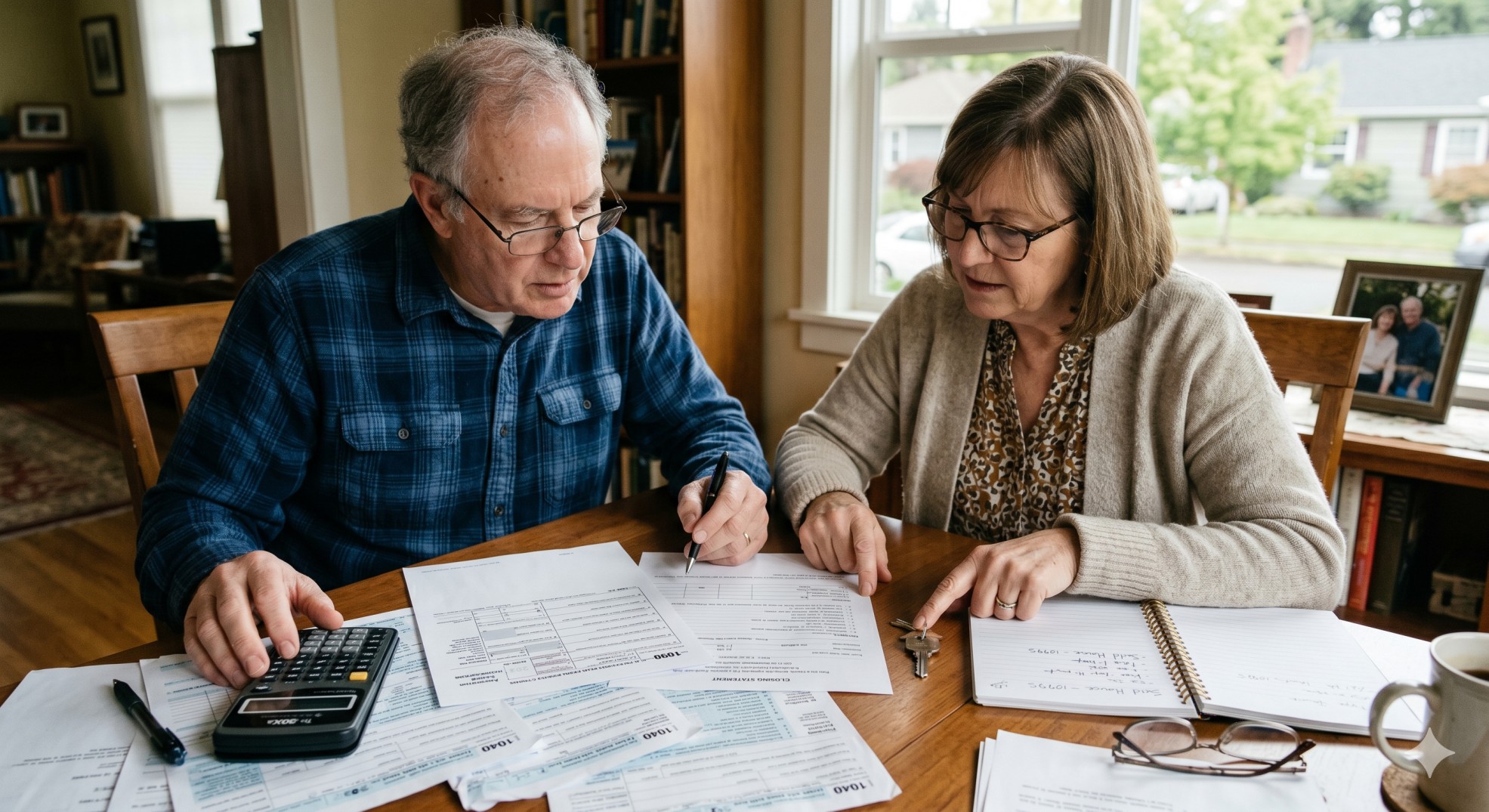
If you sell your main home in tax year 2026 and file in 2027, the IRS may let you keep some or all of the gain tax-free. This guide explains the federal rules for seniors, including the normal exclusion, the nursing-home/disability exception, and the special rule for a surviving spouse.
QUICK TAKEAWAYS
- The IRS may let you exclude up to $250,000 of home-sale gain, or up to $500,000 on a joint return in most cases.
- To get the full exclusion, you generally must pass the ownership test and the use test.
- If you become disabled and move to a licensed nursing home or similar facility, the IRS may treat that time as if you still lived in the home.
- A surviving spouse may still qualify for up to $500,000 if the home is sold within 2 years after the spouse’s death and the other IRS rules are met.
- If you receive Form 1099-S or have taxable gain, you usually must report the sale on Form 8949 and Schedule D.
WHO THIS APPLIES TO
This article applies to U.S. seniors who sell their main home in 2026 and file their tax return in 2027. It is especially useful for retirees, widows and widowers, married couples, and seniors who move because of health or nursing-home needs. This is a federal IRS guide. State tax rules may differ, so check your state return instructions too.
INTRODUCTION
The big question is simple: If I sell my home in retirement, will I owe tax on the gain? For many seniors, the answer is no, or at least not on all of it. The IRS has a home-sale exclusion that can shelter up to $250,000 of gain, or $500,000 on a joint return in most cases. The rules can also help seniors who move to a nursing home or who sell after a spouse dies. This article explains the 2026 federal rules, what the IRS means by “gain,” who qualifies, how the special exceptions work, and what forms to use when you file in 2027. It does not give personal tax advice or state-by-state rules.
MAIN EXPLANATION
What it is
In plain English, a home-sale exclusion is a tax break for selling your main home. The IRS says your main home is the home you live in most of the time. It can be a house, condo, co-op apartment, mobile home, or houseboat. If you qualify, part or all of the gain may be tax-free.
“Gain” means profit. The IRS figures gain by taking the sale price, subtracting selling expenses, and then subtracting your adjusted basis. Your adjusted basis is basically your tax cost in the home, including what you paid for it and some improvement costs. If the number is negative, that is a loss. If the number is positive, that is a gain.
Who qualifies for the full exclusion
For the full exclusion, the IRS generally wants you to meet three basic conditions:
- You meet the ownership test.
- You meet the use test.
- You did not exclude gain from another home sale during the prior 2 years.
The ownership test usually means you owned the home for at least 2 of the last 5 years before the sale. The use test usually means you lived in the home as your main home for at least 2 of the last 5 years before the sale. The 2 years do not have to be in one straight block. They can be spread across the 5-year period.
For married couples filing a joint return, the rules are a little different. The IRS says either spouse can meet the ownership test, but both spouses must meet the use test individually to get the full $500,000 exclusion. If you file separately, the normal limit is generally the $250,000 exclusion.
How the nursing-home / disability exception works
This is one of the most important senior rules. If, during the 5-year period before the sale, you become physically or mentally unable to care for yourself, and you owned and lived in the home as your main home for a total of at least 1 year, the IRS may treat you as if you were still living in the home while you were in a licensed facility such as a nursing home. The facility must be licensed by a state or political subdivision to care for people in your condition.
That means a senior who moves into a nursing home because of disability may still pass the use test, even if they no longer live in the house every day. But the exception does not erase the ownership test. You still must meet the ownership rule.
How the surviving spouse rule works
The IRS gives a special break to a surviving spouse. If your spouse died and you did not remarry before the sale, you are treated as having owned and lived in the home during the time your spouse owned and lived in it as a main home. If the sale happens no more than 2 years after the date of death and the other rules are met, you may still be able to exclude up to $500,000 of gain.
That is a very helpful rule for widows and widowers. It can make a sale tax-free even when the surviving spouse alone would not have met both tests on the sale date.
Important income and timing points
The home-sale exclusion is not based on AGI. It is based on the home rules above. But if you do not meet the full rules, the IRS may still allow a partial exclusion if the main reason for the sale was a health issue, a work-related move, or an unforeseeable event. For seniors, the health issue rule is often the most useful one.
The IRS also says that if you received Form 1099-S, you may have to report the sale even if the gain is fully excludable. If you have any taxable gain, or if Form 1099-S was issued, you generally report the sale on Form 8949 and Schedule D (Form 1040). If no form is issued and all gain is excluded, you often do not have to report it.
Common mistakes seniors make
A very common mistake is thinking every home sale is tax-free. It is not. The exclusion depends on the facts. Another common mistake is forgetting the 2-year rule or not realizing that a senior who moved to a nursing home may still need proof of disability and licensed-facility care.
Another mistake is forgetting that a loss on the sale of a personal home is generally not deductible. The IRS says a personal-use home loss is usually not deductible. That surprises many people.
Another issue is business or rental use. If part of the home was used for business or rental, special rules can apply, and depreciation recapture may be taxable. In that case, the home-sale math can get complicated fast. A CPA can help.
What changed for tax year 2026
For the 2026 tax year, the key senior home-sale rules in the IRS materials reviewed here stay the same in substance: the basic exclusion is still $250,000 or $500,000 on a joint return in most cases, the disability/nursing-home use-test exception still applies, and the surviving spouse rule still applies. The main job for 2026 is to apply the rules carefully to your facts.
When to get professional help
You should strongly consider a CPA, EA, or tax attorney if any of these are true:
- you are widowed and sold the home after your spouse died;
- you moved to assisted living or a nursing home;
- you had business or rental use in the home;
- you received Form 1099-S;
- you are not sure whether you met the 2-year tests; or
- you may have both taxable gain and a partial exclusion.
PRACTICAL EXAMPLES
Simplified example 1: Married couple sells the family home
Janet and Robert are married and file a joint return. They owned and lived in their home for more than 2 years during the last 5 years. They did not use the home sale exclusion on another home in the last 2 years. If they qualify, they may exclude up to $500,000 of gain.
Simplified example 2: A widow sells within 2 years
Linda’s husband died in 2026. Linda did not remarry. She sells the home in 2027, which is within 2 years of her husband’s death. If she and her husband met the other IRS rules at the time of death, she may still qualify for up to a $500,000 exclusion.
Simplified example 3: Senior moves to a nursing home
George lived in his home for 18 months, then became unable to care for himself and moved to a licensed nursing home. He later sells the home in 2026. Because he owned and lived in the home for at least 1 year, the IRS may treat the nursing-home time as home time for the use test. He still must meet the ownership test.
Simplified example 4: Partial exclusion for a health-related move
Evelyn could not meet the full 2-year use test because she moved early for medical care. The main reason for the sale was a health issue. She may still qualify for a partial exclusion. The exact amount depends on her facts.
Simplified example 5: Form 1099-S is issued
Tom’s closing company sends him Form 1099-S. Even if he excludes all of the gain, the IRS says he may still need to report the sale. If part of the gain is taxable, he will generally use Form 8949 and Schedule D.
CHECKLIST OR SUMMARY TABLE
Quick checklist for seniors
- Is this your main home?
- Did you own it for at least 2 of the last 5 years?
- Did you use it as your main home for at least 2 of the last 5 years, or qualify for the disability/nursing-home exception?
- If you are married filing jointly, do both spouses meet the use test?
- If your spouse died, did you sell within 2 years and avoid remarriage before the sale?
- Did you get Form 1099-S? If yes, you may need to report the sale even if the gain is excluded.
- Did you use part of the home for business or rental? If yes, special rules may apply.
FAQ
1. Can I sell my home in retirement and pay no tax?
Yes, sometimes. If you meet the IRS ownership and use tests, you may exclude up to $250,000 of gain, or up to $500,000 on a joint return in most cases.
2. What if I moved to a nursing home?
If you became unable to care for yourself, owned and lived in the home for at least 1 year, and moved to a licensed nursing home or similar facility, the IRS may treat that time as if you still lived in the home.
3. What if my spouse died before the sale?
If you did not remarry before the sale, the IRS may let you count your spouse’s ownership and use time. If the sale is within 2 years of death and the other rules are met, you may still qualify for the larger exclusion.
4. Do I have to report the sale if all the gain is excluded?
Usually not, unless you received Form 1099-S or have some taxable gain. If either is true, you generally report the sale on Form 8949 and Schedule D.
5. Is a loss on my home deductible?
Generally, no. A loss on the sale of a personal home is not deductible.
6. What if part of my home was rented out or used for business?
It depends. Special rules can apply, and depreciation recapture may be taxable. That is a good time to ask a CPA for help.
BOTTOM LINE
For tax year 2026, many seniors can still sell a home without paying tax on all the gain. The main rules are the ownership test, the use test, the nursing-home/disability exception, and the surviving spouse rule. The tax break can be very valuable, but the facts matter. If your sale is complicated, do not guess. Ask a CPA before you file in 2027.
WHAT TO DO NEXT
- Gather your closing papers, deed history, and any Form 1099-S.
- Check whether you met the 2-year ownership and use tests.
- If you moved to a nursing home or sold after a spouse died, review the special IRS exceptions carefully.
- If part of the home was used for rent or business, get professional help before you file.
- If you are unsure, consult a CPA, EA, or tax attorney.
Source note: “Sources consulted: IRS forms, instructions, publications, official updates, and related guidance.”
