
Renouncing US citizenship in 2026—or surrendering a long-held green card—is the only legal way to permanently end your obligation to file annual US federal tax returns on worldwide income. While the US Department of State slashed the administrative consular processing fee for a Certificate of Loss of Nationality (CLN) from $2,350 down to $450 effective April 13, 2026, the tax hurdles governed by Internal Revenue Code (IRC) Section 877A remain unforgiving. Before the IRS lets you walk away from the US tax system, it audits your net worth, your prior five years of tax liability, and your filing compliance history on Form 8854 to determine whether you owe a final departure levy known as the IRS exit tax.
Contrary to popular belief, most Americans living abroad who give up their passport pay zero exit tax. However, if you cross a single statutory threshold and become a covered expatriate, the IRS treats you as having sold every asset you own across the globe on the day before your expatriation date. Worse, a single paperwork mistake or an unfiled foreign information return from three years ago can trigger automatic covered status—turning a routine consular appointment into a six-figure tax bill when you file your final returns in 2027.
⚡ Executive Summary: Key 2026 Tax Rules at a Glance
- 2026 Covered Expatriate Thresholds: Per IRS Revenue Procedure 2025-32, you are a covered expatriate if your net worth is $2,000,000 or more on your expatriation date, your 5-year average annual net US income tax liability for 2021–2025 exceeds $211,000, or you fail to certify 5 years of full federal tax compliance on Form 8854.
- $910,000 Mark-to-Market Exclusion: For expatriations occurring in calendar year 2026, the IRC Section 877A(a)(3) deemed-sale gain exclusion is $910,000 (up from $890,000 in 2025). This exclusion applies only to mark-to-market capital assets—never to IRAs, 401(k)s, foreign pensions, or trusts.
- Post-OBBBA Gifting & Section 2801 Rules: The One Big Beautiful Bill Act (OBBBA) permanently raised the unified federal estate and gift tax exemption to $15,000,000 for 2026, giving ultra-high-net-worth citizens unprecedented room to gift assets before expatriating. Conversely, future gifts or bequests made by a covered expatriate to US persons face a flat 40% tax under final IRC Section 2801 regulations (reported on Form 708).
- 2027 Dual-Status Filing Deadlines: If you expatriate in 2026, your final dual-status return (Form 1040 attached to Form 1040-NR) and initial Form 8854 are due by June 15, 2027, for taxpayers residing abroad, though any 2026 exit tax balance owed must be paid by April 15, 2027, to avoid interest.
Table of Contents
- ⚡ Executive Summary: Key 2026 Tax Rules at a Glance
- What Is the IRS Exit Tax (IRC Section 877A) in 2026?
- Who Pays the IRS Exit Tax? The 3 Covered Expatriate Tests for 2026
- Statutory Exceptions and IRS Relief Procedures for Former Citizens
- 2025 vs. 2026 Expatriation Thresholds and Asset Treatment Matrix
- How the Expatriation Tax 2026 Is Calculated (Mark-to-Market & $910,000 Exclusion)
- 4 Real-World 2026 Expatriation Scenarios (With Step-by-Step Math)
- Business Owners, Green Card Holders, and the Section 2801 Inheritance Trap
- Pre-Expatriation Tax Planning: Legal Ways to Avoid Covered Status in 2026
- Step-by-Step Guide: How to File Your Dual-Status Return and Form 8854 in 2027
- Frequently Asked Questions About Renouncing US Citizenship in 2026
- Final Checklist Before Scheduling Your 2026 Consular Appointment
What Is the IRS Exit Tax (IRC Section 877A) in 2026?
The IRS exit tax—formally titled the Expatriation Tax under IRC Section 877A—is a final federal income tax assessment imposed on certain wealthy or tax-noncompliant US citizens and long-term green card holders who formally terminate their US tax status. Enacted under the Heroes Earnings Assistance and Relief Tax (HEART) Act of 2008, the statute prevents individuals from accumulating tax-deferred wealth or unrealized capital gains inside the US tax net and then relocating to a low-tax foreign jurisdiction to cash out tax-free.
Section 877A only applies to two distinct groups of individuals who expatriate during calendar year 2026:
- US Citizens: Any individual who relinquishes US nationality by taking a formal oath of renunciation before a US diplomatic or consular officer abroad (8 U.S.C. Section 1481(a)(5)) or commits another statutory expatriating act with the intent to relinquish citizenship.
- Long-Term Lawful Permanent Residents (Green Card Holders): Any non-citizen who held a US green card in at least 8 of the last 15 taxable years ending with the year in which residency is terminated—either by filing USCIS Form I-407 (Record of Abandonment of Lawful Permanent Resident Status) or by electing to be treated as a tax resident of a foreign treaty country via IRS Form 8833.
Your exact “expatriation date” controls which calendar year’s inflation thresholds apply and sets the valuation date for your worldwide balance sheet. For US citizens renouncing at an embassy in 2026, your expatriation date is the exact day you sign the oath of renunciation in front of the consular officer—not the later date when the State Department approves and mails your Certificate of Loss of Nationality (Form DS-4083). Although the State Department published a final rule on March 13, 2026, lowering the administrative CLN fee from $2,350 to $450 (effective April 13, 2026), that consular fee reduction has zero effect on your tax obligations with the Internal Revenue Service.
Who Pays the IRS Exit Tax? The 3 Covered Expatriate Tests for 2026
You only owe the IRS exit tax when renouncing US citizenship in 2026 if you are classified as a covered expatriate under IRC Section 877A(g)(1)(A), which cross-references the three statutory triggers in IRC Section 877(a)(2). Meeting even one of the following three tests on your expatriation date makes you a covered expatriate; if you stay beneath all three thresholds, you exit the US tax system owing $0 in exit tax.
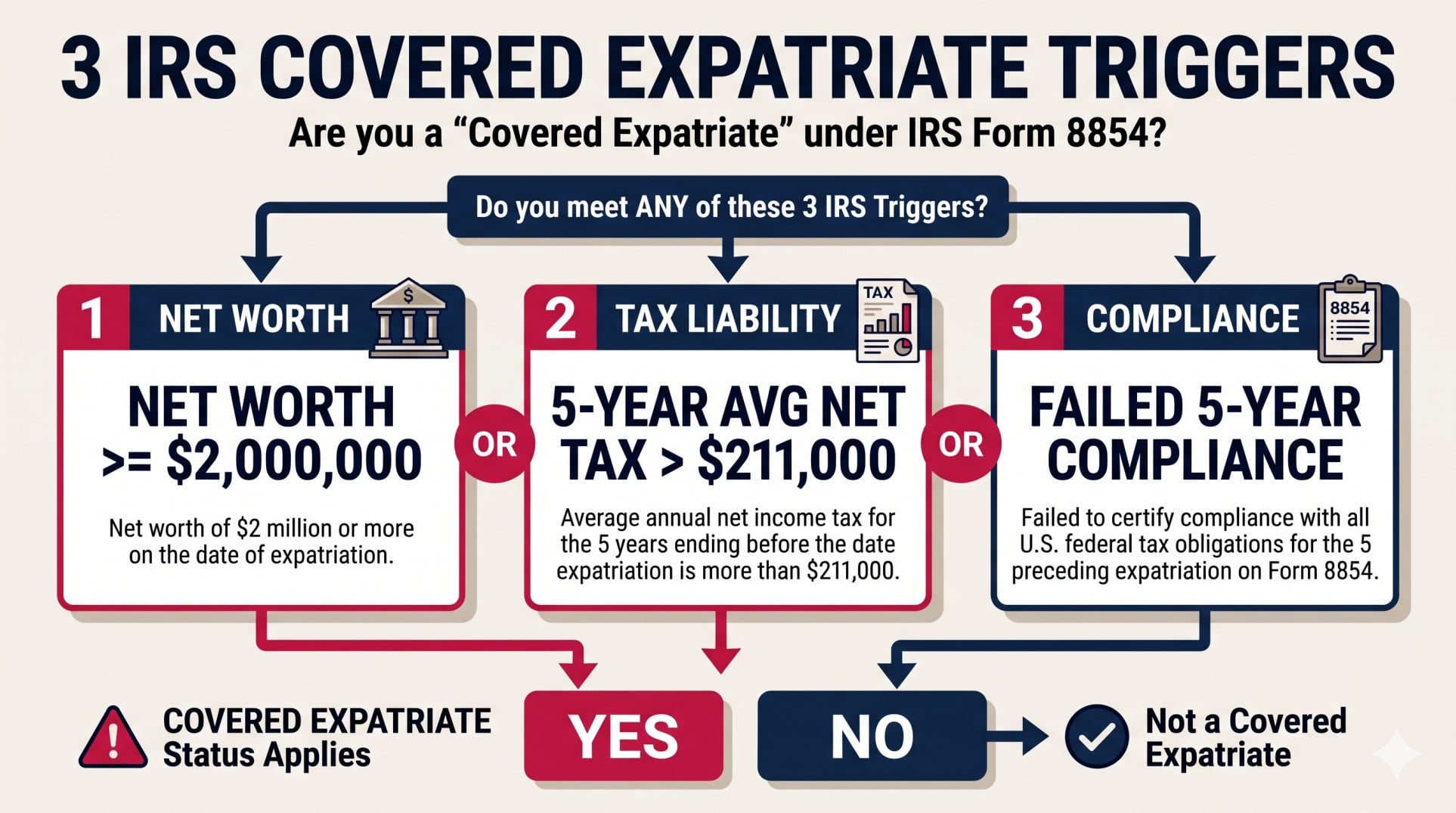
1. The $2,000,000 Net Worth Test (Unindexed Since 2004)
You are a covered expatriate if your personal net worth is $2,000,000 or more on the exact date of your expatriation. Unlike almost every other threshold in the tax code, Congress never indexed the $2,000,000 net worth figure for inflation—meaning it has remained frozen at $2 million since 2004.
Under IRS Notice 2009-85 and Notice 97-19, your net worth includes the fair market value (minus bona fide liabilities like mortgages and margin loans) of every worldwide interest in property that would be taxable as a gift under IRC Section 2501 if you transferred it on your expatriation date. You must include:
- Foreign and domestic real estate (including your primary residence, vacation homes, and rental properties).
- Cash, brokerage accounts, cryptocurrency, collectibles, automobiles, and personal property.
- The present actuarial value of US retirement accounts (401(k)s, Traditional/Roth IRAs), foreign employer pensions, and unvested deferred compensation.
- Closely held business shares, partnership interests, and beneficial interests in grantor and non-grantor trusts (valued using the two-step allocation and IRC Section 7520 actuarial tables specified in Notice 97-19).
Married couples do not combine their net worth. Each spouse’s net worth is calculated strictly on an individual basis ($2,000,000 per person), dividing jointly held marital or community property according to local property law and legal title.
2. The $211,000 Average Annual Net Income Tax Liability Test
Per IRS Revenue Procedure 2025-32 (Section 4.37), you are a covered expatriate in 2026 if your average annual net income tax liability for the five taxable years ending before your expatriation date (Tax Years 2021, 2022, 2023, 2024, and 2025) is more than $211,000 (up from $206,000 for 2025 expatriations).
Pay close attention to the wording: this test measures your 5-year average net federal income tax paid after subtracting Foreign Tax Credits, not your gross income. If you lived in a high-tax country like the UK or Germany from 2021 through 2025 and used Foreign Tax Credit vs. FEIE strategies for expats to reduce your net US tax bill on Form 1040 Line 24 to $0 each year, your 5-year average net tax liability is $0—even if you earned $1,000,000 per year. However, one critical trap catches married expats: if you filed Married Filing Jointly (Form 1040) during any of the prior five years, you must include 100% of the joint tax liability from that return in your personal 5-year average calculation, even if your spouse earned all the income.
3. The 5-Year Tax Compliance Certification Test (The Paperwork Trap)
Even if your net worth is $50,000 and your 5-year average tax liability is $0, you automatically become a covered expatriate under IRC Section 877(a)(2)(C) if you fail to certify under penalty of perjury on Part IV, Line 6 of Form 8854 that you have complied with all federal tax obligations for the five taxable years preceding your expatriation year (2021–2025).
Under IRS Notice 2009-85, “all federal tax obligations” means far more than just filing Form 1040. You must have filed complete, accurate returns and paid all taxes, penalties, and interest across income taxes, self-employment taxes, gift taxes, and every mandatory international information return—including Form 5471 (foreign corporations), Form 3520/3520-A (foreign trusts and large foreign gifts), Form 8621 (PFIC foreign mutual funds), and Form 8938 (FATCA). If you have unfiled returns or missing schedules between 2021 and 2025, you must clean them up before signing Form 8854 in 2027.
Statutory Exceptions and IRS Relief Procedures for Former Citizens
The Internal Revenue Code provides two statutory exceptions under IRC Section 877A(g)(1)(B) that exempt qualifying individuals from the $2,000,000 Net Worth Test and the $211,000 Tax Liability Test, alongside a specialized IRS administrative amnesty program for “Accidental Americans.”
Exception 1: Dual Citizens at Birth
Even if your net worth is $10 million or your 5-year average US tax exceeds $211,000, you will not be treated as a covered expatriate if you satisfy all four of these conditions:
- You became at birth a citizen of the United States and also a citizen of another country.
- On your expatriation date, you continue to be a citizen of, and are taxed as a resident of, that other country.
- You have been a tax resident of the United States (under the substantial presence test of IRC Section 7701(b)(1)(A)(ii)) for no more than 10 taxable years during the 15-taxable-year period ending with the taxable year during which the expatriation occurs.
- You still certify 5 years of full federal tax compliance on Form 8854. (The dual-citizen exception waives the wealth and tax liability tests, never the 5-year compliance certification test).
Exception 2: Minors Relinquishing Citizenship Before Age 18½
An individual is exempt from the Net Worth Test and Tax Liability Test if they relinquish US citizenship before reaching age 18½, provided they were a US tax resident for no more than 10 taxable years before the date of relinquishment—and still file Form 8854 certifying 5 years of tax compliance.
IRS Relief Procedures for Certain Former Citizens (Accidental Americans)
What if you were born in a US hospital to foreign parents, moved abroad as an infant, never obtained a Social Security Number, and never filed a US tax return? Under the IRS Relief Procedures for Certain Former Citizens (which remain active in 2026), qualifying individuals who relinquished citizenship after March 18, 2010, can achieve full compliance and avoid covered expatriate status without paying back taxes, penalties, or interest—and without needing an SSN.
To qualify for these relief procedures in 2026/2027, you must meet every single criterion:
- Your past failure to file US tax returns and pay taxes was due to non-willful conduct.
- You have zero prior filing history as a US citizen or resident (filing a Form 1040-NR under the mistaken good-faith belief you were a nonresident alien does not disqualify you).
- Your net worth was under $2,000,000 both on your date of expatriation and on the date of your relief submission.
- Your aggregate total US tax liability across the 6-year submission window (the year of expatriation plus the 5 prior tax years) is $25,000 or less after applying foreign tax credits and the FEIE (if claimed on timely returns, note that late returns under this relief calculate tax before penalties). If your 6-year aggregate tax is $25,000 or under, the IRS waives the entire tax payment completely.
- You mail a paper package containing 6 years of tax returns (5 prior years of Form 1040 plus the dual-status expatriation return, Form 8854, and all required information returns) with “Relief for Certain Former Citizens” written in red ink across the top of each first page.
2025 vs. 2026 Expatriation Thresholds and Asset Treatment Matrix
Planning for the expatriation tax 2026 requires using the updated inflation figures from IRS Revenue Procedure 2025-32 alongside the permanent estate and gift tax provisions enacted by the One Big Beautiful Bill Act (Public Law 119-21).
| Expatriation Tax Metric / Threshold | Tax Year 2025 (Expatriated in 2025) | Tax Year 2026 (Expatriated in 2026) | Statutory Authority / Form |
|---|---|---|---|
| 5-Year Average Annual Net Income Tax Trigger | More than $206,000 | More than $211,000 | IRC Sec. 877(a)(2)(A); Rev. Proc. 2025-32 Sec. 4.37 |
| Net Worth Covered Expatriate Trigger | $2,000,000 or more | $2,000,000 or more (Unindexed) | IRC Sec. 877(a)(2)(B); Form 8854 Part II |
| Mark-to-Market Deemed Sale Gain Exclusion | $890,000 | $910,000 | IRC Sec. 877A(a)(3); Rev. Proc. 2025-32 Sec. 4.38 |
| State Dept. CLN Renunciation Fee | $2,350 | $450 (Effective April 13, 2026) | 22 CFR 22.1; Form DS-4083 |
| Lifetime Federal Estate & Gift Tax Exemption | $13,990,000 | $15,000,000 ($30M married) | OBBBA; IRC Sec. 2010(c)(3) |
| Annual Gift Tax Exclusion (Per Donee) | $19,000 | $19,000 | IRC Sec. 2503(b); Rev. Proc. 2025-32 Sec. 4.42(1) |
| Annual Gift Exclusion to Non-Citizen Spouse | $190,000 | $194,000 | IRC Sec. 2523(i)(2); Rev. Proc. 2025-32 Sec. 4.42(2) |
| Section 2801 Covered Gift / Bequest Tax Rate | 40% (Above $19,000 exclusion) | 40% (Above $19,000 exclusion) | IRC Sec. 2801; T.D. 10027; Form 708 |
Once an individual is classified as a covered expatriate in 2026, IRC Section 877A does not treat all assets equally. Instead, the IRS divides your worldwide balance sheet into four distinct statutory categories—only one of which receives the $910,000 exclusion.
| Asset Category Under IRC Sec. 877A | Examples of Included Assets | 2026 Exit Tax Rule & Rate | Eligible for $910,000 Exclusion? |
|---|---|---|---|
| 1. General Mark-to-Market Property (IRC Sec. 877A(a)) | Stocks, ETFs, crypto, primary residence, rental real estate, private business shares, Roth IRAs | Deemed sold at FMV the day before expatriation; net gain above exclusion taxed at 15%/20% LTCG + 3.8% NIIT (or ordinary rates) | Yes (Allocated pro rata across all built-in gain assets) |
| 2. Specified Tax-Deferred Accounts (IRC Sec. 877A(e)) | Traditional IRAs, SEP IRAs, SIMPLE IRAs, 529 plans, HSAs, Coverdell ESAs | Deemed 100% distributed the day before expatriation; taxed at ordinary rates up to 37% (10% early penalty waived) | No (Taxed from the very first dollar) |
| 3. Eligible Deferred Compensation (IRC Sec. 877A(d)(1)/(3)) | US 401(k), 403(b), US stock options (with US payor & Form W-8CE filed within 30 days) | No immediate lump-sum tax; payor withholds flat 30% tax when actual future distributions are paid | No (Treaty benefits permanently waived) |
| 4. Ineligible Deferred Compensation (IRC Sec. 877A(d)(2)) | Foreign employer pensions (e.g., UK SIPP, Australian Super, Canadian RPP), US plans without timely W-8CE | Present value of accrued benefit taxed immediately as ordinary income up to 37% on the day before expatriation | No (Frequently triggers double taxation without foreign credit relief) |
| 5. Non-Grantor Trust Interests (IRC Sec. 877A(f)) | Beneficial interests in domestic or foreign non-grantor trusts held day before expatriation | Trusteewithholds flat 30% tax on the taxable portion of any future direct or indirect distribution | No (Unless electing deemed settlement via IRS Private Letter Ruling) |
How the Expatriation Tax 2026 Is Calculated (Mark-to-Market & $910,000 Exclusion)
Calculating the expatriation tax 2026 requires valuing every asset you own at fair market value on the day before your expatriation date, sorting those assets into their IRC Section 877A buckets, and computing the resulting capital gains and ordinary income tax on your final Form 1040.

Bucket 1: Mark-to-Market Deemed Sale and Pro-Rata Exclusion Allocation
Under IRC Section 877A(a)(1), all worldwide property not falling into a retirement or trust exception is treated as sold for its fair market value on the day before your expatriation date. Any built-in gains must be recognized immediately (and built-in losses are allowed to the extent permitted by the Code, except wash-sale rules under Section 1091 do not apply). Importantly, when calculating the deemed gain on your primary residence, you cannot claim the IRC Section 121 principal residence exclusion ($250,000 Single / $500,000 Married) against the mark-to-market deemed sale—if you want the Section 121 home sale exclusion, you must physically sell the home before expatriating.
Next, you apply the 2026 statutory exclusion of $910,000 under IRC Section 877A(a)(3) and Rev. Proc. 2025-32. Under Section 3.C of IRS Notice 2009-85, you do not simply subtract $910,000 from your bottom-line net capital gain. Instead, you must allocate the $910,000 exclusion pro rata among all built-in gain properties (ignoring loss properties) using this exact formula:
Exclusion Allocated to Asset = $910,000 × (Built-In Gain of Specific Asset ÷ Total Built-In Gain of All Gain Assets)
This pro-rata rule matters enormously if your portfolio mixes assets taxed at different rates—such as collectibles taxed at 28%, short-term capital gains taxed up to 37%, depreciable real estate subject to 25% Section 1250 unrecaptured depreciation, and long-term stocks taxed at 15% or 20% (plus the 3.8% Net Investment Income Tax on Form 8960 for MAGI above $200,000 Single / $250,000 MFJ).
Green Card Basis Step-Up Relief (IRC Section 877A(h)(2)): For long-term green card holders (not US citizens from birth), any property you owned before you first became a US tax resident receives an automatic basis floor equal to its fair market value on the first day of your US residency (excluding US real property interests and property used in a US trade or business), unless you affirmatively elect out on Form 8854.
Buckets 2 & 3: The Retirement Account Tax Accelerations
The harshest financial shock of the IRS exit tax hits retirement savings, where the $910,000 exclusion is completely unavailable:
- Specified Tax-Deferred Accounts (Traditional IRAs, SEP/SIMPLE IRAs, HSAs, 529 Plans): Under IRC Section 877A(e), you are treated as receiving a lump-sum distribution of your entire account balance on the day before your expatriation date. If you hold an $800,000 Traditional IRA, all $800,000 is added directly to your ordinary income on your final 2026 Form 1040, pushing you straight into the 35% and 37% marginal tax brackets (which begins at $640,600 for Single filers in 2026). While the 10% early withdrawal penalty under IRC Section 72(t) is waived, your host country will not recognize this fictitious US “deemed distribution,” meaning you will likely pay tax a second time to your foreign government when you actually withdraw the cash in retirement.
- Eligible Deferred Compensation (US 401(k)s and Employer Plans): If you have a US 401(k) with a US plan administrator, you can avoid immediate lump-sum taxation ONLY if you submit IRS Form W-8CE (Notice of Expatriation and Waiver of Treaty Benefits) to the plan payor within 30 days of your expatriation date (or before the first post-expatriation distribution, if earlier). Doing so classifies the 401(k) as “eligible deferred compensation,” meaning you pay $0 tax in 2026, and the US custodian withholds a flat 30% tax as distributions occur in the future.
- Ineligible Deferred Compensation (Foreign Pensions): Because a foreign pension administrator (such as a UK workplace pension, Canadian RPP, or Australian Superannuation fund) is not a US payor committed to withholding 30% for the IRS, foreign pensions are classified as ineligible deferred compensation. You must calculate the present value of your accrued foreign pension on the day before expatriation and pay immediate US ordinary income tax up to 37% on that phantom balance—without a dime of cash leaving the locked pension fund.
4 Real-World 2026 Expatriation Scenarios (With Step-by-Step Math)
To see how these rules interact in real life, review these four mathematical examples for taxpayers renouncing US citizenship in 2026 or abandoning long-term green cards.
Scenario 1: The Compliant Expat Under All Thresholds ($0 Exit Tax)
- Taxpayer Profile: Liam, Single US citizen living in Dublin, Ireland, renounces at the US Embassy on August 14, 2026.
- 2026 Metrics: Net worth is $1,450,000 ($600,000 home equity, $500,000 brokerage account, $350,000 Irish pension). His 5-year average US net income tax (2021–2025) is $0 (fully offset by Irish Foreign Tax Credits). All 2021–2025 tax returns and FBARs were timely filed.
- Exit Tax Calculation: Liam’s net worth is below $2,000,000, his 5-year average net tax is below $211,000, and he certifies 5 years of compliance on Form 8854. He is not a covered expatriate.
- 2026 Result: Liam pays the $450 State Department CLN fee and owes $0 in IRS exit tax. His Irish pension and brokerage gains escape Section 877A completely.
Scenario 2: Covered Expatriate Shielded by the $910,000 Gain Exclusion ($0 Exit Tax)
- Taxpayer Profile: Sophia, Single US citizen in Zurich, Switzerland, renounces on September 10, 2026.
- 2026 Metrics: Worldwide net worth is $2,600,000, consisting of $800,000 in cash and a taxable brokerage portfolio worth $1,800,000 with a cost basis of $1,050,000 (she holds no retirement accounts or trusts).
- Exit Tax Calculation: Because her $2,600,000 net worth exceeds the $2,000,000 threshold, Sophia is a covered expatriate. Under the Section 877A(a) mark-to-market rule, her brokerage portfolio is deemed sold on September 9, 2026, for $1,800,000, generating a built-in long-term capital gain of $750,000 ($1,800,000 FMV minus $1,050,000 basis). She applies the 2026 gain exclusion of $910,000. Because her $750,000 total gain is less than the $910,000 exclusion, her taxable mark-to-market gain is reduced to $0.
- 2026 Result: Despite being a covered expatriate, Sophia owes $0 in Section 877A exit tax (though she remains subject to IRC Section 2801 rules if she later gifts money to US citizens).
Scenario 3: High-Net-Worth Tech Founder With an IRA and Foreign Pension (Heavy Tax Hit)
- Taxpayer Profile: Vikram, a 12-year green card holder (Long-Term Resident), files Form I-407 on November 3, 2026, after moving back to Singapore. Single filer with $100,000 in pre-expatriation salary (which absorbs his standard deduction and lower brackets).
- 2026 Worldwide Assets on Nov 2, 2026:
- Tech stock portfolio: FMV $3,000,000; Cost basis $500,000 (Built-in LTCG = $2,500,000).
- US Rental Condo: FMV $1,200,000; Cost basis $700,000 (Built-in LTCG = $500,000; zero prior depreciation for simplicity).
- Traditional IRA (Bucket 2 Specified Account): Balance = $600,000.
- Total Net Worth = $4,800,000 (Covered Expatriate).
- Step 1 (Mark-to-Market Pro-Rata Exclusion): Total built-in capital gain across Bucket 1 assets is $3,000,000 ($2,500,000 stock + $500,000 condo). The $910,000 2026 exclusion is allocated pro rata:
- Stock Exclusion: $910,000 × ($2.5M ÷ $3.0M) = $758,333 -> Taxable Stock Gain = $1,741,667.
- Condo Exclusion: $910,000 × ($0.5M ÷ $3.0M) = $151,667 -> Taxable Condo Gain = $348,333.
- Total Net Taxable Long-Term Capital Gain = $2,090,000 ($3,000,000 minus $910,000).
- Step 2 (Traditional IRA Deemed Distribution): The entire $600,000 Traditional IRA is deemed distributed on November 2, 2026, with zero exclusion allowed.
- Step 3 (2026 Tax Computation):
- The $600,000 IRA distribution is taxed at 2026 ordinary brackets (32%, 35%, and 37%), generating approximately $206,400 in ordinary income tax.
- The $2,090,000 net mark-to-market capital gain sits above the 2026 20% LTCG threshold ($545,500 for Single filers) and is also subject to the 3.8% Net Investment Income Tax (NIIT), resulting in an effective 23.8% rate on the gain = $497,420.
- 2026 Result: Vikram owes a combined $703,820 in IRS exit tax on April 15, 2027, despite not selling a single share of stock or withdrawing a dollar from his IRA.
Scenario 4: Dual Citizen at Birth With $4.5M Net Worth (Statutory Exemption)
- Taxpayer Profile: Cam
