
⚡ Executive Summary: 2026 REPS Rules & Tax Thresholds
- The Two-Part Statutory Test: For the 2026 tax year, qualifying under IRC Section 469(c)(7) requires one taxpayer to spend more than 750 hours in qualifying real property trades or businesses AND ensure those hours exceed 50% of all personal services performed across all occupations.
- Spousal Qualification Rule: On a joint return, one spouse must independently pass both the 50% test and the 750-hour test alone, while both spouses may combine hours to meet the separate material participation requirement under IRC Section 469(h)(5).
- 100% Bonus Depreciation Synergy: Following the One Big Beautiful Bill Act (P.L. 119-21), 100% bonus depreciation under IRC Section 168(k) applies permanently to qualifying 5-, 7-, and 15-year property acquired and placed in service after January 19, 2025.
- Lower 2026 Section 461(l) Cap: Under IRS Revenue Procedure 2025-32, non-passive rental losses offsetting non-business income (including W-2 wages) are capped at $256,000 for single filers and $512,000 for married couples filing jointly on Form 461.
High-earning investors often buy rental properties expecting immediate tax relief, only to discover that the tax code walls off their rental deductions from their salary. Qualifying for Real Estate Professional Status (REPS) under Internal Revenue Code (IRC) Section 469(c)(7) removes that wall. When you or your spouse satisfy the annual hour requirements and materially participate in your portfolio, you can legally use passive losses against active W-2 income, business profits, and capital gains.
For the 2026 tax year, the stakes are substantially higher. Because the One Big Beautiful Bill Act (OBBBA, P.L. 119-21) permanently restored 100% bonus depreciation while resetting the inflation base for excess business loss caps, understanding real estate professional tax status in 2026 requires precision across federal statutes, Treasury regulations, and state conformity laws.
Table of Contents
- What Is Real Estate Professional Status Under IRC Section 469(c)(7)?
- How to Qualify for Real Estate Professional Status: The 3 Core Pillars
- Which of the 11 Real Property Trades or Businesses Count?
- Why the Reg. Section 1.469-9(g) Grouping Election Makes or Breaks Multi-Property Portfolios
- How Spousal Qualification Shelters High W-2 Salaries
- 2026 Math: 100% Bonus Depreciation, Cost Segregation, and Section 461(l) Limits
- 4 Real-World Hypothetical Scenarios With Step-by-Step 2026 Tax Math
- Step-by-Step Guide: How to Claim and File REPS on Your 2026 Tax Return
- IRS Audit Defense: What the U.S. Tax Court Demands in Your Time Log
- Federal vs. State Conformity Traps: California, New York, New Jersey, and Pennsylvania
- When to Use the Short-Term Rental (STR) Rule Instead of REPS
- Frequently Asked Questions About Real Estate Tax Rules
What Is Real Estate Professional Status Under IRC Section 469(c)(7)?
Real Estate Professional Status is an annual federal tax classification under IRC Section 469(c)(7) that exempts qualifying taxpayers from the default rule treating all rental real estate activities as per se passive. When paired with material participation, it reclassifies rental losses as non-passive, allowing them to offset ordinary wages and business income.
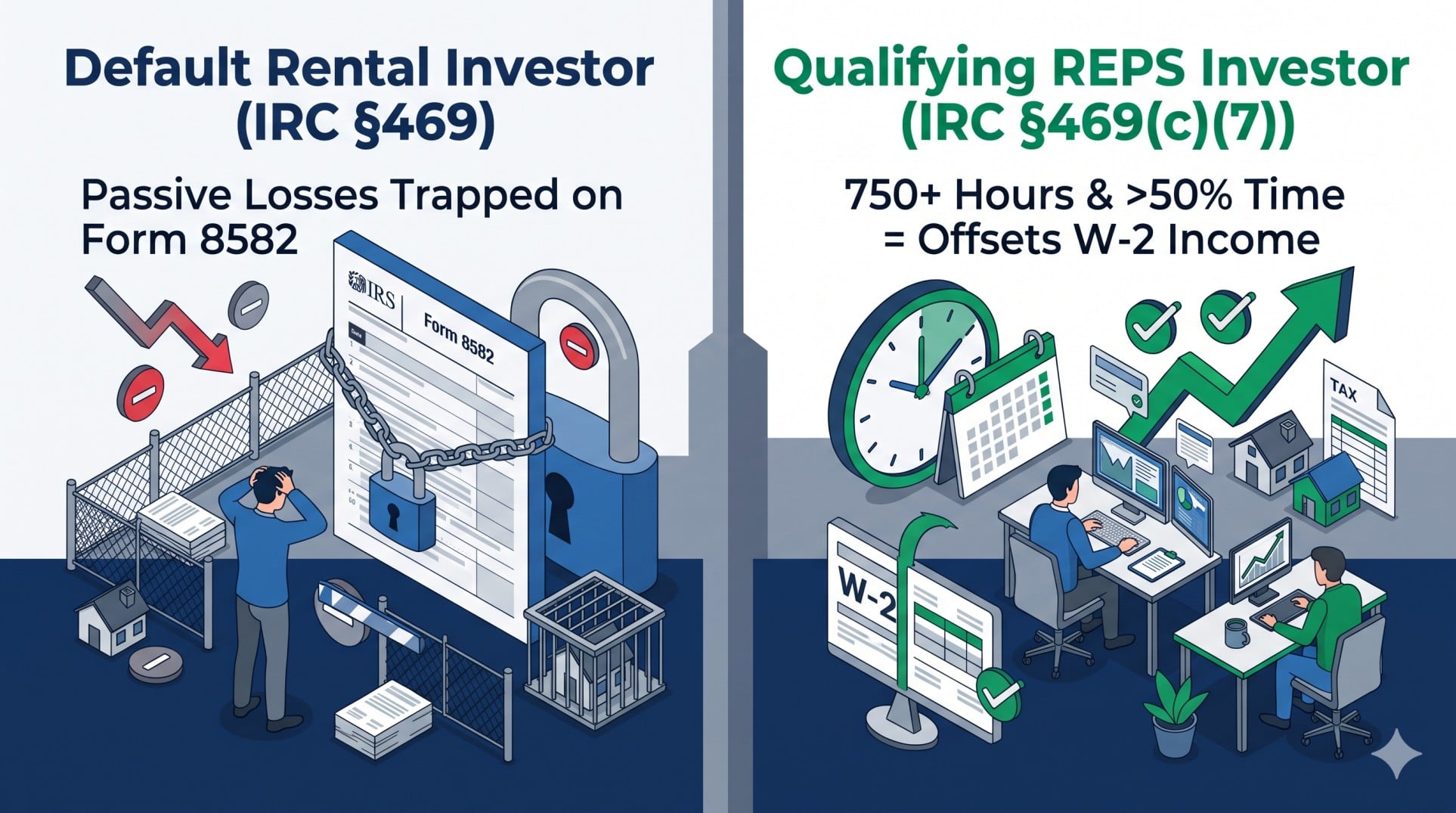
Under the default rules of IRC Section 469(c)(2), every long-term rental real estate activity is automatically classified as passive, regardless of how many hours the property owner spends screening tenants, negotiating leases, or managing renovations. Because passive activity losses can only offset passive activity income, any net rental loss generated by depreciation, mortgage interest, insurance, and repairs gets trapped on Form 8582 (Passive Activity Loss Limitations).
Trapped losses carry forward indefinitely until the investor generates positive passive income or disposes of the entire property interest in a fully taxable transaction to an unrelated party under IRC Section 469(g). Congress did create a minor exception under IRC Section 469(i)—the $25,000 special allowance for active participation—but that allowance phases out by 50 cents for every dollar of Modified Adjusted Gross Income (MAGI) above $100,000 and disappears completely at $150,000 MAGI.
High-income earners in the 32%, 35%, and 37% federal tax brackets never see a dime of that $25,000 allowance. Congress enacted IRC Section 469(c)(7) in 1993 so individuals whose primary occupation is real estate would not be penalized compared to operators in other active businesses. If you satisfy the statutory tests, your rental properties are no longer automatically passive, and your net losses flow from Schedule E (Form 1040) to reduce your household Adjusted Gross Income (AGI). For a deeper look at how passive buckets interact across different investments, review our guide on passive activity loss rules and Form 8582 reporting.
How to Qualify for Real Estate Professional Status: The 3 Core Pillars
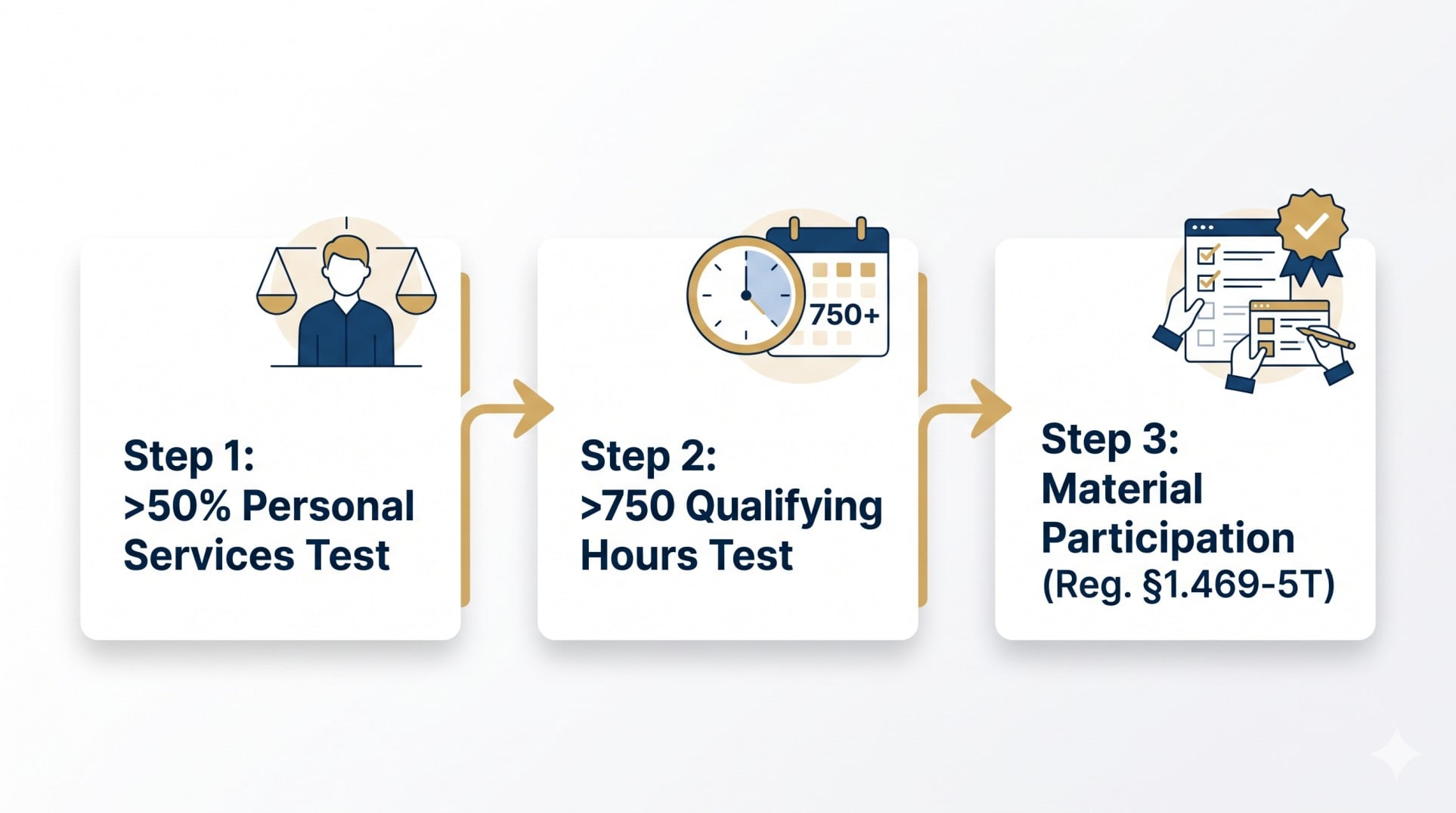
Learning how to qualify requires satisfying two annual personal service tests under IRC Section 469(c)(7)(B)—spending more than 50% of all working hours in real estate and logging more than 750 hours in qualifying real property businesses—followed by proving material participation in the underlying rental properties under Temporary Treasury Regulation Section 1.469-5T(a).
Many taxpayers mistakenly believe that holding a state real estate salesperson or broker license grants them automatic tax relief. A state license has zero bearing on federal tax classification. Qualification is strictly a mechanical, year-by-year test based on documented hours.
Pillar 1: The More-Than-50% Personal Services Test
Under IRC Section 469(c)(7)(B)(i), more than half (greater than 50%) of the personal services you perform in all trades or businesses during the tax year must be performed in real property trades or businesses in which you materially participate.
This single requirement disqualifies almost every full-time W-2 employee and full-time operating business owner from qualifying on their own. Suppose an orthopedic surgeon or software executive works 2,000 hours per year at their primary job. To pass the 50% test personally, that individual would have to log at least 2,001 hours in qualifying real estate activities during the same calendar year—a total of 4,001 working hours, or nearly 77 hours every single week of the year. The IRS and the U.S. Tax Court routinely reject claims where a full-time W-2 employee asserts they worked more hours in night-and-weekend rental management than at their day job.
Pillar 2: The More-Than-750-Hours Test
Under IRC Section 469(c)(7)(B)(ii), you must perform more than 750 hours of services during the taxable year in real property trades or businesses in which you materially participate. Logging exactly 750 hours fails the statutory test; you need at least 751 hours.
Crucially, IRC Section 469(c)(7)(D)(ii) imposes a strict ownership floor on employee hours: personal services performed as an W-2 employee in a real property trade or business do not count toward either the 50% test or the 750-hour test unless the employee is a more-than-5% owner of the employer. A salaried construction project manager or W-2 leasing agent who owns 0% of their corporate employer cannot count a single hour of their day job toward real estate professional tax status.
Pillar 3: Material Participation in the Rental Activities
Passing the 50% test and the 750-hour test only makes you a qualifying professional on paper; it does not make your rental losses deductible by itself. Under Treasury Regulation Section 1.469-9(e)(1), each rental real estate activity remains passive unless you also establish material participation in that specific rental activity.
Taxpayers establish material participation by meeting at least one of the seven tests outlined in Temporary Treasury Regulation Section 1.469-5T(a):
- Test 1 (The 500-Hour Rule): You participate in the rental activity for more than 500 hours during the tax year.
- Test 2 (Substantially All Participation): Your participation in the activity for the tax year constitutes substantially all of the participation of all individuals (including non-owners such as cleaners, handymen, and contractors) for that year.
- Test 3 (100+ Hours and More Than Anyone Else): You participate in the activity for more than 100 hours during the tax year, and your participation is not less than the participation of any other individual (including non-owners) for the year.
- Test 4 (Significant Participation Activities): The activity is a significant participation activity (more than 100 hours), and your aggregate participation in all significant participation activities exceeds 500 hours. Note that under Treasury Regulation Section 1.469-5T(c)(1)(i), rental activities generally cannot use Test 4 on a standalone basis, making Tests 1, 2, and 3 the primary avenues for landlords.
- Test 5 (5 of the Prior 10 Years): You materially participated in the activity for any 5 taxable years during the 10 taxable years that immediately precede the current tax year.
- Test 6 (3 Prior Years for Personal Service Activities): The activity is a personal service activity (such as health, law, engineering, or brokerage—not rental real estate), and you materially participated for any 3 preceding taxable years.
- Test 7 (Facts and Circumstances): Based on all facts and circumstances, you participate in the activity on a regular, continuous, and substantial basis for more than 100 hours during the year, provided no other person receives compensation for managing the activity and no other individual performs more management hours than you.
Which of the 11 Real Property Trades or Businesses Count?
Under IRC Section 469(c)(7)(C), the tax code recognizes exactly 11 real property trades or businesses whose hours can count toward the 750-hour and 50% personal service tests: development, redevelopment, construction, reconstruction, acquisition, conversion, rental, operation, management, leasing, and brokerage.
A critical distinction separates the hours used to qualify as a real estate professional from the hours used to materially participate in your rentals. Suppose a taxpayer is a self-employed real estate agent (1099 independent contractor) who logs 1,200 hours selling residential homes (a brokerage trade or business) and owns two long-term rental duplexes. Those 1,200 brokerage hours satisfy both the 50% test and the 750-hour test under IRC Section 469(c)(7)(B).
However, under Treasury Regulation Section 1.469-9(e)(3)(i), the taxpayer cannot combine their commission brokerage hours with their rental management hours to prove material participation in the two duplexes. They must still independently satisfy one of the seven material participation tests (such as logging more than 100 hours and more than any contractor under Test 3, or more than 500 hours under Test 1) inside the rental properties themselves.
| Activity Category | Counts Toward 750-Hour & 50% Tests? | Counts Toward Rental Material Participation? | IRS / Tax Court Authority & Notes |
|---|---|---|---|
| Direct tenant screening, lease drafting, and rent collection on owned rentals | Yes | Yes | Core rental management and operation under IRC Section 469(c)(7)(C). |
| Hands-on property repairs, maintenance, and contractor supervision on owned rentals | Yes | Yes | Directly attributable operational hours; keep invoices and before/after photos. |
| 1099 real estate brokerage, property flipping, or general contracting for third parties | Yes (if you materially participate in that trade/business) | No (cannot be grouped with rental activities) | Treas. Reg. Section 1.469-9(e)(3)(i) prohibits grouping non-rental real property hours with rentals for rental material participation. |
| W-2 employment at a real estate developer, brokerage, or REIT (owning 5% or less) | No | No | Disqualified under IRC Section 469(c)(7)(D)(ii) unless the employee owns more than 5% of the employer. |
| Reviewing financial statements, reading real estate books, or general market research | No | No | Disallowed as “investor-level” hours under Temp. Treas. Reg. Section 1.469-5T(f)(2)(ii) unless directly involved in day-to-day management. |
| “On-call” standby availability waiting for tenant maintenance calls | No | No | Explicitly rejected by the U.S. Tax Court in Moss v. Commissioner, 135 T.C. 365 (2010). |
Why the Reg. Section 1.469-9(g) Grouping Election Makes or Breaks Multi-Property Portfolios
Without a formal election under Treasury Regulation Section 1.469-9(g), the IRS treats every single rental property you own as a separate activity, forcing you to prove material participation in each building individually. Filing the grouping election consolidates all rental real estate interests into one unified activity for participation testing.
Imagine an investor who owns five single-family rental homes and spends 160 hours per year managing each property. Across the five-property portfolio, the investor logs 800 hours total—passing both the 750-hour test and the 50% test (assuming no other employment). Yet if that investor fails to file the Treasury Regulation Section 1.469-9(g) aggregation statement, each property is tested in isolation. At 160 hours per house, none of the properties cross the 500-hour threshold of Test 1, and if a third-party contractor or property manager logged 165 hours on a major remodel at one of the properties, that property fails Test 3 as well.
By attaching a formal election statement to a timely filed original federal income tax return (including extensions), the taxpayer elects to treat all interests in rental real estate as a single rental real estate activity. Suddenly, those five 160-hour properties combine into one 800-hour activity, easily passing the 500-hour material participation safe harbor across the entire portfolio.
Critical Pitfalls of the Grouping Election
- Binding for Future Years: Once made under Treasury Regulation Section 1.469-9(g)(3), the grouping election is binding for all future tax years in which you qualify as a real estate professional, and it can only be revoked in a year when there is a “material change in the taxpayer’s facts and circumstances.”
- The Former Passive Activity Trap (IRC Section 469(f)): Grouping only unlocks current and future rental losses starting in the year the election applies. Prior-year suspended passive losses sitting on Form 8582 do not automatically turn into non-passive deductions just because you qualify for REPS this year; under IRC Section 469(f), prior suspended losses remain locked until offset by net income from that same activity or triggered by a complete disposition.
- The Disposition Lock-In: When multiple properties are grouped as a single activity, selling just one property out of a five-property group counts as a partial disposition rather than a complete disposition of the entire activity under IRC Section 469(g), which can prevent the immediate release of historical suspended passive losses unless the sale generates sufficient passive gain.
- Late Election Relief Under Revenue Procedure 2011-34: If you qualified in a prior year and forgot to attach the statement to your return, the IRS permits a late grouping election under Revenue Procedure 2011-34 without paying a private letter ruling user fee, provided you filed consistently with the grouping on all affected returns, had reasonable cause for the omission, and attach the required relief statement referring to Revenue Procedure 2011-34.
How Spousal Qualification Shelters High W-2 Salaries
On a Married Filing Jointly tax return, IRC Section 469(c)(7)(B) requires only one spouse to independently satisfy both the 50% personal services test and the 750-hour test. Once one spouse qualifies, both spouses can combine their hours under IRC Section 469(h)(5) to satisfy material participation in the rental portfolio.
This statutory framework is the cornerstone of tax planning for dual-earner or single-earner high-income households. While the spouse earning $450,000 to $1,500,000+ in W-2 wages or medical practice income works 2,000+ hours in their career, the other spouse—who either does not work outside the home or works part-time—serves as the household’s real estate operator.
Pay close attention to how the two sets of rules split:
- Stage 1 (The 750-Hour and 50% Tests — NO Spousal Combining): Spouses cannot combine hours to reach the 751-hour threshold. If Spouse A logs 400 hours and Spouse B logs 400 hours in real estate, the household has zero qualifying real estate professionals. One spouse must cross 750 hours solo and spend more than 50% of their individual working time in real property trades or businesses.
- Stage 2 (Material Participation — Spousal Combining ALLOWED): Under IRC Section 469(h)(5) and Temporary Treasury Regulation Section 1.469-5T(f)(3), in determining whether a taxpayer materially participates in an activity, the participation of the taxpayer’s spouse counts as participation by the taxpayer. Thus, if Spouse B qualifies as the real estate professional with 760 hours across a grouped rental portfolio (or 550 hours in a brokerage plus 250 hours in grouped rentals), and Spouse A contributes 260 hours of hands-on rental repairs and bookkeeping on weekends, their combined 510 rental hours satisfy Test 1 (500+ hours) for material participation.
Tax Court Warning on Part-Time W-2 Spouses: If the qualifying spouse holds a part-time W-2 job outside real estate, track every single hour on their W-2 paystubs, including paid time off (PTO), sick leave, and holiday hours.
If a part-time nurse logs 820 hours on their hospital W-2 during 2026, logging 780 hours in rental real estate passes the 750-hour test but fails the 50% test (780 is less than 820), disqualifying the entire deduction.
2026 Math: 100% Bonus Depreciation, Cost Segregation, and Section 461(l) Limits
In 2026, qualifying for real estate professional tax status is supercharged by the permanent restoration of 100% bonus depreciation under the One Big Beautiful Bill Act (P.L. 119-21), while simultaneously constrained by the lowered $256,000 (single) and $512,000 (married filing jointly) excess business loss cap under IRC Section 461(l).
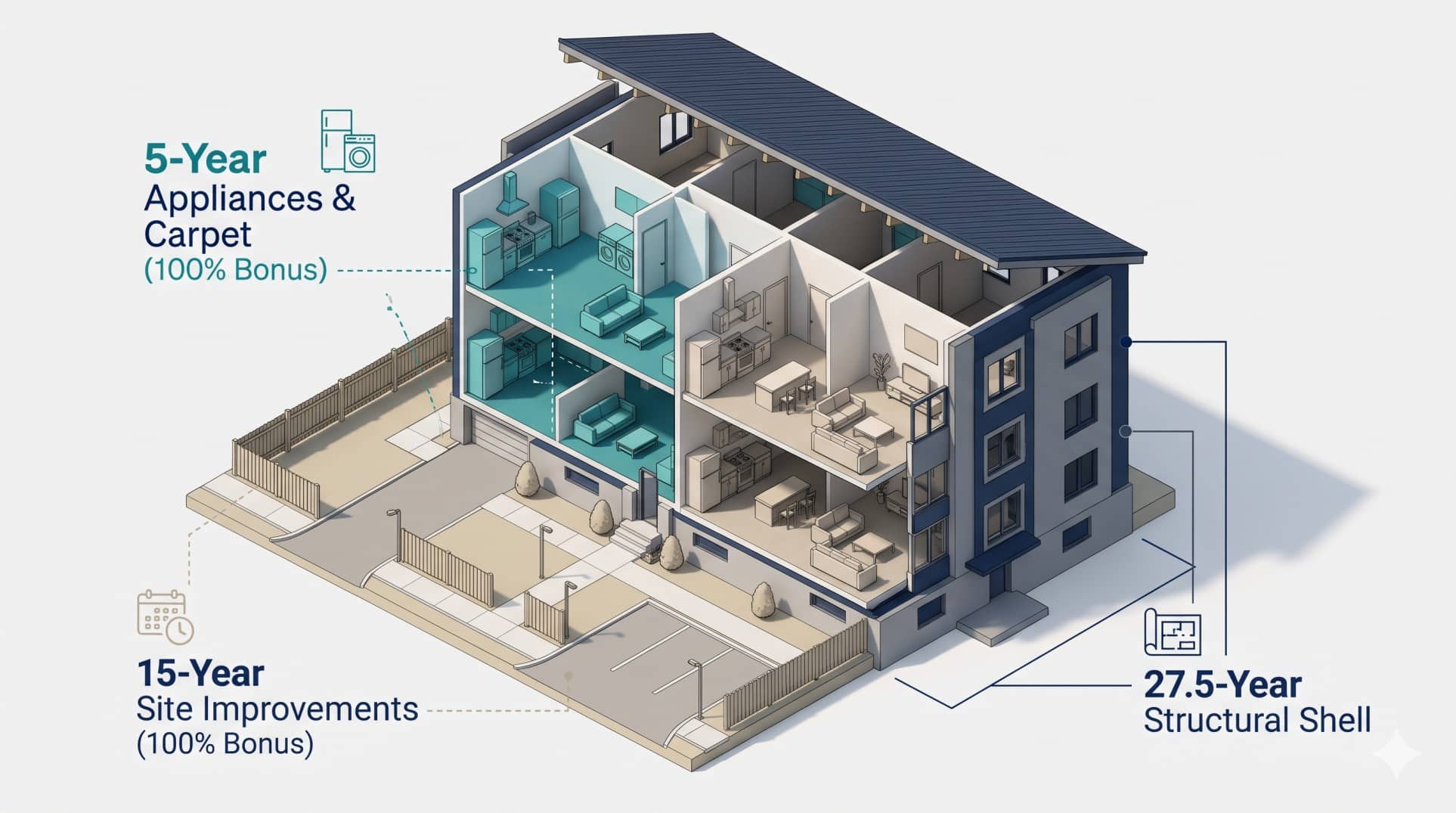
Normally, residential rental buildings are depreciated on a straight-line basis over 27.5 years (and commercial buildings over 39 years) under the Modified Accelerated Cost Recovery System (MACRS). On a $1,000,000 residential fourplex where land represents $200,000 and the building structure represents $800,000, standard straight-line depreciation yields roughly $29,091 per year—often barely enough to offset the property’s net rental cash flow.
When an engineering-based cost segregation study is performed, building components such as appliances, carpeting, decorative lighting, cabinetry, dedicated electrical/plumbing systems, fencing, sidewalks, and parking lots are reclassified out of the 27.5-year structural bucket into 5-year, 7-year, and 15-year recovery periods—typically representing 20% to 30% of the depreciable building basis.
Because the One Big Beautiful Bill Act permanently restored 100% bonus depreciation under IRC Section 168(k) for qualified property (MACRS recovery period of 20 years or less) acquired and placed in service after January 19, 2025, an investor placing that $800,000 building into service in 2026 with a 25% reclassification can deduct $200,000 in Year 1 bonus depreciation plus partial-year straight-line depreciation on the remaining $600,000 shell. Learn more about engineering studies in our complete guide to cost segregation and bonus depreciation.
The 2026 Section 461(l) Excess Business Loss Reset
Before celebrating an unlimited write-off, high-income investors must account for IRC Section 461(l), reported on Form 461 (Limitation on Business Losses). Once rental losses become non-passive via REPS, they are treated as trade or business losses subject to the excess business loss rules when offsetting non-business income—and under IRS Form 461 instructions, W-2 wages are treated as non-business income for this calculation.
In a major statutory twist, Section 70601 of the One Big Beautiful Bill Act made IRC Section 461(l) permanent and reset its inflation-indexing base year from 2017 to 2024 effective for tax years beginning after December 31, 2025. Pursuant to IRS Revenue Procedure 2025-32, Section 4.31, the 2026 excess business loss threshold dropped compared to 2025:
- 2026 Single / Head of Household / Married Filing Separately Threshold: $256,000 (down from $313,000 in 2025).
- 2026 Married Filing Jointly Threshold: $512,000 (down from $626,000 in 2025).
If a married couple filing jointly has $800,000 in W-2 wages, $0 in other business income, and generates a $600,000 non-passive rental loss in 2026, they can deduct $512,000 against their 2026 W-2 wages. The remaining $88,000 excess business loss is disallowed on the 2026 return on Form 461 and automatically converts into a Net Operating Loss (NOL) carryforward under IRC Section 172 for 2027 and future years.
The 3.8% Net Investment Income Tax (NIIT) Safe Harbor
Beyond ordinary income tax brackets, high earners with MAGI above $200,000 (single) or $250,000 (married filing jointly) face the 3.8% Net Investment Income Tax under IRC Section 1411 on Form 8960. Under Treasury Regulation Section 1.1411-4(g)(7), if a qualifying real estate professional participates in a rental real estate activity (or grouped rental activity) for more than 500 hours during the year (or more than 500 hours in any 5 of the preceding 10 years), the rental activity is deemed to be derived in the ordinary course of a trade or business—completely exempting net rental income and future capital gains on disposition of the property from the 3.8% NIIT.
4 Real-World Hypothetical Scenarios With Step-by-Step 2026 Tax Math
To illustrate how the 2026 brackets, standard deductions ($32,200 Married Filing Jointly; $16,100 Single per Revenue Procedure 2025-32), 100% bonus depreciation, and Section 461(l) caps interact, examine these four detailed scenarios.
Scenario 1: The High-W-2 Physician and Spousal Operator
Taxpayer Profile: Dr. Arjun Patel, an anesthesiologist in Texas (no state income tax), earns $650,000 of active W-2 income working 2,200 clinical hours in 2026. His spouse, Maya, left her corporate marketing job in December 2025 to acquire and self-manage a residential portfolio. In March 2026, they purchase two fourplexes in Dallas for a combined $1,800,000 ($360,000 land allocation; $1,440,000 depreciable building basis).
- Hours Logged: Maya works 0 hours at any W-2 job or outside business in 2026. She logs 840 hours acquiring, renovating, leasing, and self-managing the eight units across both fourplexes, supported by a daily digital log, contractor invoices, and lease agreements.
- Qualification & Grouping: Maya passes the 50% test (100% of her working hours are in real estate) and the 750-hour test (840 hours > 750). The couple attaches a Treasury Regulation Section 1.469-9(g) grouping election to their 2026 Form 1040, treating both fourplexes as one activity, and Maya’s 840 hours exceed the 500-hour Test 1 threshold for material participation.
- 2026 Depreciation & Loss Calculation: An engineering cost segregation study reclassifies 25% of the $1,440,000 building basis ($360,000) into 5-year and 15-year property eligible for 100% bonus depreciation under IRC Section 168(k). Including $28,000 of partial-year 27.5-year straight-line depreciation on the remaining $1,080,000 shell and $12,000 of net positive operating cash flow before depreciation, their 2026 net Schedule E loss is -$376,000.
- Section 461(l) Check: Because $376,000 is below the $512,000 Married Filing Jointly excess business loss threshold for 2026, the entire $376,000 loss is deductible against Arjun’s W-2 wages.
- 2026 Federal Income Tax Math (Taking the $32,200 MFJ Standard Deduction):
- Without REPS: $650,000 W-2 minus $32,200 standard deduction = $617,800 taxable income (reaching deep into the 35% bracket, which spans $512,451 to $768,700 in 2026). Total federal income tax = $155,700.
- With REPS: $650,000 W-2 minus $376,000 non-passive rental loss = $274,000 AGI. Subtracting the $32,200 standard deduction leaves $241,800 taxable income (dropping the household out of the 35% and 32% brackets down into the 24% bracket, which runs from $211,401 to $403,550 in 2026). Total federal income tax = $43,534.
- Year 1 Federal Tax Savings: $112,166 in immediate cash tax reduction (which can be realized throughout 2026 by adjusting Arjun’s Form W-4 withholding).
Scenario 2: The 1099 Broker and the Non-Rental Grouping Trap
Taxpayer Profile: Elena, a single filer in Florida, operates as an independent 1099 real estate broker and owns three single-family rental homes. In 2026, she earns $320,000 in net Schedule C brokerage commissions and logs 1,400 hours in her brokerage business.
- Rental Hours & Loss: Across her three rental homes (which she grouped together under Treasury Regulation Section 1.469-9(g)), she generates a $95,000 depreciation loss from
